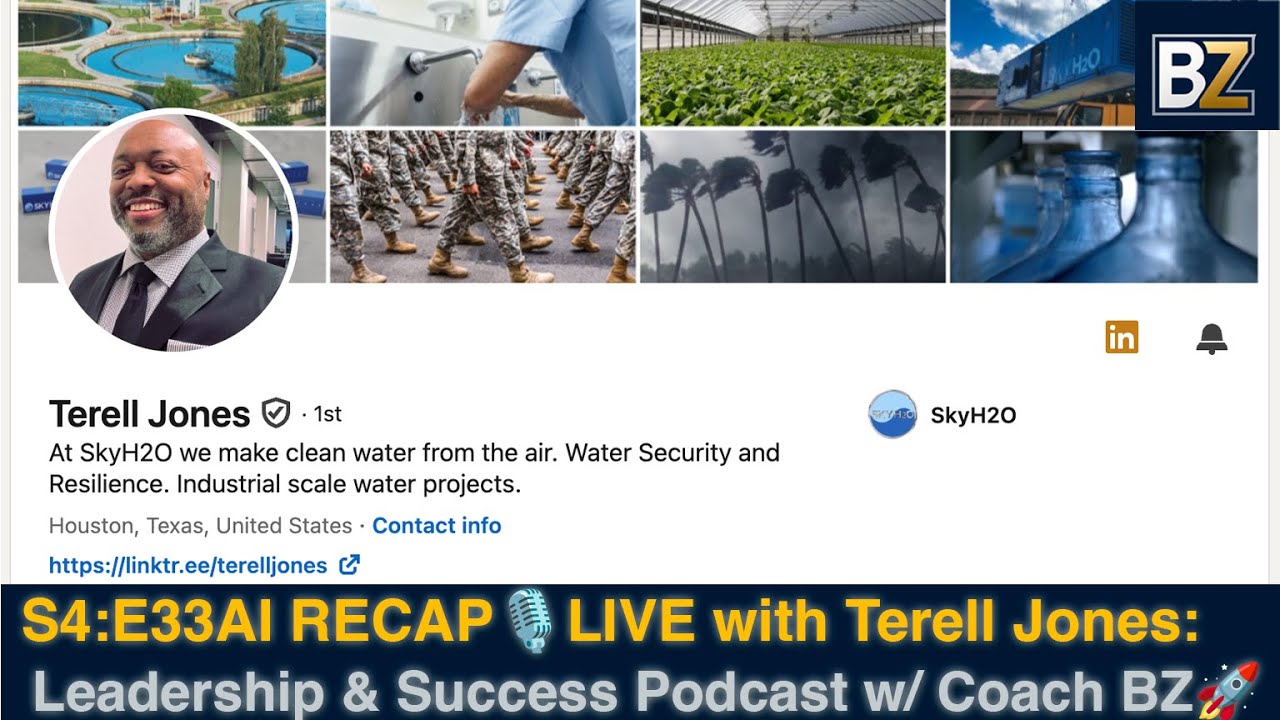
The episode opens with an endorsement from John Maxwell, positioning the Leadership and Success Podcast as a platform for high‑impact leadership insights. Host Coach BZ (Bob Fabien Zinga) introduces guest Terrell Jones, a former Navy corpsman and current business‑development leader at Sky H2O, a company that scales atmospheric water generation (AWG) technology. The conversation weaves together several strands: 1) Jones’s military medical experience—from corpsman school through Operation Desert Storm—illustrating how battlefield pressure forged resilience, rapid problem‑solving, and a “lead from the front” mindset. 2) A deep dive into leadership philosophy, citing Jocko Willink’s Extreme Ownership, John Crowe’s continuity principle, Bill Britt’s decision‑maker focus, and Maya Angelou’s urgency metaphor. Discipline, focus, and humility are highlighted as core traits. 3) A candid discussion of mental‑health stigma in the armed forces, with both host and guest urging service members to seek help via the 988 Suicide & Crisis Lifeline, emphasizing that asking for help is a sign of strength, not weakness. 4) The transition from military to civilian tech: Jones describes how he leveraged structured SOPs, self‑directed learning, and a relentless reading habit (Think and Grow Rich, How to Win Friends and Influence People, etc.) to become a leader in sustainable water solutions. 5) An overview of Sky H2O’s mission: using AWG to pull potable water from air for cities, data centers, and drought‑stricken regions, positioning the technology as a climate‑adaptation tool. Historical context (WWII German U‑boat AWG) and African‑American inventors are referenced to frame the innovation. 6) Practical takeaways: lead by serving, continuously invest in knowledge, create personal SOPs when none exist, and view failure as a learning step. The episode concludes with a call to listeners to embody “leadership from the trenches,” prioritize mental health, and support sustainable water initiatives. The AI‑recap condenses these themes into a 10‑minute highlight, while urging listeners to watch the full hour‑long interview for deeper detail.
Chapters
Hi, I'm John Maxwell. When the top companies in the world are looking for trainers, speakers, and coaches, there's one name that stands above the rest, and that's Maxwell Leadership. Our certified team members have gotten proven results for companies all over the globe, and our reputation, I'm proud to say, is second to none. Some of our members have risen to the top of their profession, including the one you're going to meet today. I proudly introduce you to my friend, Bob Fabien Zinga.
Welcome to the Leadership and Success Podcast with your host, Coach BZ. If you need to develop into a better leader, this podcast is for you. If you want to achieve a greater level of success, this podcast is for you. His mentor, Dr. John C. Maxwell, said it best: everything rises and falls on leadership. We hope to inspire you today and provide you with an insight that has the potential to positively impact the trajectory of your life. Welcome to the Leadership and Success Podcast.
Imagine gaining the leadership skills that could redefine your career. Join Coach BZ on the Leadership and Success Podcast, where each episode delivers practical insights from world-class speakers, military leaders, and industry experts. We dive deep into what matters most: building resilient teams, leading through uncertainty, and navigating complexity with clarity and confidence. Every conversation is crafted for aspiring leaders like you who are ready to grow, lead, and make a lasting impact. Don't miss our powerful live sessions and recent highlights. Michelle Hayward on building diverse, high-performing technical teams. Anne Leslie on leading through global complexity and cybersecurity risk. Ron Carpenter AI exploring faith, resilience, and AI-powered leadership. Colonel Michelle G.I. Gardner-Intz on commanding influence from the battlefield to the boardroom. Chris Robinson on shifting from drift to drive in life and leadership. And Coach Enrique Acosta Gonzalez on mentorship, legacy, and heart-centered leadership. Ready to level up your leadership journey? Tune in on Spotify, Apple, Audible Podcasts, YouTube Live, and LinkedIn Live. Join the movement toward leadership excellence. Listen now and start transforming your success.
I went out to Afghanistan and, you know, you hear gunshot wound to the head and you think that person's DOA. When they came into our hospital, there was a 98% success rate. We as corpsmen cross that line of medical assistant to nurse to nurse practitioner to doctor and everything in between and bring it all into one very big hat. There are many different specialties within Hospital Corpsman Rate, which include dental technicians, radiology technicians, pharmacy technicians, behavioral health techs. You have physical therapists like myself. The capabilities are exactly the same as a private practice. In the military, there's no competition for economics. So we can give them the best care that they deserve.
I wanted to join the Navy to be something better than I am and do something great with my life.
I went to my corpsman school and then I went to surgical tech school.
They specialize and then they get stationed at their first command.
And I've gotten my associate's within 2 years and I'm working on my bachelor's and I don't think I would have had those opportunities.
Not only do we get to do medicine, which is what I initially joined the Navy to do, but we also get to propel out of a helicopter.
So, I mean, you can't really, really beat that.
The most rewarding part of my job is having that sailor look at me say thank you.
Oh, anything at all?
Oh, well, um, as far as leadership's concerned, I do like, um, the philosophy of Jocko Willink, Extreme Ownership, of what you're trying to do. Um, too many times in leadership, you, you want to tell people what to do, but you're not leading from the front, you're probably just barking orders. And I think that's very pivotal. I think your work ethic and your discipline— he says discipline is freedom. I think, um, I got a quote from John Crowe a long time ago that said, commitment to continuity develops emotional stability and mental toughness. And he was an engineer, and I, I really looked up to him. He gave A lot of good wisdom. Another point of wisdom is Bill Britt said, um, there are no great people in the world, just great decision makers. And you can decide to be great. And thirdly, um, when I was at Prairie View A&M, I was in a theater arts class and Maya Angelou visited. She, she told our class, live life with the concentration of somebody that's going to be executed in the morning. And those are words of wisdom that I gained from others that I think I would like to share as far as leadership's concerned. You have to have discipline, you have to have focus, and you have to lead from the front.
Yes.
Okay.
That is one for— we are going to get more into this for the second portion of the podcast, because I think those lessons are enduring, they are universal, and they can be applied anywhere. Uh, so the first segment for this portion, I'm going to be asking about what is the greatest lesson you have learned so far?
The greatest lesson that I learned so far is that you can probably do more than you think you can, and you can never stop learning. It's a lifelong endeavor. You have to keep learning. And technology kind of teaches you that because you get a new version, an iteration. It's easy to understand that. We had to get certified and all these things. Every 3 months you're going to get a new technology. But, um, I've learned that, you know, as smart as you get, you're still dumb in a lot of areas. So you got to continuously—
especially if you have emotional issues, for those of us who have high security clearances, back in the day, I've been under the NSA, I've been under the DNI, they would get rid of you for going to speak to a psychiatrist or having some emotional troubles that you are working through. So instead of letting you heal, It's like shame, you know, taboo, and they want to kick you out. So therefore you keep your mouth shut and you don't say anything. So you suffer in silence and, uh, that's not good. And then you also mentioned being a man, oh, I'm a man, I'm strong and all of that, Rambo or whatever. So you get courage, you don't want to negotiate, but back there you just keep it yourself. That's really silly because there's a lot of program, a lot of benefit for you. So really my advice is for people in the military right now to, uh, really be true to themselves and to seek help when when needed. What would you add to that?
Um, I would say that pride goes before destruction, and sometimes in the military we're too prideful. Um, pride will humble you. And also ego. Ego is evil going on. So you have to be able to manage that and understand that your life is more important than this pride that you have, because you blind yourself. You're blinded by that pride. And there might be some underlying issues that are life-threatening that you need to address. And so don't be afraid to go get seen by the medical professional. Um, it's important whether it's physical or, uh, mental, you need that help. I think most people need to understand that they need help. Now, one of the things in leadership too is you don't know something, ask a question. You don't ask, you don't get. And I, I'm not afraid to ask anybody anything. And if it's gonna help me, I'm gonna ask for help. Now it sounds counterintuitive to be a, you know, tough leader. I will tell you, when you're in the middle of a panic attack and you're used to commanding 80 men in a room, and then you, you, you lose all your faculty in the middle of a panic attack, you're not in leadership of anybody at that time.
Yeah.
So you're gonna have to rein in your sympathetic nervous system fast. And then no amount of box breathing the Navy SEALs teacher is gonna help you at that point. You're gonna have to do some corrective measures, and you're going to need help doing it. You're going to need the tools and the mental tools to do it.
So I just start for Lead Upgrade Humanity.
Welcome to the podcast. We're diving deep into leadership that's forged on battlefields and then refined in breakthroughs like atmospheric water technology.
I'm excited. This story of leadership, resilience, and innovative water solutions sounds absolutely fascinating.
Absolutely. Picture this. A life, um, shaped from the very beginnings on a Navy base, where leadership wasn't taught through textbooks. It was modeled in real time. Born adjacent to leadership, he absorbed it just by being in the environment.
That's powerful. So he essentially learned leadership by just Living it, right? And then he took that mindset straight into high-pressure situations like Operation Desert Storm.
Exactly. In Desert Storm, he wasn't just following orders as a Navy medical lab technician. He, um, reimagined the workflow, created innovative cheat sheets using early Unix-based systems, boosting productivity, earning him Blue Jacket of the Quarter. His initiative truly set him apart.
Incredible! That drive to innovate under pressure is exactly what you need on the frontlines, and it clearly translated into his later business roles, doesn't it?
Definitely! It's like, um, his battlefield experiences weren't confined to military operations but became a blueprint for mission clarity and, you know, effective leadership in civilian tech.
Right. So then he makes the jump into this realm of sustainable innovation. Leading business development at Sky H2O, the company making water from air. That seems almost like magic, yet so scientific.
Absolutely, and it's a fantastic example of turning personal hardship and the intensity of battle into groundbreaking solutions for water scarcity. He's basically taking lessons from the trenches, where real leadership happens, and applying them to solving global water challenges.
And water, as we all know, is life. But here it's more than that. It's about scalable, sustainable infrastructure. It, um, connects directly with today's ESG challenges.
Exactly. Sky H2O's Atmospheric Water Generation, or AWG, uses advanced systems to pull potable water from the very air around us. It's not just selling machines. It's about developing full-scale projects to future-proof cities and industries.
So leadership here isn't just about commanding people. It's about realizing that leadership starts with addressing the real fundamental needs of communities.
Right on. Remember his core insight: "You don't lead by barking orders. You lead by getting in the trenches." That's leadership with your hands, your heart, and your brain all engaged.
Mm-hmm.
That resonates deeply. Getting in there, understanding challenges firsthand, not from an office, but out on the ground.
And it's not just about the action. It's his journey of continuous learning. Books like "Think and Grow Rich" and "How to Win Friends and Influence People" fueled his mindset. It's like, um, he's always sharpening his tools.
Right. I love that. And he even talks about the power of self-talk. How the inner dialogue can reprogram your mind for success.
Absolutely. It's— it's like he believes that you set the stage in your head before you lead others. What to say. "When You Talk to Yourself" isn't just a book title. It's a mantra for building resilience and mental toughness.
I'm curious, though. How do you see the military's strict standards and SOPs translating to the more fluid environment of tech and business?
Good question. Sure, military life is intensely structured, but that very structure taught him adaptability. When the civilian world lacks defined SOPs, he's created his own, which is a huge asset. It's like, um, you have to set the rules when no one else will.
That makes a lot of sense. Yet, I must respectfully challenge one element here. Sometimes, the rigid discipline of the military might seem, well, not completely flexible enough for tech's rapid evolution.
I get that perspective. However, his approach marries military discipline with a continuous learning mindset and emotional intelligence. It proves that when you blend those elements, you get a dynamic leader adaptable to any environment.
Yeah, so it's a sort of hybrid leadership, combining the toughness of battle with the agility of modern innovation.
Exactly. And speaking of agility, consider how he leveraged his experiences in adversity, like, um, enduring homelessness and undiagnosed PTSD. He transformed those painful moments into a mission of self-improvement and sustainable innovation.
Right. That really illustrates that failure is not the end, but the precursor to success. Falling down is part of the journey, and then you rise again with a new plan.
Yes, he makes it clear. Failure isn't something you fear; it's something you learn from. Every knockdown taught him how to build resilience, and ultimately, how to lead with even more passion.
Absolutely. And his story about creating his own SOP when none existed, That's such a practical takeaway for veterans transitioning into tech, or even for leaders in any industry.
Right. It's like a blueprint for independence in any career. When you don't have a manual, you write your own instructions on how to excel.
Mm-hmm.
I also find the connection he makes between clean water and leadership compelling. "You can't eat AI," he said, reminding us that basic human needs always come first.
That's a standout point. It ties neatly into his work at Sky H2O. Providing sustainable water isn't just about technology; it's about ensuring the very essence of life continues.
Yeah. And that, in turn, addresses major environmental, social, and governance issues today. Sustainable water is a cornerstone for healthy communities, and like you said, Mission critical beyond green technology.
Exactly. In fact, his vision is not limited to just selling a product. It's about transforming global water infrastructure, making a robust support system for industries ranging from data centers to coastal communities.
Right. And let's not forget his core leadership lesson, caring for the team. If someone's falling behind, you run back and help them up. That's as applicable in a boardroom as it is on deck.
Yes, leading from the front means being present and serving others, rather than just issuing orders from afar. It's about humility, service, and, um, extreme ownership.
Definitely. That extreme ownership also pushes each leader to take responsibility for everything in their realm, regardless of rank. That's a lesson that anyone, whether in the military or business, should carry with them.
Exactly so. It's about continual self-investment, keeping your mind sharp with books, audiobooks, and, um, even self-talk routines. His relentless appetite for learning is a model for all leaders.
Mm-hmm.
Right. It reminds me that true leadership is a lifelong journey. You stay hungry for knowledge, adapt to the new tech and challenges, and never settle.
And on that note, his work with Sky H2O is more than a business venture. It's a mission to solve a global crisis. Providing scalable water solutions using, um, atmospheric water generation changes the game for communities facing water scarcity and toxicity challenges.
Yeah. This blend of resilience, innovation, and genuine care for people is exactly the kind of leadership we need in the 21st century.
Absolutely. Every element, from the grit learned in Desert Storm, to crafting personal SOPs, to transforming pain into progress, all these pieces build a legacy of leadership that's universal.
Right. So if one key takeaway were to resonate with our listeners, what would you say it is?
I'd say leadership isn't about the rank you hold. It's about, um, the value you create, the passion you invest in your mission, and the energy you give back to your community. Own your journey, learn continuously, and lead from the front.
Absolutely. That's an inspiring call to action. With every challenge, remember to reframe failure as a stepping stone and never lose sight of what truly matters.
Right. And as he so powerfully puts it, every day above ground is a blessing, a chance to reshape not just your own life, but the world around you.
Mm-hmm. What an incredible journey this is, from a Navy base, through Desert Storm, to developing solutions that, um, literally pull water from the air. It's as much about personal courage as it is about global impact.
Exactly. His legacy teaches us that true leadership begins in the everyday grind, in the small yet critical decisions that, over time, culminate in extraordinary outcomes.
Yup. Thanks so much for unpacking these complex yet vibrant lessons with me. I hope our listeners feel encouraged to lead with resilience, humility, and an unyielding quest for knowledge.
Absolutely. Remember, every challenge faced and every failure endured is just another opportunity to learn and ultimately to lead in a way that makes a difference.
Yeah, thanks for joining us, everyone. Keep pushing forward, keep learning, and as always, lead from the trenches. Until next time.
All right, everyone, uh, I am back here, uh, on the air. I normally don't come on the air when my AI agent, uh, take care of, uh, the podcast. However, today I think I need to make an exception because of something extremely important that, uh, Carmen, uh, Terrell-Jones talked about. So I really believe if you are in the military, if you are in a service, especially for men out there, if you have mental health issues, you need to ask for help. If you or someone you know is experiencing a mental health crisis, emotional distress, or suicidal thought, Immediate and confidential help is available through the 988 Suicide and Crisis Lifeline. As you know, the rate of suicide in the military is much, much higher than the rate of suicide in the industry or the country for our counterpart in the civilian world. It's about 22 military servicemen and women die of suicide every day. Twenty—
to.
So this is a huge crisis. This is extremely important. And I know men, because I used to think that way, I am a man, I am strong, I don't need help, I'm just gonna have to endure through it. No, you need help. Okay. And the way you do it, you pick up your phone, you dial 988, just like you do 911, you do 988. And if you don't want to call, you can text, right? Send a text message to 988. And if you don't want to text, you can chat. Go to your computer, visit 988lifeline.org. Okay, there is plenty of help out there for you. This is extremely, extremely important. All right. All of us sometimes have to go through failure. All of us sometimes have to go through times where we need help. We just can't resolve the problem, whatever we are facing by ourselves.. And it doesn't make you less than a man to ask for help. So your life is much more important than that. And there are other people who depend on you. Your shipmates depend on you. Your spouse depends on you. Your children depend on you. The society needs you. All right, so that's all I'm, I'm going to say. And again, uh, make sure to watch the full, uh, episode, the podcast, about 1 hour long. That's Season 4, Episode 33. This one here is, uh, Episode 33 AI recap. It's only 10 minutes recap to give you a summary of what, uh, uh, Terrell Jones and I talked about. So now what I'm gonna do is I'm gonna be playing on two more clips from the full one-hour interview. And before I do, let me double-check to see if there are any questions in the comment section. Okay, I, I don't see any question, but even after the show when you watch the replay, go ahead and type in the question and we're gonna make sure to answer them the next day because I'm going to be back here tomorrow morning. All right, back to the teaser for the full podcast with Carmen Toale Jones.
Yeah, I see a lot of young people in the millennials especially, oh, that's not my job. I said, how are you going to stand out? How are you going to learn new skills if you don't know that part of the job, even if it's not part of your job? And so that's how I've been able to succeed. I just take on responsibilities that were outside the scope of what my job was, and it helped me get further along. So becoming a subject matter expert on the subject makes you better. Wow.
So what drew you to SkyWater and the mission of atmospheric water generation?
So, you know, I spent 25 years in information technology because of my commander in the first duty station, and I learned some skill sets there, but Um, and, and during, um, COVID, um, I was outside of an IT job and I wasn't working and I was help— I was consulting and helping businesses. And, um, I came across Alexander von Welczek and I, he said, I see you raising money for these, uh, startups and why don't you do it for me? I go, well, what is it? And Alex beco— is a, is a pioneer in solar.. And in California they had a drought in 2016 and he said, I am gonna focus on water. And so basically Sky H2O makes water from air. We are advancing and scaling atmospheric water generation for large-scale projects. So atmospheric water generation is not a new technology. It's been, it's been around since World War II. The Germans used it in U-boats to stay out to sea longer. And because we've been doing a very good job of destroying the environment, it's become, uh, something that we need to use for climate adaptation. Um, like I said, I'm African American, so I, I like to look at African American history. Lewis Latimer would be the first one. Um, he kind of helped, uh, Edison and Alexander Graham Bell. You know, quite frankly, I think he invented the light bulb, to be honest. And, um, The second would be Benjamin Banneker. He designed the District of Columbia. He was the first architect of Washington, D.C., right? And then, uh, third would be a young man from Zimbabwe, um, Maxwell Sanyulani Shikumbutsu. He has created energy from air with, uh, I think radio frequency. So he is using free air or energy from the air.
That's amazing. Wow.
He's a young guy too. Yeah.
Wow.
Okay.
Fifth segment. We are running out of time. Uh, what have you read that we should read? Which book do you recommend? I know one of them is this one, Extreme Ownership by Jocko Willink and Leif Erikson.
Yes.
Um, I think the foundational books is Think and Grow Rich and, um, Success Through a Positive Mental Attitude. Those are foundational books, but for communication skills, it would definitely be Dale Carnegie's How to Win Friends and Influence People. We have to continually learn how to speak with each other, and it's a book that you have to keep going back every decade to look at, to refresh your memory. Um, those are foundational books. And What to Say When You Talk to Yourself, that's probably the chapter in, in Think and Grow Rich's book that I, the, the leadership principles. You have to be, um, flexible enough to understand where millennials come from. They never had a fist fight in their life. They probably spent a lot of time inside playing video games. And, um, they have 3-second, um, attention spans because of all the social media that they watch. Um, so they haven't had the strict discipline that we may have had. They have a, you know, they have all these things that occupy their brain power. And so it's, you have to realize where you're, where they're coming from and, and accept people where they're at and try to figure out how to make that work.
Wow.
That is very, very insightful because I do believe that leadership is the most critical skill of the 21st century. All of the changes you mentioned, the technology, now we have AI, quantum computing, and all of that, and so many changes people are uncertain about. They are like, uh, no, AI and robots gonna take over the world and all of that. But one thing that remains constant, I think, is leadership, and people really need to learn for skill. And that's part of the reason why I've been hosting this podcast for 4 years now. So let's go back to your Navy time. So you served during Operation Desert Storm and Shield. How did that high-pressure environment shape your approach to resilience, adaptability, and strategic thinking today?
Thank you for listening to the Leadership and Success Podcast with your host, Coach BZ. If you like what you heard, Please subscribe to our channels and come back for more wisdom nuggets on how you may develop into a better leader and achieve greater levels of success. Leadership is the most critical skill. The world will always need leaders to lead others, deploy the next disruptive technology, or execute a business strategy. You may as well decide on counting yourself among the 21st century leaders. See you right here. Next time on the Leadership and Success Podcast with Coach BZ.
More from Bob

S250:E4🎙️LIVE 🇺🇸America 250: President Barack Obama Leadership, Service, and the Power of Hope






S5:E157🎙️ LIVE with CMD CMSgt Dennis L. Fritz, USAF (Ret.)(Multi Tracks Audio)



S5:E156🎙️ LIVE 🇪🇸 Leadership Lessons from the FIFA World Cup 2026 Champions (Multi Tracks Audio)

S250:E3🎙️ LIVE Leadership Lessons from America’s First Documented Family of African Descent 🇺🇸📖