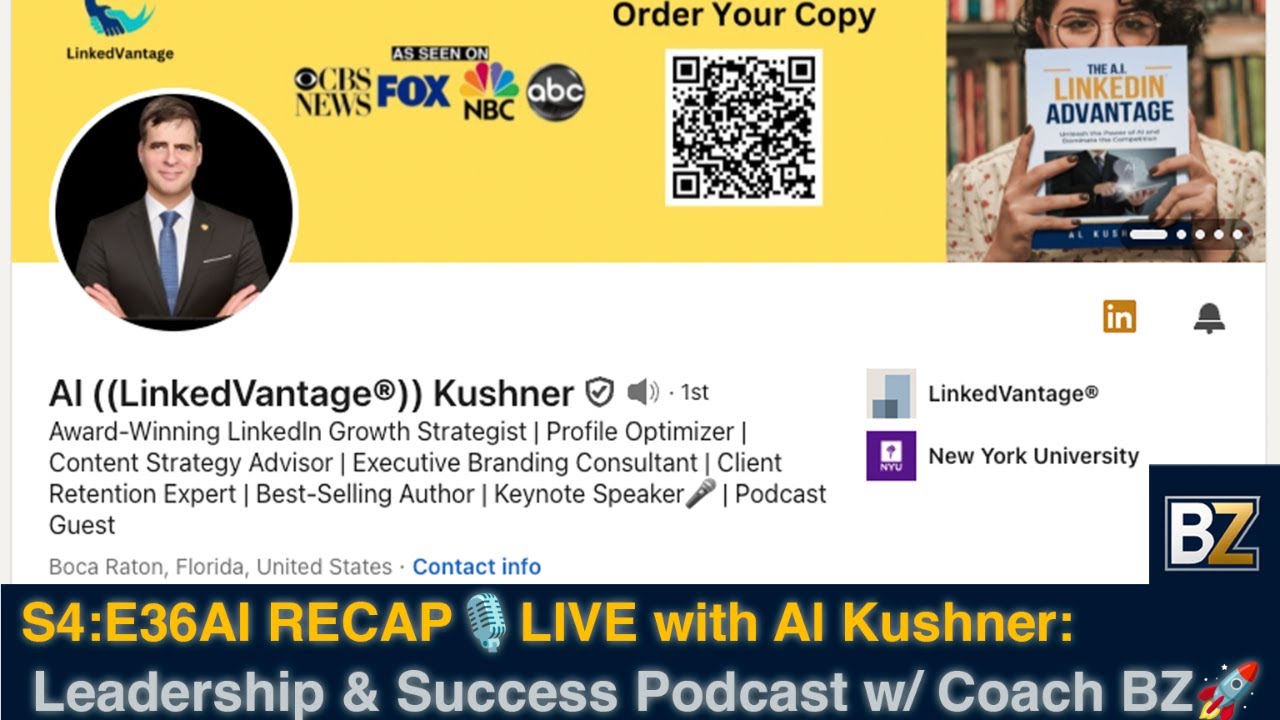
The episode opens with John C. Maxwell endorsing the podcast and introducing host Bob Fabien Zinga (Coach BZ). Maxwell frames leadership as the decisive factor for organizational success and invites listeners to develop their leadership capacity. The show then features a series of expert segments: 1. Peter W. Singer explains the evolution of cyber‑war into “information warfare,” describing how adversaries manipulate social media to influence people rather than just hack networks. He stresses the human‑psychology dimension of cyber threats and warns against alarmist narratives. 2. Michael Pope shares a personal story of extreme stage‑fright as an introverted IT professional, illustrating how vulnerability and repeated practice turned a fear‑filled moment into a confidence‑building milestone. He positions himself as a Maxwell‑certified speaker whose mission is to create a chain‑reaction of value‑adding. 3. Les Brown and Joseph McClendon III provide brief endorsements, highlighting Pope’s ability to program high performance through neuro‑encoding techniques. 4. Beth AI and Speaker C lead a dialogue on the intersection of authenticity, AI, and digital leadership. They argue that AI tools (e.g., Jasper, ChatGPT) should amplify a leader’s unique voice rather than replace it, and they stress the importance of transparent, vulnerable communication on platforms like LinkedIn. 5. The conversation repeatedly returns to core leadership themes—authenticity, failure as fuel, purpose, relationship investment, and legacy—each anchored by biblical verses (Romans 12:9, Matthew 5:16, Matthew 20:26‑27, Proverbs 24:16, Romans 8:28, Ecclesiastes 4:9‑10, Proverbs 10:7). For each verse, a concise insight and a concrete coaching prompt are offered (e.g., share a personal story, audit your LinkedIn profile for service‑oriented language, mentor a junior colleague, journal a recent mistake, revisit your mission statement, reach out to a peer, define the legacy you want to leave). 6. Throughout, the hosts stress the balance between leveraging technology for efficiency and preserving human‑centric leadership qualities such as empathy, intuition, and community service. 7. The episode concludes with a call‑to‑action: listeners are invited to subscribe, engage on multiple platforms, and apply the presented prompts to develop a “legacy leadership” footprint. Overall, the podcast blends expert testimony, personal anecdotes, scriptural wisdom, and practical coaching to present a holistic model of 21st‑century leadership that integrates digital tools without sacrificing authenticity.
Chapters
Hi, I'm John Maxwell. When the top companies in the world are looking for trainers, speakers, and coaches, there's one name that stands above the rest, and that's Maxwell Leadership. Our certified team members have gotten proven results for companies all over the globe, and our reputation, I'm proud to say, is second to none. Some of our members have risen to the top of their profession, including the one you're going to meet today. I proudly introduce you to my friend Bob Fabien Zinga.
Welcome to the Leadership and Success Podcast with your host, Coach BZ. If you need to develop into a better leader, this podcast is for you. If you want to achieve a greater level of success, this podcast is for you. His mentor, Dr. John C. Maxwell, said it best: everything rises and falls on leadership. We hope to inspire you today and provide you with an insight that has the potential to positively impact the trajectory of your life. Welcome to the Leadership and Success Podcast. Imagine gaining the leadership skills that could redefine your career. Join Coach BZ on the Leadership and Success Podcast, where each episode delivers practical insights from world-class speakers, military leaders, and industry experts. We dive deep into what matters most: building resilient teams, Leading through uncertainty and navigating complexity with clarity and confidence. Every conversation is crafted for aspiring leaders like you who are ready to grow, lead, and make a lasting impact. Don't miss our powerful live sessions and recent highlights. Michelle Hayward on building diverse, high-performing technical teams. Anne Leslie on leading through global complexity and cybersecurity risk. Ron Carpenter AI exploring faith, resilience, and AI-powered leadership. Colonel Michelle G.I. Gardner-Intz on commanding influence from the battlefield to the boardroom. Chris Robinson on shifting from drift to drive in life and leadership. And Coach Enrique Acosta Gonzalez on mentorship, legacy, and heart-centered leadership. Ready to level up your leadership journey? Tune in on Spotify, Apple, Audible Podcasts, YouTube Live, and LinkedIn Live. Join the movement toward leadership excellence. Listen now and start transforming your success.
So I'm Peter W. Singer, uh, professor of practice here at Arizona State, also author of multiple books on changes in technology national security, and I'm also a strategist at New America, a think tank in Washington, D.C. that's a partner of ASU. So I've always been interested in two areas. One is politics and history, and secondly, I've always been interested in the cross between technology and science fiction and science fiction becoming real. The books that I've been writing explore these issues of change, changes in everything from new technologies like robotics changes in new types of threats like cybersecurity, changes in warfare, to even changes in the types of online activities and threats, issues that are emerging in great importance, but we don't have a really good handle on. That's what I've been naturally drawn to. So if you think of the idea of cyber war, which we've all grown, you know, a bit comfortable with talking about over the last decade plus, it's the idea of hacking, um, networks. But cyberwar has an evil twin, so to speak. Um, and we called that like war. And it's the idea of not hacking the network, but hacking the people on social networks by driving ideas viral through their likes, their shares, but also of course sometimes lies. And, um, we see this play out, uh, in episodes that range from, um, the rise of ISIS to the rise of Donald Trump. To— it can have positive effects. We think of all sorts of activist movements. It's used in marketing. It's used by celebrities. And so myself and a young researcher named Emerson Brooking, we started on that project— gosh, I'm going to say, like, 2013 period. And essentially, we started out trying to understand how social media was being used in war zones.
Instead of focusing on what we need to learn, We've instead fed on hype that fuels fears but doesn't solve problems. Understanding the difference between hackers doing something annoying and something with the capacity to cause serious harm will better direct our fears and resources. If you think of the idea of cyberwar, it's the idea of hacking networks, but at the end of the day, it's really about human vulnerabilities, psyches, beliefs, trust. Dr. Singer emphasizes clarity over alarmism in cybersecurity. A stance still vital today. He reminds us that cyber and information warfare aren't just technical; they're profoundly human, affecting what people think and trust.
John Maxwell here. In my 40 years of experience in leadership, I've only known one way to shift bottom lines, maximize potential, and change lives, and that's by adding value with excellence. That's exactly what my friend wants to do for you and for your team. I proudly introduce you to my friend, Michael.
Thanks, John. When you add value to someone, when you connect, invest, and inspire, they add value to others, and those others add value to others. And as a speaker, it's my mission to start the chain reaction that adding value causes in your company. Hi, I'm Michael Pope, a Maxwell Leadership certified speaker, teacher, trainer, and coach. I am passionate about personal development in all its forms. I can't wait to add value to you and impact your people. Speak with me today so that I can speak for you tomorrow.
Michael, it's great to have you on our team.
You have something special.
You've got greatness in you.
Hello, I'm Les Brown. Well, Michael Pope is a young man who, number one, He helps you to begin to do the things that you don't want to do because you want to become knowledgeable, and he helps you to do it. Michael Pope, it's a blessing to be in his presence. You have something special.
You have greatness in you.
That's my story, and I'm sticking to it. Hi, I'm Joseph McClendon III, and I'm the founder of the Neuro-Encoding Institute. I've spent the last 30 years as an ultimate performance specialist for athletes, celebrities, millionaires, billionaires, and everything in between, even some royalty. I've spent my life refining and providing methods and processes to help people go further faster, and now I've certified a rare few to do the same at the highest level. And I'm honored to introduce you to one of my elite specialists certified in the neuroencoding methodology. And so one of the most amazing things about Michael Pope is that in addition to being one of our most skilled instructors is that he can show you how to program yourself to default to your absolute best no matter what. And so if you're looking to be coached at the highest level, Michael will step in and skillfully assist you in going further, faster. I look forward to hearing about your success. So until then, remember, life is always exactly what you dare to make it, and fortune favors the bold. I'll see you at the top.
Aukinyu.
Raise your hand if you've ever been nervous speaking before. Yeah, me too. I see your hand there, Jules. I'll never forget the first time I was asked to speak in front of the public. It was the summer of 2003, and I was asked to do a short 4 to 6 minutes speech about me. And I was absolutely terrified. You see, I'm a natural introvert and IT professional, and the last thing that I wanted to do that day was stand up in front of a crowd and talk. So as I sat in my seat in anticipation of being called up, I came down with a bad case of the what-ifs. What if I forget my lines? What if they don't like me? What if, what if, what if? And I heard my name get called up, and so I slowly started making my way to the front of the room. And with every step, my heart would start beating fast and the nervousness would continue to increase. When I stood in front of the person who introduced me, my hands were dripping with sweat because of how nervous I was. And I looked out at the crowd and I literally thought that the people in the front row could see the butterflies fluttering in my stomach. I started to speak and my mouth felt like it was so dry as if I had been chewing cotton balls all morning. Hi, I grabbed my nose and said, "Hi, my name is Michael." Those 4 minutes felt like 4 hours. And when I finished, I nervously went back to my seat and I sat down. Now, as an introvert, I just sat quiet, but on the inside I was like, "Yes, I did it, I did it!" In the third category of question, I like showing this gun.
I love this. On one side it says success, on the other side it says failure. Right? It says, success, never be awed by success. And then failure, never be intimidated by failure. Most people, when they look at you, they look at your books and your speaking engagement and all of that, they only see all of the successes. But I'm sure you've had to go through periods of failure as well to get to where you are today. Can you share about how failure shaped your life?
Failure has always been a catalyst for growth. It has taught me resilience and provided critical lessons on patience, persistence, and flexibility. Every setback provided an opportunity to reassess and come back stronger.
So, uh, can you share about a specific failure that, uh, refined your leadership and deepened your spiritual maturity?
Well, early in my career, I faced a major setback when a project I led failed to meet the client's expectations. That experience taught me the importance of clear communication, setting realistic goals, and the value of regular feedback. It ultimately shaped my leadership style by reinforcing the need for ongoing adaptation and learning. Hmm.
What is the greatest—
Hello, I am new to the team. I am Beth AI.
Welcome everyone. Let's dive right into this fascinating exploration of leadership, authenticity, and technology. It's like, um, the way Al Kushner emphasizes that LinkedIn is not just a resume site, but a dynamic leadership platform.
Mm-hmm. Absolutely. The idea that your digital footprint is essentially your leadership footprint really sets the stage for modern leadership strategies. I mean, it's really compelling, don't you think?
Oh, for sure. It's like, like our digital presence reflects who we are as leaders. And, you know, Al Kushner's insight that AI plus authenticity equals leadership leverage really resonates. It reminds us to use technology to amplify our unique voice, not replace it.
Right. And it's interesting how he warns against sounding robotic. It's tempting to lean too much on automation, but then where's that heart, that authentic connection?
Exactly. If you let AI do its job, like drafting content quickly with tools such as Jasper or ChatGPT, you still have to infuse your personality into the message. That human touch is what builds relationships and follows.
Yep.
Speaking of building relationships, I was intrigued by the emphasis on actively engaging with others on LinkedIn. It's not just about posting accomplishments, but about sharing transformation stories and empowering others. How pivotal do you think that is?
It's, um, absolutely pivotal. The idea that leadership isn't about self-promotion, but about lifting others up, really shifts the focus. When you see someone speak about mentoring and growing a team, you understand that true leadership is measured by the impact you have on others, not just, um, your title.
I do wonder, though, sometimes a lot of leaders seem caught between showcasing their successes and getting too caught up in self-image. Isn't there a risk of overcuration, which might end up diluting authenticity?
That's a valid point. I mean, sure, you want to project success, but if you're too polished, people can sense that you're not being genuine. Al Kushner stresses the importance of vulnerability and transparency. It's like you have to, um, show the struggles along with the successes.
Yeah, exactly. And his coaching tip to craft a headline that reflects what you do for others is so simple yet so transformative. It pushes us to think beyond titles into the realm of, um, actual value and service.
Right on. And it's that holistic approach, combining personal growth mentors, even lessons from failure that really leads to legacy leadership. You know, his idea that failure isn't final, it's fuel, really underscores the learning process in leadership.
Yep. Yes, and it reminds me of that idea where every setback is like tuition for wisdom. The reflection on failures that shape us is often more instructive than our successes. Don't you think?
Definitely. It's like if you use your failures as stepping stones, each setback becomes an opportunity to improve your strategy, your communication, and ultimately how you empower your team. That's the kind of insight that resonates whether you're a military commander or a tech leader.
Mm-hmm. And speaking of empowering teams, what do you make of his emphasis on community service and relationships? I mean, it's noted that leadership is about being connected with your community and even volunteering your time. That seems almost counterintuitive in this high-tech age.
Well, it is interesting because while technology evolves, the human need for community remains constant. The idea that investing in relationships, commenting on posts, celebrating wins, even introducing people amplifies your influence. It's like saying AI can suggest connections, but no AI can build a relationship the way genuine interaction does.
Yeah, absolutely. And that also ties into the leadership coaching prompt of mentoring someone who reminds you of your younger self. It brings a sort of full-circle mentoring process that is essential for personal growth. Don't you agree?
For sure. It's all interconnected. You nurture your network, and that network becomes your legacy. I mean, think about it. Your digital presence today can directly influence how you're seen as a leader tomorrow, because every interaction counts.
Mm-hmm. That's so true. And then there's the aspect of leveraging AI to optimize your outreach without losing the essence of who you are. Some argue that AI might push us towards a one-size-fits-all model. Do you see that happening?
I actually believe that if used correctly, AI should free up your time to be more creative and authentic. It's like, um, using an advanced calculator. You still need to know math to interpret the data. The critical aspect is that leaders must maintain a human-centric approach.
Right. That balance is, um, crucial and challenging. I mean, it's a bit of a tightrope walk between efficiency and authenticity. But his point, use AI for efficiency, not as a substitute for authenticity, is a solid rule of thumb.
Exactly. And then there's the idea that your leadership brand is constantly being evaluated by your community. It's not a static label. It's like every post, every comment, every shared experience builds or reshapes your leadership narrative on platforms like LinkedIn.
You know, that insight really pushes the point that leadership today is as much about digital interactions as it is about in-person presence. Not only do we need to adapt with technology, but also stay rooted in our core values.
Totally. And that's where his message on balancing innovation with human values comes in. He's championing the idea that while we adapt to new tools like AI, We shouldn't compromise on our integrity and vulnerability.
Yep.
And that's a point I want to respectfully challenge a bit. Sometimes in the push for digital excellence, leaders might be tempted to overly rely on data and analytics, which could risk making decisions that are less nuanced emotionally. How do we guard against that?
That's a great challenge. I'd say we always need to double-check with our intuitive judgment. Technology should inform us, not dictate us. We must balance hard metrics with the soft skills—empathy, listening, personal connection—which are irreplaceable traits of authentic leadership. Mm-hmm, absolutely.
And isn't it interesting how he also ties in timeless wisdom from classic texts and even biblical verses? It shows that while technology rapidly changes, the fundamental values of leadership, like service and empathy, remain constant. Yes, indeed.
The references to verses like "Let love be genuine" help remind us that no matter how advanced we get, our character and convictions are our true guides. It's, um, really a beautiful fusion of old and new wisdom.
Yeah, and that synthesis is so empowering. It really speaks to a generation of leaders who are trying to strike a balance between digital prowess and deep personal connection. The insights from Al Kushner, along with practical coaching prompts, seem like a roadmap for building legacy leadership.
Exactly. With actionable insights like optimizing your LinkedIn profile, crafting transformation stories, and even reflecting on failures, the roadmap is both practical and deeply humanistic. Yep, it's almost poetic.
The idea that leadership is not just about scaling up one's impact, but about carefully, intentionally nurturing every relationship and moment in your career. It turns every challenge into an opportunity to grow personally and professionally.
Right, and it's also a call to action. Don't wait until opportunity knocks. Start influencing today by engaging, listening, and responding authentically. And remember, as he highlighted, every leadership insight is a chance to redefine not just your career, but your entire legacy.
Mm-hmm, absolutely. And that legacy is measured not by temporary wins, but by the lasting, positive impact you create in others' lives. Sometimes the incremental contributions add up to a truly transformative journey. Exactly.
What a powerful way to think about leadership in our digital era. It's, um, both an art and a science, combining data-driven insights with the warmth of human connection.
What's truly striking about Bob Fabien Zinga's approach to leadership is not just how grounded it is in real-world experience, from the Navy's chain of command to the flat teams of Silicon Valley, but how it's also informed by timeless wisdom. Bob draws on scripture, yes, ancient texts written thousands of years ago, and reveals just how relevant they remain for leaders navigating today's chaotic and complex world. This isn't about preaching. It's about principles, unchanging truths that have guided great leaders across generations. What's powerful here is how seamlessly these insights from the interview with Al Kushner complement everything we've explored so far: authenticity, leadership brand, empowerment, Failure, purpose, relationships, and legacy leadership. Let's walk through each of these ancient verses Bob highlights and unpack what they mean for today's leader, military or tech, startup or enterprise.
1. Authenticity equals leadership leverage. Bible verse: Let love be genuine. Abhor what is evil. Hold fast to what is good. Romans 12:9. ESV. Leadership. Insight: Authentic leadership is rooted in integrity, not image. In a world of AI-enhanced branding and automation, genuine care and character are your leadership differentiators. When your motives are transparent and your values are consistent, people follow you, not just your content. Coaching. Prompt: Where in your communication, online or in person, can you be more transparent or vulnerable? This week, share one personal story that reflects your values, not your resume.
Second leadership brand Bible verse: In the same way, let your light shine before others so that they may see your good works and give glory to your Father who is in heaven. Matthew 5:16, ESV. Leadership insight. Your leadership brand isn't about self-promotion; it's about clarity of purpose and impact. When your light shines consistently, it guides others through ambiguity. Your digital presence is your leadership witness. Let it reflect service, not just success. Coaching prompt: Review your LinkedIn profile and recent posts. Are you highlighting service, values, and transformation? Or only titles and tasks? What story does your digital trail tell? 3.
Leadership is empowerment, not elevation. Bible verse: But whoever would be great among you must be your servant, and whoever would be first among you must be your slave. Matthew 20:26-27 ESV. Leadership insight: Greatness in leadership isn't measured by how many serve you, but how many you serve. Empowering others, especially those behind you, is the mark of lasting influence Humility scales. Ego stifles. Coaching. Prompt: This month, who can you mentor or sponsor? Identify one junior teammate or peer you can empower with feedback, visibility, or opportunity. 4. Failure isn't final.
Its fuel. Bible verse: The righteous falls 7 times and rises again, but the wicked stumble in times of calamity. Proverbs 24:16. ESV. Leadership. Insight. Failure is not a disqualification. It's a classroom. Resilient leaders embrace setbacks as tuition for wisdom. Your scars are often your strongest credentials in crisis leadership. Coaching. Prompt. Think of your last leadership mistake. What principle did it teach you? Journal that lesson and teach it to someone in your circle this week.
5. Purpose-driven people win in every industry. Bible verse: And we know that for those who love God, all things work together for good, for those who are called according to his purpose. Romans 8:28 ESV. Leadership insight: Purpose is the compass that keeps leaders anchored through volatility. When your actions are aligned with a higher calling, setbacks become setups, and ambiguity becomes opportunity. Coaching prompt: Revisit your mission statement or personal leadership philosophy. Does it reflect your values and calling, or your current job description? What needs to evolve? 6. Invest in relationships.
They are the currency of leadership. Bible verse: Two are better than one because they have a good return for their labor. If either of them falls down, one can help the other up. Ecclesiastes 4:9. 9-10-A NIV leadership insight. Relational equity is your most resilient asset. Trust and connection outlast tech trends and strategic plans. Relationships don't just enhance performance, they multiply legacy. Coaching prompt: Who in your circle needs encouragement, feedback, or recognition right now? Reach out this week with a note, call, or LinkedIn post that uplifts them.
7. Legacy Leadership Bible Verse: The memory of the righteous is a blessing, but the name of the wicked will rot. Proverbs 10:7 . Leadership Insight: Legacy is not what you leave behind; it's who you leave prepared. Legacy leaders build people, not empires. Your impact is measured not in applause but in successors who continue your mission. Coaching. Prompt: What will people remember about how you led? What systems, culture, or people will continue to thrive because of your influence?
Yeah, and in wrapping up, the take-home message is clear: harness the power of innovation while staying true to your core values, because that's really what builds influence and legacy in these rapidly evolving times. Couldn't agree more.
If leaders can maintain that balance, using AI as a tool, not a crutch, they can truly inspire change, lift others up, and leave an indelible mark on the future of leadership. Thanks for such an engaging conversation today.
Yep. Well, I would say my wife has been an incredible support system for me. I don't think I would be where I am today if it wasn't for her.
Wow, that is quite powerful. And, uh, if you could go back and give a piece of advice to your 17-year-old self standing at the edge of this incredible career you've had, what would you say to him?
I'd say that don't be afraid of failure because it's the only way you're going to grow. And don't try to be perfect And try to remember that whatever you do, it's part of a team effort and you don't have to go it alone.
Wow, that is quite powerful. Okay, I have one more question to ask you, but before I do, is there anything else you would like to share to the audience, something we haven't covered that you wanted to speak about?
Well, I've got a lot of topics to cover, so again, it would not enough to fill this program. So Okay, but if anyone wants to reach out to me, um, connect with me on LinkedIn, follow me, I'm happy to address any individual questions.
Thank you for listening to the Leadership and Success Podcast with your host, Coach Beezy. If you like what you heard, please subscribe to our channels and come back for more wisdom nuggets on how you may develop into a better leader and achieve greater levels of success. Leadership is the most critical skill. The world will always need leaders to lead others, deploy the next disruptive technology, or execute a business strategy. You may as well decide on counting yourself among the 21st century leaders. See you right here next time on the Leadership and Success Podcast with Coach BZ.
More from Bob

S250:E4🎙️LIVE 🇺🇸America 250: President Barack Obama Leadership, Service, and the Power of Hope






S5:E157🎙️ LIVE with CMD CMSgt Dennis L. Fritz, USAF (Ret.)(Multi Tracks Audio)



S5:E156🎙️ LIVE 🇪🇸 Leadership Lessons from the FIFA World Cup 2026 Champions (Multi Tracks Audio)

S250:E3🎙️ LIVE Leadership Lessons from America’s First Documented Family of African Descent 🇺🇸📖