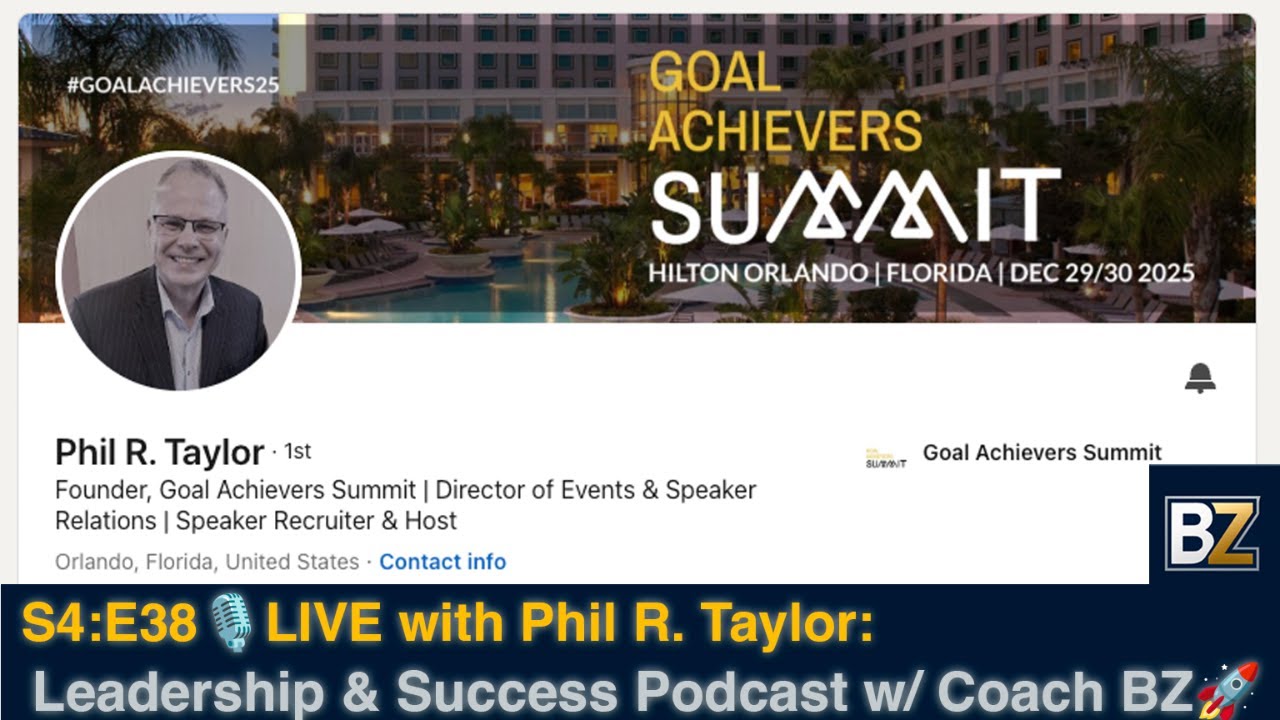
Phil R. Taylor, Director of Events at SpeakerSource, talks about his path from seminary dropout to speaker-coach, his mentors Tom Hopkins and Zig Ziglar, and why aspiring speakers should keep a day job and focus on serving others. He offers a free 17-hour Napoleon Hill series and his book Set Yourself on Fire.
Chapters
Hi, I'm John Maxwell. When the top companies in the world are looking for trainers, speakers, and coaches, there's one name that stands above the rest, and that's Maxwell Leadership. Our certified team members have gotten proven results for companies all over the globe, and our reputation, I'm proud to say, is second to none. Some of our members have risen to the top of their profession, including the one you're going to meet today. I proudly introduce you to my friend, Bob Fabien Zinga.
Welcome to the Leadership and Success Podcast with your host, Coach BZ. If you need to develop into a better leader, this podcast is for you. If you want to achieve a greater level of success, this podcast is for you. His mentor, Dr. John C. Maxwell, said it best: everything rises and falls on leadership. We hope to inspire you today and provide you with an insight that has the potential to positively impact the trajectory of your life. Welcome to the Leadership and Success Podcast. Imagine gaining the leadership skills that could redefine your career. Join Coach BZ on the Leadership and Success Podcast, where each episode delivers practical insights from world-class speakers, military leaders, and industry experts. We dive deep into what matters most: building resilient teams, leading through uncertainty, and navigating complexity with clarity and confidence. Every conversation is crafted for aspiring leaders like you, who are ready to grow, lead, and make a lasting impact. Don't miss our powerful live sessions and recent highlights. Michelle Hayward on building diverse, high-performing technical teams. Anne Leslie on leading through global complexity and cybersecurity risk. Ron Carpenter AI exploring faith, resilience, and AI-powered leadership. Colonel Michelle G.I. Gardner-Ens on commanding influence from the battlefield to the boardroom. Chris Robinson on shifting from drift to drive in life and leadership, and Coach Enrique Acosta Gonzalez on mentorship, legacy, and heart-centered leadership. Ready to level up your leadership journey? Tune in on Spotify, Apple, Audible Podcasts, YouTube Live, and LinkedIn Live. Join the movement toward leadership excellence. Listen now and start transforming your success.
Why should people come to the summit? It's a wonderful opportunity for all, and it's designed specifically on January 29th and 30th. Now, if it wasn't called the Goal Achiever Summit, we'd have it for another date. But it's very interesting because statistics and research recently has shown that 33% of Americans think about goals between Christmas and New Year's. Now, they don't think about goals during June or March or Easter or Halloween. They think about goals during Christmas, right?
New—
so we really want to tap into people's mindset at that particular time. So what we've done is we've set out two days on the 29th and the 30th leaving New Year's open for anyone to do what they want with it because it's somewhat of a sacred day. But you know, if, if there's any place you want to be on New Year's Eve, it's Orlando.
All right, everyone, this is, um, Coach Bizzy. Thank you so much for joining us today. I have a very, very special guest for you. He really doesn't need any introduction in the self-help development. He has worked with some of the best and biggest organizations out there, such as the Napoleon Hill Foundation, the author of Think and Grow Rich, and also Nightingale and Conant. So I'm very, very glad to have Phil with us today. For over 20 years, he's been the quiet force behind the scenes interviewing the top speakers in the world, publishing game-changing audio programs, and now serving as Director of Events and Speaker Relations at SpeakerSource. He's helped thousands of speakers ignite their message and connect with the right stages. So, if you are a speaker, if you are a coach, make sure to reach out to Phil. There is a huge event happening on December 29th, 30th in Orlando, Florida. I just showed you a brief clip. There's gonna be dozens and dozens of speakers, and you could be One of them. Anyway, we're gonna be talking about this very shortly. So with no further ado, let me bring to you the one and only Phil Taylor. Yay! All right, Taylor, can you hear me?
Great to be here, Coach BZ. And I'm sitting in my hotel room at the National Speakers Association Influence Annual Event here in Scottsdale, Arizona. So forgive the background with, you know, the hotel room and so forth and some of the lighting issues.
Passté.
But it's great to be here. And on that note, I'll just do a little plug for NSA. Please. If you are a professional speaker or aspiring to be professional speaker, this is an event you cannot miss. Annual. It's an annual event at this time in a different city, but it's been going on now for over 50 years.. And it's just a place where you can just learn and grow and connect. And it far outweighs any of the investment that you make. So that's Influence National Speakers Association. I can't say enough great things about it. So glad to be speaking with you from my hotel room at the conference today.
So now let's give a plug about your own event. One of your speakers was actually here. Let's see. His name is Michael J. Pop, international speaker. And also another one of your friend, I don't know if he's speaking for your event, but Tom Rosnack is the one who connected us together. Can you give us a plug about your own event, please? Let's hear about it.
Oh, well, Coach Bisi, you're too kind. You're too kind. It's almost like trying to drink water from a fire hose. You know, it's so exciting and so big and so forth. But as you know, the name is called the Goal Achievers Summit. It's a summit. For goal achievers, for high achievers, that 3% to 5% in America or in the world that really take goals seriously. They don't just wish and hope and have resolutions like many people do only to see it fizzle in the third week of January. But they know and realize the trajectory power of having clearly defined goals for yourself. And so, between Christmas and New Year, these high achievers habitually go back to their goals. They look back on the year, try to derive some lessons from it and prepare for the new year, be it 1 year, 4 years, or what— whatever it may be. But the Goal Achiever Summit is something that will be happening, God willing, uh, year in, year out, from, from now to eternity, because this is the place where you can get clarity, inspiration, and the connections you need to propel you from year in to year out every year. And it's being held in Orlando. There's 3 tracks: leadership, entrepreneurship, sales and marketing. So, if you fall in any of those 3 categories, this is the place for you. And the overlapping theme, of course, is getting clarity, the resources, the information, the connections, the tools, the resources to really make your dreams a reality. So, it's a very— it's a power force. It's a launching pad for entrepreneurs. And achievers alike. I don't know if I said— I know there's more information to it. But I'm just so excited that that's all I can say.
That's wonderful. Definitely, if you absolutely can, you need to be in Orlando in December. That is great. So to get started, Phil, let's see, icebreaker. What is something about you that most people may not know?
I had, I had an answer to that, that question. I was just thinking about the other day. Oh, oh, that, that, oh, that people— could you ask that again?
Some, something about you that most people may not be aware of? For example, for me, she talked about—
oh, okay. Yeah, uh, people think that I'm highly religious. They are convinced that I'm this church-going religious individual. Some people even think I'm a pastor, of all things. Could you believe that? You know, and the fact is, I don't go to church. I don't— I haven't— it's not that I knock church. I think it's a wonderful institution. But I'm not— I'm probably the least religious person you will ever meet. But that's perception. People think I'm highly religious, and I'm not. I have a very personal relationship with a living God. And I believe in uniting with people who share your faith and your values and interacting. But religious I am not. And some people think I am. So that may come as a surprise.
I think I know why some people might think so. What is your favorite book of all time?
Oh, the Bible.
Oh, man. Okay. And also, Guess my next question. You have been such a unique journey, right? From seminary dropout to Director of Speaker Relations. What was the pivotal moment that set you on this path? So I think this may have something to do with it.
Oh, well, I didn't have much choice, I think. When you get rejected and kicked out of an institution, you know, you gotta figure another way into existence. And that's what happened to me 42 years ago. At theological seminary my second year. And they just said, "No, you're just not what we need or what we're cutting for." But that's a story in itself. I've gotten over it. But I was 18 years old, and I was somewhat lost and confused and looking for some meaning and direction in life. And I sort of, like a lot of things, I Well, this thing called sales, you know, came across opportunities in sales. And I didn't really know much about sales per se professionally. But then I already, I always associated work with heavy labor or something you don't like that you have to go to. And it's, you know, that's work, you know. But I found this incredible profession called selling. And all I had to do was communicate a service or a product that offered value to not all people, but the certain type of people that needed it. And just to engage them in conversation and have fun. And I did that. And I couldn't believe the amount of money I could make doing that. You know, it was like all my friends, you know, sweating it out, working jobs. And I was just being paid for loving people and conveying something of value to them. And I enjoyed sales. And the first book on sales that I picked up was from my good friend and mentor, Tom Hopkins, "How to Master the Art of Selling." And that, he is one of my business mentors, so to speak, throughout the decades. And from sales came the involvement into owning businesses, entrepreneurship, and then an unwilling, reluctant leadership calling on my life. So that's kind of how it all unfolded. But God in his faithfulness has never left me, has never forsaken me, has been kind, intimate, faithful. I love him. I love his people. And I love those that aren't his people. I just, you know, God is so good. And I cannot help but declare his love and wonders to the world.
Wow, that is so wonderful. We definitely need more love in the world, especially right now. So how did founding Goal Achiever International shape your understanding of purpose? Leadership and calling?
Yeah, so going back to goal achievers, I think the pivotal book for me that started it all off was Think and Grow Rich by Napoleon Hill. And if you haven't read Think and Grow Rich, you must read Think and Grow Rich. It's basically a manual on goal achievement. That's what it is, a manual on how to achieve your goal and to find and live out of your definite chief aim in life. And so, from that, there's a big principle on mastermind groups. And we started to apply those well over 20 years ago. And it really upped the game. When you're part of a small group of individuals that unite together under the same values, same principles, and unselfishly pour into one another and treat one another's needs as if it was just as important as yours, if not even more, I tell you, it just, it just magnifies in an incredible way that's indescribable. So, we've been doing that and seeing the power in mastermind groups. And there was always the vision of, hey, why don't we all get together one year, New Year's, and celebrate each other? It was a simple concept, maybe around golf, but not everyone golfs. But, you know, it's come to the point where now a conference, everybody can get, can bring their specialty dish, like a potluck dinner, so to speak, be it leadership, sales and marketing, or entrepreneurship and feed one another at this great banquet table. And you know the analogy that Zig Ziglar, I think, used in one of his analogies. There was a person that died, went to heaven, and an angel brought him into a banquet room. Do you know that one, BZ?
Yes, I have heard that one.
And on the buffet table, there's everything to make and satisfy the soul. But everyone was miserable, absolutely miserable, right? If you remember the analogy. And he was confused. And then, you know, the angel snaps his finger and then they go into another scene, exact same scene, same table, same everything, but everyone was laughing and joyful. And it was the most beautiful, amazing imagery that you could see. And the man, the angel, and said, I don't understand, it's the exact same situation, but one room, banquet room they're all miserable, angry, and frustrated. And in the other room, they're all happy, laughing, and delighted. And he says, well, look, look at the first scene. Do you see there, there's this foot-long, uh, or this meter-long fork that's attached to the— I'm butchering up this, this illustration, of course, but, but what they're doing is they're taking this, this long meter-long fork and they're trying to feed themselves. And there's everything in front of them that they can imagine or want. I mean, there's roast beef and turkey and pumpkin pie. There's every delicacy that you want, and it's so close. It's so close, and it's so delicious, and they're so hungry, but they can't get it into their mouth because they're trying to feed themselves, right? But look at the other scene. And what are they doing? They're not thinking about feeding themselves. What are they doing? The forks are attached, meter long, but they're reaching across the table and they're feeding each other. And they go, would you like any of that? You know, that's powerful, right? And then feeding another, there's a sense of joy and happiness and humor and, you know, and that's the secret to life. And that's the key to Mastermind. Is forgetting about yourself and focusing on others. And as you're feeding others, others will feed you, and then it magically grows from there.
That is really good. You really remind me of, no, valuing people and adding value to them, just like Dr. John C. Maxwell teaches. This, this is great. Now, you have worked with some of the best speakers in the entire world, right? Uh, In your opinion, what separates the good speaker from the great ones?
Character. Greatness that comes out of character. I was speaking with Dottie Walters, who wrote Speak and Grow Rich. Now, Dottie has gone, has left us well over 15 years ago, but she said something to me once face to face. On my birthday. And she looked at me with her piercing eyes. She says, Philip, great speakers are great people who speak well. Great speakers are great people who speak well. And that really spoke to my heart because if you want to be a great speaker, you first must be great. And if you want to be great, you must find the principles that make a person great. And those principles are not what you may think about. It's not about exalting yourself. It's not about trampling over other people. It's actually principles of humility, principles of teachability, uh, principles of kindness. And as you open up your life to the giver of those principles, you grow into a great person, and then you accomplish great things. And then from there speech flows, you know, where you can share that journey with other people. Now, there are some great people who've done great things but don't speak well, nor do they want to speak, you know, but they're still great people, you know, they just their own way. But a great speaker is someone who's authentically become a great person because of the really the pressure of life, you know, I mean, gold is made and produced out of pressure. And sometimes things that we think, um, are a curse are actually a blessing, and some things that we might perceive as lucky or a blessing may actually be a curse. Life is full of paradoxes. But I know one thing, that without a relationship with God, life is, for me, completely meaningless. He's the giver of, of life and meaning and direction and hope and strength and everything. Possibly hope or imagine.
That is really, really profound because it looks like for most people out there, they kind of, you know, focus on the science and the art of success, you know, how to be successful, do well, and get a whole bunch of stuff. But they don't really focus much about how to be fulfilled. Fulfillment, happiness, purpose, that doesn't really play into their strategy, which is kind of sad. But going back to speaking, if we have aspiring speakers now listening to us, now they want to kind of break into the speaking circuit, what are some of the common mistakes you have seen emerging speaker or event planners make when trying to break into this field?
The industry. Okay. Rule 1, don't quit your day job.
That's good.
The thing, the big illusion and hope of every speaker is somehow they'll just, you know, go into the business because it's the easiest business that you can go into. You don't need any certification or anything. You could just get a business card and put, you know, John Doe, professional speaker and consultant, and boom, you're in business, you know. So it's the easiest business to get into, but the hardest business, I think, to really, really succeed at, you know, and I would estimate, I think the statistics out there, don't let the amount of professional speakers out there give you the illusion that it's an easy way to make a living. It's probably, if you were to choose, probably one of the most challenging and difficult ways to financially make a living. So that's, that's the first thing. And so I hope I haven't discouraged a lot of people. I think you have, you have to have a real mission, a real calling, a real yearning, a message that really makes an impact and causes a difference in people's lives or businesses. You know, and it's got to be delivered. I think the biggest powerful expression of the artist speaking is enthusiasm. You got to be enthusiastic about what you're talking about. You got it. I mean, enthusiastic, passionate, convicted. And it'll show up. You forget the gestures and the icon, you know, when the message grabs you, you know, and then you're the vehicle, that's where greatness of delivery. So we're talking about the— there's two components. There's the business of speaking and then there's the art of speaking. And they're somewhat, they need to be connected with one another. You know, no, um, yeah, those are my initial thoughts. I don't know if I've covered— go ahead.
That is, that is great. No, thank you so much. This is, uh, so insightful. Now, I know you've also offered a book, uh, Set Yourself on Fire. I know it's not very easy to find this, this day. Can you tell us a little bit about that?
"Set Yourself on Fire" was written— what was it written? It was written about 14 years ago. And actually, Zig Ziglar said, "Everybody ought to write a book. Everybody writes a book." At the time, he said, "Not everybody ought to publish a book or get it printed, you know, but everybody ought to write a book. And that book should be themed, 'How can I succeed in life from an introspective standpoint?'" Or, you know, how can I be successful? And that kind of prompted— I took that challenge. I wrote this book, and then I gave it to the manuscript without any intention of having it published at all to the Director of Toastmasters International, Dr. Dilip Abhishekara. And he was the Director of Toastmasters International worldwide. He looked at it, right? He said, wow, Phil, You gotta share this message with the world. And I said, really? And he said, do you know, well, do you know a publisher who'd wanna publish it? He said, yeah, I certainly do. Publisher looked at it and got it published on my first attempt. I wasn't even expecting it to be published. Yeah. But it's really a book on taking your dreams and translating those dreams into tangible goals and going through the process of achievement. And again, um, one of the great, great quotes I love is by Henry David Thoreau, and he says this— I love this quote, I have it written in my heart— he says, if one advances confidently in the direction of his dreams and endeavors to live the life for which he has imagined, he will meet with success. Unexpected in common hours.
Hmm.
I think the key is ask yourself, what is your dream? What is your goal? You know, and, and identify that and, and press forward. Because sometimes, uh, you don't exactly know how it's going to unfold, but, but when there's— if there's a way there, if there's a will, there's a way, you know. And yes, Henry David Thoreau, I think said it very well. So I would love to do something, Coach BZ, for your listeners. I'd love to send a PDF of Set Yourself on Fire. And if they get out of here, wow. Anybody that contacts you, I would— it's free for all of your community and users.
That is awesome. Awesome. All right, you've heard it here, folks. So keep watching. Leadership and Success podcast, and everyone is going to get a free book, Set on Fire.
Everyone.
I'm kind of like Oprah now. Everyone gets a book.
Yes.
Thank you. Thank you. This is great. All right, I am about to switch over to the second half of the show where I ask 7 categories of question, which I ask everyone who's ever come on this podcast. Before I do, do you have anything you would like to tell the audience?
Anything I would like to audience There's a lot of this, but I'll tell you a life proverb that has helped change my life. I was 14 years old. It was September of 1979. I was confused, lost, and I opened up the pages to this wonderful proverb, and it said this, and this translation read it this way. It says, "Do not let kindness and truth leave you. Bind them around your neck." Write them on the tablet of your heart. And to me, that just resonated. Those virtues, kindness and truth. And it just struck a beautiful balance, you know, for life. Because if you're truthful, but you're not kind, you haven't accomplished the goal. And if you're kind, but you're not truthful, really true, you're not really kind. And those two ingredients mixed together make the perfect formula for success in life. Verse 4, Proverbs 3:4, actually comes with a promise. So verse 3 says, do not let kindness and truth leave you. Bind them around your neck. Write them on the tablet of your heart. Oh, how beautiful that is, right? We all want to be touched by kindness. We all want to be, uh, interacted with integrity, truth. Then the promise comes, verse 4. Hold on. 'And then you will find favor in the sight of both God and man.' Wow. There's a promise that comes with that. And if we're talking about leadership, if we're talking about leadership, don't underestimate the power of kindness, equity/truth.
Wow, that is powerful.
That's, that's a key to influence. Yeah.
Man, that's definitely something we could be tweeting all day, kindness and truth. And what really, I think, is quite insightful is kindness is free, right? You don't have to pay anything to be kind to people. And sometimes people are just so busy and sometimes they are just mean and just don't consider others much, but it really doesn't cost you anything, does it?
Well, I think the key is the heart. The proverb says above all else, Watch your heart for everything you do and say flows from it. I believe leadership life stems from a much deeper place. It's not mechanic. If you focus on the mechanics or the tactics, that could last only so long. And there's a place for skill sets, but the language of the heart, the lang— watch your heart. And from all that I think flows. I've had situations where I interacted with probably some of the most skilled communicators. But they lacked heart. And they lost me, so to speak. And I think some of our listeners can identify with that. That saying is, people don't care how much you know until they know how much you care. And then I've been in front of people who could hardly speak English. But you could see in their eyes and you could see it in their visual expression that they wanted to get it. They wanted to help, that they care. They couldn't communicate it quite well in English, but they communicated with everything else. And those are the people that have won me over because— That's powerful. Yeah. So what was the difference between the two? Not, not the skill or the linguistic skills, but, but the condition of their hearts. So above all else, watch your heart, for from it flows the streams of life. For everything you are and do come from that. And then the question becomes, who, who can transform my heart? How can I take this heart, and where do I go to get it transformed? And, and I can, I could tell you where you can go. I mean, in that kind, I'd like to introduce you to my master, you know. Wow. Yeah, the master.
That is very, very, very powerful, living from your heart. We really need more and more of it today, even right here in America, especially in this time that we are living in. Okay, that's, that is really the first segment of the second half. We ask you about, uh, the greatest lessons you have learned. I think you, you just shared, uh, about that. But what, what do you think is the secret of your success?
My success? God. That's the beginning, the Alpha, the Omega, the beginning, the end. I wouldn't be in existence without God, uh, in his predestined— in his great love. He knew me before the foundations of the earth. He knows the count of the hair counts on our head. He knows everything about us. How can I possibly credit success to anyone other than God, you know? And my beloved mother who brought me into this world and nurtured me and so forth. So I know that that's maybe not an answer people are willing— they go, oh, that's so, you know, but no, no, I'll, you know, the Bible, I'll go back to the words of Solomon. He wrote this 4,000 years ago. And it still applies today. In Proverbs 3:5-6, he says, trust in the Lord with all your heart. Do not lean on your own understanding. In all your ways acknowledge him, and what he will direct your path.
That is powerful. That's wow.
Yeah, yeah.
Because even for this, uh, podcast, this This season I decided we have two books for the curriculum. One is 21 Irrefutable Laws of Leadership by my mentor, Dr. John C. Maxwell, but also the Bible. Now I use this Leadership Bible, but any Bible would do because I feel like, you know, I've been taking this search for success and leadership principles since I was about 17 years old. I've read more than 2,000 books. I've gone to all of the great seminars. Now I've had many mentors from Tony Robbins, Darren Hardy, Les Brown, I mean, you name them. I have read them, I've listened to them, I've been mentored by them. But really, the bottom line for me is when you take everything they say, Brian Tracy, Jim Rohn, you mentioned Zig Ziglar when he was alive, all of those people, you really get it back into ancient scripture. It is all written black and white in the Bible. Now they say it differently, you can apply it differently, but really the core message comes straight out of the Bible. Again, not to be religious or anything like that, but just to learn those principles that would help you live a better life, add value, value people, and develop those great core values. Now, you mentioned character earlier, becoming a person of character and integrity. It's really life-changing if you let it.
Yes. Yeah.
Wow. All right. So second segment of the second half of the show, what are you learning now? Because I know Leaders are learners. What's, what's your plate? What are you on?
The ongoing quest, never-ending quest for wisdom. You know, every, you know, I love the Book of Proverbs. That's, by the way, you asked me at the beginning, what's my favorite book? The Bible, the Bible, for sure. But there's one book I zero in on every single day. It's got 31 chapters, chapters, and most days in the month, have 31 days. So it's really, if you forget this, but you can make the connection, I read a chapter that's congruent with the date. So this morning I woke up, it's the 28th of, uh, of, we are the 28th of July, right? So I went to Proverbs 28 and I read the chapter for today. And I do that endlessly every single morning. And it It— sometimes if I miss it, I could then go back to the chat. But for most part, but it really sets my heart, my mind, my attitude for the day. And it never gets old. It's fresh. It's like a fresh meal, a fresh breakfast. Amazing. That is served every day. And it's just got this—
wow—
taste to it that fills—
that is really amazing. And Proverbs was written by King Solomon. Um, yes, the son of David, thousands, thousands of years ago, and still relevant today. It's just incredible. So, uh, how has failure shaped your life, right? Because most people, when they look at you, they look at all of the successes and all of that. I have this, this coin which I love. I take it everywhere I go. One side says success and the other side says failure. I really believe success and failure are two sides of the same coin. People who are very successful today have failed sometimes even more than, uh, they succeeded. So how has that been for you?
Yes, uh, tremendously more failure than successes, actually. The road to success is paved with failures, but failure isn't failure if you approach it the right way. With every failure comes a valuable learning experience. Napoleon Hill put it this way, he said, with every failure, every adversity comes an equal seed of success or greater than. And so, I mean, story— I don't think you could find a great entrepreneurial story from Colonel Sanders to Netflix to you name it that had to go through heartbreaking, cliffhanging failures, hard times before they finally, as most people now look at them and say, you're so lucky., you know, have come to experience. Listen, behind every great story is great trial and error and learning and growing from it. Hands down. Yeah.
Wow. Can you share a moment where your faith was most tested and what you learned from the experience?
Yeah, I was 15 years old. I was homeless. Um, I had a father who was a pastor, a minister, very, very articulate, talented one, and so forth. And I was very, very confused about life. Um, and, and I didn't quite— I didn't quite have all the understanding of who God was and what the meaning of my life is. And going back to my mother, she was the reason why I'm here today. Her great love stood in the gap. And, and God showed up for me in the most interesting way in one of the, the most adverse down times of my life that I'm not sure I could fully— I would, I would, I'm not sure I'm, I'm at the place where I can feel comfortable talking about it right now, but he met me. He met me. I did not reach out to him and discover him. He's the one who came and met me, and that transformed my understanding of who he was and the meaning of the love of God.
Now, some of the people who are watching, listening right now, they're going through a very, very personal, tough time. What would you tell them? What advice would you give from your experience?
Uh, what I would say is, um, that there's a greater power out there that knows you, that cares for you, that is intimate to you. And if you just humble yourself, just go to that person who just grasps that all this, this universe, did not happen by accident. There's a creative, beautiful, loving force, and, and it's not abstract, it's not far away. It's a force that's very close to the human heart. And if you go to that first person of your understanding and you just lay out your burdens, your difficulties, I believe that the God of your understanding will meet you where you are. And, um, you know, the Bible says, humble yourself before the Lord and he will he will lift you up.
You know, that's powerful.
Yeah. And, and I think that greatness is born out of the ashes of brokenness sometimes.
Wow, that is, that is very, very powerful. And, uh, I would say, as long as you have breath, there is hope for—
Amen. That's my quote.
Where'd you get that?
Yeah, because the adversity you went through, what, it should have killed you, but it only makes you stronger. So you are here and you may not know, like there was a point in my own life where I didn't know where my next meal would come from. It's like I had no idea. Basically I come to the US, I was 17 years old and the first year I was here, my mom gave me like $16,000, which I used to pay for school. But then the second year she gave me $0, nothing. And my tuition was still due, right? Even though I have A+ at the time, 4.0, perfect GPA, but I wasn't from the US, so I couldn't get any scholarship or or anything. So, it was like, how do I pay for school and how do I eat and how do I live in this country? That was probably one of the worst times in my life. But anyway, my faith in God helped me to get through it. But what I'm saying is, thinking of that time in my life, as long as I'm alive, you know, I know that there is hope for me.
So, yeah, you know, Coach Beezy, you and I share a love for a common musician called André Kraut. Yes, I love Andre Crouch, and he wrote a song called Through It All. You know that song?
Yes.
You know, and he talks about the trials and conditions of the human existence. If you want to Google, Google the word— Google Through It All by Andre Crouch, and you'll hear and listen and be able to observe the message of great hope.
Wow, that is powerful. And at the end of this podcast, I always write an article and I'm going to make sure to have links to all of those songs. And actually, it's one of the questions I'm going to be asking you soon. On our way, who do you know that we should know? Who are your mentors, thought leaders that you follow?
Oh, my mentors. Well, my mom, my greatest influencer in my life by far. By far. I was blessed with the greatest mom in the world. I know some of you will argue and so on, but what a beautiful, positive, loving— I can't— in fact, I dedicated Set Yourself on Fire to my mom. You'll see that the dedication of the book is to my mom when you turn the pages. Okay. Receive that. Great influencer. I would not be here today without her. Then there was a lot of great mentors. There was Joel Dudley, who created the largest ethnic hair care skincare company in the world, Dudley Products. There he is. Oh, Joe, I miss you. I love you. That's from his memorial on February 8th. And he put it in his will that he wanted me to speak at his memorial.
Wow.
Yeah. And what an honor and privilege. But that's not because I'm great. Because he's great. And, and he was like a father to me. He embraced me like a father, you know. He— I mean, this man was unbelievable. He just, um, oozed out with love and kindness and wisdom. But he started his business with nothing more than, I believe it was $10, I think it was $10, and a kitchen table and a dream. And, and he built it into He built it into the largest cosmetic company of its time. And one of the big, big, it was, I'm not gonna name the company, but he said, I was sitting in his car with him driving once. He said, you know, this so-and-so company just offered me $300 million to buy.
Wow.
You know, and he said, and he said, I couldn't accept it because I'm about the personal relationships that I have in the company. And that would go away. But as a result of his inspiration and leadership, I believe at least 300 millionaires were born out of his leadership motivation. Wow! Look him up on Google, Joe L. Dudley Sr. Incredible man. And by the way, he credits Think and Grow Rich and the Bible for success. Those are the two books that he build his business.
That is incredible. Wow. Yeah, so what a man with integrity. That's— we don't see that every day.
Yes, absolutely. I cannot say enough of him. And, uh, you know, that is awesome. I mean, we, we can— if you have 2 hours, I can start talking.
No, I, I, I, I, I really love this. This is part of the reason why I do this podcast, to kind of expand my mind and see who do I not know, right? You know what you know, but then there are things that you know you don't know. Then there are things that you don't know that you don't know. That's right. That you don't know. Exactly. That's right. And especially for those who have passed on, like Mr. Dudley, what I love to do is find their books, if they have any audio program, training program, a course or something, because a powerful thing, and I get that from the Bible too, talking about Abel, right? Though he is dead, yet is he as piquant. So it's really amazing with all of the technology we have where you can still hear the voice and the thought and the philosophy of someone who has passed on long time ago, but still be able to apply those principles that they have used to get whatever measure of success they were able to achieve. Wow, that is great. So if you could choose 3 people to have dinner with, who would you choose and why? They could be alive, dead, or mythical figures?
The first and easy one is Jesus. Yes, that's a no-brainer.
Who else?
Uh, you know, when you have Jesus, you have everything. I'm going to add two other components of the Holy Trinity.
Okay.
I could have dinner with God Jesus and the Holy Spirit.
Okay, okay, okay, okay. No, I'm not gonna let you off on that. Add two other human beings, alive or dead. That's too simple.
They have to be human beings?
Yes, not human beings. Yes, that's a new rule.
Oh, that's a new rule. Okay, well, you know, I just answered it the way, you know. Um, but you know what, I do meet— I do have a meeting with those, the Trinity, every day, so But I think you mentioned King Solomon in the Book of Proverbs.
I'm thinking you probably want to ask him some questions.
Well, I visit with King Solomon every day, you know, so to have dinner with him in person would be— and then there's Jesus, the man, you know, came as a man. So I would put Jesus in there. And then just as another third pick that I really admire is Gideon. You know, because Gideon was an underdog. He was like a nobody type of thing, and so was shepherd boy David and so forth. Yes, but, but an example of how God takes the most unlikely of individuals, you know, to breathe strength and vision and power and leadership into them. Read the book of Gideon and the great— you know, God picks the most unlikely individuals. And even Solomon, even Solomon in all of his greatness, he was at a place where he was overwhelmed. And God, who am I to rule and govern a nation? I'm just but a boy. You know, he was very young. And God gave him that alternative. He said, well, ask of me anything and I'll give it to you. Wow. And he said, what do you want, Solomon? He said, I want wisdom. I want a heart of understanding is the actual phrase.
That's powerful.
The rest of them. So that's kind of— I didn't even think that through, but I mean, Jesus, sure. Solomon, visit. So it'd be nice to greet him in person. And Gideon, to say, Gideon, I'm a kindred spirit with you.
Yes. Yes. Wow. That's beautiful.
Most unlikely. Yeah. Yeah.
No, no, this is great. And which books What books would you recommend to my audience?
Oh, well, the Bible. And what I would— what I would do if you've never read the Bible, if you've never read the Bible and you look at it as a big overwhelming book, hard to understand, don't let that stop you. Go to the Book of Proverbs. You know, some people say go to the Gospel of John, but I would say go to the Book of Proverbs and start with Proverbs 1 or the date of the month. If you're listening to the podcast, today's the 28th. Go read Proverbs chapter 28. You'll find some insights. And from that, I believe your heart and the force that has written that book will lead you into a deeper understanding and desire for the rest of the book. So, the book of Proverbs, number one, for sure. A book that I go to that was written many, many, many, many years ago, but its principles live on and are so powerful is How to Win Friends and Influence People by Dale Carnegie. Okay. That is bread and butter. Every leader needs to read that. I try to go back to that at least once a year, every year, and it never gets old. It will transform the way you think and look at people and conduct yourself with people. It is the best book in my view in human relations next to the book. Oops. Okay. And then for goals, I highly recommend Think and Grow Rich, uh, in summary, by Napoleon Hill. Uh, he interviewed, uh, hundreds of hundreds of people, uh, successful individuals and also unsuccessful people. But he, he interviewed— first of all, his meeting with Andrew Carnegie, who was the wealthiest man in the world at that time, and he looked to him. He, he was the, uh, he was a writer for, I believe, Success Magazine went to Andrew Carnegie and said, what made you successful? You were just a bobbin board making $18 a week, and now you're the wealthiest man in the world. How do you go from being, you know, obscurely poor to the wealthiest person? And he asked, uh, he compelled Napoleon Hill with an invitation to do a 20-year research by interviewing the most successful individuals in the world. And from my understanding, he had Andrew Carnegie notified Andrew Ford, not Andrew Ford, Henry Ford.
Henry Ford.
Henry Ford, who was also buddies with Wrigley and so forth. And a chain reaction of interviews were put together, hundreds. And he put together all those common denominators, principles of success that are capsulized in Think and Grow Rich. So it's basically a book on goal achievement.
That is really awesome. And now you are one of the craziest person I've ever met. On your YouTube channel, you give away close to 17 hours of the 17th Principle of Napoleon Hill working with his foundation. You've interviewed like hundreds of speakers. Can you tell us about that project, please? And why in the world you're giving it away for free? This is something I would have spent hundreds of dollars when I was a poor student. Didn't even know where my next meal would be coming from, I would be saving money to purchase something like that just to get the wisdom. Can you tell us more about it?
Thank you. First of all, it's not me that— no, it's the generosity of the contributors and, and others and so many others. I was just a conduit, a part of that program. But it's 17 hours on Napoleon Hill's 17 Principles of Success that starts with a Definite Chief Aim all the way to Habit Force. And, uh, there's 3 people, campfire kind of setting conversation, where we enter a conversation on their experience with that principle according to some of the people on that program. Our staple names— I know I'm going to forget some— but are people like, uh, Kent Blanchard, Brian Tracy, Mark Victor Hansen, Tom Hopkins, uh, did I say Harvey McKay? Yeah. Ivan Meisner, uh, from BNI. I mean, unbelievable, Tony. Some that have passed away where you'll never hear them again. And if you go to YouTube, just put, uh, Philard Taylor.
I, I will give them the entire direct link.
We just put it on just a few short months ago.
Wow, amazing.
Uh, and, and it's 17 hours, and you plug that into your car while you're on a long drive or whatever Yes, you're— it's like you're sitting with us in that conversation, and it's so beautiful. Yes.
Yeah, no, that is, uh, um, definitely, uh, when, when you guys download, uh, or watch those YouTube video, or when you get the, uh, the book that, uh, you're gonna be receiving free from listening to this podcast, Set Yourself on Fire, act as if you had spent $1,000 for the resources. Because one of the problems I have sometimes with receiving free things is because it's free, you think it's cheap, you think it has no value at all. I am telling you, these resources are worth thousands of dollars. So act as if it is and you're going to get so much wisdom out of it. Now, just talking about books, you've also mentioned Speak and Grow Rich, right? By Doty Walters.
Yes.
And you also mentioned How to Master the Art of Selling by Tom Hopkins.
Tom Hopkins. Yeah, that was the first book. I didn't know anything about sales. I was like 18 years old.
Incredible.
Yeah. And I go, how do I navigate through this thing called professional selling? And so I picked up the best-selling book ever written on sales, How to Master the Art of Selling, uh, Tom Hopkins. He's trained over 5 million individuals. He's written 26—
that is awesome.
Yeah. And, and he's become a personal friend of over the years, which I never expected.
One of my mentors, Brian Tracy, taught me about principles of sales, but Microsoft also did. I don't know if they still do, because when I was trying to find my way, one of the ways where I made money, I was basically selling Microsoft products to my customers. And then they made me a Microsoft Small Business Specialist, but they had like, you know, at least dozens of hours on on sales, but those principles you can apply them selling pretty much anything. And I think even if you are not a salesperson, even as an executive, as a speaker, even if you are looking for a job, right, you kind of have to sell yourself as a product to whatever company you want to be employed by. So I think selling skills are extremely important in life no matter what you do. So absolutely, definitely something to learn.
Ask any parent, right?
Absolutely. Now, And I know you don't have any specific recommendation for podcast or YouTube channel. Why is that? How do you go about finding?
Oh, it's such an overwhelm of information. We live in an information era that's just overwhelming. And one of the principles of Napoleon Hill is specialized knowledge. You know, as you're drawing out your goals, ask yourself, what's the specialized knowledge I need in order to succeed. And I'm a member for years, been a member of Audible, audible.com, company of Amazon. And there you have limitless amount. You've got a treasure trove. And there's two types of learners, right? There's people that prefer to read than listen. And then there's those that prefer to listen than to read. The ultimate thing that I like to use is use both senses. Put on the audio, get the book, get my highlighter, and listen and read at the same time, and then stop it, and then make some notes and so forth. So that's how I learned. So listen, I'm at the National Speakers Association convention with hundreds of hundreds of professional speakers that are great influencers and specialists. In the field of leadership, sales, marketing, entrepreneurship, AI, or whatever they may be. They're here because they realize the value of sharing information with one another. And so, I recommend, I ask yourself, hey, whatever field you're in, right? What are the top 5 books this past year that have been written on your subject? What is that? And make sure you read it. Get updated with it all the time, year in, year out. But you're right, Coach BZ, readers are leaders and leaders are readers. Absolutely.
This is very interesting because another one of my guests, Dr. Peter W. Singer, gave me the same exact answer when I asked him. And that's the way one of my mentors, Darren Hardy, has taught me to do that too. And the way he does that, he gets 5 books and then 5 audio programs and then 5 courses and then 1 seminar to just become a master in whatever it is it needs to learn right now. It's just amazing. So we're almost running out of time. Can you give me 5 more minutes? We're going to— Oh, yeah. Thank you. Thanks so much. I am so grateful for your time. I could be keeping you for another 2 hours, but let me keep it short. So if you had one and only one day to live, right? What would you have liked your final contribution to be?
My final contribution? To make sure that I'm right with every person that I've known in my life. Broken, to be contrite, to be right with God and man. That's, that's— if I, if I had one day to live, I, that would make it my first priority. And so the question is, if whatever answer to that question you have, why not do it today?
Wow, that is powerful. That is powerful. That is exactly why I asked the question. Because I think when people think about leadership, anytime I even talk about some of these principles, people like, I already know that. But the truth is, you don't really know that unless you do it. Right. So I really want to make it very, very practical where someone can listen to it, put it in practice and see the benefit, the impact in their life. Just listening and just hearing doesn't do anything. It's actually the doing that makes all the difference.
Herbert Spencer, to take a quote from Dale Carnegie's book, said, "The great aim of education is not knowledge, but action." Action. Action is where the rubber meets the road. Yeah.
That is right. Another one of my mentors, Tony Robbins, says, "Take massive, massive action." It's just incredible because when you take action, even if you take the wrong action, it's better than not taking any action at all because then you can learn from it and then change your strategy. Okay, we're coming toward the very, very end. You've been so generous, generous with your time, sir. How can we add value back to you?
Well, I'm not here to ask for anything from anybody, but to present an offering, an opportunity that will enrich your life. We're putting together an extraordinary event called the Goal Achiever Summit at the end of the year, 29th and 30th. Go to goalachieversummit.com. You will leave a richer, better, happier, more empowered, enlightened individual as a result of that. I just trust me on that, but let the experience speak for itself. So my desire is for you, for you to enrich your life with education and with the right relationship. You know, Ben Franklin, I think, put it well. He said, the best investment you can make is in yourself. Of course, they spoke differently back then. He said, empty the coins of your Empty the coins of your purse into your mind and your mind will fill your purse with coins. I could have forgotten that. That was years ago. But you know, it comes back. Invest in yourself, invest in your mind, and then it will continue pouring into your reservoir. And so be kind to yourself. Be kind to yourself. And Proverbs says, a man of understanding will increase in learning, you know.
Wow.
Um, so the biggest thing you can do for me is to be kind to yourself, value yourself enough to invest in your own mind, your own potential, because you're all— we're all living just a fraction of the potential that we have as human beings and the gifts that God's given us.
That is, that is very, very powerful. Yeah, I know Oprah says pay yourself first, and Brian Tracy taught me you really should be spending about 10% of your income in your own personal development. And for some of you, 10% may be too much because you are barely making it, but start with 1%. That's where I started, 1% only. And then after a while, you go to 2%, then 3%, then 5%, then eventually you're gonna get to 10%. Now, when I started, I was making less than $6,000 a year. Now I'm making a lot more than that. So I even have to find opportunity out in the world. Am I going to spend 10% of my income and where am I going to go? What am I going to learn? And that's really something that will make all the difference in life. Absolutely.
Yeah, absolutely. Coach Bizzy, may I just intervene?
Yes, please.
I want to thank you on behalf of myself and all our listeners for the servant heart you have. Your generosity, your thoughtfulness, the preparation in which you put this program together, how you think about bringing value to those who you serve. I know I've experienced it and am experiencing it. It's going beyond the extra mile, which is another one in Napoleon Hill's that really marks you as different. But your heart just spills out with so much generosity, kindness, and I just want to honor that. And I know I'm speaking for a great many of us here that are listening to your program. So thank you.
Thank you so much. I appreciate that. All right. Now, all good things do have to come to an end. So the very last question I'm going to ask you is, what is the most rewarding aspect of your life experience so far?
Oh, to give. It is more blessed to give than to receive. Emerson, in these words, it says, one of the most beautiful compensations in life is that you sincerely cannot, uh, help— you cannot help another, another without helping yourself. Wow. It's one of the great paradoxes in life. The more you pour into that, or the more you serve other, more other people, the more it comes back you. And we live in a world, in a concept that says, give me, give me, take, take, take. And people still feel empty as a result of that. And the more they take, the more empty they feel. But there are those that just pour their heart and soul into serving others, and their cup gets filled up over and over.
Beautiful.
Yeah, yeah.
And that goes back to the love principle we talked about earlier. And also, one of our common mentors, Zig Ziglar, used to You say if you help enough people get what they want, right, then you will get pretty much everything you want.
Yes, yes.
So if you could go back and give a piece of advice to your 17-year-old self standing at the edge of this incredible career you've had, what would you say? Because before, before you, you answer the question, part of the reason why I write a leadership devotion every day and I do this podcast every single day I am really concerned about the future leadership of this nation, especially in technology and in the military, right? I see myself when I was 17, 18 years old, I had this big dream, but I didn't know how to ever get there. So would you speak to that person? What do they need to know, uh, in order to maybe one day realize their dream?
Yes, it's interesting you ask that. I was just on a podcast just before this one that asked me the opposite. What would your younger self ask you today?
How?
You know, so very, very interesting flip on that. Um, it's interesting as you're saying that, and I didn't know you were going to ask this question, but I would put my arms around that 17-year-old— is it a 17-year-old self? I would comfort that 17-year-old and say, do not be afraid. Wow. I'm with you.
I'm with you.
And I think You know, it's interesting that the very thing that keeps us away from our achievements and our dreams and goals is fear. Fear is such a crippler, destroyer of dreams and goals and accomplishments. And we all have them. We have them here. And I talk about it in Set Yourself on Fire. And it's interesting that in the Bible, the book that I pointed out to as being the most influential book of all time, there's at least 365 times that the book says, 'Fear not, do not fear.' 365. And how many days do we have in a year? 365, typically, right? Isn't that interesting? So there's a reason why God in his word says, 'Fear not, do not be afraid.' And then, and then assure that person that there is a higher power, a loving God that will walk with you. And be that person. Be the person you want to see in the world. I would take that 17-year-old. I would put my arms around that 17 and say, "Don't be afraid. Let me help you." And I think that that speaks to the importance of mentorship. I have a mentor here at the conference, National Speakers Association. I don't think he'll mind I mention his name. His name is Jim Rode. He's 89 years young. He's the second oldest member of the National Speakers Association, 50 years in the association, never missed, I think, an annual conference. He has been past president of the National Speakers Association, Cabinet Award recipient. He's a mentor and a friend. He came up to my room this morning with a cup of coffee just to check in with me, pick me up at the airport in his Mercedes. And, you know, I mean, he doesn't need anything from me. But he's got 30 years of wisdom that he imparts to me. And I would say the best advice I could give to someone who's young or not so young is find someone who's traveled those years before you. Get a coach, BZ, who's been around, okay? And live life. Don't think— don't— do not be wise in your own eyes, you know. Seek advice. And you will save yourself unspeakable amount of time, heartache, money by having a mentor.
So, that is beautiful.
Wow.
Yeah.
Mentorship, big, big believer in getting it.
Powerful. Definitely a master key to success. And, it's really wonderful when you are mentored in person and I love that. But sometimes, though, it's okay to be mentored from a distance. Get your mentor's book and whatever classes, speeches, or whatever, and listen to their principle of how they figured out whatever it is you're trying to figure out now. This is awesome. Okay. We are at the very, very end. And the last quick question I ask, 3 adjectives that describe you as a child.
As a child?
Yes. 3 adjectives. Don't think too long, bro. Okay.
Enthusiastic, friendly, and kind.
Okay. What about as an adult?
Enthusiastic, friendly, and kind.
Fantastic. Okay. That doesn't happen often, but it does happen sometimes. I think I agree. Okay. And then the very, very last question. This is it. What is one word— actually, before I ask that, we are coming at the very end now. Is there anything else you thought you may want to say before we close?
I just want to acknowledge you. I would say you are a living— there's only one way to lead, and that's through example.. And you are a living example of what leadership is, what mentorship is, what generosity is. And I'm saying, if you're looking for a mentor, someone who wants— you want guidance for, go no further than Coach Beasley here. He's right here. He's got a heart of love and service, and I am just blown away by your servitude and your generosity and thoughtfulness. That's what I have to say. And thank you. Thank you for your service.
Thank you so much. I'm so glad you took the time to speak to us today because I never take that for granted. You could have been in it, no, be doing a thousand other things, but what you are saying really is potentially, I'm gonna say potentially life-changing because it's not going to change your life until you put it into practice. That's really the key. Just reading a whole bunch of books and getting all of this head knowledge and not putting in practice is not gonna help you, right? But when you put it in practice, that's when you actually experience it. Okay. The very, very last question I have for you. One word that represents our shared experience right here on this podcast together, the last hour we've spent together. What word comes to mind? Joy. Joy. I think I am grateful. Grateful is the word for me. All right. This is it, everyone. And thank you so much, Phil Taylor, for taking the time. And you are at this speaking conference, National Speaker Association in Arizona, I believe. And you took the time. Thank you. Thank you. Thank you. We are so grateful.
Bless you too. And bless to all those who are listening. Thank you, Coach BZ. Bye-bye.
Really appreciate it. All right. So for those of you who've been with us, this has been tremendous. And I hope you take it to heart. But really, the biggest thing I've taken out of this conversation with Phil Taylor is really the leader of leaders. And he's done things in this industry that nobody else has done. But you really have to value people. Like my mentor, Dr. John C. Maxwell says, right? Have great value, become a person of character, value people, and then add value to people. That's really the only way to lead, the only way to succeed. You have to love people and add value to them. Don't just live your life for yourself, but think about how you can make a difference in somebody else's life. So I hope that— actually, let me double-check on LinkedIn to see if there was any question. Okay, I don't see any question on LinkedIn. Please tag someone if this podcast is adding value to you. And even during the replay, once this podcast is over, please let us know where you are joining us from. I always like to know that. And then if you can also type in the free takeaways or one insight you are going to put into practice this week, because that could inspire somebody else. All right, until tomorrow, and tomorrow is going to be Pretty crazy. We're actually gonna have not just one but two podcasts. I'm going to have Ron Higgs, who's a retired Navy officer like myself, and then I'm also gonna have Matthew Rosenquist, one of the premier CISOs, I believe, in the country today. So you do not want to miss it. Until tomorrow, have a wonderful day.
Bye. Thank you for listening to the Leadership and Success Podcast with your host host Coach Beezy. If you like what you heard, please subscribe to our channels and come back for more wisdom nuggets on how you may develop into a better leader and achieve greater levels of success. Leadership is the most critical skill. The world will always need leaders to lead others, deploy the next disruptive technology, or execute a business strategy. You may as well decide on counting yourself among 21st century leaders. See you right here next time on the Leadership and Success Podcast with Coach
More from Bob

S250:E4🎙️LIVE 🇺🇸America 250: President Barack Obama Leadership, Service, and the Power of Hope






S5:E157🎙️ LIVE with CMD CMSgt Dennis L. Fritz, USAF (Ret.)(Multi Tracks Audio)



S5:E156🎙️ LIVE 🇪🇸 Leadership Lessons from the FIFA World Cup 2026 Champions (Multi Tracks Audio)

S250:E3🎙️ LIVE Leadership Lessons from America’s First Documented Family of African Descent 🇺🇸📖