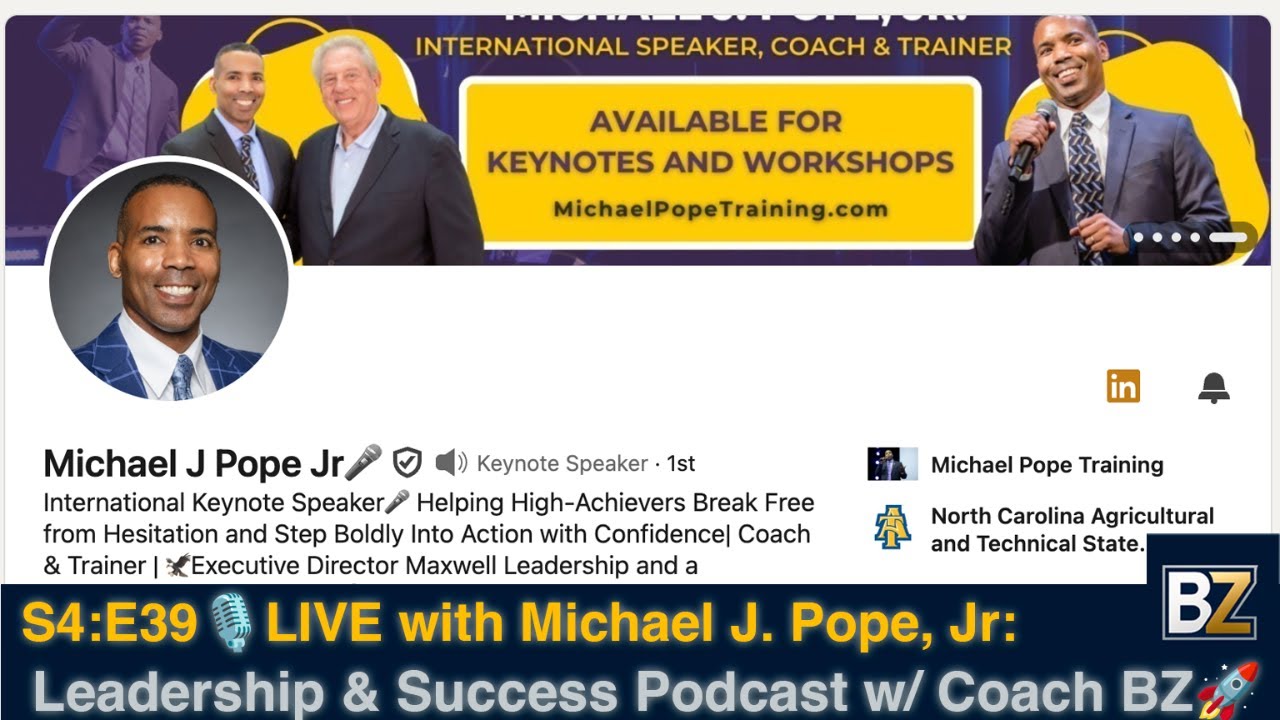
Michael J. Pope, Jr., a Maxwell Leadership speaker, went from terrified of public speaking in 2003 to an international keynote speaker. He shares the D.O.O.R. framework—Discipline, One thing, Eliminate excuses, Responsibility—and the STOP method for overcoming imposter syndrome and building confidence through mentorship and daily habits.
Chapters
Hi, I'm John Maxwell. When the top companies in the world are looking for trainers, speakers, and coaches, there's one one name that stands above the rest, and that's Maxwell Leadership. Our certified team members have gotten proven results for companies all over the globe, and our reputation, I'm proud to say, is second to none. Some of our members have risen to the top of their profession, including the one you're going to meet today. I proudly introduce you to my friend, Bob Fabien Zinga.
Welcome to the Leadership and Success Podcast with your host, Coach BZ. If you need to develop into a better leader, this podcast is for you. If you want to achieve a greater level of success, this podcast is for you. His mentor, Dr. John C. Maxwell, said it best: everything rises and falls on leadership. We hope to inspire you today and provide you with an insight that has the potential to positively impact the trajectory of your life. Welcome to the Leadership and Success Podcast. Imagine gaining the leadership skills that could redefine your career. Join Coach BZ on the Leadership and Success Podcast, where each episode delivers practical insights from world-class speakers, military leaders, and industry experts. We dive deep into what matters most: building resilient teams, leading through uncertainty, and navigating complexity with clarity and confidence. Every conversation is crafted for aspiring leaders like you who are ready to grow, lead, and make a lasting impact. Don't miss our powerful live sessions and recent highlights. Michelle Hayward on building diverse, high-performing technical teams. Anne Leslie on leading through global complexity and cybersecurity risk. Ron Carpenter AI exploring faith, resilience, and AI-powered leadership. Colonel Michelle G.I. Gardner-Intz on commanding influence from the battlefield to the boardroom. Chris Robinson on shifting from drift to drive in life and leadership. And Coach Enrique Acosta Gonzalez on mentorship, legacy, and heart-centered leadership. Ready to level up your leadership journey? Tune in on Spotify, Apple, Audible Podcasts, YouTube Live, and LinkedIn Live. Join the movement for leadership excellence. Listen now and start transforming your success.
You've ever been nervous speaking before? Yeah, I see your hand there, Jilson. I'll never forget the first time I was asked to speak in front of the public. It was the summer of 2003, and I was asked to do a short 4 to 6 minutes speech about me, and I was absolutely terrified. You see, I'm a natural introvert and I hate to be professional, and the last thing that I wanted to do that day was stand up in front of a crowd and talk. So as I sat in my seat with anticipation of being called up, I came down with a bad case of the what-ifs. What if I forget my lines? What if they don't like me? What if, what if, what if? And I heard my name get called up, and so I slowly started making my way to the front of the room. And with every step, my heart would start beating fast and the nerves would continue to increase. When I shook these of the person who introduced me, my hand was shaking Sweat because of how nervous I was. And I looked out at the crowd, and I literally thought that the people in the front row could see the butterflies fluttering on my stomach. I started to speak, and my mouth felt like it was so dry as if I had been chewing cotton balls all morning. I grabbed my nose and said, "Hi, my name is Michael." Those 4 minutes felt like 4 hours. And when I finished, I nervously went back to my seat and I sat down. Now, as an introvert, I sat quiet, but on the inside I was like, "Yes, I did it! I did it!" In my 40 years of experience in leadership, I've only known one way to shift bottom lines, maximize potential, and change lives, and that's by adding value with excellence. That's exactly what my friend wants to do for you and for your team. I proudly introduce you to my friend, Michael. Thanks, Don. When you add value to someone, when you connect, invest, and inspire, they add value to others, and those others add value to others. And as a speaker, it's my mission to start the chain reaction that adding value causes in your company. Hi, I'm Michael Pope, a Maxwell Leadership certified speaker, teacher, trainer, and coach. I'm passionate about personal development in all its forms. I can't wait to add value to you and impact your people. Speak with me today so that I can speak for you tomorrow. Michael, it's great to have you on our team. You have something special. You've got greatness in you.
Hello, I'm Les Brown.
Well, Michael Pope is a young man who Number one, he helps you to begin to do the things that you don't want to do because you want to become knowledgeable, and he helps you to do it.
Michael Pope, it's a blessing to be in his presence.
You have something special. You have greatness in you. That's my story, and I'm sticking to it. Hi, I'm Joseph McClendon III, and I'm the founder of the Neuro-Encoding Institute. I've spent the last 30 years as an ultimate performance specialist for athletes, celebrities, millionaires, billionaires, and everything in between, even some royalty. I've spent my life refining and providing methods and processes to help people go further faster, and now I've certified a rare few to do the same at the highest level. And I'm honored to introduce you to one of my elite specialists certified in the neuroencoding methodology. And so one of the most amazing things about Michael Pope is that in addition to being one of our most skilled instructors, is that he can show you how to program yourself to default to your absolute best no matter what. And so if you're looking to be coached at the highest level, Michael will step in and skillfully assist you in going further faster. I look forward to hearing about your success. So until then, remember, life is always exactly what you dare to make it, and fortune Favors the bold. I'll see you at the top.
Hello everyone, this is Coach Ibizi again. This is twice on the same day, pretty busy here today, and thank you so much for being here with us. I really appreciate you being here. So, uh, first thing first, let's make sure you let us know where you are joining us from. I see on the chat we have Laurence Doriso. Laurence, if you can tell us where you are coming from, please type into the comment box so we're going to be able to get your comments. And if you have a question for me or for Michael, please make sure to type it in the comment section as well. We're gonna get to it. So I am so very, very happy today to have a brother from another mother. He is a coach just like me, certified by John Maxwell. We call him Papa John. So he's a Maxwell Leadership Executive Director, neuroencoding specialist, and international keynote speaker. On a mission to help high achievers break free from hesitation and build habits that drive impact. So, he's the author of the powerful new book, Doers Win the Day, and he's a featured speaker at the upcoming Goal Achiever Summit in Orlando this December. So, without any further ado, let me bring in our guest today, Coach, Keynote Speaker, Trainer, Michael Pope. How are you doing, Michael?
Coach BZ is happy. I'm happy to be here. How you doing? I'm doing great.
So glad to have you here. So to get started, maybe you can let us know, can you tell us about your leadership journey?
Absolutely. So growing up, I never saw myself as a leader. I'm a natural introvert, used to be terrified of public speaking. And because I didn't grow up around leaders, I never saw myself as a leader. And so my leadership journey started back in 1997 when I met an entrepreneur. And I remember going to him and I said, hey, Percy, can you help me understand this leadership thing? How are you able to be so confident with dealing with people? And Coach Beasy— Percy was my first mentor, my first professional mentor. He gave me a book to read, and I wasn't a reader. But he kind of convinced me to read one chapter of that book. And I read that chapter. It was— the book was The Magic of Thinking Big. And he said, read chapter 2. Chapter 2 was titled Excusitis: The Failure Disease. I'd read that book, and I realized that every failure in my life was a direct result of my excuses. And the reasons why I never saw myself as a leader was just an excuse. And once I learned how to eliminate those excuses, everything changed for me. And that started my leadership journey. Me being willing to take action and, and really accept roles. In terms of leadership.
Wow. So what is something about you that most people may not know about?
Yeah, so a lot of people who meet me, or they've heard me speak or train, a lot of people don't realize that I used to be really terrified of public speaking, to the point where I would be shaking, to the point where I would decline— I declined opportunities to to speak that I can never get back. So that's what a lot of people really don't know about me. And even when I tell them, they hear my story, they're like, no, you were never afraid to publicly speak, or you're not an introvert. Yeah, I'm very introverted. And I still have to work on myself. But I have a system that helps me show up even when I don't feel like it. Wow.
And I know you've written this book, it's going to become a huge Best Sellers, Doers Win the Day. We're going to be talking about that a little bit, but I'm thinking, uh, what was the turning point that helped you move from hesitation and self-doubt to confident leadership? From where you were, I'm thinking 2003 or so, to the keynote, international keynote speakers that you are today, sought after all around the world.
Yeah, and so for me, what it was was It's really through mentorship. So I had a big fear of public speaking, like I mentioned before, and I joined Toastmasters back in 2003 to give my first speech. And as I mentioned, I was terrified. And just sitting there, I was absolutely terrified. But thankfully, I had a mentor. And she encouraged me to give my first speech. And then she let me know that, hey, Michael, we have a process in place to help you become a more competent communicator, and I'm going to help you out. And she was my mentor coach for 16 years up until she passed. Like, we had a great friendship, to the point where— so I was terrified of public speaking when I first met her. When she passed away, her son called me up, her son Mark called me up and said, hey, Michael, will you give mom's eulogy at the funeral? So that was a huge transformation for me of going from being terrified of— I wouldn't want to speak in front of a small group— to giving my first eulogy to a dear friend and mentor of mine. That was a big transformational moment for me.
Wow, it looks like, like me, not only are you a speaker, but you also very good, you have a great background in IT and communication. So how did that shape the way you lead and train others today?
Yeah, so it helps out a whole lot. So my background, I'm a software developer for the last 30 years, been, and I actually started my software development career back when I was in the 7th grade, I wrote my first computer program.. And I started doing that. And then in 1997, I got involved in personal development. So that was reading from The Magic of Thinking Big to other books like Developing the Leader Within You and all those books. And so what it taught me was I learned how to communicate effectively, to be able to take complicated IT terminology and make it simple so that anyone can use it. And because I may have that skill, that really opened up doors for me. So that put me in a position where I could go in and start being a faculty member for the John Maxwell team of teaching other coaches, speakers, and trainers how to overcome their technical hangups, but keep it very, very simple through communication. So I think communication is very important. Even as a natural introvert, I had to learn how to take these complex principles and keep them very simple so that the average person can feel like, hey, I understand that. And I don't feel silly asking Michael a question, which I think has really helped me out with making those connections.
That is really powerful. So this book that you wrote, and we need to sell more of it. What inspired you to write Doers Win the Day?
Yes, yes. So doer, the whole doer thing, started years ago, back in church, right? You think about, like, you know, I'm a Christian. So James 1:22 talks about, you know, be a doer of the word, not a hearer only. And so that principle, I grew up hearing that for years. And I started working to take action. Anytime I would have some type of fear in my life, I thought about, hey, take action, take— do it anyway, do it anyway.. And I started focusing on that. And then in 2022, I delivered a talk. It was my— it was a big keynote in front of maybe 400 or 500 people, delivered this keynote, and the keynote was called Be a Doer. And that's really where it was born in 2022. So I took that talk, and then I've given that talk in different variations over the years. And so that inspired me to go in and say, hey, let me go ahead and put it in a book format. Because Dua has helped a lot of people, a lot of organizations. So like, hey, let me actually be able to bless more people with this Dua philosophy.
That is so wonderful. So in the book, you emphasize breaking free from hesitation. What are the biggest hesitation habits you see in high performers? And how can they overcome them?
So many, right? So in the first, the first one that I talked about in the book is I talked about waiting for that perfect time. And I see a lot of people, because I work with so many coaches and speakers right now, there's a lot of people who feel like they can't take that first step, that action, because they're waiting to get things perfect, right? I gotta have the perfect email campaign, or I have to have the perfect website, or I have to have the perfect plan in place before I get started. And so, and so that's one of the biggest habits that I see people get stuck with. So that's really why that's my first chapter, is talking about that trap of waiting for that perfect time. And I like to let them know, like, it's a mistake because you're waiting instead of starting. And I've got a quote here. And where is it? It is— let's see. And then what happens is you get good at waiting, and you get consistent at doubting. Wow. And, and that holds people back, right? That you're consistently doubting yourself. You're like, oh no, I probably shouldn't do this. Or no, that's not perfect. Or I need to ask such-and-such's permission. And it just holds you back. And for me, what I've realized— so I turned 51 this year. And what I realized is that I have fewer productive days left on this earth than I've already used up. And so for me, I have to break free from that hesitation of stopping myself. So I'm constantly pushing myself. Because, you know, it's like, tomorrow's not guaranteed, right? The next breath is not guaranteed. I mean, earlier this, this week, you know, we lost someone my age, you know, someone who I considered an amazing role model for me, Malcolm Jamal Warner. He's a dear friend of one of my mentors. And, and, and he's like, he was 54 years old. But, you know, something happened, accident happened. And he's no longer with us. That's what we can't let that hesitation stop us. So yeah, so that's what I feel it is waiting for that perfect time. There is no such thing as a perfect time. Yeah, oh, that illusion.
Oh, it is so true. And one of my mentors always told me, feel like there's going to be a perfect time, and the perfect time really never shows up, right? And to take action. So can you walk us through.
Yes, so the, the D.O.O.R. is all— D.O.O.R. is an acrostic. And so let me just say what D.O.O.R. stands for. So the D in D.O.O.R., and I got my water bottle here, right? So D in D.O.O.R. stands for discipline. And you think about discipline, discipline is doing the prescribed activity no matter what, even and especially when it's difficult. So any area in your life where you're trying to get some improvement, you're trying to become more productive, It's going to start with discipline. You've got to discipline yourself to do something, right? If you want to lose weight, if you want to get in better shape, you've got to discipline yourself. If you want to get a promotion on your job, it's going to require some discipline, some self-discipline in there. So it starts with discipline. The O in DOER stands for one thing. So one of the mistakes that a lot of people make is— a lot of even high achievers— is they try to do too much at once. And so think about that one thing. What is the one thing, what the one action or one task I need to do to move me closer to my goal, and focus on that till it's done and then move to the next thing. So that's the one thing. E-Endure is all about eliminate excuses. That is huge. And really what that means is you're— stop focusing on the things or the reasons why you can't and start focusing on the reasons why you must.
Right?
So you've eliminated those excuses, and you focus on those really reasons why— this is why I have to do this. This is why it needs to get done. This is why I'm the right person for this.
Wow.
Okay. And then R is all about responsibility. So responsibility for your personal actions, responsibility for your attitude. Those are the only two things that we have complete control over— our actions and our attitude. And so when you take that personal responsibility, you will be able to accomplish whatever you're looking to accomplish. You will truly be a doer. And it just, it helps you, helps you focus, and it's simple enough where anyone can do it.
Wow, that is powerful. Doer. So discipline, one thing, eliminate excuses, and responsibility.
Yes, easy to remember.
That really applies, doesn't it? Wow.
Okay.
Yeah.
So it does. And I've used it in a lot of different scenarios. And that's why I was like, man, it does apply to every area of your life.
Because in addition to being a Maxwell Leadership Executive Director, you are also a neuroencoding specialist, right? Under Joseph McClendon III. How does neuroscience play a role in building lasting habits for leadership and execution?
It's so important, right? So what neuroscience does is it helps you rewire your brain for success. And during coding specifically, it's all about doing successful habits to make it where it's automatic, right? Your automatic default behavior is to do certain things. So like one of my automatic default behaviors right now is to celebrate myself. So when I do something, even if it's a small little thing, I'm constantly celebrating myself. I'm saying, hey, Michael, you did a great job. Michael, you wrote an amazing book. Michael, you did an amazing job with that speech, right? I'm constantly programming my mind for success. And what that does is it, it gives me that motivation to do something, because I know that a reward is praise on the end of it. It's that self-praise. So that's part of the neuro-encoding process is programming your mind for success. And I absolutely love it. And then also, there's also other things that play in with that. But the simplest thing is just learning how to praise yourself.
Self-talk, that is powerful. Because another one of my mentors usually says that something in your daily routine, right, is the secret of your success or failure. So what's your personal morning or daily routine that helps you win the day?
Yes, absolutely. Right. So I love winning the day. One thing that helps is, is winning the day the night before, right? So it's taking time that night before to say, okay, tomorrow, what are the top 3 things that I want to accomplish tomorrow that's going to help me win tomorrow? So that I know that, hey, when I lay my head on the pillow, I can look back and say, I did that, I did that, that, yes, I won the day. So I think for anyone who wants, you know, you're a high achiever, you want to be able to win the day, plan it out the night before. And you can put that list together and allow your subconscious mind to work on it while you're sleeping. And you're gonna wake up with those fresh ideas like, yes, I get to do this today, I get to do that. And you want to have ideas already. And it'll give you that energy. So that's part of it, having that successful plan. And then also celebrating. So every time you do something, making sure that you celebrate, reward yourself, because what gets rewarded gets repeated.
That is quite powerful. As you know, every year, people have resolutions, they want to do well. And usually they do well for a couple of days, maybe a couple of weeks. But by February, nobody goes to the gym any any longer. Now we are halfway through the year now. But there's just no execution. So how do you recommend people balance not only goal setting, but goal setting with execution, especially when life gets busy?
Yes, absolutely right. So one thing is winning doesn't— winning shouldn't be alone. Like you look at people who truly win in life, they have a team around. And so I encourage people, if you're looking to do something, get a team around you, people who can be accountable, that you can be accountable to, they can be accountable to you, right? You get that win-win relationship. It might be a coach, it could be a mentor or mentee that you're working with, but you've got that relationship, and that's going to help you out. I love having accountability partners in my life. I love having coaches in my life. I have a lot of coaches that I've paid for that keep me on track of my goals. Because let's face it, when we're left alone, it's easy to get comfortable. It's easy to say, oh, I'll wait till tomorrow to do that. Yeah. So you've got somebody that's going to motivate you and keep you going, then it helps you to be productive.
That, that is so true. As a coach myself, I know when I say I'm gonna do something, but then I'm like, okay, it's not that important, maybe I do it tomorrow, I feel tired, or I, I find some type of excuse because I'm just human, right? But then if I know that tomorrow I'm gonna meet with Michael and he's going to hold me accountable, then I absolutely have to do do it, right, to kind of save face. And that does make a big difference. So what about imposter syndrome? I do believe that's a real thing. So many of us from time to time, even the most talented, we kind of go through this phase where we are like, hmm, I don't really think I belong here. Do I really have what it takes to do what is needed? So you've coached so many professionals throughout the years, many of them stuck in imposter syndrome. So How can someone begin to rewire their mindset to overcome that?
Yeah, absolutely. So my mentor, Joseph McClendon III, teaches a technique to overcome imposter syndrome called the STOP technique, S-T-O-P. And the way it works is, so S in the STOP technique stands for either say it, so essentially a pattern interrupt, right? So I may say something that interrupts the pattern, I may stand up if I was sitting down, So something to interrupt the pattern. So I'll just say something. Even in my mind, I might say stop in my mind. And then the T in stop is— and I'm losing my train of thought now, right? So then T is— why am I forgetting that? Yeah, I don't know why. For some reason, it's I want to say the T is taking— okay, so T, I need to take action. So T is, okay, what is the action I need to take? So identify—
so basically, you are breaking a pattern.
Yes. Yep. So I'm breaking that pattern. O is all about the outcome. What do I want the outcome to be? And then the P will be about praising. So make sure that I'm praising myself as a result of it. Right? So, so stop interrupting that pattern. Taking— figuring out, okay, what action do I need to take? Thinking about the outcome. So visualizing that outcome, that successful outcome of what I want, and then praising myself for it.
Okay, so what about emotional intelligence? So I live in the San Francisco Bay Area, Silicon Valley, we have a lot of very, very smart people, IQ just out of, out of range, a lot of geniuses here. But one thing I've noticed, I've been here since 2014. So the last 11 years I've lived here, emotional intelligence is something that a lot of people here lack. They may be very, very smart, very intelligent, but they just don't know how to deal with people and be self-aware and be kind of aware of their surroundings and the people around them. So what role does emotional intelligence play in your leadership and coaching style?
Yeah, I think it's important, right? I think, in my opinion, emotional leadership— I mean, emotional intelligence starts with you understanding yourself first, right? It's that self-awareness that John Maxwell talks about. I think you have to know yourself to grow yourself. And the way I like to look at it is understanding your mind. Because if I'm happy with me, like, if I'm in love with me, I love the person in the mirror, then it's easier for me to love Coach Beezy, Right. It's easier for me to love this person and treat you with respect, add value to you.
Yes.
Because we've got that common bond of, you know, I love you, I appreciate you, I respect you. And it helps with that mental state because I see things as— it allows me to see people as positive, to see your potential versus letting other doubts and biases into play there. And so that's what helps me maintain, like, that emotional intelligence.
That is very, very powerful. So I'm gonna ask you one more question for the first half of this segment, and then we're gonna switch over to the second half. This is as old as the Bible, probably. Apostle Paul is one that made it very, very famous. But as a coach, what's your approach when someone says, I know what to do, but I just can't get myself to do it. So many of us, we, we are in that point where we have a lot of head knowledge, we know exactly what to do, but we just can't get ourselves motivated enough to take action and see the positive impact of that. So how do you help people like that?
Yeah, so athletes, right? So that's where it comes to being a doer is all about. It's all about taking that action, even if it's small. So I like to tell people, okay, so let's figure out, okay, what is that first step that we can take? Even if it's something small, let's see if we can do it, if we can get it out the way. And then make sure that we praise that. Wow. We praise that step. Okay, hey, you made that phone call. You know, you didn't make 10 calls, the person didn't answer the phone, but you still make the phone call. Yes, you did it! How does that feel? And then keep moving forward, those little small baby steps.
Wow. Actually, if you are watching right now, would you please type, "Yes, I did it," in the comment section? I think that is very, very powerful because you're right. When you do something, even if it's very small, it kind of starts building momentum, right? And many times, even in my own life, something— we are human, we like to procrastinate from time to time. But once you just get started, even if you need to go to the gym, you don't really want to go, just drive there. Just get there and get started. And before you know it, you're going to enjoy it and you're going to spend an hour, 2 hours, and you're going to feel good for it. But it's just getting started. I think that initial energy to get going. And by the way, so we have Lawrence Jurisso on LinkedIn. He says he's watching us from Beaumont, Texas. Thank you so much. And Rana Amoud says, yes, I did it. Thank you so much. We are seeing you. And then if you have a question again for my guest, international, keynote speaker, Michael Pope Jr., please type it in the comment section. So before we move over to the second half of the podcast session, is there anything you wanted to share?
My guess— the last thing I'll say, I'll encourage you, so go to, go to doerswintheday.com and learn more about the book, learn about the, learn more about the process of being a doer. And I've got other resources on there as well that'll help you out. But I tell you, once you start the process of being a doer, it's going to change everything in your life. It, it really affects every area of your life when you're doing, right? Being a doer, not just a hearer only, right? It's like, it's, it's, it's a solid principle for sure. Wow.
So again, you purchase your book from Amazon or wherever books are sold, and then go back to doerswintheday.com. And once you do that, Michael is going to give you additional resources for free. Is that correct, Michael? That is fantastic. So you can go on. All right. So first segment of the second half of the show, I always like to ask, what is the greatest leadership advice you have ever received?
So the greatest leadership advice I've ever received, man, there's so many I've had. And think about that, right? So for me, Probably one of the biggest leadership advice that I've learned came from my Grandpa Joe. So he told me that. So I mean, I've got a whole Grandpa Joe story. I won't go through that. My Grandpa Joe told me that, Michael, you have to make serving others part of who you are. And I kind of changed it to making doing for others part of who you are. Because that was kind of who my Grandpa Joe was. And since you got me I'll spotlight it. So he, he won this award back before he died, the Thomas Jefferson Servant Leadership Award. And it was after years of him serving in the community, serving all over. And interesting thing about my Grandpa Joe is, is probably the last 15 years of his life, he was, he was, his legs were amputated below the knee. So he had prosthetic legs. And this was years ago. So he had heavy, heavy wooden prosthetic legs. That he'd have to strap on every single day. They were painful, but he would still go out. He would drive neighbors to appointments. He would go visit people. He delivered— like, he was always out of the house doing for other people. And I didn't understand it as a young boy at first. But, you know, his, his lesson taught me of him telling me, hey, Michael, make serving others part of who you are. And I lived that my whole life. So that, and that has opened up doors, so many doors for me, of me just serving, adding value to people first, right? Like, that's my focus. If I get a reward out of it, I do. Great. If not, no big deal. I get to know that, hey, I've added value to this person.
That is possible.
That's my biggest lesson.
I think that's really servant leadership in action really makes a big, big difference. What, what do you think is the secret of your success?
Yeah, so one is adding value to other people. I think also I have an amazing support system. So my wife and I have been married for 28 years, we've got a great support system. And we have— we are— our goals are in alignment. Like she understands my goals. And so she supports me and backs me up. And I think that helps, because I am able to show up and and add value to a lot of other people because she's added value to me and it just makes it easier for me to do the things that I do.
Wow. Okay. And I know from Papa John, leaders are learners. So what are you learning right now?
Yes, so much. So a couple of things. So one is I'm still in technology, so I'm really learning the GoHighLevel platform. So I'm learning. That's part of my daily learning is I'm learning something new and using it for my whole business. So GoHighLevel, that's one thing I'm learning. But in terms of the leadership thought process is I'm constantly studying productivity. So I love reading productivity books and the habit books. Like, my favorite habit book would be James Clear's book.
Atomic Habits.
Yeah, Atomic Habits.
Yeah, thank you, James Clear.
Yep. I love his, I love his book. I've got the audiobook as well. And like, you know, I'm constantly listening to that. Because I know that you're having successful habits creates a successful life.
Wow.
So it's so, so important. So that's why I'm constantly making, okay, like, how can I make these habits better? Of mine.
No, this, this is really great. I think I, I heard, I believe it was Papa John who talked about the secret of, uh, transformation starts with how you think, which affects how you feel, right, which then affect what you do, and what you do habitually will then impact your purpose and your destiny. But it starts—
yeah, so Josephine III talks about that, right? He says, as I, as I think, so I feel, as I feel, so I do, so I do, so I have. Type of process. And it's, it's so true. It all starts with how we think. As a man thinketh in his heart, so is he. That's the father, you know. You know, he's like, you know, wow, principle, thousands of years old.
That's right. There's really nothing new under the sun, like Ecclesiastes says. Really, you know, I've been studying leadership and success now very intently since I was about 17 years old. But really, I found out everything I've learned from Tony Robbins, from Joe McClendon, from Les Brown, from Papa John, from all of these great huge people around the world, Brian Tracy, it's really all the same. They say it in different ways, right? But it's really essentially the same. And I've seen all of it straight out of the Bible.
It's really— yeah, it comes back to James 1:22, right?
Doer.
You know, because there's some people who are hearers only, right? They go to conferences, they're consuming information, they're reading, they're reading books, but they're not doing. They're not doing the doing part of it.
That is, that is powerful. Yeah, because you, you need to start doing something with what you have learned, right? Because one of my mentors told me you don't really know anything until you actually do it. Just having it as head knowledge, that's absolutely nothing. I won't know that you know something until I see you do it. And Papa John says to do 5 things every single day: read, think, ask questions, write, and file. Every single day, read, think, ask question, write, and file. If you do it every single day, I think in time it will compound and you're going to develop so much compared to the average person. That's— wow, that is quite powerful. Okay. Third section in this segment, I like showing this. This is a coin I have. On one side it says success, and then on the other side it says failure. So people look at you and all of the successes you had. Part of the reason why I wanted to show your book promo, you said in 2003 you couldn't hardly speak and you were afraid even for just 5, 6 minutes. You felt like you have cotton ball in your mouth and you were such a dry. And everybody goes through that, right? I think one thing I've heard over and over again since I came to the US is most people are afraid of death and taxes. But they are afraid of speaking in public much more than that, which is really incredible. They'd rather die and pay a lot of taxes than speak publicly. So how have you gone from being such an introvert, unable to speak publicly, to the man you are now? How has failure shaped your life?
Failure is huge, right? So I know Ryan Leake talks about this a lot in his book, Chasing Failure. Is, and I learned that years ago, where I think I read the book on Feel the Fear, Susan Jeffers, Feel the Fear, Feel the Fear and Do It Anyway. And I remember reading through that book. And that helps me to overcome some fear. And then reading Ryan's book about Chasing Failure, I'm like, yeah, I need to do that more. Right? Just keep, keep chasing failure. And don't be afraid of it. Just do it. And so now my biggest thing is, if I'm, if I'm about to do something new, I want to do it and fail as soon as possible and get a result and then improve that result. And I relate it well to that because I'm a software developer. And so as a software developer in IT, we know, hey, you write some code, the first code is going to have issues, you want to get to those bugs as soon as possible, right? So it's like you write it, then you get an issue, you fix it and make it better, right? And then you keep releasing it. That's why like all your software programs are constantly having updates and things to it, because we realize, okay, You're gonna write some code, then you can always make it better. You can always make it better. You can always make it better, right? And so I learned that principle of just chasing failure. So I'm looking for opportunities. Hey, how can I go outside of my comfort zone? Whether it's with speaking, whether it's with, you know, writing a book, or whatever it is, stretch myself a little bit, feel that fear, but stretch myself and do it anyway, reward myself for doing like, yes, did it. You know, I faced another fear. And you have to keep doing that over and over and over.
Wow. That is, and that's something I've definitely lived here in Silicon Valley, you know, with the agile methodology. Usually the very first version of the software isn't that good, but in time it gets better and better and better. We really go after failure here in Silicon Valley. I think that's why we are the number one center of innovation. In the world. It's not because we are always so successful, it's because we fail so much that we eventually succeed. But we run out of ways of failing, so eventually we find great, great success. And that is a lesson I definitely take to, uh, to art. Wow, that is, that is powerful. Okay, uh, let's move on to, uh, section number 4. What kind of people are you following right now? Who do you know that we should know? Who are some of your thought leaders?
Hmm.
Yeah.
So some of the people, um, Joseph McClendon III, I encourage people— so I've got an opportunity in about an hour or so to get on a call with him. But yeah, he's someone who I learned from on a regular basis. He's a great personal friend of mine now, mentor of mine. But yeah, I'm constantly learning from him. He's in his 70s, but he has more energy than most 20-year-olds. And the way he thinks is absolutely amazing. Like, I love being around the guy. Like, he's, he's full of energy, full of life. So much possibility, right? I love being around people like that, that kind of stretching and stretch me to make— man, I need to do more. I love being around those people.
Amazing. Amazing. So if you could choose 3 people to have dinner with, who would you choose and why? They could be alive, dead, or even fictional character.
Yes. So one would be Les Brown. Because I've had opportunities to have lunch with Les before, and he's, he's going to keep you laughing, right? It's going to be enjoyable. He's got stories. And so, so definitely, you know, Les Brown would be a great person to have dinner with there.
Jamal?
Yeah, so see, I say Ryan Leak. Ryan Leak is— I love his humor. So I could definitely see putting him at that table. And this— I'm a natural introvert. So I'd probably be quiet the whole time just listening to these guys chat. So I would love that. And then somebody else I would love to have dinner with at this table would be Deion Sanders. He spoke at Maxwell Conference, I think it was last year. But I gained a great respect for him, just, just hearing him, his, his confidence in what he does and how he learns how to shut off the noise, the negative noise of outsiders, of what people's opinions— like, he doesn't care what other people think. And so I, I love that. And just be able to pick his brain about some of that, I think, would help me out.
But it was really wonderful to see the transformation from being one of the best football players to becoming one of the greatest coaches that's ever lived. It's pretty incredible. Wow, very inspirational. Okay, so, uh, what books would you recommend our audience to read? Of course, first and foremost, I want everybody to get your book, right, about Doers Win the Day. But which, whichever book would you recommend?
Yeah, so one I would recommend is Developing a Leader Within You by John Maxwell. That is a powerful book. That's probably one of my go-to books in terms of, of understanding that self-leadership. I think that's powerful. Also, another book would be Chasing Failure by Ryan Leake. We've already talked about that. I think understanding that principle of chasing the failure and, and really embracing it of like, yes, I'm gonna do it anyway, even, even though I might fail, I'm gonna do it.
Yes.
I think that's a powerful mindset to have. Atomic Habits, which we talked about before as well. Yes, great book to read, to understand how to get How to develop some winning habits for yourself. Wow.
Okay. What about podcasts? Any that you recommend?
I don't really— yeah, I don't have any podcasts that I follow on a regular basis. I mean, there's— if I look at my phone, I probably got a list that I listen to when I need certain information. But I listen to more audiobooks than podcasts.
Yeah, that is, that is perfect. And over the last couple of years, podcasts have really blown up. I know my wife has been doing podcasts for at least 10, 11 years now. It's really funny. When we used to live in Northport, Alabama, that was 2010, 2009, she was actually on the COVID of the Tuscaloosa News for being one of the original podcasters for that small city.
Wow, that's awesome.
Anyway, but now it looks like we even elected a president mostly because of podcasts, which is just amazing. And the traditional regular news, it looks like that's pretty much dying now and, uh, things are changing with tech technologies. That's why I asked. So, uh, what about, uh, any movies you would recommend?
The Forge is a really good movie. So I, I love that, The Forge. Um, you know, I had an option to watch that movie with my wife. I have 3 sons, so 18-year-old, 17-year-old, 12-year-old. And so we watched that movie with them. But it has great leadership principles in it.
Yes.
And so it's why I love movies like that, where it's like there's some teaching points, right? So hey, you know, what about this decision? What about that? Yeah, those discussions with them. Wow.
Okay. So when you wake up in the morning, what is one problem you would like to solve?
When I wake up in the morning, what is one problem I would like to solve? And that is tough. Yeah, I don't know, because I don't. So I am very— I'm a good problem solver anyway. But I typically wake up more solution-oriented, of thinking about, okay, here's what I'm going to accomplish. So that's normally my mindset when I wake up.
Yes.
Focusing on your goals. That is, that is Wonderful, because so many people don't even have goals for the day. You know, how can you win the day if you don't even know what you want to accomplish? Basically, you end up accomplishing somebody else's goal, you know, working on somebody else's priority.
Uh, exactly. Like, if you don't, if you don't control your calendar, someone else will, right? And it's like, you'll look at the end of the day like, man, I didn't accomplish anything. Well, you're right, you didn't for yourself. True.
So what is one action then that you are thinking about taking that you believe will positively impact your life?
One action. So for me, probably. Okay, so one, one action that I'm, that I'm actually gonna be doing this year is starting my own podcast. I've helped a lot of people, Coach BZ, start their podcasts and get it set up. And I've been their first guest on a lot of different podcasts that I helped set up, right. But I don't have my own. So one, one action that I am planning to take is to set up a Doers Win the Day podcast. Yes.
Outstanding. I will be the first subscriber. Absolutely. Wow. That is powerful. Yeah. Because the world is definitely changing because YouTube has blown up quite a bit too.
Yes.
Like, I don't know about you, but for my family, since the pandemic, it's been 5 years now. We're not subscribed to cable channels anymore. There is no reason to pay $200 for CNN or whatever when I can get all of that news free from the internet. So it's, it's, it's incredible. So if you had one and only one day to live, what would you have liked your final contribution to be?
Yeah, so for me, it would be knowing that I've added value that's gonna last past, past the day, right? And so it's creating that legacy. And which is why I talked about my grandpa Joe a lot because I felt like he created a legacy in me of serving others that I've now been able to pass down to, like, my sons. And I see them doing it right without me having to tell them now. Like, it's just their natural behavior. Like, it's part of who they are. So I see them serving in church. I see, like, my two oldest, they teach a— they're all— all three of my sons are black belts. Wow. They actually teach one of the classes. So the, their instructor has seen leadership in them. And she has them running one of their dojos for certain. Wow.
Which, which martial art?
Karate.
Fantastic.
Yep. Yeah. So the oldest, they're working towards their third degree black belt, and the youngest is working towards his second degree black belt.
Outstanding.
Wow. So yeah, but it's just all about that legacy. A legacy of, of, of being a server, being a doer for others.
Wow, that is, that is wonderful. So we are getting towards the end of the podcast. So for the, uh, last and, uh, seventh segment is when I ask you, uh, how can we add value back to you? You've been so generous with your time, and, uh, you've helped so many people, not only across America but around the world. But how can my audience add value back to you.
Yeah, so one way I'll say if you do get the— if you do pick up the book Doers Win the Day, I would ask for— leave a review on Amazon or wherever you get it from. But then also send me a message, right? So you can always send me a message and let me know how is it helping you? Or what's missing? Like, hey, I read the book, but I still feel stuck. Reach out. And let's talk about it.
Wow, that is fantastic.
Because I find out one of the things that keeps most people stuck is that hesitation, right? It's not, it's not a lack of knowledge. But it's just that, man, you know, they're like, they're, they're teetering. They're like, man, I'm gonna do it someday. Like, they know they're gonna do it. But it's like, they're still hesitating through it. And I want to help push through that, help you push you over that line. Wow.
Okay. So toward the end of this podcast, what I want to ask is, what is the most rewarding aspect of your life experience so far?
So for me, it has been probably me, the action that I've taken has opened up so many amazing doors for me. And so probably one of the most rewarding things that I experienced this year was I had an all-expense-paid trip to Sydney, Australia, and I took my wife along with me to speak at a conference. And so that was, I mean, that was amazing, right? That's a dream come true of someone who was terrified of public speaking. Now I'm getting an opportunity, all expenses, to go to another country and speak.
Wow.
That was very rewarding for me. But it all starts with taking action, even messy action, imperfect action, scared action, right? But taking action, doing.
Wow, that is very powerful. Because another thing too, I do believe representation does matter. Now, you happen to be an African-American, a Black man, and I think our young Black men out there, it really makes a big difference when they see somebody like you. You are not a rapper, you're not selling drugs, you're not treating women badly and all of that, but you are doing work according to your purpose and making a huge difference in the world. And I think just by being you, not even doing anything else, you already have a huge, huge impact on a group of people, showing them what is possible. So that is really, really powerful. So part of the reason why I do this podcast daily now and I write a Leadership Devotion every day is, uh, no, I've been in the Navy for more than 20 years. No, I'm gonna be eligible to retire very, very soon, and, uh, I've already achieved pretty much all of my dreams. Everything I ever wanted to be or do, I am doing it right now, which is pretty amazing. No, our common mentor Papa John always told me there's a huge difference, right, between significance and success. Success about me, myself, and I. But once you get to a certain level, you really need to start thinking about everybody else developing other leaders. So having, having that in mind, on this podcast focusing on the aspiring leaders in the military and in technology specifically, uh, if you could go back and give a piece of advice to your 17-year-old self standing off at the edge of this incredible career you've had, what would you say to him?
One thing I would say, I would tell my 17-year-old self is to look yourself in the mirror every single day and say, Michael, I love you. I believe in you. You're gonna do great things, right? Speak those affirmations to yourself. And then also go out and add value to others. Like, don't think about yourself first. Think about, hey, how can I add value to people today? And just that, that reframing changes everything. I know for me, when I started doing affirmations, like mirror acts, affirmations like that, it boosted my self-image, but it also put— made me other people-focused. And it made it so much easier, Coach BZ, for me to go out and like add value to people and just find people that I can help. And that mindset is what got me on— as a— I'm a faculty member with the Maxwell Team. And that started in 2021. And it was because I added value. I'm on Joseph McLennan's team because I added value. Wow. So many other opportunities, but it's just— but it started with me adding value. Because I, as John Maxwell say, like, I'm a person of value. I value people and I add value to people.
Yes, simple as that. That is powerful. I have great value, I value people, and I add value to people. Really, you will find your success and really leadership through service. It's not about your title, but it's really about how you make people feel. That's really the essence of it. Wow, powerful. Okay, we are coming to the end of the hour. If you can give us 3 adjectives that describe you as a child.
Fearful, very shy. I'll say reserved. I was fearful, reserved. I was doubtful, I guess. I doubted and hesitated a lot as a child, which is why that resonates with me so much now. So yeah.
Okay, what about as an adult?
Confident. Yes. Charismatic. And people-focused.
Wow, that is powerful. Okay, so the last thing at the very end, so we have only a couple of minutes left, is what is one word that represents our shared experience in this podcast today? One word that comes to mind for this hour we've shared together.
Doer.
Doer. Yes, yes. Well, I guess for me it would be winning the day because if you are a doer, you will definitely absolutely win the day. So let me check on LinkedIn to see if there is any question. So when Amoud says thank you for great information, that is wonderful. So I don't see a specific question. So thank you so much for taking the time. I'm so glad you are here. This has really been a pleasure. Do you have any last word before we let you go?
No, I say just connect with me on social media. I'm very approachable. I love connect— I love to connect with new people. And if I can add value to you in any way, your audience members, you know, please let me know.
That is fantastic. And also, like Michael said, in about an hour, so it's going to be 6 PM, right? 8?
No, 5.
Sorry, 5 PM California time. And then 8:00 PM Eastern. The link, just go to my LinkedIn page at the very top. You can register for an event by Joseph McClendon, completely, completely free. So this is incredible. This is another thing I have also seen people who do very, very well in this field. They give away a lot of free stuff. Like you're going to purchase this book, but not only you're going to get the book, then it gives you a whole bunch of resources, even more expensive than the price of of a book because they always want to add value. And, uh, that is just wonderful. So, Michael, again, thank you, thank you, thank you. Uh, really appreciate you being on the show today.
You're welcome, you're welcome. Thank you for your time.
Bye.
All right, everybody else, I'm going to be back here tomorrow at 7:00 AM Pacific time. And then on Friday, I will be talking with, uh, Phil Taylor. He's actually the CEO of Goal Achievement Summit. That's the summit where Michael will be speaking this December. And make sure we're going to add the link to go on Michael's page where you can purchase a ticket for 80% off. So for just like $197, I think is what Michael is selling tickets for when they actually go for $1,000. That's going to be in Orlando in December. Well, actually, Michael is here. Maybe he can talk to you about it. So let me bring you back. I think we need to talk about that. You are going to be one of the keynote speakers there in December 29th and 30th in Orlando.
Can you tell us about the Goal Achiever Summit in beautiful Orlando down in December? Highly encourage you to consider coming. It's gonna be an absolutely amazing event. Over 40 speakers are going to be on the stage in different, different capacity. And I'm going to be talking about how doers win the day. So because it's the end of December, we're gonna be talking, giving people strategies on how to set goals. And so my goal is I'm going to give you strategies on how to win the day, how to win the year, right? So this is going to be going into 2026 strong.
And what is the, your website where they can go and purchase discounted ticket?
Yes, I think if you go to goals.let's see.
Goals.michaeljpopejr.com. Okay, got it. That michaeljpopejr.com. So make sure, uh, to go there and get your ticket while they last. I'm sure they're gonna be gone very, very soon for only $197. Of course, once you get to Orlando, there is a lot more things that you could be doing better. Okay, thanks again for coming back, Michael. I felt like it was important enough to mention, and thank you for all you do to make us better. All right, this time, goodbye, and we see you guys. I will be back here tomorrow.
Bye. Thank you for listening to the Leadership and Success Podcast with your host, Coach BZ. If you like what you heard, please subscribe to our channels and come back from more wisdom nuggets on how you may develop into a better leader and achieve greater levels of success. Leadership is the most critical skill. The world will always need leaders to lead others, deploy the next disruptive technology, or execute a business strategy. You may as well decide on counting yourself among the 21st century leaders. See you right here next time on the Leadership and Success Podcast with Coach BZ.
More from Bob

S250:E4🎙️LIVE 🇺🇸America 250: President Barack Obama Leadership, Service, and the Power of Hope






S5:E157🎙️ LIVE with CMD CMSgt Dennis L. Fritz, USAF (Ret.)(Multi Tracks Audio)



S5:E156🎙️ LIVE 🇪🇸 Leadership Lessons from the FIFA World Cup 2026 Champions (Multi Tracks Audio)

S250:E3🎙️ LIVE Leadership Lessons from America’s First Documented Family of African Descent 🇺🇸📖