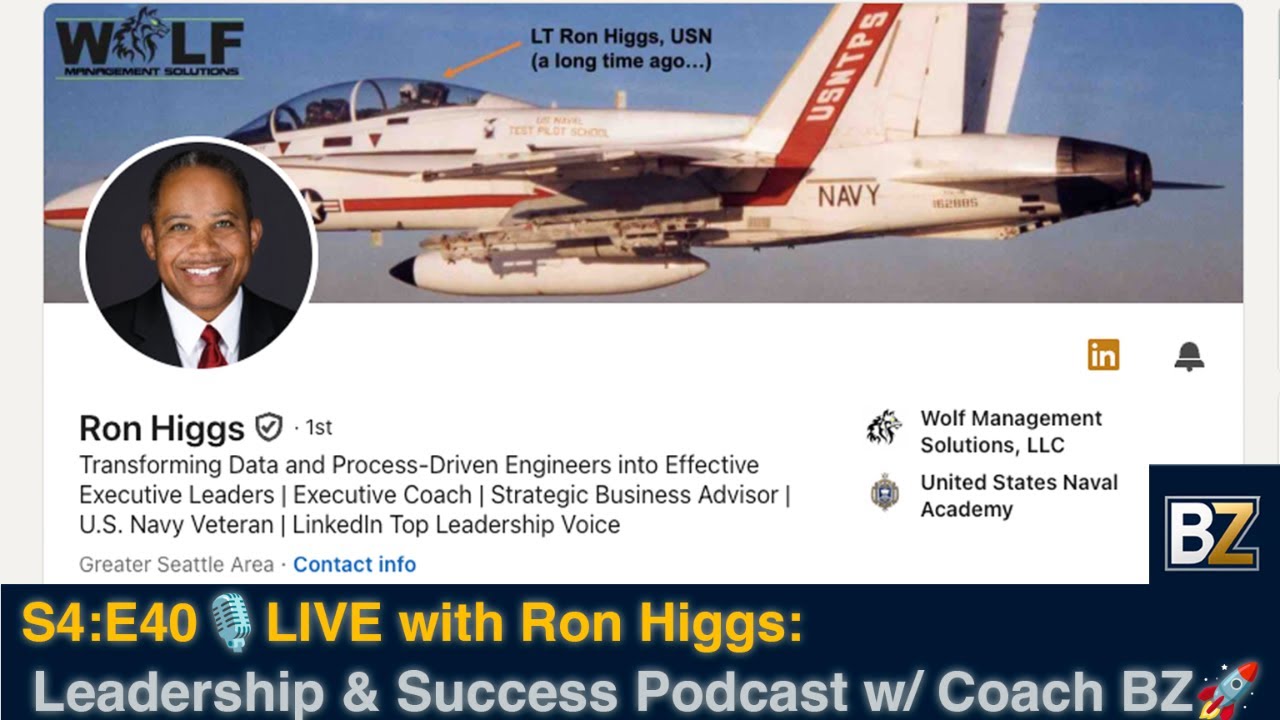
Coach BZ interviews retired Navy flight officer Ron Hicks about leadership lessons from military service. Hicks emphasizes mission clarity, core values like honor and courage, and the shift from technical expert to people leader. He shares stories of failure and after-action reviews as tools for growth.
Chapters
Hi, I'm John Maxwell. When the top companies in the world are looking for trainers, speakers, and coaches, there's one name that stands above the rest, and that's Maxwell Leadership. Our certified team members have gotten proven results for companies all over the globe, and our reputation, I'm proud to say, is second to none. Some of our members have risen to the top of their profession, including the one you're going to meet today. I proudly introduce you to my friend, Bob Fabien Zinga.
Welcome to the Leadership and Success Podcast with your host, Coach BZ. If you need to develop into a better leader, this podcast is for you. If you want to achieve a greater level of success, this podcast is for you. His mentor, Dr. John C. Maxwell, said it best: everything rises and falls on leadership. We hope to inspire you today and provide you with an insight that has the potential to positively impact the trajectory of your life. Welcome to the Leadership and Success Podcast.
Imagine gaining the leadership skills that could redefine your career. Join Coach BZ on the Leadership and Success Podcast, where each episode delivers practical insights from world-class speakers, military leaders, and industry experts. We dive deep into what matters most: building resilient teams, leading through uncertainty, and navigating complexity with clarity and confidence. Every conversation is crafted for aspiring leaders like you who are ready to grow, lead, and make a lasting impact. Don't miss our powerful live sessions and recent highlights. Michelle Hayward on building diverse, high-performing technical teams. Anne Leslie on leading through global complexity and cybersecurity risk. Ron Carpenter, AI, exploring faith, resilience, and AI-powered leadership. Colonel Michelle G.I. Gardner, INS, on commanding influence from the battlefield to the boardroom. Chris Robinson on shifting from drift to drive in life and leadership. And Coach Enrique Acosta Gonzalez on mentorship, legacy, and heart-centered leadership. Ready to level up your leadership journey? Tune in on Spotify, Apple, Audible Podcasts, YouTube Live, and LinkedIn Live. Join the movement toward leadership excellence. Listen now and start transforming your success.
Leadership isn't just about climbing the ladder. It's about transforming yourself and those around you. That's exactly what my next guest, Ron Higgs, is all about. Ron is a Navy veteran, former naval flight officer, and now an executive coach helping engineers become impactful leaders. From the cockpit to the boardroom, his journey is packed with lessons on emotional intelligence, strategic thinking, and leading with purpose. Join me live for Season 4, Episode 40 of the Leadership Success Podcast, Tuesday, July 29th, 11:00 AM Pacific, right here on LinkedIn. Drop your questions in the comments and be part of the conversation. Leadership Success Podcast with Coach BZ, where military precision meets executive excellence.
Have a plan, execute that plan, but be ready when things don't go according to plan, right? And so the more of those things you understand, if you understand the mission, you understand your priorities, right? You understand your plan. When things sort of go off the— or off the rails, you know, and if you understand that mission and you have those priorities, I think you can, you know, you can, you can work your way through it. And then in that book, I talked about how I kind of use— how I think like an aviator, both kind of in the business world and in my real life too, because there are a lot of people who get paralyzed when things don't go according to plan, right? And then if you If you go with the intent, it's like, something's going to go off the rails. I just need to be ready for it at any time. We spent a lot of time talking about emergencies.
All right, everyone, it is such a delight to be here today. I have a very, very special guest for you. That's none other than Ron Hicks, a Navy flight officer and executive coach. Wow! So Ron has walked the walk from the cockpit to the boardroom, and now he coaches high-performing engineers. That's people just like you to become emotionally intelligent strategic leaders. Now, with no further ado, let me bring to the Leadership and Success Podcast my friend, my brother from another mother, John Higgs. Hello, Commander Higgs.
How are you?
I am fantastic, Bizzy. Thank you for having me on the show. I'm really excited to chat with you.
Thank you. Thank you. There's so much that our audience today is going to be learning from your leadership journey. To get started, is there, uh, what is one thing about you that you think most people do not know?
Wow, you didn't tell me you're gonna ask me that. Um, one thing about me that people don't know, you know, I am, I'm a snowboarder. Love the snowboard.
Wow.
Picked it up in, um, I think I've been doing it now for almost 30 years. And so, wow, whenever I'm on a mountain, don't see very many people that look like me. But it is one of my favorite things to do. Love it.
That is awesome. Awesome. Good to know. So maybe to get started, can you tell us about your leadership journey?
Wow, where do I start? So I will tell you, you know, I'm a graduate of the Naval Academy. I went to Naval Academy Prep School first. Right. So it— leadership, like I want to say, was ingrained in my DNA since I was 17 years old. And as that, you know, what we were taught at the Naval Academy on to being a naval officer for all those years, retired from the Navy and immediately went out into the corporate world, a couple of different roles in the corporate world. Where leadership just came along. So I've been able to leadership from, you know, in the military, having been taught those principles at the Naval Academy, an institution that's been around since 1845, teach people to be leaders. And one of the things that I've noticed is that a lot of the leadership principles that come naturally to me as a military officer and other military officers aren't so common in the corporate world. And I am a student, a lifelong student of leadership. Anybody that thinks they have it wired, I don't think that's true. I learn something every day and I strive to learn more every day. And I'll leave you with this. I strive to be a better leader today than I was yesterday.
That is awesome. We're going to talk a little bit more about that. But before I do, for everyone listening to us, please let us know where you are joining us from. Please type it in the comment. And if you have a question for my guest, Commander Ron Hicks, US Navy retired, please type it in the comment as well. And then also, if this is adding value to you, or you think it might help someone you know in your network, please tag someone along so they can watch along with you. All right. So, Ron, leaving the Navy, I guess you started as a naval flight officer, and then you became an aerospace Engineering Duty Officer.
Yes.
What leadership lessons that you learned in your naval career that you are still applying today as you coach engineers to become better leaders? What do you think is the most important?
You know, there, there are so many, and a lot of them were, were in that clip that you showed in the beginning from the other podcast that I was on. I do believe in the Navy, we took an oath to support and defend the Constitution of the United States. That was our mission. And we were very clear on our mission. And sometimes, I don't find that to be the case for organizations.
True.
Throughout, no matter what the organization is, doesn't have to be a business and be a nonprofit, it could be anything, right? So first, you know, be clear on the mission. Every time I launched in an airplane and every time I took off, I could relate what I was doing to the accomplishment of that mission supporting and defending the Constitution of the United States.
Yes.
And so being aligned, I think, is very important in what the company does. There are some other lessons there, but I'll just kind of— you asked one, so I'll give you that. And really understanding the mission, I think, is very, very important.
That is so powerful and so true. For example, most people in corporate America, they have nice flyers on the wall about the core values, but nobody knows what those core values are. So Taylor, what are your Navy core values?
What the Navy core values were honor, courage, and commitment. So we all knew that, right?
Every single time I was an E-1 to now, and it doesn't matter, those core values are the same, and we know them inside out. But if you go Or you go to Microsoft, any other Fortune 500 company, you just ask an employee, hey, what are the core values of your organization? You're gonna get different answers and it doesn't match with what the company says their values are. Same thing with, with a mission. And I really believe the military, the Navy, but I think all of the other branches too, including the Army. So go Navy, beat Army. But we, we all really understand the mission of the organization and, uh, we are really a leadership organization. That's, that's really what, what I think. From the lowest rank, from even as an E-1, I— nobody reports to me, I don't know anyone, I salute everybody. But even at that level, the Navy is teaching me to become a leader and to take initiative. No, I mean, as an E-1, you don't take too much initiative, but no, within, within reason, at least trying to do something to accomplish the mission of your organization. And that's something that's very much lacking in corporate America today.
Wow.
So in what ways does your military training influence how you handle coaching challenges, especially with technical leaders, right? Engineers who struggle with people-centered leadership?
Well, I think in the culture of aviation, and I think it transcends aviation in general, we in the military subsist on feedback. We get feedback in everything that we do. And sometimes it wasn't so nice, if you remember. And also, one of the differences is that whenever we were assigned to a unit, we knew that we would be in that unit for a finite period of time, 2 years, 3 years, 4 years, however it's long, however long it is. And then when you walk into a unit, no matter what, you are being trained to replace someone.
Yes.
And after a little bit of time, you are now training someone to replace you. And in that, when you are given that feedback, you are very interested in having that person be the best that they can be. Why? Because we depend on each other for our lives.
Yes.
So if that person isn't as best that they can be, you know, it may cost them their life or cost you yours. So I think that culture of feedback— so for instance, in a flight in aviation, every flight had 3 components. There was a brief, you know, where you go out, talk about what you're going to do, the execution, they actually go out and do what it is, and you come back and you debrief every flight, even when it went well.
Yes, yes.
And those debriefs are really where the learning takes place, what made us stronger, which made us better. And I think that as military people, we crave the feedback because we know we make it better. So I look at feedback as a gift, you know, even if it's not so nice and intended. Um, you, you can't— sometimes you just have to tell people the truth and not really sugarcoat things. It's like, that didn't go well, and you know what, you did— could have cost somebody their lives. It was really dangerous, and we need to work on this, that's something you need to work on. So that, that culture of feedback, I think, is really one thing that's powerful that stayed with me throughout my career.
Absolutely. That's definitely the same for my Naval experience too, in the information warfare community. That is really, really key because I also think another big difference between the Navy and the corporate world is sometimes in corporations, people tend to compete, right? They are afraid if they give you too much feedback, you're going to get better than they are, and then you're going to get the promotion and they will not. Whereas in the Navy, like you say, sometimes it's a matter of life and death. Right. And we really, at a very early stage in our career, they teach us to lead with an open arm. Right. I'm only better if the person to my right and the person to my left is better. Even when I went to boot camp, it's like the first lesson I learned. You are responsible not just for yourself, but for the person to your right and to your left. If they mess up, you mess up, and the entire unit is going to pay for it. So if you're a struggler, everybody's going to come and help you out so that you can at least meet the standard. So no, we don't have to do so many push-ups and walk so, so many miles or run or whatever the case might be. So it's really ingrained at our cellular level. You have to help the person to your right, to your left. That is how we succeed. And those are really see in America. Please go ahead.
No, I, I just want to add, absolutely, because like I said, you go in that unit for a specified amount of time, and you're training someone to replace you, you're definitely going to replace that person one day. I am training that person to replace me and take my job. And it's not like, you know, sort of corporate America where you can stay stagnant, or somebody's worried about, you know, training somebody else and taking that person taking their job. I am counting on that, that person is definitely coming to take my job, and I want them to be the best that they can be at it. As I move on to take someone else's job.
True. No, that is, that is very, very powerful. So how you do executive coaching, what pattern do you consistently see with technical professionals, with engineers that hold them back, right, from stepping into the C-suite, of becoming more of a leader than a hands-on expert operator?
I think with engineers, importantly, uncertainty is a big thing. And I think it goes with everyone. There's this big fear of uncertainty. I want to be certain about the outcome. I want to be certain about this. And so as engineers— and I'm an engineer— and as engineers, we work on things. Everything's very logical. You know, you plug a formula in, a mathematical formula or anything, and you get the same answer. You program a machine to do something and the output is predictable. It's the same every time. Well, human beings don't work that way, right? And most of your interactions are with human beings. So, so what I find is that they're engineers. Our— a lot of our egos and well-being and everything else is wrapped up in our technical expertise and our skill. But when you take a leadership role, you have to shift your mindset to— from a technical mindset to serving people. Because most of what you do now that you've accepted the people management role are people-centered things and not the leadership thing. So maybe— or I'm sorry, not the technical And so maybe some fear on losing their technical edge, their technical proficiency, because now they're putting out all of these fires, all of this people stuff. You know, I've got all these meetings, I have a meeting with a finance person, a marketing person, this is keeping me from doing my engineering stuff, you know, and they feel they might lose the edge. At least that's what I'm seeing.
That is right on point. Actually, it was something I really had to learn myself, because when you are an individual contributor and you are very good at what you do. Usually that's how they select you to then become a manager, a leader, a director, or whatever. But then really making that switch where I am doing all of the work and I do it so well to now getting the work done through other people, right? So you are being more strategic, maybe even overseeing the operation, but all of the tactical stuff, really having your people do it. But like one of the hangups I used to have when I made that jump is I always felt like I did it much better than the people who reported to me. So why not just do it, right? I keep doing it because They're going to do it wrong anyway. But what I didn't realize is they need to do it wrong so they can learn to do it right. Because myself, when I first started, I didn't do it right. It took time. It took a lot of training and trial before I was able to perfect whatever I was doing. So I need to give somebody else a chance to do that too. So become more like a coach, a leader than the one doing the work for them. So having said that, do you have an example you might share of a before and after story of someone that you coach and mentor who was able to just hit the ball out of the park and kind of go through that transformation?
Well, well, let me add to your point first. So you're exactly right about that. A lot of us as engineers, like, hey, I know how to do this, why don't I just do it myself? Or you like the fact— a lot of engineers like the fact that the younger engineers and folks on their team will come to them for all of the answers. They're the answer person. It's like, hey, I'm— and they, they like that. However, then they start coming to you for everything, and you realize you're enabling. Yes. Right. And so what you need to do, just like you said, is answer with questions, questions that will help them figure it out themselves and become better engineers. So they're not dependent on you having the answers. Wouldn't it be nice for you to walk in every day and have everything done instead of telling people what they need to do and providing all the answers. So to answer your question, I just remember early in my career, not necessarily early, my first aerospace engineering duty officer job, I had a team of engineers. And there was one engineer in a leadership role who just came in one day and he goes, I just want to go back to being an engineer. I just don't want to do this anymore. I just want to be just an engineer, you know, I started asking him, well, why? Oh, it's just such a pain getting trying to get all these people motivated and give them all the answers. Keep giving, they keep coming to me for all the answers. I don't know why they're not doing it themselves. You know, these types of things. I don't want to sit in all of these meetings and, and things like that. So yeah, after working with them for a while, He— this was— it took a little while. I left to go on a 10-day vacation. And I left him in charge. And he— and actually having him agree to— yeah, I'm not sure, you know, he maybe had 49% of the vote. After having him agree to lead the team for 10 days while I was gone. Wow, that was a huge, huge step forward. And, you know, when I got back, what happened was fantastic. And you know how it is with the learning, right? We go over some things. It's like, hey, I put you in charge, I will take responsibility for any decision that you make. We go back and forth and go, well, that's about what I would have made in this situation. But I put you in charge, so I'll back you up. But here's the thing. As a leader, sometimes you screen people from things. And they're not aware of a lot of the variables that you're taking into account to make a decision because you're screening them from it because things they don't need to know things. So I'm like, well, now here's an— here's a variable that I would be considering that maybe you haven't, because these are one of the things that it's not your job, my job. Now, Now that you have this additional information, would you have made the same decision? So one or two, or I learned from them, which is great. Like, well, I made this decision because, because they're in the weeds and they're working. And I'm like, wow, I didn't know that. I just learned something from you. So now I'm a better leader because I learned something from you. So it's always a two-way communication. And I always learn something from those interactions.
And as I That is quite powerful. But really, if you are listening, you are a senior leader, you absolutely have to learn to delegate. There is no if and but about it. You just have to. I know it's not easy because if you are a leader and you cannot even go on vacation, if you go for a 10-day vacation like Commander Hicks did, and then everything just falls apart and the store burns down, then you are a bad leader. You are the worst leader ever. Because you need to be able to step out, step away, and have your people I have the confidence and the competency to carry the work forward. And again, in the Navy, sometimes they don't even tell you that explicitly. But in everything we do, the way our days are arranged and the things we do, it's really ingrained into us. That is what we want. That is what is acceptable. And that is what's going to give you great marks on your fitness report, not just being a great leader, taking care of yourself, but being able to take care of another team so they can step up and do the work. That's just Awesome. So what advice would you then give a junior engineer or mid-level manager right now who's brilliant technically but hesitant to lead others, just like the example you chose? What's the one piece of advice you would give them?
Well, well, first, um, don't try to do everything yourself, because that's the, that's the trap that I think a lot of folks fall into when they first get into a leadership role. Okay, I have to do everything myself. Again, we talked about this before, right? I have to have all the answers. I have to be the go-to person for everything. Well, not really. Right. And there's more than one way to do things right. You hinted about this before, right? There are— there's more than one way to get things done. Perhaps they don't do things exactly the way you would have done it. But if the end result is the same, then it's fine. You have to let go of that. And so just don't get sucked into that trap of having to do everything yourself. And the last thing I'll say is it does require a mindset shift. You really have to shift your mindset from being that tech, you know, from a technical focus to a people focus. Yeah, because as leaders, that's what we do most of what we do are the team dynamics and the people stuff.
That is right. Let me see if you've heard it throughout your Navy career. Mission first.
What's that now?
Mission first.
Absolutely.
And what you're supposed to say? Mission first. And what, what comes next?
That might have been after my time, man.
Okay. Okay. People always. Yeah, that's, that's—
sorry. Yes. Yes. People first. Mission first.
People.
Yeah.
When I— especially when I became a commanding officer, because in the Navy, it's much different than the other branches. Maybe it's because, you know, back in the days, our commanding officer would go just to see, and there is really no communication between whatever you're doing out there in the middle of nowhere and, uh, you know, headquarters back in Washington, D.C. So really, the leadership, the flags, they really trusted you to make the right decision, take care of the mission, take care of your people. It's not like you could go every 5 minutes, oh sir, did you mean this, and what, what do you think? No, this is what you need to do, these are the priority. Just go and execute, right? I think we have a name for that, help me out, command by negation. I think that is the right word. And I know in the Army they don't do that, that's not their culture, but in the Navy it is. And when you are a commanding officer in charge of a unit of a command, basically you are at the very top and that's it. There is nobody else really above you, so you make all of the decisions and I almost killed myself, first CEO, trying to do everything by myself. And then I realized, okay, wait a minute, I have department heads here, right? I have N1, N2, N3, N4, N5. So why don't they do their job? Why do I have to do their job? They need to do their jobs and I need to hold them accountable, but they need to do it. They need to take care of their people because it's so much easier for a department head to take care of 6, 10, 12 people than for me to take care of 100, 200 people. That's just too many. There is just no way I'm going to be able to sleep. So You have to have people that you trust who are competent, but you have to let them do their job. Of course, if they have questions or issues, they can always come to you, but you have to empower them to do their job. Even I know in the Navy, uh, CNO and ROR, they don't do it a lot, but I would give them permission to sign for me as the CEO in the area of their expertise or the area where I've designated them to lead. They could sign as the CEO. They had by designation signature. Almost every order you get in the Navy, the Admiral doesn't sign it. It's always someone that he designates under him. But again, lots of differences between the Navy and corporate world, but a lot of the lessons we learned really in the Navy, I think, would help corporate America so well. I don't know, anything you wanted to add about that?
No, I think you're 100% right with that. And you're just empowering people. And you'll be surprised that sort of once you let them go, what they what they do. I used to measure my success on how well my job got done when I wasn't around.
Wow, that is, that is beautiful. How well does your job get done when you are not around? And you are sometimes, you, you are really get amazed and surprised because again, you do have a standard, right? So whatever they do, they have to meet the standard or exceed it. But the way they go around it, uh, as a leader, I found that many of my folks would really blow my mind. Like, they would actually teach me other ways to do things, not just the way I've always been doing it, but that gets you there even quicker, faster, and better. I'm like, wow, that is just amazing. But you do need to empower them and trust them to get the job done. So another question I wanted to ask you then is, you emphasize emotional intelligence in leadership, and I don't know, does that come naturally to you? From my experience, when I joined the Navy 20 years ago, we were not very emotionally intelligent. I mean, it was like, I am the boss and you know it, and I tell you to jump and you say, how high is that kind of things, right? But I think in the last 20 years or so, there's been a lot of changes. Maybe some of it also due to the new generation of sailors. Like in my unit, about two-thirds of my folks were Gen Zs and they are a different breed of folks, right? When I went to boot camp, chief would be like 2 inches from my face and shouting at me, obscenity at times. And today when you say a curse word, you have to apologize, you hurt people's feelings, they need timeout and all of that. But anyway, I guess what I'm saying is the Navy is becoming more and more professional and emotional intelligence, I think, is having a higher level of priority in the way we lead people. And to me, I think it is much, much better and it's a lot more effective. I don't know what you think, but anyway, One of the questions I want to ask you is, how do you help technically-minded clients develop more self-awareness and empathy?
Well, one, in the military, I think, with the chief being 2 inches from your face and yelling at you, and some things not being politically correct, I guess, if you're being shot at in the military, and you can't handle anybody yelling at you, then when you get shot at, or when things are really stressful, then that's going to be a problem. So some of those things I, I think are okay, because ultimately, you're gonna get put under a lot of stress in wherever you are in the military, your life is going to be on the line. The airplane's on fire, and I have to put out the fire and land it. Ships, submarines, people on the ground have emergency, and then you're talking about combat if you're actually in a combat situation. So I think some of those prepare things prepare you for the stress of that. Now on to emotional intelligence. I think I started to understand more about that, as I ran into people who weren't good leaders.. And I realized how they made me feel like people— what I think I was— people were unfair. I was treated unfairly. I wasn't treated fairly. There's favoritism. There are other things I wasn't— there were some things I wasn't included in for whatever reason that we could probably do a whole show about that. So those things for me, I was like, I'm gonna start to be more in tune about how I make people feel. And I don't want to make anybody feel like that person just made me feel. So unfortunately, you and I probably in the Navy have learned more from bad leaders and bad examples than we have from the good ones. And the good ones really stand out, unfortunately, because they were so few and far between. But I think— I want to say 51% of what I learned about leadership were from people who were bad examples. And I do remember this, even if you're in a situation where you just don't have a good leader or a good boss or whatever the case may be, remember it, learn those lessons so that you won't repeat them because those people were at least good enough to serve as bad examples for you forever. So I just remember going, thinking to myself at some point, well, what would my, you know, one of my first commanding officers, What would this guy have done? Well, I said, I will do the opposite.
Yes.
Wow.
No.
So that's really what got me in tune to emotional intelligence. So now, I learned something from, from a CEO that I had when I was working for a startup. And he said, attitude has momentum.
Hmm, say that again.
Attitude has momentum.
Wow.
And if you remember that, and you also remember that a lot of us in social situations, whether we're sitting down to dinner with our family during the holidays, or we're out with friends during happy hour, a lot of the subject comes around work. How many stories and stories have you heard about people telling horror stories about in the workplace about their boss, about their knucklehead boss that does or did something like that? Well, guess what? When you take on a leadership role, you are that boss, and those people are talking about you. So are they going to say good things or bad things?
That's up to you. Wow. No, that is, that is quite powerful. Now, I guess I am lucky, but most of my Navy experience has been very, very positive. I've met some of the best leaders ever, some that I would follow to the end of the earth, just because of the way They let us know how much they really cared about us, the person, not just the mission, but us as individuals as well. And especially women. I think women CEOs have been the best in my career.
We didn't have enough of those during my time.
Life-changing. Okay. And yeah, again, it could be different for different people, especially depending on the community you belong to. I'm not going to say anything bad about the surface warfare community, but I've heard that they tend to eat their youngs over there. But in the IP community, in the information warfare community, we take care of our babies, right? We love on them and we help them. And, and, uh, uh, but, but that's not the way some community in, in the Navy do for whatever reason. But, but yeah, so I can, I can see that. But no, no matter what, I like what you say. If it's bad leadership, make a mental note. This is what you never do when I get the chance or the opportunity to become a—
Well, take the opportunity to learn from it because I hear people just complain about being in those situations. And rather than complain, I mean, there's not much you can do. So just learn as much as you can from it.
That's right. That's right. Wow. That is powerful. Okay. It is that time now to flip over to the second half of the show where I'm going to be focusing on leadership. So I'm going to be asking you 7 types of questions that I ask every guest. Before we do that, is there Anything you'd like to say?
No, thank you again for having me. I really appreciate it. I appreciate the conversation, the connection we have about the Navy. I've been on a few podcasts, uh, none with a fellow naval officer, so it's, uh, it's good to, to be able to talk about some of these things. That is, and how our respective experiences in the Navy have shaped the way we think about things.
Definitely some— one of the best decisions I have ever made, uh, joining service. I guess, uh, JFK, our former president, said the same thing about just, uh, for life spent in service. But okay, so the first segment of the second half, we've already talked about some of the leadership advice you have received, those that you, you would give. But let me ask you this: what do you think is the secret of your success? Because if I understand correctly, uh, you went through the Naval Academy and you retired as a lieutenant commander, which is Pretty awesome. And then you got into civilian work, and now you have your own consulting firm. What do you think makes you so successful?
Curiosity and love of learning. I think a combination of both. As someone who's 17 years old, boom, right? The Naval Academy prep school, Naval Academy, and then a career in the military. I mean, I was 41 years old before I had a job in corporate America. And so there's that innate curiosity about when I got to corporate America, well, how do things work here? How do people like startups? How do people start businesses, nonprofits? How does that work? So there's all sorts of curiosities I had about different things. And I stayed in aerospace and defense after I got out because it was safe. And then I got to the point, like, if I stay here much longer, I won't be— I'll be too old to really go anyplace else and do anything else. So I'm going to just leave. And I, I left abruptly without a good plan. So I almost, you know, built my parachute, you know, jumped out of the plane and built my parachute on the way down. And my curiosity about startups landed me in a couple of startups. My— then I have to make some money. Let me do some consulting. What is the common thing in everything that I've done? Oh, leadership. And I am not afraid to talk to people, to ask for advice, to do those things. I got a job as a COO of a company through pure luck and networking. I wasn't looking for it. But I fell into it. And And I was successful at it until COVID hit. I got laid off. Longer story than that. But it was— and a lot of us during COVID had to sort of reinvent ourselves. And so I did some fractional COO work for a while. I've always loved coaching. And I've always loved leadership. So at one point, it's like, I think I just want to do this full time. How can I separate myself from the other coaches are out there? Wait, I have— I'm an engineer. I've led teams of engineers. I had some challenges moving into a leadership role as an engineer. I've helped other engineers throughout my career make their— successfully make their transition from individual contributor to people manager. So that's what I— that's what I think I'll focus on from here on out. So that is my, you know, my path. So again, the willingness to learn and my curiosity about other things. And the consulting, I really like finding out about other— I spent so much time in the military and aerospace and defense, I really like the opportunity to learn about other industries. Like one of my first jobs, one of my first consulting jobs was consulting for a microbrewery. And I am a beer enthusiast. And I know about, you know, craft beer, and, and I ended up finding a consulting gig with a brewery. So I got to do a lot of different things. And that love of learning and curiosity is what got me there.
Let's talk a little bit more about that. Because I think that's very fascinating, especially for junior officers who might be listening, or maybe a junior cybersecurity engineer or something. When you network, kind of what are the benefit of being curious and really making those connections. Let's, let's talk about, about that a little bit. What, what would you advise an aspiring leader about the importance of really making human connection even outside of your organization or your field?
Funny. So one of the things I do in my coaching is emphasize the fact that your ability to build relationships is probably one of the most important skills you can have.
Why?
In terms of leadership, every human being is motivated by different things. You have no idea what motivates that person until you actually create a relationship with them. Right? So that, again, is learning how to create relationships. And I think the key is genuine curiosity about other human beings. We all have stories, we all have those experiences. I guarantee you every conversation I've had with any human being has ended in a, wow, that story is great, whatever their story is, or something that they've done, something they've achieved, something that they've worked through, something that they've beat, things like that. But it has to be a genuine curiosity. And I'll tell you a quick story. I had someone who worked for me, who I had worked with at some point, then that person ended up working for me, didn't necessarily get along well with that person, sort of tolerated each other and worked. When that person came to work for me, I took the time to get to know that person. And it completely changed my perspective because of listening to the story, listening to that they've been through. And I'll, I'll leave you with this. Everyone you meet is fighting a battle that you know nothing about.
That's true. That is true.
Approach it with that mindset, in terms of leadership and genuine curiosity about them. I think that that's the key to networking and getting to know people. And even with all of these networking events and things like that, you don't have to go around and meet everybody in the room. You know, one good relationship is better than, you know, a handful or 10 superficial relationships.
That's powerful because that could definitely change your life or an amazing opportunity could come out of it. But yeah, when you talk about really truly caring, everybody has met, you know, the boss who's like, hey, how are you doing? How was your weekend? Okay, whatever, go back to work. I mean, this is, it's like they don't care about what you say. You could have even almost died on the weekend. They absolutely don't care. You are here, you have to work. This is what we need to do. But then you see those uncommon leaders. I can— my Navy experience, quite a few of them, especially the women who led me, where they really, really truly care about you and they make you want to go like 110%. I know, yeah, no, you are an engineer, it's not mathematically possible, but that's really the way you feel. You know, you, you would almost go to hell and back for leaders like that, people who really care. Like my mentor John Maxwell says, right, I have great value, I value people, and I want to add value to people. And People know now if you really mean it or if you are just using some psychological trick or something to try to get them, to manipulate them to do something. Anyway, so what are you learning right now?
Well, just like everyone, right? AI, right? We're all looking at AI like, how can I use this? How can it help me? And every day, I think I— we all do, maybe— think of a new use for it. Think of what's overwhelming is the number of tools that are available now and the number of tools that are coming out at almost an exponential rate. And just when you find one, you're like, this is awesome, I love this, I'm gonna pay for it. You know, like a week later something else comes out that's better.
True.
It's like, man, I just paid for this other thing and now this is the So now I am— there is so much to learn there. And that's where I focus in some of my efforts on learning more about that, the tools that are available and the tools that can help me do my job better.
That is, that is wonderful. Always, I think that curiosity and love, love of learning, it will take you a long way. Now, we know that it's not especially in in the Navy, and I know some mistakes that we could make could be fatal, like people could actually die. But I've really enjoyed the CEOs who allowed me to make mistakes, learning from my failures, really, really learning from them so I don't repeat those ever again. But they gave me room, right, to be human and make mistakes and learn when the stakes weren't so so high. So having said all of that, I know with all of the successes you've had, you've had to go through periods of failure as well. I know in my own personal life I failed more than I have succeeded, and that's why I've attained the level of success I've been able to attain so far. So I guess my question for you is, uh, how has failure shaped your life?
Well, I think it makes you do— maybe changes your mindset and perspective about things. So, so for me, this self-employment experiment, I call it, working on— yeah, it's been up and down. There are things, times when it's been great, and times where I've been ready to throw in the towel and, and, and go work for somebody else again. It's like, no, I'm going to stick with it. So one, it sort of tells you what you're, what you're capable of. No, I'm going to stick with this. I'm going to stick it out. And it changes some perspectives. And you can sort of really see what you're made of. But I think, you know, you start thinking about some changes that, that you make and innovating, thinking in ways that you haven't really thought before, seeking out the help of, help of others. And one of the things that really kept, keeps me going is accountability partners, colleagues, accountability partners, people who, who lift you up and you help each other through all of these times. They keep you accountable, but also keep you, keep you headed in the right direction. So I think everyone needs to—
I—
do you know anyone that hasn't failed at something?
No.
And depending on what it is, I mean, sometimes it's like, well, maybe this isn't for me. Yeah, so it'll— maybe the universe is setting you on a, on a path that you should be on instead of the one that you think you want to be on.
Yeah, actually yesterday I wrote an article about embracing criticism. I like a quote by Aristotle that made me laugh. Basically says it's very easy to never be criticized. Just don't do anything and, uh, don't lead anyone and, uh, just keep your mouth shut and just do nothing and you will never be criticized. I guess that's, that's an option for some people, but for me that's not an option, right? I have to go out there, I have to try. So then I just need to learn how to deal with whatever life brings your way. So that's, that's very, very—
let me throw this out there. So you know that I think it was Nelson Mandela, right? He says, I never lose, I either win or I learn, right? So again, with the learning, right? So at some point, even the failure, you're going to learn something.
That's right.
That will, that will help you with the next iteration, whether you're going to try it again or change That is so powerful.
Yeah, John Maxwell has a book too, Sometimes You Win and Sometimes You Learn. Definitely, if you can go through those moments of failure and really learn why it happened, what you could have done different, that could really have a profound effect on the trajectory of your life. And I know in the Navy, we do it all the time now after action report, every time we have an exercise, every time there is an incident, like you say, every flight, you cannot have everything, you do the execution,. But then there is the after-action report. What did we do right? What did we do wrong? That's how an organization learns.
And, uh, even if it all went well, even if things went great, right, we still, still go through that debrief.
Oh my goodness, we are running out of time. We having too much fun. Okay, let me, let me go on. Uh, I could talk to you for hours. Okay, fourth, uh, segment of, of the second half. I'm going to ask you, um, what are some of your thought leaders, people that you are following right now that we should follow, or you are listening to?
I'm a big pro— you know, we're on LinkedIn, right? LinkedIn is, is my channel. It's where I spend most of my time. Um, Bridget Hyacinth, if you know, she— everything she posts is gold.
Um, I think, I think she's, she's on the island, I believe, right?
I believe so, yes.
I mean, she always talks about leadership.
She has millions of followers.
Yes.
Alex Hormozi, Chris Donnelly, Travis Bradbury, Corey Dunham. And there's—
fantastic. Well, that's pretty cool. After the podcast, let's make sure to add their name on the event for this episode. I want people to know them and to follow those because I'm sure there are some folks I left out.
But those are the ones that I wrote down. Really quickly, but those— that's wonderful. John Lee Dumas, he does that. And I know you're going to ask me this, but the podcast—
I think you mentioned now Reed Milner too, right?
Yeah, Reed and the Grow Road podcast, another good podcast. Entrepreneurs on Fire, John Lee Dumas, that is probably my favorite.
Entrepreneurs on Fire, I believe it's this one here. Okay, fantastic. All right, so if you could choose 3 people to have dinner with Who would you choose and why? They could be alive, dead, or even mythical figures.
Now see, this question, this question always, every time I get asked this question, you're not gonna like my answer, or maybe not, right? Honestly, if I had that kind of power, I would not waste my time with anybody that's considered famous.
Right?
Okay. I mean, I would go with my dad and my two grandfathers. Oh, have all of us be the same age, like 30 years old. Or something like that, right? Because that's what I care about, and those are the people that I want to talk to, right? Because we have never— you've never been able to talk to your elders as equals, right? Another— I would love to, to my 30-year-old self, to talk to my grandfather's 30-year-old self and my father's 30-year-old self, right? So those things I have never considered. Um, you know, when people ask me that, I'm like, you know, there's just I haven't considered— I don't want to talk to Napoleon. I don't want to talk to my grandfather. I want to talk to my father, great-grandfather, maybe, right? Or someone else, right? And maybe, maybe someone in my ancestry that was a slave, and to let them see where I am now.
Wow.
And what's— what their future looks like. So, wow, different answer than you probably expected.
That is, that is very, very, very very powerful. I really appreciate that because I can tell you, you are definitely the wildest dream of your slave ancestors. If only they knew. But it's just because I was really lucky. I did talk to my father quite a lot before he passed away. Actually, he gave me part of our genealogical tree and which I am working on. We started with like 12 people and I have more than 200 people and I'm still building this kind of part of his legacy. And me being originally from Africa, in Africa we say when an old person dies, like an entire library that dies because unfortunately we didn't have the written history like we do in the Western world. Most of our history is oral, right? And when those people who know die, nobody else knows. Storytelling.
Pass along, I think, through stories.
Yeah, absolutely. And if your parents or grandparents are still alive and you're listening to this, definitely spend some time with them and try to really get wisdom out of, out of their life. It's really, really priceless. I really love that. Okay, what are some of the books you would recommend to my audience?
So I, I think, um, the, the big one, and especially in my— I wish I would have read it before business—
it's called The Go-Giver by Bob Burg, and it shaped my, uh, this one, I believe. Yeah, yeah.
I mean, that shaped my approach to consulting and the service that I I get it. So for you, for those of us that are doing what we do, I think those of us that joined the military are value, value service above self, right, contributing to a greater cause. And like you mentioned before, I have add value to other people and to make a difference in people's lives. And the, that book captured a lot of it. The second one you saw there, Invisible Ink, You know what that book does? And it's probably an odd choice. But I think all of us need to learn how to tell stories better. And engineers too, you know, especially technical people, learn how to tell a story, tell a story that's going to capture people. And that book, Invisible Ink, is all about how to tell stories and story structure. And I learned a lot from that. Next one there, The Big Leap by Gay Hendricks. I really liked that book. One of the things the book does is talks about you operating in your zone of genius. And it put the things you do into 4 categories, sort of a zone of genius, a zone of excellence, a zone of competence, and a zone of incompetence. And you obviously shouldn't be doing the things that are in your zone of incompetence, and you want to do things that are in your zone of genius as much as you can. One of the things I got out of that is that the zone of genius is where you naturally operate and what you're good at. Some of us are good at so many things, or good at things naturally, we don't know we're good at it because it comes so naturally. So the best thing to do is ask other people what you're good at, those around you and your colleagues, and they will point you, help you get to your zone of genius. Finally, The Winner's Mindset there, that's the book that I was— we had 33 authors in that book. My chapter is chapter 12. And it's called A Mindset Shaped by Naval Aviation. And I also post on LinkedIn every Tuesday. So the one came out today called Leadership Lessons from Aviation. And I am— one day you may see an entire book by me, wonderful lessons from aviation.
So for podcasts, we already talked about Entrepreneurs on Fires. I believe you also mentioned this one.
Yes, Masters of Scale. And again, if you, if you like learning about startups and how people take these startups and the ideas and just make great companies, that is a great podcast. And there's an episode, I think it was Reed Hastings, I think the Airbnb guys where they talk about how they started Airbnb. It was, it's just a great story to listen to. And I talked to Steve here, Doing Business with a Servant's Heart. Servant's Heart, that is just a great podcast. It's very human-centered, very, you know, just genuine interest in serving others. And then Scott Ritzheimer there, he does a great podcast. That's a good one for coaches and anybody anybody else, others learning about how to grow businesses, how to scale businesses. And a lot.
Fantastic. What about any movies you would recommend?
You know, I am a— yeah, I'm a science fiction guy, so I like Star Trek, Star Wars, you know, most of them. I think—
have you noticed that a lot of the science fiction is becoming reality more and more? These days.
You're right about that.
Right?
That's crazy.
Okay, what about those things? But yeah, you know, that song, funny that, you know, I don't necessarily associate music with life, but that one, you know, the chorus in that song is like, you got to be bold, you got to be strong, you got to be stronger, you got to be wiser. You know, that whole thing, you know, resonates. And it resonated at the time, especially when the things that you're doing You know, it's like, I gotta, I gotta make it through this. And that song was, uh, I think that encapsulates a lot of the things that we learned. And in general, you know, I, I love reggae music. Reggae music, it just almost makes you feel like you're on vacation. I mean, I can give you a bad mood. Yes, just gives these images of, uh, sitting on the beach with, uh—
No, that is powerful because I, I am a musician. Pretty much I can tell you every important milestone in my life, there was a song, there was a music, there was a sound that really helped me kind of get through it. It's very, very powerful. But like, if I could ask you, where were you on September 11th, 2001? That's really the day I believe that really marked my generation before COVID Of course, I know exactly where I was, what I was doing, and the music I was listening on that day. But Anyway, okay, we are technically out of time. Can you give me 5 more minutes? We almost have to go. Thank you so much. Okay, really quick. Actually, this is a pretty serious question. My question is, if you had one and only one day to live, what would you have like your final contribution to be?
Wow, I never thought about that. And you talk about because if that was the case, again, I would just love to spend that time with the people I love the most. And so, you know, in terms of contributions, you know, I would just want to be there with those people and making their last memories of me be good ones. So, you know, I hadn't thought about, hey, what am I going to leave? You know, I just want to, you know, leave a place better than I found it.
Right.
So that's in general, that's what we try to do. And you probably did it too, as a naval officer, you know, you go into, you get assigned some job. And it's like, I want to leave this, whatever this is, this organization better than it was when I started. Powerful.
Okay, we've come all the way to the end. The final question, the seventh one I ask everyone who's a guest on the podcast is, how can we add value back to you? How can we make a difference? You've been so generous with your time. We really do appreciate sharing your knowledge and experience. How can we help you out?
Well, I'm an exec— I'm a self-employed executive coach, and I earn my living with clients. So I could always use more clients, more work. My website is wolfmanagementsolutions.com. I spend a lot of time on LinkedIn. Again, I'm focused on transforming data and process-driven engineers into effective executive leaders. If you know of any engineers who are in leadership roles that may need a little help or executive coaching, love to do that. I also coach executive teams, the team as a whole, especially when the team as a whole is maybe in conflict, a couple of people in conflict, conflict that is impacting the business. And I can help coach the team as a whole and manage— help them manage that conflict and move the business forward. Again, LinkedIn, more LinkedIn followers, please connect with me. Like, comment on some of my posts. I love adding value to other people. And I'd love to ensure that, that content that I am bringing and the things that I am posting are valuable and impactful. So tell me what you want, tell me what you might want to hear more about, those types of things.
Wonderful. Now, uh, I'm looking, we had a member from Twitch. Of course, on Twitch they don't use their real name, but this, uh, uh, use Betrayed2MaxSXY1 is, is when the name he uses. Anyway, it's just saying hello from there. And then we have someone, Randy Gustafson from LinkedIn, who says, great job, gentlemen.
And speaking—
I know that guy.
All right. So that is great. So now we are at the very end. One thing I would ask you is if you could go back and give a piece of advice to your 17-year-old self standing at the edge of this incredible career you've had, what would you say?
I like to tell people this, and I probably tell my own— myself this: be open. And that's general, like, be open to other ideas, other perspectives. Listen more to other people, take the opportunity to learn more from other people than you have. There are things that my father and grandfather were trying to teach me that maybe I didn't listen to. And so maybe I'd knock myself on the head and say, listen, listen more to what they were trying to tell you.
All right. Thank you. And we have 2 minutes left, and this is the very, very end. Really quickly, 3 adjectives that describe you as a child. Don't think too much. Just 3 adjectives as a child.
Oh man. So curious was one, you know, learner was one. 2. And one more. What is— remember that old word rambunctious?
Rambunctious.
Okay.
What about as an adult? I think 2 of them will come back as an adult. 3 adjectives.
Yeah. Curious is still there. Rambunctious is not. Do you know what I mean? Curious, a lot more patient. And, you know, I'm not sure how I can demonstrate, like, values is our own values.
Right.
And so that value of service above self, wanting to give, wanting to make a difference in lives and adding value to other people. Probably not one word, but those are things that describe me. Service, I believe.
One more. So we have curious, we have service, one more learner.
Oh, for sure. Avid learner.
I thought so, knowing you. I thought so. Okay, then the very, very, very last one. This is the last one. First, do you have anything else you would like to say before we end the podcast?
No, thank you. I appreciate your support, having me on the show. It's been a great conversation, and maybe we can circle back around another time and revisit.
Especially when you publish your next book out of all of the leadership stuff you are writing. Because believe it or not, since May, I think every single day I write a leadership devotion and I do this podcast, but I'm having so many ideas. I think I know exactly what my next book is going to be. So the very, very last question. I don't see anything on LinkedIn or YouTube or Twitch. So the very, very last one you're going to answer today. What is one word that represents our shared experience on this podcast today? Just one word that comes to mind.
For me, it was exciting, exciting to share the whole thing with you. Again, our shared Navy background made this exciting. And I'm always excited to share my experiences with everyone. So yeah, it's been exciting. It's been great.
So for me, it will be open mind. And thank you so much. It's always great to talk about the Navy. Oh, yeah. All right. Okay. Thank you. Thank you so much, Ron. I really appreciate that. So for everyone, please purchase Ron's book. I think I have a picture right here, Winner's Mindset. So that's a very important book to have. And also please follow Ron on LinkedIn, right, which is my favorite social media network. Right here, Ron Hicks, and his LinkedIn address, I think I added here earlier. Which is LinkedIn. It's Ron-Iggs. So follow him, and, uh, if you are connected with him, please endorse his skills, send recommendation, and send potential clients his way. He's one of the best coaches ever, because when you are a naval officer, I believe your number one, number two, number three jobs is leadership, right? I believe leadership is to the Navy, like my, uh, sea daddy told me when I became an officer, leadership is to the Navy what location is to real estate. Okay, thank you, thank you so much. I really appreciate all of you, and today is a special day because I'm gonna be back today at 2 o'clock. I'm going to be interviewing my friend Matthew Rosenskris, one of the premier CISOs in America, really the world today. He just got selected as an ambassador for Thinkers360 for cybersecurity. Great, great guy. We're gonna have a lot of great conversation about cybersecurity and leadership. You don't wanna miss it. So that's gonna be 2 PM my time, 5 PM Eastern time. So, I don't see any other question. So until later today, and I'll be back again tomorrow, Tomorrow, have a wonderful day, and thank you so much for allowing us, um, to be a part of your journey. Bye for now.
Thank you for listening to the Leadership and Success Podcast with your host, Coach BZ. If you like what you heard, please subscribe to our channels and come back for more wisdom nuggets on how you may develop into a better leader and achieve greater levels of success. Leadership is the most critical skill. The world will always always need leaders to lead others, deploy the next disruptive technology, or execute a business strategy. You may as well decide on counting yourself among the 21st century leaders. See you right here next time on the Leadership and Success Podcast with Coach BZ.
More from Bob

S250:E4🎙️LIVE 🇺🇸America 250: President Barack Obama Leadership, Service, and the Power of Hope






S5:E157🎙️ LIVE with CMD CMSgt Dennis L. Fritz, USAF (Ret.)(Multi Tracks Audio)



S5:E156🎙️ LIVE 🇪🇸 Leadership Lessons from the FIFA World Cup 2026 Champions (Multi Tracks Audio)

S250:E3🎙️ LIVE Leadership Lessons from America’s First Documented Family of African Descent 🇺🇸📖