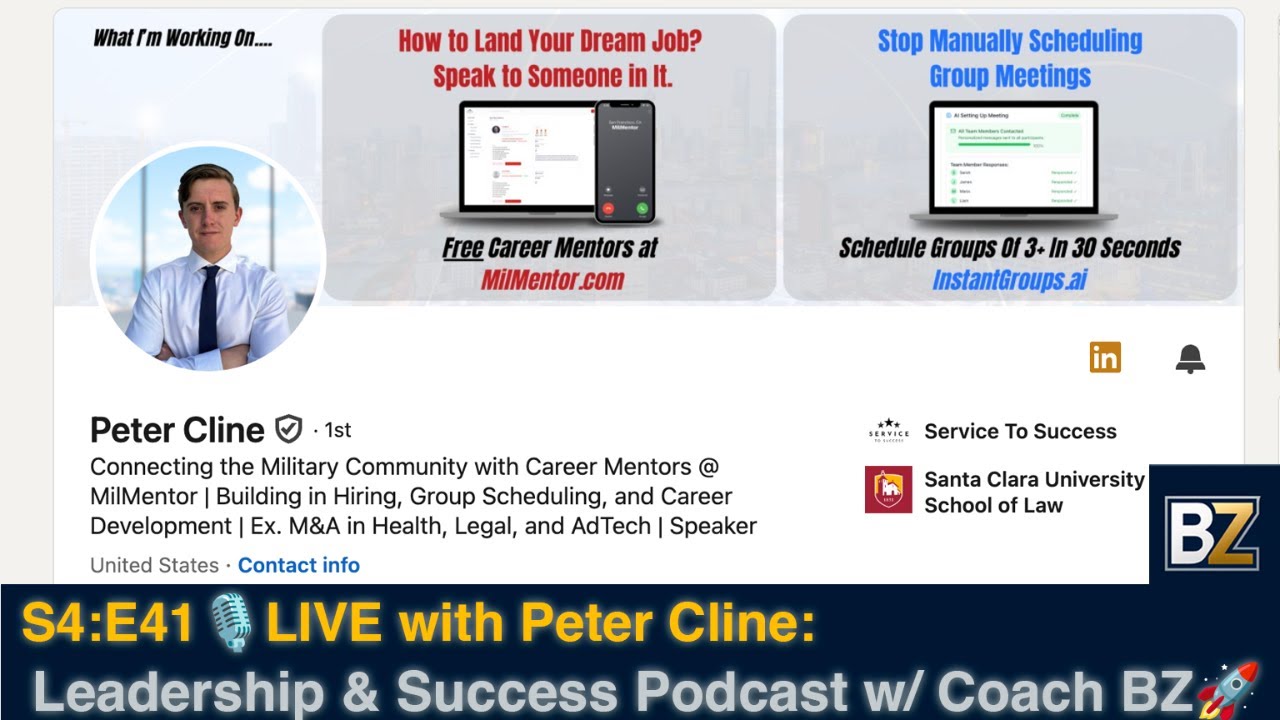
Coach BZ interviews Peter Klein, an Army veteran who founded Boots to Books, Mill Mentor, and InstantGroups.ai. Klein discusses how military leadership shaped his approach to delegation and trust, why Mill Mentor connects military job seekers with civilian mentors, and how he learned from failure across multiple ventures.
Chapters
Hi, I'm John Maxwell. When the top companies in the world are looking for trainers, speakers, and coaches, there's one name that stands above the rest, and that's Maxwell Leadership. Our certified team members have gotten proven results for companies all over the globe, and our reputation, I'm proud to say, is second to none. Some of our members have risen to the top of their profession, including the one you're going to meet today. I proudly introduce you to my friend, Bob Fabien Zinga.
Welcome to the Leadership and Success Podcast with your host, Coach BZ. If you need to develop into a better leader, this podcast is for you. If you want to achieve a greater level of success, this podcast is for you. His mentor, Dr. John C. Maxwell, said it best: everything rises and falls on leadership. We hope to inspire you today and provide you with an insight that has the potential to positively impact the trajectory of your life. Welcome to the Leadership and Success Podcast. All right everyone, this is, uh, Coach Bizzy. Thank you so much for being with us today. We really do appreciate this. I have a very special guest with you today. Today we're gonna be talking about Peter Klein. We're gonna be talking with him. So he's the founder of Boots to Books, Service to Success, Mill Mentor, and InstantGroups.ai. This is very exciting. If you are a veteran, you definitely need to be here. And his journey from enlisted infantryman to serial founder is nothing short of extraordinary. But also if you are in the industry and you love the military and you'd like to give sailors, airmen, Marines a chance, you need to listen to us. So without any further ado, let me bring Peter Klein. Can you hear me, Peter? How are you doing today? Perfect.
Thanks so much for having me.
Absolutely. We are so pleased to have you here. What an honor and privilege it is. Just to get started, can you tell us what's one thing about you that most people may not know?
Oh gosh, that's a good one. Maybe a good one is that when I went to join the military and, you know, took the various tests, I spoke with the recruiter and he really wanted me to be, you know, a Patriot missile technician or do some kind of hard-to-fill role that they had been struggling to find. And I, you know, in hindsight, a little stupidly, but I'm happy I made this decision, chose the infantry. And it was, you know, for those who are not military related who may listen, that one you typically need the lowest test scores to qualify for. But it's the most fun in my opinion. And it was a good decision in hindsight.
Wow, that is wonderful. Definitely on the opposite, because after 9/11, I tried to join the military, any branch really. So I talked to the Army, to the Marines, the Air Force, and the Navy. Very, very quickly I found out, hmm, Army and Marines, that's not for me because you have to use a lot of muscles and that's not who I am. I can use my brain though. So I was like, okay, Air Force and Navy, I definitely would fit in. I ended up with Navy. Again, I never looked back at the decision, but that's really wonderful. Definitely need more people like you. So that's wonderful. Can you tell us about your leadership journey?
Yeah, yeah, definitely. So I, you know, I joined the military directly after high school as an infantryman. And so it didn't start for a while. You know, I started as a private and then worked my way up and eventually became a team leader when I was a specialist about a year and a half into my time in the military. And was later promoted to Sergeant and continued from there. But that was really the first taste of leadership I had was military leadership, which, which is significantly different than civilian leadership, though it does have a lot that carries over. And it was great. I mean, I was young, you know, 19 years old and leading a team of people, many of which were older than me from different places and, you know, ways of life. And so, yes. It was definitely a masterclass in kind of understanding where other folks are coming from and trying to make everyone happy while also motivating them to achieve whatever the, you know, the goal you have is. And so got out of the service in 2020 and short after started a nonprofit based on help I had gotten from a friend named Aubrey Sine. The nonprofit is called Boots to Books, and that has grown over the last 5 years pretty significantly to the point where, you know, we've grown a small team, we've hired folks for projects. Uh, and after that I've worked in several other roles and now started a few other ventures to where I've gotten to use a lot of the things I learned in the military, uh, and then further refined and developed as a professional on the outside of the military, uh, a lot in entrepreneurship.
Wow, that is pretty amazing. Scholarship, Job Seeker Prep event, and more opportunities for the military community. I think you are one of the same go— single person that does so much for the military even after you left the Army so long ago. That's really, really, really impressive. Can you tell us about some of the, um, leadership lessons you've, you've learned as an enlisted infantryman? Especially, I think that's a very big deal, I believe you won the Fort Benning NCO of the year competition, right? Non-commissioned officer.
Yeah, yeah, I did. And that, you know, it was more of a competition of who can be abused by the Ranger training battalion, you know, for the longest and, and kind of put up with it and I had a 5+ year age advantage on my competitors. And so that was a shoo-in to win from the start. But I think a lot of the lessons did carry over, especially, you know, by joining as a private at the lowest level of the infantry and that, you know, people are inevitably going to talk about you as a leader and they'll either talk about you as the person they absolutely hate or, you know, think is a little crazy, but you kind of are inspired by. And yes. Rarely that much in between. And so, you know, what do the people look like that are on either side of the spectrum? And I think the ones who are on the inspiring and crazy side are usually the ones who are extremely enthusiastic about the work they're doing. They're very knowledgeable. And every single time there's a task to be done, or, you know, soldiers in this case, or in the private sector, employees are being sent to do something that's objectively not fun. You should be there too. Yeah. And that usually defines the good ones. And then the bad ones are, you know, setting unrealistic standards, don't really understand how to do the work themselves and come down extremely hard on their employees at the wrong time or team members. And all that I think is just emphasized in the military because it puts people in leadership positions really quickly. And so you see a lot of bad leaders, a lot of them, and you see a lot of good ones, you know, people who are naturally inclined to lead. And so, yeah, that split is highlighted really well for you. And so I think for those who can do some self-reflection, cuz they'll mess up as, as young leaders, but also take a step back and look at the broad spread of leaders that they're among and who's performing well and why, it, it's really informative.
Well, that, that's very interesting. Just, just like you, when I joined the Navy 20 years ago, I was a seaman recruit, right? E-1, just like a private in the Army, but pretty much saluted everything and everyone I saw back then. But my experience with you as far as leadership is a little bit different in the service. Would you say that you had more of the good, great, outstanding leaders, or your experience was mostly those people who really shouldn't be leading? Okay. Because the other thing I have found in the Navy is eventually we have a system, a way to get rid of those bad leaders pretty quickly. So if you are not a good leader, you're not gonna stay in command for a long time. Pretty much your days are numbered. At least that has been my experience. I must say, for the 20 years I've been in the Navy, maybe only 2 or maybe 3 bad leaders I've met, but all of the other dozen and dozen and dozen of leaders I've had have been absolutely outstanding. Some of them I would definitely follow to the end of the earth just because of the way they led and the way they Made us feel. So how has your military experience shaped the way you lead now and build so many companies?
Yeah, yeah. I mean, you know, some of the, the companies are very much in progress, like Instant Groups. Um, but I mean, I think it, uh, one, affected my work ethic, which I think is— your actions speak a lot louder than, than anything else. I mean, you should not like speak poorly to people, but you know, what you do is, is going to be the ultimate determinant of if people want to follow you and do the work. And, you know, the results you produce, if you're really starting something exciting and people see the potential impact, they want to be a part of it. And so the first thing I think is just work ethic. And every single veteran and military spouse has that because they, you know, compared to what they did in the military or the schedule they had to keep or being on call like that, most of the work is pretty easy. And I think the second thing though is kind of what I talked about before is just being there when the work is done and wanting to be a part of it. And but also realizing that there's an end to that, you know, that you have to give people a certain degree of trust if you're ever going to be able to achieve more than you're doing now. And that's been a big— I don't think I fully learned that lesson in the military. I think I got it, you know, kind of forced on me by the military. I think now especially is I'm trying to do kind of more and more and have less and less time. Like, that's my biggest issue now, um, is working with really, really, really good people who I can trust and, yes, you know, either delegate things to or am in partnership with them and they're just taking things off my plate themselves. Um, and that, that's happened really well this year, but it's been, you know, for anybody who started a business or you know, you just led something for a while, it's hard to give up pieces of it and to get some capacity back.
So definitely delegation and empowering your team to take things off of your plate. What do you think about the power of emerging technologies like AI and things like that to kind of help you maximize your productivity and efficiencies? Do you think there is any thing.
Yeah, sorry.
Yeah, I know.
I mean, I think there's, there's plenty. I think for somebody like us, you know, for someone like me or a small, primarily tech-driven business owner, and, you know, the benefit is just there's a lot more leverage now for each of your employees. You don't need to hire as many people usually. Like, we You know, if we need to do sales, for instance, we can launch a really big campaign, you know, email a bunch of people or message a bunch of people on LinkedIn or something, uh, without hiring 5 new employees. And so, you know, that— and there's, you know, additional things to that, you know, like recruiting candidates, writing SEO content, like all these things have some degree of automation you can add. And But, you know, you also want to be, be really, really careful about it because like there's been, you know, like CNET, that company, the large digital publisher, this is an extreme example, but they were purchased, I think, for $500 million. And at some point soon after being purchased, published incorrect AI-generated content and it was totally flagged by users and their trust score got hurt. And like several years later, it transacted for like $100 million. It's like a major haircut.
Yes.
Um, I forget who, who owned the business, but you know, one of the big digital publishers. But I mean, that's, that's all.
Yeah.
Yes, but with caution. And mainly for us, it's like it helps to write code with the review of somebody who can code really well. It helps with the review with somebody who knows how to do so.
I think with review is key. I think in the age of AI, you really need to have the human in the That's why I really believe AI shouldn't be really replacing jobs and people, but it's more like making people better at what they do, more efficient, more productive. You definitely need that human in the loop, especially in the military when you're gonna be using artificial intelligence or some type of robots or drones or whatever to be potentially ending the life of people. You wanna make sure that what you are doing is legal, moral, ethical and you want to minimize as much, you know, casualty as possible. But yeah, so that's why I think human in the loop is definitely key. So I do encourage the audience, aspiring military and tech leader, to start using AI now and getting familiar with it. But again, you know, think before you click. We say in cybersecurity, same thing applies to AI. Anything you wanted to add?
Yeah, I'll say I also kind of hedge that too. Like if you're starting a brand new business, you shouldn't, you know, there's kind of nothing to wait on unless it's like deep tech or some proprietary research. Like there's code tools like Replit and Cursor and all these others to where you can build a really good looking website that demonstrates what your product does and can start getting signups before your product's even built. Um, you know, in 2 hours with one of those tools, even if you have no idea how to code. And so the, the, that's amazing to start a business. The best time is now thanks to these tools, in my opinion.
Yeah, that's, that is definitely a game changer. Talking about, um, new product and services, tell me about MailMentor. I am really, really, really excited about this. I think that's what used to be called, um, uh, Verati, right?
Verati.
Yes.
So separate organizations. They were amazing and did really, really fantastic work. They went down in August of last year, um, due to some issues with their platform, and they sunsetted it. They were completely done. And so we had A ton of folks reach out to us about if we were going to build a solution for mentorship, as there is now a kind of really big hole in the market, you know, for that people needed this help. And we said, yes, we will build it. And so we built this in just a few months and have continued to build on it since. And now it is just this really, really kind of beautiful platform. And what it allows job seekers to do is they create a free account with their LinkedIn profile. And they can log in and scroll or search through 1,000 different mentors by job title, company name, expertise. So like, ask me about resumes, interviews, starting a business, things like that. And once they find a mentor they're interested in, or several, because they can pick as many as they want and whoever they want—
and Commander Zinga is one of those mentors, by the way.
There we go! That's awesome. I'm so happy you're on. And folks can click their— this mentor's profile, and the mentors have already connected their calendars and said, hey, this is when I'm willing to talk with mentees or get requests. And so for a job seeker, you just pick a time that the mentor has already provided and request a time to chat.
Wow.
And it eliminates all the kind of 101 LinkedIn message back and forth. Hey, do you have a time to chat or do an informational interview? In this case, all of these 1,000+ people have already raised their hand and said, yes, I would love to talk to military-connected job seekers or founders. Just book a time within these windows that are automatically pulled from my calendar. And so it makes it really easy if you pick a phone call, which is option number 1 to connect, we call you automatically. And so at that scheduled time, wow, you get a call from us. It hides both cell numbers. It's, you know, me on the phone, basically. Hi, press 1 to connect. Yeah. And then there's a, you can also do a Zoom call and that just sends you a calendar invite and you meet via Zoom. And then for mentors, like obviously you, it makes it easy for folks who are busy and, you know, obviously have a ton going on like you do, but also want to step in and make a difference. And so when you connect your calendar, you can say, I only want to take 1 or 3, however many requests a week, and I need 7 days to respond. You can set all these toggles very easily so that being a mentor works around your schedule, and then you get this aggregated report about the impact that you've made, be it reviews, number of hours, all these things.
So wow, that is amazing.
Always be free.
So I, I guess most of the mentee like Viterelli would be transitioning, um, military veterans. So they were on active duty or reserve, and now they are trying to join the industry. Now what about mentors? I guess I A lot of the mentors would be veterans like myself, but what about industry leaders, people who have no experience in the military but who may be, you know, CISOs like I am, or CIOs, or whatever, corporate leaders in corporate America? Why should they consider becoming a mentor for MEL Mentor?
Yeah, well, I'd have two big things to say to that. The first is people who have no connection to the military community are very, very much encouraged to join. It's actually our biggest priority right now. Is mentors, and we've gotten a lot. We've made really good progress, but we want a ton more. Because if you're trying to transition from military to civilian and you only talk to people in the military, it makes no sense. They need to connect with their future coworkers, folks in industry. And so just by connecting on a phone call for 15 minutes and saying, hey, this is what my day-to-day tasks look like, as you know, as an IT architect or whatever it is. Um, yes, you can really help somebody define the career they want and totally change their life. I mean, we're seeing the reviews validating that every day. Uh, so one, sign up. I'll say the reason you should is because it makes making a serious difference in someone's life and advancing the future of your industry easy. It works on your schedule, and when you chat with these folks, um, That is the biggest impact you can make is helping them land a great career and start in a new industry. Um, so the impact is huge. And then the second thing, that was one big block. The second thing would be if you work with a company or you're running a company or, you know, you're an executive at one, companies can participate for free. We're not adding a cost to this whatsoever. And so I won't go super into detail here, but I'll say if you're a company who wants to have a page there and be able to track all the mentors from your company's impact, give them a really easy way to sign up. It's totally free. We want to encourage mentorship programs, and we have a couple Fortune 500s and then some companies kind of all down the size chain and some government contractors signed up that will go live, I think, at the end of next month. And so join the group.
Wow. So yes, I, I cannot encourage that enough, especially for those who've been in the military all of their life and now are trying to get into corporate America. It could be like a jungle. It's like a completely different universe. Especially when you are in academia, sometimes everything is pretty much taken care of. You know where you're gonna live, where you're gonna sleep, when you're gonna eat, and all of that. You don't have to think but focus on your mission. But when you are out there in corporate America, you are really on your own and can be very, very, very confusing. So thank you. Thank you so much for that. Another thing I wanted to touch on just a little bit, you've worked on billion-dollar M&A deals and public company carve out? How has the experience influenced how you build and scale your startup?
Yeah, yeah. So working, I mean, working in, uh, you know, both consulting and corporate development, a big focus of ours was doing— I mean, corporate development was entirely mergers and acquisitions. Consulting, you know, that was financial transactions were a big focus, and it's a good thing. I mean, I would— I think there's a lot of slander out there for working on you know, what the lifestyle of working on transactions is like or what being a consultant is like. Um, and I think there's a lot of value in it. I mean, I'm not the preeminent expert to speak on it. I, you know, left after a few years to go build businesses, but I think that there is an incredible amount of value in working in an analytical field where you get a lot of exposure to a lot of problems in corporate America. And any professional services roles like consulting, finance, law, yes, or any, you know, role where you're doing transactions. So, you know, corporate development, private equity, investment banking does give you an incredible amount of exposure to, you know, C-level leaders at large companies and how they think, and also, you know, making difficult decisions with data, oftentimes kind of disparate data, and working with what you have. Um, and that's really important. I mean, now, you know, every company we build has no matter how inaccurate it'll prove to be, like some idea of a scratchpad model that's making sure like, okay, our unit economics at least makes sense. Um, you know, and we're growing how we think we should. With the more established businesses like Service to Success now, like we're, you know, tightly managing our finances and like tracking our cash conversion cycle and things that are really important to professional services firms. Um, but like had I not spent that time in finance, we never, we never would be able to.
Um, wow.
And so there's probably a world in which, you know, we will go invest in other companies. I mean, we've had a couple opportunities so far that we've passed on, um, or acquire another company. I mean, it's not out of the realm of possibilities.
That's incredible. Wow.
Yeah. And so all that, you know, I mean, the net effect of it is we won't go spend 2% plus the transaction costs in addition to the transaction cost on a banker.
Yes.
We can do the deals on our own likely.
Wow, that is just outstanding. So working with government or Fortune 500 companies, what advice do you have for navigating slow bureaucracy while still staying agile?
Yeah, I mean, we've been lucky in that we've had a lot of clients who are willing to move pretty quickly despite the kind of perceived nature of their organizations. But we, you know, we do deal with long sales cycles. And so I think it, it depends on your business a lot, but like I, you know, broadly, if you're targeting large enterprises for your business plan without some predefined way in, you know, a connection, an agreement to do a pilot, something of that nature, it's really, really hard to sell enterprise without a track record. And without the cash to live 9 months to a year until a sale closes. Yeah. And that's, you know, almost across, uh, not, not across every single thing you can do, but, but generally a good rule is that the larger the business is, the longer the sales cycle is going to be, and the larger the track record they'll probably want from you. And so typically, a kind of typical startup pattern is you'll start with individuals or small to medium-sized businesses and then work your way up to enterprise. And, and they'll also want tighter data protections, you know, better contracting, like various things that you need to be either slightly more mature or have the industry expertise to serve. And we've been lucky to be able to do that, um, or, you know, have the team to do it and learn quickly. But it's not a— it's not an easy game for sure. You know, start with the SMBs, get some quick wins, and then build your way to a large logo and compounds from there.
Great advice. Now, you've also been awarded the Entrepreneur of the Year and the Presidential Volunteer Service Award. How do you define legacy at this stage of your journey?
I mean, that's definitely a good question. I mean, I think if I— my hope and the thing that will make me extremely, extremely happy is if Mill Mentor continues to grow like it has.
Mm-hmm.
I think the best thing that any of us who are doing some form of trying to help folks reach the next stage in their life, the best thing that we can get is seeing a lot of people do that. Um, and knowing that you played some part in it. And so, um, I think right now I'm really, really focused on seeing No Mentor reach 10,000 people by the end of the year. Um, which is a goal we've been really open with and I think we're going to smoke.
Um, nice.
And so maybe we'll move the goalposts a little bit just to make it harder on ourselves, but that's where it's at for now. And so that's the goal now is reach that many folks while maintaining the underlying quality of the connections and the impact it's having on people.
I guess another thing I would add is you don't have to be a C-level executive or director to be a mentor, right? Even if you are a manager, even an individual contributor, an engineer, an analyst, Couple years of private sector experience. Exactly. You can definitely help someone coming out of the Army, of the Navy, of the Marines and trying to figure out this corporate America industry. So I definitely encourage everyone to apply. So we have about 28 minutes left, so we're going to switch over to the second half of the show where I ask you 7 category questions that I ask every guest on the show. Before we do that, is there anything you would like to say?
No, no, I think you covered it really, really well. I appreciate this.
Fantastic. And then for those watching us live, please make sure to use the comment section and send in your question. I'm going to make sure to ask Peter while we are live on LinkedIn. And we are live on YouTube as well. And also please let us know where you are watching us from, what city, state, and if you're out of the country of the US, which country you're coming from. Okay, the question I have For you then, first category is what do you think is the secret of your success? Why are you so successful?
Well, I would hesitate to use the 'so.' I think I'm building a lot of things at once, which can give the appearance of, you know, I think everyone's got an outward appearance that they're smoking it. I think things were going very well with the business.
At least you have momentum for sure.
Lots of momentum. And I think Service Success has become a great business quickly. I think Boots to Books is a great organization. But I say that because there's just an incredible amount of work to do ahead. You know, probably a fifth of the way there. But I think what has helped get to this current point and get things off the ground and the momentum going is, I think, 3 things. I think the first is just working extremely hard. And that helps a lot. Um, the second is working with very good people. Um, and that doesn't mean people that you like. I've, I think one of the hardest things in my professional journey so far has been finding co-founders and sticking with them. Um, and usually it's not a matter of, it's actually never been a matter of us splitting as a disagreement, you know, of people like not liking each other. It's been misaligned input. Like, we're doing different amounts of work and care different amounts about the business, and it becomes very evident. Um, and so working with really good people, and that's, that's hard to do. And then I think the third thing that has helped a lot is learning from your own mistakes. And I've been very, for a long time at least, was very subject to almost not reflecting on anything I did wrong, kind of mentally blocking it out and pushing forward. And that worked decently well when most of the things you're doing are like physical challenges. But that's kind of a shift post-military that I've had to do a lot more reflection when things don't work out, especially, you know, starting business. I've tried to start so many businesses that didn't work, all kind of unrelated to the one I'm doing now, like travel apps and things like that. Yes, but each one failed, and for good reason. But each time I learned something, you know, like, okay, this time I learned I probably shouldn't try and build a business where the co-founder is just like so, so not committed, it's incredible. And I shouldn't try and build a business where, you know, I can't really figure out who the target user is going to be, it just sounds like a really cool idea. Or like, you know, nobody signs up for a waitlist first, I just start building it immediately. Or you learn how to use Google Ads or run a cold email campaign. It's like each one adds, but it's important for you to say what didn't work and what did.
Wow.
And kind of use that and pull it all into the next one. Because if you are kind of naturally entrepreneurial and want to keep building things, it's important to do that. So that's helped a lot. Those are, I think, the 3 things.
No, that is very powerful. Like we say on the Leadership and Success podcast, we need to fail forward, right? Don't let failure go to waste, right? And in my own experience, I've learned so much more when I failed than when I succeeded. I think it was JFK, right, who said that success has many fathers, but failure is an orphan. But when you do fail, you are not a failure, but you need to learn from the experience so that you don't repeat the mistake. I think in my life in the Navy, So that's pretty much what my mentors and CEOs allowed me to do, to fail in a safe environment where I couldn't do too much damage, but where I could actually learn, make mistakes and get better. And yeah, and not try to make failure a habit, but definitely reflect, like you say, and learn. So what do you think is the greatest leadership advice you have received so far?
Yeah, I mean, I think The best advice is to be there, you know, having a physical presence and actually showing up and checking in on people really matters. Um, small things compound and count. Um, I mean, big things do too, you know, you like, don't get me wrong. At the end of the day, people want to be part of the winning team. And so delivering results is important. So you should, as an executive, be doing that and inspiring people to deliver big results with you. But I think often that desire to deliver big wins overshadows, you know, what makes working with you enjoyable or what makes the mission enjoyable. And so if there is something bad, you should be there and show up. And if, you know, it's just normal work, I think you kind of going the extra mile, checking in on folks, doing things like that, uh, make a difference. And so, yeah. A lot more things you think about than when you're in the military, often as a leader, and things are a lot more, uh, you know, you're commanding from position of authority versus, you know, there's some when you're leading a company.
Influence, for sure.
Yeah, yeah, it's more influence.
Yes. Wow, that is, that is wonderful. Okay, so as a leader, what are you learning right now?
Yeah, I think right now the biggest thing I'm learning is a lot about technology. Um, I mean, I'm learning a lot how to work with, with teams. I think right now the team I'm working with is the fastest moving, smartest team I've ever been with. Um, and it's incredible. And so one is, is learning how to work with a team that at times runs faster than I do, and so keeping up and then dragging them along when I'm ahead. And so now it's more exciting than learning of like, wow, I've never moved this quick with a group. But, you know, learning how to operate it, what I feel like is just a really, really top level, um, that we're at. So, so that's kind of something I'm learning. But I think that the real learning and where I'm focusing a lot of time right now is, you know, we're building in several of these businesses like technology products. Like Mill Mentor is a tech platform that obviously we just talked about that is adding job features and various other things to kind of close the loop on helping folks find careers. Then Instant Groups is obviously an AI scheduling tool. And so each of them has unique components to it that I have to learn at least to some degree to be able to do product. Um, you know, I don't have to code them, but I have to be pretty, pretty fluent in how it all works and what changes we could make. And so that's been a lot of my time and it's been a lot of fun. I mean, it makes you think deeply and my respect for product managers has increased exponentially.
Wow, no, that is quite fascinating. So we talked about failure earlier. I love this coin I have. One side says failure, the other side says success. I think success and failure are two sides of the same coin. How has failure shaped your life?
A lot. I mean, I think it's the best worst thing ever. That's an interesting way to put it, but I talk to to somebody on the phone the other day, and, and they were talking about somebody who was— had a startup idea that they were just closing down and it didn't work out. And, you know, I said, that's, that's really sad. I'm sorry for the person, but that, that pain is going to be good for them. Um, you know, like, it's— that sounds so like David Goggins-esque, and that's not the angle I'm going about it, you know. Like, I don't even want to respect him, but I'm not saying like, stay hard, pain's good, but like, failing is a good thing, you know. There is, uh There's a quote I heard. I think a good way to put it is, and I forget whose quote it was, but, you know, if you were 10 failures away from your big win, how fast would you try and get through failing 10 times? Um, you know, how excited would you be about failing each time? Um, and I think about that a lot, of like, that is the case, you know. If you were really thinking through and putting effort into these ideas you have and doing research and truly giving it your best efforts for several months at a time, uh, you know, eventually results will come. Sure, you may have to pull the plug on, on a lot of ideas, but, um, I mean, there's countless stories of like the Airbnb founder Brian Chesky, who was, you know, Airbnb was startup number like 10 or something for him, and it worked out. And so it's, uh, that's, that's very important. I mean, it— when I was at Fort Benning when I was in the Army I was a young private. We did, uh, the Soldier of the Quarter competition, which was very similar to the, uh, Noncommissioned Officer of the Year that I won in 2020, but kind of a smaller, slightly easier version with a smaller competitor pool, uh, you know, maybe a tenth of the size. And I had a heat stroke during that tournament because I was really, really pushing my body and, wow, really close to— I mean, I dangerous temperatures already, but very close to like kind of the critical danger zone for internal body temperature. Um, and got airlifted and had to get all these IVs and it was a big incident. Um, but, uh, I was basically forced about a year and a half later to do the NCO of the year. Cause I had entered myself back in these competitions and kind of kept winning. And then I was about to get out of the army, but they were like, oh, you should do one more competition. I was like, okay. Um, but like the one thing that really motivated me throughout the competition is that was kind of my, my get back, you know. That was my chance to silence the one thing that had really been bothering me from the military, which was that incident and, you know, not being able to win when I, when I thought I could. And so, wow, it should use it as a— it— failure is great when you use it as something that motivates you and you can learn from. It's bad when you use it as, you know, a source of confirmation for your negative thoughts and discouragement.
Say that one more time. That is very, very insightful.
Yeah, yeah. Failure is good when, you know, it's a source of inspiration, kind of anger, and something you can learn from. And it's not when it fuels your discouragement or negative thoughts.
Wow, that is so powerful. It's really amazing how the same situation, circumstances can affect, you know, people maybe grew up in the same house, you know, same background and so forth. But they just react completely differently. One of them, they completely go depressed, they even want to kill themselves. And another one, they just thrive and then they overcome. It's just amazing to see. So we are now halfway through the second half of the podcast. That's where I start asking you, who are your mentors and thought leaders that you follow? Who do you know that we should know?
Yeah, yeah. Not a huge amount of public figures that I— well, I'll start with smaller figures and maybe work the size up. I had several really good leaders in the Army who encouraged me to start taking college classes and whose leadership I wanted to emulate. There was one, an NCO named Staff Sergeant John Pierre, who was kind of the epitome of, you know, do as I do. You know, he demonstrated what good looked like. He didn't just walk around preaching it like, like some folks I had seen. And then as I got out of the service, you know, the first bosses I worked for, a boss I worked for in consulting who was a former Marine named Max Kurgan, was a, you know, probably the most foundational kind of mentor I had in my private sector journey. And then there's been a bunch of entrepreneurs who are far, far further than I am in their journey who have offered support, advice to go out to dinner, like all these, all these really helpful things.
Yes.
And so that's, that's been really good. I think in the private sector, um, or I mean in that kind of public sphere, I should say, uh, there's a lot less folks who I look to to emulate. Uh, I've been a Jamie Dimon fan for a while because I think from chess, yeah, can come back from failure pretty well. Um, but, but there's not many who I would, you know, say are kind of unscathed and I would want to purely quote, I'll say, uh, I'll say Jerome Powell is, uh, there's a leader to emulate. Yes, fearless in the face of opposition.
That's, that's beautiful. So if you could choose 3 people to have dinner with, who would you choose and why? They could be alive, dead, or mythical figures.
Oh gosh, that's a, that's a very good question. Um, probably, gosh, I'm a kind of nerd for financial history, and so mine, mine would be, would be probably a lot more more boring than most. Um, I'd probably bring in one, one athlete of, of many, many years ago, uh, maybe a more recent one. I was a big Tyron Matthew fan when he was at LSU. It's the most random addition. Um, so maybe like an athlete or something, because I always love sports. Uh, probably a historical figure or philosopher of some kind who could bring some, some very insightful discussions.
And then my Like, like who?
Gosh, that's a good one.
Socrates?
Who wrote a— what's the author's name for A Man's Search for Meaning again?
Yeah, I know you're talking about, uh, I will, I will find it. Yeah, yeah, okay, that's a good one.
I read that a long time ago and really liked it. It was suggested to me. Maybe, maybe someone like that who would get very deep. And then probably the last would feed that, that kind of financial nerdiness for me. So maybe like a Paul Volcker or somebody who's around, maybe, maybe George Soros.
I don't know. I think it was, um, Viktor Frankl, Man's Search for Meaning. Okay, Viktor Frankl was one. Okay, very, very good. Okay, and, uh, so we are already halfway through, so can you tell me, uh, which books would you recommend?
Yeah, I mean, I think it depends on, on what For leadership, I, I have, I read a lot of books about great businesses that have been built or calamity in financial history. Um, and so my best advice would be read books about the business or industry that you're very interested in and read everything you can find that interests you and stick to stuff that interests you because you can find enough of it in your industry to read for a long time. Um, it's like for me, that was finance for a long time. And so, you know, everything from Too Big to Fail to When Genius Failed. To, you know, the Caesar's Palace coup. Yes. Okay.
That's wonderful. What about podcasts? Are you a podcast person? Do you listen to any that we should follow?
So I listen to, again, to bore folks, I do listen to Bloomberg every day. That's usually how I'll start the morning is like go through emails.
That's so exciting. Wow. Bloomberg.
Great. But I do think that there's a lot of value. Value in listening to the news or reading it every day. And if you see a headline that interests you, reading the article, especially if you want to work in, you know, like finance or one of those worlds. But even in entrepreneurship, you know, read what, you know, TechCrunch and other of these publications put out because it's really idea-provoking sometimes.
Yeah. Now talking about the news, as, as you know, especially with AI now, there is a lot of fake news out there, how do you decide which news is actual factual and which one is just a bunch of nonsense to distract you? Because one thing, especially with social media, right, Gen Z is like my daughters, they never watch TV ever. All of the news they get is through social media and they have no way to really gauge if it's true, if it's not true. It's just people blabbing and having clickbaits and stuff. It's really crazy. What, what would you advise my audience? One or two things that they should be aware of? Yeah, yeah.
I mean, I, um, that's a— it's a fantastic question that I am figuring out for myself. I mean, I think the best thing is, is just look for multiple sources. Um, you know, if you see something to be true, look for the source. And there's a good book— I'm forgetting— but basically about how data can be used to lie about anything. And it's very true. I mean, you see it in the finance world all the time. So when you see a data point that is shocking to you on its face, you should— or a headline— you should double— you should question it. Um, because I could find a survey right now that, you know, 60% of Americans hate America, but it turns out that I've surveyed, you know, people who've been incarcerated for 10 years or more, you know, the sample size was 100 people. And so like, yes, and that's how like so much of this stuff is from like so many of these like, you know, half-ass think tanks. And so like, it's, it's double— just put pressure on things and don't believe things at face value. And I think that's one of the issues with the information age is we've lost our ability to think critically and question the things we read.
I guess from a military standpoint, when you talk thinking about asymmetric warfare, back in the days to do military deception, you know, it took a lot of money, resources, to do that. But today with just a few dollars and the internet, you can pretty much do almost anything. And especially even when you use AI now with some of the deepfake, even experts like myself, I can't really tell if this video is real or if it's a fake unless I'm using some specialized tool. Like maybe 5, 7 years ago, you could immediately tell. Like they used to have people with like 5 fingers and 7 fingers and stuff, but you don't see that anymore. Like AI has improved so drastically and it's It's just an incredible world we are living in. So I think having good judgment is important. Okay. So in this section, last thing I'm going to ask you, are you a movie person? Any movie you would recommend or music?
Yeah. I just watched two movies, both of which are very good, one of which is somewhat relevant. I watched the BlackBerry movie. Oh yeah, which I thought was entertaining. And I will say, the, uh, I forget who the actor was, but you know, the very intense CEO. And you need a slightly toned-down but still that general persona person at your company. I mean, that guy's kind of a bulldog, a little to the extremes, obviously, and like goes to jail. You don't want anybody to go to jail, but like, yes, you need somebody who is going to press the envelope and, and force everybody to do so. And so, yeah, I think that's interesting.
And one thing about Blackberry, that's, that's a good movie because I remember in 2010, 2011, Blackberry was the number one most secure smartphone ever. The government used nothing but Blackberries, I remember. But of course today, who knows what Blackberry is? Like, they don't even exist anymore. iPhone and Android really are the only two in the market now, even Microsoft was even not too bad, pretty decent, maybe a third, but Microsoft stopped making phones a while ago.
More from Bob

S250:E4🎙️LIVE 🇺🇸America 250: President Barack Obama Leadership, Service, and the Power of Hope






S5:E157🎙️ LIVE with CMD CMSgt Dennis L. Fritz, USAF (Ret.)(Multi Tracks Audio)



S5:E156🎙️ LIVE 🇪🇸 Leadership Lessons from the FIFA World Cup 2026 Champions (Multi Tracks Audio)

S250:E3🎙️ LIVE Leadership Lessons from America’s First Documented Family of African Descent 🇺🇸📖