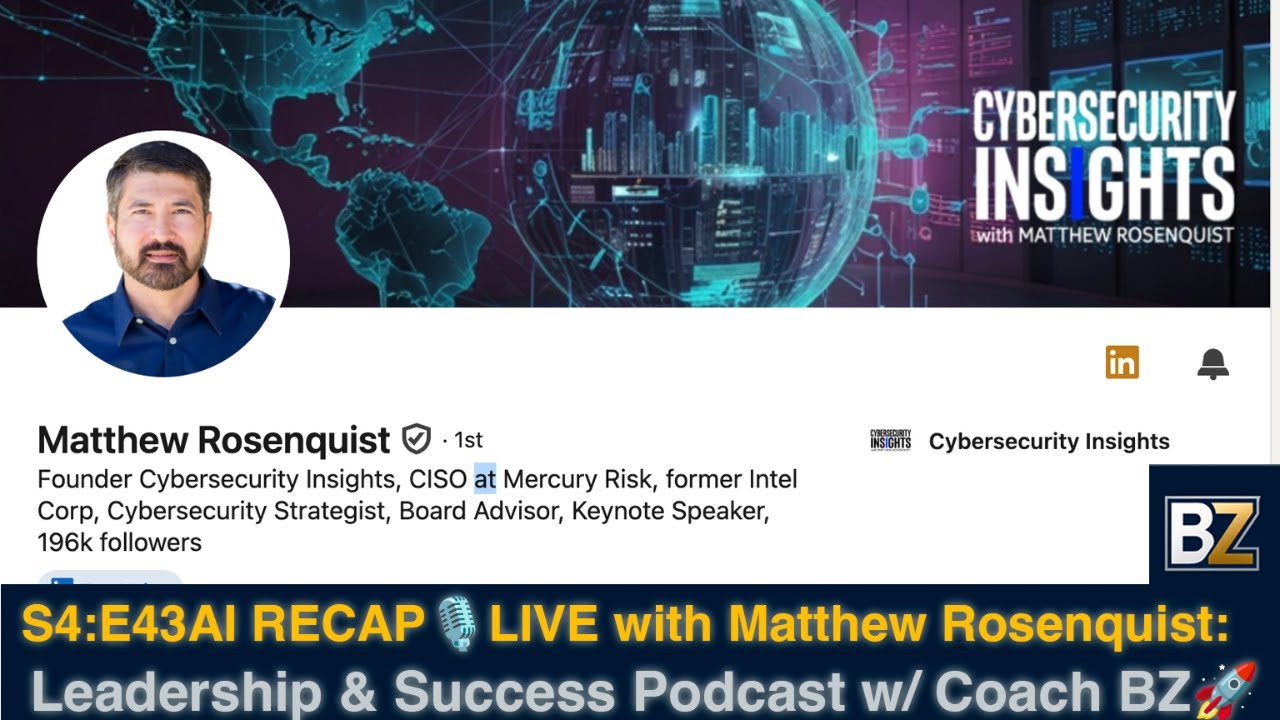
Matthew Rosenquist, CISO of Mercury Risk and Compliance, discusses his 35-year career shift from technical jargon to translating cyber risk as revenue impact for boards. He frames AI as a force multiplier for both attackers and defenders, and argues that CISOs need servant leadership, strong communication skills, and lifelong learning to navigate emerging threats like quantum computing.
Chapters
Hi, I'm John Maxwell. When the top companies in the world are looking for trainers, speakers, and coaches, there's one name that stands above the rest, and that's Maxwell Leadership. Our certified team members have gotten proven results for companies all over the globe, and our reputation, I'm proud to say, is second to none. Some of our members have risen to the top of their profession, including the one you're going to meet today. I proudly introduce you to my friend, Bob Fabien Zinga.
Welcome to the Leadership and Success Podcast with your host, Coach BZ. If you need to develop into a better leader, this podcast is for you. If you want to achieve a greater level of success, this podcast is for you. His mentor, Dr. John C. Maxwell, said it best: everything rises and falls on leadership. We hope to inspire you today and provide you with an insight that has the potential to positively impact the trajectory of your life. Welcome to the Leadership and Success Podcast.
Imagine gaining the leadership skills that could redefine your career. Join Coach BZ on the Leadership and Success Podcast, where each episode delivers practical insights from world-class speakers, military leaders, and industry experts. We dive deep into what matters most: building resilient teams, leading through uncertainty, and navigating complexity with clarity and confidence. Every conversation is crafted for aspiring leaders like you who are ready to grow, lead, and make a lasting impact. Don't miss our powerful live sessions and recent highlights. Michelle Hayward on building diverse, high-performing technical teams. Anne Leslie on leading through global complexity and cybersecurity risk. Ron Carpenter, AI, exploring faith, resilience, and AI-powered leadership. Colonel Michelle G.I. Gardner, INS, on commanding influence from the battlefield to the boardroom. Chris Robinson on shifting from drift to drive in life and leadership. And Coach Enrique Acosta Gonzalez on mentorship, legacy, and heart-centered leadership. Ready to level up your leadership journey? Tune in on Spotify, Apple, Audible Podcasts, YouTube Live, and LinkedIn Live. Join the movement toward leadership excellence. Listen now and start transforming your success.
I'm Matthew Rosenquist, CISO, cybersecurity strategist, and industry advisor. I have my own consulting firm, Cybersecurity Insights, and and am currently the CISO of Mercury Risk and Compliance. Now, I've always been passionate about technology and law enforcement. My career has now spanned over 30 years, and I continue to be excited every single day in cybersecurity. Now, it may sound cliché, but doing what you love makes a tremendous difference in your contributions, your success, and ultimately your longevity. And I love the chaos, ambiguity, and the challenges that intelligent adversaries bring as part of our industry. Every day I look forward to making a difference. Now, if you can find that passion, It will drive you to give your best, to seek out new challenges, and fuel both your success and happiness. Just keep in mind, your journey is uniquely your own. No two are the same. The key is to find your optimal path. I love dealing with intelligent adversaries, right? And a lot— most of them I would say a huge percentage of them, more than average, are smarter than me. They're more capable than me. I'm working against an adversary that is larger, more powerful, better funded. They communicate and collaborate better. They've got great innovation. They've got massive diversity of thought and background and experience. So it's an uphill battle every day. I love it. I love it. You know, so that's my personality coming into this. And I've been doing this for 35, almost 36 years. And I love every single day. Even at Intel, when, you know, we would have our sabbaticals every 7 years, you get several weeks off, about 6 weeks off for sabbatical. And I would look forward to it because then I could go do more. I could go do more keynotes and speaking on cybersecurity and dive into research. I would have a stack of research I could go read because I would have time.
Wonderful.
So to me, it's not bad stress, it's good stress, but it's still stress and it can still grind on you. And so, you know, having the expectation, managing it appropriately. And my wife does a great job when she sees me stressing or grinding my teeth, she'll come and, you know, gently tell me or physically intervene.
Yes.
And go, what are you doing? You're stressed out. Go relax. Right.
Wow.
So that helps.
No, that is great. So a lot has definitely changed in our field. How do you see the cybersecurity executive today? Because when I first started, it looks like initially it was really a bunch of geeks, very, very smart, very, very highly technical folks. But every time they opened their mouth, nobody understood what they were talking about using all type of jargon. So they couldn't talk to the business. The board couldn't understand. What they were saying. But past today, what do you think is going to make a cybersecurity executive effective in a business environment?
Well, we have to get over several barriers that we've created for ourselves. And I agree with you, the vast amount of CISOs that have come up through the ranks have been technical, right? Very technical-oriented. And it kind of makes sense, right? Because this is the battlefield that we're playing on. And so if you put an engineer or a developer or a technologist or an architect in that space, well, yeah, they're going to fix cybersecurity. And that was the concept back in the day that this is an offshoot of IT and IT deals with fixable problems, scriptable problems, problems that you can predict, mean time before failure, all these great metrics. And so So therefore cybersecurity is just a, you know, a hacker, somebody in a hoodie in a basement, and they're doing, you know, they're taking advantage of vulnerability. All you have to do is close. We've got this generation of CISOs now, technical, look at it as a technical problem, look at it as fixable. And that's what they communicate. But the reality doesn't manifest that way. And talk about stress.
Yes.
So there is an evolution here and it's an evolution of transformation for the CISO. We've got legacy CISOs that talk tech, right? And they're only talking tech. They're not talking business. They only see it as vulnerability management or pen testing, things of that sort. They're not even seeing or can communicate What are the type of people attacking me? What are they going after? What resources do they have? What are their go-to methods? How are they going to evolve? How are they funded? Right. They're not thinking in those terms. They're thinking strictly defensively. So, you know, they need to change in this transformation. It's like a cliff that's coming up. We've got two decades worth of CISOs, you know, going to the board and going to the CEO saying, I need money, using fear, uncertainty and doubt to get a big bag of coins with the expectation that it's going to be fixed. And it isn't. And they're asking for 20% increase year over year. That is average. They're not getting it, but they're asking, whereas they position themselves as an overhead, a cost center. Now, business majors here, MBAs, will understand if you have a cost center, right, an organization that doesn't revenue— doesn't generate revenue, Your goal is to reduce the cost, to introduce efficiencies and reduce the cost year over year. Well, cybersecurity increases year over year, and that does not work in the long term. At some point they say, stop, enough, right? And at that point you've lost because you have to continually adapt because the attackers are. So at that point, it's time for the CISO to pick up their bags and move to another company because they cannot succeed. So we've built this structure in and the way we have to move forward is better communication, better collaboration, and for CISOs to transform from technical risk experts to business risk partners, right, to help the organization understand those risks and opportunities. Because again, if you are a technical risk person, you're just there to manage the bad things. You're not actually talking about the potential business benefits. But if you want continued revenue and investment, you have to contribute to the bottom line. And that will be the transformation.
Welcome everyone to today's podcast, diving into some deep insights on cybersecurity leadership, servant leadership, and thriving amid chaos. Let's get started.
I'm excited. It's such a dynamic topic. So Where do you want to kick things off?
Well, let's begin with the evolution of the CISO role. It's interesting how, you know, from being just a technical gatekeeper responsible for system security, it's morphed into a strategic business leader. It's no longer just about servers.
Totally. It's about protecting reputation, trust, and even enabling business growth, right?
Exactly. And if you think about it, It's like the cybersecurity function used to be a silo, but now it's a horizontal collaboration across HR, finance, supply chain, and boardrooms. It needs to speak the language of revenue and brand, not just risk.
Absolutely. It's fascinating, and it invites a level of strategic communication that's quite new. How do you think leaders should adapt to that?
Well, they need to step away from pure technical fixes and communicate risks in business terms. You know, instead of sounding like a constant department of no, it should be enabling, almost like saying yes, and here's how we can do it safely. It's a transformative conversation.
I agree. And that brings us to the burnout challenge, right? Cybersecurity is a 24/7 kind of battlefield against intelligent adversaries.
Definitely. The profession is high stress because Um, you're contending with adversaries who are smarter, better funded, and constantly evolving. Yet, interestingly, Matthew Rosenquist talks about loving the chaos.
Yeah.
He sees it as good stress, if managed right.
But isn't there a risk that this love of chaos might, um, lead some to burn out eventually? I mean, can loving chaos really offset the burnout?
That's a good point. I mean, um, he does mention that balancing eustress, the good kind, and distress is critical. It's about discipline, routine, healthy boundaries, and of course, having a strong support system—mentors, peers, and even a spouse who can tell you when you're grinding your teeth. Yeah, that kind of balance is key. I appreciate that perspective.
Now, shifting gears a bit, what about servant leadership? How does that tie into cybersecurity?
Ah, servant leadership is, um, really the moral backbone of it all. Matthew emphasizes that caring for your team is fundamental because without trust and leadership that invests in people, you just don't get the resilience needed to handle threats. Right. It's about walking with your team into those deep valleys.
It's like he's saying that effective leadership in cybersecurity is as much about empathy and mentorship as it is about technical prowess.
Exactly. I mean, it's like, um, building a culture where small wins are celebrated and failures are seen as opportunities to learn. Speaking of which, he really speaks to the idea of failure as a teacher.
That was a really striking point. I mean, learning more from failures than successes? It really challenges the conventional narrative of always having to be right.
Yes, it's, um, like he says, "Intelligent failure transforms you." And it's crucial to create an environment where your team feels comfortable failing safely. Yeah. A sort of controlled space where errors become lessons instead of stumbles.
I see that. But don't you think some leaders might resist that, arguing that failure undermines confidence?
I get that concern, but I respectfully challenge that. Failure, when framed correctly, builds resilience and prepares you for even bigger challenges. Yep. It's a clever reframing of what we consider setbacks.
Right, and it's especially important when you're training the next generation of CISOs and tech leaders. Speaking of which, what advice do you think is key for aspiring CISOs?
Well, um, there are a few pointers. First, master communication. Translate technical risk into business impact so the board and other executives actually get it. Second, build your network and, uh, continuously learn, especially with emerging stuff like AI and quantum computing.
Lifelong learning is indispensable. And that makes me wonder, with AI advancing so rapidly, how do you see it impacting cybersecurity in the near future?
Oh, oh, it's huge. I mean, it's like AI is a force multiplier for attackers as well as defenders. Adversaries will use AI to scale their attacks, so defenders must adopt it too for detection, response, and predictive analysis. It's a double-edged sword.
But then don't we run into the problem of having to secure the very AI that's being used to secure us? It sounds like a vicious cycle.
True. But that's why it's not just a technical issue. It's about governance, ethics, and trust. Leaders must spearhead guidelines on AI adoption and risk management.
Right.
Bridging the gap between tech and business.
Such a nuanced approach, honestly. On a related note, what did he say about where the CISO should ideally sit in the org chart?
Ah, that's another interesting discussion. Matthew points out that there is no one-size-fits-all answer. It depends on your organization's culture and maturity. Whether the CISO reports to the general counsel, CFO, or CEO, the key is collaboration across all verticals.
It's horizontal influence, not just top-down orders. This horizontal collaboration seems critical. I mean, without buy-in from every department, security measures would all fall apart. Exactly.
And it's, uh, about positioning cybersecurity as a business enabler. Instead of blocking every initiative, it's ensuring that risk is managed so the company can— Absolutely. —innovate safely, making security a partner, not a roadblock.
I like that a lot. And it sort of ties into the idea of leadership transformation from being seen as a cost center to a strategic asset.
Yes, and that's a central theme here. Successful CISOs are not just risk managers. They're strategic advisors who, through influence and clarity, drive both security and revenue growth. Right on! Communicating risk in revenue terms opens up new opportunities.
Now, let's look at his call to action. He urges collaboration and mentoring. Could you share more on that?
Sure! Matthew challenges leaders to work together, share failures and successes, and help the next generation. He emphasizes that cybersecurity only wins when we collectively mitigate risks. Yeah, it's like a shared responsibility for our digital future. I love that idea.
It's empowering, and it pushes for a community approach rather than isolating departments. Absolutely.
And the essence of servant leadership comes through again here, lightening the load, fostering open dialogue, and being a mentor. This approach not only strengthens the organization but builds a resilient future. It's a complete shift from the old keep everyone at arm's length mentality.
Definitely. And before we wrap up, I want to bring up the notion of failure as a learning tool again. I think many aspiring leaders worry too much about failure.
What's your take? Well, it's like If you never fail, you're not pushing boundaries. Intelligent failure, as he reminds us, is a badge of honor because it turns setbacks into learning opportunities. And it's something every leader, technical or otherwise, must embrace. Right. Failure is just a stepping stone to smarter solutions.
That really ties everything together. From evolving the CISO role to the power of collaboration and, um, learning from what didn't work. It's all part of a big picture of modern leadership.
Absolutely. And it's a reminder that in cybersecurity, as in life, the journey is about adapting, learning, and continuously supporting one another. Yeah. It's all about transforming challenges into opportunities. Great discussion, truly enriching.
For anyone listening, remember, embrace failure, keep learning, and lead by enabling others. Thanks for such an engaging conversation.
Thank you, and thanks everyone for tuning in. Here's to leading with purpose and turning chaos, um, into a catalyst for innovation and resilience. Until next time.
And cybersecurity. Yeah. Absolutely. Know your adversary. You have to. Most technologists don't do that. They don't look to see who their adversary is. They're more interested in what's the playing field, right? Or the battlefield. Sun Tzu talks about the battlefield, and that's technology. And if you're only focused on the battlefield, you're missing so much of— and that's why a lot of security fails, right? We only address it from one perspective. We're not seeing the people, we're not seeing the adversaries or the processes and If you only look at it from a technical perspective, you will get far, but you will not win.
Yes. Yeah, yeah, absolutely. So if that's the only thing you guys listening right now get out of this podcast, it's definitely worth it. Future CISOs out there, this is incredible. So I'm not going to ask you— I ask everybody about books, movies, podcasts, all that. I know you don't do any of that, which is—
I don't have time for any of that stuff. I understand.
But let me ask you this for you personally, Bob. Is there maybe a song, a book, a movie that would be your life's theme or anthem? Anything comes to mind?
I don't know, something with Robin Williams, some comedy. I don't know.
You know, Robin Williams was a great actor. I love his comedy.
To our society and how we communicate and collaborate, in how we form relationships, in the borders we draw on maps. In how we value each other. Cybersecurity, because it protects digital technology, right, is important. And making sure that we trust our digital technology is going to be more important every single day that we embrace this digital global ecosystem. So we have a role to play. It is important and we can contribute to that if we're in the right mindset and we should.
It needs to happen. I know we don't have much time, but I do want to get your thoughts about how disrupting you think AI is going to be for cybersecurity going forward.
Massive. You know, an 11 out of 10. I'm not sure how you want me to quantify this, but, you know, a lot of people don't understand. They saw GenAI and they're like, oh, that's AI. No, that's a little piece. I mean, that's a piece of deep learning, which is a piece of machine learning, which is just one little branch of AI. So if you think you were disrupted by, you know, ChatGPT or GenAI, oh, stand by.
Thank you for listening to the Leadership Success Podcast with your host, Coach BZ. If you like what you heard, please subscribe to our channels and come back for more wisdom nuggets on how you may develop into a better leader and achieve greater levels of success. Leadership is the most critical skill. The world will always need leaders to lead others, deploy the next disruptive technology, or execute a business strategy. You may as well decide on counting yourself among the 21st century leaders. See you right here next time on the Leadership and Success Podcast with Coach BZ.
More from Bob

S250:E4🎙️LIVE 🇺🇸America 250: President Barack Obama Leadership, Service, and the Power of Hope






S5:E157🎙️ LIVE with CMD CMSgt Dennis L. Fritz, USAF (Ret.)(Multi Tracks Audio)



S5:E156🎙️ LIVE 🇪🇸 Leadership Lessons from the FIFA World Cup 2026 Champions (Multi Tracks Audio)

S250:E3🎙️ LIVE Leadership Lessons from America’s First Documented Family of African Descent 🇺🇸📖