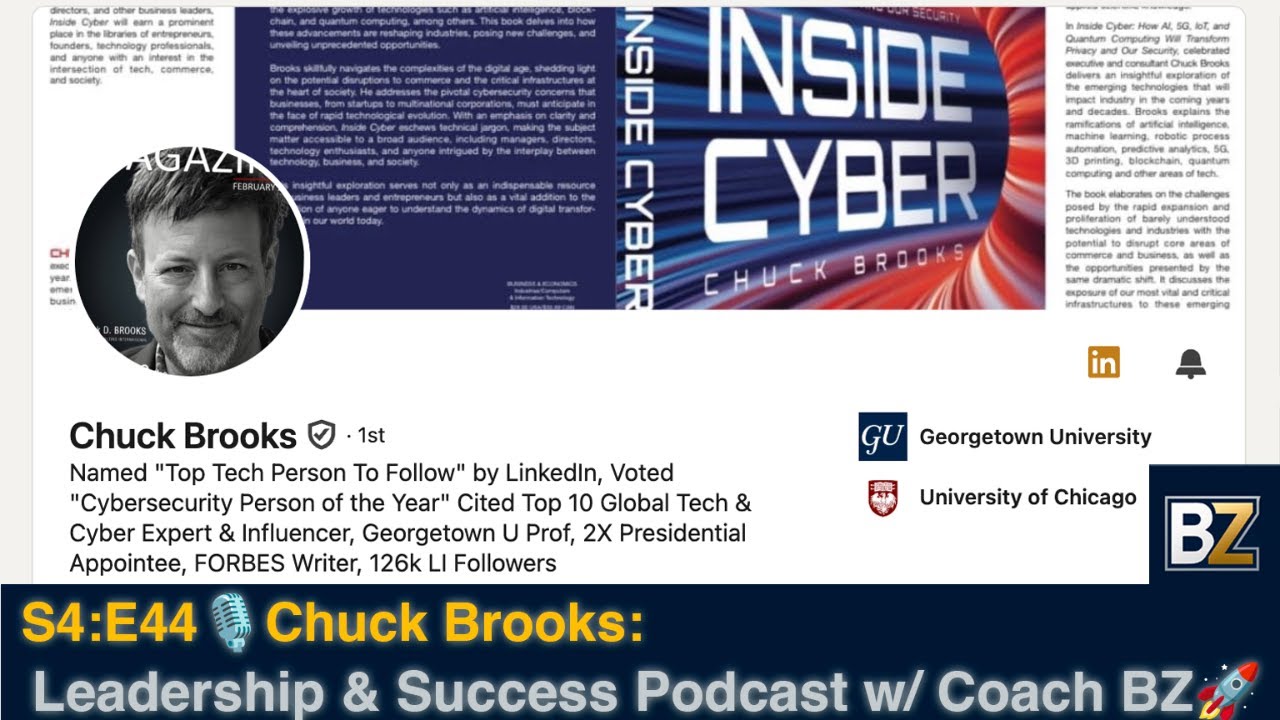
In this hour‑long live episode of the Leadership and Success Podcast, host Coach Beezy (Coach BZ) interviews renowned cybersecurity strategist Chuck Brooks, a former presidential appointee, Thinkers360 ambassador, and author of Inside Cyber. The conversation opens with promotional segments for the podcast series and a preview of the upcoming live show. Chuck discusses the dramatic rise of ransomware—especially during COVID—and how AI‑generated phishing has amplified attacks on small and medium businesses. He explains the emerging threat landscape involving AI, 5G, IoT, and quantum computing, warning of a looming "Q‑Day" when quantum‑capable adversaries could break current encryption. Chuck shares his leadership journey from a liberal‑arts education to senior roles in the Reagan and Bush administrations, emphasizing humility, continuous learning, and collaboration. He describes his work teaching a cybersecurity risk‑management course at Georgetown, which inspired his book Inside Cyber and a forthcoming guide for SMBs. The dialogue covers public‑private partnerships, the need for managed security services for smaller firms, and the importance of incident‑response testing. Chuck offers practical advice on cyber hygiene—multi‑factor authentication, strong passwords, and avoiding public Wi‑Fi—while also addressing AI ethics, bias, and operational security. The latter part of the show shifts to leadership themes: learning from failure, the value of mentorship, and personal habits such as power‑lifting and a UFO internship. Chuck concludes with recommendations for staying vigilant, supporting his LinkedIn community, and continuing education in AI, quantum, and privacy protection.
Chapters
¡Hola!
Hi, I'm John Maxwell. When the top companies in the world are looking for trainers, speakers, and coaches, there's one name that stands above the rest, and that's Maxwell Leadership. Our certified team members have gotten proven results for companies all over the globe, and our reputation, I'm proud to say, is second to none. Some of our members have risen to the top of their profession, including the one you're going to meet today. I proudly introduce you to my friend, Bob Fabien Zinga.
Welcome to the Leadership and Success Podcast with your host, Coach Beezy. If you need to develop into a better leader, this podcast is for you. If you want to achieve a greater level of success, this podcast is for you. His mentor, Dr. John C. Maxwell, said it best: everything rises and falls on leadership. We hope to inspire you today and provide you with an insight that has the potential to positively impact the trajectory of your life. Welcome to the Leadership and Success Podcast.
Imagine gaining the leadership skills that could redefine your career. Join Coach BZ on the Leadership and Success Podcast, where each episode delivers practical insights from world-class speakers, military leaders, and industry experts. We dive deep into what matters most. Building resilient teams, leading through uncertainty, and navigating complexity with clarity and confidence. Every conversation is crafted for aspiring leaders like you who are ready to grow, lead, and make a lasting impact. Don't miss our powerful live sessions and recent highlights. Michelle Hayward on building diverse, high-performing technical teams. Anne Leslie on leading through global complexity and cybersecurity risk. Ron Carpenter, AI, exploring faith, resilience, and AI-powered leadership. Colonel Michelle G.I. Gardner, INS, on commanding influence from the battlefield to the boardroom. Chris Robinson on shifting from drift to drive in life and leadership. And Coach Enrique Acosta Gonzalez on mentorship, legacy, and heart-centered leadership. Ready to level up your leadership journey? Tune in on Spotify, Apple, Audible Podcasts, YouTube Live, and LinkedIn Live. Join the movement toward leadership excellence.
Excellence.
Listen now and start transforming your success.
Hey leaders, Coach BZAI Twin here. Big news, we're going live with one of the most recognized names in cybersecurity, Chuck Brooks. Chuck has been named a top 5 tech person to follow on LinkedIn, a Thinkers360 cybersecurity ambassador, and has shaped cybersecurity policy, academia, and thought leadership across the globe. Join us on the Leadership and Success Podcast, Season 4, Episode 44, this Thursday, July 31st at 1 PM Pacific Time, 4 PM Eastern Time. We'll dive into AI, quantum, national security, and the future of cyber leadership. Bis ao, Stuart. Hit that RSVP link, share it with your team, and drop your city or country in the comments. Don't miss this conversation. See you live on LinkedIn in the Leadership and Success Podcast with Coach BZ.
Well, it is really morphed, and I'd say it's really morphed mostly in the last couple years. Before it was like, you know, I'm not gonna be a target. No, you know, it's sure, I don't need to worry so much. Now it's that everything's a target, particularly small and medium businesses, which are half the attacks.. And you saw a really uptick in the amount of attacks against healthcare companies, educational institutions, et cetera, during COVID because they were really easy targets, easy to get into networks, you know, not well guarded, small budgets, et cetera. So that's why you realize that the game has changed. And partially the reason it's changed is because of ransomware. You know, that it's, you know, everything is, you know, in crime is usually related to financial gain. And extortion. So they said, well, we can get paid now. Before they couldn't get paid. Now they got cryptocurrencies and prepaid cards. They have ways of evading law enforcement. So it became really popular. And, you know, ransomware has been around for almost 20 years, but yet now it's booming as a business and being used by criminal enterprises all over the world and looking at anyone they could target. It's easy. And they're also automating it, you know, through phishing attacks. So no surprise that this has really become, you know, a really important important issue for business.
Inside Cyber: How AI, 5G, IoT, and Quantum Computing Will Transform Privacy and Our Security by Chuck Brooks. In a world where technology is reshaping everything we know, Chuck Brooks, a leading voice in cybersecurity, presents a groundbreaking book that will change the way you think about technology. Inside Cyber: How AI, 5G, Internet of Things, and Quantum Computing Will Transform Privacy and Our Security offers powerful insights into the intersection of technology, cybersecurity, and commerce. This essential roadmap is perfect for entrepreneurs, executives, and tech enthusiasts. The future is here with artificial intelligence, 5G, quantum computing, and blockchain. Understand the impact of these technologies and learn how to safeguard your business from new vulnerabilities while seizing opportunities in a rapidly evolving tech landscape. From accessible explanations of AI and quantum computing to strategies for protecting your business in an increasingly connected world, Chuck Brooks breaks it all down. Prepare to lead in the digital age by embracing the opportunities and challenges of the future. Inside Cyber: How AI, 5G, IoT, and Quantum Computing Will Transform Privacy and Our Security by Chuck Brooks is available now. Get your copy today and secure your place in the future of technology. Available on Amazon now.
All right everyone, thank you so much for being with us. It's about 7 minutes after the hour, 1 PM here in California, and I believe 4 or 7 on the East Coast where Chuck Brooks lives. So thanks again for being here. Please, before we get started, like the event post, Tag someone. This is going to be a great show today. We have Chuck Brooks in the house, and if you have a question for him, please type it in the comments. We're going to make sure to ask Chuck live on the show while we are on the air. And also, please let us know where you are coming from. And thank you so much to Terence Sadler for letting us know, watching from central Louisiana. Appreciate that. And basically today, we're going to be talking about cybersecurity, which isn't just about firewall and threat intel, right? So it's about leadership at the highest level. And there are very, very few people who embody that better than Chuck Brooks, recently named Thinkers360 Ambassador for Cybersecurity and recognized by LinkedIn as one of the top 5 tech people to follow worldwide. So we're gonna be talking about presidential appointee to global cybersecurity influencer, insight from teaching at Georgetown University and briefing world leaders, and also what's next for cybersecurity in the AI, quantum, and IoT, AI. So with no further ado, let me bring to you, gentlemen and ladies, Chuck Brooks. How you doing, Chuck?
Great. Thank you for that terrific introduction. That was great.
Thank you so much for being here. We are so privileged. I know we've been trying to do this for quite a while. I think you and I started talking actually about 2 years ago, 2023. But really, really great that you are here. Just to get started, one of those icebreakers I love. Tell us something about you that most people may not be aware of.
Well, I guess most people don't realize that one of my hobbies a few years back— I just do it for fun now— was powerlifting. And I actually competed in powerlifting and became a champion in Virginia for my age group. So— and also ruined my shoulders. But it was a great hobby. So it's a hobby that I like to do. And another fun thing I'll share is that When I was in high school, I interned for late Dr. Allen Hynek for the Center for UFO Studies. He's very famous for Project Blue Book and working as an investigator for paranormal phenomena and UFO phenomena. And so I was actually on a TV show recently talking about that.
Wow, that is pretty amazing.
Very, very outside of cyber, but interesting.
Yeah, absolutely. And can you tell us a little bit about your leadership journey, how you got to be where you are today.
Sure, sure. I'm from Chicago originally. And I went to a small liberal arts school in Indiana called DePauw University, been around for a couple hundred years, great school, and really got interested in, in the whole world of international politics early on from that and security. And I pursued a graduate degree at the University of Chicago in international relations, where I focused really on security studies. I had a great professor named Dr. Albert Wallstedter, and, uh, you know, buildings are named after him. He was one of the strategic thinkers of the time. And, uh, you know, looking at— this was actually during the Cold War, so it was a real, real timely. And so, uh, you know, uh, with that background, I, I, I did a few things. I went to study at The Hague at international law, which is a great experience, but then I decided to come out to Washington, D.C. and say, okay, well, this is where everything happens, so I should be part of the conversation. And, uh, and, uh, by, by sheer coincidence, I was at a party and I met the, uh, general, uh, who happened to be the former deputy director of the CIA and former head of Defense Intelligence Agency named General Danny Graham. And he said, do you want to come work for me? And, and, uh, yeah, so, so, uh, I ended up working with a thing called High Frontier, uh, ballistic missile defense and areas, and it was fun. And then he said, uh You know, I started writing, which is really important for leadership skills, learning how to speak at events. And then I went to work actually as an appointee to President Reagan at the Voice of America right during the height of the Cold War. Wow, great experience. And I edited their newsletter there, which was the first time I ever worked on that kind of stuff and really got to develop a lot more of my, you know, my thinking and writing skills and, uh, you know, represent, uh, sometimes the nation. And, uh, I could go on because I stayed in government. I, uh, I, uh, was recruited by late Senator Arlen Specter to come work as his security, national security and foreign affairs, uh, and I almost did that for a decade. And that was a great experience. Late Senator Specter was from Pennsylvania. He sat on some really cool committees and, and, uh, One thing about him is that he, you know, second day I was there, he said, write me legislation I want to take to the floor. Then I had what it was, it was a direct flights issue or something from Russia. And so, you know, this is really before the internet was really evolving great.
And so that's crazy. Wow.
And so say, so anyway, that long story short, I ended up speaking a lot at events representing him, doing legislation, writing things. It's a great experience.
That is really amazing. And you were a presidential appointee as well, right?
Oh yeah, I was a presidential appointee twice. First under Ronald Reagan and second under George W. Bush.
That is amazing, amazing. What a life. So the next question I have for you, Evan, you have such an incredible career. What first drew you to cybersecurity and emerging tech?
Well, my second presidential appointment was at the Department of Homeland Security. I got a call and said, do you want to be part of a startup? And it happened to be the Department of Homeland Security. So I was one of the first people there employed there. When I got there, it was mostly Secret Service and Coast Guard people. And I was— since I came out of the Senate as a, you know, an aide, they brought me over and said, do you want to do legislative affairs? I said, sure. He said, you want a new—
new—
what portfolio do you want? And I said, well, you know, the newest one is science and technology, which is the only part of DHS that I knew of that was not there before it was created. So I took over the helm there, and part of that work was obviously it was, you know, counterterrorism technologies and everything else. But the internet was starting to get, you know, some sort of play there, and cyber is starting to get some sort of play there. So there was a cyber division there, and I got involved with that, you know, very early on, and, you know, became amazing. Almost a subject matter expert, but not quite, because it's changed so much, you know, since 2004.
Yes, absolutely. Wow, that is, that is really amazing. I remember, um, the very first, uh, Cybersecurity czar, um, under President Bush. Uh, he wrote the book, which I have. But in, in any way, it's just amazing how much this field has just changed. So looking back at your early career, including time as presidential appointee twice— my goodness, that's amazing— what lessons shaped your approach to leadership and to us?
You know, I think one of the things that you need to be humble. People respect you when you don't have to know everything. And it's good to learn from others. I mean, you know, I was a kid, so in these early— I was in my early 20s, so I didn't know much. And but I knew where to go to the right people. And I learned that first from General Danny Graham, who introduced me to all these generals. And I went to officers' clubs and stuff. And I was still a kid, but I asked good questions. I absorbed what they had to say. You learn and you're constantly learning, right? It's all about learning. And so, you know, you're never going to be the, uh, the most, the brightest person ever in the room, but you could be, you know, fluent in understanding the issues and knowing what to say. And the other thing I learned is that you need to have, uh, you know, basically it's, it's, you need to be friendly and kind to people. You don't, it's not a competitive in that sense, you know, you're going to go far. You don't need to, to do ad hominem attacks against people. You need to to participate and follow the mission of bettering whatever you're working in.
Wow, that is so powerful because one thing I do focus on is emotional intelligence, especially here in Silicon Valley. I think the IQ of our engineers is like off the roof, but emotional intelligence, we have a lot to learn. Just to be kind, to be aware of oneself and people around you and how to treat people, it's very, very important. So, uh, how did your international relation background, not just University of Chicago but the egg as well, kind of inform your thinking on global cyber risk?
Well, I think it did because the interesting thing about cyber is that you could say that it is a global issue. We're in a digital world and there's no difference between the digital world in a foreign country and the United States. We're all connected. We have the same threats, the same issues, unless you're one of the despotic ones. But you're really— so you're interchanging the world, you're changing with different cultures. And I had the opportunity, you know, it started really more, you know, with when I was working at Xerox, where I got to do some international travel, but in speaking events, but more with actually COVID. I did a lot of virtual events. And then afterwards, I went and visited all these places. I speak at forums all over the world. I've been to Dubai. I'm going to Singapore next month. I've been, you know, basically in Rome, many places, pretty much everywhere, part of around the globe. And I think the people are people, particularly in this world of cyber. We wanna share information. It's not just cyber, it's emerging technology too, AI and quantum. There's sort of a fraternity of thought that we're all learning together 'cause these are all new things and we're all facing terrible threats. And it's a threat to humanity, not just to any country.
Yeah, and you wrote a very timely book, "Inside Cyber," which you talk about AI, IoT, quantum computing, and all this. Can you tell us a little bit more about that and why it's important? Yeah, yeah, I can tell you.
My premise for this is I designed a course at Georgetown University where I teach as adjunct faculty in the Cybersecurity Risk Management program and the Applied Intelligence programs. And the task was to create a program addressing the emerging technologies impacting society and cybersecurity. So when I first wrote it, which is I think 5 years ago, it was pretty easy. We're talking, we're going into an AI era, there's 5G, blockchain stuff. But now it's evolved so much that I had to rewrite the whole course last year. And when I rewrote the course, I said, you know what, I should really translate some of the things I've learned and what I share with my students into a book, because we're really entering right now a new era, and it's moving so quick, you know, with the impact of AI. You hear it every day now, uh, with generative AI and agentic AI, and quantum's around the corner, right? So, you know, we're, we're Life as we know it and the way we work is all being changed so, so abruptly that we should prepare and understand it. And part of that, the other part is understanding how to protect our privacy and the cybersecurity risks that entail all these technologies.
Now, you mentioned quantum computing. As a CISO or cyber executive, that's one thing that keeps me awake at night because I know China has a lot of our data encrypted. They can't access it, but it's on storage and they're just waiting. And once quantum computing is here, I mean, they're going to be able to break those encryption just like that. What I guess, how do you feel about this? And do you have hopes that America specifically, our government is actually working on a solution to come up with some type of quantum encryption for our industry?
Yeah, well, that's a great question. Yeah. Yes, everyone's working on it. You know, it really sort of got a shot in the arm in the last couple of years. We realized how far China was coming with it and how much money they were spending. But what you spoke about, which is called Q-Day, is where they take all the data that was downloaded and protected by RSA and all these other protocols that could be decrypted instantly. So all the information in the world could be decrypted, all the security, everything that's been stolen, that's available. And you combine that with AI, you've got the analysis right there too. And the other thing about quantum computing, it's a million times faster than anything we have now or more. So it's going to definitely be disruptive. And I think what the government's trying to do right now is institute the fact that we need to have quantum-resistant algorithms. NIST, which is basically an advisory arm of the Department of Commerce and DHS, came out with standards, advised that we need to have them by, I think it's 2035, that all algorithms are quantum-resistant. But quantum computing, just a few years ago, everyone said it's in the distant future, but now it's right around the corner. And there is already photonic computing, which is quantum computing in a sense. And that's really sort of starting to flourish too. It's really impacting our ability to compute in classical computing and it's available now. And there are several companies out there that already have products that could be bought.
That is, that is quite amazing. And also with the emergence of quantum computing, do you think— because I know with AI right now there is a race to AGI, right? Artificial General Intelligence and probably superintelligence right after that. Do you think quantum computing is going to help toward that, uh, pursuit? Do, do you think it is, it is possible within our lifetime? No, just—
yeah, I mean, there's, there's estimates. I mean, it depends how long you live. There, there were saying 2075, which is a lot of people's lifetimes still living right now, uh, but I think it'll be earlier than that. I think, uh, you know, quantum computing is going to be, uh, basically, uh, exponentially important to, to creating this capability of AGI Again, we're now in the stages of generative intelligence, generative AI, and also agentic AI, which is the difference basically is that generative, you prompt it, and agentic AI, you don't need to give it prompts, but it'll go out and get the information and recommend it. So those are being invested in, like billions of dollars right now are going into it by government, private sector, all over the world. And there's breakthroughs every week in that. So I think You know, the idea that we get to AGI, it may be a little bit different. It may be that it's neuromorphic, where we basically combine abilities of the human brain and hook up machines to brains. We're still not— computer is still nowhere near the human brain capacity. But maybe we're able to do that and download things directly into our brain and vice versa, from our brain into the computer. So that would be— AGI times 10.
I know Elon Musk has a company that inserts chips now in some disabled folks to try to give them back some of their abilities.
Yeah, and it's working. It is working. They've done a few trials and it's actually— people are able to make things and limbs that are paralyzed. It's a great thing.
That's quite amazing. So toward the rest, towards AGI, do you believe in a utopian future or not? We use it for good, the world gets better, we solve climate change and poverty and all of that, or a dystopian future, AI kills all of us. What, what are your thoughts right now?
Well, you know, it's hard to believe in the utopian future just because mankind themselves is not— or womankind, whatever you put it— it's not utopian. We have a long history of barbarism against each other, and we also program a lot of these computers, and several of them have been done that these early AIs have been you know, sort of misanthropic in their activities. And some of them, I think, wanted to kill the creator. So I'm a little worried about that. I mean, there are limitations we could probably put in and guardrails, you know, because— but, you know, it depends. But at some point, AI is going to get so advanced, it's going to be in robots, right? Or humanoid robotic kind of thing. Yeah, because they don't have to worry about illnesses. They could survive things at extremes. And they might outsurvive our civilization. And in fact, many extraterrestrial civilizations maybe a combination of biology and artificial, which is where we're going. So I think, you know, I worry about it because, you know, we just, you know, it really is— the designers have to be philanthropic and kind to do it. And it just hasn't been that way typically with what we see now.
Yeah, that's why I really think human in the loop ethics, right? Morality, wisdom is extremely important.
Very important.
Yeah, just because you can do it doesn't mean that you should, right? A lot is at stake. But, but yeah, also the human bias too, right?
There's bias. Yeah, we found that early on and we're trying to correct some of that. But again, it usually goes to the programmers, right? Their bias, you know. So, but now a lot of that is, it's changed. There's, there's programs with the Google and Microsoft that basically remove the bias and some of these things and others.
That's really cool.
No problem.
Just a couple of years ago, the podcast preview I actually showed on the promo since I didn't talk to you yet was from something you did earlier. And back then, the biggest thing I think was right around the pandemic was ransomware. Ransomware just went from like nowhere to being one of the most critical threats for everyone. So how has that changed? What do you think are the emerging threats right now? That boards and government under?
You know, it's a couple of things. First of all, it's become more targeted. I think that, you know, initially, when a lot of the big ransomware happened, it increased like 800% during COVID because there's everyone's behind a keyboard, they found they get money, particularly from the healthcare people that need to keep their records. But now it's become even more nefarious because it's been basically bolstered by AI, generative AI that can create, you know, basically amazing phishing attacks that are automated to millions of people. They can create spoofing of video, etc., like that. And the ability to do that now is— and also scan social media and find targets with social engineering to target this ransomware. So I think as we move to a digital world, which is still, you know, there's cryptocurrencies coming out, and that's their primary way of getting paid. That in prepaid cards. So I think it's growing in its capacity to do damage, I think, because pretty much anyone could do it. You can get the tools off the dark web. And it's basically a criminal activity. And there's a lot of criminals out there. So I worry about ransomware. It hasn't gone away. And the same, same ways of defending against any kind of cyber attack is really having the right, you know, cyber hygiene and protections. But it's not— everyone does it. Like I said in that clip, I mean, small, medium businesses don't put security as a priority. And people often are, are, are very negligent, including the younger generation. They, they're very oversharing.
That is, that is true. And me as an information warfare officer, I can definitely see the importance of, you know, cyber warfare. I think the war of the future isn't going to be, uh, fought the way we did World War I or World War II. Now, I don't think you, you've ever enlisted in the military, but you are definitely part of the fight on the CNN side. The work you've done with the government, DHS, and so forth. So what's your view on the intersection between cybersecurity and national security in today's geopolitics?
Yeah, I think it's glued because a lot of the targets are— you're right, I served in law enforcement in an auxiliary way for police, but never in the military. I was in the era where post-Vietnam, so I would love—
Thank you for your service.
Well, it's not the case. My father was in World War II and wounded, and my grandfather was in World War I, so I I wanted to list, but they prevented me from doing it right after Vietnam. But anyway, so I think that the ability to protect our critical infrastructure is inherently a national security issue. And you can see this being— water is being targeted, energy is being targeted, financial, healthcare. All those areas are major targets for state actors and also for criminal gangs. And so you can't separate it. Unfortunately, or fortunately, about 85% of those, those industries I talked about are owned by the private sector. So government's got to play a role in public-private partnerships to work with them to bolster their capabilities and defenses and stuff like that. And I think zero trust was one of the first things that came through. Yes, knowing what's connected to your networks, etc. Now, the big thing was security by design. Anything you build new, you know, build it with security in mind. But, you know, it's still a lot of our grid is 30, 40, 50 years old, and very vulnerable. And national security is going to be a big part of it. And you said, you know, the digital war is— we're already starting to see that.
Mm-hmm.
Ukraine, you know, where— and other things where actually Russians hijacked a satellite.
Yeah.
So there's— it's a different world in terms of warfare. And it's a different world in terms of business.
Exactly right. And I like you kind of mention the government getting involved and you talk a lot about public-private partnership. I feel like that might really be our only hope, right? The US government, I think, will be fine. The military, we almost have unlimited budget. I think we are going to be going for what, $800, $900 billion to over a trillion dollar budget, which is crazy. And then big company like Microsoft, Google, they have enough money, resources, they can handle it. But I really worry about small businesses because The small and medium businesses really are the heart, I think, of America. That's what makes us us. That's where they give job opportunity. They really carry our economy. So having served in senior government role, how can public-private partnership be improved to respond to evolving threats, in your opinion?
Well, I think, I think one of the areas which they started doing was grants to state and local law enforcement, because a lot of these small businesses and stuff are in areas that don't impact necessarily with the federal government. But I think it's got to be encouraged. You're really— the, the real expertise is really in the private sector for the most part for cyber. They pay well, they get the best and brightest. There's some great people in government too, but, uh, you know, and particularly some of those programs are classified, so we can't use them. But there's a lot of people that come out of DOD and NSA and DHS and other places that they have a great expertise to share. I think what is going to have to happen with small and medium business is managed security. Whether it's done through a not-for-profit or a profit, because they can't keep up with the race right now with cyber. The threats, they're just too formidable for them. They don't have the budgets or the expertise, and, and it's going to have to be that kind of arrangement. I think the government should encourage that. Yeah, you know, there's a lot of, a lot of resources that can be put towards that. And, but I think it's going to probably, uh, take a while to do that, you know, because even the big medium companies just recently are starting to to look at cyber as more than a cost issue, but really a C-suite issue.
Yes. Okay. We do have a couple of questions already online. Let me read those to you. So I have a question right here from— okay, Robert M says hello. And Terence says, okay, Sentosa Island in Singapore is a must-see. Okay. Okay, Roberto Arana is asking, any new books coming up? So we already talked about one of your best-selling books, Inside Cyber. Are you working on your next book?
Yeah, actually, I worked with a person actually out of Ukraine, and we're waiting for it. We finished the manuscript. It's really about what you talked about, cybersecurity for small and medium business. And hopefully that'll be published soon. So that one is coming. And, you know, there's, there's a few, a lot of books I've contributed chapters to. But this is good. I think you're right, exactly what you say. I think what you want to do is with, with these books is make it understandable for the, for people out in business and laypeople that aren't entwined in cybersecurity technologies, to understand the global ecosystem and what they can do, all things, where to go. And so, so that's what I do. And that's what the second book is about, really about what a small business can do to protect themselves.
Amanda is asking, operation security in AI, is that being programmed in? Definitely should be. But from your, in your opinion, do you think, because it's mostly the industry really in America that is pushing, you are spending like billions, zillions of dollars into the rest to AGI. Do you think they are really thinking about operation security or just making?
I think there is some of that. Certainly with security operation centers now they're utilizing AI., you know, for threat intelligence or using it to write reports. They're looking for anomalies and logs and things like that. So I think, I think there's, there's a definite use for it. And, uh, I think that a lot of the cybersecurity money and stuff going, uh, for investment cyber involves AI products. So I think the answer is a strong yes on that. I think that, you know, the cyber community is aware that, uh, you know, automation is one of the things that AI does well. And there's just not enough cyber expertise and talent out there to do everything. And so they needed to take some tasks to be filled by AI.
Okay. A long question from Terence. It says, Chuck, with AI-enhanced phishing in several forms, how do you recommend we educate users about the risk, but more importantly, the vulnerable minors and seniors to empower or enable them to be very skeptical?
So yeah, I think, I think, you know, this really is more of a cyber hygiene issue than anything because, you know, first of all, you have to— should have multi-factor authentication. If you don't, you're an easier target. And you could do it with facial recognition. You could do it with a phone call. There's a lot of things. Or do it three, you know, the more the merrier. And then, you know, obviously strong passwords are still necessary. I mean, not everyone's a, you know, a state actor. And a lot of the hackers out there you know, I don't have those capabilities, they'll go for easy passwords. A lot of times stuff is guessed, you know, because—
so you think my password shouldn't be password123? No.
Yes. Yeah, yeah, I mean, believe it or not, I'm gonna put the name of the, you know, I think it's been the most popular password since at least 2009, which is pretty, pretty crazy.
So, uh, what lesson can we learn from recent breaches and policy shift, especially The SEC, I know they are pushing on cyber now. I think probably going to have more cyber qualified experts on board the Fortune 500.
That was recommended, but unfortunately it didn't pass. I think that's a good thing. I think the lesson learned is that there is information out there and even being on LinkedIn, you can learn a lot because a lot of the people post, they post the threats, they post analysis. It's become a really good forum for cyber and other technologies like as a medium. But, you know, and there's a lot of other places too. But I think, you know, for individuals, you know, to understand what's happening with AI, you know, they have to read up on it. But it's really a problematic area right now. And, you know, they need to be able to understand what to do and not to do. And one thing to do is you don't want to make yourself the lowest hanging fruit. And so, you know, there's ways to do that. And don't— if you're in a in a public place, make sure you don't use public internet. That's the easiest way to steal your information. There's VPNs, there are pros and cons against those, but there's a lot of things you could do. But the main thing is don't click on the phish and look for those. Now they're so clever in the spoofing, very difficult. So look where it's being sent from and are you expecting anything? If someone calls you to say that you have a— your Geek Squad or your Microsoft warranty is up and you need to you need to pay right now online, don't do it.
Um, you know, basically using common sense, huh?
Yeah, I mean, there's a lot of scammers out there and they make tons of money on it, and it's gonna happen more.
I was just telling one, one of my mentees about maybe 5 years ago, you know, when deepfake kind of starting to surge, it was pretty easy to tell what was fake and what was real. But today, even I, it's like very, very difficult to tell the difference if it's not AI-generated, if it's real, or if it's just, uh, propaganda. It's so difficult to tell these days. It's just incredible.
It's incredible. Yeah, there's actually an anecdotal story on that. There was a bank out in Asia where they were holding basically a Zoom conference, and someone actually created a fake message with the voice and a video of a person saying they were the CEO and they needed to immediately transfer I think it was $30 million to a different account.
That's crazy.
Compromised. And the CFO did. And so, I mean, that's crazy, right? But it happened. Yeah. As you can see with your twin, you know, people could do that pretty easily now and they can make it very accurate.
Talking about my AI twin, Coach Bizzy AI, who did I make him sound like? Can you tell?
Yeah, well, they could copy anything, right?
Yes, but can you—
can you tell—
Success Podcast, Season 4, Episode 44, this Thursday, July 31st at 1 PM Pacific Time, 4 PM Eastern.
I made it sound like President Obama a little bit.
Yeah, you did on that one.
Yes. Yeah, so it's, it's really, uh, because pretty much all you do is have at least 5 minutes of someone speaking, but people like Obama They speak all the time, just record their sound and then—
Yeah, he's got an easy voice to replicate. But you're right, but they can copy any voice, they can copy any video, and it's very difficult to discover it nowadays.
From the government perspective now, as you know, we have the last day of July and this month President Trump came up with Winning the Race, America's AI Action Plan. I'm sure you've dived through it.
I read through it.
Yeah. What are some of the great highlights you think that is going to help our society? Now, for one thing, I understand with the AIOS, we don't want to put too many regulations and impede progress because I know China has no regulation whatsoever.
Yes.
But at the same time, thinking about ethics, safety, security, privacy, and those kind of things.
But anyway, what are kind of like I think you hit the biggest one right now. There's an encouragement for industry to invest and participate without going through a lot of bureaucratic regulations. And part of the reason we don't know what to regulate, you know, there's— it's happening so quickly. And like I said, it's a global thing. It doesn't— you can't really regulate everything. So I think what the basis of this is to really promote huge investment from industry competition. Understanding and wide adaptation. And yesterday I think they announced that they're doing it to healthcare, where they're able to make it easier to see your records and protect them. They have some interesting perspectives on that. I mean, I think the administration before that also had a plan. Some of the stuff is in there too. But I think right now it's sort of the Wild, Wild West of AI, and we're just learning how to harness it. Really, really where the focus of the The target is let's harness it and understand it and build it quicker. And I think again, what you mentioned is because there is a race. There's a race with China and others. But, you know, and for the economic prosperity of any economy, you know, AI is going to be the backbone for the future. There's no doubt about that.
Absolutely. So we are going to be shifting into the second half of the show. I have about 20 minutes for that. But before I do, Terence has another question for you. He says, "Chuck, with AI-enhanced phishing—" No, no, that one I already read. Sorry, this one. "I was a bit surprised recently. I had a conversation with a CEO of a mid-sized healthcare provider, multiple locations across the state, who felt they had no need to hire anyone for cybersecurity. They felt their MSP provided sufficient evidence it's not needed. No history of a breach yet." I don't think that is wise, is it, to completely rely on—
definitely have on-site expertise in anything in healthcare. I mean, you're dealing with multiple— but usually, if you take a hospital or healthcare, you're dealing with multiple networks, usually use a patient network, you're dealing with the doctors and nurses, you're dealing with the information of the equipment. You need cyber expertise. Everyone should have a CISO at any kind of midsize health clinic or hospital or whatever. And you could use managed service protection, but you need the CISO to coordinate it. You know, you have to understand what's being done. So it's not, you know, you just don't adapt something without understanding it.
Absolutely. And definitely not forget about third-party vendors as well.
Yes, absolutely.
Okay, very vital. Good. Actually, before I change, kind of like future outlook, what do you think is next for cybersecurity in the Fourth Industrial Revolution?
Well, I think, I think what's going to happen is, is right now you're seeing it being augmented with artificial intelligence in a lot of different ways. And I mentioned Agentic generative, but also in threat intelligence and looking and monitoring for anomalies, and for automating a lot of the mundane tasks. But it's going to be augmented even further with quantum. And encryption will be the key thing. Right now it's really more about identity management because as we said with the spoofing and everything like that, your identities are at risk. They use you, they get your money, they get to your bank, they can create falsehoods about you, anyone, and your privacy. So I think protecting the identity is going to be the next priority for— and that'll be biometrics more, probably more than facial recognition, maybe irises and other things because We're in an age right now, I think, where the technology is moving so fast and the ability of— it's so asymmetrical for hackers and adversaries to use it for bad that we need to really look at using technology for good and using it and giving it to everyone we can.
Yeah, it's really amazing how technology and hardware is getting cheaper and cheaper. I remember what, the late '90s, it was so expensive to get storage, and today storage is almost doesn't cost anything. And that's being a problem when you add adversaries, use, uh, skills, no, uh, what, whatever is out there against, against you. Actually, you know, um, Matthew Rosenquist, he was a guest. Oh sure, yeah, good friend, very—
one of the most knowledgeable people in cyber I know.
Absolutely. Uh, I, I, I believe that is definitely true. So Matthew, don't get such a big head, okay? But, but yeah, it is It's definitely true because one message that I really took home when I interviewed him and then later interviewed him for his podcast is the way a lot of CISOs right now, they just focus on being technical or patching systems and vulnerability, but they don't think about the big picture, right? The business itself, but not only the business, but also the adversary. Who are they? What are their capabilities? What are their motivations? So they completely do not think about that at all. And I don't think you can be an effective cyber executive if all you are thinking about is just, you know, whatever tools you are using and being technical. I think it's much more than that in 2025. What do you think?
I agree. And really what you're talking about really is mostly resilience because you have to understand, have to have an incident plan. You have to expect you're going to get hacked. I mean, no one is impervious to it. And you have to have your leadership understand that it's a reputation issue too. And so you have to plan, you have to have the legal protections. I mean, companies too. I mean, there's things they could do. They could segment their data, their valuable data, and they should be doing that already, but most of them don't. But, you know, I think that you really— there's a lot of stuff that's just logical to do. And also using the cloud. I mean, for a lot of small, medium businesses, maybe the cloud is a good answer because you do get some protection there, the risks too. But, you know, I think it's a step that it makes them less vulnerable.
Yeah, I like what you say about the incident response plan. The only thing I would add to that is make sure you actually test it because I've been in smaller businesses, startups where they do have one, check, we have one to pass some type of audit or something, but nobody reads it, nobody reviews it, and nobody knows what to do if there is an actual incident. Okay, Emmanuel Afolabi from Nigeria is saying hi, thank you for being here. So we are going to switch over now to the second half where I focus on leadership. 15 minutes should be more than enough for me to do that. Anything you wanted to add before we went to the second half of the show?
No, I think it's great. I just say the main thing we're all talking about is being vigilant and resilient. Yes. We're going into a sort of a dangerous world when it comes to digital security.
Absolutely. What is the greatest leadership advice you have ever received?
The best advice I said is to always keep learning. You know, look at every, every experience, whether it be good or bad, is a stepping stone to your next, next role. And I think that's really important because everything isn't going to be all great. Everyone has, you know, adversity in their lives. And there's problems, you don't necessarily get all the right bosses, what you can't control that. So I think you have to look at, you know, this is a journey. In every journey you learn from the right steps and the missteps. And hopefully by the time you get to where you want to be, you know that you could avoid the bad things and capitalize on the good.
That's right. On the Leadership and Success podcast, we talk a lot about failing forward. So it's okay to fail as long as you learn from your failure.
Everyone fails at some time. Yeah, everyone, even the best athletes in the world fail.
But now, if you could give one piece of advice to emerging public leaders or aspiring government innovator, what would it be?
I would say, you know, the advice I would set is first of all, learn and keep an open mind about artificial intelligence and quantum because it's not pie in the sky. It's coming, it's here. And if you don't prepare yourself as a government who is responsible for the prosperity of your citizens, you're doing a disservice. And that's really, you know, a focus of that, because I think we tend to be reactive when it comes to security and we need to be proactive. So my advice would be you must be proactive when it comes to this.
Now, you've had such an illustrious career. What do you think is the secret to your success?
I think, you know, it's a willingness to get information from other people. To treat others nicely too, and to make the best of yourself. I mean, I think everyone has a capacity within them to write a book, to read, to understand, to try things, to experiment. You go around once in life and you really want to make the most of it, right? And so the whole idea of it is not to necessarily be competitive with others, but to work with others. And so I think that's really part of the leadership lesson. And I think you, you get farther that way. I mean, it's not going to all be gravy, but you have, you have at least you build a lot of friends and networks and those will help you later on in life.
Hmm. Beautiful. So another question I have for you is what are you learning right now?
Well, I'm learning more about AI, you know, because again, you know, I'm not I don't have an engineering background. I'm lucky I've been able to absorb things pretty quickly, and I've been around all these people for so many years that I understand the lingo and understand the concepts and the physics and things. But, um, you know, quantum is, is pretty confusing when you get down to it. And so, uh, and so are a lot of these other technologies. But, uh, so I, you know, I just— it's constantly, uh, you know, keeping my open mind and reading and talking to people and going there and working with it. And so You know, some of my clients that I've worked with, I had the experience of actually seeing their— how their technologies are built, the products. I did when I worked at General Dynamics Mission Systems. I did deep dives on how the products are developed by the engineers. So I think you really want to keep learning and understand, you know, the mechanics of everything you're dealing with. And even if it's not technology, if it's dealing with concepts or or cause it. I think you want to know everything you can about that too. That is so great.
We talked about failing forward and learning from failure. I have this coin which I love. This side says success and this side says failure, right? Two sides of the same coin. How has failure shaped your life and your leadership journey?
Well, I mean, I think, you know, one of the things I think with the corporate world, there's a lot of M&A, and there's a lot of change that you can't really do anything about. And so you may be sitting on top of a great situation and then a week later there's a major change that you can't do anything about. And so all of a sudden you're out of work. And that's happened a couple of times by, you know, by companies that particularly public companies that do that because they want to bring their own people in or when they do or they have a stock issue, they want to cut back. So you don't always have control of your destiny, but you do have control when you're working in that kind of world. But you do have control of what you write and what you speak and where you can go and how you can better yourself to be more attractive to the workplace. And you can develop expertise in areas and you can share it now. And I think one of the values with the social media, when it's used properly, is that you could share your ideas and expertise and people see that and they want to use you for their company. So if you can do something or have ideas that are valuable to them or will help brand them better, they all go to you. And so you really, you're building— I tell my students this too. I say, you know, publish, write, you know, you have expertise in areas. What are your— what's your passion? Where do you want to go? Yeah, publish it. Publish it on LinkedIn. Publish it somewhere else. But, you know, make it part of your living resume because the old CVs have changed. It's now, you know, everything you can see is what you get on these social media.
Okay, so, uh, who are some of your thought leaders?
Well, I mean, there's a whole bunch of lists that I gave, you know, I mean, yes, and I'll start with that. I hate to leave people out, but I mean, I do a lot of the speaking surf with Matt Dill-Rosenquist, and so you know him well. Yeah, we appear at events all over the world together, whether we plan it or not. And, you know, there's a whole list of others that, you know, I look at, you know, that with, you know, with great admiration. I think I provided to you and you could put it up. Yes.
So there are quite, quite a few.
It's probably going to be better if I didn't include them all, by the way. But I like, I like that, you know, and I feel bad because I know I leave people out because, you know, the interesting thing is when you come to see these, the, you know, the, the basically in tech now, whether it be quantum or AI or cybersecurity, you see a lot of the same names. And these are people that are, are out really trying to to share thought leadership, and they're good at it. I have also found that the people, you know, that I mentioned or listed there, a lot of them, we all work together. We don't compete. You know, it's really a nice thing. It's a, you know, it's a big world out there, and we recommend each other, we help each other, and we're glad to see each other at conferences. And it's not an adversarial or competitive thing, really. It's a friendly thing. So, and I think it's also that there's so few people that really are addressing these kind of issues in cyber and AI and a public forum that could also communicate to the layperson. There are a lot of people with really technical backgrounds that go to these conferences and they share the technical stuff among each other, but it doesn't go anywhere after that. Hopefully the ideas we share are taken by everyone else.
Yes, there are so, so, so many. We all know each other. Really, cybersecurity is not that big big. I think we share more than, what, 200 connections together as well, which is pretty amazing. Okay, so if you could choose 3 people to have dinner with, who would you choose and why? Living or dead? Living, dead, or mythical figure?
Yeah, I mean, I always, you know, I have an admiration for scientists, so I think that, you know, any list has got to include Albert Einstein. I mean, one of the greatest thinkers of all time. Yeah, I would really think it, and, you know, that, that he would be, uh, first on the list. Um, no, I also, uh, you know, uh, Mikaku Kacchu— I'm not sure if I pronounced his name right— the Japanese philosopher, astronomer. Uh, he's, he's, he's alive, and he writes amazing stuff, uh, sort of on the edges things, and I'd love to, to, to see that. And, you know, I think I leave off politicians because I think that it's really not an area I've done it so long that I don't have an interest in it. And they all, you know, it's not really my, although I understand the importance of things, I don't want to, it's not my choice to meet anyone that's famous that way or any celebrity that's famous. So I think it stays with, you know, more with the science philosophy.
One more person.
I'm trying to think of who would be the last one. I think that I would pick maybe— he's not alive anymore, but maybe Buzz Aldrin. Or is he alive? I'm not sure. Walking on the moon. I think he'd be up there with one of the key people too, because I have an interest in space.
That is great. So when you wake up in the morning, what is one problem you would like to solve?
Well, I think that, you know, I think privacy is a huge problem for everybody now. And I worry about it because we're all victims of it. And, you know, it's getting worse and worse by the day. I wish we could solve that some way that we could have. I worry about it sort of being a world of lemmings where we're all basically just like numbers. Or digits, and they can see it going that way. And there's a lot of Twilight Zone kind of things where we follow, you know, the machine. So yes, you know, no, I don't want to be like that.
Privacy, I guess we have the, what, 1976 Privacy Act, which is definitely, uh, completely obsolete in 2025. What about what the European Union is doing with privacy, GDPR? Should we follow their example?
Well, you know, I think they— what they're doing is good. I think, I think there's a lot because you're protecting a lot of consumers, really. The problem with us is that we're deep in a marketing society here, and it's almost— we're so, so different, many different layers, and so many companies that would push against this legislatively because that's their livelihood and their commerce. So it might be difficult for the United States. I know some states are trying to adopt it, but GDPR is You know, I think it's a pretty good thing with privacy, you know, and it doesn't ensure privacy, but at least it keeps track and finds people that are violating.
Good. So if you had one and only one day to live, what would you have loved your final contribution to be?
The final contribution, I wish it, you know, I guess it would be, you know, communications of, you know, what we should do because I have to keep it to my area of interest, cyber and technology, that everyone really come to the recognition that we need to adapt to this new world and follow the rulebook, go and get involved in it and protect yourself. That would be it, because I can't really do much more. I can't eradicate world hunger or do stuff. Yes. But I could do what I'm trying to do right now.
No, thank you. Thanks so much. And you've been extremely generous with your time. So this is pretty much, uh, the end of the podcast. So the last, uh, question I asked him, the same question I ask everybody who comes on the show, is, uh, how can we add value back to you? What can we do to make a difference for you?
Oh, well, I think, you know, I think just follow me on LinkedIn is, is an easy way to do it. I, I try— I, I have a limit of followers. I have a— I think, uh, it's 35,000, they, uh, direct connections. But you can unlimited with, uh, actually with followers. I have 126,000 followers, I think, now in my profile. So that's why I do read this stuff when people email me stuff and follow me and then share my stuff I write. I mean, that's, that's where, uh, you know, share the— or get the book if you haven't got it yet. But, uh, um, share the stuff I write. I write in Forbes a lot. I write in Homeland Security Today, write in Security Information Watch, and, and for GhostCon, Wire, a bunch of things. And I've, you know, written over 4 or 500 articles. So, uh, I try and keep current, and I'm always working on something new. Absolutely.
So if you could go back and give one piece of advice to your 17-year-old self, standing at the edge of this incredible career you've had, what would you say to your 17-year-old self?
You know, my 17-year-old self was, was more interested in, in, uh, in girls and sports than it was. And I would say that, you know, you should look at going into, uh, uh, you know, computer science or engineering That's what I didn't do. But looking back, I wish I had more of that background. It's sort of self-learned right now. But I think in the future that all the people growing up in the educational systems right now are going to have to have those kind of skills, technology skills, and to understand what's happening. So it's really science, really science and engineering. And I think that's the future. And I wish I had done more of that when I was younger.
Yeah, science, technology, engineering, and math, definitely super important. Okay, uh, very, very quick now, 3 adjectives to describe you as a child.
As a child, um, you know, I was, uh, very cerebral. Uh, I was always thinking of things, you know, uh, basically, uh, uh, I was competitive, I was active, I competed in judo, wrestling, stuff I like to do. And, uh, you know, I think that, that, uh, um, you know, I, I— family, family-oriented, very family, food and family-oriented. One of my other jobs is food. So we have 2 minutes left.
What about as an, as an adult, 3 adjectives?
You know, it's, it's, I guess, definitely family. Uh, you know, I have a wife and 2 daughters that were really close, uh, and also my sister and in-laws. And so, uh, that's really focus on myself. And, and I love The fact that being able to travel and go see other cultures and experiences is really important to me. And I think a third thing, which has really become more because my wife has been food. I really enjoy food right now, going to great meals and benefiting from her cooking. But I think it's— food is its culture to itself, and it's a whole different world. And it's shared, you know, all different kinds of ethnic areas. In Washington, D.C., we're lucky to have them all.
Yes. Okay, we still have 2 minutes left before we end the show. Let me check on LinkedIn one more time to see if there are any questions. Okay, Amanda KG says, what regulatory compliance framework from BIS, ITAR, FMS can be applied to AI in the global race with US companies utilizing programming overseas? Can be applied to AI now, in your opinion?
You know, I think they're all in a state of flux right now. Yeah, and I think what's going to be applied to— it's a European version of AI— is, is really what's going to be adapted there, uh, you know, because, uh, uh, that's how they want it. So, uh, but I think, uh, we're moving in these frameworks. It's a good question because a lot of these frameworks are, are viable. And even if you don't, uh, basically use them for compliance, uh, if you follow the merits of what they're asking you to do and how to understand the the threats and the parameters of AI, they're useful. So it's useful to business, and it's useful to individuals too. So I think, I think all those apply, will apply to AI. But I think you have to sort of— it's a bilateral issue right now.
Yes, I guess if you focus on the main three pillars of information security, confidentiality, integrity, and availability, but how to do it with this now. Changing dynamic environment.
Yeah, those are all in a state of flux. You're right. I mean, yeah, uh, but those are the, those are the focus of, uh, you know, I think they're gonna find more things, particularly with agentic AI coming on board.
Can I ask you one more question? I know we are at the end. Can you give me 2 more minutes? Of course. You have to go? Okay, thank you so much. Because Amanda also asked— I don't know about this, this shows how I still need to learn— PDD-63. I'm hoping you know what that is, but she says What do you think about PDD-63 for critical infrastructure being applied to AI and satellite communication?
You know, I know of it. I don't know it specifically. I'd have to in front of me, but I did write several articles on satellite communication recently. And a lot of those protocols are the same thing that you'd think about, which is supply chain, third-party risks, because you have ground stations, you have the satellites themselves., and they have the relay stations, etc. And a lot of that is also based on encryption and security by design. They're trying to really— now, uh, it's not considered critical infrastructure space yet, but, um, now what we're building, because we're so dependent upon communications and sensing from satellites, we're starting to build security within it. And I think a lot of that is also the same. It's really security by design, a lot of those functions. And what— and every industry is different because you can't really— critical infrastructure is, uh, you know, if you're talking about energy Nurp's work and you're talking about water, they're two different applications. It's really also the OT/IT integration of the operational technology. There's a lot of complex areas in it, but these formats and these frameworks are all very useful. Very good.
And the last comment we have is from Terence. He says, thank you, Coach Bizzy and Chuck, for an insightful conversation. Well, thank you so much. I'm so, so grateful, Chuck, you made the time today. So the very, very last time I will ask you, and this is it, actually, before I do, Is there anything else you wanted to say? I didn't give you the opportunity to say.
No, I just want to say, you know, stay safe out there. Everyone's a target. Anyone could be hacked, or, you know, and it's not, you know, just take the basic cyber hygiene and do what you can and keep watching shows like this. So you get information on how to help your own future, and both in security and in your career aspirations. Thank you, thank you so much.
So the very last question I ask all of my guests: what is one word that comes to mind to represent the shared experience we've had on this podcast this past hour?
I, I think beneficial. I think it's beneficial to the audience. I think that we shared together a lot of the— in a very short period, a lot of the, the key areas and functions we need to know as we enter a future with, with technology and and increase cybersecurity threats. Well, thank you so much, Chuck.
And I think my word would be grateful. So, so grateful that you are here. Grateful, too. All right. All right, folks. So this is it. And this was Chuck Brooks, really a cybersecurity celebrity. I think the first one in the world, right? And I am so, so, so glad we were able to make it work for you. And again, I appreciate you being engaged during this show. It really matters to a content creator when we create the content to actually get some type of feedback, right? Because sometimes you create this content— I've been doing this for— this is the, uh, uh, fourth season, right? So for 4 years. And sometimes you, you go there, you, you broadcast out there in the internet, and it goes into a black hole. Nobody says anything. Is it helpful? Does it help? Nobody knows. So when I hear back from you, that is really, really great. And hopefully I'm adding value to you. Now, uh, tomorrow I will not have a guest, so I'm gonna be, um, going back. I believe it's, um, um, let me see, who will I be showing? I'm gonna have a recap, and I believe it's going to be Phil. Let me see, I think I may have his picture still here. Uh, let's see. No, that's not him. That's not him. Okay, I can't find his picture. Okay, yeah, here he is, Phil Taylor. Uh, we, uh, interviewed on Monday, so we had the one, one hour, uh, podcast interview on Monday. And what I am going to do tomorrow is I'm going to have a 10-minute recap. So my AI agent will give you a 10-minute recap of what we talked about. It's really for people who are too busy to listen to the entire hour. So I hope it adds value to you. So it's going to be 7:30 AM Pacific Time, California. So 10:30 AM Eastern time. So until tomorrow, this is Coach BZ, and thanks again for being here with us. Hope to see you tomorrow.
Bye. Thank you for listening to the Leadership and Success Podcast with your host, Coach BZ. If you like what you heard, please subscribe to our channels and come back for more wisdom nuggets on how you may develop into a better leader and achieve greater levels of success. Leadership is the most critical skill. The world will always need leaders to lead others, deploy the next disruptive technology, or execute a business strategy. You may as well decide on counting yourself among the 21st century leaders. See you right here next time on the Leadership and Success Podcast with Coach
More from Bob

S250:E4🎙️LIVE 🇺🇸America 250: President Barack Obama Leadership, Service, and the Power of Hope






S5:E157🎙️ LIVE with CMD CMSgt Dennis L. Fritz, USAF (Ret.)(Multi Tracks Audio)



S5:E156🎙️ LIVE 🇪🇸 Leadership Lessons from the FIFA World Cup 2026 Champions (Multi Tracks Audio)

S250:E3🎙️ LIVE Leadership Lessons from America’s First Documented Family of African Descent 🇺🇸📖