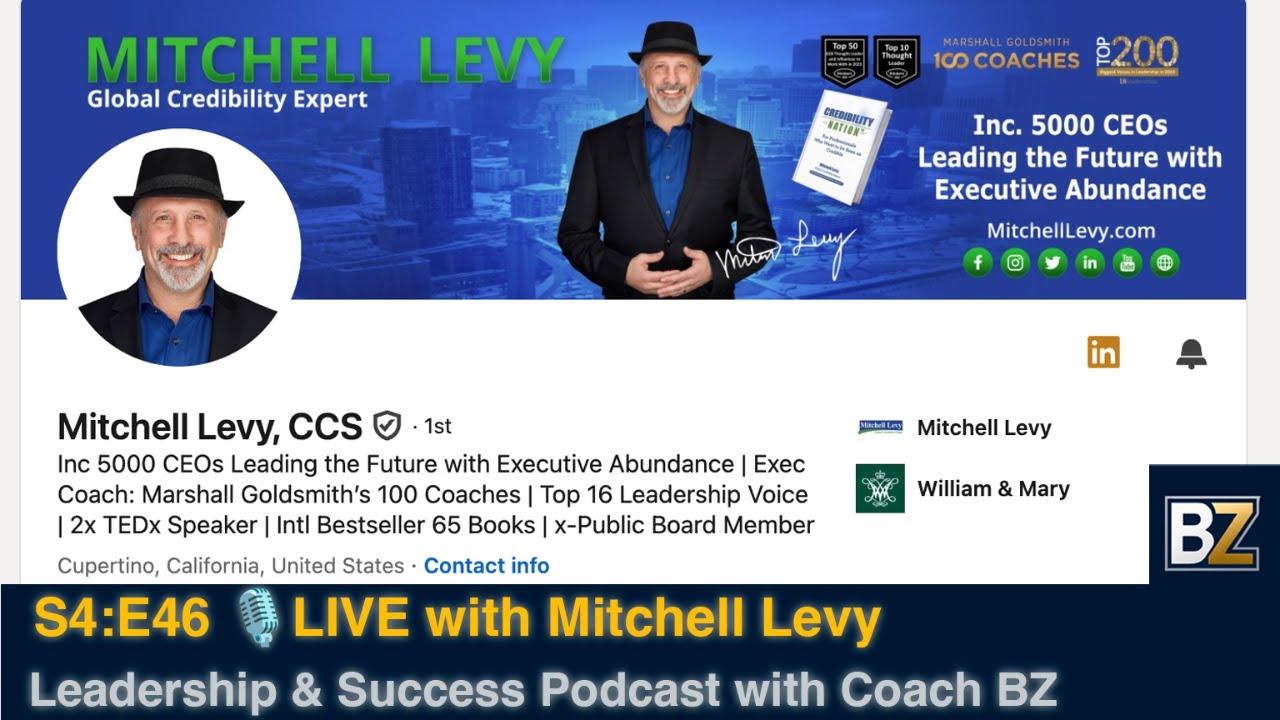
Mitchell Levy, a Silicon Valley veteran with 38 years in tech and 60+ published books, argues that credibility and clarity are the twin currencies of modern leadership. He introduces the Customer Point of Possibility, a ten-word statement that captures who a leader serves and what pain they solve. In the AI era, deepfakes threaten trust, making one-to-one relationships essential.
Chapters
Hi, I'm John Maxwell. When the top companies in the world are looking for trainers, speakers, and coaches, there's one name that stands above the rest, and that's Maxwell Leadership. Our certified team members have gotten proven results for companies all over the globe, and our reputation, I'm proud to say, is second to none. Some of our members have risen to the top of their profession, including the one you're going to meet today. I proudly introduce you to my friend Bob Fabien Zinga.
Welcome to the Leadership and Success Podcast with your host, Coach BZ. If you need to develop into a better leader, this podcast is for you. If you want to achieve a greater level of success, this podcast is for you. His mentor, Dr. John C. Maxwell, said it best: everything rises and falls on leadership. We hope to inspire you today and provide you with an insight that has the potential to positively impact the trajectory of your life. Welcome to the Leadership and Success Podcast. Imagine gaining the leadership skills that could redefine your career. Join Coach BZ on the Leadership and Success Podcast, where each episode delivers practical insights from world-class speakers, military leaders, and industry experts. We dive deep into what matters most: building resilient teams, leading through uncertainty, and navigating complexity with clarity and confidence. Every conversation is crafted for aspiring leaders like you who are ready to grow, lead, and make a lasting impact. Don't miss our powerful live sessions and recent highlights. Michelle Hayward on building diverse, high-performing technical teams. Anne Leslie on leading through global complexity and cybersecurity risk. Ron Carpenter AI exploring faith, resilience, and AI-powered leadership. Colonel Michelle G.I. Gardner-Intz on commanding influence from the battlefield to the boardroom. Chris Robinson on shifting from drift to drive in life and leadership. And Coach Enrique Acosta Gonzalez on mentorship, legacy, and heart-centered leadership. Ready to level up your leadership journey? Tune in on Spotify, Apple, Audible Podcasts, YouTube Live, and LinkedIn Live. Join the movement toward leadership excellence. Listen now and start transforming your success.
Thanks for having me here. I really appreciate it. Now, when I look around the world, I see a trend I'm not excited about. I see more and more companies, more and more people acting dubiously versus credible. My goal is to tip the scale between credible and dubious, and I would like that to be yours as well. I'm sure many of you feel this way. Now, credibility starts with clarity. If 90% of us do not actually know our purpose, if we are born, live, and die without knowing that, and 98% don't know clarity, let's start there. It's as simple— if you're a credible human, if you have a credible company, it's as simple as to focus on who you serve. And either the pain point or pleasure point that they feel they need to be addressed. Let's start with clarity, then let's move it into credibility, and let's make this a better planet together. Thanks for joining me.
All right everyone, thank you so much for being here with us. Uh, today is Thursday, August 7th. You are on the Leadership and Success Podcast. I'm so happy today I have a tremendous guest with us. Have you ever wondered how do you build trust, influence, and authentic leadership in a noisy digital world? If you've been watching the show for just a little while, you will know that we define leadership here as influence, nothing more and nothing less. And today, we have someone who has the answer. So he's a 2-time TEDx speaker, founder of Credibility Nation, publisher of over 750 books, Let me say that again. That's not a typo. He has published more than 750 books, himself authored more than 60 books. That is incredible. He has coached more than 500 thought leaders and conducted hundreds of interviews to decode the values that drive real credibility. He's helped leaders worldwide articulate their customer point of possibility and become credibly magnetic, whether in boardroom, startup, or global stages. It is my great pleasure to bring to you none other than Mitch Oliver. How are you doing today, Mitch Oliver?
BZ, thanks, Coach BZ. Great to be here. Thanks for having me.
I am so, so honored for you to be right here. Just to get started, I know we only have an hour, so much to talk about. Can you tell us about something about you that most people may not be aware of? Most people may not know.
You know, it's interesting. So I will share something. One of the best practices people talk about is they talk about, well, every day you should meditate. You should really allow yourself to sort of have reflection on who you are and how you're doing. And so, so first I'll define what is meditation. To me, it's taking your mind off of all the problems that you have, all the issues that are going on, and allowing yourself to be singularly focused on potentially nothing. So my form of meditation, I combined with walking. So I want to get my 6,500 to 10,000 steps a day. I want to meditate every day. So one of the things that most people don't know about me is I still play Pokémon GO. And so what I'll do every day is I'll go out for an hour, an hour and a half walk. And in essence, since I'm only focused on walking, making sure I don't walk across the street and hit traffic, And I'm singularly focused on nothing but playing a game whose rules I already know. And both meditating and walking and having fun.
Wow, that is incredible. Okay, can you tell us about your leadership journey?
Hmm. Let me— I think you've covered a lot of it. But let me— we'll do a snapshot of what most people think is important, right? So I've been in Silicon Valley for 38 years. Wow. Been happily married for 36, have a 27-year-old son. I've started 20-ish companies. I have sat on the board of a NASDAQ firm for 9 years. Wow. You did talk about the publishing. So published over 750 books. I've written 60. My 66th book called Executive Abundance will be the best book I've ever written. I've created executive business programs for Silicon Valley universities. And, and I think what really made me a lot of who I am today— you would ask me, you know, why do I think it's important that coming on time is coming early? I was not that person until I actually interviewed 500 thought leaders on credibility. It was my— wow— it was my Napoleon Hill journey. And so not only do I have a really good definition of credibility. But I actually unlocked a superpower. And I didn't really realize I had this superpower. And that superpower— and you mentioned it— Customer Point of Possibilities. I abbreviate it as a CPOP. I can sit with— and there's a formula that I can share— that essentially any company or any human, we can articulate where you are executing on your purpose in less than 10 words. And when you have that level of clarity, it gives you a compass that makes it a whole lot easier to navigate life.
Wow. That is really insightful. And also, I guess once you know your purpose, it makes it a little bit easier for you to say no to anything that doesn't align with that purpose, doesn't it?
So I want to say yes. And I'm going to do a teeny clarification. Right? So I didn't say that I can help you articulate your purpose, right? Because what happens a lot is when you talk to people who are very, very religious, their purpose is to serve God. And when you try to find something else, that's all they could say is to serve God. So then the next statement is, well, how are you serving God? Or better yet, Where are you executing on your purpose?
Yes.
And so it really is in less than 10 words, where— because we, we sort of think that purpose is this one be-all, end-all thing and it's what we do our entire lives. And, and maybe that's true. Maybe that's not. So what I can say is today, in today's moment, with today's resources and who you are and what you do, Where are you executing on your purpose today?
Wow.
And that makes it a lot easier for people to wrap their arms around.
No, that is so true. So talking about your story, what pivotal moment led you to dedicate your life to credibility?
I'm, first of all, I could say I'm not 100% sure. But I will tell you two. OK, one, when I was 9, when I was 9 years old, my, my parents got divorced. My father would come in, you know, one, one day during the weekend, once a month or every other month. And one of the questions the 9-year-old Mitchell asked himself is, hey, what is the purpose of a father? What role should they serve? I.e., is this being a dad or is this trying to be a dad? It was the integrity thing. Okay, now let's fast forward. Um, between, uh, let's see, I was still serving on the board of a public firm, but in 2005 I started a book publishing company. It was a nice company. We've published over 750 books. It was a great, uh, six-figure business between 2005 and COVID. Uh, we'll just say that COVID knocked it down and Amazon ran over it 2 or 3 times.
Okay.
So that publishing company is something that was powerful. And what I saw happening, and this is what Amazon brought about, is the democratization of publishing. Anyone who wants to publish a book can. Now, not everyone publishes, and that's a whole nother set of statistics, which are fascinating. But what's fascinating to me is in 2019, prior to COVID, I'm thinking to myself, you know what, it's time for me to evolve. It's time for me to do something different. And the first thing I thought about is, well, I have and have published 750 books. I've met a lot of really cool people. What do they all have in common? And what they all had in common is they were publishing the book for credibility. So I looked at the definition of credibility in the dictionary and I didn't like it, right? The definition of credibility in the dictionary at the time is the pow— is, is, is the way in which you make somebody, uh, the quality in which you're being trusted. I'm like, God, that seems light. It just feels like, like just to say that, it's not enough. So what— and I love you put up that, that credibility definition. As a matter of fact, I'll put up my own if you don't mind.
Please.
It turns out after doing the research that credibility is the quality of being trusted, known, and liked. And underneath that are the 10 values of credibility. So, what was interesting, BZ, is I didn't— when I started doing the research, I just knew I'd come up with something better in terms of a definition of credibility, or different.
Yes.
Um, I think it's better, but you know, that's me. You know, the quality of being trusted, known, and liked. It's not that I know of you, that I actually know you. But then the other thing that came out of it is understanding, and that's where I cultivated and didn't realize I was even doing that, the superpower of being able to articulate where anyone's executing their purpose in less than 10 words. So I'll just do a quick— if you're looking at those 3 pillars of credibility, the, under being trustworthy, probably one of the most important things I think about is coachability. When I look at being known, I'm looking for people who are servant leaders. So for instance, on coachability, if a, if a board brings me a CEO and says, can you coach him? The only conversation I have— A, is it going to be fun? If it's not going to be fun, it's not worth it. But more importantly, are they coachable? If they're not coachable, I'll say no, right? Um, under being known, it's being a servant leader. And, and under being likable, it's showing respect. I know that sounds really simple, but that's where— before doing the interviews, the meeting started whenever I showed up, and I was typically 1 to 4 minutes late to every meeting. Because I was busy, right? Um, but when you're having an interview, and I ended up having somewhere between every Tuesday and Wednesday, I'd have between 12 to 14 back-to-back half-hour interviews. When somebody's late, it, it messes up everything. And all of a sudden I realized, oh, I need to keep track. Do they come early? Do they come prepared? Are they, are they ready? Are they coachable? And that's when I started realizing, oh, wait a second. If they're showing disrespect for me, what am I doing? What am I doing when I come a minute or 4 minutes late? I'm like, huh, okay. So anyhow, that's sort of the thing is you asked me previously, was I military trained? And the answer was no. I was trained by being slapped in the face enough times by Wow. People who did not show me respect. And I, but I couldn't take it personally because I was, you know, doing research.
Yes.
Wow.
That is quite powerful. And being coachable is such a powerful thing because especially here in Silicon Valley, we do have a lot of very, very smart people. I think the IQ for most engineers here is just off the roof. But when it comes to emotional intelligence, I think we have a lot of work to do for sure. And Feeling like you are the smartest person in the room. My mentor always told me, if you are the smartest person in any room, you are in the wrong room because there is really no room for you to learn. So how important is it, you think, especially when you have such a big title, you are the CEO, you are the CISO, you are the executive, and you have this huge title and you have these people who follow you just because that's the way your organization is set up. How important is it to be coachable and to be humble and to be a servant leader?
You know, the hardest thing in the world, as your title increases, what you think in the past was a question turns out to be an order, even if it doesn't sound like an order.
Hmm.
Right. And so it is very, very difficult when you're in a group meeting to say anything as the, as the big cheese and not have it sound like an order. So what needs to happen is you need to put a process, a system, an approach in place, and allow other people to be able to execute from their capability. If you are a servant leader and have the intent and commitment to do the right thing, and you have people underneath you who are doing the right thing, you're just cultivating them to do the right thing.
Wow.
Now, if you want to be coachable, you can easily encourage the handful of smart people who work for you, you could easily encourage them to tell you the truth when the door is closed.
Hmm.
Right now, you don't want to have that happen publicly, but privately, you want to hear the truth. Now, sometimes, and in many cases, this is still the case, you need an outside executive coach to do that.
Yes.
But there, if you— depending on who you are as a CEO, there is absolutely an opportunity for you to go, listen, I'm coachable, I don't know it all, and we're going to have a different sort of relationship. I need you to tell me how I could help you. And that turns the channel. As a matter of fact, to me, the best CEOs are those that their job in their mind is to help everyone on their team be more effective. Versus the other way around.
Wow!
Talking about CEO or even aspiring executive who might be listening right now, what is Credibility Nation and who is it for?
You know, I love the concept. You can get to credibilitynation.com. It was one of my initial attempts after start, you know, after doing the interviews. I'm like, hey, credibility is important. I gotta sell credibility. And I spent 3 and a half years. And once again, I created a nice six-figure business selling credibility, but it wasn't the change the world business. One of the, one of the items that you tagged and information you have is a TEDx I did. It's called We Are Losing Our Humanity, and I'm tired of watching it happen. And I believe if we do nothing more than act credibly, we'll be more, we'll be more powerful, we'll be more humane. And, and so, oh yeah, you're showing my, uh, you're showing the podcast. Um, the interesting part is, is that with Credibility Nation— and now I move people over to the Substack, which is really the podcast, uh, area. It's, it's, uh, it's mitchellevy.substack.com. And what happened with Credibility Nation and what happened with Clarity is— and I'm going to tell you a vulnerable story if you don't mind.
Please.
So here I am, 3 and a half years focusing on credibility, did okay but not change the world. So I'm like, hey, I'm going to create a Clarity Certification program. This is the CCS, Clarity Certification Specialist, and did that for a year. Also got enough people in the room, turned into a six-figure business. And it's been now, I think it was 8, 9 months ago I had a friend of mine slap me in the face. Not physically. Okay. But he was and is a really good marketing person. And one of the things that he asked me, he goes, he starts the conversation. So, Coach Bizzy, imagine this. Somebody comes on the conversation and says, Mitchell, I know every living marketing person on the planet today who has a brand name. There is nobody who does clarity as good or better than you do. You're the best. Like, okay, my, my— by the way, if you're gonna clip that, don't just stop, make sure you finish the rest, right?
Yes.
And I go, oh my God, that's so exciting. And then he says, all right, so how many people don't have clarity? And based on the research, it's 98%.
Wow.
I know. By the way, 90% of humans do not know their purpose. 98% don't have clarity. Okay, crazy. And if you want to ask yourself if you know, if you have clarity, in less than 10 words, can you articulate who you serve and their pain point or pleasure point off the top of your head? Right? That's what the CPOP is. So he says, Mitchell, I'm going to share something with you you're not going to like. Now he opens up the conversation. I'm like, my head is like really big. He goes, but I'm going to share something you're really not going to like. And, and what I want you to picture is a balloon. So imagine a balloon is filled up and you take a pin and you stick in the balloon, and all of a sudden it deflates, like immediately pops and deflates. He did that to me. I couldn't imagine he could, but he did. So here's what he said. He goes, Mitchell, you are world-class at something that 98% of your audience doesn't have. They don't have it either because they think they have it and they don't, or they don't think they need it. Either way, that number sucks.
Hmm.
I couldn't argue with him. And what he, what he ended up doing, which is nice— so by the way, if you're ever going to pop somebody's balloon have a way out. So he goes, oh, Mitchell, let me help you. And I will, I will tell you what he did immediately. And then when I woke up the next morning, what I got. What he said was, Mitchell, look me in the eyes right now. Tell me what you could do for me this minute that will put money in my pocket tomorrow. And I go, huh, executive presence. You know, think about this. I've published over 750 books. I've been on LinkedIn since before LinkedIn was making money. I know this world of executive presence. I've now morphed that phrase into executive abundance.
Yes.
The next morning I woke up and I remembered something I've known my entire life. Oh, thanks for sharing executive abundance.
Yes.
There's something I've known my entire life but didn't follow to about 9 months ago.
Hmm.
And as soon as I say it, you go, yeah, of course. But even though we know it, we don't always follow it. Are you ready? Here we go. Sell them what they want, deliver what they need.
Hmm.
Sell them what they want, deliver what they need. So after 1 year interviewing 500 thought leaders, thought leaders, 3 and a half years deploying credibility and a year deploying clarity, I realized that both credibility and clarity are things that people need, not what they want.
Wow, what a difference, right?
Because so one of them is my executive coaching has always focused on executive abundance. I just didn't label it.
Mhm.
The other thing I ended up doing is buying a, a LinkedIn agency Supporting Leaders Tired of Slimy LinkedIn Sales Tactics.
Yes.
And what we're doing there, by the way, is kind of fun, is I'm just helping those people who are in business build relationships using LinkedIn.
Wow. And I know I've heard you speak about being fully present and listening with not just your ears, but pretty much your entire being. And that really does make a huge difference. So what, what would you say to someone who wants to become credibly magnetic? I think that's a term that you came up with as a new author, speaker, or executive.
You know, I'm going to share this. I'm going to share this again. As many of these values as you can demonstrate makes you more memorable, right? If, if you're coachable and, and authentic and, and have external and internal integrity, they're both aligned, and you're vulnerable, like, people trust you. They just do. If the first thing you care about is, is being of service to others, By the way, thank you for, for showing me, showing me respect, sharing your stage. I call it sharing cred dust. That's under being likable. And having the intent and commitment to do the right thing. What a great opening you did, right? And so if you start showing up this way, you become memorable. You become one of those people that people want to recommend. Now, how can they recommend you? You have to make it as simple. I'm gonna say, I'm gonna go back to, if you deliver with clarity and, and, and then share your credibility, people will remember you and share you. So what does that mean? If you can articulate in less than 10 words who and how you serve, then when you show up with credibility and people go, wait, I trust that this person will support my friend, or support this recommendation, or make me feel good by recommending them. That's how you get referral partners to want to refer you. That's how you get customers to want to buy from you.
Yeah, and I've also heard you talk about the Agricultural Age, right, Industrial Age, and then I guess the Information Age now. But it seems to me like in 2025, right, this is the, uh, still the 21st century. However, we are getting into the age of artificial intelligence. So can you tell me how with AI on the rise, deepfake and misinformation everywhere, how do we preserve trust in the age of machine-generated everything?
I think, I think so. Something happened in 2023, and I'm going to, I'm going to back up first to 1996. Yeah, I was at Sun Microsystems in the, in the early days before the dot-com days. And Sun Microsystems was one of those companies, uh, that's associated with bringing the internet to the world. But it was really, it was really, uh, DARPA is really the, the ability of, of the government who, who called for the internet. It was around for a number of years, but when the world started seeing the internet was 1996. In 1996, Marc Andreessen came out with Mosaic, and all of a sudden people got to see what the internet is. Now think about the internet today versus 1996, right? Think about 29 years, and what does that mean since that came out? Okay, let's fast forward to 2023. We've been talking about AI for 60 years, but in 2023 OpenAI came out with ChatGPT. Yeah, I will tell you with no uncertain terms, is OpenAI and artificial intelligence has now made thought leadership ubiquitous.
Hmm.
If thought leadership is ubiquitous, everything we can think of in terms of how people did jobs, how they— the, the speaker that would get up there that would tell you the truth We, we can immediately look at their phone and see that it's not the truth. Yes.
Huh.
So, so what that means is, how do you establish trust? And the answer is, for many, many cases, it's on a one-on-one basis. And being able to actually know, like, if you have your— you had said when we were in a green room that you'd been following for a while, you saw a lot of other stuff, you like what I do. But you still, you sort of knew me, but it's when we started talking that you get to know me.
Yes.
All right. And, and I think instead of thinking about the world of how can I sell one-to-many, we all have a lot of tools that can do that. How can I sell, communicate, be of a, be effective and be a servant leader one-to-one?
Hmm.
That is, I think that's kind of where we're Where we need to lead is those advocates, those clients who trust, know, and love us.
That is quite powerful. So, as we look at future boardrooms and policy spaces, right, how do you see credibility becoming a leadership currency in the next era?
Well, this comes down to the concept I have. And if you wanted to show the Executive Abundance screen, If you went to executiveabundance.com, this is the new thing I'm focused on. And you could sign up to be notified of the book when it comes out and see what we're doing.
And that's going to be next April, right?
It's next April. Yeah. What's interesting is having sat on the board of a public firm and having coached a lot of execs of public companies, I'm going to say something interesting. And that is the primary stakeholder most public companies focus on is the investor, right? So when we do that, we're ignoring 4 other stakeholders. So it's, it's hard to read that screen, but all I'll say is you're ignoring family and self. Yeah, like, what's the purpose of making your investors happy if you're in a hospital? Right? Or if you're getting divorced or your kids don't know you. So that's one of the stakeholder groups. Uh, employees. If you do a good job empowering your employees and making them effective, guess what? They're going to do a good job of making your customers happy.
Yes.
If you do a great job of making your customers happy, guess what? That's going to turn into making your investors happy.
Yeah.
And subsequently, there's a community at large, both virtual and physical, that, that you play in, that you need to make sure you address. And so the boardroom of the future will be looking at metrics that are not just how much money, are we hitting our earnings, all of that stuff. But the metrics we need to look at need to incorporate all 5 stakeholder groups.
Wow, that is quite comprehensive. Yeah, I must say that in my experience in Silicon Valley, many times we have those lofty goals, or we say these are our core values. First of all, not everybody in the company knows what those core values are. But even when we say like, one company I worked for, believe it or not, one of the core values was dinner at home. But just imagine how many times they actually allowed us to have dinner at home. Almost zero, right? Because they really wanted people to stay at the office like 60+ hours a week. But that was on paper one of our core values, dinner at home. And then of course, the very first time they have a little challenge or whatever, and their short-term solution is to just lay off like half of the company or an entire department. First time I ever saw that, like the entire QA department, they told them it was about 60, 70 people, everybody was laid off all at once. It's like, what about your mortgage? What about your family? What about themselves? It's like, okay, whatever. So yeah, that's definitely very, very important if you are going to be a company that has core value, integrity, and trust and those type of thing. Wow, that is powerful. Okay, it is this time now in the podcast where we are going to switch over to the second half. Before I do, is there anything you wanted to share?
You know, it's interesting. I'm enjoying the fact that this is not your standard interview and podcast. And thank you. I love your enthusiasm. So you clearly love what you do. And I'm honored to be here. So thank you again.
Outstanding. And just to let you know, I am checking on the chat too. Somebody from Twitter, I told you we We broadcast on Twitter as well. It goes by @Lejumenschtraw. It just says I. Usually I don't get any serious questions there, but there's someone from LinkedIn, Terence. He's actually a veteran. He says he used a niche publisher for his first book. Now he's decided to publish his second book himself. What advice would you give someone in my position to market the book as an independent author publisher? He hadn't thought about credibility being via purpose. Ah, for a driver.
So it's a great question, and it really requires a mindset change. Okay, the, the biggest thing, and, and, and this was potentially true 20, 30, 40 years ago, is that you might actually publish a book to make money on book sales. Okay. But at the time, and this was starting in 2005, and I have a number of authors that have made six figures in book sales. That said, the primary purpose of a book, if you're writing a book and you're in business and you're writing a non-fiction book so that you can actually, um, do more consulting, do more speaking, do more coaching— if that is the purpose of your book, it almost doesn't matter how many books you sell.
Yes.
Okay, what matters is that you— are you ready? Hear my words— you put the books in the hands of the people who need to see them. So the best technique— and this was now 20 years ago, and, and I've repeated this over and over again— the best technique any author has ever done is before the publishing time, they've, they've actually written down the addresses of— in this case, she wrote down 300 addresses, um, professors, uh, referral partners, potential clients. And when the book came out, she had written the addresses. She created, uh, USPS and FedEx envelopes And she wrote handwritten notes to everybody.
Wow.
And stuffed the book in all those envelopes. And then her and somebody else on her team did follow-up calls. From what I can tell, last time I talked to her, she has been like 80% capacity utilized. Wow.
That is, that is wonderful. Wow. Really doing everything with intention. Okay. All right. So For the second segment then, the first portion of that, I'm gonna ask you what's one of the greatest lessons you've learned so far?
Hmm, God, there's so many fun lessons. Give me a hint, what do you like?
I don't know, maybe it could be a life lesson, leadership, or even, I mean, I guess it was a Life-changing experience for you, right, to speak to more than 5—
life-changing. Let me do a life-changing. Okay, so, you know, during the dot-com days, I was really busy, uh, the type of busy where you're, where you're working 7 days a week, loving what I'm doing. And, and my son was born, uh, so as you could tell, a couple years ago my son was born, and That first year, although my wife was in the house and I was in the house, um, I didn't spend as much time with him as, as I could have or should have. And as I was talking to people, they, they told me I would regret it if I don't. And so I went to my wife and I said, hey honey, I got a gift for you. She goes, okay, great. I put her in an embrace and I go, I want to give you every Sunday, every Sunday I'm going to take our son, his name's Duncan, We're gonna call it Daddy Duncan Day. Now the thing is, she was really smart and she immediately said, hey honey, that's a gift for you, not for me.
Hmm.
Now first of all, I could have not been coachable, right? I could have said— I could have argued and got mad and all that. And I go, huh. I said, okay, let's not stop the embrace till I have an answer. Right. And then I was racking my mind. Ooh, I was thinking necessarily me first, because in her mind, think about this. Uh, she will be the disciplinary 6 days a week. I'm the fun dad 1 day a week. Yeah, she was absolutely right. And by the way, it was fun to about 16. And he goes, yeah, dad, I don't know about that Daddy Duncan day anymore.
Right.
So, um, and what I thought about is what she loved most is traveling to Europe. And so I said, well, what if I took 4 to 6 weeks every year and we go to Europe? And, you know, if I— I'll have to run the business, you know, I won't, I won't do business development, but whatever needs to happen, I'll keep doing it. Yeah. Um, what if I did that? You do all the booking and I'll do the rest. And for 25 years, we've rented a house in Europe for a month and invited friends and family, and that That lesson came from my wife, for me listening to my wife. And by the way, we've had amazing times and amazing years and have lived our life as life is going by. And, but if I didn't listen and I didn't think and I didn't want to be a servant leader to my wife who told me that my gift to her was a gift to me, that may not have ever happened.
Wow, that is beautiful. And talking about going to Europe, I think we initially thought we would schedule this interview last week, but I think you were in Paris, France, weren't you?
Well, it wasn't Paris, it was much further south, but it turns out about 20 years ago, there was a family and their two boys, so husband, wife, and their two boys, who came visit us two years in a row. And, uh, and they invited us to go to France. Now, we normally wouldn't go to France booking a month ahead of time and just staying for a week, um, but when my wife says, can we afford to go? And my response was, can we afford not to?
Yes.
And I have to tell you, when we went, first of all, we had a great time for two reasons. One, when you're a host, you're responsible, or at least in your mind, you're responsible for everyone's travel and what they do and they get there safely and they're having fun. When you're a guest, you get to eat, drink, and enjoy. So yes, that was one reason. But the other reason, which was really fascinating, is each and every day he thanked me for the gift I gave him 20 years ago. Because in his mind, he had a great year last year and decided that he was going to um, put money aside to do— are you ready? I'm putting in double quotes— do what the Leavis did.
Wow.
Right? And, and so when I said, can we afford not to, I didn't realize that the answer was, yeah, we really couldn't, because he needed to— in his mind, he needed to pay us back for that gift that we had given back then. And I, I'm honored. I'm, I'm glad we went. We had a great time, and we actually did sort of we actually did see a leg of the Tour de France, which was even more fun.
Oh, wonderful. Donc vous parlez un peu français? Un peu.
Un tout petit peu.
Très bien. Yeah, because I am originally from the Congo, which was a French colony. My extended family, half of them are French citizens, the other half African. Anyway, I go to France quite often. So what are you learning now? I know leaders are learners. What are you learning?
You know, the— it's— I'm getting a PhD. Um, the coursework is done, and where my thesis is going is on that concept of executive abundance.
Yes.
And it's— what I'm learning is that some of these systems are already in place. We just don't use those words, and, and they've been changed into something different. So that's really what the thesis on is, tying together past research and things that are happening and existing, uh, company successes so that we can actually, we can actually start considering in the boardroom running a company different than just focusing on the quarterly returns.
Yes. Wow, that is so— I think that is so needed right now. So the next question I'm going to ask, I love this going One side says success, the other side says failure. So we know about all of your successes and all of the great things you've done, but how has failure shaped your life?
Oh, I had, I had two really cool failures. Um, now notice I use the word cool and failure in the same sentence, right? Um, the first one that really absolutely changed my life was— so I left Sun Microsystems 1997, created an e-commerce consulting business, ended up running 4 conferences for the largest IT conference at the time, which was COMDEX, did executive coaching work for a Japanese firm, um, did lots of fun things. We created the first e-commerce management program on the planet where people from around the world fly in to learn what the— what integrating the internet into business meant. And that business, running an e-commerce consultancy, was really good during the dot-com days. But somewhere around the 2000 timeframe, we had the dot-bomb. Now, one of the things that was interesting at the time is, is, uh, one of my students from, from the the e-commerce management program, asked me if I could be part of a CEO networking group, you know, similar to a Vistage-type group. And I said, sure. By the way, he made me a promise which wasn't true. He said, hey, Mitchell, I just need your name. You don't have to do any work. But, you know, if you're doing a networking group, which, by the way, we live in a networking life and society, Yes, you have to do work, and that is relationship building on a continuous basis. So that business was making about $60K a year. The, the consulting business, the e-commerce consultant, was making a whole lot more, um, that in the executive coaching. And, and so I was just about ready to, to boot the CEO networking business, and all of a sudden the dot-com came, and my every everything associated with coaching and e-commerce went to zero.
Wow.
And, and so then, by the way, $60,000 looked really good, just to be clear. Now what was interesting is the big lesson I learned was that it wasn't me, right? I didn't— there was nothing I could have done to stop the dot bomb, right? There's— that was not in my purview. Yes, recognizing that it wasn't me and life is changing and maybe always having more than one egg in your basket, multiple streams. Yeah, right, makes, makes a lot of sense. And, and so subsequently I was much more prepared when COVID came about and my book publishing business essentially went to zero. Right, same sort of thing. It's the authors I was working with were using books that corporations would buy, the conference— conferences would buy. And when we didn't travel for a couple years, yeah, those book sales didn't happen. And I was getting a really nice back-end recurring revenue stream.
Yes, right.
But you know, the thing is, I, I had already— I'd seen this story before. Because history always repeats itself.
Yeah.
And so I was just better off. So the, the lesson I learned is sometimes things don't work not because of you, but because the environment has changed around you. So let's bring that to today.
Wow.
Who you are today and what you do and how you live is going to be so dramatically different than tomorrow because of AI. If you don't believe it, you're going to be— you're going to disappear. Like all the dinosaurs. So everything every human does today is going to change. I just got to work on it and prepare for it because that is a— once again, think about 1996 and Mosaic and internet today.
Yes.
And now think about 2023, who you were and what you did then, and even where you are now a couple years later. But think about 5 years since then. 3 years from now. I think about 7 years from now, like 10 years from the time AI has come, like every job that was in 2023 won't exist. It'll be changed. So how can you be part of that transformation?
Wow, that is very, very profound. Okay, so who are some of your thought leaders, some of your mentors?
Uh, it'd be impossible for me not to say Marshall Goldsmith, who has had a significant, uh, a significant opportunity and transformation of me and who I am, uh, in my life, right? I— yeah, he is truly a servant leader, and his— what he does now is, is give away all of his tools. And he has an AI called marshallgoldsmith.ai. So if you want to go there, you can actually talk and interact directly with Marshall Goldsmith.
That's amazing.
You know, I also I enjoy some of the greats like Brené Brown, who talked about vulnerability. You know, I'm going to say I often quote both in positive and negative ways Simon Sinek.
Right?
Because Simon says the why is most important. I'm going to tell you why isn't always most important. I think the CPOP is most important. But that's a different story. OK? And, and what I'm going to say is, having interviewed 500 thought leaders, having deployed over 1,000 CPOPs, I learn from people all the time. Um, one of the guys who are part of— I'm part of the 100 Coaches, uh, with Marshall Goldsmith, and, and one of the, one of the people who are part of the Marshall Goldsmith Coaches is a guy by the name of Gary Ridge. Gary was the former CEO. He's still, uh, chairman emeritus at WD-40. WD-40 is a company that truly executed on the purpose, what I call executive abundance.
Yes.
Even though obviously I had nothing to do with that, but Gary was that person. And in the book, I'm actually finding case studies. I've got 10 companies that I've cited are doing things along the lines of executive abundance. Wow. So having, having interacted and exchanged lots of conversations throughout the years with, with Gary Ridge, and now you could learn, he's got a book called Any Dumbass Can Do It. Um, it's very Australian type book, right? Um, and there are others. I, I think there were, I, I mentioned 3 other books. Uh, one was a book we published, guy by the name of Christian Boo, uh, Bukosis. He wrote a book called The Afterburner Advantage. Yeah, so for anyone in the military, it takes— in this case, it's Australian Air Force methodologies and approach, but anyone who's in the military, you'll really appreciate him taking the, the standard military sort of processes that people go through and he applies that to corporations. That's called The Afterburner Advantage.
Wow, that is, that is wonderful. So, uh, if you could choose 3 people to have dinner with, who would you choose and why?
Oh, that's interesting.
Alive, dead, or mythical figures?
Yeah, well, you didn't prepare me in advance for that one. Um, man, I would, I would say Jesus would be one of them.
Mm-hmm.
Uh, trying to think about who else would be interesting. I, I'd want to say Socrates, but I don't think I get a word in edgewise, so I'm not going to put him on the list. Um, I, I would go with live. If it was private, I probably would say Trump. Uh, I'd love to see and learn Whether or not I agree or disagree with the politics, that would be, that would be really interesting. I'm trying to think about, you know, and I'm going to say Obama, not at the same time, by the way.
Yes. Great. And for some of the books you've already mentioned, let me see, you should see it on the screen. Hold on. Come on, technology. Okay, I'm trying to share my screen here.
Uh, oh, I'm seeing the Afterburner Advantage at the moment.
Okay, you, you do? Okay, for some reason I cannot see it. Okay, you, you can see it. So we mentioned the Afterburner Advantage by Christian Bucosis, uh, great book. And of course You also have Any Dumbass Can Do It, Gary Ridge from WD-40.
Yeah, yeah, Any Dumbass Can Do It, right? WD-40. Yeah, he's, he's, uh, that's a great book as well.
What about Selling the Wheel?
You know, there were two other books that I mentioned. Uh, Selling the Wheel, this is a really old book. Like, if you want to listen to the book, yeah, They will sell you old cassette tapes, right? So it's a really old book. But Selling the Wheel is where I learned that not all salespeople are the same. It's a very simple, very simple fable. It's, you know, if you read any of the Patrick Lencioni fables, you know, it's very similar along those lines. So Selling the Wheel really changed my mind in terms of what a salesperson was. And The E-Myth by Michael Gerber. And there's a lot of permutations of that. Now, that one changed my mind about what an entrepreneur is.
Yes. Wow. Powerful. Okay. We are running out of time. I think I only have about 8 minutes with you, but I think we can do this. So, if you had one day and only one day to live, what would you have liked your final contribution to be? Hmm.
You know, I recognized a couple years ago that I had hit all my bucket list items.
Hmm.
And so I believe I am living every day what I want my final contribution to be. Wow.
That is amazing. I told you before the interview, when I grow up, I want to be just like you. Now it's definite. That is awesome, dude.
You're so— well, you're way too kind. Thank you.
But tell me seriously, what do you think is the secret of your success? Because it's very rare to see someone who really lives their purpose, right? You don't see that very often, you know.
It, it, if we're going back to the, the, the secret, take a look at the, I really think, and this is where the Executive Abundance book, the Credibility Nation book is a book that came out after I finished the interviews.
Yeah.
The Credibility Nation. And it's got lots of raw data in it. You know, it's like, it's the raw data of, of focusing on interviewing 500 thought leaders. You know, it's like The Think and Grow Rich before people really thought about it, right? He interviewed 500 millionaires. The, the interesting part is, is I've now had the chance— oh, you even had that available, how cool— I've even had the chance to, um, deploy credibility. And so if you have clarity and you're executing at it in a credible way, there's nothing to regret, right? So if you can— the CPOP, that definition we— I sort of flirted at a couple times. If you know in less than 10 words who you're going to serve and their pain point or pleasure point, that's the compass. Wow. Execute that compass in a credible way, then those people who need to be in your, in, in your audience they're going to find you. Those will be your referral partners. Wow. That want to do business with you will buy from you. And if you, if you can do that every day— and by the way, what happens is your CPAP is going to change and who you serve is going to change. But if you can live your life being a servant leader and doing that for, for the exchange of energy— many cases the exchange of energy could be money, the other there could be opportunities where the exchange of energy is for something else. Wow. But if you could do that, what, what, what, what will you regret in life?
Man, that is so simple but so powerful. Okay, we are almost out of time. Can you give me a couple more minutes? We almost done. I think I can make it happen.
You got it.
Thank you so much. I really do appreciate it so much. But really, like we say, you're really— execution is everything. Because sometimes when I coach people, I talk to people, they're like, I already know that. But the truth is they don't know it because they're not doing it. Right? The only way I know that you know it is when you do it. By doing it, you're proving to the world that you know it. But unless you do it, if it's just head knowledge and it's not in your heart, it's not in every fiber of your being, you're not actually working it out every day. And again, that consistency, right? Day after day after day. Like one of my mentors, Darren Hardy, he wrote a book, The Compound Effect. I really love that book. He said something like, what would happen if everybody like they went to McDonald's and they ate one of those junky burger or whatever, and then they gained 500 pounds on the spot, nobody would eat at McDonald's ever again if it happens right away. But the thing is it takes time. It takes a lot of time. And the same thing when you do something right, it doesn't happen right away, but you have to be consistent. And it's by execution that you actually see the possibility. Okay. We are toward the end. One of the last questions I ask is, you've been so generous with your time. Thank you. Thank you. Thanks so much. How can we add value back to you?
No. So two ways. And normally only ever give one. So two ways. If you actually go and, and Coach BZ, I'm glad you did this. Go to executiveabundance.com and just sign up to be notified when the book comes out. Right. And share it with your friends. Like, like that would be amazing.
Okay, right.
And, and then the second thing is my website is— so that's a website, but my website's mitchellevy.com. And if you go to mitchellevy.com, you can see the stuff I'm working on. And if you really are intrigued by any of the things that I'm doing, um, oh, that's, that's my LinkedIn, by the way. Um, yeah, but, uh, just the mitchellevy.com. Um, so if you go to mitchelleavy.com, you can, you can take advantage of any of the programs we're running, or if you want to book time on my calendar, feel free to do that. So that's at mitchelleavy.com. And it just, you know, I'm— that's, you know, it's so funny, we try to figure out how do we show up in the world in one way, um, and at the moment it's, it's mitchelleavy.com. I have a nice LinkedIn presence and at some point in time, the more the Executive Abundance will appear on Mitchell Levy. It's some— I'm in the middle of build mode on the Executive Abundance side.
Wow, that's wonderful. Okay. No, this is, this is great. Okay. And then this is the very end. One question I do want to ask you is, if you could go back and give a piece of advice to your 17-year-old self, standing at the edge of his incredible career you've had, what would you say to him?
Hmm, you know, the tongue-in-cheek one is, um, uh, not only buy Amazon but hold for a while.
Yes, yes, incredible.
There's a couple companies I— there's a couple companies. Do you remember Webvan during the dot-com? Yeah, yeah, yeah, Webvan. I did buy. I lost my money. But Facebook I bought and did well, and Apple, and you know, there's just, there's some obvious ones that you're like, huh, it's crazy. Buy more. Why did I get, you know, my financial advisor was saying, you know, you should go and take more of a mortgage on your house and buy. Yeah, dude, that's not sound financial advice. Sorry.
Yeah. Sometimes I even think about Blockbuster. They had the chance to purchase Netflix, but, uh, they just missed it. But it's really incredible how technology can just disrupt an entire industry like that. Wow. Okay, so we have to do it now. 3 adjectives that describe you as a child.
What do you think it is based on this conversation?
You tell me, man.
As a child, I was, uh, 3 adjectives. I was lost. Lost, unaware, in the clouds.
Okay, as an adult.
Ah, servant leader, clarity and credibility.
That is correct. Okay, so this is it. And the very, very last question I'm gonna ask you, and thank you so much for giving us a couple more minutes. Again, I'd like to end this show right on time. I'm very, very thankful for you taking the time here. But the very last question I'm going to ask you— actually, before I do, is there anything else you wanted to say to the audience?
Thank you. Once again, I'm honored to have had the questions that you've asked, and I appreciate that. A good interviewer will always cause the interviewee to think about how they say things different and how to formulate things differently going forward. And, you know, you're no different. And I, I appreciate it. And it looks like, and hopefully there is some opportunity for us to do something together going forward.
Absolutely. So the very last question I'm going to ask is one word that comes to mind about representing our shared experience on this podcast today.
Sorry, I got caught up in Terence's—
Yes.
Terence's comments. So, let me focus on you. I wasn't present. Okay, ask me again. Sorry.
One word that comes to mind. Don't think too hard. Just one word that comes to mind representing our shared experience together on this podcast.
Oh, heartfelt.
Okay, mine would be grateful. So, thanks again. So grateful for you to be here, the one and only Mitchell Levy. And thank you so much. And, Yeah. And actually, before I let you go, let me triple check to see if I have another question from LinkedIn. Sometimes I miss those questions based on how LinkedIn shows. I think I need to get my daughter to do this for me.
Okay.
Terence says, Precious, he says, what a great interview. Thank you both for sharing your time and that relationship. So basically good things. Okay. No questions for you. Thank you so much, Mitchell. Really, really appreciate that.
My pleasure. Thanks for having me.
Okay.
Take care, everybody.
All right, everyone. Thank you so much for being here. And Terence, thanks so much for being active. I really love the feedback because sometimes when we produce this content, not always sure who's listening on the other side. So thank you so much for the feedback. And I'm going to be back here tomorrow. And until then, have a wonderful day.
Thank you for listening to the Leadership and Success Podcast with your host, Coach Beezy. If you like what you heard, please subscribe to our channels and come back for more wisdom nuggets on how you may develop into a better leader and achieve greater levels of success. Leadership is the most critical skill. The world will always need leaders to lead others, deploy the next disruptive technology or execute a business strategy, you may as well decide on counting yourself among the 21st century leaders. See you right here next time on the Leadership and Success Podcast with
More from Bob

S250:E4🎙️LIVE 🇺🇸America 250: President Barack Obama Leadership, Service, and the Power of Hope






S5:E157🎙️ LIVE with CMD CMSgt Dennis L. Fritz, USAF (Ret.)(Multi Tracks Audio)



S5:E156🎙️ LIVE 🇪🇸 Leadership Lessons from the FIFA World Cup 2026 Champions (Multi Tracks Audio)

S250:E3🎙️ LIVE Leadership Lessons from America’s First Documented Family of African Descent 🇺🇸📖