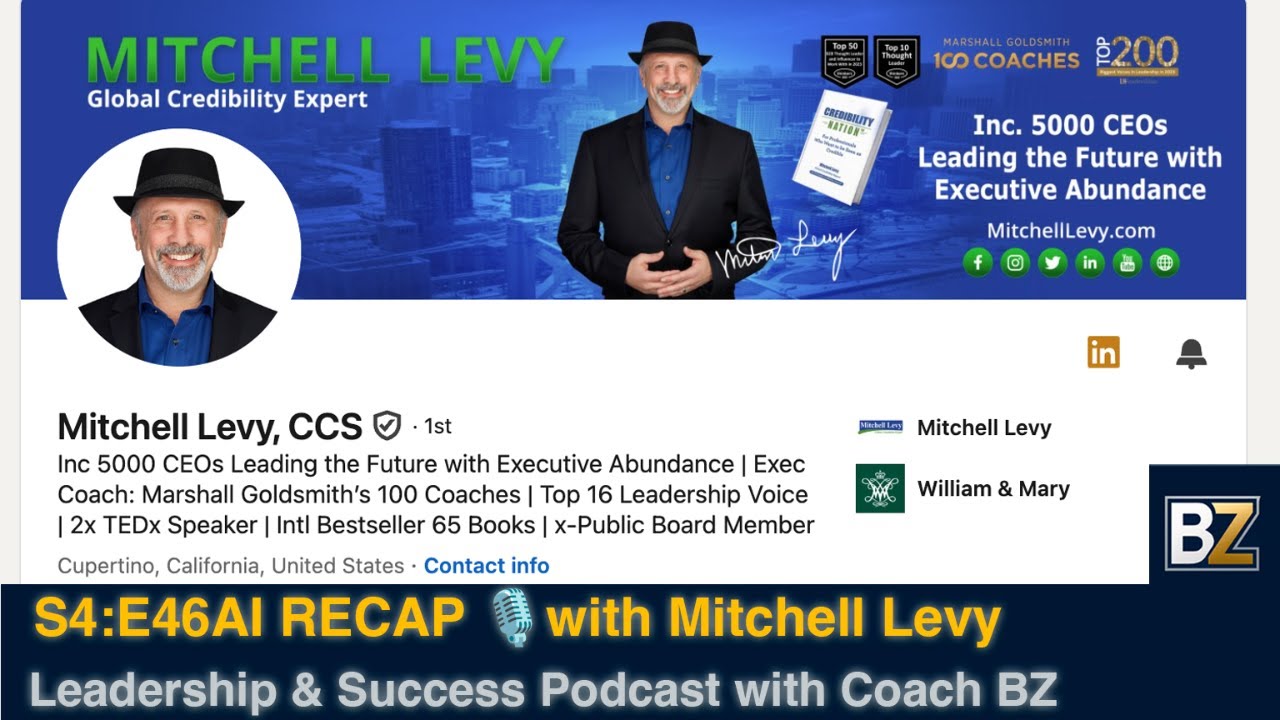
Mitchell Levy introduces his CPOP framework for leadership, a 10-word personal mission statement, and the Executive Abundance model that balances five stakeholder groups: self, employees, customers, investors, and community. He shares how the dot-com bust taught him that external forces, not personal failure, drive setbacks, and argues that authentic one-on-one relationships matter more in an AI-saturated world.
Chapters
Hi, I'm John Maxwell. When the top companies in the world are looking for trainers, speakers, and coaches, there's one name that stands above the rest, and that's Maxwell Leadership. Our certified team members have gotten proven results for companies all over the globe, and our reputation I'm proud to say, is second to none. Some of our members have risen to the top of their profession, including the one you're going to meet today. I proudly introduce you to my friend, Bob Fabien Zinga.
Welcome to the Leadership and Success Podcast with your host, Coach BZ. If you need to develop into a better leader, this podcast is for you. If you want to achieve a greater level of success, this podcast is for you. His mentor, Dr. John C. Maxwell, said it best: everything rises and falls on leadership. We hope to inspire you today and provide you with an insight that has the potential to positively impact the trajectory of your life. Welcome to the Leadership and Success Podcast.
Imagine gaining the leadership skills that could redefine your career. Join Coach BZ on the Leadership and Success Podcast, where each episode delivers practical insights from world-class speakers, military leaders, and industry experts. We dive deep into what matters most: building resilient teams, leading through uncertainty, and navigating complexity with clarity and confidence. Every conversation is crafted for aspiring leaders like you who are ready to grow, lead, and make a lasting impact. Don't miss our powerful live sessions and recent highlights. Michelle Hayward on building diverse, high-performing technical teams. Ann Leslie on leading through global complexity and cybersecurity risk. Ron Carpenter AI exploring faith, resilience, and AI-powered leadership. Colonel Michelle G.I. Gardner-Ins, on commanding influence from the battlefield to the boardroom. Chris Robinson on shifting from drift to drive in life and leadership. And Coach Enrique Acosta Gonzalez on mentorship, legacy, and heart-centered leadership. Ready to level up your leadership journey? Tune in on Spotify, Apple, Audible Podcasts, YouTube Live, and LinkedIn Live. Join the movement toward leadership excellence. Listen now and start transforming your success.
Thanks for having me here. I really appreciate it. Now, when I look around the world, I see a trend I'm not excited about. I see more and more companies, more and more people acting dubiously versus credible. My goal is to tip the scale between credible and dubious, and I would like that to be yours as well. I'm sure many of you feel this way. Now, credibility starts with clarity. If 90% of us do not actually know our purpose, if we are born, live, and die without knowing that, and 98% don't know clarity, let's start there. It's as simple— if you're a credible human, if you have a credible company, it's as simple as to focus on who you serve. And either the pain point or pleasure point that they feel they need to be addressed. Let's start with clarity, then let's move it into credibility, and let's make this a better planet together. Thanks for joining me. Well, this comes down to the concept I have. And if you wanted to show the Executive Abundance screen, um, if you went to executiveabundance.com, this is the new thing I'm focused on. And you could You could sign up to be notified of the book when it comes out and see what we're doing.
And that's going to be next, next April, right?
It's next April. Yeah. What, what's interesting is having sat on the board of a public firm and having coached a lot of, of execs, uh, of public companies, I'm going to say something interesting, and that is the primary stakeholder most public companies focus on is the investor, right? So when we do that, we're ignoring 4 other stakeholders. So it's, it's hard to read that screen, but all I'll say is you're ignoring family and self. Yeah, like, what's the purpose of making your investors happy if you're in the hospital, right? Or if you're getting divorced or your kids don't know you. So that's one of the stakeholder groups. Employees, if you do a good job empowering your employees and making them effective, guess what? They're going to do a good job of making your customers happy.
Yes.
If you do a great job of making your customers happy, guess what? That's going to turn into making your investors happy.
Yeah.
And subsequently, there's a community at large, both virtual and physical, that, that you play in, that you need to make sure you address. And so the boardroom of the future will be looking at metrics that are not just how much money, are we hitting our earnings, all of that stuff. But the metrics we need to look at need to incorporate all 5 stakeholder groups. Yeah, like what's the purpose of making your investors happy if you're in the hospital, right? Or if you're getting divorced or your kids don't know you. So that's one of the stakeholder groups. Employees. If you do a good job empowering your employees and making them effective, guess what? They're going to do a good job of making your customers happy.
Yes.
If you do a great job of making your customers happy, guess what? That's going to turn into making your investors happy.
Yeah.
And subsequently, there's a community at large, both virtual and physical, that, that you play in. That you need to make sure you address. And so the boardroom of the future will be looking at metrics that are not just how much money, are we hitting our earnings, all of that stuff, but the metrics we need to look at need to incorporate all 5 stakeholder groups.
Wow, that is quite comprehensive. Yeah, I must say that in my experience in Silicon Valley, uh, Many times we have those lofty goals, or we say these are our core values. First of all, not everybody in the company knows what those core values are. But even when we say like one company I worked for, believe it or not, one of the core values was dinner at home. But just imagine how many times they actually allowed us to have dinner at home, almost zero, right? Because they really wanted people to stay at the office like 60+ hours a week. But that was on paper, one of our core values, dinner at home. And then, of course, the very first time they have a little challenge or whatever, and their short-term solution is to just lay off like half of the company or an entire department. First time I ever saw that, like the entire QA department, they told them it was about 60, 70 people.
Welcome everyone. Today, Um, let's dive headfirst into the idea that clarity and credibility aren't just buzzwords; they're the very essence of powerful leadership. Think about it—when you know your purpose clearly, your influence naturally skyrockets. Absolutely.
And it's interesting how the idea of a crisp 10-word statement, the CPOP, right, can serve as a compass. It's like, um, a mini mission statement you can use every single day.
Exactly. Yeah. Mitchell Levy, for instance, shows that if you can articulate in less than 10 words who you serve and the problem you address, you're— it's like setting your internal GPS. It's all about having clarity before you even step into any leadership role.
I mean, think about it. 98% of people are lost when it comes to clarity, and 90% don't know their purpose.
That's huge, don't you think? It really is. Um, mind-blowing. And once you nail that part, then comes credibility—being known, liked, and trusted. It's pretty elegant when you break it down. Yeah, absolutely. It's, um, truly a blueprint for authentic leadership.
Speaking of credibility, the values Mitchell emphasizes, like coachability, servant leadership, respect, authenticity, and integrity, really hit home. It's not about titles. It's about everyday decisions.
Right. And it's like when you're coachable, you open yourself up to growth. I mean, it's the difference between being stuck as the smartest person in the room versus, you know, being in a room where you can learn and help others grow.
Couldn't agree more. But, you know, sometimes I question, don't you think there's a risk of oversimplifying leadership by boiling it down to just these principles? I mean, isn't it more complex in the real world?
That's a valid point. While the principles are simple, their implementation is deep and requires consistent action. It's like using a simple recipe for a gourmet meal. It doesn't guarantee success unless you execute it just right. Absolutely. Right.
And then there's the aspect of servant leadership, which, as Mitchell points out, becomes even more critical when you move up the ladder. Suddenly, questions sound like orders if you're not careful. It's a subtle transition, isn't it?
Yes, exactly. When your title increases, you have to be almost, um, hyper-aware that you're not inadvertently giving commands instead of inviting collaboration. That's the essence of servant leadership—empowering others, really asking, how can I help you?
Rather than dictating. And that ties in perfectly with the idea of building trust one-on-one, especially now with AI-generated content and digital overload. That individual connection is more important than ever. Right.
Um, Mitchell makes a great point. AI might make thought leadership ubiquitous, but true trust, real credibility is earned face-to-face, one-on-one. It's like having that personal handshake which no algorithm can replace. It's wild to think about, isn't it?
In this age, even as we see deepfakes and misinformation swirling all around, the human element, credibility built on genuine interactions, remains the gold standard. Exactly.
Credibility in this digital world is, um, more than just a polished LinkedIn profile. It's anchored in how you treat real people, how you honor commitments, like showing up on time and being respectful.
Right on. And speaking of commitments, Mitchell's notion of executive abundance really redefines success beyond just profit. It's about aligning personal well-being, customer satisfaction, employee happiness, investor interests, and community impact.
That's a comprehensive view. Yeah, it's like he's saying, what's the point of making investors happy if you sacrifice your health or your family's happiness? It's a, um, holistic approach to leadership that demands you consider all the stakeholders in your life. Absolutely.
I really appreciate that. It forces us to ask ourselves, am I sacrificing something that's deeper or more meaningful for a short-term win? It's a call to, you know, balance and intentionality. For sure.
And another interesting bit is his discussion on failure. Where he reveals that some failures aren't really yours to own. They're products of a changing environment, like the dot-com bust or COVID impacts. That was a humbling reminder.
Yes, it reminds us that failure in many ways is just a signal to pivot. It's not so much about personal inadequacy, but recognizing that the world is in constant flux and adaptability is key.
Right. And this ties back into how leaders need to stay coachable and continuously evolve. Like, failure is a disguised invitation to learn if you are open and willing to listen.
Yeah, what I find fascinating is the willingness to share personal stories. Like, um, Mitchell's transformation from being habitually late to valuing punctuality as a mark of respect. Those small changes have such a profound ripple effect in leadership credibility.
Exactly. It's these everyday choices, demonstrating respect and authenticity, that build your reputation over time. One minute of tardiness can undermine years of hard work if it becomes a habit, right? Mm, totally.
And in the context of cybersecurity and even military leadership, where Bob Fabien Zinga operates, such credibility isn't just a nice-to-have. It's life or death. Trust in leadership ensures organizations and teams function effectively.
Yes, his background in cybersecurity and the military really underscores that point. It reminds us that credibility isn't built in a vacuum. It's forged under pressure where your choices have real-world ramifications. Right.
I'm also intrigued by the notion that selling what they want versus delivering what they need flips the script in leadership and service. It pushes leaders to truly understand their stakeholders rather than just pushing a product or idea.
Absolutely. It's a mindset shift. Instead of assuming you already know what's best, you actually go out and ask, what does success look like for you? That approach creates true alignment and opens doors for genuine relationships.
Exactly. Now, I'm curious, how do you see this approach evolving as AI continues to disrupt industries and as the digital noise intensifies?
Good question. I think that as AI makes distribution and content creation almost effortless, the real differentiator will be the authenticity behind that content. In other words, how well you translate your clarity and credibility into tangible actions on a personal level.
So, um, in a way, while tech can replicate the what of leadership messages, It can't replicate the how of genuine human connection.
Exactly. That human touch, the way you care, listen, and act remains irreplaceable. And in that sense, leaders who invest in building one-to-one relationships will thrive even in an AI-dominated landscape. Absolutely. I love that.
It's almost like authenticity and emotional intelligence become the new currency of leadership, transcending traditional metrics. For sure.
And if you think about it, our modern boardrooms and workplaces are starting to measure success not just in financials, but in holistic metrics—self, family, customers, employees, investors, and the community. That's the essence of executive abundance.
Right, it's the long-term game. I mean, who would want to prioritize short-term gains at the expense of long-term well-being? It's refreshing to see that leadership evolves to look after the whole person and community. Couldn't agree more.
And, um, while we're on the subject of evolution, let's also touch upon mentorship. Mitchell mentions figures like Marshall Goldsmith, Brené Brown, and even Simon Sinek. Their insights help remind us that learning from others is critical, no matter how high you climb.
Right on. Yet, I sometimes wonder if the emphasis on these mentors might overshadow the need for personal experimentation and, um, trial and error in leadership. What do you think? That's a fair challenge.
While mentors provide a valuable framework, it's essential to adapt those lessons to your own context. It's like, um, you can read all the recipes in the world, but you still need to cook your own meal and adjust the spice levels to your taste.
Mm, yeah, and that personal adaptation is where true innovation happens. Even if you start with a mentor's blueprint, your individual journey creates your unique legacy.
Exactly. And that brings us to the heart of it all—leading with purpose, living with clarity, and acting with credibility. Whether you're a cybersecurity commander, a tech leader, or stepping into civilian leadership, the principles remain the same. Right.
In the end, it all comes down to asking yourself, What's my personal CPOP? Who do I serve and how do I deliver what they need? Those are the questions that will define our legacy in an ever-changing world. Well put.
Thanks for this engaging conversation. Let's keep challenging ourselves to be clearer, more credible, and truly servant leaders in every aspect of our lives. Exactly. Until next time, lead with purpose.
Wow, that is— so I think that is so needed right now. So the next question I'm going to ask, I love this coin. Once I say certain Success, the other side says failure. So we know about all of your successes and all of the great things you've done, but how has failure shaped your life?
Oh, I had, I had two really cool failures. Um, now notice I use the word cool and failure in the same sentence, right? Um, the first one that really absolutely changed my life was So I left Sun Microsystems 1997, created an e-commerce consulting business, ended up running 4 conferences for the largest IT conference at the time, which was COMDEX, did executive coaching work for a Japanese firm, um, did lots of fun things. We created the first e-commerce management program on the planet where people from around the world fly in to learn what the what integrating the internet into business meant. And that business, running an e-commerce consultancy, was really good during the dot-com days. But somewhere around the 2000 timeframe, we had the dot-bomb. Now, one of the things that was interesting at the time is, is, uh, one of my students from, from the, the e-commerce management program asked me if I could be part of a of a CEO networking group, you know, similar to a Vistage-type group. And, and I said, sure. By the way, he, he made me a promise which wasn't true. He said, hey, Mitchell, I just need your name. You don't have to do any work. But, but, you know, if you're doing a networking group, which, by the way, we live in a networking life and society. Yes, you have to do work, and that is relationship building on a continuous basis. So that business was making about $60K a year. The, the consulting business, the e-commerce consultant, was making a whole lot more, um, that in the executive coaching. And, and so I was just about ready to, to boot the CEO networking business, and all of a sudden the dot-bomb came, and my everything associated with coaching and e-commerce went to zero. Wow. And, and so then, by the way, $60,000 looked really good, just to be clear. Now, what was interesting is the big lesson I learned was that it wasn't me, right? I didn't— there was nothing I could have done to stop the I, you know, it's interesting. I'm enjoying the fact that this is not your standard interview and podcast. And thank you. I love your enthusiasm. So you clearly love what you do. And I'm honored to be here. So thank you again. Outstanding.
And just to let you know, I am checking on the chat too. Somebody from Twitter, I told you we broadcast on Twitter as well. It goes by Légère Menstrual, just as I. Usually I don't get any serious questions there, but there's someone from LinkedIn, Terence. He's actually a veteran. He says he used a niche publisher for his first book. Now he's decided to publish his second book himself. What advice would you give someone in my position to market the book as an independent author publisher? He hadn't thought about credibility being via purpose.
Ah, for a driver. So it's a great question, and it really requires a mindset change. Okay, the, the biggest thing, and, and, and this was potentially true 20, 30, 40 years ago, is that you might actually publish a book to make money on book sales. Okay. But at the time, and this was starting in 2005, and I have a number of authors that have made six figures in book sales. That said, the primary purpose of a book, if you're writing a book and you're in business and you're writing a non-fiction book so that you can actually, um, do more consulting, do more speaking, do more coaching, if that is the purpose of your book, it almost doesn't matter how many books you sell. Yes. Okay, what matters is that you— are you ready? Hear my words— you put the books in the hands of the people who need to see them. So the best technique— and this was now 20 years ago, and, and I've repeated this over and over again— the best technique any author has ever done is before the publishing time, they've, they've actually written down the addresses of— in this case, she wrote down 300 addresses, um, professors, uh, referral partners, potential clients. And when the book came out, she had written the addresses, she created, uh, USPS and FedEx envelopes And she wrote handwritten notes to everybody. Wow. And stuffed the book in all those envelopes. And then her and somebody else on her team did follow-up calls. From what I can—
Thank you for listening to the Leadership and Success Podcast with your host, Coach BZ. If you like what you heard, Please subscribe to our channels and come back for more wisdom nuggets on how you may develop into a better leader and achieve greater levels of success. Leadership is the most critical skill. The world will always need leaders to lead others, deploy the next disruptive technology, or execute a business strategy. You may as well decide on counting yourself among the 21st century leaders. See you right here next time. Next time on the Leadership and Success Podcast with Coach BZ.
More from Bob

S250:E4🎙️LIVE 🇺🇸America 250: President Barack Obama Leadership, Service, and the Power of Hope






S5:E157🎙️ LIVE with CMD CMSgt Dennis L. Fritz, USAF (Ret.)(Multi Tracks Audio)



S5:E156🎙️ LIVE 🇪🇸 Leadership Lessons from the FIFA World Cup 2026 Champions (Multi Tracks Audio)

S250:E3🎙️ LIVE Leadership Lessons from America’s First Documented Family of African Descent 🇺🇸📖