🚨 S4:E48 🎙️ LIVE — Leading Across Five Generations
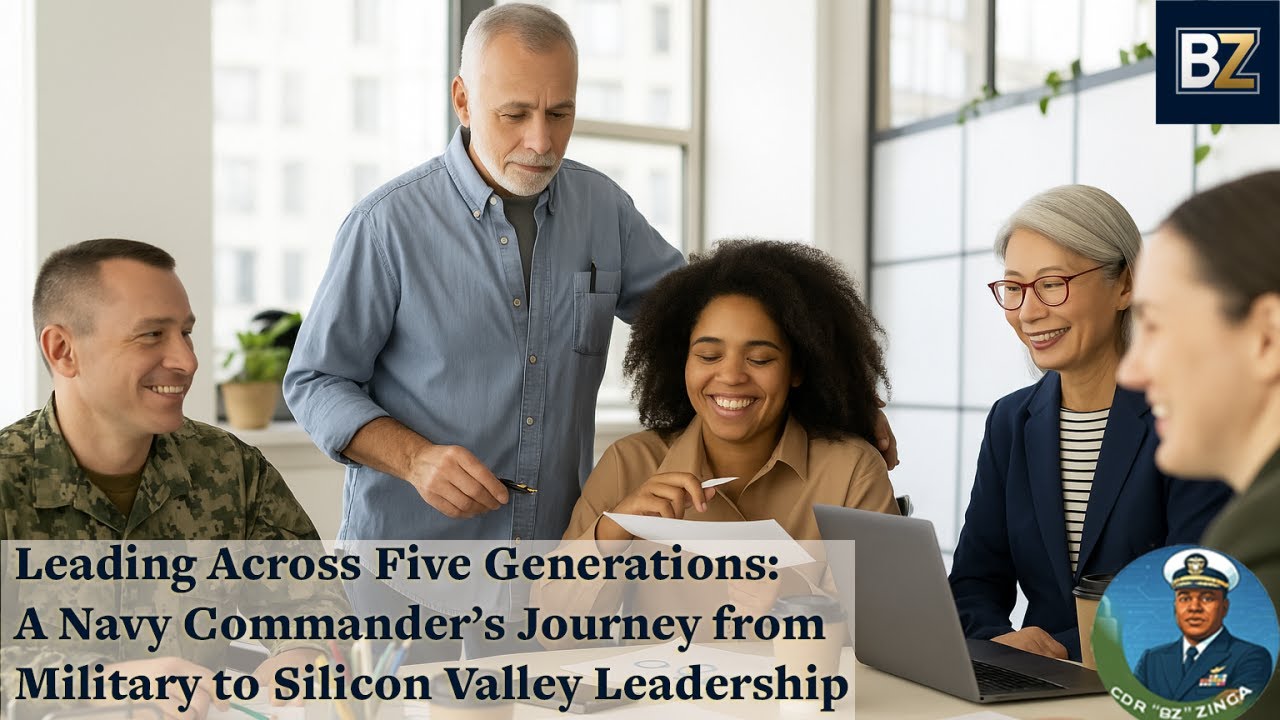
Coach BZ discusses leading teams across five generations, drawing on his Navy and Silicon Valley experience. He covers influence versus authority, reverse mentorship, and adapting your style to different age groups. John Maxwell introduces the episode.
Chapters
Hi, I'm John Maxwell. When the top companies in the world are looking for trainers, speakers, and coaches, there's one name that stands above the rest, and that's Maxwell Leadership. Our certified team members have gotten proven results for companies all over the globe, and our reputation, I'm proud to say, is second to none. Some of our members have risen to the top of their profession, including the one you're going to meet today. I proudly introduce you to my friend, Bob Fabien Zinga.
Welcome to the Leadership and Success Podcast with your host, Coach BZ. If you need to develop into a better leader, this podcast is for you. If you want to achieve a greater level of success, this podcast is for you. His mentor, Dr. John C. Maxwell, said it best: Everything rises and falls on leadership. We hope to inspire you today and provide you with an insight that has the potential to positively impact the trajectory of your life. Welcome to the Leadership and Success Podcast.
Imagine gaining the leadership skills that could redefine your career. Join Coach BZ on the Leadership and Success Podcast, where each episode delivers practical insights from world-class speakers educators, military leaders, and industry experts. We dive deep into what matters most: building resilient teams, leading through uncertainty, and navigating complexity with clarity and confidence. Every conversation is crafted for aspiring leaders like you who are ready to grow, lead, and make a lasting impact. Don't miss our powerful live sessions and recent highlights. Michelle Hayward on building diverse, high-performing technical teams. Ann Leslie on leading through global complexity and cybersecurity risk. Ron Carpenter, AI, exploring faith, resilience, and AI-powered leadership. Colonel Michelle G.I. Gardner, INS, on commanding influence from the battlefield to the boardroom. Chris Robinson on shifting from drift to drive in life and leadership. And Coach Enrique Acosta Gonzalez on mentorship, legacy, and heart-centered leadership. Ready to level up your leadership journey? Tune in on Spotify, Apple, Audible Podcasts, YouTube Live, and LinkedIn Live. Join the movement toward leadership excellence. Listen now and start transforming your success. What if your next keynote speaker could bridge the worlds of national defense, Silicon Valley innovation, and global leadership? Meet Bob Fabien Zinga, BZ Zinga, award-winning keynote speaker, U.S. Navy Information Warfare Commander, and trusted executive in technology, leadership, and strategy. With over 20 years of proven leadership in the U.S. Department of Defense, the U.S. Navy, higher education, and the high-tech sector, from startups to Fortune 500 companies, BZ delivers keynote experiences that inspire, challenge, and equip equip leaders for real-world impact. BZ speaks with authority on cybersecurity and national security, strategies to safeguard critical assets in an age of constant threat, artificial intelligence and emerging technology, how to innovate responsibly while staying ahead of disruption, leadership and corporate governance, building resilient, ethical, and high-performance organizations in any environment. Every keynote blends military precision, Silicon Valley agility, and boardroom strategy. Delivering practical takeaways that leaders can apply immediately. Audiences leave inspired, informed, and ready to lead with clarity and courage. Whether you're hosting a global conference, corporate summit, or leadership retreat, book BZ to energize your event and empower your audience to lead in a rapidly changing world.
All right everyone, thank you so much for being here. This is Coach Bizzy. First of all, thank you for watching, and I'd like for you to please like the post where you are watching this from, and also if you would please tag someone who might benefit from what we're going to be talking about today. And also let me know where you are joining us from, what city, what state, and if you're outside of the US, what city and which country you are watching us from. And if you have a question for me, please type it in the comment section, and I'm gonna make sure to answer your question live on the show before we end today. So today we're gonna be talking about leading across 5 generations, which is something that's becoming more and more current these days. We have people at work who may be in their late 70s or 80s who still want to work for some reason. And when you have young people like my children, Gen Zs in their 20s or late teens, who are just starting to enter into the workforce. So What we're gonna be talking today, so it's not for this first time in our history, 5 generations working side by side in the same space, from deck plates to the US Navy, uh, to the innovation of Silicon Valley. So I will share real-world lessons on leading across age, culture, and experience, building influence over authority, fostering mentorship, and creating psychological safety for all. How do you lead in a diverse work environment. All right, to get this done, I'm going to have my AI agent break it down for me. So it's gonna be about 30 minutes or so. And again, if you have a question for me, please make sure to type it in the comment. Here we go.
Welcome everyone. Today we're diving deep into a fascinating journey of leadership that spans 5 generations from Navy deck plates to Silicon Valley boardrooms. It's like, um, a real-life masterclass in leading diverse teams.
Yeah, absolutely. It's intriguing how one can transition from commanding sailors in high-stakes cyber missions to leading tech teams in today's fast-paced environment. I mean, you have 5 generations in one room. Can you imagine that?
Right, exactly. The core of it is all about adaptability and understanding that leadership isn't a one-size-fits-all deal. When you're dealing with traditionalists, baby boomers, Gen X, millennials, and Gen Z all at once, each group brings, um, its own flavor to the table.
Mm-hmm, definitely. It's almost like trying to blend a vintage typewriter with a modern laptop. Both valuable, but very different. So, what do you think is the most important takeaway here?
Well, it's the insight that leadership in the 21st century is predominantly about influence, not authority. The article makes the point that leading diverse teams means recognizing individual needs and bridging gaps. Yep, and not just relying on rank or technical know-how.
Right, influence over rank. Totally. That's a powerful message, and I love how the author, Bob Fabien Zinga, draws on his personal journey. His story from Navy Command to Silicon Valley really highlights that even in traditional and structured institutions, there's a need to shift towards empathetic leadership. Correct?
Exactly. He points out that the leadership methods that worked in a homogeneous group of 30-year-olds in the 1980s just wouldn't fly today when you're dealing with a mix from 20-somethings to 70-plus veterans.
Yeah, that's so true. And interestingly, he cites some memorable quotes. One from George Orwell reminded us how every generation thinks it's smarter than the last. It's like saying, "Each generation imagines itself to be more intelligent than the one that went before." But in the workplace, that can lead to misunderstandings, right?
Precisely. And that's where the challenge lies—bridging those so-called "generational gaps." Um, it's about not labeling groups with stereotypes. For instance, thinking that all millennials are just looking for praise or that Gen Z doesn't appreciate direct feedback. Instead, we have to focus on their individual strengths.
Absolutely, right. It's all about viewing people as individuals. But I have to ask, do you think the author might be oversimplifying the contrasting communication styles? I mean, isn't it sometimes more nuanced than just calling Gen Z digital natives and boomers old school?
You know, that's a good point. While the article highlights clear differences, he does also stress that within any generation, there's a wide spectrum of communication preferences. So rather than pigeonhole them, the emphasis is on understanding and adapting to the individual's style.
Yeah, exactly. That makes sense. And speaking of adapting, the shift from a command-and-control style to a more coaching style, especially for younger sailors or employees, seems critical. It's like, if you bark orders at a Gen Z sailor, you'll probably lose their motivation, right?
Right on! The story about a blunt correction that demoralized a young sailor is a prime example. The leader then had to adjust his tone and approach, More explanation, more empathy. It shows that effective leadership is about creating a safe environment where mistakes become learning opportunities. Absolutely true.
And that's a strategy that can be applied in any organization. I noticed the article suggests reverse mentorship as well, pairing a younger team member with a senior leader to exchange skills and perspectives.
I find that incredibly innovative. Right. Reverse mentorship is a brilliant way to bridge the gap. It's, um, like turning the traditional mentor-mentee dynamic on its head. Younger employees can teach tech to veterans while the veterans impart wisdom on leadership or industry nuances. This results in a win-win situation where both sides grow.
Yeah, that's a fresh take. Now, on the topic of strategies, the article lays out several practical tips for leaders managing multigenerational teams. Can you talk about the emphasis on feedback?
Sure thing. The article stresses that feedback should be continuous and tailored. For, um, younger team members, feedback needs to be immediate and constructive, while older team members might prefer a more structured cadence. The idea is to create an open two-way dialogue.
Right on. Mm-hmm. That continuous feedback loop really, um, Resonates. But doesn't it also risk overwhelming people who might prefer less frequent interaction?
Well, that's where balance comes in. The key is to ask whether the team is getting the type of communication they need. Leaders should, as the article points out, ask themselves if they're truly listening. It's about adapting based on honest feedback from the team.
True, definitely. Exactly. And what about flexibility and work-life integration? The article makes a strong case for personalized working arrangements, right?
Right. It's like saying one size doesn't fit all. Traditionalists might appreciate a more formal schedule, while Gen X and Gen Z might value flexible hours, maybe to balance family commitments or pursue side projects. Tailoring work conditions helps harness everyone's potential.
Yeah, that's spot on. One interesting point was also about championing diversity and inclusion beyond just age. It goes into gender, ethnicity, culture, all under one roof, making the workplace richer. How do you see that being implemented on a daily basis?
It's about creating an environment where every voice is valued, like ensuring that in meetings, even the quiet ones are asked for their input. You set team norms that um, encourage everyone to participate, regardless of their generational or cultural background. It's similar to the idea of dancing, as Werner Mayer said. Everyone should be part of the dance floor, no one left on the sidelines.
True that, mm-hmm. I like that analogy, a dance floor where every unique step matters. And it ties back too, to the leadership idea of influence and inclusion. But how do we, as leaders, actually challenge our own biases? Sometimes, without realizing, we fall back on stereotypes.
Great point! The article challenges us to avoid lazy labeling and instead get to know each team member personally. Instead of assuming a Gen Z employee is just entitled and distracted, ask them about their aspirations, and vice versa for older colleagues. It's about keeping an open mind and never assuming that age alone dictates— Absolutely, that's essential.
Right, and it ties into that coaching question the article poses about ensuring everyone feels safe to give feedback, even challenging your own leadership. It's a reminder that a leader's job is to nurture growth both in themselves and in their teams.
Yes, absolutely. The emphasis on humility really stands out. Being quick to listen, slow to speak, and ensuring your team knows you're there to support them. It's not about having all the answers, but being willing to learn from all members of your team, regardless of age.
Yeah, mm-hmm. And what's especially compelling is how the article shows that through this deliberate shift in leadership style, team performance and creativity actually improve. Have you noticed that in your experience or among colleagues?
Oh, for sure! There's evidence that when diverse teams are truly united by inclusive leadership, problems are solved faster, creativity blossoms, and there's a strong sense of loyalty. It's not just theory; it's been proven in both military operations and tech companies. I mean, it's like when you mix different ingredients to get a perfect recipe—each adds a unique flavor that contributes to a winning dish. Yeah, exactly.
That's a great analogy, and I was really struck by the personal story about the Gen Z sailors. It demonstrates clearly that sometimes, a leader's old way might not always serve the best interests of the team, and being open to change is key. How do you see that influencing leadership beyond the military or tech?
It's universally applicable. Um, whether you're in education, healthcare, or any sector, the core idea is that respecting individual communication styles and motivations is crucial. It's about, as the article states, meeting people where they are, listening, adapting, and making sure that leadership becomes a shared, evolving journey.
Absolutely, mhm. Now, one thing I want to respectfully challenge— some might argue that constantly adapting your style could dilute authority or lead to inconsistency in expectations. What do you think about that?
That's a valid concern, and, um, it's a fine line indeed. But the article makes it clear that leadership isn't about rigid authority. It's built on trust and confidence. Consistency in core values like integrity and respect remains while the delivery adapts. It's less about diluting rules and more about delivering them in a way that resonates.
Yeah, I can see that. It definitely requires a balance, maintaining standards while also being flexible. And what about the role of continuous learning? The article references Mentor Wisdom, urging leaders to be among those who make things happen. How do you interpret that?
I think that speaks to the idea that leadership is a journey. Um, you're never really done learning. You must evolve with your team by staying curious, asking for feedback, and even sometimes being humbled by new insights from those younger than you. You continuously make things happen. It's like being a student of life at every stage.
Yes, absolutely. And it's interesting to see how that principle is backed up by some great coaching prompts and biblical references in the article, like 1 Timothy and Proverbs, which remind us that leadership isn't just a role. It's a responsibility to nurture and build up those around us. Right.
Those scriptural insights tie the whole message together by reinforcing the idea that respect, humility, and mutual growth are timeless. It's a reminder that while technology and demographics evolve, the essence of leadership remains grounded in integrity— Absolutely. —and care for your team.
So if we bring this full circle, the journey from Navy commander to Silicon Valley leader teaches us that leadership across generations is about constant adaptation, active listening, and breaking down stereotypes. It's, um, really inspiring to think about the potential this holds for any organization.
Exactly, and it's a call to action for every leader out there. Engage in those one-on-one conversations, challenge your assumptions, and create that inclusive environment that lets every generation shine. Remember, leadership is less about the title and more about the impact you have on those you serve. Right, that's the key.
I love that. And honestly, it's a reminder to all of us that the future of leadership lies in our willingness to evolve, learn, and truly connect with the people we lead. Thanks for this deep dive. It's been an enlightening conversation.
Thank you, and keep questioning, keep listening, and, um, always strive to make things happen. Catch you all next time. Frequently Asked Questions. 1. What is the central challenge of leadership in the 21st century according to the author? The central challenge of leadership in the 21st century is adaptability, specifically in navigating an increasingly generationally and demographically diverse workforce. The author emphasizes that technical prowess or business acumen alone are insufficient, The most critical skill is the ability to bring people together, inspire them, and adapt to their individual needs, regardless of their age or background. For the first time in history, 5 distinct generations are working side by side, each shaped by different events, technologies, and values, leading to potential misunderstandings and friction if not managed intentionally. 2.
Who are the 5 generations currently in the workforce? And what are some of their distinguishing characteristics. The 5 generations currently in the workforce are: Traditionalists, born approximately 1925 to 1945. Tend to be loyal, detail-oriented, and prefer formal communication, e.g., handwritten notes. Baby Boomers, 1946 to 1964. Often pride themselves on paying their dues, may favor face-to-face meetings, and may have a live-to-work mindset. Generation X, 1965 to 1980. Often flexible in communication, using whatever method is most efficient, they value work-life balance and independence. Millennials, 1981 to 2000. Seek purpose, feedback, and work-life balance, often preferring text or instant messages for quick updates. They crave continuous feedback. Generation Z, 2001 to 2020. Are digital natives comfortable with constant connectivity and quick information flows? The TikTok generation. They respond well to a coaching style of leadership built on empathy and encouragement.
3. How does the author's dual career experience in the US Navy and Silicon Valley inform his leadership philosophy? The author's dual career in the U.S. Navy and Silicon Valley taught him that while fundamental leadership principles are universal, their application must be tailored to the specific context. In the Navy, he learned to lead diverse teams under strict discipline and hierarchy, while in Silicon Valley, he encountered flatter structures where influence often mattered more than rank. This experience solidified his core truth: Effective leadership is about understanding people as individuals, not just labels, and adapting one's style to meet them where they are. He learned that a command-and-control approach suitable for some seasoned military personnel might alienate a young Gen Z sailor, just as a one-size-fits-all approach in tech might fail to leverage the experience of a senior engineer. 4.
What is the difference between leading by authority and leading by influence, and which does the author advocate for in a multigenerational environment? Leading by authority relies on one's rank, title, or position to command obedience. Leading by influence, on the other hand, is about earning trust and respect from team members. The author strongly advocates for leading by influence in a multigenerational environment. He states that leaders cannot simply rely on their title; they must genuinely care about their team members as individuals and demonstrate that care in ways that resonate with each person. When leaders invest in understanding and supporting their diverse team members, those individuals are more likely to be inspired and committed to the mission, regardless of their age or background. 5.
What are some practical strategies for effective leadership across generations? Practical strategies for effective multigenerational leadership include: Focus on the individual, not stereotypes. Be aware of generational tendencies, but avoid pigeonholing people. Understand their unique strengths, goals, and working styles. Build collaborative relationships. Foster relationships across age groups, perhaps through mentorship or reverse mentorship programs, and create mixed-age project teams to encourage informal learning. Adapt communication style: Recognize that different generations prefer different communication methods, e.g., in-person, phone calls, text, chat, and adjust your approach and tone accordingly. Provide and solicit frequent feedback: Younger generations often crave continuous feedback. While older ones may prefer more structured reviews. Adapt the frequency and style of feedback, and crucially, create a culture where team members feel safe giving feedback to their leaders. Embrace flexibility and work-life integration. Personalize work arrangements when possible, offering flexible schedules or remote options, and judge performance by results, not just clock time. Champion diversity, equity, and inclusion. Actively ensure every voice is valued, especially from those who might be hesitant to speak up due to generational or cultural factors. Frame generational differences as an asset to be celebrated, not a problem.
Yay! 6. Why is it important to avoid generational stereotypes, and what commonalities exist across generations? It is crucial to avoid generational stereotypes. E.g., "Millennials need trophies," "Boomers won't learn new tech," because they are often exaggerated, unhelpful, and can lead to misunderstanding and fragmentation within teams. While some typical traits exist, individuals vary widely, and research shows significant common ground across age groups. Specifically, every generation shares fundamental desires, They want their organization to succeed. They want similar qualities in leaders, and they seek opportunities for career growth. Recognizing these shared values allows leaders to unite people under common goals rather than dividing them by age.
7. What is the payoff or benefit of successfully leading a multigenerational team? The payoff of successfully leading a multigenerational team is the creation of a powerful, unified force. Organizations that leverage multigenerational talent and diverse teams tend to outperform those that don't, benefiting from reduced blind spots and a wider range of ideas. This approach fosters innovation, as veteran experience combines with rookie perspectives to spark new solutions. It also leads to significant personal and professional growth for team members, with junior members blossoming into confident leaders and senior leaders becoming more empathetic and tech-savvy. Ultimately, treating age as an asset, not a barrier, results in a team where everyone feels included, heard, and empowered to contribute their best, leading to increased loyalty and productivity.
8. What fundamental qualities of leadership remain timeless, even as approaches evolve for a diverse workforce. While the application of leadership must evolve with the times, the fundamental qualities of great leadership remain timeless. These include vision, empathy, courage, and integrity. The author emphasizes that effective leadership in a diverse world is rooted in active listening, measured response, and consistently setting an example through one's actions. It requires humility, mutual respect, and a servant-hearted approach, ensuring that every individual, regardless of their generational background, feels valued and empowered to contribute to collective success. Think on these things.
What's truly striking about Bob Fabien Zinga's approach to leadership is not just how grounded it is in real-world experience, from the Navy's chain of command to the flat teams of Silicon Valley, but how it's also informed by timeless wisdom, In his article, Bob draws on scripture—yes, ancient texts written thousands of years ago—and reveals just how relevant they remain for leaders navigating today's chaotic and complex world. This isn't about preaching; it's about principles, unchanging truths that have guided great leaders across generations. What's powerful here is how seamlessly these insights complement everything we've explored so far. Let's walk through each of these ancient verses Bob highlights and unpack what they mean for today's leader, military or tech, startup or enterprise. 1 Timothy 4:11-12, NIV: Command and teach these things. Don't let anyone look down on you because you are young, but set an example for the believers in speech, in conduct, in love, in faith, and in purity. Leadership insight: Age does not determine the power of your leadership. Character does. Young leaders are called not only to lead but to model integrity, humility, and love. Respect is earned not by age or position but by example. Coaching prompt: Are you empowering the younger members of your team to lead by example Regardless of their age, how are you intentionally mentoring and equipping them to lead now, not later? Proverbs 27:17, NIV: As iron sharpens iron, so one person sharpens another. Leadership insight: Effective teams thrive on mutual growth. Intergenerational collaboration sharpens both the wisdom of age and the innovation of youth. Leaders must foster environments where mentoring and reverse mentoring are valued. Coaching prompt: How are you creating opportunities for your team to sharpen one another across generational lines? Who are you learning from that is from a different generation than you?
Romans 12:4-5, NIV. For just as each of us has one body with many members, and these members do not all have the same function, So in Christ, we, though many, form one body, and each member belongs to all the others. Leadership: Insight. Diversity of age, culture, and skill enriches the body, the team. Each person, regardless of background or generation, brings a unique function that is essential to collective success. Coaching: Prompt. Do you actively value and leverage the different functions, skills, experiences, perspectives each generation brings to your team? Where might you be underutilizing the gifts of someone on your team simply because their strengths look different from yours? James 1:19, NIV.
Everyone should be quick to listen, slow to speak, and slow to become angry. Leadership Insight. Great leadership is rooted in active listening and measured response. Generational differences can cause friction. Patience and listening to understand are key to navigating conflict and building trust. Coaching Prompt: When was the last time you truly listened, without preparing your reply, to a teammate from another generation? What one practice can you adopt to become a better listener this week?
Titus 2:7-8, NIV. In everything, set them an example by doing what is good. In your teaching, show integrity, seriousness, and soundness of speech that cannot be condemned. Leadership insight. Leadership is more caught than taught. Across generations, people are watching more than they are listening. Consistency in your actions earns respect across all age groups. Coaching Prompt: Are your daily actions setting an example of integrity and excellence for both younger and older teammates? Where might your behavior be unintentionally sending the wrong message?
Ecclesiastes 4:9-10 : Two are better than one, because they have a good return for their labor. If either of them falls down, one can help the other up. Leadership. Insight: No leader succeeds alone. A team rich in generational diversity provides strength in support, perspective, and resilience. The young bring energy, the older bring stability. Together, they are stronger. Coaching Prompt: How are you fostering a culture where generations are lifting one another up rather than competing or criticizing? Who can you intentionally encourage this week, someone older or younger, to strengthen your team's unity? These verses beautifully underscore the importance of humility, mutual respect, and the power of generational diversity in leadership. They mirror the core idea from your article: leading across generations is a calling for the wise, the humble, and the servant-hearted.
So as we wrap up today's episode of the Leadership and Success Podcast with Coach BZ, we invite you to reflect. What spoke to you today? Which leadership insight will you carry into tomorrow? What are your 3 takeaways from this episode? What's one leadership insight you've just learned or been reminded of that you'll apply this week? Type it in the comments so others can grow from your insight and tag a colleague, junior officer, or tech leader who could benefit from this episode. Join us again tomorrow, right here, for the next episode in this powerful leadership series. Until then, keep growing, keep leading, and as always, stay resilient.
All right, many thanks for watching. This is going to be the end of the podcast. Let me triple-check, make sure I don't have any question in the comment section. Okay, I see somebody from Twitch, Yellow Prerogative 9, just saying hi. And I don't see any question on YouTube or LinkedIn. All right, I'm gonna be back here tomorrow morning, and thanks so much for being with us. If this podcast is valuable to you, please like the post and let us know where you are coming from and tag someone else you know might benefit from this conversation. Okay, until tomorrow, this is Coach Kizi. Have a wonderful day. Bye.
Thank you for listening to the Leadership and Success Podcast with your host, Coach BZ. If you like what you heard, please subscribe to our channels and come back for more wisdom nuggets on how you may develop into a better leader and achieve greater levels of success. Leadership is the most critical skill. The world will always need leaders to lead others, deploy the next disruptive technology, or execute business strategy, you may as well decide on counting yourself among the 21st century leaders. See you right here next time on the Leadership and Success Podcast with Coach BZ.
More from Bob

S250:E4🎙️LIVE 🇺🇸America 250: President Barack Obama Leadership, Service, and the Power of Hope






S5:E157🎙️ LIVE with CMD CMSgt Dennis L. Fritz, USAF (Ret.)(Multi Tracks Audio)



S5:E156🎙️ LIVE 🇪🇸 Leadership Lessons from the FIFA World Cup 2026 Champions (Multi Tracks Audio)

S250:E3🎙️ LIVE Leadership Lessons from America’s First Documented Family of African Descent 🇺🇸📖