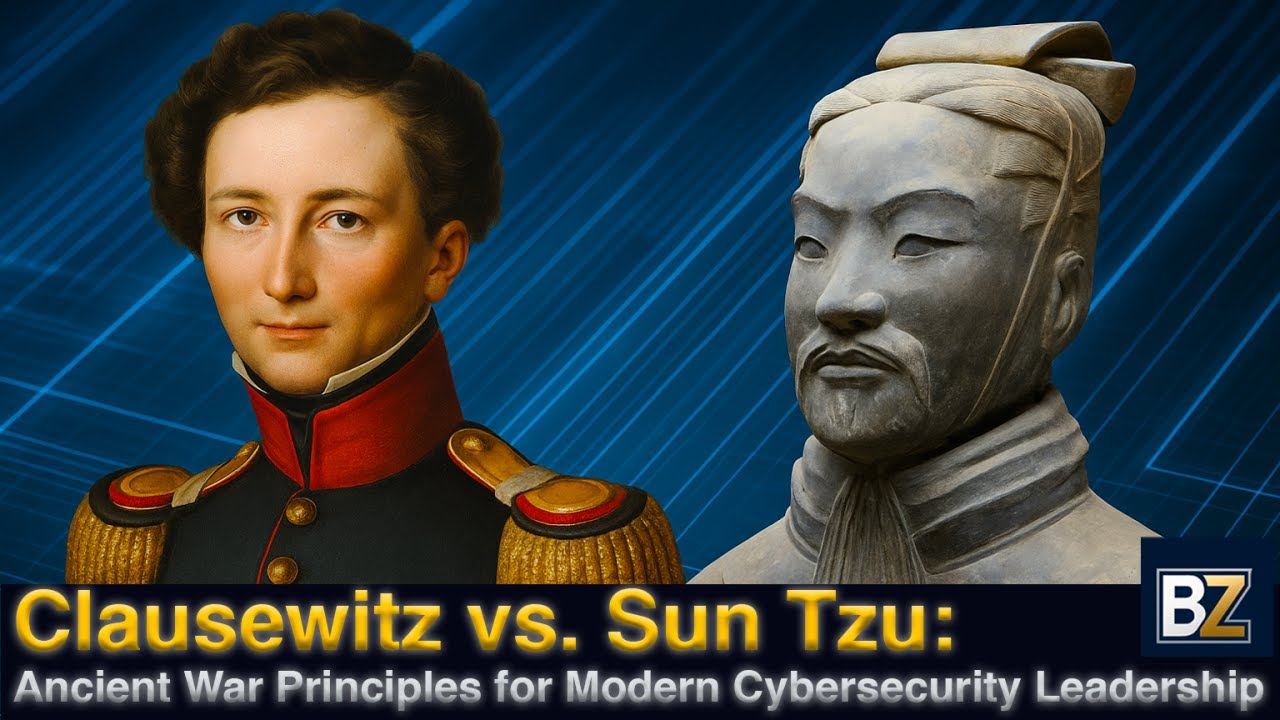
Coach BZ applies Clausewitz and Sun Tzu's military strategies to cybersecurity and leadership. The episode uses the SolarWinds breach and Russia-Ukraine cyber conflict to show how knowing yourself and your enemy matters, and why trust and clear communication beat technology alone.
Chapters
Hi, I'm John Maxwell. When the top companies in the world are looking for trainers, speakers, and coaches, there's one name that stands above the rest, and that's Maxwell Leadership. Our certified team members have gotten proven results for companies all over the globe, and our reputation, I'm proud to say, is second to none. Some of our members have risen to the top of their profession, including the one you're going to meet today. I proudly introduce you to my friend, Bob Fabien Zinga.
Welcome to the Leadership and Success Podcast with your host, Coach BZ. If you need to develop into a better leader, this podcast is for you. If you want to achieve a greater level of success, this podcast is for you. His mentor, Dr. John C. Maxwell, said it best: everything rises and falls on leadership. We hope to inspire you today and provide you with an insight that has the potential to positively impact the trajectory of your life. Welcome to the Leadership and Success Podcast.
Imagine gaining the leadership skills that could redefine your career. Join Coach BZ on the Leadership and Success Podcast, where each episode delivers practical insights from world-class speakers, military leaders, and industry experts. We dive deep into what matters most: building resilient teams, leading through uncertainty, and navigating complexity with clarity and confidence. Every conversation is crafted for aspiring leaders like you who are ready to grow, lead, and make a lasting impact. Don't miss our powerful live sessions and recent highlights. Michelle Hayward on building diverse, high-performing technical teams. Anne Leslie on leading through global complexity and cybersecurity risk. Ron Carpenter AI exploring faith, resilience, and AI-powered leadership. Colonel Michelle G.I. Gardner-Intz on commanding influence from the battlefield to the boardroom. Chris Robinson on shifting from drift to drive in life and leadership. And Coach Enrique Acosta Gonzalez on mentorship, legacy, heart-centered leadership. Ready to level up your leadership journey? Tune in on Spotify, Apple, Audible Podcasts, YouTube Live, and LinkedIn Live. Join the movement toward leadership excellence. Listen now and start transforming your success. What if your next keynote speaker could bridge the worlds of national defense, Silicon Valley innovation, and global leadership? Meet Bob Fabien Zinga. Award-winning keynote speaker, U.S. Navy Information Warfare Commander, and trusted executive in technology, leadership, and strategy. With over 20 years of proven leadership in the U.S. Department of Defense, the U.S. Navy, higher education, and the high-tech sector, from startups to Fortune 500 companies, BZ delivers keynote experiences that inspire, challenge, and equip leaders for real-world impact. BZ speaks with authority on cybersecurity and national security, strategies to safeguard critical assets in an age of constant threat, artificial intelligence and emerging technology, how to innovate responsibly while staying ahead of disruption, leadership and corporate governance, building resilient, ethical, and high-performance organizations in any environment. Every keynote blends military precision, Silicon Valley agility, and boardroom strategy delivering practical takeaways that leaders can apply immediately. Audiences leave inspired, informed, and ready to lead with clarity and courage. Whether you're hosting a global conference, corporate summit, or leadership retreat, book BZ to energize your event and empower your audience to lead in a rapidly changing world.
Clausewitz versus Sun Tzu— those are two of the greatest military strategists ever. And I've had to learn about them as a junior officer in the US Navy. All junior officers in the military in the US have to learn about war strategy. So today we are gonna be covering them, but in a way that we can use their principle to guide us, you know, in cybersecurity and leadership challenges in both the military and high-tech corporate security. We're gonna be covering building trust and morale as a foundation for success. Decision-making in uncertainty, the fog of war, servant leadership as a strategic advantage, lesson from SolarWinds and the Ukraine-Russia cyber war, and then applying timeless war principles to modern AI-driven security threats. So make sure to let me know, let us know where you guys are coming from. Where are you joining us from? What city, state? And if you are outside of the US, what city and country? And if you have a question for me, please go ahead and type it in the comment. And also please consider tagging a colleague or anyone in your inner circle you think might benefit from this podcast. And then while you listen to the podcast, please think about some takeaways, right, from this episode. And then if you would please jot down your insight, this way we can learn from each other. And I should be back probably in the next, what looks like 20 minutes or so, 20, 25 minutes. All right. Thank you so much for being here with us. Hi.
Welcome everyone to this deep dive into ancient war wisdom meeting modern cyber defense. We're looking at how Clausewitz and Sun Tzu's timeless leadership principles can shape cybersecurity leadership today.
Oh, absolutely. There's so much to unpack here, right? From military battlefields to boardrooms, these ideas still rock.
Exactly, it's like— it's like bridging the gap between centuries of warfare and today's digital battlegrounds. Clausewitz, with his, um, fog of war and focus on moral forces, reminds us that even in uncertain environments, say, during a critical cyber attack, strong leadership is key.
Mm-hmm, right, and Sun Tzu brings that whole other flavor of strategy with clarity in communication and the idea of You know, knowing yourself and your enemy.
Yep, Sun Tzu's emphasis on treating soldiers like family— well, more like caring for your team— really aligns with modern servant leadership. It's about, um, being strategic yet nurturing.
But let's get into specifics. How do these ancient tactics truly map onto, say, cybersecurity leadership today?
Well, think about it. Klauswitz talked about maintaining calm under pressure, calmness and firmness, even in chaos. In cybersecurity, that's just like a CISO guiding their team through a zero-day attack with clarity instead of panic.
Absolutely. And Sun Tzu's idea that "if you know the enemy and know yourself, you'll never be defeated" really rings true when you consider threat intelligence. Leaders have to understand both their capabilities and their adversaries' tactics.
Exactly. It's like, um, it's like preparing your team by doing constant self-assessment, knowing your system's vulnerabilities, and staying ahead of potential attackers.
Yep. Now, one thing sometimes feels a bit too idealistic though. I mean, can you really build that perfect trust structure within every organization?
I see your point, but I'd say it's more of a guiding principle. Remember, both Clausewitz and Sun Tzu stressed that leadership isn't just command. It's about, um, fostering trust and unity. In cybersecurity incident response, that trust can make or break how well a team collaborates under pressure.
Yeah, I get that. So basically, we're talking about servant leadership, right? Leaders who put their team first, and serve them, not the other way around.
Absolutely. Whether you're in the military or in a tech startup's security team, a leader who nurtures and empowers their people creates a cohesive unit that can, uh, handle the chaos of cyber warfare.
Mm-hmm. And that's key during crises like the SolarWinds hack or the cyber front of the Russia-Ukraine conflict, where clear communication and strong morale really help defuse situations.
Right, exactly. The SolarWinds event showed us that even when defenders are caught off guard, a leader who clearly communicates and builds trust can mobilize a quick and effective response. It's, um, almost like turning chaos into opportunity through leadership.
True that. And speaking of morale, Clausewitz really hammered on the idea that the will and spirit of the soldiers or team, as they put it, devotion to the cause can be more decisive than sheer technology.
Yes, indeed. Imagine a security team, even if it's small, that's highly motivated and united. That's a force multiplier on its own. It's like having an army of lions led by a lion, not sheep.
That brings us back to Sun Tzu's aspect of discipline along with benevolence. He stressed that a leader must care for his team yet be strict on standards. It's that balance that really solidifies leadership in a crisis.
Right, and that discipline is crucial. Sun Tzu's story of drilling palace concubines, setting clear expectations, even if it sounds severe today, illustrates that clarity prevents disorganization during emergencies.
Yeah, for sure. But I do wonder, isn't that sometimes too harsh? I mean, executing orders with strict discipline might stifle creativity in some organizations.
That's a fair point. However, in a cyber crisis, like when every second counts, strict adherence to protocols can prevent chaos. It's not about stifling creativity, but ensuring that the basic defensive measures are executed flawlessly.
I see what you mean. So it's all about context. A leader must balance being strict and supportive, especially when facing fast-paced cyber threats.
Exactly. And that's where servant leadership really shines. Leaders who serve empower their teams with clear guidelines while also fostering an environment of mutual trust and ongoing learning.
Yep, exactly. And then there's the modern twist— technology. AI and automation are now crucial in cyber defense, but these tools require, um, wise oversight. You can't just let them run wild.
Right. Clausewitz would probably caution that technology, no matter how advanced, still leaves room for uncertainty. It reminds us that technology should assist human judgment, not replace it.
Mm-hmm. That's spot on. That makes me think about, uh, the idea of aligning technology with human values. Even as we implement cutting-edge AI in our defenses, leaders must ensure these tools operate ethically and in line with our mission.
Spot on. And Sun Tzu's principle of winning without fighting becomes Um, super relevant here. It's about deterring attacks by showcasing a robust, well-prepared defense, the kind that makes attackers think twice.
Exactly, exactly. So whether it's a cyber warfare scenario, like the Ukrainian defense against digital attacks, or a major hack in the corporate world, the old strategies still have a modern place.
Definitely. The actions taken during the SolarWinds hack, for instance, reveal that when leadership builds trust, communicates clearly, and empowers teams, even devastating breaches can be managed before they spiral.
Yeah, I can totally see that. And it's fascinating how these principles extend even into the realm of AI-driven warfare. With AI speeding up the decision-making process, our human ability to remain calm and judicious is more critical than ever.
Uh-huh. The faster the pace, the more we rely on that human element. We need leaders who can guide their teams through, um, the unexpected rapid moves in cyber conflict, just like in a real battlefield.
Absolutely. It's really about melding ancient wisdom with our current realities, a sort of synthesis of military strategy and modern technology.
Exactly. And that synthesis is what gives rise to robust, resilient cybersecurity cultures. Leaders inspired by Clausewitz's realism and Sun Tzu's strategic compassion can, uh, truly fortify modern defenses.
Yep, it's all interconnected. And don't forget the coaching insights sprinkled throughout, like building trust, practicing clear communication, staying calm under pressure, and empowering your team to adapt and learn continuously. All of these are action points for anyone looking to step up their leadership game.
Right. These concrete lessons empower not only military cyber commanders but also tech professionals in corporate environments. At the end of the day, whether you're defusing a cyber crisis at 3 AM or strategizing boardroom defense, leadership remains the ultimate force multiplier.
Mm-hmm. Absolutely. I love how these timeless lessons remind us that behind all the tech, it's the human element, Trust, discipline, clear communication, and servant leadership—that actually makes the difference. Exactly.
So, take these lessons to heart. Serve your teams, be bold yet wise, and lead with a balance of, um, empathy and resolve. That's how you'll shape a resilient future in cybersecurity. That's the ticket!
And with that, what an inspiring reminder of how deep historical wisdom still drives contemporary success. Thanks for the insightful conversation.
Thank you for joining in. Until next time, keep leading with purpose and integrity. Frequently Asked Questions 1. What core leadership principles do Clausewitz and Sun Tzu emphasize, and how do they apply to modern cybersecurity? Both Carl von Clausewitz and Sun Tzu, despite living in vastly different eras, underscored the critical importance of human elements in conflict: leadership, morale, and trust. Clausewitz, a 19th-century Prussian general, focused on the "fog of war" and friction, highlighting the chaotic nature of conflict and the need for strong, calm, and audacious leadership to navigate uncertainty. He believed that moral forces like courage and devotion to a cause were paramount. Sun Tzu, an ancient Chinese military philosopher, emphasized virtues such as wisdom, sincerity, benevolence, courage, and strictness in a commander, promoting a moral bond with troops and clear communication. In modern cybersecurity, these principles translate directly. The fog of war becomes network intrusions and zero-day attacks, demanding steady, decisive leadership. Cultivating moral forces means building high morale, trust, and a shared purpose within security teams, enabling them to outperform even larger, disengaged counterparts. Sun Tzu's emphasis on knowing oneself and the enemy translates to continuous threat intelligence and self-assessment of an organization's security posture. His focus on clear communication is vital for incident response, ensuring everyone knows their roles and directives.
2. How does servant leadership bridge the ancient wisdom of Clausewitz and Sun Tzu with modern cybersecurity demands? Servant leadership, where a leader prioritizes serving their people and mission over personal gain, is a unifying theme between Clausewitz and Sun Tzu. Sun Tzu explicitly advocated for a selfless general who cares more about the mission and troops' well-being than personal fame or disgrace, treating soldiers like beloved children. This fosters absolute loyalty and commitment. Clausewitz, though from a hierarchical tradition, recognized a commander's duty to be a moral and intellectual anchor, accepting responsibility for tough decisions to enable the team to act with confidence. In cybersecurity, this means a leader building trust through through transparency, admitting mistakes, and encouraging input—Sun Tzu's sincerity. It also involves advocating for the team's well-being, investing in their development, and giving them credit for successes—Sun Tzu's benevolence. From Clausewitz, it means having the moral courage to make difficult decisions, such as isolating critical systems during a breach, even when outcomes are uncertain, and taking responsibility for those decisions. This servant-hearted approach ensures that security teams are motivated, cohesive, and willing to walk through firewalls and fire for their leader. 3.
What role does trust play in leadership, according to both strategists, and how is this reflected in cybersecurity? Trust is presented as the fundamental bedrock of all leadership. According to both Clausewitz and Sun Tzu. Sun Tzu's emphasis on sincerity and benevolence directly builds trust within the team, making troops willing to follow their commander into the deepest valleys and even unto death. Clausewitz similarly believed that a leader's willpower to rally an army through severe tests was bolstered by trust, both up and down the chain of command and in the alignment of military actions with political objectives. In modern cybersecurity, trust operates on multiple critical levels. A CISO must earn the trust of the C-suite and board through clear communication and consistent delivery on promises of risk reduction. Internally, leaders must foster a culture where analysts trust their leaders for support and guidance, and leaders trust their analysts' judgment. This pre-established trust and servant-leader ethos become invaluable during a crisis, ensuring teams can act cohesively without second-guessing or self-preservation, as exemplified by the broken trust highlighted in reports on the SolarWinds breach. 4.
How do the concepts of fog of war and winning without fighting from Clausewitz and Sun Tzu respectively apply to cyber warfare? Clausewitz's fog of war describes the inherent uncertainty and chaos of conflict, where plans face unexpected obstacles. This perfectly mirrors the dynamic nature of cyber warfare, characterized by network intrusions, zero-day attacks, and the rapid evolution of threats. Effective cybersecurity leadership in this context requires the ability to maintain calmness and firmness under pressure, making decisive, bold calls even with incomplete information, much like a general navigating an unpredictable battlefield. Sun Tzu's principle of "winning without fighting" emphasizes achieving victory through strategy, deception, and superior knowledge of the enemy, minimizing direct conflict. In cybersecurity, this translates to proactive measures—shoring up defenses, practicing incident responses, and projecting a strong security posture, to deter adversaries. It also means investing in threat intelligence—knowing the enemy—and self-assessment—knowing yourself—to gain a psychological advantage, making an organization less attractive as a target. 5. What lessons can be drawn from the Russia-Ukraine cyber warfare regarding Clausewitzian and Sun Tzu principles? The Russia-Ukraine cyber warfare provides a powerful real-world example of these ancient principles in action. Initially, Russia's attempts at a quick, deceptive knockout, akin to Sun Tzu's style, faltered against Ukraine's robust cyber defense. This highlighted Clausewitz's lesson on the power of morale, will, and leadership. Ukrainian cyber units, bolstered by high morale and transparent communication, demonstrated remarkable resilience, denying Russia psychological victories by preventing panic and disinformation. The conflict also showed how cyber defense is in upholding trust and morale among the local population, illustrating Sun Tzu's focus on bolstering one's own will. Furthermore, the rallying of a civilian IT army by Ukraine's Minister of Digital Transformation exemplifies servant leadership. Acknowledging Clausewitz's view that war involves the spirit of the whole populace and empowering individuals to contribute to the common cause. This demonstrates that human elements—leadership, morale, and unity—remain decisive even with advanced technology.
6. How does the SolarWinds hack exemplify both the challenges and the application of ancient war principles in the private sector? The SolarWinds hack in 2020 served as a classic example of Sun Tzu's surprise attack from the adversary's perspective, using deception—malicious code in legitimate software updates—to strike where the enemy was unprepared and achieve victory without a direct fight. It exposed a failure of strategy in proactive risk management and supply chain security from leadership, akin to neglecting a weak point in one's defenses. In response, however, the incident highlighted the importance of servant leadership and Clausewitzian decisiveness. Organizations with clear communication channels between security and executive leadership could react faster. Companies like Microsoft demonstrated sector-wide servant leadership by sharing threat intelligence transparently, building broader ecosystem trust. The crisis also underscored Clausewitz's principle of decisive decision-making under pressure, where bold and rapid action to contain damage, even with incomplete information, proved crucial for survival. 7.
What are the key practical coaching insights for aspiring cybersecurity leaders based on these ancient principles? For aspiring cybersecurity leaders, key coaching insights include: Build trust and morale: Be sincere, transparent, and actively invest in your team. Know yourself, know your enemy: Continuously learn, stay current on threats, and honestly assess your organization's strengths and weaknesses. Practice clarity in communication: Deliver clear, concise instructions and translate technical risks into plain language for non-technical stakeholders. Stay calm and make decisions under fire. Maintain composure in crises, as your demeanor sets the tone for the team, and be decisive when quick action is needed. Be audacious but not reckless; take calculated risks for the mission's benefit, balancing boldness with wisdom. Empower and serve your team; listen to frontline experts, Remove obstacles, mentor, and advocate for your team's well-being and success. Foster adaptability and learning: Encourage flexibility, innovation, and continuous improvement, viewing setbacks as learning opportunities. Align tech with human values: Ensure that the use of technology, including AI, upholds ethical standards and serves people, not just profits.
8. How will the increasing role of AI and automation in cybersecurity impact the relevance of human leadership principles? While AI and automation are exciting force multipliers in cybersecurity, they do not diminish the importance of human leadership. In fact, they often heighten it. Clausewitz's fog and friction can be magnified by the speed and complexity introduced by AI, meaning that technology can accelerate war but not eliminate uncertainty. Human leaders are still needed to verify AI outputs, make critical judgments, and establish ethical guidelines for autonomous systems. Sun Tzu's advice to know your tool as you know yourself applies to AI. A CISO cannot blindly trust AI to handle everything. Instead, AI should augment human capability. As AI and adversary AI evolve, the fundamental need for agility, knowledge, unity, and human judgment becomes even more critical. Teams with strong leadership, mutual trust, and clear communication will outperform those relying solely on technology. In high-stakes, rapid-fire cyber scenarios, it is ultimately human leadership presence that steadies the team, provides purpose, and inspires action when split-second decisions are required. Think on these things.
What's truly striking about Bob Fabien Zinga's approach to leadership is not just how grounded it is in real-world experience, —from the Navy's chain of command to the 'flat teams' of Silicon Valley—but how it's also informed by timeless wisdom. In his article, Bob draws on scripture—yes, ancient texts written thousands of years ago—and reveals just how relevant they remain for leaders navigating today's chaotic and complex world. This isn't about preaching; it's about principles—unchanging truths that have guided great leaders across generations. What's powerful here is how seamlessly these insights complement everything we've explored so far. Let's walk through each of these ancient verses Bob highlights and unpack what they mean for today's leader, military or tech, startup or enterprise. Think on these things.
One, build trust and morale as your foundation. Verse: Therefore encourage one another and build each other up just as in fact you are doing. 1 Thessalonians 5:11. Leadership Insight: Trust grows when leaders actively encourage and invest in their people. Encouragement boosts morale, fosters loyalty, and inspires commitment to the mission. Coaching Prompt: How am I intentionally building trust with my team this week? What recognition or encouragement can I give today that will strengthen morale? 2.
Know yourself, know your enemy, and know your environment. Verse: Be very careful then how you live, not as unwise but as wise, making the most of every opportunity, because the days are evil. Ephesians 5:15-16. Leadership Insight: Wisdom comes from self-awareness, discernment, and understanding the external environment. Leaders who understand strengths, weaknesses, and threats can act with precision and foresight. Coaching prompt: Have I done an honest self-assessment of my leadership strengths and blind spots? What external threats or opportunities must I address in the next 90 days?
3. Practice clarity in communication. Verse: If the trumpet does not sound a clear call, who will get ready for battle? 1 Corinthians 14:8. Leadership Insight: Clarity is a force multiplier. Unclear instructions breed confusion, but precise, timely communication aligns people toward a common goal. Coaching Prompt: Are my instructions clear enough that no one needs to guess my intent? How can I simplify and strengthen my message to ensure alignment?
4. Stay calm and make decisions under fire. Verse: Be still and know that I am God. Psalm 46:10. Leadership Insight: Calmness in crisis reassures teams and creates space for wise decision-making. Leaders who remain composed under pressure inspire confidence and prevent panic. Coaching. Prompt: How do I manage my own stress signals so I remain steady for my team? Do I have a decision-making framework ready for high-pressure moments? 5.
Be audacious but not reckless. Verse: Be strong and courageous. Do not be afraid. Do not be discouraged, for the Lord your God will be with you wherever you go. Joshua 1:9. Leadership Insight: Courage enables bold action, but wisdom ensures it's not reckless. The best leaders balance vision with calculated risk-taking. Coaching Prompt: Am I avoiding necessary risks out of fear? What bold move could significantly advance my mission if done wisely? 6.
Empower and Serve Your Team. Verse: Whoever wants to become great among you must be your servant. Matthew 20:26. Leadership Insight: Servant leaders empower others, remove obstacles, and elevate their team's success above their own recognition. Coaching. Prompt: How am I making my team's work easier and more effective today? What leadership responsibility can I delegate to develop someone else's capability?
7. Foster a culture of adaptability and learning. Verse: Instruct the wise and they will be wiser still. Teach the righteous and they will add to their learning. Proverbs 9:9. Leadership insight. Learning cultures thrive on adaptability. Leaders set the tone by embracing change and making continuous growth a shared value. Coaching. Prompt: When was the last time I encouraged my team to question and improve our processes? How am I modeling lifelong learning to those I lead?
8. Align Tech with Human Values. Verse: The integrity of the upright guides them, but the unfaithful are destroyed by their duplicity. Proverbs 11:3. Leadership Insight: Technology is only as ethical as the leaders guiding it. Integrity ensures that tech serves people and aligns with the organization's values. Coaching prompt: Does our use of technology uphold our ethical standards and mission? How do I ensure our tech strategy protects people as well as profits?
So, as we wrap up today's episode of the Leadership and Success Podcast with Coach BZ, we invite you to reflect. What spoke to you today? Which leadership insight will you carry into tomorrow? What are your 3 takeaways from this episode? What's one leadership insight you've just learned, or been reminded of, that you'll apply this week? Type it in the comments so others can grow from your insight. And tag a colleague, junior officer, or tech leader who could benefit from this episode. Join us again tomorrow, right here, for the next episode in this powerful leadership series. Until then, keep growing, keep leading, and as always, stay resilient.
All right, thank you so much for watching today. I'm gonna check on LinkedIn to see if there are any questions there. I don't see anything. Let me check YouTube also. Okay, I don't see anything on YouTube either. All right, so this is it. But I think for me, one of the most important lessons, right, from the strategist Clausewitz and Sun Tzu is servant leadership, right? How to treat people. I think that is really the most important insight in my leadership journey. My mentor, the late General Colin Powell, says, my own personal definition talking about leadership, is that leadership is the art of getting people to do more than the science of management says is possible. There are lots of variations and coloris on that. Good leadership is getting people to do a lot more than the science of management says. If the science of management says that the capacity of this organization is at 100%, good leadership takes it to 110%. Leadership is all about people. It is not about organization. It is not about plan. It is not about strategies. It's all about people. Motivating people to get the job done, you have to be people-centered. And that reminds me of another episode I had here with retired Commander Ron Hicks. Go ahead and watch it, Season 4, I believe it was Episode 50, I believe. But, uh, Anyway, leadership is all about people. And also the most important, I think, definition of servant leadership I've ever come across is from Steven Pressfield in the book Gates of Fire. I think I have a copy here somewhere. Let me see. Gates of Fire. Okay, I can't find it now, but I know I have a copy of— okay, here it is. Gates of Fire. So it's about best-selling author of Tides of War. Steven Pressfield brings the Battle of Thermopylae to brilliant life, and he does that, uh, and he does for that war what Charles Fraser did for the Civil War in Cold Mountain. So that's another book I need to read, Cold Mountain. I haven't read that one yet. But anyway, in Gates of Fire, he says a king does not abide within his tent while his men bleed and die upon the field. A king does not dine while his men go hungry, nor sleep when they stand at watch upon the wall. A king does not command his men's loyalty through fear, nor purchase it with gold. He earns their love by the sweat of his own back and the pains he endures for their sake. That which comprises the arshes burden A king lifts first and sets down last. A king does not require service of those he leads, but provides it to them. A king does not expend his substance to enslave men, but by his conduct, or her conduct for a queen, an example makes them free. So that's really what the essence of leadership is, servant leadership. Okay? And I believe that's probably the most important lesson to get from this podcast today. Okay, that's it for me. Until next time, I will be back see you tomorrow. And tomorrow I'm gonna be talking about, uh, uh, we're gonna have a recap of the, uh, episode we had. This was back in season 3, episode 4, with Coach Mike Manosky, uh, where he talked about, um, humility and hope. And, uh, we are gonna be doing that, uh, tomorrow. All right, until, uh, next time, until tomorrow, this is Coach Bizzy. Have a wonderful, wonderful day. Bye-bye, everybody. This is Coach Bizzy. Thanks for watching. Until next time, don't forget to like, comment, and share.
Thank you for listening to the Leadership and Success Podcast with your host, Coach Beezy. If you like what you heard, please subscribe to our channels and come back for more wisdom nuggets on how you may develop into a better leader and achieve greater levels of success. Leadership is the most critical skill. The world will always need leaders to lead others, deploy the next disruptive technology, or execute a business strategy. You may as well decide on counting yourself among the 21st century leaders. See you right here next time on the Leadership and Success Podcast with Coach BZ.
More from Bob

S250:E4🎙️LIVE 🇺🇸America 250: President Barack Obama Leadership, Service, and the Power of Hope






S5:E157🎙️ LIVE with CMD CMSgt Dennis L. Fritz, USAF (Ret.)(Multi Tracks Audio)



S5:E156🎙️ LIVE 🇪🇸 Leadership Lessons from the FIFA World Cup 2026 Champions (Multi Tracks Audio)

S250:E3🎙️ LIVE Leadership Lessons from America’s First Documented Family of African Descent 🇺🇸📖