S4:E53 (AI RECAP of S3:E4) 🎙️Live with Coach Mike Manoske
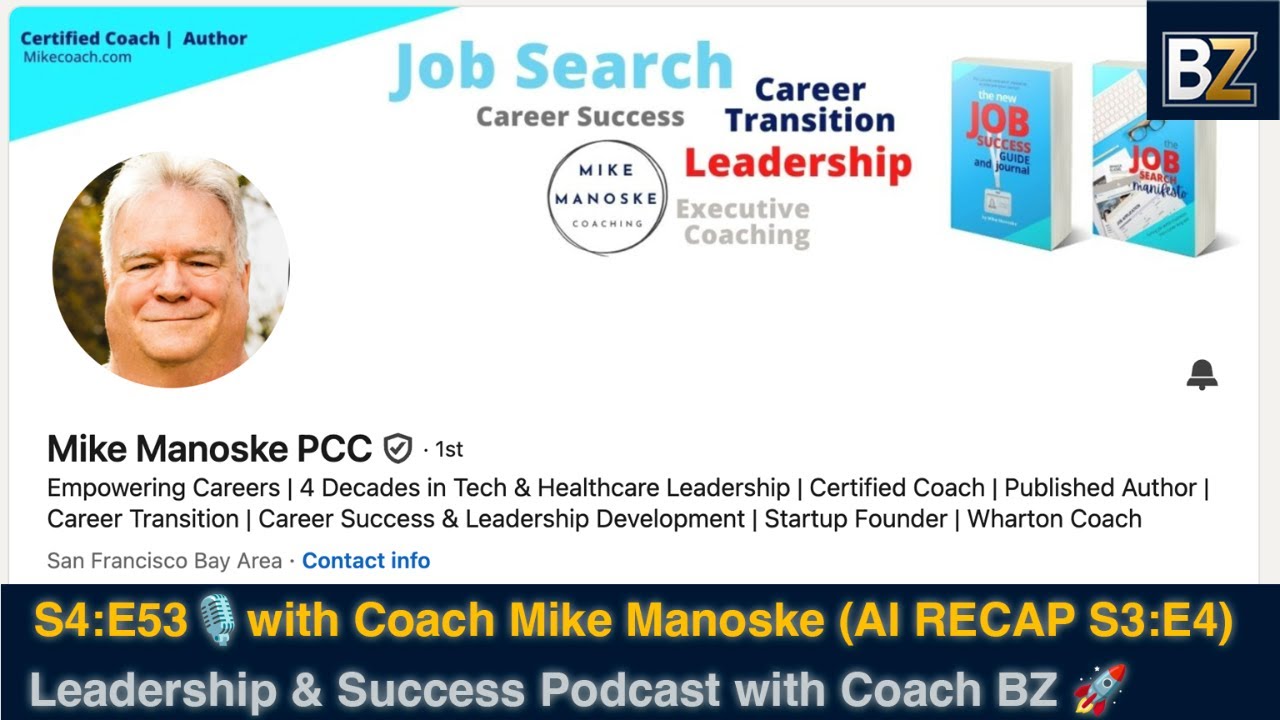
The episode is a live, AI‑generated 10‑minute recap of a prior interview with Coach Mike Manaske, hosted by Bob Fabien Zinga (Coach Bizzy) on the Leadership and Success Podcast. The host opens with promotional material for Maxwell Leadership, his own keynote credentials, and calls to action for listeners across platforms. The core of the recap distills six leadership themes from the original conversation: (1) humility and hope as the twin engines of effective leadership; (2) reframing failure as a trampoline rather than a tombstone; (3) servant‑leadership habits that build lasting trust; (4) the super‑power of “learning how to learn” in a constantly changing environment; (5) a networking shift from transactional asks to journey‑focused conversations; and (6) moving from chasing personal success to creating lasting significance. Throughout, the host interleaves live audience engagement prompts, brief Q&A with the guest about his background, coaching services, and recommended role models (e.g., Martin Luther King Jr., Warren Buffett). The episode concludes with a call for listeners to apply a simple principle—asking “What can I give?”—and invites comments, shares, and future live sessions. The tone is conversational, motivational, and promotional, with a blend of enthusiastic encouragement and measured reflection on leadership challenges.
Chapters
¡Hola!
Hi, I'm John Maxwell. When the top companies in the world are looking for trainers, speakers, and coaches, there's one name that stands above the rest, and that's Maxwell Leadership. Our certified team members have gotten proven results for companies all over the globe, and our reputation, I'm proud to say, is second to none. Some of our members have risen to the top of their profession, including the one you're going to meet today. I proudly introduce you to my friend, Bob Fabien Zinga.
Welcome to the Leadership and Success Podcast with your host, Coach BZ. If you need to develop into a better leader, this podcast is for you. If you want to achieve a greater level of success, this podcast is for you. His mentor, Dr. John C. Maxwell, said it best: everything rises and falls on leadership. We hope to inspire you today and provide you with an insight that has the potential to positively impact the trajectory of your life. Welcome to the Leadership and Success Podcast.
Imagine gaining the leadership skills that could redefine your career. Join Coach BZ on the Leadership and Success Podcast, where each episode delivers practical insights from world-class speakers, military leaders, and industry experts. We dive deep into what matters most: building resilient teams, leading through uncertainty, and navigating complexity with clarity and confidence. Every conversation is crafted for aspiring leaders like you who are ready to grow, lead, and make a lasting impact. Don't miss our powerful live sessions and recent highlights. Michelle Hayward on building diverse, high-performing technical teams. Ann Leslie on leading through global complexity and cybersecurity risk. Ron Carpenter AI exploring faith, resilience, and AI-powered leadership. Colonel Michelle G.I. Gardner-Intz on commanding influence from the battlefield to the boardroom. Chris Robinson on shifting from drift to drive in life and leadership. And Coach Enrique Acosta Gonzalez on mentorship, legacy, heart-centered leadership. Ready to level up your leadership journey? Tune in on Spotify, Apple, Audible Podcasts, YouTube Live, and LinkedIn Live. Join the movement toward leadership excellence. Listen now and start transforming your success. What if your next keynote speaker could bridge the worlds of national defense, Silicon Valley innovation, and global leadership? Meet Bob Fabien Zinga. Award-winning keynote speaker, U.S. Navy Information Warfare Commander, and trusted executive in technology, leadership, and strategy. With over 20 years of proven leadership in the U.S. Department of Defense, the U.S. Navy, higher education, and the high-tech sector, from startups to Fortune 500 companies, BZ delivers keynote experiences that inspire, challenge, and equip leaders for real-world impact. BZ speaks with authority on cybersecurity and national security, strategies to safeguard critical assets in an age of constant threat, artificial intelligence and emerging technology, how to innovate responsibly while staying ahead of disruption, leadership and corporate governance, building resilient, ethical, and high-performance organizations in any environment. Every keynote blends military precision, Silicon Valley agility, and boardroom strategy, delivering practical takeaways that leaders can apply immediately. Audiences leave inspired, informed, and ready to lead with clarity and courage. Whether you're hosting a global conference, corporate summit, or leadership retreat, book Bizzy to energize your event and empower your audience to lead in a rapidly changing world.
Set of questions, and I think I already know the answer for you. What is the most rewarding aspect of your life experience so far?
Other people's success. Yes.
Wow, that is, that is great. Okay, now, uh, last 3 questions, they're gonna go really, really fast. I don't want you to spend too much time thinking, but just give me answers. What are 3 adjectives that would describe you as a child?
As a child?
Uh, adventurous. Curious and, uh, risqué.
Okay, as an adult?
Adventure, curious, and shared.
Wow, okay, didn't change very much. That is good to know. And finally, I love that, what is one word that represents our shared experience in this meeting right now? What word comes to mind? To me, I think it's humility.
Awesome.
Yes.
All right.
Thank you so much. And I'm gonna triple check, make sure I don't have any more question on LinkedIn. I don't think we do actually. Uh, no, I think we are, we are, we are good. And, uh, thanks again for, for your time. I really appreciate that. It's been almost, uh, an hour and, uh, this is going to be, um, on LinkedIn for, uh, rebroadcast immediately. And by the end of today, it should be everywhere podcasts are found. So thanks again for your time, Shachinin. Really appreciate it. We're definitely going to do that. Until next time.
Bye.
Thank you.
All right, everyone, this is Coach Bizzy. Thanks so much for being with me today. That was Coach Mike Manaske. We had a great interview actually a couple of years ago. That was for season 3, I believe it was episode 2. And today we are going to do the AI recap, a 10-minute recap for busy people. Just going to give you the highlights you need to know about what we talked about for about an hour a couple of years ago. So we're going to be— I'm going to give you a taste of what you're going to be learning in this AI-powered recap. One is why humility and hope are the twin engines of great leadership. How to see failure as a trampoline, not a tombstone for your career, right? The servant leadership habits that build lasting team trust. And why learning how to learn is the leader's ultimate superpower. The networking shift that changes everything from asking for jobs to asking about someone's journey, right? How to move from Chasing Success to Creating Lasting Significance. All right, I'm going to have my AI agent take it from here. So it's gonna be about 10 minutes or so. So if you have a question, please go ahead and type it in the comment and also let us know where you are watching us from, what city, what state, and if it's outside the US, what country. And also please be engaged with the content, like the post of the event, and also, please let somebody else within your circle who is going to benefit from this conversation, tag them so they can join in. And we really do appreciate that. We are live on YouTube as well. And like I say, let us know where you are joining from. Okay, I'm gonna step away now. And if you have a question, again, type it in the comment and I'll be back in about 10 minutes or so. I'm gonna have Joe and Beth AI do the Yeah, summary, recap for me. Right.
Welcome to this conversation on leading through change, where we dive headfirst into the essence of humility and hope as catalysts for effective leadership. It's, um, quite an invigorating concept, isn't it?
Absolutely. It really is. So when we look at these insights, what's the core takeaway about humility and leadership?
Well, humility Um, is portrayed as the unwavering willingness to keep learning, to always be open to new ideas, no matter how high up you are. It reminds leaders that no matter how accomplished you may be, there's always a lesson waiting right around the corner.
Yeah, I like that. It's like, you know, a never-ending journey of self-improvement. And hope, how does that play into it?
Hope acts as, ah, this powerful motivator that that keeps you moving forward even when setbacks come. The idea here is that if you truly believe that things can improve, you're far more likely to press on even after a failure. Yeah, it's essentially framing failure as a trampoline rather than a tombstone.
Right, that metaphor always gets me thinking. It's like every fall is just setting you up for a bigger rebound, isn't it?
Exactly. And in leadership, Especially in today's world of rapid change, that mindset is crucial. When you're steering teams through new technologies or market shifts, humility and hope become your twin engines driving innovation and resilience.
Um, speaking of rapid change, the content really emphasizes how our modern leaders have to be comfortable with perpetual transition. It seems like the underlying message is to adapt and embrace change rather than fight it.
Right. It's like our environment now is almost always in flux. Whether you're navigating a high-stakes tech product launch or leading a military unit, you have to be agile. And that starts with earning the right to influence by communicating effectively.
Yeah, that quote really stood out to me. Before you can influence, you have to communicate effectively. It's almost like leadership is a cycle of learning, sharing, influencing, and then adapting.
Absolutely. And it's that cycle that allows leaders to, um, stay connected with their teams. It emphasizes that influence isn't given; it's earned over time through trust and consistent action.
Mm-hmm. That makes a lot of sense, though I've got a small critique here. Do you think that sometimes that focus on communication might oversimplify the complexity of real-world decision-making under crisis conditions? Conditions.
I appreciate that perspective. It's true that in moments of crisis, decisions can be chaotic. Yeah, but even then, effective communication serves as the backbone because it turns potential chaos into, um, coordinated action. Though I must admit, there are times when even the best messages struggle to hit home.
I see what you mean. It's almost like in the heat of the moment, Your team's emotional state could skew the message, no matter how crystal clear it is.
Exactly. And that's why emotional intelligence is such a critical complement to servant leadership. Understanding not just the mission but also the emotional undercurrents of your team refines how you lead.
That brings up the concept of servant leadership. I love how the conversation stresses aligning the team's personal why with the mission. It seems like genuine care for your people ends up fueling the mission success.
Yes, and it's really about creating an environment where every member feels valued and understood. In military or tech settings, it ensures that the team is not just following orders but are actually motivated by a shared purpose. Yeah, it transforms work into a collective journey rather than a lonely struggle.
And then there's this idea about reframing failure, turning what looks like a setback into a launchpad for future success. It's kind of refreshing compared to the usual negative connotation failure often carries.
Right, it repositions failure as a necessary step in long-term growth. You know, sometimes a setback, like stepping away from a role that seemed promising, is really the first step towards something far more impactful. It's a bold call to view challenges as opportunities.
What really captures that is the notion that sometimes career transitions, even those that seem like career suicide, can lead you into your true calling, like how Coach Mike transitioned into writing and coaching.
Totally. It's like life nudges you to see that the straight path isn't always the one that leads to, um, true fulfillment. Instead, Detours might be the secret routes to unprecedented growth.
And that journey isn't just about personal achievement, it's about significance, transforming your success into lasting impact on others. How do you see that balance playing out?
It's a delicate balance, really. Success might light your career, but significance, where you shift your focus from 'what can I get' to 'what can I give,' is what truly defines legacy.
Yeah.
And that transition, though challenging, is what separates a good leader from a truly transformative one.
Right, that shift is so central. I mean, the idea of cultivating significance through nurturing others is what builds resilient organizations. It's almost philosophical, don't you think?
It is indeed. It's like designing a legacy where every success is measured by the positive imprint on individuals and the community. And when you start asking, what can I give? It naturally encourages you to invest in your team's learning and growth.
Speaking of learning, the idea of learning how to learn is a vital skill they bring up. It seems essential for thriving in environments where the only constant is change.
Absolutely. Learning how to learn means not just acquiring new skills, but also developing the agility to absorb, adapt, and apply fresh knowledge swiftly. And that becomes the sharpest edge in any leader's toolkit in our fast-paced world.
It's almost like a twofold approach, focusing on personal growth while simultaneously cultivating an adaptive team. But then, don't you think it can be quite overwhelming to keep up with the pace?
Oh, for sure, it can be daunting. But the perspective here is about building a culture of continuous improvement. When you embed this collective learning, the entire team becomes more resilient to change.
And there's also something intriguing about the networking shift they mention. Instead of the classic cold outreach, asking about someone's journey creates a, um, more genuine connection.
Exactly. It pivots the conversation from a transactional "I need a job" to an exploration of insights and experiences.
Definitely.
That subtle change can lead to far more meaningful responses and opportunities.
I love that approach. It not only boosts your network but also enriches your perspective by learning from diverse paths. It's like the networking ecosystem becomes more collaborative rather than competitive.
Yes, it fosters an environment where every interaction is a chance to grow, not just to get ahead. And it truly highlights the difference between success which is individual, and significance, which is collective.
Now, a bit of food for thought. While these ideas are inspirational, do you think every leader can easily adopt these mindsets, especially in traditionally rigid environments like the military or legacy tech companies?
That's a fair question. I believe the challenge is indeed significant, but that's precisely what makes it so rewarding. It might require a cultural shift, but starting with the individual, embracing humility, nurturing hope, and prioritizing clear communication can slowly and often powerfully change the organizational dynamics.
I can see that. It's like planting a seed that eventually reshapes the soil of an entire organization. But it definitely demands courage and persistence.
Absolutely. And that courage often comes from learning to see failures not as not as dead ends, but as springboards. Taking that leap, say, moving from a high-powered role to something that seems less conventional, can spur colossal personal and professional breakthroughs.
Totally. And that's where the narrative of the podcast really resonates. It's not just about bouncing back, but bouncing forward. It underscores the beauty of navigating change with resilience and a compassionate heart.
Indeed, and as we wrap up, the actionable plan for rising leaders stands out. It's about earning influence, practicing humility and hope every day, reframing adversity, and most importantly, shifting from seeking personal gain to making a significant impact on others.
Yeah, that's the key for anyone, be it a military commander or a tech startup leader. The message is clear: lead with character, embrace vulnerability, and make your journey meaningful both for you and those you lead.
Exactly. So as we reflect on all this, what's one leadership principle from these insights that you think listeners can really start implementing this week?
I'd say it's about asking, what can I give? Rather than, what can I get? That shift is simple yet profoundly transformative.
Right on. And for anyone listening, that might just be the beginning of a more empathetic, Resilient, and impactful leadership journey.
Yeah, well put. It's been an enlightening discussion, touching on everything from the power of humility and hope to the importance of being a lifelong learner in the face of constant change.
For sure, and remember, every challenge is just an opportunity in disguise. Keep learning, keep growing, and lead with both heart and purpose.
And to everyone out there, consider this: What's one way you can shift your leadership focus from personal achievement to making a lasting impact? Drop your thoughts and let's continue the conversation.
Well, one would be Martin Luther King, because I think he— his ability to make change, his ability to communicate that change, stunning. I've always— I I just found him so inspirational. Uh, not only just his ability to be a good storyteller in the background, right? So he'd be one. Um, ironically, one would be Warren Buffett. And, and the reason I like Warren Buffett, or he's already this guy, the wizard. Yeah. What's interesting about him to me is this guy doesn't have pretense. This is a, this is a guy who could be living in, in, you know, 500 different houses, all fully paid for, but he lives in Omaha, Nebraska. And he's, he's humble about it. And that, yeah, I use the word humility. I just find him absolutely fascinating, uh, from that aspect. I could keep going, but those are two guys that have always kind of been on my list. I understand that if I wanted to try to get lunch with Warren Buffett, it's like a half million dollars to your charity or I don't know. I don't want to put my money, right? But so I'll just be, I'll just read about it. But those would be two people. Uh, yeah, I mean, sound very different, but I just find people like that fascinating.
Definitely somebody I'd like to meet someday. Him and Bill Gates, right? They used to be the richest people in the world at one point, but now they're getting rid of their wealth. It's just incredible.
I think I will just say this and I can't go too much deeper. But my brother, my brother worked for Microsoft.
We are getting toward the end of this interview session. So question number 7 was about how can we add value back to you? How could we, uh, what, what, uh, could we do to make a difference? And if you have any product or services that you would like to share out there or benefit the audience, that, that would be great.
Buy my book. The Job Switch Manifesto is, is a program that we developed at Ward Ward. It's what I skill— about half of my practice is focused on career transition. The other half, I really focus on career success and leadership. Uh, people want to talk about that. MikeCoach.com is my website. Uh, but those are the— I even make some people, I mean, even Ward Ward, there's something very serious. I'm doing a lot of posting these days on LinkedIn. Comment and read and connect with everyone. Because as what I'm doing is it's a precursor to several books I'm writing. And some of the best ways to write is to pre-write, get the ideas out there, get thoughts going. And I would love comments about what you're seeing me post a little bit. And, uh, also on— not as much on Twitter these days, we won't go into that, but I'm really focusing on LinkedIn because I think that's where I'm finding my lot of key readers. So I'd love people to read and comment on it.
Wow, that's amazing. And I'm showing your website right now. So you definitely provide coaching, job search, career success, and leadership coaching. And you are really, really passionate about that. Why, why do you think anybody listening to us now, they may say coaching is not for me, why would they want to hire you or someone like, like, like you, a leadership coach?
Because you have an aspiration you can't achieve by yourself. In other words, you got to cause, you got to get the desire higher. I want, I want to achieve this. And what you find, Ray, is you can get it. In many cases, you may be able to achieve it on your own. But you know what? How do you scale that? How do you take the achievement and build a process, an action plan that you can scale? Because Once you've achieved that, there's always something else. How do you take what you've learned and that process?
All right, that's it for today. This is Coach Bizzy. Thank you for watching. Let me check and see if there are any questions in the chat. Okay, I don't see any question from LinkedIn or YouTube. But I do see there is a gamer on Twitter, Gizuna B, saying hi. So thank you for watching us live on Twitch. I guess that's it for now. And I will be back here tomorrow around 7:30 AM Pacific time, so 10:30 AM Eastern time. Until tomorrow, this is Coach Bizzy. Thanks so much for being with us today. Bye.
Bye, everybody.
This is Coach Bizzy.
Thanks for watching. Until next time, don't forget to like, comment, and share.
Thank you for listening to the Leadership and Success Podcast with your host, Coach BZ. If you like what you heard, please subscribe to our channels and come back for more wisdom nuggets on how you may develop into a better leader and achieve greater levels of success. Success. Leadership is the most critical skill. The world will always need leaders to lead others, deploy the next disruptive technology, or execute a business strategy. You may as well decide on counting yourself among the 21st century leaders. See you right here next time on the Leadership and Success Podcast with Coach BZ.
More from Bob

S250:E4🎙️LIVE 🇺🇸America 250: President Barack Obama Leadership, Service, and the Power of Hope






S5:E157🎙️ LIVE with CMD CMSgt Dennis L. Fritz, USAF (Ret.)(Multi Tracks Audio)



S5:E156🎙️ LIVE 🇪🇸 Leadership Lessons from the FIFA World Cup 2026 Champions (Multi Tracks Audio)

S250:E3🎙️ LIVE Leadership Lessons from America’s First Documented Family of African Descent 🇺🇸📖