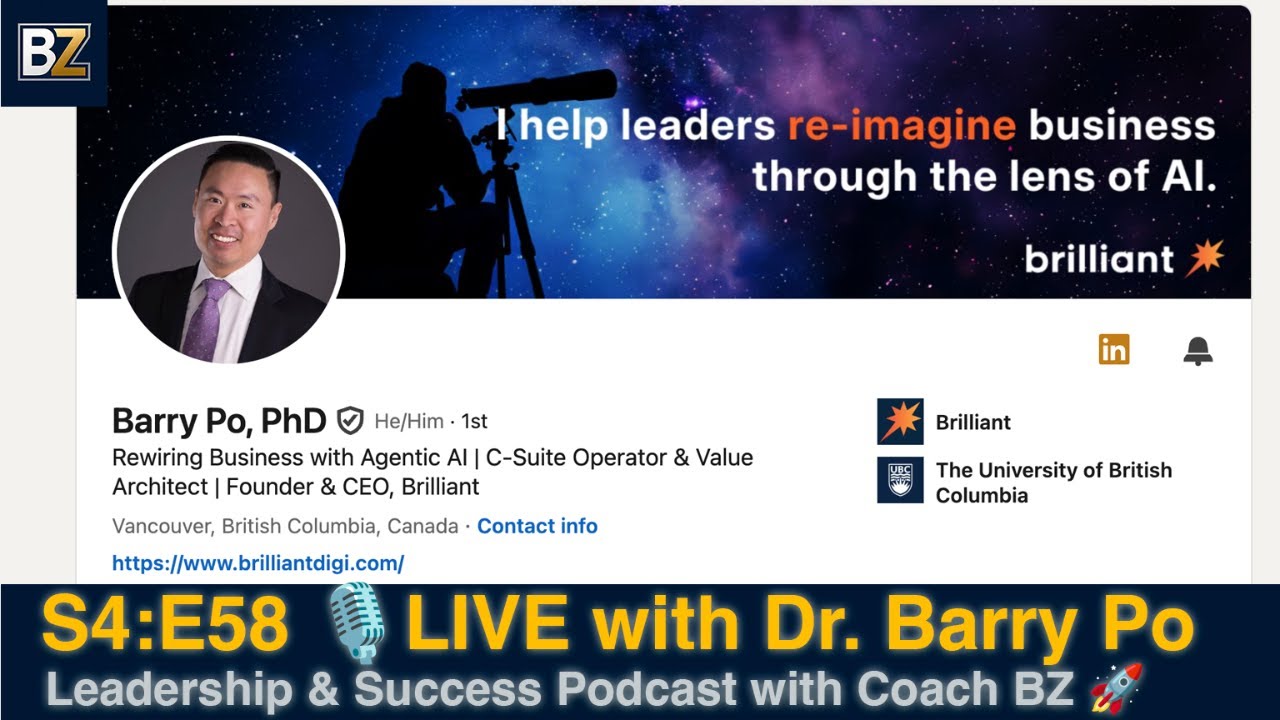
Dr. Barry Pope, former HSBC and Nokia leader, argues that transformation is people-first, not technology-first. He emphasizes defining problems clearly before solving them, building ethical AI systems, and fostering psychological safety and curiosity in teams.
Chapters
Hi, I'm John Maxwell. When the top companies in the world are looking for trainers, speakers, and coaches, there's one name that stands above the rest, and that's Maxwell Leadership. Our certified team members have gotten proven results for companies all over the globe, and our reputation, I'm proud to say, is second to none. Some of our members have risen to the top of their profession, including the one you're going to meet today. I proudly introduce you to my friend Bob Fabien Zinga.
Welcome to the Leadership and Success Podcast with your host, Coach BZ. If you need to develop into a better leader, this podcast is for you. If you want to achieve a greater level of success, this podcast is for you. His mentor, Dr. John C. Maxwell, said it best: everything rises and falls on leadership. We hope to inspire you today and provide you with an insight that has the potential to positively impact the trajectory of your life. Welcome to the Leadership and Success Podcast. Imagine gaining the leadership skills that could redefine your career. Join Coach BZ on the Leadership and Success Podcast, where each episode delivers practical insights from world-class speakers, military leaders, and industry experts. We dive deep into what matters most: building resilient teams, leading through uncertainty, and navigating complexity with clarity and confidence. Every conversation is crafted for aspiring leaders like you who are ready to grow, lead, and make a lasting impact. Don't miss our powerful live sessions and recent highlights. Michelle Hayward on building diverse, high-performing technical teams. Anne Leslie on leading through global complexity and cybersecurity risk. Ron Carpenter AI exploring faith, resilience, and AI-powered leadership. Colonel Michelle G.I. Gardner-Intz on commanding influence from the battlefield to the boardroom. Chris Robinson on shifting from drift to drive in life and leadership. And Coach Enrique Acosta Gonzalez on mentorship, legacy, and heart-centered leadership. Ready to level up your leadership journey? Tune in on Spotify, Apple, Audible Podcasts, YouTube Live, and LinkedIn Live. Join the movement toward leadership excellence. Excellence. Listen now and start transforming your success.
All right everyone, this is Uncoach Bizzy. Welcome to Season 4, Episode 58, another episode for our season in 2025. Uh, to get started, we will start with our moment of gratitude. We're going to take less than a minute. If you would, if you feel like it, unless if you are driving, go ahead and close your eyes for just a second and go to that happy place. For me, it's probably by the beach. I see the waves, my wife is sitting next to me, I see my kids playing in the sand, and that's my happy place. I feel fulfilled. I feel like I'm doing everything I am supposed to do. On this earth, and I'm very, very grateful. So what is one thing that you are grateful for? Go ahead and type it in the comments. Think about that one thing and type it in the comments. Thank you so much. For me today, I am grateful that I still have breath. I'm still alive. As long as I am alive, I have hope. All right, thank you so much for participating in this moment. And part of the reason why we do this is because in the military, about 21, 22 people commit suicide every single day. And it's impossible, right, to be suicidal while you are grateful. It's impossible to be depressed when you are grateful. So every day, be grateful for one thing. I think it's going to be great for your mental health.
Okay.
Today I have a very, very special guest. And before I talk about the guest, let's make sure if you would please like the event and we share it into your feed if this podcast is adding value to you, and also tag someone within your circle of influence so we can grow our reach here. And I really do appreciate that. And if you have a question for my guest today, please go ahead and type it in the comment and we're going to be answering your questions live within the hour. All right. And I really do appreciate that. And also, as you listen to the podcast, if you get the aha moment, you get some type of takeaway or inspiration, please type in what you are learning. And this way, we can share what we are all learning here together. All right. Let me see if I can do our guest justice. I'm so excited that he's here. From shaping the smartphone era at Nokia, to driving global digital banking transformation at HSBC, and now as the founder and CEO of Brillant, Dr. Biri Paul has always been at the intersection of big technology and business reality. He is a visionary AI strategist, enterprise leader, a mentor helping executives across America and around the world cut through AI hype to deliver real measurable results. In this episode, we will dive into how leaders can translate innovation into clarity Execution and long-term value. Without further ado, let me bring to you, ladies and gentlemen, the one and only Dr. Barry Pope. How are you doing today?
Doing very well, Bob. Thank you so much. That was the best intro that I've had in quite some time.
Appreciate that. If you would please, if you wanted to participate in a moment of gratitude, is there one thing you are grateful for today?
Absolutely. I think just the opportunity to share with everyone who's here That's a real blessing. It's not very often that we get the opportunity to talk about leadership and to have an open conversation. So that is definitely something that I'm grateful for.
Thank you so much. So first question I'm going to ask you, what is one thing about you that most people may not be aware of?
Oh, that's a really good question and maybe not one that's easy to answer. I will share with you that music has always been an important part of my life. While I can't claim to be a pro or an expert by any stretch, I've spent my entire life with musical instruments. I started playing piano when I was very young, uh, spent a little bit of time in high school playing clarinet and then the alto sax. So I've kind of got a little bit of range there, maybe not necessarily the depth, but definitely the range.
That is wonderful. I've been playing the piano since I was 7 years old. Now I do play the flute also a little bit, but the sax I don't, except on the keyboard. But that is awesome. Uh, music really helped me go through a lot of tough stuff. So, uh, if someone met you for the very first time, how would you describe what you do?
Well, I think what I would say I do is that I help be a translator between business and technology. I think one of the most important things that can be done, especially in an age where, you know, people talk about digital disruption, they talk about digital transformation, is to be that bridge that connects, you know, organizations that really want to accomplish something with the technology that enables it. And so that's really kind of the core of my business at Brilliant. We really help people, organizations, leaders who really want to achieve great outcomes, see success, how they get there by guiding them through that journey so that way they can chart their own unique path to that success.
Wow, that is wonderful. Can you tell us a little bit about your leadership journey?
Yeah, I mean, I started my career at HSBC. So I had the privilege of kind of finishing up a PhD in computer science. And so I was a technologist coming into financial services. It was such an interesting experience for me because it kind of exposed me to all the things you don't get to learn in school Among them, despite the fact that digital transformation has the word digital and people kind of tend to associate it with technology, what I got to learn at my time in the bank was that transformation actually has little to do with technology and more about people and intent. Getting clear about what good looks like and helping teams manage that, cross that gap. Those are really, really important. That was something that actually I got to build on as a strategic product leader at Nokia. I spent a lot of time there kind of looking after— if anyone remembers Windows Phone, that was among the programs that I got to spend some time and have a hand in. What was super interesting is you've got a lot of really talented, really smart people. That's something I've been privileged to have the chance to kind of interact with over the course of my career. One of the things that I think you learn about really smart, really driven teams is that they tend to take the initiative. Taking the initiative is a good quality if it gets paired with alignment. Which is one of the other things that I've had the opportunity to learn over the course of my career. It's one of the things that's kind of taken me to all these different places that I've had a chance to play a role in.
Huh, that is really fascinating because even when I design cybersecurity programs, usually the focus really is on the people first and then the processes, governance, and then the technology. Technology is always last because technology can always change. But if you can, because no, In cybersecurity, I really wish we could patch people the way we patch systems, but you just cannot do that. And they really are your most important asset, and you're only as strong as your weakest link. So it's pretty fascinating that you said that. So you've had a very fascinating career path, right? From Nokia, HSBC, as you mentioned, to leading at mCloud and now founding Brilliant. Looking back, what pivotal moment do you think shaped you as a leader?
Well, a couple of things. I think I've certainly had the experience of working with lots of different teams in lots of different places. I think one of the pivotal things that's really shaped my career is travel. You know, it's one of the things that I love doing in my spare time. And it's because I think the opportunity to travel the world and to work with many different teams in many different places really takes home the idea that there are many ways to do things and that there's not one way, and that there's something to learn from every— everything, every place that you visit and every team that you work with. Because while they do something different, there might be something that you can take away from that experience that you might be able to apply elsewhere.
Wow, that is really powerful. And one thing I noticed, right, coming from the Congo to the US, I was living in Alabama, I noticed in Alabama, generally speaking, in the Deep South, people don't travel much. Like, I've met so many people, they said, I was born here and I'm gonna die here. I'm like, okay, what way of thinking so small with such a great world? Now, especially if you have a US passport. Now, I'm not sure if a US passport 20 years later is as good as it used to be back then, but at least back then with the US passport, you pretty much could travel to any country in the world without visa. So, but anyway, yeah. Traveling is extremely important. Or even like, even when you live in California, right, you don't even have to go very far to change scenery. We have snow, we have, uh, uh, you know, deserts, everything you can think of. We have ocean, rivers, I mean everything in between. But yeah, there are people for whatever reason that just feel like, I want to stay in this one spot for the rest of my life and not learn anything, not be exposed to any other culture or learning. That's kind of sad, isn't it?
I think that we, to the best of our ability, we should always encourage people to take the time to go and explore. I mean, the world is such a rich place that it's a shame if you don't have the chance to experience at least more than just one part of it.
Absolutely. So what lesson did you learn working on the early smartphone era at Nokia that still influence your leadership today?
Well, a couple of things. I think when you're building a phone, you're building a platform. And I think there is a power to be had when you're thinking about products that go beyond just some unit that you're selling to thinking about the ecosystem and the network that you're creating with it. And so the power of that ecosystem is one of the things that I certainly had the privilege to see firsthand. Both, by the way, the potential of building an ecosystem that can scale because now you're essentially creating a device that enables people to do many different things that maybe you didn't originally conceive of, but also the challenges of standing it up up, which is to say that, you know, an ecosystem does not grow because you say you want one. Sometimes it happens organically, which means that it has to be managed. You've got lots of different people in an organization that will have different points of view as to how that organize— that ecosystem should be shaped. And so the things that you learn in that experience, among them, it's really like, how do you get everybody on the same page about the ecosystem that you're really trying to stand up and enable?
Wow, leadership, dealing with people, right? Our greatest asset and sometimes the greatest pain as a leader. So you do have a PhD in computer science. How did your PhD influence the way you approach business strategy and people leadership?
There are probably a couple things. And by the way, like, I take this away as somebody who spent time in both the boardroom and also in the R&D of a business. I think business is in many ways an exercise in reasoning about uncertainty. Like sometimes you don't always have the ability to have perfect information before you're required to make a decision. So one of the things that you learn in your PhD is the ability to really think about how you reason about that uncertainty, because the things that you're doing have no answers. And so you've gotta cultivate that as a skill. The one thing that I always take away with having a PhD in computer science is, how to abstract and think about problems. You know, like a lot of business challenges, they're too big to wrap your arms around. And so one thing that I've always taken away in my leadership is how do you, how do you take a big problem that might be at first glance too big to put your hands around? And then how do you decompose that into smaller chunks that you can deal with? And then taking a look at how you can bring those small pieces together to actually solve the bigger problem.
Wow, that is quite fascinating. So, hmm, you often say, like, even during the introduction, introduce yourself as a translator. So now you say, you know, you translate between AI hype and actual business outcome, which is great. But can you unpack what that means for leaders trying to make AI practical?
Yeah, and I'll share a few things on that front because I work with leaders of many different stripes and many different leadership teams in there's no one template for what leadership looks like inside an organization, at least in my experience. If you, if you take a look at what happens in the boardroom, businesses often talk about revenue, they talk about profit, and then they talk about risk. If you talk to the technologists, they speak a completely different language. They're going to talk to you about models, they'll talk to you about data, they'll talk to you about code. The key is to be able to find a way to translate those into proper outcomes. So you're not translating, let's say, English into code, right? What you're really trying to do is you're trying to translate what might be fuzzy outcomes into clear intent that teams can execute on. And that's, that's maybe easier to say than, than it is to do. But that really is the trick is how do you get all these different teams who work from different places to say the exact same thing about what they're looking to achieve?
That is quite powerful. So what's the biggest mistake you have seen companies make when they adopt AI?
Good question. I think part of that is maybe solutions in search of a problem. You know, I do find that a lot of organizations, and this isn't specific to AI, but I think it's especially acute when, now that AI is at the forefront, people start with the technology and then they say, how could I apply this technology to problems in my organization? And of course, in a way, that's kind of backwards, right? Like you actually want to know, like, what is the challenge that's worth solving?
Yes.
And then what technologies might you apply to address it? Right. And I think that while that's— that also seems like an obvious thing, it's not obvious when you walk into a business and then you look at how they operate. Oftentimes that is something that you've got to coach and guide them through is that process of like, how do you take a step back, think a little bit about the challenges that you want to solve, and then think about what technologies are actually appropriate to solving those problems.
Wow. That is quite interesting. I guess it's just human nature. Sometimes I guess people have fear of missing out, I guess, FOMO. Everybody's using AI, I got to use it too even. Without having a plan of thinking about how it actually helps me strategically.
You know, interestingly enough, and I work with a few customers today where, you know, that is a, that's a real challenge because they feel the need to react to everything. I think a good sign, you know, a good sign of leadership is learning how to create and stand up your own agenda and being confident that you have the right agenda because then you don't necessarily feel the need to react to every situation that comes your way. I mean, the tech world changes every day. So like we talk about AI today, I am sure that in the not too distant future there'll be some new AI model or some new AI architecture. And then people will be asking us, well, how do I respond to that? Maybe your answer might be nothing.
Yeah, right.
And that's also okay.
No, that is, that is, that is why. So how can leaders bridge the execution gap, right? Where great ideas either take flight or fail?
I would say that there are a few things, right? You're, you're really in an exercise of seeking clarity and finding purpose, right? There's kind of 3 questions that I think you, everyone would want to ask. Like, one is, what are the specific, measurable outcomes that you're trying to create? You know, how will we know unequivocally that we've succeeded? And then who needs to be aligned and who's committed to doing this work? Those are 3 really important questions that businesses, sometimes they're aware that they need to ask them, but they don't explicitly ask them. And in fact, before engaging in a project or a program of some kind, I'd always recommend have clarity in that way. Think about, think about how you would answer those questions. And if you don't have the answers to those questions, insist on them.
Yes. Wow, that is simple but Powerful. Wow. So how should business then think about building not just intelligent but also wise systems, if that's even possible?
That's also a really good question. You can, you know, here's something that I sometimes share with customers, like intelligence is about finding the right answer. Wisdom is about asking the right questions. And so you say that again. So intelligence is about finding the right answer.
Wow.
Wisdom is about asking the right question.
That is powerful.
And so, you know, to put that in the context of something like AI, you might have, let's say, an intelligent system, you know, a system that can optimize a supply chain. A wise system might ask, though, whether that supply chain is in fact sustainable, it's profitable, it's ethical, the things that often businesses really need to know in order to make sure that they understand what success really looks like. Those require more than just asking, what's the mechanical process through which you optimize the system?
That is really powerful. My 20-plus years in the military, one thing I've learned is sometimes people, they spend a lot of time and energy going after an outcome and then it's not even needed. They didn't have to spend any, it didn't need to be done at all. So I really love having that clarity. What's important, what is critical. And it may not be urgent, but it is the most important thing that you really need to focus on, especially as a leader.
Absolutely. Taking, taking the time to discover rather than commit or before you commit. I think that that's really important. In business, sometimes you feel compelled, I think, to make decisions really quickly. Like one of the things that I think some leaders feel is that, you know, they have to show that they're taking action. And like, yes, being decisive, taking action is really important. Also being intentional, that's really important, right? It's not, it's not just about making decisions, about making the right decisions and knowing that the decisions weren't accidental. They weren't just things that you did. They're in fact things that you know and are confident are the right things to do given what you know.
Yes. Wow. That is amazing. Can really make a huge, huge difference in an organization. So now with the rise of agentic and autonomous AI, What should leaders do now to prepare their organization?
I think a couple of things that are really important, and I share this because, as we were talking about a moment ago, transformation is more about people and intent than it is about technology. One thing I would always encourage leaders to do, like master the art of problem definition, like define problems and learn how to define them. As you were just saying a moment ago, there are obviously problems that sometimes people commit to solving. They don't know why it's important or even if it's worth solving. Mastering that, that's an art, that's not a science. Problems don't just automatically reveal themselves. You have to discover them. The, the other thing that I might say there is that especially when you're talking about AI, uh, investing in upskilling, not just technology, that's also an important thing. Upskilling people, uh, and this is about teaching people not just about AI and how to write the right prompts, which I think you'll see lots of guides around. It's about cultivating the wisdom about when to apply the tool, to really understand the limitations of the tool, and to know in what way can AI be a partner to the person who's seeking the help.
Wow, that is powerful. Just a minute ago, you also made me think of what one of my mentors told me, Brian Tracy, right? Kind of measure twice and cut once. He says, right, a minute in planning will save you at least 10 minutes in execution. And I've always taken that to heart. Even in cyber, we say, what think before you click, what think before you download and send. So it's always good to take a pause and think, strategize, and then massive execution, like Tony Robbins says. So what role should ethics and human intent play then in AI deployment?
Yeah, ethics is such a big part of the conversation around AI right now. And Actually, I think a lot of people talk about trust and ethics and responsible AI all in one breath. I think in a way ethics, ethics is more than just playing a role. Like they're the foundation of a proper AI implementation. You know, I think it's easy to maybe decompose ethics into like a little box that you can tick at the end of project completion. What you really want to do is you want to be thoughtful about the ethical guardrails, the intent that you're trying to accomplish, and making sure that you can define those things because they're really your blueprint for how you want to build out your agentic system. You don't get there just by saying, I can deploy an agent. You get there by being clear about what the agent's mission is.
Well, now there is something that you do that is very important here on the Leadership and Success podcast. We really love to focus on the aspirational, the next generation leader in both the military and tech. Those are two worlds that I know very well. So you are a mentor, founder at Futurepreneur Canada, MBA candidate at UBC Sauder School of Business. So what leadership gaps do you see most often in the next generation?
Good, good question. I— a few things that I, I see. I, I think one is, um, commitment. You know, I think that that is sometimes a gap. Sometimes people come in and they're curious, or they've got great ideas and want to start things. Commitment is not just about starting things. It's about seeing them through to completion. And commitment as well is not about doing things half-heartedly. It's also about committing to them fully. You know, when you commit to doing something, you're going to put your all. You might not always agree with it, but you're going to do it because you're committed to it. I think that that's important. That's an important skill for any leader. Resilience. I sometimes come across entrepreneurs who love the idea. They love the idea of being an entrepreneur. But along with it comes, has to come the recognition that some things do take time, that not all results are instant. And that commitment and that ability to persevere, despite the fact that there are challenges, and maybe you don't know how those challenges are going to work out. Those are important qualities as a leader. The last thing maybe I'd share there is curiosity. Curiosity. I think curiosity is an important skill that maybe we don't always encourage. And we were talking about decisiveness a moment ago. I think, you know, alongside being decisive, the quality of being curious is what often allows you to maybe discover the problems that are worth solving, and then also to look for inventive solutions, maybe things that aren't immediately obvious.
Well, that is That is great. Now, a significant portion of my audience are junior military officers and aspiring tech and cybersecurity engineers. What type of advice would you give them into transitioning into a leadership role today?
A couple of things, and this is going to sound soft, but it's really not. One thing that I think is very important for a leader is to be clear about what's authentic to you. You know, what do you value and what do you choose to bring to work every day. Those kinds of things don't, don't automatically come out of thin air. And they're not things that you can tell people and that they embrace. They have to come from you. And so I think finding out what's authentic, and then also building the skill to have the confidence that what's authentic to you actually matters, and that it's something that you want to share with others. Having the confidence that you are good enough, and that you don't have to rely on that external validation. Very important skill.
Wow, confidence and competence. This is good. I think this is a great way for us to transition into the second half of the podcast where I ask you about specific leadership questions, which I ask to everybody who comes on this program. Before I do, is there anything you would like to say that you wish you had said for the first segment?
I think probably we've covered a lot of really good ground. Maybe one thing I'll share, you know, because I've shared it across a bunch of the different questions that we've talked about. Intentionality is important. You know, good results are never accidental. They come because somebody has consciously thought about how we're going to achieve those results. And so it's, it's not just a question of, you know, can you make decisions? Do you have the confidence? And have you thought critically about those decisions and understand the consequences of those decisions before you enact them?
Wow. That's wonderful. My primary mentor, Dr. John Maxwell, says, uh, you do not climb uphill by accident, right? And, uh, that's what success is. It's really a climb uphill, and you have to be intentional and, and consistent, right? You, you talked about building the skill, being confident, but yeah, uh, committed, which in the Navy, our three core values: honor, courage, commitment. Uh, so really drilled into us from, from, from day, day one. But as you do things every single day, even though you don't see much change, but in time you will make huge, huge progress. Well, that is wonderful. Okay. The first category of question, Ben, for the second half of the show is what is the greatest lesson you have learned so far?
What's the greatest lesson that I've learned? To keep an open mind. And in fact, sometimes I have to remind myself that that's an important lesson. When you're busy and you have lots of stuff to do and you've got pressure and commitments, it can be really hard to entertain the possibility that maybe you're not doing the right things or that you're not working on things the right way. But I think keeping an open mind and always reminding yourself that actually, like, whatever you're doing today, it doesn't hurt to take a step back and maybe ask yourself, are you doing the right things? That's hard to do sometimes, but incredibly powerful. That only happens if you're open to the possibility that maybe there's a better way of doing things.
Well, that is great because it really falls into one of my core values, which is humility. Right. Because sometimes I think if you are too arrogant and I live in Silicon Valley, we have a lot of very, very smart people. Their IQ probably off the chart, but sometimes their EQ not so great. Right. And you've got to be aware that you do not know everything there is to know. That's not possible. So you're going to need to collaborate with other people and learn from somebody else. At least having that open mind, I think, is Absolutely key. So what do you think is the secret of your success? You've had such an incredible career.
Perseverance. I would say that that probably matters more. So here's an interesting thing. I sometimes get asked questions about like, well, how did you start your career in a technical field and then move your way into executive leadership? I think some of it has to do with being a good translator, but I also think some of it is having the resilience to see really hard situations through and the ability to bring teams with you on that journey. That's a hard skill. And those are some of the, maybe the biggest challenges for any leader to overcome. But the leadership is not limited to the people who have MBAs, right? And so I would always say that that's actually like a really important component of that aspect of my career has been like, how do you move people along with you?
I think you mentioned your MBA. I have a Master of Business Administration as well. What do you think is the difference between management and leadership and are both needed?
Oh, yes. Good question. I was taught a long time ago that, you know, you might, you might in a sentence say that leadership is about learning to do the right thing. And then management is about how to do things the right way. Both are important, but for different reasons. And so you can be a great manager and a terrible leader and vice versa. You could be a great leader and a terrible manager. The trick is to know when and in what quantities you need each.
That is very, very, very, very good. We definitely need both. Like, even in Monavia, I know leadership is really critical. They drill it into us. Even as the lowest-ranked seller, I was an E1 even back then. Leadership was a very, very big deal. But the truth is we do need some hands-on people manager who oversees the work and making sure it meets the standard and all of that, while some other people are thinking about the vision, the strategy, and kind of know where we are going as an organization. And both are definitely important.
Oh, absolutely. And I think one other thing I'd share there is that every role is important, every role is critical, because if you're missing one part of the system, the system doesn't work.
Yes. Wow, that is powerful. What do you think is the greatest leadership advice you received so far?
Oh, I've received so much great advice over the years. And that's part of the reason why I'm so privileged. I think, I think probably the most powerful leadership advice that I've ever gotten is learning to recognize the difference between outcomes and outputs. You know, I think, I think in a lot of organizations, you know, people find themselves in roles, and they're taught and trained to believe that, you know, delivering and creating deliverables is the reason, is your reason for existence. It's why you're in the organization, to deliver output. The challenge is being able to distinguish between the deliverables you create and the value that those deliverables have. And so getting clear about outcomes is in some ways very, very important because sometimes it's not clear. You might be working on something like that, that 30-page report that your manager, your boss asks you to work on. Why are you doing it? How is it going to be used? And how is it going to create value? You should know those things.
Yeah, yeah. We said earlier about working on projects or things that don't even need to be done at all, but feeling busy, feeling happy, and like you're doing something. But wow, that is great. Second portion of this segment, what are you learning now? I know leaders are learners. What interests you this moment?
A lot of things. I think that we are— one thing that I've observed, and this isn't something that I think has come up immediately recently, but I would say over the last 5 or 10 years, as you've kind of taken a look at disruption, the scale and the magnitude of disruption has certainly increased over time. And it's now kind of reached a fever pitch where And I'm fond of saying it, even in the world of AI, things seem to change every day. Like there's always a new model or there's a new technology and there's always something. And so I think one of the things that I'm learning about right now is how do you, how do you keep teams out in front of it? And then how do you keep teams resilient enough to not be bothered by it? Because change always happens. The hard part is knowing, you know, whether the path that you're on continues to be relevant. And it's a path that you're committed to, or whether it's a path that frankly needs to take into account what's going on around you. That's not always easy. And I don't have necessarily any straightforward answers other than sometimes that clarity of purpose, that clarity of mission. That's where it becomes valuable.
That is, that is good, because when you're clear about your mission, your purpose, then you know what doesn't belong, right? So you learn how to say no to what you shouldn't be getting yourself involved with, which is really, really great. So I love this coin I have. One side says failure, the other side says success. I believe success and failure are two sides of the same coin. We look at your incredible career and we are in awe of everything you've been able to accomplish. But I am pretty sure you've had some times in your career where you didn't always succeed. So my question is, how has failure shaped your life?
Failure, failure is a part of life. I think I've certainly done things in my career that for sure I would not repeat. And I think the most important thing that I've learned, you know, and maybe I'm still learning it, is not to dwell on those things per se, but to make sure that I take the time to truly reflect on them and to learn about them, and then to commit to myself what I'm going to do differently next time. I for sure I've never claimed to be a perfect leader, and I would never, ever do that. But I do think one of the things that's important is that leaders also evolve and that leaders also commit to getting better. And I think that that only happens with the acceptance that failure is a part of the journey. And in a way, I wish organizations would be more open to rewarding failure, because I think that organizations would learn a lot more that way than just rewarding success.
You are correct. There's a new, relatively new concept I've learned on psychological safety, maybe the last 5 years or so, where you really want to encourage your team member to be themselves and to learn to make mistakes and learn from those mistakes. And that usually builds, I think, much more resilient organization. You mentioned about making teams resilient.
I think on top of that also, That's— along with that safety comes the ability to be candid. And I think candor is important when you're having conversations. And I'll share with you like a really, really good example of that is, you know, people often have these conversations about how AI is going to be deployed. At some point, someone needs to raise their hand and ask, it's like, why are we deploying this AI? And is this the right thing to do? Right? Those are important questions. You can only ask those questions if, one, you feel safe that, you know, you can ask the question and you're not going to You're not going to fall because of it. But also, you've got the ability to be candid about the question. And people can be equally candid about how they would respond to it.
Wow. So can you share a moment where your values were tested as a leader? And what did you learn from the experience?
Yeah, I've had so many of those. I think I recall a project that I worked on many years ago where there was a lot of— and I won't get into specific details here, but there was a lot of pressure to go and deliver something on time. And it was like essentially like a technology project, a flagship project for this organization. And there was a lot of pressure just to deliver it, like launch it, you know, like people were saying you had to do it. And I think the ability to essentially say, to say no to that. And then to frankly have to figure out a way to say that without necessarily— while keeping in mind that not only did you want us— did you want that to be the outcome, you needed to do it the right way.
Yes, yes.
And when you don't do it the right way, sometimes the conversation that follows isn't the one that you want to have. And so, I've learned through experiences like that, that it's important not just what you want to do, how you do it. Really matters. You do get points for style.
That's very important. So who are some of your thought leaders? Who do you know that we should know? Who do you follow?
I follow, I follow a great number of people, I guess. I mean, if you take a look at my LinkedIn profile, you'll probably see the number of leaders that I follow. You know, there are, there are people like Simon Sinek who I follow. You know, he had the, he had the book Start With Why. I think that that's always something that's been very core to what I think of as being like among the most essential of questions when you're starting a program. You should always know why you're doing something. And it's not just important enough for someone to say like, this is what you should be doing. You should know why you're doing it and the why of the program, but also why you.
Well, you know what? This might be the 8th or 9th time this season alone, 2025, that somebody, I brought on on the podcast talked about this book, Start With Why. It was not on your list when I asked you, but I did have a picture of it because so many people mentioned that. So that's why I have a picture of Simon Sinek right here. Great, great leader. I love him. And you also, is this your favorite quote by any chance?
I love this quote, by the way. Alan Kay is a computer scientist. And so, you know, he has this quote that's like, the best way to predict the future is to invent it. It is a reminder to me that The future waits for no one, and that frankly, the opportunity exists to seize the initiative and then to create the future that we want to live in. I think some people might say, like, there are so many things that are out of our control, we can't change the world that we live in. I'm like, maybe not everything, but there is some stuff that is in your control. And the question you've got to ask is, among the things that are within your control, what can you do to directly influence the trajectory?
That is powerful. And can you tell me about this astronaut here and your experience with him?
Yeah, so I had a brief amount of time where I had the privilege of working with Chris Hadfield. He's a Canadian astronaut, probably best known for singing songs in the International Space Station, but an incredibly, truly incredibly brilliant and committed individual. I think—
The song goes around the world. Yeah.
Yes. One of the things that I think I learned from my experience, the time that I had the opportunity to interact with him, is how intentional and how deliberate he was. And even more importantly, how he would leave nothing to chance. You know, like I was working with him, we were setting up an opportunity for him to give a talk. And I recall like he obsessed around over every single detail, right down to like the length of the patch cord that would connect the microphone to the speakers. And the reason for that was because it was within his control and he had the courage to ask the question rather than leaving it up for, up to chance. And I admire that greatly. It's something that stuck with me as like a reminder of like great leaders should not be afraid to ask the right questions. You might not like the answer, which is okay. But at least you know what the answer is.
Well, that is really great. Right on. So last question I'm going to ask you into this category is, if you could choose 3 people to have dinner with, who would you choose and why? They could be alive, dead, or fictional character.
Oh my goodness. 3 people. 3 people that are alive or dead.
Oh, even—
I would love to. Yeah, yeah. So I mean, I'm just thoughtful because like I'm just running through like all these, all these people that have kind of shaped and molded my own career. I think it would— I would love to have dinner with Bill Gates one day. I think, I think he's been very thoughtful and obviously transformational in his own way. Something that's been super important to me. I would love to. And, you know, you saw the Alan Kay quote. I think Alan has also been incredibly important in the field of computer science in that way. You know, I have a love of motorsport. I have a love of Formula One. I would love to have dinner with someone like Lewis Hamilton one day.
Fantastic. No, that is great. All right. So leaders are readers, right? What books are you reading right now?
Well, there are a few that I am reading right now. And in fact, I've just recently finished reading Ray Kurzweil. He's a futurist. Um, he's written a— he's written a series of books actually, and this is probably the latest one. Um, The Singularity is Near, uh, and he really talks about— this is, by the way, he's got like a whole series of books. It started with like The Age of the Intelligent Machine, and they had another one called The Age of the Spiritual Machine, and he's kind of had this whole series. But he talks about really the current state of the future, um, and, and even more importantly, uh, he charts out the reasons why the future, um, while we can't necessarily predict it, there are ways that we can prepare for it. And that, that despite what we think about the way the world might turn out, we really can't imagine, uh, what the world will be like. Uh, and so this is kind of his attempt at doing that. Super, super important book from that perspective. Uh, there's a— there's another book that I recently, uh, recently read from Karen Hao. She has a— she's doing a book tour right now, uh, called The Empire of AI. Found a fascinating look. If anyone really wants to understand, you know, what's embedded in the hype cycle that makes AI so prevalent in the news. That's a really good and sharp insight into it. Maybe a third book, Adam Higginbotham, he wrote a book on the Challenger incident that I read not too long ago. Very insightful. And actually, like, for anybody who's interested in leadership as a technical engineer, it's a wonderful book because it's a reminder that despite organizations having had success, You can't rely on that success. You can't rely on legacy and history to take you forward. You must be deliberate and conscious, and you have to actively manage it. And those are some of the powerful lessons that come out of that. So I would say lots of different books there and lots of messages to be learned.
Wow, that is great. What about any podcasts? Do you listen to any that you would recommend?
I do listen to podcasts from time to time. I, you know, admittedly am not as big into the podcast. I spend more of my time reading than I do listening to podcasts per se. There are a lot of really interesting ones, and there's one that I came across recently, unfortunately whose name I can't recall, but they have a tendency to bring along a lot of AI thought leaders, folks who are involved in the AI space today.
Zalisan, after the interview, the event page, you can go go back there and just add a—
I, I will certainly take a look. Yeah, yeah, absolutely.
So I'm gonna guess, uh, what about movies? Any movies you would recommend?
Movies? Um, yes. Um, Arrival, uh, is a, is a great one. This one that I've always loved, The Martian, is another.
Very good. And what, what about music?
Music? Um, I listen to a lot of classical music, I listen to a lot of soundtracks, and I listen to a lot of pop. And so I don't know that I necessarily have like famous artist that I tend to focus on. But music fits the beat of your life, right? And I think in some ways—
Say that again. Music does what?
Music fits the beat of your life. And so—
Beat of your life. I love it. I love it. I love it.
I would say I'm not an apologist and I don't kind of believe that there's one kind of music. You'll find me, I listen to EDM and electronic music from time to time and it's because it just fits the moment.
Yes. No, that is wonderful. Also, one thing I love about music is it can change the atmosphere around you and get you into, you know, whatever state of mind you want to be in. So if there was, uh, one song, a book, a movie, or that would be the life's theme or anthem, right? What would it be?
Anthem for my life?
Um, or a theme for your, for your life? Song, book, or movie?
Oh, wow. That is an excellent question. I'm not sure that I've got an answer off the top of my head. It's not one that I've thought about critically, but I will say that— this will sound a little trite, but like Rocky.
Yes. No, no, that is a great inspirational movie for sure. I love it. Okay. Toward the end, we have about 12 minutes left on the clock. So if you had one day to live, what would you have liked your final contribution to be?
I would have— I think I would want to know that I've given more than I've taken. And I think in the ways in which I try to spend my time by volunteering and mentoring the next generation of leaders, I think one thing that would be super important for me to know would be that, you know, that in fact, I've had that impact by being able to share what I've learned and that that will get carried forward into the way that other people think about leadership. And that would really be one of the most important things.
Good. And when you wake up in the morning, what is one problem you would like to solve?
What is one problem I would like to solve? I would like to solve the problem of empathy. You know, I think empathy is also a business skill, one that doesn't often get talked about. But I think that learn— helping teams, helping organizations cultivate that empathy and knowing that some business decisions are truly business decisions, they're not personal, but also having the empathy to know how to carry that decision out. Becomes really important. And that is something that preoccupies my mind, especially in the age of AI, where you almost feel like you can automate leadership. And that is not true. I think leadership on autopilot is maybe the most dangerous thing that, you know, it's the most dangerous risk that we could walk into. And the best way to address it is by making sure that leadership is in fact an intentional activity, not something that we've decided to outsource Wow.
No, that is great. Actually, the CEO of Microsoft AI just posted something, I think a couple of days ago, saying how some people believe that AI has a conscience when it absolutely doesn't, but it seems like it does. And in my opinion, that could be quite dangerous. Anyway, I am writing an article now about that subject, but we definitely need I think human oversight, that leadership, I don't think you can really, especially in the military, right, remove that human element from automated and agentic AI as it is today. But anyway, that's my opinion.
It's a good opinion. I would say Geoffrey Hinton, who's kind of sometimes looked at as being the godfather of modern AI, he recently said that one of the most important things to ascribe to AI is teaching AI some of the— applying some of the maternal instinct into AI. And I think that there's something very important about what you've just shared, which is that we build these things into AI. They're not things that happen or grow organically. And so if we have an expectation that AI will evolve to become the partners that we need to be able to run businesses better, that comes from building it. And like, and you'll appreciate this as somebody who's in cybersecurity, security, like the, like that kind of ethical, uh, that kind of ethical thinking around AI, that has to be built into the spine of the system. It cannot be something that you bolt on. And I think that's a, that's a really important observation that needs to have the attention.
Yes. No, I think that is That's absolutely right. So we are getting toward the end of our podcast. That's where I ask you, how can we add value back to you?
Well, here's what I'd like to invite everybody here to do. I have a newsletter on LinkedIn that I'd welcome you to subscribe to, you know, so you can see my perspective on AI. Visit my company. My company's Brilliant, brilliantdigit.com. We have a playbook. If you're a leader out there that is interested in maybe exploring what your own journey to build agentic systems, agentic capabilities in your business, have a look, download the playbook. Also happy to have a chat anytime. I would certainly welcome a chat with anyone who's interested.
AI Upfront is a newsletter on LinkedIn and Brilliant is the website. Brilliant.
Thank you for sharing.
Yep, absolutely. Uh, thank you, thank you. And so, uh, last few questions I'm going to ask, and we're gonna wrap up on time like I promised you, is, uh, what is the most rewarding aspect of your life experience so far?
I think, um, the most rewarding part of my, my, uh, life experience so far is just the opportunity to, to travel the world, uh, and to meet so many different people in so many different places. Like, I I feel really blessed by having had the chance to be in and around so many different interesting personalities. We talked about Chris Hadfield being like one example of that. Like, I, you know, I'm very privileged to have had the chance to see and learn from so many different individuals.
Yeah, having mentioned that, right outside of work, you're a traveler, lifelong learner. How do those passions feed into your leadership and innovation mindset?
So, so many ways. I think, I think travel is maybe an intake for new inspiration and new ideas. Just when you think you figured out the world and then you visit someplace new, you realize it's like, oh, this is going to challenge the way that I think about it. And then of course, then I get to bring that back, stew on it for a little bit and think about like, how do I bring this into how I work? And maybe how I deal with other people. It's a limitless challenge, as it were.
That's good, especially as an American. I know in Europe and many other places out there, they used to think Americans are just so proud and arrogant. They go to a place and they think everybody speaks English, everybody has to bow to them and do things the way they do them. Usually don't have the mindset. I mean, I guess it's not true for everyone, But generally speaking, to learn about the culture, the people just kind of impose their own culture and their own way of doing things when they're not even in their own home. And some people don't like that very, very much. So I like that idea of being humble, having an open mind and being able to learn from other people. That's really the way we learn and grow. That's fantastic. So is there a question I should have asked you that I haven't asked yet?
We've covered a lot of ground. Yes. And I know we talked a little bit, you had asked me that a little bit earlier. I talked a little bit about intentionality. I will maybe, here's something that I might share. For any leader that really wants to take AI to the next level, have the courage, have the courage to be able to think about reimagining your business and not just taking what you have and then automating it with AI. I would say like that, That, that does take courage because it does require that, you know, you're going to set yourself maybe on a path that's more difficult than the low-hanging fruit that's obvious and out in front of you. But it is also the path to getting to sustainable long-term value. And so there's something really powerful there.
That's wonderful. Having said that, so if you had to leave listeners with one leadership principle of navigating the AI-enabled future, what would it be?
Bring your human clarity. I think in this age of AI, any organization's greatest competitive advantage will be clarity of vision, clarity of mission, and bringing that unique clarity to AI. AI doesn't create clarity on its own. Sometimes it may seem like it's very confident in how it answers, and it may seem like it knows the answer. It's just following patterns. And so, you know, at least LLMs are today. I think what's important is that we're able to bring our humanity to AI and making sure that AI understands and begins to recognize what that humanity really is. That clarity, not replaceable.
Yeah, that is powerful. Okay, this is an important question on the show. If you could go back and give a piece of advice advice to your 17-year-old self standing at the edge of this incredible career you've had? What would you say to your 17-year-old self?
Uh, don't be tentative, I would say. I would say, um, I would say that, you know, when I was younger, um, especially, especially growing up in an Asian family, you sometimes learn, you know, that, you know, you need to, you need to take things stepwise, uh, and that, you know, it's not— you should always look before you leap. And maybe, as you were saying, measure twice, cut once. I think I would have probably taught myself early on in my career, you know, commit to things fully. Don't be tentative when you do something. Like when you're—
when you really—
when you say you want to go and do something, go and do it. Don't just say you will and then don't. I think those are important lessons.
Yes. One of my mentors taught me about paralysis by analysis, and sometimes you just have to make a decision and execute.
Okay.
Really quickly. We have 2 minutes left. What are 3 adjectives describing you as a child?
3 adjectives. I would say curious, playful, and probably messy.
Okay. 3 adjectives describing you as an adult.
Better organized, I would say, is one thing. Thoughtful and deliberate.
Fantastic. Okay. The very, very, very last question of the show, and we have a minute and a half left, What is one word that represents our shared experience in this podcast today?
Exploration. I think exploration, maybe clarity. Those are maybe two of the things that I bring up.
Yes, I think for me, it's definitely clarity, and it goes a long way. Very, very simple, but could really be extremely impactful. All right, this is it. It's been 59 minutes and 45 seconds. Thank you so much for your time today. Really, really appreciate that. So the podcast was live on LinkedIn and YouTube, and it's gonna be on all major podcast platforms within an hour or two. And thank you so much, Dr. Beripour, for being with us here today. Really appreciate that.
Thank you for sharing your time with me. I really love this.
Right. So for everyone else, I'm gonna be back here tomorrow, and I think I have an important show tomorrow. Yesterday, I don't know if you guys knew, but it was the the 406th anniversary of the first African-American slaves right here in the English colony in Virginia, 1619. I wrote an article about it yesterday on the anniversary, and tomorrow I will have a podcast about it. I think it's important for us to learn from history and, you know, help make our country and our world better. But anyway, so that's it for today, and thank you so much for being with us. And I'm checking, I checked YouTube and LinkedIn, I didn't see any questions. So thanks again for being with us. But if you have a question after you watch the replay, that's okay. Type in the question in the comment. I'm gonna make sure that we answer them on the next podcast. Until tomorrow, have a wonderful day. Thank you for being with us today. Bye everybody. This is Coach Bizzy. Thanks for watching. Until next time, don't forget to like, comment, and share.
Thank you for listening to the Leadership and Success Podcast with your host, Coach BZ. If you like what you heard, please subscribe to our channels and come back for more wisdom nuggets on how you may develop into a better leader and achieve greater levels of success. Leadership is the most critical skill. The world will always need leaders to lead others, deploy the next disruptive technology, or execute a business strategy. You may as well decide on counting yourself among the 21st century leaders. See you right here next time on the Leadership and Success Podcast
More from Bob

S250:E4🎙️LIVE 🇺🇸America 250: President Barack Obama Leadership, Service, and the Power of Hope






S5:E157🎙️ LIVE with CMD CMSgt Dennis L. Fritz, USAF (Ret.)(Multi Tracks Audio)



S5:E156🎙️ LIVE 🇪🇸 Leadership Lessons from the FIFA World Cup 2026 Champions (Multi Tracks Audio)

S250:E3🎙️ LIVE Leadership Lessons from America’s First Documented Family of African Descent 🇺🇸📖