S4:E61 AI RECAP – 🎙️LIVE with COL (Ret.) Fred Stein, U.S. Army
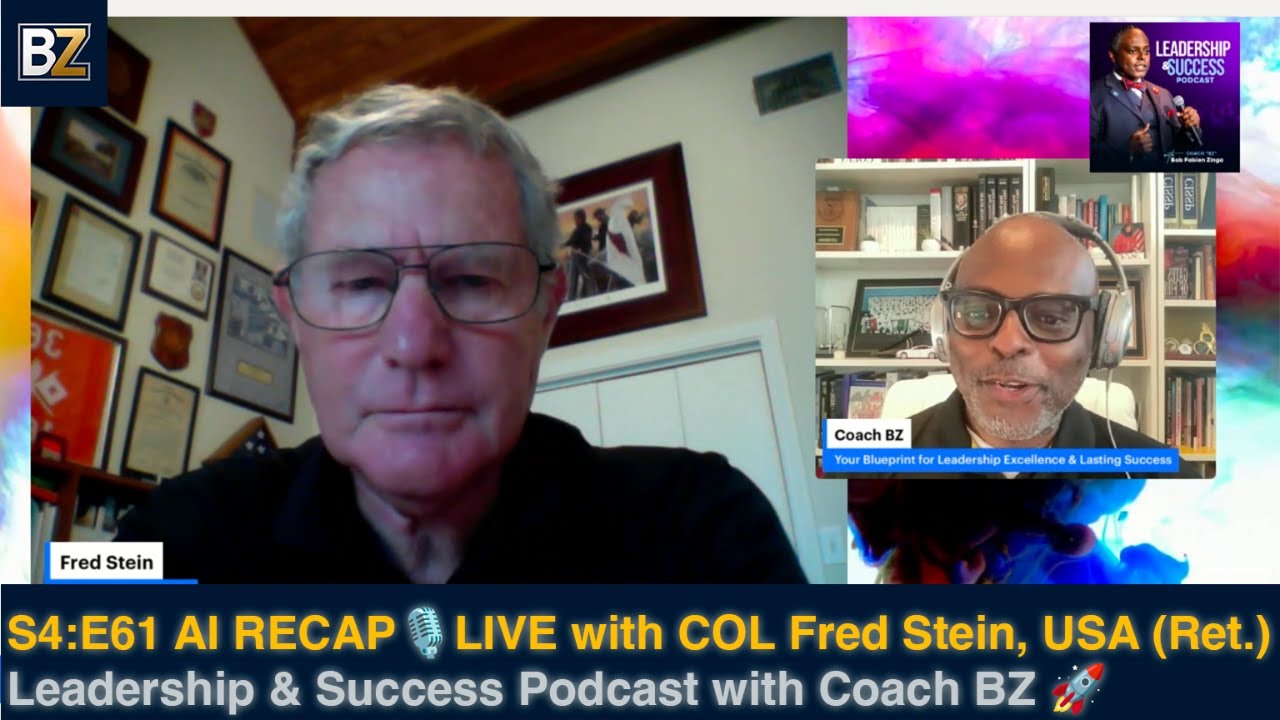
In this 10‑minute distilled version of a longer interview, Coach Bizzy (Bob Fabien Zinga) hosts retired U.S. Army Colonel (Ret.) Fred Stein to explore how the principles of network‑centric warfare (NCW) translate into modern leadership and AI‑driven environments. The episode opens with a gratitude moment, a brief nod to the U.S. Constitution, and a call for audience interaction. Stein explains NCW as a doctrine of information superiority and self‑synchronization that lets units operate without direct orders, using the OODA loop and the football‑vs‑soccer analogy to illustrate speed of command. He then draws parallels between early NCW adoption and today’s AI surge, warning about deepfakes, over‑reliance on algorithms, and the irreplaceable role of human imagination, common sense, and moral courage. The conversation shifts to leadership themes: self‑awareness (Myers‑Briggs, journaling), moral and physical courage, building trust through psychological safety, transparent decision‑making, and the importance of diverse, high‑performing teams. Stein emphasizes that shared knowledge is power, that leaders must model vulnerability, listen actively, and balance decisive action with empathy. Listeners are prompted to share takeaways, practice the discussed principles, and engage with the broader podcast community. The episode closes with a rapid Q&A on trust, discrimination, and a light‑hearted historical “dinner party” thought experiment featuring Washington, Lincoln, Churchill, and Gandhi.
Chapters
Hi, I'm John Maxwell.
When the top companies in the world are looking for trainers, speakers, and coaches, there's one name that stands is above the rest, and that's Maxwell Leadership. Our certified team members have gotten proven results for companies all over the globe, and our reputation, I'm proud to say, is second to none. Some of our members have risen to the top of their profession, including the one you're going to meet today. I proudly introduce you to my friend, Bob Fabien Zinga.
Welcome to the Leadership and Success Podcast with your host, Coach BZ. If you need to develop into a better leader, this podcast is for you. If you want to achieve a greater level of success, this podcast is for you. His mentor, Dr. John C. Maxwell, said it best: everything rises and falls on leadership. We hope to inspire you today and provide you with an insight that has the potential to positively impact the trajectory of your life. Welcome to the Leadership and Success Podcast. Imagine gaining the leadership skills that could redefine your career. Join Coach BZ on the Leadership and Success Podcast, where each episode delivers practical insights from world-class speakers, military leaders, and industry experts. We dive deep into what matters most. Building resilient teams, leading through uncertainty, and navigating complexity with clarity and confidence. Every conversation is crafted for aspiring leaders like you who are ready to grow, lead, and make a lasting impact. Don't miss our powerful live sessions and recent highlights. Michelle Hayward on building diverse, high-performing technical teams. Anne Leslie on leading through global complexity and cybersecurity risk. Ron Carpenter, AI exploring faith, resilience, and AI-powered leadership. Colonel Michelle G.I. Gardner, INS, on commanding influence from the battlefield to the boardroom. Chris Robinson on shifting from drift to drive in life and leadership. And Coach Enrique Acosta Gonzalez on mentorship, legacy, and heart-centered leadership. Ready to level up your leadership journey? Tune in on Spotify, Apple, Audible Podcasts, YouTube Live, and LinkedIn Live. Join the movement toward leadership excellence. Listen now and start transforming your success.
Hello everybody, this is Coach Bizzy. Today is Tuesday, August 26th, and, uh, we are going to have a, uh, short podcast today. And, uh, I'd like to thank, uh, I think Nad Kumar, uh, just told us, uh, is watching us from India in Chennai. Thank you so much for being here with us, and I do appreciate that. We're gonna first get started with our moment of gratitude. This is where I ask you to think about one thing that you are grateful for today. So if you can close your eyes and think about one thing that you are grateful for today. For me, it helps to put myself in my happy place, which is by the beach, by the ocean. And I feel good. I feel like I'm living on purpose and I'm doing everything I am supposed to be doing and adding value to a lot of people. And what I'm grateful for today is the Constitution of the United States of America. And part of the reason why I really love the Constitution is it is a great document. I think there is nothing like it. Around the world. Initially, it was only applicable to white men, but eventually it became applicable to all of American citizens, including Black people and women too. And as a commander in the U.S. Navy, my oath is not to a person, but to support and to defend the Constitution of the United States against all of its enemy, foreign and domestic. It is a great document, and I think it is worth fighting for. And again, there is just nothing like it around the world. So that's what I'm thankful for. So if you can type into the comments on LinkedIn or YouTube where we are live, what is that one thing you are thankful for today? All right. Now, I would like to— I had an hour-long interview with Colonel Fred Stein. I'm really so honored and privileged to I've spoken with a man with such great wisdom and experience. Actually, I was surprised to know that he was actually a Brigadier General Select. He just never, never pinned. But anyway, very, very grateful for his service. What we're going to do different today, I'm going to take the 1-hour conversation we had and slim it down to only 10 minutes. So I'm going to have my AI agent do it in just a second. And I want to remind you, thank you for letting us know where you are coming from. And also, if you have any question, please type it in the comment, and I'm going to be back to come back in about 10, 15 minutes and answer whatever questions you might have. And also, if this podcast is adding value to you, please go ahead and tag someone within your sphere of influence so they can watch this with you, so it might be beneficial to them. As well. And I am also asking for you to like the event post and follow me and then repost it in your own feed so that people, again, within your sphere of influence might have access to this. And another thing I had mentioned before, one of my mentors, Darren Hardy, he has what he calls Darren Daily. Every morning, it's about 5:30 my time, he will send you a free email with insights that's really going to help you get a better day, a leadership principle, a nugget of wisdom that's going to help you. So I am asking all of my followers to please go ahead and sign up for Darren Daily. It takes like 5 seconds, bit.ly/DarrenDailyBiz. And if you sign up, you're going to be receiving mentorship from Darren Hardy. Darren Hardy is the author of the New York Times bestselling book, The Compound Effect. But he was also the publisher of Success Magazine where he really met hundreds of the most famous successful people in the world, from Steve Jobs to John Maxwell, Mark Zuckerberg, Bill Gates. I mean, he's talked to them all and he's been able to do that and really crystallize the essence of success. Why did these people get so successful? And then he spent his life now mentoring more than what, half a million CEOs and people who want to get more out of life like me. And I would like for you to be a part of that. Again, Bitly, Darren Daley, Bizzy. All right. That's all I'm going to say now. And let's go ahead and have Oh, another thing, uh, Nandakumar says he's grateful for his parents, his mentor, and God. Thank you so much, uh, Nanda. I, I really do appreciate that. Very, very grateful for my parents too. Uh, it is, it is really, uh, amazing when a child grows into a family where you feel love from both mom and, and dad. And if you're fortunate enough like me to have lived in a household where both parents were around, it, it really is a blessing. Thank you so much, Nadar Kumar. I really do, uh, appreciate that. All right, I'm, I'm gonna first play, uh, a 2-minute, uh, taste of the podcast I had yesterday, and then we're gonna get the 10-minute summary.
Then NCW allowed you to self-synchronize. That's allowing units to move without direct command in support of each other. It's actually a mathematical term., but it has to do with movement without direction. That then allowed you the final thing, because you had to have a reason for all this, and that was to get inside the enemy's OODA loop, observe, orient, decide, and act, John Boyd's philosophy or concepts of the Air Force. And that had to do with speed of command. And very briefly, speed of command is probably easily illustrated in a manner of having American football and soccer. American football, which many of us played, obviously is a violent game punctuated by periods of rest or at least passing of knowledge in the huddle and then violent execution. Football, or Fußball, or soccer is a continuous game. There is no huddling. And so if you are playing soccer when your opponent is playing football, you will get inside their hoodlum.
Wow, that is, that is powerful. Now, today is the age of AI, right? In today's environment with artificial intelligence-driven operation, cyber warfare, and disinformation, what parallel do you see with the early days of, uh, NCW?
Yeah, again, great question. Uh, so AI, like most technologies, and your audience is familiar with, has those curves of, you know, acceptance, over-acceptance, etc. I had originally— I've spoken a good deal on my lectures with senior citizens about using AI, and I've started to use AI to some extent as well. I think AI has great potential. I think obviously it has areas of great concern. Deepfakes and fakes for political reasons or other reasons are a real issue with AI, and just bad information. Sometimes you ask a question and it gives you information But AI is clearly the next thing. Whether— I think we talked a little before we started this, and I mentioned that maybe you will have an AI where you have somebody sitting on your shoulder that you can turn and say, well, this is a situation. What might others have done with it historically? It won't be exact, but it will allow you the guidelines or guide rails, if you will. And so where AI is, It's approaching that. On the other hand, imagination, common sense, and innovation are not AI. Those are human. And so we need to distinguish. We've got to stop arguing about the human brain and the digital brain. They operate fundamentally differently. And AI, as good as it is, is not going to be innovative. It's not going to have common sense.
Welcome back, everyone. Today we're diving into a discussion on network-centric leadership. Drawing inspiration from Colonel Fred Stein's remarkable journey. He really, um, redefines courage, clarity, and command.
Yeah, absolutely. I mean, his insights about moral and physical courage really got me thinking about how leadership isn't just about the title but about the values that truly drive decision-making.
Right. It's like, um, his story shows leadership begins with self-awareness. Even someone commanding thousands can be nervous. Knowing your own strengths and stress triggers is key, like using the Myers-Briggs to understand that INTJ temperament.
Yep, that point really stands out. I mean, how many times have we seen leaders forget that self-reflection fuels authenticity? But I'm curious, how do you think leaders can practically implement self-awareness tools in high-pressure environments?
Well, it's like, um, incorporating journaling, soliciting honest feedback, and maybe even structured assessments. It's not just about knowing yourself; it's how you channel that understanding to inspire your team.
Mm-hmm. And it seems Kohlstein makes a distinct separation between leading and just managing. Resources can be tracked, but people need vision and purpose. That's a challenge in any organization.
Exactly. It's like you can count fuel or funds, but you can't count on motivation unless you, um, offer clear direction. Remember the example of the two battalion commanders he mentioned? One was strict and effective, while the other, more likable, was indecisive.
Right. That comparison is brutal but true. It forces us to ask, Are you setting a clear path, or are you just trying to be everyone's friend without the backbone to make tough calls?
Yeah, and that brings us to the idea of courage. Not just in the physical sense, but the moral kind. He, uh, shifted his focus from maintenance to operations, risking his career, if you can believe it.
Yep, that actually gets me. Sometimes, choosing the unpopular decision is the true test of leadership. But, um, don't you think that for some leaders, this kind of risk might feel too extreme?
I get that hesitation, but, um, Carl Stein's experience teaches that sometimes you have to stand alone if it means setting up your team for success in real operations. It's about having that moral fortitude and a little bit of risk-taking.
Mm-hmm, right? And then there's his perspective on command climate. If your team isn't engaged in a meeting, It might signal that they don't trust you or feel valued. That simple red flag can really indicate deeper issues.
Precisely. A silent room in a staff meeting is like, um, a crack in the foundation. It reminds us that building a culture of trust is just as critical as any tactical decision.
Yeah. I mean, think about it. A lack of trust can undermine even the most brilliant strategy. Leaders need to create safe spaces where ideas flow freely. How can they really do that?
It's about being honest, open, and, um, encouraging feedback even when it's hard to hear. Leaders must make sure that every voice is valued. It's not always easy, but it's necessary for long-term success.
Absolutely. And speaking of strategy, COL Stein also emphasizes the power of shared knowledge in his work on network-centric warfare. The idea is all about information superiority, leading to faster, more synchronized decisions.
Yes, think of it like soccer versus American football, a continuous flow versus a stop-start game. When teams operate with shared information, decisions become as fluid as in soccer.
Mm-hmm, that analogy really illuminates the difference. In modern leadership, whether on the battlefield or in the boardroom, flattening hierarchies and enabling teams to self-synchronize is frankly revolutionary.
Exactly. It's like transforming your organization into a living, breathing network. You remove too many bottlenecks and allow people to adapt and innovate on the fly.
Right. On that note, let's talk about technology. COL Stein draws parallels between early network-centric warfare and today's discussions about AI. He warns that while AI has potential, it also comes with risks like deepfakes. What's your take on that?
It's a fascinating juxtaposition. In his view, AI offers huge opportunities to augment human capabilities, but it must be guided by, but not replace, human judgment.
Definitely right. The idea is to balance AI-driven efficiency with human-driven innovation. I've seen cases where overreliance on technology actually stifles creativity. Maybe we need more leaders like Colonel Stein who remind us that common sense and imagination remain human responsibilities.
Precisely. It's like you can have the best algorithms, but without human oversight and ethical decision-making, you risk losing perspective.
Mm-hmm. And let's not forget his final reflections on humility and the importance of learning. He admits that sarcasm once undermined his leadership, and now he strives to listen more. That's a lesson in legacy, isn't it?
Completely. True leadership isn't measured by rank or, um, power. It's about the positive impact you have on others over time. His quote, "Gladly would he learn, and gladly would he teach," encapsulates that idea beautifully.
Yep. It makes me wonder how many leaders out there still view learning as a finished chapter rather than a lifelong journey. Wouldn't you say that continuous growth is the hallmark of effective leadership?
Absolutely! It's like, um, every leader should view each day as an opportunity to learn something new and then pass it on to someone else. That cascading effect is what builds a legacy of excellence.
Mm-hmm. Now, one thing I want to challenge here is the idea that tough decision-making always equates to being effective. Sometimes I wonder if a bit more compassion might balance the strict clarity C.O.L. Stein talks about. What do you think?
That's a great point. Look, clarity is essential, but it shouldn't come at the cost of empathy. It's a fine balance, being both firm and compassionate. Sure, tough calls are part of leadership, but they must be delivered with sincere care for your team's well-being.
Yep, exactly. I appreciate that nuance. It's not black and white. At times, being overly strict can alienate people. How do you think leaders can strike that balance in today's fast-paced environments?
It's like, um, applying situational leadership. Adapt your style depending on the team's mood and the moment's demands. If you find silence in a meeting, for example, maybe it's time to check in and ask, "Hey, does everyone feel heard?" That makes sense.
Read the room rather than sticking rigidly to one method. And speaking of rooms, trust within teams is another recurring theme. How exactly can leaders build an environment where truth feels safe to be spoken?
Leaders have to model vulnerability. It's like, um, if a leader can admit a mistake or ask for feedback, it sets a precedent. It tells your team, "I value your insight." Exactly.
Yeah, and that environment is crucial for innovation. When people trust you enough to share ideas, even risky ones, the team can pivot quicker. That shared knowledge is power, as Colonel Steen would say.
For sure. It goes back to his idea of network-centric warfare, flattening hierarchies so everyone shares knowledge at the speed of command.
Mhm. And that brings us full circle to the call to action. Kohlstein challenges us all to exercise moral courage, build trust, and share knowledge rapidly. It's not just military doctrine; it's applicable to leadership in any industry.
Exactly. It's like— every leader, whether in the boardroom or behind a computer screen, needs to ask themselves, "Are my actions inspiring trust, and am I empowering my team to be the best version of themselves?" Yep.
It's quite a holistic approach when you think about it, integrating self-awareness, ethical decision-making, and, um, technological prudence. One can almost say that Kolstein's principles are a blueprint for resilient leadership in our modern world.
Absolutely, and it's refreshing to see leadership being discussed as not only a duty but a lifelong calling. Whether it's management, direct command, or harnessing AI, the principles remain constant: lead with courage, clarity, and integrity.
Mm-hmm, well put. It seems the take-home message is clear: great leadership is a continuous journey of self-improvement, empathetic yet decisive action, and above all, trust. Thanks for this deep dive into network-centric leadership. I'm sure our listeners will have plenty to reflect on.
And you helped develop the network-centric warfare, and that's for not just for the Army but the entire DOD. And later you co-authored the book. So for those unfamiliar, how do you explain network-centric warfare in simple terms?
Yeah, uh, I was very fortunate to serve under Admiral, uh, Sobrowski, God rest his soul, Brilliant, brilliant individual, certainly the smartest man I ever worked with. I would leave his office hoping I understood 10% of what he had to say, knowing it was all important. But network-centric warfare has to do fundamentally with the concept of information and information sharing. Information superiority, not dominance, and that's important. Information superiority is what you want to gain on the enemy. An example would be air superiority over the channel, English Channel on D-Day. The Germans flew, I think, two missions, two Messerschmitts or two Focke-Wulfs in the whole period of strafing. And so the US and British had air dominance and superiority over that. Information superiority is knowing more than your enemy knows, certainly about yourself and to a lesser extent about them. Of course, red is often much harder to acquire than blue. So network-centric warfare had to do with establishing the positions of mobile weapon systems on the battlefield— tanks, helicopters, APCs— not individuals yet. And that gave us the idea that— and we've often heard the comment, knowledge is power. I would rephrase that. I would say shared knowledge is power, and only if it's shared. Then NCW allowed you to self-synchronize. That's allowing units to move without direct command in support of each other. It's actually a mathematical term, but it has to do with movement without direction. That then allowed you the final thing, because you had to have a reason for all this, and that was to get inside the enemy's OODA loop— observe, orient, decide, and act— John Boyd's philosophy or concepts the Air Force, and that had to do with speed of command. And very briefly, speed of command is probably easily illustrated in a manner of having American football and soccer. American football, which many of us played, uh, obviously is a violent game punctuated by periods of, uh, of rest, or at least passing of knowledge in the huddle, and then violent execution. Uh, football, or foosball, or soccer is a continuous—
All right, I'm gonna play one more teaser before we are done, but while we are here, we did get one question from Daniel. He says, thank you for sharing this insightful episode summary. The emphasis on moral courage and shared knowledge is particularly valuable in today's complex landscape. Trust within their team. I believe trust is the most important currency of leadership, right? People cannot follow you if they do not trust you. And as a follower, you can usually tell if a leader really cares about you or if they don't, right? If they just say the right words to make you feel good, but they don't really mean any of it. So, first of all, Daniel, thank you for your reflection. I definitely agree with you. So, in my experience, to cultivate that trust, you have to create an environment where people feel safe to make mistakes. They also call this psychological safety. It is okay to make mistakes as long as people learn from those mistakes. You don't want to have an environment where mistakes are not allowed, and when people make mistakes, they hide those. And when they do hide those, it's gonna cause a lot of problems later down the line. But if you find out about those mistakes right away, and there is no judgment, you learn from the mistake and you fix it, then your organization is growing and learning, right? So that is very important. So people need to be able to make mistakes and learn from those mistakes. And honesty needs to be rewarded, right? People have to be honest and transparent and support one another. And people also need to feel like they are being heard, right? It's not just you, the boss, the commander, or commanding officer telling everybody what to do, and you never listen to your people. You have to listen to them, get feedback. Now, eventually, you make the final decision. Like we say, the buck stops with you. But before you make the final decision, listen to your people, listen from their feedback, from their experiences, because many times they may have a better way, right? They may give you an idea that is going to be much better than what you are thinking in order to solve whatever problem you are having. So, I think building that environment where people feel safe to share their thoughts is extremely, extremely important. I believe, you know, if your people are too afraid to speak in your presence, then I think you have failed them, right? So, if you want to build trust, you need to be able to listen to people, consider what they say. You don't always have to do what they say, but you have to listen, consider it, and then you make your final decision. So trust will go when leaders are transparent about their own decision and they are consistent too in their action, right? You don't have to be nice to everyone, but you have to be consistent. Treat everybody the same. Don't have favorite, right? And many times I've had some bosses who were almost mean, right, but very, very harsh. Like even the Colonel mentioned, those two battalion commanders, one of them was extremely nice, but didn't make any decisive decisions, so people didn't know what to do. And another one was actually, you know, a jerk, but he knew exactly what to do and it was very clear in his communication, and people did exactly what was needed in order to be successful. Now, I don't think you should be a jerk. I think you can still be nice, but you need to be very clear about your expectation, right? Your communication has to be very, very clear all the way from the top, all the way down to the chain of command. And then you have to be consistent on how you apply the rules, right? You cannot say, oh, I am the boss and the rules do not apply to me. Actually, you are the servant of everybody that reports to you, so you need to be the first one to actually follow the rules, right? You have to be an example. I think that is really, really key. It's very, very important if you're going to be a leader that people trust. You have to be a model, all right? And, um, also be intentional about listening. You have to listen to the people who report to you, to your team. You have to get their feedback because you might have— actually, I know you do have some blind spots. That's why you also need to have a diverse team. I think diverse teams make organizations a lot more successful. People from different backgrounds, different races, different genders, different education levels. So you can get— so you are not leading in an echo chamber, right, of people who look just like you, with the same background as you, think exactly like you. You need someone with a different point of view who might balance you so that their strength will help out your weaknesses and vice versa. So again, diversity, I believe, is really key for high-performing teams. And also be the kind of leader who shares credit with all of your organization. And then when things go wrong, you need to take on all of the responsibility because the bugs do stop with you. So I think if you create an environment like that, over time, consistency will build a climate where people feel safe to speak truth and innovate boldly. I believe that's what Colonel was referring to yesterday. Let me see if Colonel is watching. If he is, I might bring him on. No, I don't see him. But yes. So that's essentially, I think, what it takes to really build trust within a team. Okay, I don't see any other questions on LinkedIn. Let me check YouTube. Okay, I don't see anything on YouTube either. All right, so what I'm gonna do now, I'm gonna play one more teaser, and then that's gonna be the end of the podcast today. But another thing I would like to ask is, please, type in what you've learned during this podcast. What are your 1, 2, or 3 takeaways? And which insight are you going to apply this week? Because I really love to be practical, right? One thing I've really found out about leadership and success, those principles generally are extremely easy. It's not too difficult, right? But the problem is, it's not just knowing them in your head, but it's actually practicing them, putting them in practice. Execution, I believe, is everything. You really get to know something after you've done it. Just like yesterday, the Colonel says, learn and then teach, in that order. You really get to learn something after you teach it. So you have to do something, you have to take action. I think that's really the only way to really learn anything. So if you would share the insights you've received from this episode, type them in the comment section. So everybody can learn from you because different people listening to the same thing will have completely different insight. And I really do appreciate you for your engagement. All right, this is it for now. I will play one more short clip from the episode and I'm inviting all of you to please watch the full episode, season 4, episode 61, and you will get the entire hour of the wisdom of Colonel Stein. Fred Stein, U.S. Army Colonel retired, and thank you, thank you so much for your engagement this week. I am thinking probably—
yeah, I was going to say it would either be Washington or Lincoln, it would be one of those two, simply because of their tremendous intellect and their influence on the United States. A question that you posed early, and I don't know, and it's, I think, proper to bring it up now with Lincoln. If you woke up one morning, what is one problem you'd like to solve? And I couldn't solve it, but I have always been both incredibly confused and angered by any form of discrimination based upon race or religion. I don't understand it. It seems stupid to me. I just don't get it. I know it exists. I'm not stupid enough not to understand that it exists, and you have to fight against it. And certainly both Washington and Lincoln— Washington freed his slaves. He couldn't free Martha Washington's slaves, but he understood slavery was wrong, tremendously wrong. It's not an American problem. It's a worldwide problem. It's gone on through history, but it's wrong in any case. And any form of discrimination weakens organizations, and I just— I'm both confused and angered by it. So that would be the problem to solve. I'm afraid, like world hunger, it's probably not likely to be solved.
Yes, so who would be your third guest? So we have President Washington and Abraham Lincoln, and who else?
Well, I guess it probably would be Churchill or Gandhi. Yeah, and Gandhi would be the other. I almost— I tend to Tend to link because I read a book that linked Churchill and Gandhi, and they may have had more in common than not. Gandhi, I did get to go to India and talk on network-centric warfare, and we did get to go through where Gandhi was assassinated by a Hindu, as you recall, because he didn't want no discrimination, which was Gandhi's wish, but certainly those two. There are lots of others, but it's hard in history.
Uh, no, that would be a fascinating dinner for sure. I'd like to be a fly on the wall for that one. So what is one song, book, or movie that would be your last theme?
Or—
yeah.
Bye everybody, this is Coach Bizzy. Thanks for watching. Until next time. Don't forget to like, comment, and share.
Thank you for listening to the Leadership and Success Podcast with your host, Coach BZ. If you like what you heard, please subscribe to our channels and come back for more wisdom nuggets on how you may develop into a better leader and achieve greater levels of success. Leadership is the most critical skill. The world will always need to lead others, deploy the next disruptive technology, or execute a business strategy. You may as well decide on counting yourself among the 21st century leaders. See you right here next time on the Leadership and Success Podcast with Coach BZ.
More from Bob

S250:E4🎙️LIVE 🇺🇸America 250: President Barack Obama Leadership, Service, and the Power of Hope






S5:E157🎙️ LIVE with CMD CMSgt Dennis L. Fritz, USAF (Ret.)(Multi Tracks Audio)



S5:E156🎙️ LIVE 🇪🇸 Leadership Lessons from the FIFA World Cup 2026 Champions (Multi Tracks Audio)

S250:E3🎙️ LIVE Leadership Lessons from America’s First Documented Family of African Descent 🇺🇸📖