S4:E65AI RECAP 🎙️LIVE with Nick Rackley (Multi Audio Tracks)
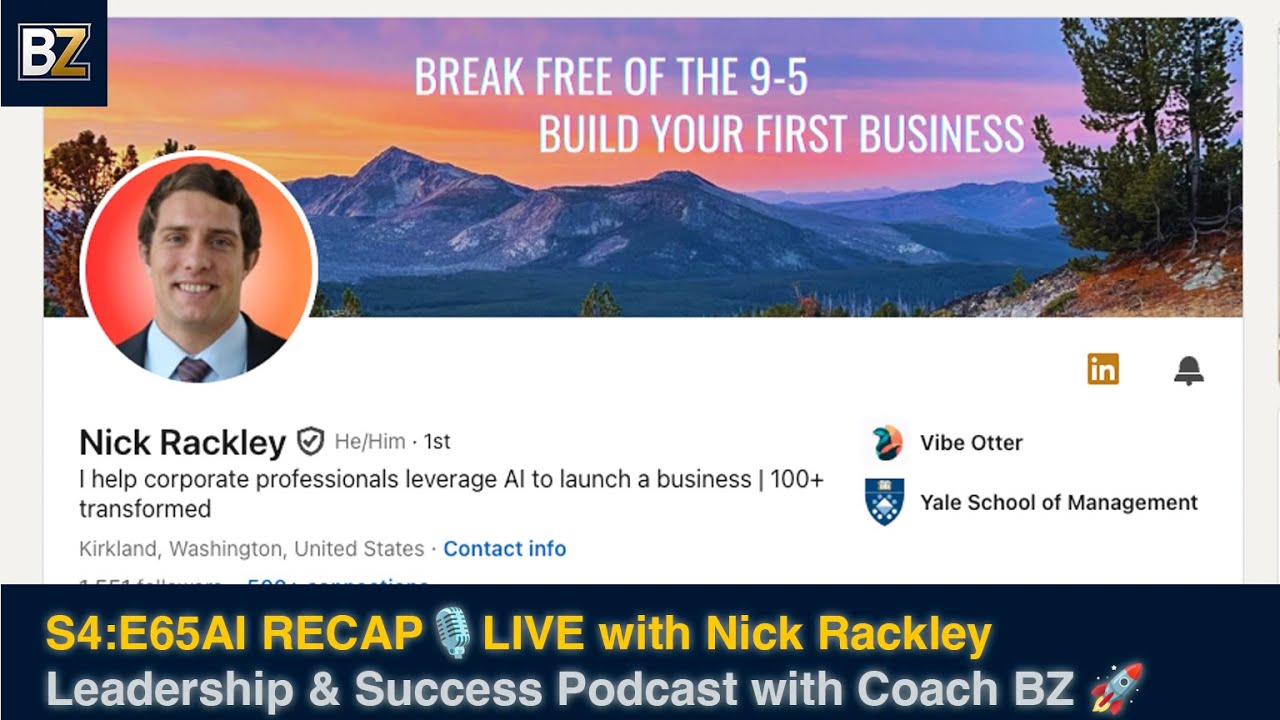
Coach BZ talks with Nick Rackley, an Army Ranger and Yale MBA who co-founded Vibe Otter, an AI platform for small-business owners. Rackley discusses radical ownership from military training, how gratitude affects mental health, and why veterans struggle moving into civilian work.
Chapters
Hi, I'm John Maxwell. When the top companies in the world are looking for trainers, speakers, and coaches, there's one name that stands above the rest, and that's Maxwell Leadership. Our certified team members have gotten proven results for companies all over the globe, and our reputation, I'm proud to say, is second to none. Some of our members have risen to the top of their profession, including the one you're going to meet today. I proudly introduce you to my friend Bob Fabien Zinga.
Welcome to the Leadership and Success Podcast with your host, Coach Beezy. If you need to develop into a better leader, this podcast is for you. If you want to achieve a greater level of success, this podcast is for you. His mentor, Dr. John C. Maxwell, said it best: everything rises and falls on leadership. We hope to inspire you today and provide you with an insight that has the potential to positively impact the trajectory of your life. Welcome to the Leadership and Success Podcast.
Imagine gaining the leadership skills that could redefine your career. Join Coach BZ on the Leadership and Success Podcast, where each episode delivers practical insights from world-class speakers, military leaders, and industry experts. We dive deep into what matters most: building resilient teams, leading through uncertainty, and navigating complexity with clarity and confidence. Every conversation is crafted for aspiring leaders like you who are ready to grow, lead, and make a lasting impact. Don't miss our powerful live sessions and recent highlights. Michelle Hayward on building diverse, high-performing technical teams. Anne Leslie on leading through global complexity and cybersecurity risk. Ron Carpenter, AI, exploring faith, resilience, and AI-powered leadership. Colonel Michelle G.I. Gardner-Ince on commanding influence from the battlefield to the boardroom. Chris Robinson on shifting from drift to drive in life and leadership. And Coach Enrique Acosta Gonzalez on mentorship, legacy, and heart-centered leadership. Ready to level up your leadership journey? Tune in on Spotify, Apple, Audible Podcasts, YouTube Live, and LinkedIn Live. Join the movement toward leadership excellence. Listen now and start transforming your success.
Welcome back to the Leadership and Success Podcast with Coach Beezid. I'm excited for today's episode because we're featuring a remarkable leader like me whose story spans the battlefield, the boardroom, and the tech startup world. Our guest is Nick Rackley, a U.S. Army Ranger, Bronze Star and Purple Heart recipient, and veteran of two combat deployments to Afghanistan. During his 8 years of service, Nick led soldiers in some of the most challenging environments, commanded millions of dollars in assets, and embodied the Army principle that the commander is responsible for everything the unit does or fails to do. After transitioning from the military, Nick earned his MBA at Yale, his MS in electrical engineering at the University of Washington, and became a senior corporate strategy manager at T-Mobile. Where he helped lead initiatives that impacted over 4,000 employees and reallocated more than $3 billion in resources. But Nick didn't stop there. Today, he's the co-founder of Vibe Otter, an AI-powered platform that lets small business owners create professional websites just by sending a text. His mission? To break down the barriers of entrepreneurship so anyone with a dream can launch and grow a business. Nick is also deeply committed to veterans advocacy as chapter commander of the Military Order of the Purple Heart. Ensuring the stories and wisdom of older generations of warriors are preserved and passed down. In our conversation today, we'll explore what it means to lead with radical ownership, how combat lessons translate to tech and entrepreneurship, and why AI is unlocking new opportunities for small business owners everywhere. So grab your notebook because this is going to be a powerful session. Please join me in welcoming Nick Rackley to the Leadership and Success Podcast.
When you are grateful, you can be suicidal at the same time.
And I think being—
having a spirit of gratitude is going to help you improve your mental health. So I feel like we need this. More than ever before. So if you would please put yourself in your happy place, take a deep breath if you need to, and think about one thing that you are grateful for today. What are you grateful for? And if you would please type it in the comment and share it with the community. Today, I am grateful because I get to speak to inspirational leaders like Rick Wakely, I will be talking to in just a moment. It really is a blessing to talk with other people who inspire you and help you kind of, you know, get on with your own purpose as well. So that's what I am grateful for today. Please let me know what you guys are grateful for. So I've already introduced him. In the, uh, teaser, but, uh, again, for those who missed it, uh, Nick Rackley is a US Army Ranger, Purple Heart recipient, Yale MBA, tech strategist, and co-founder of Vibe Auto, where he's making it possible for small business owners to build professional websites, uh, just by texting to an AI agent. So from leading soldier in combat to leading entrepreneur in tech, Nick embodies resilient leadership. Radical Accountability and Innovation at the Edge. So with no further ado, let's bring on to the stage Nick Watley. How are you doing today, Nick?
I am good.
How's everyone out there doing? Well, yeah, I'm doing great, Bob, and thanks for having me with us.
Absolutely. So to get started, is there one thing that you are grateful for today?
Yeah, I mean, I think the thing I'm grateful for is the same every day. It's my family, my two kids, and my wife. That's, uh, I'm always thinking that. But yeah, I just thought you're like a statement about how like gratitude makes it hard to be suicidal. That really resonated with me. I think there's a lot of depth there.
Yes, exactly. And actually, there is another veteran I am a friend with. He actually does something where he asks people for 21 days to be grateful for one thing. It's like a challenge he has every year. I usually do mine around Thanksgiving time. And then so you're grateful for something today and then you challenge somebody else on your network to do the same thing. So hopefully your entire network will be grateful for the next 21, 22 days. I think it's quite powerful. So what is something about you that most people may not know about?
All right, everyone, this is Coach Bizet coming to you live from the San Francisco Bay Area. Thank you for being with us today. Like I said in the video, I am grateful to meet inspiring speakers like Nick Rackley and really grateful for my network, grateful for you watching the show right now and being with me in this moment. So if you would please type in the chat where you are coming from, what city, what state, and if outside of the US, what country. And also let me know that one thing that you are grateful for today, and we want to celebrate with you. I think life is worth living. And if you are a veteran, even if you've only served one day in any of the branches of the US military, I want to say thank you, thank you, thank you for your service. And I am rooting for you, and I believe you are very special. Very, very few people like myself really have raised the hand and accepted the call to, uh, serve this great country. And I believe the Armed Forces really truly make our country great and really preserve our freedom. So, uh, and there is nothing greater, right, than a friend giving his life, uh, for his friends. There is just no love greater than that. And every single person who joins the US military is willing to do that every day. And I am just in awe and really, really grateful for the US military. The Navy, truly a force for good. Okay, and if you believe this podcast is going to be helpful to you, please consider liking this post and then sharing the post into your own feed and tagging somebody that you know who might benefit from it. So this is going to be episode 65 AI, meaning I would like for you to go back and watch the full episode 65. It's about an hour or so. This one is the 10-minute recap, which my AI agents are going to provide to you in just a moment. And I'm going to be playing a couple of teaser videos as well. But Again, listen to this recap and as you listen to it, please write down what you are getting out of it, any takeaway, and most importantly, any insights that you are going to be able to apply today, this weekend, and next week. And if you have a question for me, please type it in the comment and I will be back in about 10, 15 minutes. Thank you so much. All right, let's go to the recap now.
Welcome everyone to an engaging deep dive into leadership lessons drawn from a remarkable journey, from the battlefields of Ranger School to the fast-paced world of AI entrepreneurship.
Exciting stuff. So let's kick off with what really stands out, that idea of radical ownership, right?
Absolutely. Imagine this. In the military, there's a core principle that says, The commander is responsible for everything the unit does or fails to do, and Nick Rackley really drives that home. It's like in every decision you make, you own the outcome, good or bad.
Yeah, so instead of asking, "Who is to blame?" the focus is on, "What can I do to improve this?" That flips the script entirely.
Exactly. It's, um, that relentless accountability that sets exceptional leaders apart, whether on a battlefield or in a boardroom. It's almost like a mindset reset.
And isn't that amazing when you think about how rare that is in many corporate cultures today?
Totally. You see, too often leaders in the civilian world deflect blame or settle for mediocrity. But Nick, coming from an Army Ranger background, stresses taking full responsibility for outcomes. It challenges the common approach in many organizations.
I get that, but don't you think that sometimes the strict, all-hands-on-deck mentality in the military might not translate perfectly to a more collaborative corporate environment?
Good point. I, um, think Nick's approach is more about setting a high personal standard, embracing mistakes, learning from them, and then guiding the team with that same level of accountability.
Yeah, exactly.
It's a template rather than a one-size-fits-all. Which means adaptation is key.
That makes sense. Moving on, another fantastic part of the conversation was about resilience, drawing directly from his combat deployments and Ranger School experiences.
Right. Nick shares a powerful insight: "Most people don't quit because they can't do the work. They quit because it gets hard." And, um, he really compares the grit required in Ranger School to that needed in entrepreneurship.
It's like running a marathon. You don't just sprint, you, um, push past the exhaustion.
Exactly. And it's like a constant reminder: when things get tough, it's not about avoiding the challenge but about enduring it. Resilience means keeping your eyes on the finish line even when it feels miles away.
Speaking of endurance, Nick's transition after military service is a story in itself. Going from combat leadership to telemarketing mortgages, and then to strategic roles. That's a wild ride, isn't it?
Absolutely. It's like shifting gears from high-adrenaline combat to navigating the often murky waters of civilian careers. He even points out there are two types of veterans: those who slide right into roles, and those whose skills are, uh, a bit harder to translate.
Right, and his advice to veterans in transition is so practical. Stay humble and relentless, even if your first role feels beneath your capabilities.
Exactly. It's about focusing on growth and eventually proving your true value. That persistence opens doors.
Now let's talk about that innovative leap with AI, the startup Vibe Otter. How does that tie into his leadership philosophy?
Ah, yes, Vibe Otter is fascinating. Nick saw that AI could simplify website building, and he seized the moment to lower barriers for small business owners.
Right.
It's all about harnessing technology to empower rather than replace.
It reminds me of how companies will evolve into these AI-native companies that are lean, innovative, and unburdened by bureaucracy.
Yeah, exactly. It's almost like that is the future. Using AI to assist and amplify human potential rather than—
Yeah, definitely.
It's a smart, forward-looking approach to leadership in a digitally transforming world.
And yet it's clear that Nick isn't just about technology or business strategies alone. His emphasis on servant leadership really rounds it out.
Absolutely. He's a true servant leader. It's, um, mission first, people always. This principle underscores that taking care of your team directly builds trust and fortifies the mission.
I like that a lot. It's not just about driving profits. It's about honoring the legacy of those who paved the way, something he stresses as a veteran.
Exactly. Nick actively encourages veterans to connect with history, to bridge the generations. He's, um, really passionate about ensuring that the lessons from older veterans aren't lost. That way—
Right on.
—today's leaders are armed with timeless insights.
And then there's that robust leadership toolkit he shares, books like Extreme Ownership, South by Ernest Shackleton, The War of Art, and more, which basically serve as a roadmap for mindset transformation. Definitely.
It's a curated collection of wisdom that spans military rigor to creative discipline. They're not just motivational reads. They're tools that shape how one leads and innovates.
You know, I find it interesting how, in his narrative, every lesson is tied back to a personal experience, whether it's a moment in combat or a business setback. That personal touch really drives home the impact of these principles. Uh-huh, totally.
And, um, that's where his coaching insights come in. For instance, asking, "What can I do to fix this?" Instead of dwelling on blame. Yep, precisely. It transforms failure into a learning opportunity.
Now, one thing I sometimes wonder though is whether these military-derived leadership models always seamlessly translate into the tech arena. Do you see any challenges there?
That's a very valid, um, question. Nick's approach does require adaptation. The strict yes-or-no environment of the military is very different from the creative, sometimes chaotic world of tech startups. I see what you mean. But by focusing on foundational principles—ownership, resilience, service—it provides a sturdy backbone.
I agree. When you distill these lessons to their essence, they're just about human behavior, regardless of the environment.
Exactly. And it's that universal applicability that makes his ideas so compelling. It's like, um, no matter if you're leading soldiers in a combat zone or guiding a tech team in Silicon Valley, those core values remain crucial.
Yeah, absolutely. And speaking of values, the integration of AI in leadership, using it as a tool to empower rather than replace, that's a profound shift.
Yes, it is. Nick cautions us that the future isn't about locking horns with AI. But embracing it. Mhm. He advises starting small, even automating a repetitive task, to see how technology can be a supportive teammate.
It kind of reminds me of building a supportive bridge— technology on one side, human ingenuity on the other, coming together. Exactly.
And along with that, his emphasis on continuous learning, never stopping being a student even after reaching high positions, is extremely relevant. Right. It's an ongoing, lifelong journey of growth.
So to wrap things up, what's the one takeaway you think resonates the most?
For me, it's the blend of radical ownership, resilience, and servant leadership. Nick's journey is a testament to how these principles transcend industries, military, corporate, and tech alike. It's a roadmap for anyone looking to lead with integrity and impact.
And for anyone listening, maybe ask yourself, what's your Ranger School moment? How can you own your challenges and emerge stronger?
Well said. Remember, mission first, people always. And that universal truth will guide us through every challenge. Thanks for joining in this conversation.
Thanks for the insightful dialogue. Always a pleasure to explore these transformative ideas.
In Silicon Valley. But in order for them to be so successful, though, they've had to go through a lot of failure, and sometimes people don't think about it. So, and I think I, I want— we were in the green room earlier today, I talked to you about this coin, which I love to see. One side says failure, the other side says success. So two sides of the same exact coin. How has failure shaped your life so far?
Yeah, I mean, I think failure shaped my, my life a lot. Um, I consider my biggest failure was a combat failure where I lost a soldier., and I had a lot of like, you know, anyone's gonna have a lot of survivor guilt from that. Um, and yeah, I mean, I think just, you know, kind of overcoming that, learning your lessons about how, you know, you were an inexperienced lieutenant. Um, and that, yeah, you know, you basically, you did your best in coming over it. Uh, it's really helped my life in the long run though, of just the sense of it's made me value people a lot more. I think that's why some of my response responses to some of these other questions are always so people-focused. It's like, that's why. It's like, I genuinely do have like just a deep value for all the people I encounter and everyone that I work with. And yeah, it's also like a very— it is like a very big humbling thing that is always going to be with me, and in a good way. Like, I think it's good to stay humble no matter how successful you are.
It's helpful.
Now, uh, you are deeply involved with the Military Order of the Purple Heart. I believe you lead your local organization there in Washington. Why do you think it's important for young Iraqi and Afghanistan vets to connect with Vietnam vets while we still can?
Yeah, this is a really recent realization and initiative of mine, but I'm really trying to encourage Iraq and Afghanistan vets to join a VSO to connect with Vietnam vets. Um, I've come to realize a lot of these Vietnam vets, like, they don't really have that much more time where they're going to be able to share with you. Like maybe like 10 years. A lot of them, you know, they have been affected by Agent Orange and it's just crushing them. I like, I joined the chapter here actually when I quit my job about a year ago just because I mostly wanted to just connect with people because I knew I would be coding a lot in the beginning. And yeah, just hearing the Vietnam vets' experiences, hearing it impressed on me how they kind of talked similarly about how like they had that same relationship with World War II and Korea vets. They'll always talk about what they used to say in our meetings. And it made me realize, like, if I'm the only one here and no one else is joining, like, who else is going to carry on, like, the Vietnam vet and probably by extension the World War II and Korean vet knowledge?
So Thank you for watching. I don't see any question in the chat, so this is it for the recap today. And I appreciate it if you guys just let us know if you have a question. I may be able to get to your— to the answer tomorrow. And also, uh, Like I said earlier, like the post, share it with someone you know who might benefit from this podcast and also watch the full podcast, right? Season 4, episode 65 with Nick Wrightley. So I hope this has added value to you. And tomorrow I will be back here. Tomorrow is Saturday, so I'm going to be here at 7:30 and we're going to have two AI recap with Yadira Caro. So it's going to be one in English and another one in Spanish. So 7:30 AM California time, so 10:30 AM Eastern time tomorrow. Thanks again for being with me today. See you tomorrow.
Bye everybody, this is Coach Bizzy. Thanks for watching. Until next time, don't forget to like, comment, And share.
Thank you for listening to the Leadership and Success Podcast with your host, Coach BZ. If you like what you heard, please subscribe to our channels and come back for more wisdom nuggets on how you may develop into a better leader and achieve greater levels of success. Leadership is the most critical skill. The world will always need leaders to lead others, deploy the next disruptive technology or execute a business strategy. You may as well decide on counting yourself among the 21st century leaders. See you right here next time on the Leadership and Success Podcast with Coach BZ.
More from Bob

S250:E4🎙️LIVE 🇺🇸America 250: President Barack Obama Leadership, Service, and the Power of Hope






S5:E157🎙️ LIVE with CMD CMSgt Dennis L. Fritz, USAF (Ret.)(Multi Tracks Audio)



S5:E156🎙️ LIVE 🇪🇸 Leadership Lessons from the FIFA World Cup 2026 Champions (Multi Tracks Audio)

S250:E3🎙️ LIVE Leadership Lessons from America’s First Documented Family of African Descent 🇺🇸📖