S4:E66 🎙️LIVE with Yadi Caro 🌟 (Multi Audio Tracks)
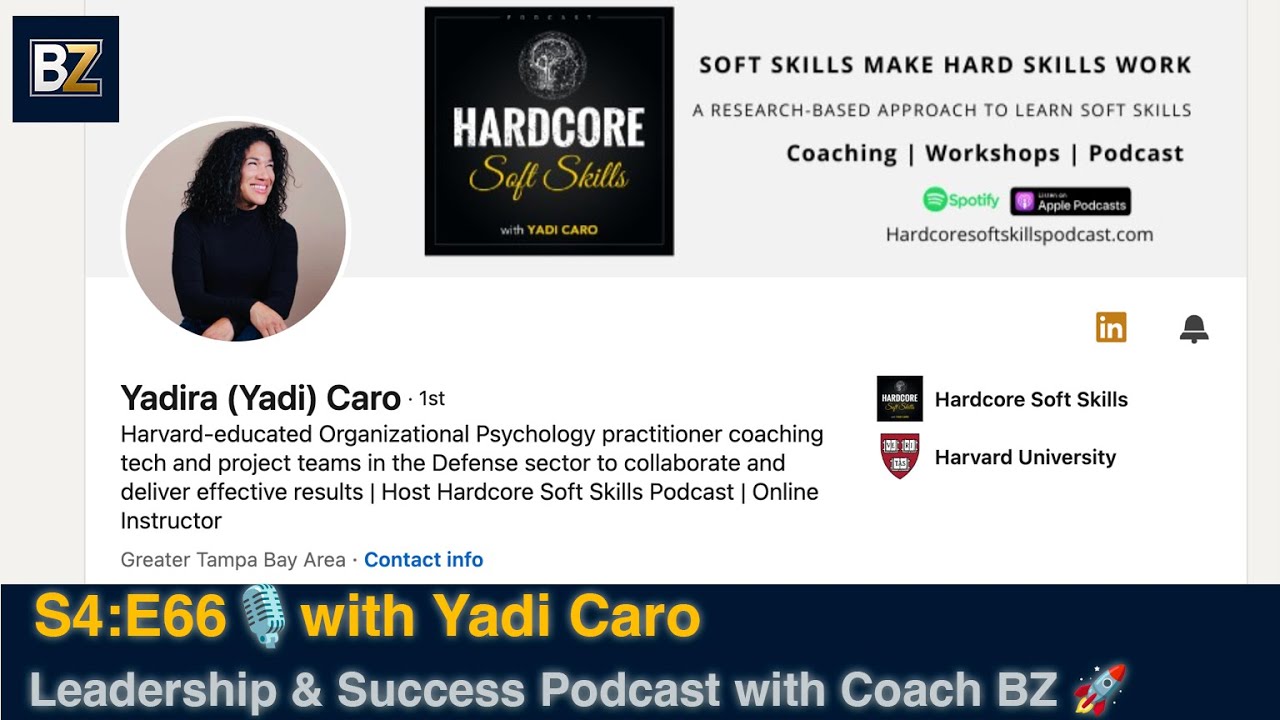
Yadira Caro, a Puerto Rican Agile coach and journalist-turned-organizational strategist, discusses building soft skills in military and tech teams. She emphasizes intrinsic motivation through autonomy, mastery, and purpose, and shares practical habits like active listening and psychological safety to transform hierarchical environments.
Chapters
¡Hola!
Hi, I'm John Maxwell.
When the top companies in the world are looking for trainers, speakers, and coaches, there's one name that stands above the rest, and that's Maxwell Leadership. Our certified team members have gotten proven results for companies all over the globe, and our reputation, I'm proud to say, is second to none. Some of our members have risen to the top of their profession, including the one you're going to meet today.
I proudly introduce you to my friend Bob Fabien Zinga.
Welcome to the Leadership and Success Podcast with your host, Coach Beezy. If you need to develop into a better leader, this podcast is for you. If you want to achieve a greater level of success, this podcast is for you. His mentor, Dr. John C. Maxwell, said it best: everything rises and falls on leadership. We hope to inspire you today and provide you with an insight that has the potential to positively impact the trajectory of your life. Welcome to the Leadership and Success Podcast. Imagine gaining the leadership skills that could redefine your career. Join Coach BZ on the Leadership and Success Podcast, where each episode delivers practical insights from world-class speakers, military leaders, and industry experts. We dive deep into what matters most. Building resilient teams, leading through uncertainty, and navigating complexity with clarity and confidence. Every conversation is crafted for aspiring leaders like you who are ready to grow, lead, and make a lasting impact. Don't miss our powerful live sessions and recent highlights. Michelle Hayward on building diverse, high-performing technical teams. Anne Leslie on leading through global complexity and cybersecurity. Security risk. Ron Carpenter AI, exploring faith, resilience, and AI-powered leadership. Colonel Michelle G.I. Gardner-Ince on commanding influence from the battlefield to the boardroom. Chris Robinson on shifting from drift to drive in life and leadership. And Coach Enrique Acosta Gonzalez on mentorship, legacy, and heart-centered leadership. Ready to level up your leadership journey? Tune in on Spotify, Apple, Audible Podcasts, YouTube Live, and LinkedIn Live. Join the movement toward leadership excellence. Listen now and start transforming your success.
Welcome back to another episode of the Leadership Success Podcast. I'm your host, Coach BZ, and today we have a truly special guest joining us. From Puerto Rico to Harvard University to transforming organizations across more than 30 countries, Yadira, or as many know her, Yadikaro, is a powerhouse of leadership, agility, and purpose. She's the award-winning host of the Hardcore Soft Skills Podcast, where she's interviewed leaders and experts from around the world to uncover the human side of success. Yadi is also an organizational strategist and a global voice for developing the soft skills that really move teams forward. Today, Yadi will be sharing her extraordinary journey, her hard-won insights, and some practical strategies you can apply right away, including how to lead with empathy and clarity, how to grow soft skills in hierarchical environments, how to thrive authentically in male-dominated spaces, and how to build cultures of transparency, agility, and courage. So wherever you're tuning in from, Navy junior officers aspiring to command or Silicon Valley engineers stepping into leadership, get ready to take notes. You're about to learn from one of the most dynamic voices in leadership today. Yadi, welcome to the show and tell us a little bit about you.
Yeah, thank you so much, Enrique. I'm super happy to be here in the, in the show. I've been following your show for a while and, and it was great to connect with you finally me in person because I've been following your work and all the interviews that you do here. So I am, as you've heard, I'm Yadi, and I'm a Puerto Rican as well. I work right now as a, been working as an Agile team coach for various years with, I work a lot primarily with, as a consultant with various organizations in the military. What I do right now, and as my passion project as well, is have the podcast Hard Corps Soft Skills and launching as well in terms of workshops and to offer to organizations on different soft skills. And I'm a, my background is in communications, but also I just recently completed my master's degree in industrial organizational psychology as well. And I'm very passionate about understanding what makes teams work and what makes work happen effectively. For leaders, for the particularly tech teams. So I'm a learner and I like to share what I learn via the podcast, via the courses that I have on LinkedIn and other platforms as well. So this has been researched and I am just thinking of the work of Daniel Pink in the book, I believe the name is Drive, that intrinsic motivation is really effective on a team because you will think that, hey, if I give people a particular salary, a competitive salary, that's going to be enough motivating factor for the team to do something. But it has been researched and studied that it is the intrinsic motivation, giving— specifically talking about autonomy, mastery, and purpose. So if the employees feel that they have the autonomy to choose the job they are going to do, that's something that will keep them in a job longer or make them have greater job satisfaction.
All right everyone, this is Zen Coach Bizzy. I'm so very, very happy you are here today and so grateful for the guest who's going to be speaking to you in just a moment. Let's start really quickly, as it is our tradition on the show, to have a moment of gratitude. It takes less than 1 minute. I just want you to take a moment. If you can, close your eyes and put yourself in your happy place. Take a deep breath if you want and think about one thing, one thing that you are grateful for today. What is that one thing for you? Today I am grateful for the blessing. Whatever that one thing is for you, please type it in the comment. And let us know what you are grateful for. And thank you so much for participating. So now let's get started. I have a very, very special guest today, Yaji Caro. Like you've seen from the promo, she really doesn't need any introduction. She's the award-winning host of the Hardcore Soft Skill Podcast, organizational strategist, and global voice for developing the skills that truly move teams forward. So she's gonna be joining me live to share her journey, insight, and actionable strategy for leading with empathy and clarity, growing soft skill in hierarchical environment like the military, thriving authentically in male-dominated spaces, and building culture of transparency, agility, and courage. Without any further ado, ladies and gentlemen, let me bring to you Yadi Kao. How are you doing today, Yadi?
I'm doing great. Thank you so much, Bob. I'm very humbled by the introduction. So that's pretty cool, what you— what the introduction here. So thank you.
I'm gonna try in my broken, uh, Español. Bienvenidos al podcast de Liberación y Éxito de Yari. Saluda a nuestra presente audiencia, España.
Muchas gracias, Bob, y muy contenta de estar aquí. Saludos a todos los que nos están viendo y escuchando. Como escuchan, soy puertorriqueña y estoy con un gran honor de estar aquí en este podcast con Coach Bob, y sé que van a aprender mucho. No es solo en este episodio, sino todo, vean todos los episodios que tiene el coach porque da muchísimo valor y aprendizaje. Gracias por acompañarme.
Muchas gracias. For most of my fellow Americans who hardly speak English, you really need to learn another language, okay. In South America, we speak at least 2, 3, 4 languages. And same thing in Europe, 3 to 5 languages on average. In Africa, probably 5 to 7. So try to learn a language other than English. And if you live in California specifically or Florida, I think Spanish has to be that second language. But thank you. Thank you so much. So to get started, I don't know if you wanted to participate. Can you share something you are grateful for today?
Absolutely. I'm thankful. I'm grateful for the opportunity to be here and being able to connect with you and with the people who will be listening, because I always look forward to connect with others and learn a lot from them as well. So I'm very grateful for that.
Thank you so much. And people may not know, actually, you are the one that believe reached out to me first. Maybe it was 3, 4 years ago, I think, when I was on your, uh, podcast. So I definitely very much— let me see, I think I have an image of it right here. The podcast Everybody Needs subscribe to hardcoresoftskills.com, right? And it's available on all of the major podcasts. So thank you so much for that. And what is one thing about you that most people may not know about?
Ah, let's see. I'm trying to think because I usually share a lot on the social media. Well, everybody must know, probably, I'm a proud Puerto Rican. I'm a mother of two boys, and they're 12 and 8. And I just, something they may not know? Oh yeah, that I was, um, I, since growing up, I was painfully shy. I will not speak in public settings. I was, uh, excited from in the classroom, but I've all my life I was known as the shy, uh, person of the house in comparison with my sisters who are quite introverted, uh, extroverted, I should say. So yeah.
Wow. You must hide that very, very well because when you interview people and everything, it seems like you are very extrovert. So Wow, that, that is, that is good, uh, to know. Can you share a little bit about your leadership journey?
Well, that's interesting. When you mention the word leadership, I, I found it very— I tend to think of leaders who have, you know, lead, uh, like yourself in the military or, or settings that are like, uh, very, uh, precarious scenarios. So when I think of my own leadership journey is, uh, more along the lines of self-leadership in terms of where do I want to take what I learned and what I share with people, and also how do I enable others to be leaders as well. Because growing up, as I mentioned, being shy and taking that decision to be like, no, I need to, I need to be able to speak up, I need to put myself out there more, which it started as becoming a journalist, which was a career that was either you have to reach out to people and make cold calls or you don't have a story. So, so starting with that and just trying to, through my professional career, to find situations where I could make myself just a little bit more uncomfortable every time in order to, to get out of my comfort zone and more people. And I've enjoyed that very much.
That is very powerful. We're going to be talking about that some more, I think, the second segment of this, uh, episode, because Just like me, I joined the US Navy and I didn't know how to swim when I joined. I was very afraid of the water. I used to when I was a young, young boy, but then something happened. I, it wasn't physical. Like I could swim, but I just wouldn't allow myself to. But anyway, after I joined the Navy, they gave me 12 months. You either learn how to swim or we're going to kick you out. So I had to learn and I did it, but anyway.
That's fascinating because I come from an island and I did not learn how to swim properly until I had my first kids. So I need to learn because if something happens, I need to save him. So I feel your pain.
Yeah, I think as human beings, we really have a very strong spirit where we can pretty much learn anything we need to learn in order to make it, I think. So you've worked, like you said, in journalism, the military sector, and organizational strategy. How did those transitions shape your perspective? On leadership?
Yeah, so in journalism, I wasn't even thinking about joining, um, working with a military organization. I'm not military. I don't have, uh, I don't come from military, uh, family. So I worked for a couple of years in journalism, and then a friend of mine, Marisa, she actually, um, told me about this opportunity to work in a military organization doing similar things, like senior, uh, being an editor for our magazine that will go globally. So, um, so that project started and I joined, uh, started working with, um, with various military organizations there, was leading, uh, the creation of a magazine for the Southern Command area. And from there in the world of, of, of consulting, the great thing about that is that there are other opportunities that come along. So after I did that for a few years, then other opportunity within the same company came up to work more closely in communications, but with, with IT. And I was thinking, when my manager at the time said, yeah, you're going to be working in IT, I'm like, I'm not technical, what are you talking about? So he helped me make that connection that it's not about just knowing the technical part, it was about that you need the communications aspect to be able to convey to the users. So in that time of that product, that that they need the product, that how they're going to be using it effectively. And that has shaped my career in the sense of understanding that, that there's a link there. It's not just the technical part, but everything else. The communication part is very important too.
Wow, that is quite powerful. And some people may not know, I believe when you interviewed me for your podcast a couple of years ago, you were living in Germany at the time. I believe you've lived in Germany for 6 years and traveling to more than 30 countries. That's a lot. So how has global exposure influenced your approach to team culture?
Well, in terms of the traveling part, it has shaped the fact that being able, for example, when I was working in that magazine in the region, understand that there's a lot of areas in common, or even going on vacation with my family, it's just being able to understand that at the end, you could be able to see that, that even though we spoke different languages, you could see the same patterns of the people, of the relationships, of that we're not, we're not different at all, and that it just replicates itself. It's just with a different, a little bit of a different culture. Like, for example, working with, in Latin American scenarios, it's a little bit more, you know, trust, close, uh, more camaraderie, I guess. That's a bit of a different type than what you have in, let's say, a non-Hispanic environment. So it's all nuances of culture, but at the end, a lot of the same elements that pertain to having a team and working together, they're pretty much very similar.
Wow, that is quite powerful. Now, your personal story, right, from Aguada to Harvard, right? What personal habit or mindset shift made that possible, you think?
Well, that was interesting because, and I'm from, as you say, Aguada is the name of my hometown, a little hometown in Puerto Rico on the west side. So if you go, make sure you visit. And I went to school in Puerto Rico, University of Puerto Rico, very proud graduate from there. And I've always wanted to continue studying. I went to Florida International University, did a master's there, and also did graduate in University of South Florida and others. And while I was in Germany, the, the— I've always had this dream of wanting to study psychology. And then I started exploring schools. And then I saw, I'm like, hmm, what if I go to like an Ivy League school? Let's see. And so I have heard from another former colleague about this program with Harvard and to be able to do online classes to start with certificate, and then you could enter into the master's program. So I continued that journey to see where did it lead me, and, and I was able to finish. And the mindset, as you asked, is the aspect of understanding that following the process— and I've always been very disciplined, or trying to be disciplined, in the sense because at the time I had full-time work, kids, husband. So a lot of that support from my husband, of course, but also the fact of being able to learn how to divide my time. I'm being very obsessed about dividing the time effectively. So, so that's something that I always try to, to, to maintain. Wow.
So let's talk about soft skills in our environment. Why do you believe soft skills are mission critical in high-pressure technical environment like Silicon Valley or hierarchical environment like in the US Navy? Why? Why is that?
Yeah, so soft skills, even though that name, it's, it's not a great name about soft, you know, having the— as you've been finding that it's nice to have, those are essential skills or power skills as they're known as well, because those are the skills that you need to be able to work with others. And particularly in this age of AI, these are— a lot of our work could be automated, but aspects like empathy, conflict resolution, being able to communicate effectively. Yes, AI can help us write things, but when it comes to having your own voice or explaining complex concepts, it's very important to practice those skills. So I think those are really essential, and we are focusing a lot on, on learning new things. But when it comes to the technical aspects, and it's important to place attention to that. But the realization that we also need to make deliberate efforts to learn those skills of communication, of creative ways— that creativity, we all have it, but it's how do we hone it effectively. So those are things that we need to realize, that as I've learned through all the experts I've interviewed on the podcast, that there are techniques, that there are mindsets that you need to cultivate in order to continue improving.
Yeah, that is so critical, I think. And in hierarchical organization, transparency and agility can be tricky. So how do leaders balance structure with flexibility?
Yeah, and to make sure I understand your question, how do leaders balance the flexibility with the structure?
Like the hard structure, like in the Navy, for example, we have chain of command, which means a lot. And how do you balance that being flexible, but then working within a very rigid structure?
Yes. And that is a critical factor. And working recently in one of the organizations, military organizations, that a group of us were trying to promote agile principles. So any practices and by nature agility implies working removed, stripped from silos and being able to collaborate together. So it boils down a lot not to the perfect tools or the perfect processes. It boils down to mindset that it starts with the individual realizing that, hey, I have a question and just being able to think like I can contact that person, I could ask them the question. Or even if you think it's their higher rank or if they're from another, um, from another section, you just start with that first step of contacting that person. And when you— that creates— that first step is what starts creating the connection. But we, we create these barriers in our own head of, of the fact that, hey, we have a hierarchy, we cannot even talk to those people. Well, no, you can talk to people, you can collaborate effectively. Yes, at the end you may need to follow some processes when it comes to that, uh, the the vetting of the product or other things when it comes to military organizations, but just have the ability to like, hey, let's collaborate on this, let's do all the work in the background instead of having to wait. I think it's a lot of the problem is with us as individuals to realize that we have that capability to do that and we're not breaking any laws. Or, um, to the contrary, when speaking with, with people that are either higher rank, you will realize that those are people that want to be being in the know about what's going on. So they value that as well.
Yeah, you are also right now a master instructor on LinkedIn. You have this course, Persuasion at Work, which again, I want everybody who's listening to please take it. Very, very powerful stuff. But what do you think is one of the most overlooked soft skills, whether in tech or in the military, that leaders really need to develop and how would you get better at it?
Yeah, definitely listening, because we think, oh, we need to be better communicators and have the perfect spiel and, you know, looking at people in the eye. But just listening, you don't even need to look at people in the eye. You could be like, you need to acknowledge that you are, that you are listening. But listening is very important because it helps us to truly understand what the other person is referring to. And one quick way to improve on that is, as you listen, pause and also repeat back to what the other person is saying. Like, hey, let me, let me make sure I understand what you were, what you were saying. And then you repeat back to the person in your own words, and they will be able to validate if you're on the right track or not. And a lot of times, for myself, it's like, no, that's not even what I'm talking about. I'm Okay, well, let's talk further to understand. But just that simple technique, it's something that particularly in meetings, we were in meetings and at the end of the meeting everybody walks away like, I heard this, I heard this other thing. Just do a recap, a summary to make sure everybody's on the same sheet. And just that will save people so much time than having to go back and forth via email to be able to clarify things.
Yeah, active listening, that's so important because I think we all have filters, right? Which is what you alluded to where we can both hear the same thing, but we hear things completely different. And also I think it was Steve Covey who used to say, listen to understand, but not to respond. Because for a lot of us, when someone is speaking, we completely block them out and we're thinking about, oh, what's my answer going to be? What am I going to say? So just stopping and really, really actively listening. That is very, very powerful. And in your podcast, again, everyone, you need to subscribe right now. Not only they need to subscribe, but I believe if they go to hardcoresoftskills.com— no, hardcoresoftskillpodcast.com— they can actually sign up for your newsletter there as well, right?
Yeah, that's right. Thank you.
Everybody needs to definitely do that. So you've interviewed a lot of experts in diverse fields. What's the standout lesson that has transformed the way you lead?
Hmm. Because there have been so many, so many guests that has been very, with a lot of valuable information. And when I can think of, and that probably because I just had him on the podcast, David Marquet, because he, I had him again on the podcast talking about decision-making. But in a previous podcast, we were talking about his journey from leading Navy nuclear submarine and being able to, to turn the ship around, basically, to be able to, from a low morale ship into one of the highest ranking awarded ships. So the thing that he mentioned was leader— leaders create other leaders. And it comes to that part of realizing that we like to think like, oh, I'm going to be the leader, I'm going to, you know, save the day and make sure that, you know, people are going to miss me when I'm gone, etc. But It's realizing that a true leader is able to enable others to, to lead and do the thing, and they work themselves out of the job, basically. So I think that was really powerful. And that has led the way that I think of when I go into working in an organization of thinking, how can I enable others, not necessarily because I have all the knowledge, and I'm going to teach it to them. It's just that, how can I make their life easier, so they can shine and are able to truly lead as well.
Wow, that is quite powerful. You really make me think of courage, which is one of the three core values for the Navy, right? Honor, courage, and commitment. What role does courage play in leadership, you think, especially when you advocate for change?
Yeah, courage is very critical in leadership, and not just for leaders who are in, let's say, managerial roles, but also for people who are on their journey of self-leadership and who want to lead. Having courage implies that you want to be able to speak up, that you are able to speak up, that you are able to see if something is not right, that you speak up about it as well, or to, to have different points of view and, but being able to have a conversation about it with others. So I think courage is critical because a lot of times And particularly, for example, in toxic workplaces, it becomes a problem when people are part of it and then nobody really speaks up. So those are things that leaders, no matter their role, should be able to do and should be able to have courage to, to speak up. So it's very critical.
Well, so how do you measure the impact then of soft skill training or cultural transformation in an organization?
Well, yeah, so soft skills training, and particularly when it comes to having it in a team setting, is very powerful because I believe it was J. Richard Hackman, which is a psychology researcher that did a lot of studies about teams, and the teams that learn together are stronger. So I think it's not just about teams learning new things, tech on the technical side, or no, no, non-technical technical skills. But when it comes to having a learning together of how to resolve conflict, for example, and how to deal with that as a team, is very, very powerful. And you don't have to wait until something bad happens. It's just that even if, let's say, for example, I provided a small workshop to a group of, of team members who were having conflict, but being able to from there, instead of turning it into a mediation, like who's right or wrong, it's like they just give the team the tools to be able to deal with conflict when it happens next time, because we're not trying to reduce conflict, we're not trying to eliminate it at all. That will be bad because then everybody is getting along, quote unquote, but being able to like, okay, we are able to defer, we are able to have conflict, there's good conflict and then there's bad conflict. But if— how do we avoid from making it personal and focus on the work? So that's an example of, of soft skills training that is very important to have in organizations.
Yes.
In order to be able to deliver a product at the end, it's about what the work that you're doing. But those things around the dynamics is what you need to deal with and train the team on so you can actually be successful.
Actually, something you said I think is very key. There is good conflict and there is bad conflict. I think some people, like my wife, for example, she doesn't mind, she doesn't like conflict, and she would do almost anything to completely avoid it. She kind of compliments me because that's not how I am. I feel like if there needs to be a conflict, so be it. We're going to be respectful. We're going to focus on the problem. But let's solve this so that it doesn't become a big, big problem that is potentially going to destroy the culture of the organization. So having said that, how can leaders build what I call a feedback culture, or I guess, Some people call it psychological safety, where people feel safe, right, to share their feedback, but also be accountable.
Yeah, very important question. Because when it comes to feedback, it starts with the leader itself. And by the leader, meaning like the person, let's say, in the managerial role, they should be able to, before they say, can I give you feedback, coming from a place of all-knowing, like, let me mentor you, like, no, nothing about that. To be able to, as a manager in an organization, being able to ask people, hey, I would like to get your feedback on something, and/or give me feedback on how am I doing. So once you set that example, and not just give it lip service, like, hey, I'm getting feedback, we collect feedback, but then do nothing about it, is to actually demonstrate that you're taking action based on the feedback and recognize, like, hey, thank you for that feedback. 'Now I'm able to change and improve this thing.' Then that's when you start slowly building that culture of creating that everybody asks for feedback just as a mechanism for improvement. So it starts with the person in the managerial role to set the example. So then you can give feedback, always focusing on that particular action behavior, not on personality, saying like, 'Oh, you're always so quiet in meetings,' or things along those lines. Just focus on specifics. As you give and receive feedback too.
Yeah, I love what you said, focusing on specific, because sometimes I think for some managers, you seem like you have so much to do, right? It becomes paralysis by analysis, and then you just don't do anything. So what is one small daily practice you think every leader should start like tomorrow to strengthen their influence and team trust?
I think it goes back to that Knowing the work that others are doing and being curious about it, like listening. So for example, when I hear managers say that I just let the team, they do what they do, and they're not able to really identify what is it that they're doing, like nothing has broken, but I don't know what you do, but you do what you do. Actually, people want to be able to show you the work if you go to even if you're remote, you can ask the person like, tell me more about how you do your work. I want to understand. That's, that's a step that shows that the, that the leader really cares. And not just like gathering status reports or that they, they know the work that the team is doing, not because they want to be able to intervene on it, but that they are curious of the, of the value of the work that each team member or each person in the organization is doing.
All right, so that's going to be it for the first segment of the podcast. And one question I would like to ask before we switch over to the second segment, uh, is there a question I should have asked you that I have not asked yet? And anything you would like to share before we go to the second portion that focuses solely on leadership?
Um, I don't know. I, um, I think because I, since I'm usually on the other side asking a question, I'm like, I want to ask you questions.
Okay, okay. All right.
Good.
Yeah.
So what is a key skill you think, a soft skill that leaders, that is underrated, that leaders should develop?
Well, I must tell you, I've been in Silicon Valley for what, since 2014, so 11 years now. I can't believe this. I think we have a lot of very, very intelligent people here. I think the IQ is just off the chart. But when it comes to emotional intelligence, I think we have so much more to learn. I think it's important as a leader to not just be aware of yourself, no, your personality, the way you think and how you feel, but also being aware of other people too, right? And, uh, and I think it's important, like, again, my wife and I, we kind of opposite, or we complement each other very, very well, uh, being married to her for almost, what, almost 25 years now. It's been 24 years. She has really taught me how to be more aware of my surroundings and of the feelings of people, right? Because sometimes you may be right, but just being right doesn't mean that you have to show it or that it is important for you to be right. I think it also matters how everybody else feels, right? Trying to get that environment where you collaborate instead of fighting. Like I told you, naturally, I am not afraid of conflict. However, I think there is a great way to do it where you really don't focus on the people, personality, and all that, but you just focus on the problem. It's not about casting blame or anything like that, but okay, what is the problem and what do we need to do to solve it? And at the same time, being more aware of the other people around you, how they feel and how they're gonna react to what you say. Something Oprah said, right? People may forget what you tell them, but they will never, never forget how you made them feel. And another way to say that, which I've learned from Dr. Maxwell, is I have great value, right? But I do value people and then I want to add value to people. So, I think taking a pause, even if you are right or you think that you are, but being humble enough to ask for feedback and really collaborate with other people, even if you think you are the smartest person in the room, but get their feedback and really think about it to even improve whatever solution you had in mind if you are the team lead. I think it's really gonna take you a long way because this way too, people feel like they have skin in the game, right? And they want to do a lot more to help craft this vision of the mission of the organization. I hope that kind of answers your question. But really—
So much, so much great information there. That's great. And I love that. You're wise, you're very wise woman.
Yeah. Let's put the spotlight back on you. So what is the greatest lesson you have learned so far?
What is the greatest lesson I have learned? Let's see, because there are so many. But in regards— I want to go back to that leadership lesson about leaders create leaders. But also that the one lesson that I've learned that has been very practical in the day to day when I've learned negotiation and talked about it on the podcast was, particularly as women, a lot of times there's a perception that we're not great negotiators. So when we think in terms of negotiating or advocating on behalf of others, we're great, and we excel at that. So one lesson I have tried to apply to myself is what can I do? Like, if I need to advocate for myself, then imagine I'm advocating for somebody else, and that allows me to, you know, speak up a little more or, um, and, and advocate for what I think it's right. So I think that's just been a very key practical lesson I've learned.
Wow, that is, that is very, uh, powerful. And something I've learned too is, you know, you need to take care of yourself so you can take care of others. Absolutely right. And, uh, okay. So what, what do you think then is the secret of your great success?
I, I still, when you say great success, like, oh, there's so many things. Like, I haven't even gotten it, you know. I, I, in terms of the successes I have in, in, in certain areas of my life, I think it's just discipline. Um, and I want to continue that, uh, approach because it has served me well because of the fact that there's so many things that I need to improve upon. But I think it goes back to the discipline, like, you know, I mentioned Jocko Willink, that talks about leadership is— I'm sorry, discipline is freedom. So I think it allows me to do that, to be able to like, I have a lot of things to learn about and goals and things I want to succeed in. But when it comes to the things that I've been able to achieve so far, it comes to— goes back to that discipline.
No, that is so powerful. And I think with discipline comes intentionality, right? What is your end goal? What do you really want? And then what are you willing to do in order to get it? I think in the world today, we have too many screens and distractions and so much happening more than ever before in our history, right? When my grandparents were growing up, maybe the only thing that would distract them would be a book or something.
Right?
And then maybe when my dad started growing up, the radio and then the TV. But today with the internet, it's like you have thousands of channels, you don't even know what to do with your time. So I think very clear goal and focusing on what's important to you with intentionality and being disciplined that way will definitely give you a lot of freedom later. I appreciate that. So as a leader, what are you learning right now?
Well, I'm learning, and again, going back to the In my journey of self-leadership, because I keep thinking of the leader of the word, the meaning itself is so huge that I think of it in the smaller sense of my self-leadership journey. I think it's important. I'm sorry, I just kept thinking about the word leadership. But what was the question in terms of what I have learned?
Yes. What are you learning right now? —any subject, any area? What are you reading or listening to?
Yeah, so I'm trying to learn a lot about entrepreneurship because I've been that person of trying to learn different things from the discipline side of things, college and, you know, and information. I'm trying to learn a lot more about entrepreneurship in order to continue growing, um, hardcore soft skills from being, you know, the podcast education platform into like, how can I achieve, um, bigger audience greater audiences in terms of, um, and being able to, um, to provide what I'm, uh, what I'm able to provide to them. So, so I think that has been a very interesting journey that I'm still have lots to learn about and learning by doing as well.
Wow. Yeah, I think in, uh, the 21st century it's pretty much impossible to know everything there is to know. I, I used to be a PhD student, uh, in the '80s. My, uh, primary professor said he knew absolutely everything there was to know about microbiology. There was nothing that he didn't know. But in the 2000s, it's just impossible. Just forget about it. So we talk a lot about success here. It's even in the title of the podcast. But I have this coin which I love. On one side it says success, but the other side it says failure. And usually people don't know about this. And in my opinion, failure is what allows you to be very successful. So can you share how failure has shaped your life?
I want to think, because it's— I think about that question and I think that the fact that I haven't failed enough, that in terms of— because, and not because I'm doing the great things and it turns out wonderful. No, not at all. It's because of the fact that I think that I may have stayed at times a lot in my, in my particular comfort zone. And I want to be able to to, to provide, um, um, to, to fail more, and particularly on what I was talking about, the entrepreneurship. So right now when I think of failures, it's more like it's on the fact that I need to fail more, and the failures may have been on, on not being for my team enough or providing enough support. Um, but I think, I think, I think I need to fail more, and then once I'll come back to that question of what you mentioned in regards to the biggest failure. So, so Are you saying the more you fail, the more you will succeed? I believe so, yes.
That's a different way of looking at things. I think it was Michael Jordan who said the only reason why, at least at one point, I think he's still the greatest of all time, the GOAT, but some people think it's somebody else, but I think MJ is the one. I think all of the Gen Xers would probably agree with me. But anyway, he said the reason why he was the number one basketball player of all time is because he had failed a lot more than he had succeeded. And that really kind of puts you back to think about success in a completely different way. Wow. Is— are you willing to share about specific experience where your faith was most tested, or what you had to do to overcome a specific failure in your experience?
Yeah, that's a very interesting question because, um, when it comes to faith, I, I think, uh, even in hard moments that become like the personal moments, for example, where, um, you know, which related to motherhood or losing a child, or, um, I think I've been more close to my faith, um, in those particular moments And I try to think of moments where it has been tested. It may have been, um, I don't know, maybe not too like recently, perhaps being in a more— not losing the faith in God or anything, but losing the faith in, in myself when it comes to being, for example, in a toxic work environment where you think that your contributions are not valued and you're like, you start doubting yourself, like, hmm. I wonder, you know, what, what's going on? And you start losing that faith in yourself. That's why I'm so passionate about helping create better workplaces, because those experiences, once you come out of there and then you start reaching other people, it's like, no, no, no, we need people like you with, with this skill set, and it's valued. So, so I think it's that, that, that it's very important to not lose faith in yourself, of course, by a higher power, but also that faith in yourself. Perhaps it's because of the fact that you're in, in wrong environments. And if you feel that this is not the right environment for you, that you need to be able to find ways to just step out of there, no matter what, step out of there, do not continue in those environments where, where you can lose the faith in yourself.
Wow, that is, that is very powerful. I guess all of us at some point, when you are in a toxic environment, right, it's kind of like, can I affect the culture and make it better, or is it just too toxic? I need to go somewhere else for my own sanity. I don't know, if someone is listening, do you have some tips on how someone might decide if it's time to go or to keep fighting to keep improving things wherever they are?
Yeah, absolutely. So if you are in the role of the manager, then if there's a toxic work culture, then you are at fault. And then you need to be able to, to, to change that and listen and realize that it's not your team, like, oh, they're not getting along or anything. It's like, look at yourself and figure out what are you creating as a leader. If you happen to be within a team that has that, aside from, well, bring it up, speak up, try to find from the experience of others if they're experiencing the same thing. And bring it up to those people who are actually being toxic, that you consider, uh, with some feedback, like, hey, this is how I feel, and bringing that feedback. Now, if after repeated attempts to change that, or that you hear, or that they put back the blame on yourself, then you realize that it's time, like, no, no, no, you need to step out because they're not— there's not a realization that this is a problem, or that people are just simply too scared to speak up, and therefore, they're not going to do anything about it. So even if, let's say, even if you escalated even higher or other, that's not going to help. It has to come from the, from the group itself. So that's when you know, like, yep, time to, time to move away to another area where you feel better and do not just feel better. It's not, it's about being, you can be more productive as well.
Absolutely. I know one thing my mentor said, right, it's there is nothing like being in an environment where you are not just tolerated, but celebrated, right, where they accept you and your uniqueness, and you really add value to the organization. But as the leader, you are absolutely right, you know, the buck stops with you. So you are at the very top, and you need to create that environment to allow people to bring in their very, very best effort. Wow, that is powerful. We are already running out of time so quickly. Let me ask you, who are some of your mentors, people we should know, thought leaders that you listen to, and that you think we should follow?
Well, you know, when I think of mentors, like I have mentors around me that have been great within places I've worked with when it comes to, to people that I look up to for knowledge. So there's a— you showing some there for organizational psychology that inspired me. There was Adam Grant, which is well known, Francesca Gino as well, because of the work that they do with, with teams. And what else? There are others in terms of— yeah, Robert Cialdini, because of his work with influence, and it's just very, very powerful too. Yes, anything, any, any thought leader that have worked on the area of teams, like Patrick Lencioni, Richard Hackman, and others that have focused on that area of of trying to identify the scientific aspect of what makes a team work. That's always people I look up to in terms of trying to understand the science behind it. The flow author Mihaly, and I'm not even going to try to pronounce the last name there, but he focuses on the aspect of flow. Going back to those concepts, and of course Ellen Langer because of mindfulness. One, you start reading a whole lot. Yeah. And Arthur Brooks, who has a point in there, because he talks a lot about the concept of happiness. Yes. So those concepts are something that I've been learning a lot about. Now, of course, I need to learn a whole lot more about different areas. But from what I've been focusing on the podcast to identify, broke, break down those, those skills, and break down what makes teams succeed. That's what I've been following. Now there's a whole lot more to learn, and now in entrepreneurship I'm learning a whole lot more too.
That's wonderful. What, what about books? Which books would you, uh, uh, recommend to my audience?
Oh, so many as well, because I read for every author that comes to the show. I, I, uh, I, um, I've read their books. So Getting to Yes, it's— I haven't had them on the show, but it's a key book on negotiation that I learned with my professor in Harvard, Diana Butu. Great with that. Others, like, I'm— I learn a lot about the, the parallels of parenting and managing, and as a mom, I have so much to learn. So that book, for every parent listening, that's a key book you need to have: How to Talk So Kids Will Listen, because there's the negotiating aspects with kids, just so, so, uh, intense. Tong Fu, Sam Horn, I had her on the podcast, and It's a practical book, advice of, of how to get the daily communication one-on-one, and you don't know how to respond. That book has so much practical advice. I had the pleasure to have John Kotter on my show, and he's the guru of change management. So he talks— there's a formula when you want to have change in an organization. There's a whole formula that a lot of organizations will follow. I did follow them. For change recently in the transformation. I followed that and it was very successful. Leading— Jay Richard Hackman as well, and his work too, as I mentioned, because of the focus on working in teams. There are so many others. Yeah, Daniel Pink, which I talk a lot about on the LinkedIn course, because motivation is the key factor of That's been the critical question when working with teams. How do I motivate my team? And it's creating those conditions as a manager to allow your team to be motivated. So it's not easy, but it could be.
Yes. What about podcasts? Which podcasts would you recommend?
So I'm listening a lot, and again, so many podcasts, but I'm just mentioning what I have. That's Marisa Babich. She's a great mentor as well because she has a podcast called Renuncia Feliz. Quit Happy, meaning like you quit your job to entrepreneurs. But it's— I've been listening to her because she has so great advice about entrepreneurship. Um, and also, uh, Halataz, uh, Yap Media, she, she brings a lot of guests, uh, to the show that goes back to the practical advice that I love to give on my show as well. Um, Money for Couples with Parmeet Sethi, this is, uh, if One of the key reasons that couples argue is, um, money. So if you want to have a happy life, as I hear you have with your wife, having an understanding that— The Diary of CEO, I just love Stephen Bartlett because he brings so many intense conversations about so many topics. And that, that podcast is on like— I listen to every single episode. The same with, um, Aspire with Emma Bredt, uh, because again, going to practical advice on entrepreneurship and coming from as a woman of color is very— a lot of key lessons there. Oh, and one that I just listened to that discovered recently, Founders, and it talks about just founders that are famous. I'm trying to get more to understand the biography. So that's a great way to learn a lot about recent founders. And of course, my own podcast as well, because it's I bring guests and I share what I learned, so I definitely recommend it.
Now, you said you don't watch much TV, but there is one TV show I think you're gonna be watching, or it might be interesting.
I, I binge. I've heard a lot about it. I'm like, oh, what could be so good about it? But I binge on The Bear because it was so— it's crazy and funny, but there are so many key leadership lessons there that I definitely recommend watching. And when it comes, of course, to watching TV, it's either sitting with my kids to watch something like, you know, Gumball or another show like that. So yeah.
Oh, oh, one more. What about music?
Oh yeah, of course. So, um, music, uh, a lot of, uh, you know, I, I put there of course Bad Bunny because he's very popular right now, and the fact that I went to the concert recently, um, because of the fact— more because of the fact that the Puerto Rican music, it's, it's so rich, um, those African roots of the Puerto Rican music are so great. So if you want to Google like Bomba Plena, just Google that and you'll find a lot of great music there. So a lot of Puerto Rican music to keep me close to my culture. And now that my kids are listening to the stuff I listened to back in the day, and, you know, and rock emo music and all that. So that's—
wow, that is, that is pretty amazing. So if you could choose 3 people to have dinner with, dead or alive, or even methodical figures, who would you choose and why?
That's a, that's a tough question. Then one thing, definitely, I had my nephew pass a few years ago and he would have been almost 30, and I would have loved to just have dinner with him because of like tell him all the cool stuff that has been happening since, you know, and particularly with his nephews and all that. So of course that Um, in a more— in a different tone, uh, would be— I kept thinking, I'm like, and there's— even though it could be probably not a dinner because that person will be running around a lot, I wanted to get in the brain of, um, of Elon Musk. And I know he's not— he's, you know, he could be, uh, not so nice, but I'm thinking I just want to understand how controversial they think. Exactly, controversial. Like, I want to understand how these people think. Like, probably will be a tour of him with the organization, so I'm like, it may not be a pleasant lunch, but I just, I'm just curious to understand how that, how that works.
And definitely affected a lot of industries, just disrupted them.
Yeah, exactly. Yeah. And I just want to understand because I'm interested on the aspect, like, how can you be, um, um, not a kind person, but also could you, could you do the same things but adding the kindness into it? So I just, I was thinking on the line, so I'm like, oh, an hour it will be just to get into understand what's going on. Um, and one more will be Thinking about the money aspect, because I would— I was thinking of probably one of the sharks on Shark Tank, and Barbara, probably, because I just want to understand the business aspect that will ask me questions about my own interests. So I think there's so many people that I would love to have lunch with, but I'm thinking, like, what are the immediate things that I will, like, tomorrow have lunch with some person? Like, I have these questions, let me ask her. Yeah.
Yeah, it's also amazing to see women like Barbara who do so well in a male-dominated industry and advocating for herself as well and making sure she's treated at the same level as everybody else. That's really beautiful to see. So if you had one day to live, uh, what would you have liked your final contribution to be?
I think it goes back to parenting, that the contribution being that I— that my kids are that are emotionally intelligent and that are capable of living in a world, you know, without me, or without— like, they're just healthy, healthier emotionally and healthy physically. I think that will be my greatest contribution because it's like, yeah, there's all the part of the other work, and, you know, all that stuff is out there, but when it thinks like it's your last day and then you're like, contribution, like, great kids that are able to do great things in the Wow, that is, that is powerful.
So when you wake up in the morning, what is one problem you would like to solve?
Um, I think it goes back to the workplace. Like, if, if I can at least help a person and to have a more pleasant experience at work, either because they are able to solve a problem or communicate effectively, and those are the, the hidden fights that each individual has that it just impacts their personal life so much. That's what I think of that. How can I solve that problem today for a person? Giving advice or sharing through the podcast or a post, or if they call me for some questions, then at least I can give them some, hey, here, take this advice and see how that works because it impacts their personal life so much.
Yeah. That is so powerful. I'm so glad you're here. We are almost at the end. I think we have a couple of minutes left here. So toward the end, then my question for you is, you've been so generous with your time. I know we had to reschedule this podcast a couple of times. You are such a busy woman, but I'm so glad you are here. How can we add value back to you? How can we make a difference?
Uh, for me, I think it will be for themselves. I think it's a key factor of like, um, get off your phone and, you know, and, and talk to the person next to you, particularly at work. It's like, I see them, you know, I see us ourselves, like just scrolling through, like just talk to the person next to you, like say hello and get out. And listen to the podcast, hardcoresoftskillspodcast.com, because then just to be able to understand, get key advice. And I would love to hear from people who listen as well, because it's a continuous learning journey. So I want to continue on learning more techniques too. And I'm launching my book very soon. So yes, more to follow on that. Yes.
And that's gonna be coming out by the end of the year, right?
Yeah, yes, that's the plan. So much to share, and I'm planning like, come on, maybe I'll leave for the next book and the other book. So, um, but for now, yeah, so I'm looking forward to share what I have learned.
Will be a great honor to have you back once your book is published. So we are pretty much at the very end of the podcast now. Is there a question I should have asked you that I have not asked yet that you wanted to share today?
I think I I could think later, but it goes back to like, I want to ask you more questions. Okay. I should have you back on my show. Yeah. Yeah.
Okay. Ask your question really quick and then we're going to end the show. What is your question?
Because we're back to the scale. The question you asked me in regards of what problem do you want to solve when you wake up in the morning?
There are a lot of problems, but one problem that has been breaking my brain since I came to Silicon Valley, we're living in one of the most expensive zip codes in the world. We have plenty of billionaires here, probably more billionaires than anywhere else in America. But it's really, really sad to me that right here in the San Francisco Bay Area, there are people who are homeless. They don't have a place to stay. Is that really breaks my heart and I don't know how to solve it. Um, it's so strange. If you live— we used to live in, uh, San Jose. There is a great area, Centenario. It's a lot of luxury, great stores, and, and it's really wonderful. But then you just drive 2 blocks from Centenario, you see like poverty. It's like you think you're in a completely different country. And that just doesn't, doesn't make sense to me. It really, really breaks my brain. But I know there is no easy solution for that because for some people, they may be addicted to drugs and they may have some other social issues why they don't have a home. But it's really something one day I would like to be part of the solution. Absolutely. I don't think there should be a single homeless family in the most expensive zip codes in America. That's just not That's just not right. You have some people who have way too much money they will never be able to spend in a lifetime. And then you have people who don't even have barely enough. And that's something I believe as a community, as a society, we should definitely do something about. So yeah, not an easy answer, but—
That's amazing. Yeah. Thank you for sharing that. All right.
So I think the most important question I have for you then is if you could go back and give a piece of advice to your 17-year-old self standing at the edge of this incredible career you've had. What would you say to the 17-year-old Yadikaro?
Um, I think it will be stop being concerned about other people's opinions, or actually even more so, I think it will be ask more questions. Ask more questions, not be afraid to assume that you don't know it all, um, because that was at the beginning of the career, you kind of want to seem you know, but there's a way to— it is very important to just ask more questions. And you could just learn so much more. So I think it will be like not those two things, not caring too much about what others may think, but also not being afraid to ask a question and be like the, you know, quote unquote stupid person in the room. It's like, no, at the end, it's curiosity. And it leads— it helps us, it gives us the tools to succeed.
That is powerful. All right. Now we are at the very end. Uh, think really quickly, 3 adjectives describing you as a child.
3 adjectives as a child that describe me as a child? Um, shy, as I mentioned. Um, very, um, I guess studious, because I was like reading, always reading something. Well, no cable TV or internet, um, at the time in Puerto Rico. Um, and I think, uh, I guess empathetic. I think it was because I will, as a child, like What about as an adult? As an adult, it could be— I keep thinking of intense because that's how my husband describes me at times. Curious and also disciplined. Yeah. Oh, very good. All right.
So the very, very last question, and we're going to end the show with this. What is one word that represents our shared experience in this podcast today? What words come to mind?
I try to think of like illuminous. I don't know. I think of— Illuminating? Illuminating. Yes. Illuminating. Yeah. I think mine would be grateful.
I'm so, so grateful that you made the time to be here. I think you have so much to add. And yeah, my audience will be so grateful and thankful. And you're helping us be better at work. And again, everybody, I am asking you, you definitely need to go ahead and register at hardcoresoftskillpodcast.com and register there, subscribe to our podcast. And also, if you're on LinkedIn, which you are, that's how you're watching this podcast, go to LinkedIn Learning and Persuasion at Work: 5 Tips to Communicate with Influence, Gaining Team Buy-in. Extremely important. And thanks again, Nayadi. So grateful for you being here on Making with Them. I'm so grateful. No, thank you.
And thank you for all you do for the listeners and for any of your own work as well. Thank you for your service especially.
Thank you so much. All right, everybody, you've had it. And this was one of the most fascinating podcasts for the season. And I'm going to be back here again tomorrow. And tomorrow I will have 2 podcasts at 5:30 AM. I am going to have my friend and mentor, A.D. Bright Jr. You don't want to miss this. He's the global CEO of UpTask. And then at 9:00 AM tomorrow, again, I'm going to have the one and only Lida Citroën. She's written more than 7 books, personal branding, reputation management expert, GApp executive, and Entrepreneur Influence Positive Perception. So make sure to be here, ask your question. They're gonna be live. For about an hour. And please tag someone if you think this podcast would be valuable to them. Repost in your feed and also share and subscribe to the podcast. Thanks again for your time today. And for sure, follow Yadi on LinkedIn.com, and she's Yadi Ouei Kao. So follow her on LinkedIn, and that's one of the best decisions you will ever make today. Thank you so much. We'll see you tomorrow. Bye everybody. This is Coach BZ. Thanks for watching. Until next time, don't forget to like, comment, and share.
Thank you for listening to the Leadership and Success Podcast with your host, Coach BZ. If you like what you heard, please subscribe to our channels and come back for more wisdom nuggets on how you may develop into a better leader and achieve greater levels of success. Leadership is the most critical skill. The world will always need leaders to lead others, deploy the next disruptive technology, or execute a business strategy. You may as well decide on counting yourself among the 21st century leaders. See you right here next time. Time on the Leadership and Success Podcast with Coach BZ.
More from Bob

S250:E4🎙️LIVE 🇺🇸America 250: President Barack Obama Leadership, Service, and the Power of Hope






S5:E157🎙️ LIVE with CMD CMSgt Dennis L. Fritz, USAF (Ret.)(Multi Tracks Audio)



S5:E156🎙️ LIVE 🇪🇸 Leadership Lessons from the FIFA World Cup 2026 Champions (Multi Tracks Audio)

S250:E3🎙️ LIVE Leadership Lessons from America’s First Documented Family of African Descent 🇺🇸📖