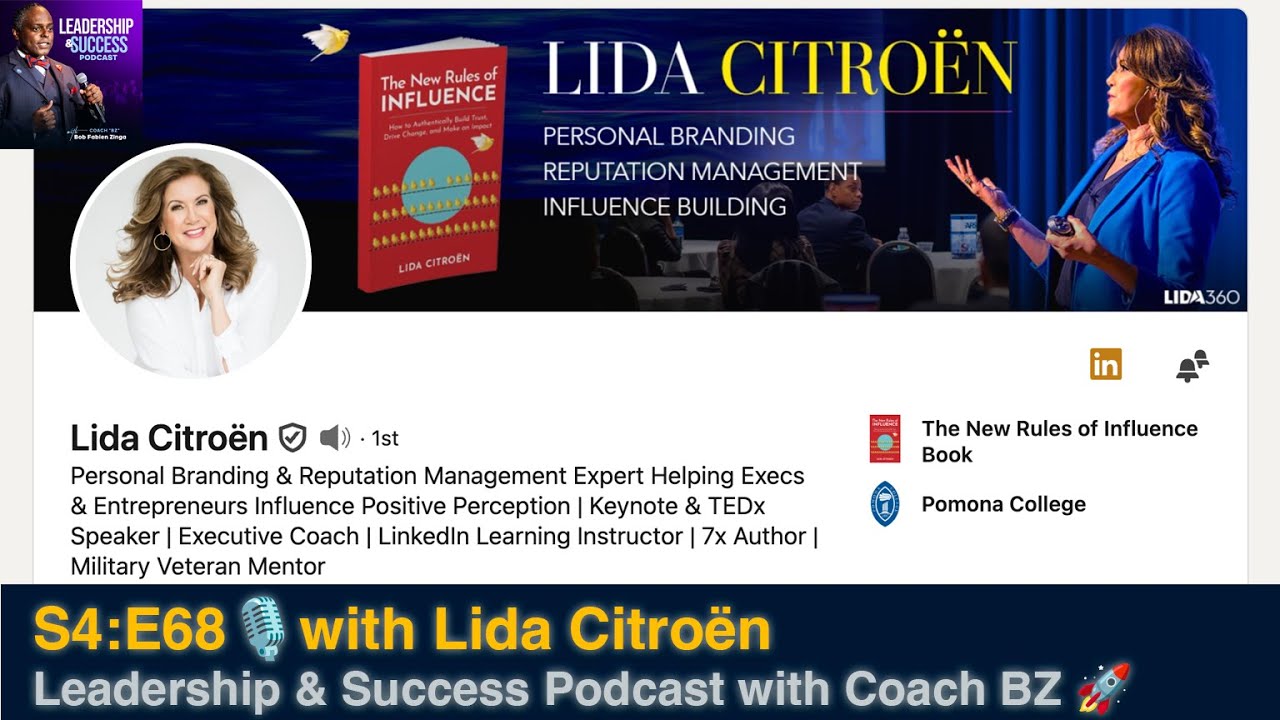
Reputation expert Lida Citroën talks personal branding, influence, and helping veterans transition. She discusses her book The New Rules of Influence, why listening to your gut matters, and how to build trust when everything feels uncertain.
Chapters
Hi, I'm John Maxwell. When the top companies in the world are looking for trainers, speakers, and coaches, there's one name that stands above the rest, and that's Maxwell Leadership. Our certified team members have gotten proven results for companies all over the globe, and our reputation, I'm proud to say, is second to none. Some of our members have risen to the top of their profession. Including the one you're going to meet today. I proudly introduce you to my friend, Bob Fabien Zinga.
Welcome to the Leadership and Success Podcast with your host, Coach BZ. If you need to develop into a better leader, this podcast is for you. If you want to achieve a greater level of success, this podcast is for you. His mentor, Dr. John C. Maxwell, said it best: Everything rises and falls on leadership. We hope to inspire you today and provide you with an insight that has the potential to positively impact the trajectory of your life. Welcome to the Leadership and Success Podcast.
A TEDx speaker, instructor on LinkedIn Learning, and well-known presenter, Lida Citroën is an expert in reputation management and personal branding. Featured in international media for her work in reputation management, Lida has authored powerful books and numerous articles on personal branding. Whether in front of a camera or a live audience, Lida's message is relevant, compelling, and delivers tangible results your audience will use today, tomorrow, and into the future.
Focusing on your target audience cuts away a lot of the noise. Who are the people that hold the opportunities you want? No matter where you are in your career or what kind of work you do, If you interact with people, you need a compelling personal brand in order to influence, inspire, and impact others. A strong personal brand removes ambiguity. It takes the randomness out of your career and instead purposefully drives value to your patients, clients, investors, and customers. A brand is always about an experience of what could come. A resume is the complete opposite. A resume looks backward and says what you've done in the past. I'm giving you an opportunity now to think about your legacy. What do you want to be remembered for? What difference will you make at the end of your life? Everyone has a personal brand by design or by default. Identifying and actively shaping your personal brand puts you back in control, gives you the intention and the focus to build your reputation the way you design. I am one of those people who loves what she does. To see people come to life in front of me, find their voice, take ownership over their career, it's why I do what I do. Freedom isn't free, and I know that. I know that because my mother taught me that at a young age. You see, she grew up in in communist Hungary. And when she came to this country, she saw freedom for the first time, and she was always telling my brother and I, "It came at a cost," and I remember that. I am so honored and grateful that I get to serve our military in this way. They have changed my life in a way I never could have imagined, and I am so grateful that I got chosen to do that with them. I feel them here with me today. So I ask you, if you feel called to serve, if you feel like you want to figure out the reason why you're here, then ask yourself those same tough questions that I had to ask myself. What are you passionate about? What difference do you want to make? And how will you leave this world a better place by expressing gratitude and generosity for those around you. Thank you. All right, everybody.
This is Uncoach Bizzy again, twice in one day. Can you believe that? Thank you so much for being with us live. We are live on LinkedIn and YouTube. If you have a question for my guests, please go ahead and type it in the comment and we're gonna make sure to answer your question live. Also let us know where you are tuning in from, what city, what state, and if outside of the US, what country. We're gonna also be talking about one thing you are grateful for in just a second. And please, if this adds value to you, think of someone in your circle of influence that you could tag so they can watch live review or repost in your feed. So let's do our moment of gratitude really quick. It takes less than a minute. And I want you to please, if you can, close your eyes, put yourself in your happy place, take a deep breath if you need to, but think about one thing, one thing that you are grateful for today. And for me today, like I said earlier today, I am really grateful for my network. I feel like I've never really met a stranger ever in my life. I have a lot of LinkedIn connections, acquaintances, or friends, but there are so many people throughout my life, my experience, that have helped me and done things for me that I couldn't do for myself. And many of them, I don't even know their name, and I never will be able to pay them back. So I am really, really grateful for networking. One of my mentors told me that your network is your net worth, and I believe that is true. Okay, whatever you are grateful for, if you would please type it in the comment section, and thank you so much for that. All right, so I already introduced Lila through the video, but let me see if I can say just a little bit more about her. And by the way, I want to give a shout out to Sabrina Gilg, watching from Harmony, Pennsylvania. Welcome to the show, Sabrina, and let us know what you are grateful for today. Thank you. Thank you so much. So Lida really doesn't need any introduction, right? She is an executive coach, global keynote speaker, award-winning author, and passionate advocate for the military community. She has helped thousands of leaders across 30+ countries shape their reputation, build trust, and thrive with authenticity. Her TEDx Talk, The Power of Gratitude and Generosity Serving Those Who Have Served, has reached over 43 million, that's with a capital M, right, viewers worldwide. And now she's joining us to share her wisdom of influence, reputation, and servant leadership. Ladies and gentlemen, without any further ado, let's bring on the Leadership Success podcast, Lida Citroën. Hey Lida, can you see me? Are you there? Here you are. Hey, welcome to the show.
I am here. I was here, I went away.
Yeah, you are back on the show. Thank you so much for being here. How are you doing today?
I am doing great. How are you doing?
I'm trying to make sure this technology works exactly the way it is supposed to. It's such a pleasure to have you here. I guess to get started, is there one thing that you are grateful for today?
You know, it's hard to say one thing because I wake up every morning and I thank God for another day. And I'm grateful for the challenges. I'm really grateful for the opportunities and blessings. But yes, it's all about gratitude for me. So to say one thing would feel— yes, hard.
Yes. Another day that is so powerful because I guess another one of my mentors told me, what doesn't kill you makes you stronger. If I'm still alive, there is hope for me. So that is, that is wonderful. And what is one thing about you that most people may not know?
I'm really tall. And, you know, people knew that before COVID And then when the pandemic shut everything down, I do so much of my work now from this vantage point. And when I talk about being tall, they're like, well, but, you know, I'm 6'1". That's tall. So, yeah, that's probably one thing. I'm kind of an open book. People know a lot about me.
Well, talking about being tall, when I joined the Navy 20 years ago, I was almost 6 feet, like 5'11". And last time I checked with my doctor, it looks like I'm 5'10" now. So I'm getting shorter. But anyway, that's wonderful to know. Can you tell us a little about your leadership journey?
You know, it's interesting. I never described it as a leadership journey until people started describing my path that way. I spent 20 years in the corporate world doing everything that we're supposed to do, right? I performed up to expectations. I met benchmarks and milestones. And got recruited to go do the next thing after about 2 and a half years in every job. So I bounced around a lot, which to me fed my Gemini personality because I wasn't interested in just kind of replicating and doing the same thing over and over. But I did that for like 20 years and got to a pretty high level of executive status. And then the market imploded in 2008 and I found myself unemployed like a lot of people. It was really in that moment that my husband, who is normally very quiet, said, you know, instead of finding another job, why don't you figure out what you really want to do? And since then I have said, you know, you need to talk more because that's pretty profound. And that led me to taking the experience I had in the corporate world of helping companies and products and services build a brand and thinking about it for people, which wasn't really talked about 17 years ago. But that became much more interesting to me, is to help people tell their story, build their brand, be intentional about the way they show up. And I built a whole company around it.
Wow.
Yeah. So that is really powerful, man.
Yeah.
And, and I know you also do a lot of work to help out a lot of the veteran, you know, speaking and things. Like, for example, the TEDx talks I mentioned, right? More than 43 million viewers around the world. That is a lot. Why do you think your message of gratitude and service resonates so much?
You know, in 2009, I became aware that nobody was talking to military men and women, right? Active duty service members coming out of the military about the tools that I was getting hired to teach executives and entrepreneurs and thought leaders around the the world, nobody was talking to our veterans about that, or active duty service members. And, and it didn't make sense to me because as I saw it, it's a very different culture. And a lot of the work that I do is navigating culture. I work in over 38 countries, and personal brand, self-promotion, it plays the same with nuance, right? Because we have different cultural nuance. But nobody was talking to, to the military about this, and it seemed like an opportunity. The only challenge was I didn't know anyone who'd been in the military. I had no personal connection. No one in my family had served, so it was very— an uphill battle. But how do they tell their story? How do they market themselves coming from a culture that has its own language, terminology, job titles, you know, hierarchy? Everything is different in the military. But when they come out of the military, as you know, It's like they don't know what they don't know. And so I was able to lean in about 16 years ago and say, I got some tools that might help.
Yeah.
Wow, that is really powerful. So how do you personally define authentic influence in leadership?
It really is that part of you that is based in your values, right? We can spin anything. We can make anything look good on camera. But authentic leadership, that trustworthy, heart-driven servant leadership style, it comes from who you are organically. And getting to that place, whether it's with a corporate executive or a military officer, is such an honor that they let me go there with them. Because that's the, that's the genesis of how your brand is going to come to life. With social media, with AI, with all of these new tools we have now, you know, faking it is getting harder. And that's a good thing, because we shouldn't be faking it. But being able to share what's in your heart, what's driving you to that leadership position and that commitment, the— what's driving you is your values. And that's where you establish your credibility, which is the basis of a personal brand.
Wow. So there are many leaders, both in tech and in the military, that kind of struggle with balancing authenticity and perception. So how can leaders manage their reputation without feeling inauthentic?
Right.
So there's a couple things that you mentioned. So perception is a reality, and it may not be my reality. Your perception may not be my reality, but it is real to you. And we have to honor that because The perspective, the biases, the judgment, the perception that you bring into a conversation is formed by everything that's happened in your life. So it might not be what I see, and it may not be how I see it, but it is a reality to you. And that is the lens that you are going to judge me through. I, I get people all the time who say, I don't want to be out front because I don't want people to judge me. Well, we judge inherently. We judge based on what we know to be true, what we believe. It, it just happens. We, we shouldn't judge falsely. We shouldn't judge negatively. It's very hard to tell somebody not to do that. But what we can do is I can influence and affect how you will judge me based on what I put out there. So we can affect perception as much as we can, right? I can't change you. You're a, you're a human being. But I can manipulate, and that's not always a bad word. I can influence and affect how you will perceive me. And that I have control over. To the authenticity question, you know, people, people are scared to show that soft underbelly. I talk about that a lot in The New Rules of Influence. That, you know, what we're asking for next-generation leaders is a scary thing. Yeah, we're saying you have to be vulnerable. You have to let people know who you are at your heart. And that can be terrifying. So here's a way that I sort of unpack that. I think it's important to be a real person, right? If you want to use the word authentic, that's fine. But real is is gritty. It's base. It's understanding. It's like, you know, Bob, let's just get real here. Like, you'd know what I mean by that. If I said, you know, Bob, let's get authentic, you might say, well, I thought I was. I thought I was being honest. But real has a different ring to it. And I want to give people permission not to worry about being transparent. There is a big difference between being real or authentic and being transparent. One of the videos that I did on my YouTube channel that actually got terrific engagement is one where I said I'm anti-transparency. I, I think government should be transparent. I think many businesses should be transparent, but I don't think people should because we're allowed to keep some things private. So when I say I'm an open book with some exceptions, right, I have guardrails around topics or incidences or things that I choose not to talk about. And that's how I keep myself safe. And then I know how free and vulnerable and open I can be because I know where the boundaries are.
So, wow, that is quite powerful. Talking about personal branding, what are the most common mistakes executives and entrepreneurs make when it comes to personal branding?
Well, it's a little different for an executive than an entrepreneur. So let me talk about the executive in a company, right? They think it it— somebody can do it for them. I, I cannot tell you how many times people have tried to hire me and said, so you'll just like create this persona and run it, and then I just do my work in the background. It doesn't happen that way. It has to be you, and you have to own it and live it and breathe it every day. For the entrepreneur, the challenge is often I want the product or the company to be the brand, not me. And the challenge with that is, sure, I'll, I'll be interested in your car or your lipstick or your SaaS service. But I want to know who's behind it. I want to know whose vision this was. You know, who is standing behind the product or service or company? So the individual entrepreneur's brand is important in the equation. Those are two misperceptions.
That is quite powerful. In your book, right, The New Rules of Influence, I believe that's your latest, you talk about trust. How can leaders actively build and sustain trust, especially in times of uncertainty like we're living right now?
You know, yeah, we're in uncertain times. And, you know, some see it as a good time. Some are seeing it as maybe not such a good time. But the leader has to be agile. They have to be courageous, right? And courage doesn't mean you're not afraid. It means you work through fear and you have courage, right? Military knows all about that. I learned a lot about courage from the military. And then an agility to flex and adapt and know that, OK, we may have been moving in that direction in the past, but now things have changed, and I have to lead people in a different direction. We have to be inclusive. And inclusivity is a mindset. I love to talk about inclusivity in the way that it, it opens the aperture for who's in the conversation. And if we include more voices, it doesn't threaten us. It doesn't mean our idea isn't still good. But a leader who brings people in and says, "How does this work for you? How would this play in your community?" How does this feel in your heart? To a lot of different people is the one who is going to either learn something that will help them adapt and move through the uncertainty, or is going to help them feel more confident in what they, in the direction they were going. So, you know, courage, adaptability and agility, inclusivity, they're all really important ingredients right now. And If you're scared, it's OK to say you don't have all the answers. You know, sometimes your team needs to hear that. I don't know what this means for us as a company or as a team. But here's what I do know, right? Because we look to leaders for safety and guidance and credibility. Lying, trying to make things up on the spot, never a good practice. Yeah.
Yes. Well, that is quite powerful also, the, humility it takes to really lead well. And you talked about being vulnerable and authentic. Now, one thing, you are sought after, not just in America, but really around the world. I've seen you in shows in the UK and always people looking for your feedback on scandals happening at a very, very high level, a lot of celebrities and so forth. But someone watching now, how should they repair their reputation after a setback or misty steps.
Oh yeah, the media loves to bring me in when somebody does something wrong. Um, it's like, what about all the good things people are doing? Um, but I think, you know, when somebody does something wrong and it makes headlines, it makes all of us afraid. Uh-oh, what if I did something wrong and it made headlines? And honestly, it could, right? We could say something wrong on X or post something on Instagram or say something to someone who repeats it to our boss, and it becomes somewhat public knowledge. When that happens, okay, and I'll say when because let's all prepare for it, there are a few really important steps. And I've done videos on this, um, you can go to my YouTube channel, I've got so many videos on reputation repair. I actually have a LinkedIn Learning course on reputation repair. It's really important to take a beat, right? Don't go into react mode. That's what we typically do. Most of the clients who I, who I work with have taken all their social media down. They've isolated from friends and family. They don't show up for work, right? They go into a hole, and that's not what you want to do. You want to take a beat and, and just try as best you can to separate the emotion from the facts. And if you're not able to do that, get some people around you who can really help with that. Because how you feel about what's happening can cloud what you do next. So, you know, separating the emotion from the fact, and I know that sounds really easy to do. And that's why I say get some, get some people you trust to help you with that. And then really look at what is the short-term and long-term impact? Was it just a bad joke that some people got upset about? Was it, you know, something that could put you in jail? I mean, there's all different levels of this, right? I've talked to people who've lost, lost their family, they've lost their careers, they've lost everything. One person I worked with had to leave the country because it got so bad. So there's all different layers of this. Taking a one-size-fits-all approach isn't the right way to do it. Get some people around you. Um, in the book that I wrote, Control The Narrative. There's a whole section on what to do if your reputation gets attacked, and that's primarily, I think, a lot of the reason people buy that book. I would love for them to read the first couple sections, but the last section is, is what they go to. Um, because I can't just say do this, this, and this and everything goes away. You may have to apologize. You may have to apologize publicly. You may have to apologize many, many, many times. You may not apologize. You know, it all depends on, you know, what happened. And for every situation, there is definitely a response. There is a way forward. And I'm a firm believer in second chances. Yeah.
That is, that is very powerful. Now, this was not a question we had planned. But if you don't have anything to say, I completely understand. The Coldplay thing with the —video. Yeah, it was really, really hot on LinkedIn and all social media a couple of weeks ago. And I was pretty amazed. I don't know if you saw the response from the actual company who they hired to provide their response. And the other thing is people may not have known, but she was actually the ex-wife of the singer. I think everything they did about their response was just fantastic. Yeah, she, she was, she was married.
I think Martin Smith, I think was his name. Chris Martin. Oh right, when they hired Gwyneth Paltrow. You know, as soon as you start getting celebrities involved and as soon as you get corporate spokespersons, I'm out. I'm like, okay, yes. Well, because it's— and now it's being crafted right now. It's being massaged and crafted into a message that has been vetted by the lawyers and I mean, my work definitely interacts with lawyers. If, if we've got a high-profile situation, we have to know the board of directors is involved, the shareholders are involved. I mean, it's got lots of layers to it. But as soon as you start putting celebrities out there, okay, have fun, because everybody makes mistakes. Let's face it, Bob, we all make mistakes. Yes, some of them go viral like that, and some of them can quietly get deleted from social media, and very few people saw it.
Yes, yes. Wow, that is, that is a, a great insight from, from an expert. I don't think many people thought of it that way. Thank you. And also, all of the work you've done, uh, with the, uh, military, with your advocacy— actually have quite, quite a, quite a few books related to military life, like Engaging with Veteran Talent and Our Next Mission, when they, uh, transition What— I guess this is a two-part question. What advice would you give a veteran right now who's still on active duty, who's thinking about transitioning, but also most importantly to companies that would hire a veteran?
It's a tough time right now because, you know, we're not in an active conflict. And so veterans' sentiment is different than it was, let's say, 10 years ago, right, when we were still somewhat close to 9/11 and all of the patriotism. That being said, it is a great time to come out of the military if somebody is looking to do that. Having a plan in place, knowing what the strategy is for the next chapter is very important. So in my book Success After Service, which is right there on the screen, um, I talk about, you know, if you're 18 months out or 24 months out or 30 days out, what should you be thinking about in order to put the pieces in place so that your transition is a little more smooth. Transition out of the military is not a day. It's not an event when you get, you know, you retirement ceremony. It's a process. And I coach people who've been out of the military for 10 years, and they say, "I still feel like I'm transitioning out of the military." Breaking some of those cultural norms that don't translate are very hard to do. Just like if you came from a different country, and you're trying to learn this culture, and some of those norms are getting in the way, in, in a way that you want to move forward. For companies, it's, you know, a smart company hires for character and trains on skills.
And if you are— say that again, please.
That's powerful. Smart companies hire on character and train on skills. That's not to say that the military isn't very highly trained. It is the most trainable and trained workforce that we have. I mean, when you join the military at 18, 19, 20 years old, you don't know how to do the things that you're going to learn how to do. I mean, where would you have learned that? So you learn that in the military, and they're constantly training. So to think that you're talking to someone with a military background who's in their 30s or 40s or 50s They know how to be trained, so they can, they can learn Java, they can learn C++, but they— you can't teach someone to have a service mentality. You can't teach someone to be courageous and loyal and, you know, about helping others. That's what the military has baked in, and that's what we should hire for. Teach them the skills. That's not hard.
Yes, yes. Wow, that's, that's a very interesting way of looking at it. I, I couldn't agree more as a veteran myself. But also, you know, a lot of the work you've done talking about women in the workforce, you have shaped executive narrative worldwide. And what advice would you give to women aspiring to leadership role in— no, let's face it, most of our workforce today is still very much male-dominated. So what would you advise to aspiring women leaders listening to you right now?
Definitely get ahold of my book, The New Rules of Influence. I had people say they thought it might have been written for women. And I certainly didn't do that. But I think it speaks to a lot of the challenges that women face, right? We wait often until somebody tells us it's our turn. We wait until we've achieved a status or rank or position in the company before we feel empowered to be able to assert ourselves and have the kind of influence that we want. And we don't have to wait anymore. No one has to wait. People, you know, there are so many underrepresented voices out there that have something amazing to offer. They have an idea or a question or even a challenge that needs to be heard. But we're all waiting. We're sitting in the back of the room. We've got our, you know, our hands under our lap. And we're biting our tongue because no one's called on us, or no one has said, OK, now you have the authority, the positional power to go out and say something. And that's got to go away. So what I did in the book, which I'm so proud of, is I really kind of broke down the model of executive presence. Because that's what many of us, I know for myself, I had been taught When you have executive presence, you can have clout, you can have authority, you can have respect. But executive presence didn't look or sound like me. Right? It told us to dress a certain way, speak a certain way, and enter a room with gravitas. What the heck is gravitas? Right? Nobody— everybody says it's important. And you see it and you know it, but nobody can teach it. And I'm like, if I can't teach it, why am I going to tell somebody it's important? So what I do in this book is I just say, look, let's put that off to the side because there are some people who are going to hold true to that. But there's all these other ways that we can have influence, even if you don't have the job title, you don't have the positional authority, you don't look and sound like everyone else in the room, which is a good thing. That's where we have opportunity to have influence. But the burden is on us to get clear about why we want to have influence, who we want to influence, and then how and where, which is how the book is structured.
Wow. That is very powerful. Now, talking about diversity, and it kind of has a bad rap in the country, right? But 2 hours ago, I talked to, uh, Jr. is an expert in the field. He says truly diverse and inclusive companies are 32% more profitable. That is pretty big. So I guess my question for you is, how can leaders authentically champion diversity, equity, inclusion through their personal brand? Actually, Eddie doesn't call it DEI anymore. He calls it ROI, not just return on investment, but return on inclusion as well. And inclusion is not really It can include race and gender, but it's much more than that, right? Like today, it's more than 5 generations working in the workforce at the same time, and very soon it's going to be 6 in the next couple of years, people coming from different backgrounds, education, and so forth. But anyway, the bottom line is diversity appears to be very, very profitable. So what would you advise leaders to champion diversity in their personal brand?
And again, if it's part of their personal brand to champion diversity and inclusion, then you lean into it. If it isn't, be careful forcing it. Because I think when it looks forced is when we think it's a check-the-box thing. And I don't want to be part of a diversity program just because I'm female. Right? I want to be able to stand on my merits. And so that's why I say, you know, inclusivity is a mindset. Diversity is a mindset. I, I grew up with different accents in my home, right? I grew up in Los Angeles, where there's so much diversity. I thrive in that. That's my choice to surround myself with that, because I think it makes me a better leader. So, you know, my right-hand person you know, is Spanish-speaking. And you've met Sabrina, who I know is listening and probably dying of embarrassment that I'm— but she's Spanish-speaking. And, you know, my mother's Hungarian. And I have all these people in my life who come from different backgrounds. And that's what I lean on to grow my own perspective. And when I'm introducing an idea or a new program, I always want to make sure that I run it through their lens to make sure that I'm not missing something, because that's, that's not my brand. My brand is not to be exclusive. So I think that's where it's just a commitment. It's not something I force. I, I don't hire based on it. I don't promote based on it, but I welcome it because I know how much I love it. I love different languages and cultures and food, and that to me is just part of the American experience. Wow, that is powerful.
Actually, Gary Ann, who's watching live right now from Hawaii on Honolulu, I love that place. He said inclusivity is a mindset, like listening versus just hearing. So people are absolutely getting what you are saying. So we are about to switch over to the second segment of the show. Is there a question I should have asked you for the first segment that I haven't asked yet?
I don't think so. I think you've done a really good job. Thank you.
Wonderful. All right. So for the second segment, that's where I'm going to ask you the 7 types of questions I ask everybody who comes on the show to really drill down on leadership. First category would be, what is the greatest leadership advice you have ever received?
The greatest leadership advice I ever received and that I give is to be intentional. I think a lot of people think they can just be in the moment. They can wing it. They can just sort of fly by the seat of their pants. And you can still be in the moment and be present, but think about it ahead of time. Think, think through the narrative, think through the message, think through the vision. Don't leave it to chance, because that's where we make mistakes. That's where we say, "Oh, I probably shouldn't have said that." Right? Don't leave things to accident. Be intentional, be forward-leaning. And, and, and just grab those opportunities that are exactly what you've asked for. Yeah, that's what I've done because that's advice that I've followed.
Now, you've had quite an incredible, uh, success story. What, what do you think is the secret of your success? Why are you so successful, you think? I think it's two things.
I think, um, I built a brand for myself, so I had to model what I teach, and I built it for myself that, first of all, is very intentional, but it's very real to who I am. And it's so easy to be me because I built that brand, right? And people hire me because they say, build for me what you built for yourself. So it's like being a website designer and not having a website, right? I model what people look to me for. I think the other thing that has been really important in my success has been prayer. I, you know, there have been many times where my work with the military, it takes a lot of time, and I speak at conferences all over the country. I coach and mentor anyone who reaches out to me that needs help. I have donated my books, and I don't get paid for that work. And there have been times where, you know, I run a for-profit business. I don't want to become a nonprofit. And I've had to pray on, you know, if I'm supposed to still serve this community, then I need some help over here. And prayer has always been the ingredient, not just to share my gratitude, because every day I share gratitude for that, but to really anchor me in why I'm doing what I do.
Wow, that is so powerful. That's part of the reason why I've put this show the way it is now. I kind of like to get behind the curtain and kind of see what you are thinking, what you're feeling, and what has allowed you to get where you are now. So we don't want to get what you have earned, right? That is yours and you deserve all of it. But what have you learned that we can apply in our own life and hopefully get similar results? Thank you so much for sharing that. That was powerful. So I know that leaders are learners. What are you learning right now?
Now, you know, a topic that I'm fascinated with that I've never been good at is negotiation. And so Chris Voss was highly recommended by some people. And so I've really been diving into his work. And, you know, he's a former FBI hostage negotiator. And, and I'm just fascinated with the psychology and the human behavior and the social, social society part of it. And and just how people work and how that leads to negotiation. Because I don't think it's just, you know, I want to be paid this much, you want to pay me this much. That's not the kind of negotiation. But I think we negotiate with people all day long, right? Yeah, we're constantly trying to find win-win situations, and that's where I'm really learning more about negotiation. I'm just fascinated with it.
Yeah, and I know, uh, Chrissy has a master class. I, uh, I believe in the Masterclass app. I've watched that too. Yeah. That is wonderful. It's really amazing how much information is just available out there. Very, very different from what it used to be even just 20 years ago. Exactly. Wow. Okay. So I love to bring this coin. One side it says failure, the other side it says success. I think success and failures are two sides of the same coin. But people with so much success like you, all we see is success, success, success. But I know you've had to go through failure. To get to where you are now. Could you share some instances of how failure may have shaped your life?
You know, when you asked that question in advance, I was thinking back and I certainly don't want to say I've never had failure because I don't want to jinx whatever energies are around me. I think about maybe getting swept up in enthusiasm in the wrong direction. And, and so here's an example, and I've not shared this. Launching the book last year was such a personal journey for me. The New Rules of Influence is the first book I ever wrote that was so personal. I share a lot about my, my own stories, my own failures, my own vulnerabilities. And I went there. And, you know, I had my husband reading chapters going, am I going too far here? And he's like, no, keep going. Right? All my friends said, keep going. And my publisher was so excited, and, and we did so much investment in promoting that book. And I invested financially in some tactics that I thought could work, spent a lot of money, and they didn't work. They didn't prove a return on investment. So when I think of failure, I think of what I had to unpack looking back on that experience. And really what works about the book is that it isn't about bright lights and, you know, Instagram this and PR. It isn't about that. It's about people reading it. Now I see that somebody who has this amazing job will read this book and put something on LinkedIn from their own heart about what it meant to them, and that does wonders for other people knowing about the book. And so I look at that and I think, wow, that was a failure. It was a financial failure because I spent a lot of money, but I also— I misjudged what I knew in my heart wasn't the right direction. And I take that as a failure. I should have listened to my gut a little bit more. Um, I know what makes that book work, and it's the intimacy that the reader and I feel when they read it. And a lot of people have said they feel like they're curled up on the couch with a good friend who is giving them really good life advice. And I missed that at the beginning.
So, wow, that is powerful. I usually do not do that, but I think I need to take just a second. I am going to play it at the end of the show. It's only about 2 minutes or so, but I think it's It's a very, very, very powerful book. Can you— you've already said so much about it, and I think people need to buy it, so you don't want to give them too much. But what else can you tell us about this one book, your latest book, The New Rules of Influence? Why should people really get a copy of it?
Because what we've been told isn't true. We've been told we have to wait. We've been told that because you or I or someone else doesn't look like what we should look like or sound like or have it— have certain credentials or certificates to be able to give us legitimacy. Everyone has an idea. Everyone has something to contribute. And it's not just about banging pots and pans and being loud and screaming. That's not the answer. But when you know why you want to lead, when you know why and who you want to serve, and then I walk you through how and where you build influence, it's something we can all do, whether you're just coming out of the military or you're, you know, you're an executive looking to, you know, finish out their career. It's just such a consumable book. It's so easy to read. And I know there's all these heavy academic books out there. And I've read them all. I've taken all the courses. And there's validity But I think that the market, people are just looking for something that you can read and go, I can do that, or I relate to that. You know, I talk about the origin story. Everybody has an origin story. Everybody has something about them that makes them special. And okay, so Sabrina put in the, in the chat, she put a link to the, um, to the YouTube video. Yes, thank you. Check it out there. Yes. Yeah, but it's— plus it's, it's, um, it's real personal to me that people know that if I can go there, you can go there too. If I can share those, um, not flattering stories, which, you know, I wanted to keep in the back, you know, under a bunch of boxes, then you can too. And there's a way to do it. There is a way to do it.
Wow, that is very, very powerful. Thank you so much. So who are some of your thought leaders, some of your mentors, people who have helped shape the way you think and lead?
Well, I certainly love Brené Brown. I have followed her work since that first TED Talk that really kind of catapulted her. You know, Simon Sinek for some of the thought leadership that he's introduced. Amy Cuddy, Because I— oh, you're popping the books up. Sorry.
Yeah, no, it's fine.
Yeah, Amy Cuddy talks about presence and body language, which is part of personal branding. Um, trying to think who else. Chris Voss, like I just mentioned, I'm reading his. And then I read stupid, you know, um, thrillers, which I can't even tell you what they were about when I'm done because it's like brain candy. So, um, wonderful. I always try to mix like the business books, the things that are good for my work and my creativity, with the candy.
Wow, that is, that is beautiful. Okay, let's, let's talk about books that you are going to recommend. I believe you should recommend all of these for sure. Yeah.
All right, those are mine. Um, yeah, so the one that I just finished that I was mentioning is Chris Voss's book, Never Split the Difference. That is a Fabulous book. I actually did the audiobook. Um, here's a little secret. I listen to audiobooks while I do jigsaw puzzles. How crazy is that, right? I got into jigsaw puzzles during COVID and it's like my zen. It's my, you know, and so I listen to audiobooks. I'm listening to some Brené Brown, and then I just finished, um, Never Split the Difference by Chris Voss, and it's fascinating. Absolutely.
Yeah, I think one of my mentors, Tony Robbins, calls it net time, no extra time, where you can listen to a book while you're working out, driving, or whatever.
Exactly. Or podcasts. I've gotten— obviously now that I've launched a podcast, I've been listening to a lot of podcasts. Some, some I really get into, some are not my thing, and that's okay because my podcast is not for everybody, and that's okay.
Can you recommend a couple of the podcasts you, you got into?
Of my day. Mel Robbins, definitely. She's a great interviewer. And I love that she doesn't talk too much. But she talks enough. And then of course, Jay Shetty, because he's just amazing. Sometimes Joe Rogan, for some of the people that he has on, I like his interview style. It's very gritty. So those are the ones that I'm sticking with. I won't mention the ones that didn't, didn't work for me.
Actually, for Christmas, my wife gave me, uh, Mel Robbins' latest book. I was looking for it, but yeah, that's wonderful. Okay, and, uh, another question I have for you then. If you wanted to— if you could invite 3 people for dinner, a live, dead, or even mythical figure, who would you choose and why? Any 3 people at all.
You know, it's, it's gonna sound so corny, um, It would be my husband and my boys. And I know that sounds so corny to say that because it should be Plato or Aristotle or, you know, people who've passed on. I am happiest when my kids and their families and we're all together. That's, that's where I feel creative. That's where I feel love. That's where I feel safe. That's where I, I just, my heart just grow so much. So yeah, it'd be wonderful to have, you know, dinner with Steve Jobs and Aristotle. And yeah, yeah, awesome. And Jesus. But my, my boys and their families and my husband, that's, that's home.
That is, that is beautiful. So if you had one day to live, what would you have liked your final contribution to be?
So it does, it sounds corny. But I live that way every day. I, because I teach legacy, right? When you think about your brand, you're thinking about how do you want to be remembered at the end of your life? How do you want to be known? So I live that every day. I, I mean, I don't wake up and think about, you know, this could be it. But I think about how I want to leave this world and making sure that everything I do is to reinforce that I was grateful for everything that came my way, challenges and opportunities and relationships, and that I was generous, that I gave way more than was expected. And gratitude and generosity, it's the title of my TED Talk. Yes. But it's also how I live my life. And I am pretty confident that I would be remembered that way. I hope and I plan to have a lot of time to continue to build on that. But, but that is how I will be remembered. If I, if I'm doing this right.
Wow, that is very, very powerful. Two simple words, gratitude and generosity, really mean a lot, can make a difference. I guess if I can ask you this, uh, what is your definition of success? What does success look like to you?
I grew up thinking it equaled money and status, right, and power. I think it's happiness. I, I have some people in my life who don't have money don't have, you know, everything that should make them feel secure, and they are so happy, and they would consider themselves so successful. And I, and I, so I think it's being happy, knowing that where you are is where you're supposed to be, that God didn't get you this far to just get you this far, and, and, and leaning on what you've done and, and being excited for what comes. That to me is success. Now, I do like money. I'm not trying to say I don't because I love a Chanel purse. But I am a happy person. And that to me is successful, regardless of money and status and all that.
So. Wow. Yeah. Thank you so much for sharing. That is very, very powerful. So when you wake up in the morning, what is one problem you would like to solve?
My cat being really loud. I don't think we can solve that. She's just really loud in the morning. One problem I would like to solve is I want people to know that their voice matters. Everything I do, every post on social media, every book that I've written, everything like this that I do, every podcast is to help people wherever they are know that their authentic, real voice matters. It matters to me. It matters to the world. We need to hear from you. We need to see you. And there's a reason you are here. And I want to be someone who helps them find that reason and then shares that voice.
So is there an action that you are thinking about taking right now that you believe will positively impact your life?
Action I want to take right now? You know, what I'm doing more of is leaning into less of the business messages and more of the heartfelt messages. Which is what this book really unleashed in me. And so, you know, things that I've mentioned on your podcast are not things I've necessarily mentioned in other, um, interviews. And, and my assist— my marketing manager Sabrina— almost called her an assistant— I know she's over there going, oh my gosh, you said this, you said this. Um, but that's what I'm doing on my podcast too, is I'm going, look, you know, things, um, things are messy. Life is messy. We don't have all the answers, but here's how I find— found a way through it. And if that helps somebody, then I want to be a person who can go there instead of just sticking on the business messages. I don't know if that makes a lot of sense, but absolutely.
And, uh, Sabrina, I know you are watching out there. Let us know what you are grateful for today. Sabrina is really excellent. I mean, I know you are super, super busy, but no, she, she always gets, gets back to whoever is reaching out. And just excellent. Okay, so we are coming toward the end of the podcast. We have a couple of minutes left, which is good. I'm managing my, my time here, You've been so generous with your time and your wisdom. What can we do to add value back to you?
How can we make a difference? You know, obviously, I wouldn't be a marketing person if I didn't say like and subscribe, right, to this episode. I have so much content on YouTube, LinkedIn. Let's connect. I would love to hear from you. If you want to connect on LinkedIn, message me and let me know that you heard this interview so I make sure that I connect with you. If you have a chance to read the book or listen to the audiobook, I would love to hear what you think about it. And if there's something that I can help you just move through that would be meaningful. But I'm pretty easy to find on social media on pretty much every platform. And I just love building a sense of community. So whoever wants to join me on that, that would be great. Wonderful.
And your primary website, I believe, is Lida360.com. Com, right? And yes, from there they can go to your YouTube channel, your podcast, and everything else. And again, uh, be ready to build influence, and definitely have to purchase that book. Okay, that is really great. And, uh, finishing up, so what is the most rewarding aspect of your life experience so far?
Oh, the most rewarding? I mean, oh my gosh, I'm— I really sound corny. Um, I mean, it's obviously my work. It's being able to be on stages like TEDx, or, you know, in front of I mean, I've, I've been in front of the President of the United States. I met the First Lady. Like, I mean, those things are significant and they're milestones and courses on LinkedIn Learning and 7 books and, and counting. Yes. But no, Sabrina will say, bite your tongue. Um, but I look at my, my sons and they're the next generation and they're good men. They're really good men. And that I'm really proud of. I'm proud of the relationships I've built, the people that I've heard from, that I've made a difference with. That's what I go to sleep at night saying, "All right, doing a good job." All right.
So we are coming toward the end of the podcast. All good things come to an end sometimes. Is there a question I should have asked you that I haven't asked yet?
I get asked a lot about what's next. And I would say, I really want to build on this idea of influence. I want people, I want to reach more audiences. I just spoke at a Latina conference which was amazing. Just all these rich voices and ideas. And I want to help those voices learn the way to move forward and be heard so that their message is received the way it's intended. We can be loud and we are heard. But it's not always the way it's intended. So that's what I'm leaning into. And we'll see where that takes me. But that's my next.
That's powerful. Everyone has an Origin story, everyone has a voice and heartfelt message. Yes. Everything you say is completely aligned. It is powerful. I'm so glad that you were with us. So I think one of the most important questions I really ask on the show as we are closing down, oh, by the way, here is Sabrina again, very grateful and blessed for my work with Leda. She's an outstanding and so inspirational leader and I have learned so much from her. I think she deserves a raise. A raise, Leda. A raise? Yes. Okay. Here's the most important question, I believe, of the podcast. If you could go back and give a piece of advice to your 17-year-old self standing at the edge of this incredible career you've had, what would you say to the 17-year-old Leda?
Trust your gut. Trust your gut. Stop listening to what everyone else is telling you is right and is success and is achievement and is what you're supposed to do. Follow your gut. I learned that later and I live by that. I wish I knew that when I was 17.
Wow. That is powerful. Part of the reason why I asked that is because when I was 17 is when I had this big dream and I had no idea how to get from A to B. And I wish I had known a lot more then than I do know now. But anyway, that is very, very key. So really, really quickly, what are 3 adjectives that describe you as a child? We are closing now. I'm sorry?
3 adjectives describing you as a child. As a child? Talkative. Yes. Curious.
One more.
I know, I know. Talkative, curious, and approachable. Okay. What about as an adult? Oh, grateful, generous, and warm.
Okay, wonderful. You definitely got grateful and generous there for sure. Okay. And then the very, very last question, and this is it. No more question after that. What is one word that represents our shared experience on this podcast together?
Insightful. Insightful. Insightful. You've asked questions I don't get asked a lot, and that's been really fun to go there with you. You make it safe for a guest to go there. So I appreciate that. Thank you so much.
Insightful for me. Well, I am really, really— I am super, super grateful. Today has been such a blessed day. I've already spoken what I believe are giant people who really lead industry. And thanks so much for taking the time to share some of your knowledge and insight. We are so grateful. Thanks again for being here. Thank you. Thank you.
Really, really good. I appreciate it.
All right, well folks, you've heard it. So again, I want everyone to go right now on Amazon and purchase the book, right? The New Rules of Influence.
Thank you for listening to the Leadership and Success Podcast with your host, Coach BZ. If you like what you heard, please subscribe to our channels and come back for more wisdom nuggets on how you may develop into a better leader and achieve greater levels of success. Leadership is the most critical skill. The world will always need leaders to lead others, deploy the next disruptive technology, or execute a business strategy. You may as well decide on counting yourself among the 21st century leaders. See you right here next time on the Leadership and Success Podcast with Coach BZ.
More from Bob

S250:E4🎙️LIVE 🇺🇸America 250: President Barack Obama Leadership, Service, and the Power of Hope






S5:E157🎙️ LIVE with CMD CMSgt Dennis L. Fritz, USAF (Ret.)(Multi Tracks Audio)



S5:E156🎙️ LIVE 🇪🇸 Leadership Lessons from the FIFA World Cup 2026 Champions (Multi Tracks Audio)

S250:E3🎙️ LIVE Leadership Lessons from America’s First Documented Family of African Descent 🇺🇸📖