🌍S4:E69 🎙️LIVE with Dr. Elisangela Rodrigues🇫🇷 🇧🇷
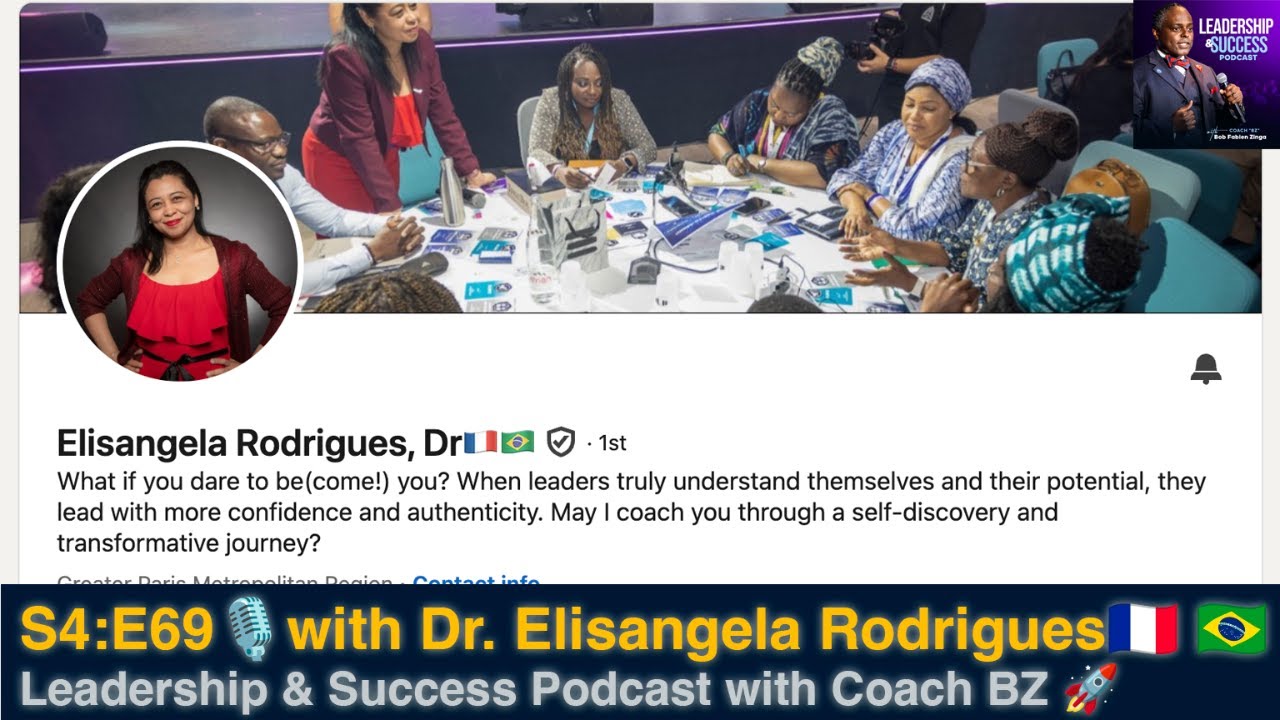
Dr. Elisângela Rodrigues, a Brazilian leadership scholar and Maxwell mentor, talks about her two decades coaching executives across three continents. She emphasizes authenticity, vulnerability, and the law of sacrifice, and describes her vision for the Maxwell iLead program serving children in the Amazon.
Chapters
Hi, I'm John Maxwell. When the top companies in the world are looking for trainers, speakers, and coaches, there's one name that stands above the rest, and that's Maxwell Leadership. Our certified team members have gotten proven results for companies all over the globe, and our reputation, I'm proud to say, is second to none. Some of our members have risen to the top of their profession, including the one you're going to meet today. I proudly introduce you to my friend, Bob Fabien Zinga.
Welcome to the Leadership and Success Podcast with your host, Coach BZ. If you need to develop into a better leader, this podcast is for you. If you want to achieve a greater level of success, this podcast is for you. His mentor, Dr. John C. Maxwell, said it best: everything rises and falls on leadership. We hope to inspire you today and provide you with an insight that has the potential to positively impact the trajectory of your life. Welcome to the Leadership and Success Podcast. Imagine gaining the leadership skills that could redefine your career. Join Coach BZ on the Leadership and Success Podcast, where each episode delivers practical insights from world-class speakers, military leaders, and industry experts. We dive deep into what matters most: building resilient teams, leading through uncertainty, and navigating complexity with clarity and confidence. Every conversation is crafted for aspiring leaders like you who are ready to grow, lead, and make a lasting impact. Don't miss our powerful live sessions and recent highlights. Michelle Hayward on building diverse, high-performing technical teams. Anne Leslie on leading through global complexity and cybersecurity risk. Ron Carpenter, AI, exploring faith, resilience, and AI-powered leadership. Colonel Michelle G.I. Gardner-Ins on commanding influence from the battlefield to the boardroom. Chris Robinson on shifting from drift to drive in life and leadership. And Coach Enrique Acosta Gonzalez on mentorship, legacy, and heart-centered leadership. Ready to level up your leadership journey? Tune in on Spotify, Apple, Audible Podcasts, YouTube Live, and LinkedIn Live. Join the movement toward leadership excellence. Listen now and start transforming your success.
Welcome back to another powerful episode of the Leadership and Success Podcast with Coach BZ. Today, I am truly honored to introduce a remarkable leader, scholar, and mentor who has dedicated her life to equipping and empowering others. Dr. Elisângela Rodrigues. Dr. Rodrigues is a Brazilian-born, France-based visionary, a wife and mother of three, who embodies what it means to lead with both heart and impact. With a PhD in computer science from Telecom SudParis, she has bridged the worlds of research, industry, and education. But she didn't stop there. She transitioned her career into leadership development, becoming a certified professional coach, and a coach, speaker, and trainer with Maxwell Leadership. Over the last 20 years, Dr. Rodrigues has mentored and trained leaders across 3 continents and in 3 languages—Portuguese, English, and French. From coaching executives and entrepreneurs to guiding diplomats, managers, and church leaders, her mission is clear: to encourage, equip, and empower leaders who create lasting transformation based on human values. She is the founder of Émerveillez, Rise Up and Evolve Together, a movement dedicated to helping individuals, especially expatriates, leaders, and parents navigate life's transitions with resilience, authenticity, and purpose. On social media, you may know her for her inspiring words, "I don't look for perfection. I look for authenticity." And in today's episode, we'll explore what authenticity in leadership really means and how it can change the way we live, lead, and connect with others. So get ready because this conversation is going to inspire you to grow, to lead with courage, and to multiply leaders in your own sphere of influence. Let's welcome my friend and today's special guest, Dr. Elisângela Rodrigues.
Hello everyone, thank you so much for being here. Today is going to be a very special day. I have a special guest with me, and before I introduce her, let's do our moment of gratitude. It's only going to take a minute, and what I want to do is I would like to ask you to think about one thing you are grateful for today. So if you would, and you can, close your eyes, put yourself in your happy place. You can take a very deep breath if you want to relax and think about one thing you are grateful for today. And for me, today I am grateful for emerging technology, especially when it comes to global communication. It is really amazing what we can do with technology today. You are going to see videos of me on this platform speaking in French, which I do speak French, but Spanish I don't speak very fluently, Portuguese, Korean, Vietnamese, and all kinds of languages that I don't normally speak, but it's going to be done automatically by artificial intelligence. And I think that is really wonderful that we can use emerging technology to bridge the gap between communication between us and the rest of the world. So I'm going to be bringing a very, very special guest today. I am honored to welcome Dr. Elisangela Rodrigues, a visionary global leader, international coach, certified Maxwell Leadership Mentor, to this episode of the Leadership and Success Podcast. Dr. Rodrigues brings a unique blend of global experience spanning America, Europe, and Africa with over 20 years of leadership training across 3 languages: Portuguese— she was born in Portugal— English, and French, and she lives in Paris, France. So she's done coaching executive entrepreneurs to mentoring Diplomat and church leader, our mission is clear: to encourage, to equip, and empower leaders who create lasting impact. So without any further ado, let me bring Dr. Elisângela Rodrigues. How are you doing today, Dr.
Rodrigues? I'm so honored, and I'm definitely not feeling that young when you say 20 years of experience. Maybe it should mean— yes, time has passed.
Yes. Wow. But yes, so grateful, so grateful to have you here. What a great honor. And of course, you and I, we've been mentored and coached and trained by the one and only Dr. John C. Maxwell. And it's really amazing the global impact that his organization has. I don't know if you've ever gone on mission trips with him, but I think it was 2, maybe 3 years ago, I went with him to the Dominican Republic and we were able to actually reach out and teach pretty much most of the government and the society of the Dominican Republic within a week. I think we reached out more than 25,000 leaders there. Me personally, I spoke at a school with teachers. I spoke to businessmen there in the Dominican Republic, entrepreneurs, and I also spoke Yeah, I said it was school. Yeah, school and businessmen were mostly what my assignment was. So I probably taught maybe, I don't know, 200 people, but the entire group, we reached more than 25,000 people in one week teaching them about leadership principles and values. I've been there.
I've been there with Ian on November 2021 as well. Wow, that is really, really awesome. So I was in one of them.
Yeah. Wow, that, that is, that is really amazing. Can we start, uh, what is one thing you are grateful for today?
You were asking and I was thinking, um, you know I love hard questions, so today I am thankful for the discussion I had with my oldest son. That wasn't easy. But yeah, I love because I think we grow together when we are having this hard conversations. So I'm glad we had uncomfortable but necessary.
Good. Wow. Yeah, that is true. I have two children myself. One of them is, I guess, a young adult now, but it's really amazing how kids grow up almost like overnight. It seems like like, like she was just born yesterday. But anyway, time, time goes on really quickly. And what is one thing about you that most people may not know?
What do people don't know about me? That's quite interesting question. Um, those who doesn't know me would say, I would say it's, I think I feel so transparent. Authentic that people who knows me, they know me. That's the point. Why? Why secret? So I would say, um, I can be extrovert person, you know, and also someone who is reserved in the same time, you know. So I can talk with anyone, but I will just show my real feelings, my questions, my insecurities to few people, those who you can really trust. So that's one of the things.
Yeah. That's powerful. And how many languages do you speak?
I speak 3 fluently, and I'm studying Spanish, so I can listen, I can understand, but I don't practice as much as I should.
Wow. So it's Portuguese, French, and English, right? That is pretty amazing. Wow. Okay. If someone met you for the first time, how would you describe what you do? What I do?
I would say I help people to become their better version of themselves. Wow. That would describe what I do.
So can you tell us a little bit about your leadership journey?
Leadership journey, it's something I started really, really young, you know, maybe not with that name, but since I was a kid, I was a leader. That's, that's something I was encouraged by my father, and I just make a pause to say to all men, listen to us, that you have an amazing influence on girls' life, because when we have our daddy behind your back, nobody stops you. Nobody. Nobody. So my father has been that, that father who not only were near me, but he was encouraged me to think. He was a teacher on mathematics, so he was used to come home and bring books with questions to make me think about logic. And he let me with an exercise and say, later at night I want the answer. So that allows me to start thinking, you know, what is the answer for this? What is the answer for this? And regularly he would answer, would keep asking questions to make me think. So based on this asking questions. I was asking questions about the world, why people do this, why we do this way, why we do, you know. So soon you become a leader in front of others because you are— won't be near the people who have influence and say, why do we do this way, why can't we do it another way, what if we ask people about this. So first of all, it was at school, second at the church, And later in the university, I became a leader in the university. We had an association that belongs to an international organization called International Fellowship Evangelical Students. We had a branch in our university and we had biblical studies mainly. And again, my question would be, why just biblical studies? You know, we have people who do a lot, a lot of art, theater, musicians. Why we could not go and do more than just biblical studies to share the gospel? And this became something that really was contagious. People were curious about this other ways to share gospel, and even Christians were involved. So this became such think that I was invited to spend 3 weeks entirely in a training on leadership. That was my first time trained by leaders on leadership. They said, I want to help you to develop your leadership. Wow. So that's, that's how— that's my journey. So that's the first time. So this world leader became something that I became more familiar with. I was for the first time retrained to what means leader. So that was my 20s. And from there it never stopped.
Wow. That, that is really fascinating. So you were born in Manaus, Brazil, right? And now you live in Paris, France. Uh, can you share your journey from the Amazon to becoming a PhD holder in France and a global leadership mentor?
Yeah, I indeed, I was born in Manaus, that is in the north of Brazil, this huge forest around us. And I had a dream, among many others, that was to travel to other nations. And I told my parents that I would love to. So when I was 13 years old, my mom decided to help me to learn English. I had a private teacher who helped me to learn, and from that moment I knew, and everybody knew, that I wasn't there to stay there for long. So when I was in university, I started studying computer science, and my parents were a lot involved in healthcare you know, working in administration, education, and I knew the need to have, for example, telemedicine in Amazonia because we have a lot of rivers, people are far away, there are no doctors everywhere. So I said, I want to study computer science to help develop solutions to help the doctors to bring their help to these people who live far, far away. But there were not this kind of studies in our city. So I had to leave to another city, São Paulo, that in the southeast of Brazil, you know, in order to try to find a place in that university. So I was there trying to do my best, you know, to be— because it's huge, really hard when you came from my city. Yes, to be selected to be one of them. So I decided to be a volunteering for a year in a lab, in a research lab, you know, in such a way that they could know me better. And I— my parents— that year, and then the next year was invited to be part of the master of computer science in that area. So that's how my journey started. During my master, I met my husband, and my, my husband had that dream to come to do his PhD outside of Brazil. So we got married and we came to Paris. I thought it was for 4 years at most. We never came back.
Wow, that is really amazing. Let me tell you something else that is striking. I've talked to quite a lot of leaders even now. Sometimes I, I'm looking for people who I think I might interview, bring on the show, but most people, they don't see themselves as a leader at at all. They're like, no, I am not a leader. Leadership is way too high. I am way, way down here. No, I don't, I don't want to talk to you on your podcast. But something that you said though, you were just a child and your father influenced you. You actually knew you were a leader as a child. So how do you define leadership? What was that experience like when you realized you were a leader? Because something that Dr. John Maxwell teaches, which makes leadership very, very easy, and I think bring it down to where everybody can have it. He says, no, leadership is influence, nothing more, nothing less. And I think anybody, anyone can have influence on somebody else. If you are a father, if you are a mother, if you are a student, if you are a colleague, you can influence one person. And if you can do that in a positive way, I believe that already makes you a leader, right? You don't have to have a big title. You don't have to be a CEO or have thousands of people following you to be a leader. Actually, I also believe in self-leadership. Sometimes the only person you need to influence is yourself, right? Even if nobody else is following you. But it's just very striking that out of the gate, even as a child, you knew that you were called to leadership. Can you tell us a little bit more about that?
I think that's the great gift that God give us as kids. Is that you don't know that you can't do things. Yes, you know, so when you see it in a kid's heart, in a kid's belief about their, um, their power, and that you have their right to raise their voices and do things, you know, empowering them, especially behind your father, your mother, I mean, who can be against you, you know? You feel really powerful about this. You are not understanding that you have influence. At least I wasn't. I just felt my father were doing things. He was raising his voice for cause that were in his heart. And when I was telling him that I was— I didn't agree with that, you know, at school something happened, he never told me doesn't care. He said, what can you do? What can you do? What can you do? And I said What can I do? I think I can talk to the teacher. What can I do? I think we should talk to the director. I think we should— and he said, why don't you do it? Wow, do it. So that's the point. I mean, you, you were a leader because the environment where I grow up allows me to raise my voice. And wow, even it doesn't mean you are always right. I always kept on that too. Journey. Sometimes I step back because I realized when I talk that there were people already doing something, and then I came back to that and said, oh, they are already doing something, they are inviting me to join them, what do you think? And he asked me again, what do you think? Do you want to join them? Wow. It was, he was asking me, decide Elisa, I'll be here to help you to make your decision. You know, that's the point. So for me, it was natural to raise my hand and say, I agree, or I don't agree, or why do you do this way, you know. And later I realized the world is not open for the women or for a girl, right? Later. But when I was a kid, I didn't know that.
Wow, that is very, very powerful. You You remind me of a concept in military we call extreme ownership, right? The thing that we can change, we definitely, no excuses, we are going to own this, succeed or fail. Kind of like the Serenity Prayer where it says, God grant me the serenity to accept the things I cannot change, the courage to change the things I can, and the wisdom to know the difference. But as a young child, you already knowing What is possible and what you can change and taking ownership of that. That's true leadership. That is very, very powerful. Now you, you mentioned, obviously you are a woman. So how has being a woman leader in a male-dominated environment influenced your perspective on authenticity and resilience?
How many hours do you have? Yeah, because that's the point. I mean, again, and I will say it again, because I think now I know the importance of having a father encouraging daughters, saying you are allowed to, you know, because this belief you have inside of you will help you to stay true to yourself through the challenge, through the season, through the cultures, and through the countries. Because I realized that if I was a woman, um, when I was in university, for example, I was a leader that was invited to And I was doing things that for me was so natural. I just were seeing opportunities, you know, why don't you do this and that. I was invited for someone who was a leader at the university and say, do you know you are a woman and that women are not allowed to do so? That you should have a man being the president of the organization. We should have a man doing this and you should be Helping me. That's okay with that. That was the first time I really had this one-to-one conversation. Wow. Older than me, a leader, a man, and saying, you are the person for this, you know? And I was looking and he thought I'm probably not understanding why, but he was speaking in my language. I was in my seat, I was just cleaning my nose and also, but that was the first time I realized that would be a problem. And later, as you mentioned, through the cultures coming, for example, just to give a huge example, Brazilians are known for what? We are known for football or for dancing. Samba, carnaval. That's what we are known. And as woman, when I was in Europe, people were not looking at me as a smart girl or a doctor or PhD student, you know. They were asking me, do you like football? 'And do you dance?' Wow, that's the only thing. Then I said, 'I want to meet the ministers, I want to go to the ambassador, I want to be in rooms where decisions are being taken.' 'Who do you think you are?' You know, so I, I do had to thank God for John Maxwell, you know, for this environment later in my life. But just to, to give a few moments in life when God made me stay true to the device that is called inside of you. Yes, definitely is the our beliefs. And remember that voice of my father say, you are allowed to, you are allowed to, you are allowed to. Yes, that man voice was powerful and has been powerful in my past.
Well, that is really powerful. Sometimes I kind of joke in my house, right? Of course, my wife is a woman. I have two daughters. If it wasn't for our dog, right, I would be the only male in this house. But I really don't understand why even in America, supposed to be the most powerful country in the world, even women don't get paid as much as men when they have the same experience and they do the same exact job. And this is 2025. We are in the 21st century. Like, what is going on? That doesn't make any sense at all. Of course, we've never elected a woman president in France or in the US, but yeah, I really truly believe in the way I've raised both of my daughters. They can do anything a man can do. Really, there is no limit and there shouldn't be. And so anyway, things are getting much, much better, but we're definitely not where we need to be.
I mean, I'm a generation of pioneering women. I know that, you know, my generation or our generation as men and women, uh, we are the pioneers where this leadership where both are leading is the first generation. So we are, we are facing so these struggles, but our daughters, they will have another women as reference, you know. So the things are changing.
True. Let's talk about global leadership a little bit, especially with your background and, and mine. So I know you were born in Brazil, so you speak Portuguese, and then now you live in France, so you do speak French. How did you learn English?
As I told you, when I was 13 years old, my mom decided that I should have to learn another language because I was telling them I want to go to another culture, another travel through the world. I want to visit other nations. And she said, I have no idea where you're going to, but I see you are really talking about this all the time. The best thing I can do is help you to learn another language. So from 13 to 18 years old, I was having regularly, um, English class and also meeting missionaries that were going to Amazonia, and, you know,. And then, so this helped me to improve. Yeah, that is amazing.
And, and, uh, those classes were like in your public school in Brazil?
No, it was a private class.
Okay, okay, okay. Wow, that is, that is, that is powerful. It's, it is, it is, uh, amazing. Because one thing with language, especially the way they normally teach it in schools, they really teach you how to write, right? You, you can write the language and maybe read with a bad accent, but actually being able to be fluent and speak, that's very, very, very difficult to do in any language. Like, it took me almost a month to speak in English.
You have to know the why. Yes. I was really, for me, I was sure I want travel, and if mom is saying that I need to learn English, I will learn English. I not only take classes, I will learn.
Wow, that is powerful.
When somebody told me, read the Bible in English. Read the Bible in English? Yeah, because this will help you to read things that you know in another language. So I did. When somebody told me, why don't you translate to the missionaries? I said, me? I went to travel with them, and then I started listening, and they were talking to me, and they said, you are ready. Come on, let's do it. That is powerful. So, wow.
Okay, so you, you have trained and mentored leaders then across 3 continents and 3 languages, you said Portuguese, English, and French. So what are the biggest leadership lessons that remain universal across cultures no matter where you go? The main leadership lesson—
Lord, this question is hard. I had many, but I would say honestly is Believe in yourself, invest in yourself when you know the why. Yes. Wow. Because it's not about you, you know, it's never about us. It's not about me. It's why, why I'm doing this. Why am I learning another language? Why do I want to be here with you?
Why? That's powerful. Wow. This, this is really good because I mean, it is so true. I really started studying leadership when I was 17 years old. I got serious about it when I moved to the, to the US, but I've lived in Africa, the Congo where I was born. So I'm Congolese by birth, but French by culture. We were a French colony and then American by, by choice, but it's true. No matter where I have lived. Those leadership principles are universal, right? Believing in yourself, investing in yourself, and knowing why you do what you do. Whether you live in the Congo, in Paris, or in San Francisco, it doesn't matter. Those principles apply and they will help you be more successful. Wow, that is, that's very powerful. So knowing all of these cultural differences that shape people around the world in different environment? How can leaders be more effective in multicultural environments?
I would say the first thing is listen to people instead of coming and say, I know everything, I teach you. You know, when we are leading in a different culture, listen to people. You have to do. And thank God I came to France without speaking French. Wow. I didn't know my husband would be French, so I wasn't prepared for that. Wow. That wasn't a choice, it was just the reality. I couldn't speak to people. So during the PhD, um, I could have my discussions and all the things in English while we studied French. So this allowed me to start listening to people more than speaking, you know. So, wow, I remember it wasn't comfortable. Can you see? I speak with my hands. Yes, it was really, really hard. But it was— I remember talking to someone who was more used and older than me in dealing with different cultures, and I asked him, why If it was God, why you put me in a country I can't speak? And he said, because you need to learn, Elisa, now to behave like a child. And that, that is fascinating. Behaving like a child means you have to learn to observe exactly as kids do, you know. So I would say that's the main thing when you want to influence and work with people, different cultures, instead of to say I know everything. So shut up and listen. Yes.
Wow. That is very, very, very powerful because I remember when I was learning English, one thing that slowed me down a lot was I would think in French, then translate my thoughts to English and then speak in English. And then when someone replies back, I would hear what they say in English, translate that in French, respond in French and then translate my response. So it would take me forever to say anything. Of course, now I'm extremely fluent. I speak so fast. But initially it was very, very slow, very, very difficult. And she's like, you say, be like a child. When my children grew up, the way they started speaking English, they just started listening and then they started speaking. They weren't translating with any other language. So they were immersed in the culture and the language. So when you do that, that's why I think my Spanish is pretty good, but I don't speak fluently yet. But I think if I go to Mexico for like 2 weeks, maybe 3, a month, I will become very fluent. I know the words, but of course with my accent too, I don't really want to speak and show how bad I speak the language. But again, if I get in the environment, I feel it will just flow. So that's really what you did when you went to Paris, France, and just— Tu as commencé à parler français comme les Français.
I had to listen first. To be a child, to allow myself to make a lot of mistakes.
Yes, yes.
And I think if she listens to me, her name is Rafa Medreg and she's from Algeria. And she was the first one who told me, from now on, Elisa, you are speaking French with me.
Yes, yes. Well, that is really, really powerful because I think What some people don't realize is anybody who is a leader today, like you with PhDs and all of that, when you first started, you didn't have a PhD, you didn't have the expertise you have now. You had to learn it. So with time, you become an expert. And also when you start something brand new, you are not very good at it. Even a child, when they learn to ride the bike, they don't know how to do it. They fall and then they keep trying and then they get better. Even walking is probably the best example I choose. Both of my daughters, guess what? They walk today. But when they first started, they would walk one step to step and then they would fall. I didn't say, oh, I am your dad. You are failing at walking. You cannot walk. No walking for you. No, that's not what you say as a parent. You say, try again, try again, try again. It's not comfortable. You get out of your comfort zone. But again, with practice, you get better and better. So I think it's the same thing with AI.
And you know, Bob Fabien Zinga, just to extend to your audience, I know you work with leaders. And people from military, and I know military have a discipline, and make mistake is not something that you consider too. So, and for all those who, when they especially want to become entrepreneurs, we know entrepreneurs, you are going to make mistakes, you're going to fail, fail forward. Yes. So listen for these words and apply to every sphere of your life, you know. Soon you will Yes. Soon you make mistakes, soon you learn.
You know? Yes. Wow. That is, that is powerful. So you've already shared a lot of tips, but in your work with diplomat, executive, and entrepreneur, what qualities distinguish a leader who thrives internationally? I know one thing you said is believe in yourself, invest in yourself, and know why you're doing what you're doing. You said listen to people. And you say, don't be afraid to make mistakes, but when you make mistakes, learn from them and fail forward. Is there any other qualities you think a leader should have in order to thrive internationally?
Yeah, it is learn to ask for help.
Hmm, that's perfect.
Why? Because, oh, again, when we have this mission this goal in our lives. Leaders have this, you know, doesn't matter if it's for politics or for— and doesn't matter the sphere, you have this mission and you have the responsibility and you, you become this Superman, Wonder Woman, you know. So you are afraid to show vulnerable, we were afraid to make mistakes, we're afraid to be authentic. Sometimes you have to be careful because you use it to have this As one of the diplomats, one ambassador told me, I represent my country even in the way I am dressed when I go to meetings, you know. So when I had this coaching sessions with this person, in front of me was just a woman, not the ambassador, not the— you know, it was a married woman with her fears, with her struggles. So I say this is the most courageous thing that a leader has to do, is ask for help, is be coachable, be vulnerable. Yes. But that's power.
Wow, that is, that is, uh, very, very, uh, powerful. Be coachable, be vulnerable, be humble. Because I think when you do that too, uh, it allows people who follow you to see that you are still human. You're not some type of god or superhuman being or something, and they can relate to you and with you and follow you even, even more. That is so true. And it is true that in the military for a long time, it was really a macho organization, our chain of command and all of that, very, very strict and disciplined. But I must tell you, in the last 20 years I've been in the Navy, our leadership style has changed a lot. And I think part of it is because we have more women in the military, which is great. And we have more minorities also. So like when I was a commanding officer at Ginooska Norfolk in Virginia, in my command, about two-thirds of my people were enlisted and maybe I would say close to 30% of everybody in my unit were Gen Z. These are my kids' generation. So basically I had about 5 generations working together in one command. I must tell you, Gen Zs are very, very different from Gen X. We are not the same because I remember when I went to boot camp, my drill sergeant would be like 2 inches from my face and cursing at me and shouting and all of that. But if you do it to these kids today, they're going to need to take a timeout. They get triggered. All of that. So it's a completely different environment. But then, as a leader, I still need to reach out to them, and I need them to do their very best and contribute to the mission of my organization. So the way I may be able to lead another Gen X person is not the same way I'm going to be leading people from my daughter's generation, right? So I have to change the way I inspire them and lead them to do the work. So it is quite a challenge. But I think, I guess that's why leaders get paid the big bucks, right? So another question I have for you for the first segment. So you are a John Maxwell team certified coach, speaker, and trainer, just like me. So which one of Dr. Maxwell's leadership laws resonates most with you personally and why?
Which law? Which is your favorite? Which law? It's my favorite, but not the easiest. Okay, it's the sacrifice, the law of sacrifice. And why?
Yes, um, because the law of sacrifice.
Yes, and the reason is that's my journey, you know, literally. It was easier to be a kid influenced with my dad on my back or next to me. Now as an adult, I'm going to higher places, as John says. And you can't go with all your luggage, you know. Just as when I came from Brazil to France, I just had two luggage to bring, and all my life was in two luggage, you know. Everything. Wow. That's exactly what happens when you go higher, you want positions, you wanna— you have to know what you're going to sacrifice. And you don't sacrifice things you don't like, you sacrifice things you want to, you love to. Sacrifice my family, I sacrifice time with my kids. Sacrifice sometimes, for example, I'm going to spend a month in Brazil, which means I'm going to be far from my kids, far from home, you know. So this law helps me daily to remember again the why I'm doing what I'm doing.
Wow, the law of sacrifice. A leader must give up to go up. And it says, what would you give up for the people who follow you? This leader gave his life. Why? Because he understood the power of the law of sacrifice. But I must tell you, my entire experience, the only place, the only industry I've seen where people are willing to give their life, of a person to their right and to their left is in the military. I don't see anybody in the tech industry, you know, from Microsoft or Google or Facebook, say, Bob Fabien Zinga, I would be okay with giving my life for you. But when I am in the Navy, especially in time of war in the combat zone, the sailor to my right and to my left, I count on them and they count on me too. And yeah, that love sacrifice is definitely real in the military. And as a leader, you Yes, it is definitely something you should do. As a servant leader, you're supposed to be serving those who follow you. So we're going to switch over. We're quickly running out of time to go to the second half of the podcast. But before we do, is there a question I should have asked you that I haven't asked yet for the first segment?
No, that's fine. There are many questions.
Okay, very good. Okay, so for the second segment then, one of the questions I would ask, what do you think is the secret your success, with all of the accomplishments you have had, why do you think you are so successful?
God. There is no other main reason, and I would not take— yes, yeah, grant for anything. Honestly, I thought about my daddy, and I say that my relationship with God is what it is because I had a father's was present and showed me love. So I believe in God, literally. Yes. And he says, Elisa, go. I go. Wow. That's the way I say again, when you have your father has your back, no one can stop you. Wow, that is powerful.
That is powerful. Yeah. And, uh, I am really glad my oldest daughter too, she's really, really grateful that I've always believed that she could do anything she wanted to do in life. That gave her a lot of courage and boldness when some other people would tell her, hey, you are not enough, you are a woman, you can't do it. She's like, no, my dad already told me I could, so it doesn't matter now. It makes a big, big difference. Wow, that is powerful. So what do you think is the greatest leadership advice you have ever received?
I would say now something that's coming to my mind, that's Trace Morrow, that's from our leadership team as well. And once she said, she told her kids, there are two things you have to pay attention to before doing something. First is think honoring God And the second is this dishonoring someone. And she says that if you follow all decisions in your life asking these questions— is this honoring or dishonoring God, or is this dishonoring someone in particular— when you are dealing with different cultures, you know, because sometimes you may think it doesn't dishonor anyone. And again, look, I'm dressed like I appreciate, but when I go to a Muslim environment, I have to cover my head, I have to cover my body. That means that I agree with that? No. But when I am in their environment, yes, I have to respect their rules. You know what I mean? Yes. So yes, what it means, dishonoring can change from environment from That's the way you lead in different cultures, is knowing, are you dishonoring them doing your way?
You know, that is very, very, very powerful. Honor your environment. Wow. No, this is, this is really, really, uh, great. And I guess Paul says that when you in Rome act as a Roman, but being able to show that respect, that really makes a big, big difference. Wow. No, this is great. And I know I've traveled quite a bit after I became a US citizen. I know in some countries people really think that Americans are very arrogant. They come to your country, they act like it belongs to them, and they just do things their own way and don't show any respect for the local culture and mores. That is wrong. But when you go to somebody's house, you definitely need to show reverence and respect for the way their culture and the way they do things. I think that is one.
Well, okay. Bobby, just again, because as I work with people from different cultures, I know it's one thing that comes to our mind is, who am I? You know, if I have to behave like the other to honor this place. That's what I'm not saying, is find your way that it respects who you are and also respects the other. Just to give an example, I remember one mastermind I had, 15 Laws of Leadership of Growth. We had this lot of Muslim people that were in it, they were from Senegal, and I, I realized that I should be more covert. So in the next lesson, I decided I would have a vest, you know, a jacket with me, and I just decided to, um, just touch my hair like this, you know. So in this way, I wasn't covering my hair, but I wasn't exposing, you know, because it becomes a distraction for them. So just find a way that you, you are who you are, but you can be sensible for what matters for them as well. That's the compromise.
That's very powerful because that's really emotional intelligence, right? Being aware of yourself, but also of your environment. I must tell you that I've been married since 2001, 24 years now. My wife is probably the single greatest person who's helped me be more aware of my surrounding and of the feeling of other people. Because sometimes, you know, as a born leader, you kind of like, no, I have something to do and I'm gonna do it, business, business, business. I can't even step on toes and not even realize it because I'm like, we have a mission, we have to do this. Task, task, task, task. But sometimes, like, okay, you have to stop and think about feelings. No, how do people feel? And, uh, yes, that's very important. So, wow, okay. So as a leader, I know leaders are learners. What are you learning right now?
What I'm learning right now is, you've just mentioned, is about how to manage more emotional. I'm reading about emotional intelligence. I'm, I'm preparing, um, whole program about this as well.
Wow, that is, that is powerful. And, and I must tell you, I live in Silicon Valley. We have a lot of very, very smart people here. I think the IQ is probably off the chart compared to most places, but emotional intelligence, we have a lot of work to do, uh, and that is so important as a leader. So how has failure shaped your life?
Oh my gosh, many ways. When you are pioneering, you know, you have to know you are going to make a lot of mistakes and learn from them. So, um, it will help you to build who you really are, you know. Remember the why again. Why am I going Am I going to try again, you know, or I just give up? Um, and mainly I would say, it seems easy when I say, but it was hard for me, was learn to ask for help before, you know, learn, ask for help before something happened. If you are starting something new, find mentors, find an environment where people are already doing this, you know. Ask for help before you start doing things. That will help you to be humble, you know, and say, I need your help, Bobby, to do, for example, a podcast like this. Yes, amazing. Or your podcast is, you know, instead of just proud and all by myself, ask for help before we start.
Wow, that is, that is, uh, powerful. So Who are the people that you know that we should know? Who are some of your thought leaders and mentors? John Maxwell, that's for sure.
Someone who really became my— as a father for me. Um, Paul Martinelli as well, it was the founder of the organization. He has helped me a lot with mindset, and I'm so grateful for his life. And the other one is more for the Brazilian community, is Elton, uh, Eller, who is helping me about emotional dependence, emotional relationships, and things like this.
Yes, wow. And if you could choose 3 people to have dinner with, who would you choose and why? They could be alive, dead, or even mythical figures.
This is quite an interesting question because I think the first one would if she's not alive indeed. It's from the Bible and her name is Deborah. I do admire this woman. For those who doesn't know, it's a woman who went to the war with men and with the 10,000 men, you know. So I would love to speak with her and said, how could you be a leader in that time? Yes, the only woman among this man. Won the war. I love— that's for sure, that's what I would be the first in my life. And the, the second would— I— it's someone who is alive, is Michelle Obama. I do admire her and Barack Obama journey as well, being, you know, minority becoming the president, the first lady. Her book Becoming is something that I appreciate. So I would love to sit with Michelle Obama, you know. One more? And the third one, she's also a Black woman, but she's more influenced in the Christian environment. It's Priscilla Shirer.
Yes, Priscilla.
Particularly her book, The Resolution for Women, is one book that I love, and I'd love to have time with her.
Nice. Good. So having talked about books, which books would you recommend to my audience?
Are you ready to take notes? Yes, this is my favorite part. Books, I love books. So, um, I'll say the Bible. I would say for sure the first one is the Bible. That's the book that I read daily. Um, I would say read books from Maxwell. You mentioned the 21 Laws, they know that's one book. And Put Your Dream to the Test, that's a good way to help you to Fail a little bit more or less to make less fail. Um, um, I would love— influenced by Paul Martinelli, I would say Think and Grow Rich, that is Napoleon Hill. Uh, I would say The Science of Getting Rich, that is Wallace Wattles. Yeah. And I would say also the, the last one is, um, Psycho-Cybernetics, that is from Dr. Maxwell Maltz. The 3 books that mindset for me are the Bible of mindset. And for more for women, if you allow me, I would add— yeah, this— The Lady of the Lamp is Florence Nightingale. She's the one who created the nurse school. And if you never read her book, her life, read it for all ladies right there. And Francine Rivers' The Lineage of Grace is about 5 women in the Bible who I would consider never for being the lineage of grace, but the exception that were there.
Yeah. So what about, uh, podcast? Which podcast would you work besides yours?
I would say Esther Perel, that she, she mentions a lot about relationships. And I think we need, in particular, in particular, why? First of all, she is not Christian, you know, to not say, don't just, but he is someone who, she's married for many, many years and she says, I have remarried with the same man. So she says, our relationship in a given moment, you are going to have difficult, you know, it's hard going. And she said, restart again. You have the choice that you choose somebody else or come back and do the same. So she says, in our 30 years of marriage, we have restarted again. So I love the way she— wow.
And I think he's mentioned this one also.
Definitely, that's about finances, The Ramsey Show. That helps a lot about how to manage and become a billionaire. Yeah, Dave's—
that's Okay, what about the best podcast in the world?
Mine? This is starting definitely something. It's easier leadership, and these are leaderships. Either is women in the Bible, so it's how to learn this, become leaders, but in the way God thinks we should be leaders, not against men but next to men.
Yes. Okay, uh, we are almost running out of, out of time. I'm So enjoying speaking with you. If you had one day and only one day to live, what would you have liked your final contribution to be?
I would say that the people who I care most, my three kids, to let them know they are loved unconditionally, doesn't matter what. I would say to my husband to cultivate a gratitude in his heart more than stress and worries. I like, I know men, who are providers, sometimes I stress it, how to provide. I would say keep gratitude instead of stress and worries. And I would say that for all of us, let's invest in the next generation beyond us, you know. Let's do whatever we can, even if it's one person, for the next generation. Let's help them to become better.
Thank you. Thank you so much. And by the way, we have someone listening now, Sigali Betsy, coming to us from Burkina Faso. So that's in Africa. Thank you so much for being here. I do appreciate that. And also for those who are watching, you still have time to let us know where you are joining us from, what city, state. And also I'd like to know one thing you are grateful for today. And also, if you have a question for Dr. Rodrigues, please go ahead and type it in the comment. And I'm going to make sure to ask you in the next 5, 10 minutes before we end the show. Thank you so much. Wow. This is, this is very powerful. And Dr. Rodrigues, what is one problem you would like to solve when you wake up every morning? What is that one problem you really would like to solve?
The main problem is in front of myself. It's me. I have to be honest. This life has allowed me to understand I need help. I need to work for myself daily, you know. I, I'm aware of this. So the main problem is, don't forget, you have to be careful about your words, your attitude, you know. That's the main. But beyond me, yes, it's really how can I add value for the next generation. And I think we are going to have time to mention about the social work that I'm working in Brazil. But this is really is how can I become more, how can I have more money, how can I help more kids, you know. Yes, that's the thing that is burning my heart in this season.
Wow, that is helpful because yeah, it is time for us to ask you, you've been so generous with your time, uh, how can we add value back to you?
So help other Elisangela that are there in the Amazonia where I was born. So just to, to, to be more specifically, we have one of the programs of Maxwell Leadership that is iLead, and iLead is one program that helps kids to develop themselves as in their social and emotional environment. And we are having this program translated to Brazil since 2023. We have someone, Fabiana Oliveira, who with her husband who is founding, and we have 15,000 kids just in Amazonas. 100,000 kids in Brazil who are receiving this program, 3-year education program. And our dream is to have this in the whole Amazon. My dream is to bring this to my whole state, which means 450,000 kids in my whole country. Each kid requires around $25 investment, so any help to help us with this finance will be wonderful. Wow.
So what I would say, I'm encouraging everybody who's a friend of this podcast to go to Maxwell Leadership Foundation, right? MaxwellLeadership.org. And donate to the foundation, but make sure to say, I lead Brazil, or you lidero in Portuguese. And I'm asking for just $5. That's the price of a coffee, right? Starbucks. So again, let me just put it here too. But basically, Maxwell Leadership Foundation donate. I think that is very, very important that we do. And I think even if you are not a billionaire, I think most of us, especially in America, we can afford $5. Now, $5 may not be very, very much, but I think everything adds up. Because I remember when the war in Ukraine started, right? I asked my network to only give $5, but we were able to raise over, not just my network, but everybody who gave over $2 million for the Ukraine. Ukrainian people, because I have about 30,000 people who follow me and another 64, uh, no, 35,000, um, first-degree connection, and then another 34,000 people who follow me on LinkedIn. Together, that's 64,000 people. See, if everybody of us gives only $5, if everyone contributes, there will be more than $300,000. So I think, um, don't despise the small amount.
This is one of the examples of the The kids.
Yeah, thanks to you. Yes. So maxwellleadership.org/donate. Again, make sure to put I Lead Brazil so it goes to that. So because of that, I'm going to play a short video, only about 3 minutes. It's in Portuguese, but there is a caption. So let's play that for just a minute. I think this is a very important video.
Casa do Desenvolvimento de Habilidades Interpessoais e de Liderança para Crianças, Adolescentes e Adultos. Nossos pilares são família, educação e trabalho. Nascemos da certeza de que educação emocional, socioemocional, é o maior e mais potente vetor de mudanças, pois trabalha um processo educativo voltado para o vivendo e aprimoramento desenvolvimento das habilidades cognitivas. Ela tem sido utilizada como ferramenta principal para melhorar o aprendizado de crianças, jovens e adultos, auxiliando na sua formação indivíduo. Oferecemos uma plataforma digital social que democratiza o conhecimento socioemocional. Temos 3 programas para o desenvolvimento de habilidades de liderança, uma delas comunidades, organizações e escolas no Brasil e países de língua portuguesa. O Eu Lidero é uma metodologia que desperta uma nova mentalidade em crianças e adolescentes de 9 a 18 anos, criada pela Maxwell Leadership Foundation e trazida para o Brasil em parceria com a Oliveira Foundation. O programa de formação A liderança transformacional é voltada para educação socioemocional de adultos. Nossa metodologia conta com 3 pilares: Ser, Fazer e Ter, que promovem o despertar de uma nova mentalidade, gerando um ambiente com foco no desenvolvimento integral de cada indivíduo. Acreditamos que uma liderança consciente de seu potencial é o que precisamos para a transformação de cada um. Desse país e do mundo. O programa Mude Seu Mundo nasceu de um livro de John Maxwell e Rob Hoskins e se tornou um processo, uma plataforma e um movimento mundial. Um verdadeiro guia para as boas escolhas e formas de enfrentar as dificuldades. Já alcançamos mais de 30 mil crianças e adolescentes, mais de quase sempre em busca de soluções. Formamos mais de 3.500 líderes adultos e para tudo isso acontecer, nós desenvolvemos uma metodologia simples e engraçada que conta com metodologias de educação socioemocional, habilidades atuais e de liderança, plataforma de ensino a distância e material didático facilitador e treinados. Seguimos firmes em nossa missão de Acreditamos no som ético que geramos juntos, muitos frutos. Acreditamos na transformação necessária para as próximas gerações. Oliveira Foundation, a cada nova mentalidade, uma nova realidade, individual, global.
All right, for those of you who are going to give, I am very, very grateful. I think it was also inspired by this book Change Your World. And I believe Papa Maxwell said this is the book he was born to write. He's written more than almost, what, 100 books, sold more than 30 million books, bestseller, New York Times number one bestseller. But this is how you change your world, right? One person at a time. So I just wanted to take a minute to do this because I think this is critically important. And thank you so much, Dr. Rodriguez, for bringing this to our attention. And again, Maxwell Leadership Foundation, I trust them and I know them. They're not going to waste your money. Every donation is going to be used for the maximum to really make a difference in the Amazonian. So thanks again, Dr.
Bob Fabien Zinga. Thank you so much. And I thank you everyone who's going to contribute and everyone who has spent your time listening to this journey. Thank you for adding value to us, you know. Thank you for this amazing work. I didn't know your podcast, but I started seeing it after you invited me. And I thank you for what you've been doing.
Merci, merci beaucoup. So we are pretty much at the end of the podcast now. Is there a question I should have asked you that I haven't asked yet?
No. Okay. All right.
So now I'm going to ask you, I believe the most important question I ask every guest. If you could go back and give a piece of advice to your 17-year-old self, standing at the edge of this incredible career you've had. What would you say to the 17-year-old Elisangela Rodriguez?
Oh my gosh, I would say never, never doubt what God has told you because he's faithful to accomplish far beyond whatever he could ask or think. Honestly, it's not just repeating Bible verses. It has been my journey.
Wow, that is powerful. Never doubt. Yeah, it's very interesting. Sometimes when God gives you a dream, right, it shows you kind of what the final thing is going to look like, but it doesn't show you how to go from A to B to C to D. So all of that, you kind of have to figure it out yourself to end up at your final destination. And sometimes you're going to be afraid, and that's normal. And sometimes you're gonna have to have faith and courage. Yes, that's so—
eat afraid. Do eat afraid. Yes, yes.
Wow. Feel the fear and do it anyway. That is powerful. Okay, now at the very end, a free adjective about you as a child. Don't think too long. Free adjective when you were a child that describes you. Extrovert girl, leader. Joyful. Wow, you have the first person who ever said that you were a child leader. That's just amazing. I can't believe it. Okay, as an adult, 3 adjectives as an adult. I think I am coachable.
Um, I am pioneering and I'm visionary.
Very good. All right. So, uh, this is the very end of the show and the last question I'm going to ask you, what is one word that represents our shared experience on this podcast together? What word comes to mind? Beyond.
Beyond expectation. Yeah. Yeah. Yeah. That's the word.
Beyond. Yes. I think mine is similar. Mine is amazed. Uh, because what's very interesting, right? It was 5 AM here in California. I believe it was 2 PM in Paris, France, and we are able to talk because of the power of technology. And the video I just showed, it will eventually be dubbed in English too, but you can see it in like 11 languages on my YouTube channel right now. And it's just amazing what technology can do for communication globally and being able to have a leadership conversation in any language using the internet and artificial intelligence. That's just so powerful. So thanks again for being here. And again, In your honor, you are the first person I have spoken to originally from a Portuguese-speaking country. So when I get my 10-minute AI recap of our conversation, it's going to be in English, of course, and then in French, because you speak French, and in Portuguese as well. So it's going to be the first time I'm going to produce in Portuguese. Ariane, did you see the promo I made for you? I was speaking in Portuguese. Perfect. Yeah, I don't speak a word of Portuguese, so that was all done by artificial intelligence. And this show also, when I put it on YouTube, it is going to have a audio track in Portuguese. So you're going to hear yourself speaking Portuguese, somebody else's voice, but it's going to be AI. But people are going to be able to see that. Again, thanks again for everybody coming on the show. And very, very many thanks to Dr. Elisangela Rodrigues. Thank you for making the time to speak with us today.
Be blessed.
Bye-bye. All right guys, you've had it. That was Dr. Elisangela Rodriguez, and what a blessing to be able to talk to her. Please follow her on LinkedIn, LinkedIn in Elisangela Rodriguez. And, uh, later today, I believe it's gonna be 2 PM, I'm going to be talking to my shipmate, my friend, Commander Kevin Jack. We've served together in the US Navy, and it's going to be really, really wonderful to get his perspective on leadership. So be there. Again, I'm going to triple check the time. I believe I'm meeting with him today at—
no, sorry.
Okay, here we go. 2:30, actually. 2:30. So 5:30 PM Eastern Time, 2:30 PM California time. Again, I'm going to be meeting with my buddy, my shipmate, Commander Kevin Jack. So make sure to come back on LinkedIn and YouTube, and we're going to have that conversation. Thanks again for being with us today. Again, I really would appreciate if you let me know where you are watching from, even as you watch the replay. And if you have a question, go ahead and type it in, we're gonna answer that. And also, I appreciate if you can like, subscribe, and repost and tag your friends so they can be part of this conversation as well. All right, I will see you guys later today. Thank you so much for being here with me. And again, Dr. Rodrigues says honored for having your attention, and we are so honored to have had Dr. Rodrigues with us today all the way from Brazil and Paris. All right. Bye everybody. This is Coach BZ. Thanks for watching. Until next time, don't forget to like, comment, and share.
Thank you for listening to the Leadership and Success Podcast with your host, Coach BZ. If you like what you heard, please subscribe to our channels and come back for more wisdom nuggets on how you may develop into a better leader and achieve greater levels of success. Leadership is the most critical skill. The world will always need leaders to lead others, deploy the next disruptive technology, or execute a business strategy. You may as well decide on counting yourself among the 21st century leaders. See you right here next time on the Leadership and Success Podcast with Coach BZ.
More from Bob

S250:E4🎙️LIVE 🇺🇸America 250: President Barack Obama Leadership, Service, and the Power of Hope






S5:E157🎙️ LIVE with CMD CMSgt Dennis L. Fritz, USAF (Ret.)(Multi Tracks Audio)



S5:E156🎙️ LIVE 🇪🇸 Leadership Lessons from the FIFA World Cup 2026 Champions (Multi Tracks Audio)

S250:E3🎙️ LIVE Leadership Lessons from America’s First Documented Family of African Descent 🇺🇸📖