S4:E70 🎙️LIVE with CDR Kevin Jack, USN (Multi Audio Tracks)
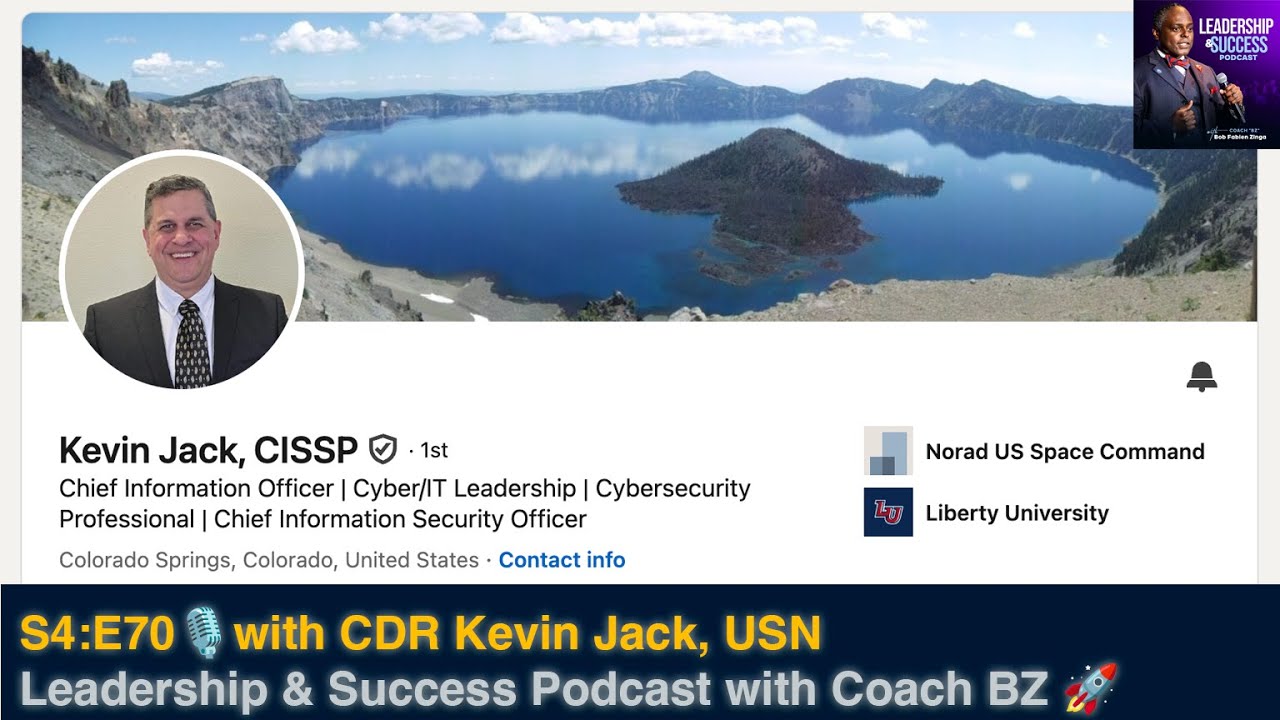
Navy Commander Kevin Jack, a cyber-operations officer with 20 years of IT experience, talks about rising from high school dropout to O-5 officer under U.S. Space Command. He emphasizes servant leadership, avoiding being a single point of failure, and the role of faith and family in his success.
Chapters
Hi, I'm John Maxwell. When the top companies in the world are looking for trainers, speakers, and coaches, there's one name that stands above the rest, and that's Maxwell Leadership. Our certified team members have gotten proven results for companies all over the globe, and our reputation, I'm proud to say, is second to none. Some of our members have risen to the top of their profession, including the one you're going to meet today. I proudly introduce you to my friend, Bob Fabien Zinga.
Welcome to the Leadership and Success Podcast with your host, Coach BZ. If you need to develop into a better leader, this podcast is for you. If you want to achieve a greater level of success, this podcast is for you. His mentor, Dr. John C. Maxwell, said it best: everything rises and falls on leadership. We hope to inspire you today and provide you with an insight that has the potential to positively impact the trajectory of your life. Welcome to the Leadership and Success Podcast. Imagine gaining the leadership skills that could redefine your career. Join Coach BZ on the Leadership and Success Podcast, where each episode delivers practical insights from world-class speakers, military leaders, and industry experts. We dive deep into what matters most: building resilient teams, leading through uncertainty, and navigating complexity with clarity and confidence. Every conversation is crafted for aspiring leaders like you who are ready to grow, lead, and make a lasting impact. Don't miss our powerful live sessions and recent highlights. Michelle Hayward on building diverse, high-performing technical teams. Ann Leslie on leading through global complexity and cybersecurity risk. Ron Carpenter, AI, exploring faith, resilience, and AI-powered leadership. Colonel Michelle G.I. Gardner-Ins on commanding influence from the battlefield to the boardroom. Chris Robinson on shifting from drift to drive in life and leadership. And Coach Enrique Acosta Gonzalez on mentorship, legacy, and heart-centered leadership. Ready to level up your leadership journey? Tune in on Spotify, Apple, Audible Podcasts, YouTube Live, and LinkedIn Live. Join the movement toward leadership excellence. Listen now and start transforming your success.
Since then, Kevin has led at every level, managing IT departments of more than 120 personnel revitalizing entire shipboard networks on a US Navy aircraft carrier, and serving as an IT services consultant across Europe with the Defense Information Systems Agency. Today, he serves at the Joint Cyberspace Operations Center under US Space Command, where he is helping shape the future of cyber defense in the space domain. But Kevin's story doesn't stop at operations. He is also a dedicated scholar holding multiple master's degrees in strategic intelligence, national security, and Joint C4I Systems, and is currently completing his doctorate in strategic leadership. He's also a Certified Information Systems Security Professional, CISSP, and a true advocate for servant leadership, always putting people first. Beyond the medals and titles, Kevin believes in humility over pride, that the truth is always the best policy, and that you can learn something from every single person you encounter. He's a fluent Spanish and Italian speaker, a passionate mentor, and has even appeared in Armed Forces Network commercials to promote cybersecurity awareness. So today we're going to dive deep into Commander Jack's journey, what it takes to lead in the high-stakes world of cybersecurity, how servant leadership shapes stronger teams, and the lessons he's learned serving on the front lines of both technology and national defense. Stay with us, grab your notebook, and get ready for some incredible wisdom. It is my absolute pleasure to welcome to the Leadership and Success Podcast Commander Kevin D. Jack, United States Navy.
October is National Cybersecurity Awareness Month, and with technology impacting every aspect of our lives, from homes and cars to economic well-being, and especially our nation's security, it's important to continue raising awareness of cybersecurity across our nation. We must ensure that we have all the resources needed to be safer and more secure online. Individuals and organizations are empowered to own your role in protecting cyberspace. If we all do our part by implementing stronger security practices, raising community awareness, educating vulnerable audiences, and training employees, our interconnected world will be safer and more resilient. Together, we can provide the lines of defense against all levels of cyber threats.
Do your part. Be cyber smart. All right, this is, uh, Coach Bizzy. Uh, thank you so much for being with me again today. I really appreciate you being here. Uh, we're going to start quickly with our moment of gratitude. Every day we want to be thankful for one thing. So if you would please get ready, this will take less than a minute. If you can, close your eyes, put yourself in your happy place, take a deep breath if you want to, and think about one thing that you are grateful for today. What are you grateful for? I think today I am grateful for life. Life, such a precious, precious gift. My second daughter, her name is Zoe, which means life. I'm just grateful to be alive today. What about you? So if you would please type into the comment what you are grateful for, let us know that you are there. Please let us know where you are joining us from, what city, state, which country if outside of the US. And also, whatever you are grateful for, type it in the comment. And if you have a leadership question for Commander Jack, please type it in the comment as well. And we're going to be answering your question live. And while you are listening to our leadership conversation, please type in your takeaway in the comment and also let us know what you're going to be applying, which insight you're going to be applying this week. So Let me do a quick introduction. So Commander Kevin Jack is a cybersecurity leader, servant leader, and US Navy officer like myself with over 20 years of IT and cyber operation experience. From directing IT department of 120+ personnel to leading future cyberspace operation at US Space Command, his story is one of resilience, service, and strategic leadership. What you'll get from this conversation, we're gonna be talking about insight into cybersecurity leadership, at the highest level, lessons on servant leadership in complex environments, and inspiration from a leader who has navigated both the deckplate and the boardroom. With no further ado, let me welcome to the Leadership and Success Podcast Commander Kevin D. Jack. How are you doing today?
Good afternoon, Bob. It's good to see you. Glad I'm doing great.
Thank you so much for making the time to be here. I know you are a super busy man. I guess to get started, what is one thing that you are grateful for today?
Something that I'm grateful for is my granddaughter. She was born actually 4 weeks ago today. And so I'm very grateful to be a grandfather. And I just love my little— Wow.
That is amazing. I must be getting old. Cool. Congratulations. I'm sure there is nothing, nothing like it. Hopefully, I'm gonna have to wait a couple more years before I'm a grandfather. But what is something about you that most people may not know?
Something about me that a lot of people don't know is that I actually dropped out of high school. Even with all the academic achievements you've mentioned already in your introduction. Yeah, I actually dropped out of high school because I just thought that A high school degree apparently wasn't that valuable because they just handed them out to everyone. So that's the way I thought, at least.
They allow you to enlist without the high school degree?
No. So actually, uh, the, the recruiting office that helped me enlist, they had a deal with a local adult education center that could actually give high school degrees, and I was only short a couple of credits.
That's amazing.
So they kind of helped me get through that and get my high school degree.
Okay, it's got to be a story there. We're probably going to get back to it later. That's just amazing. Wow. Because I told both of my daughters, right, they're going to have to have a bachelor's degree. It's probably not as worth what it used to be when I was growing up, but still, I feel like it's kind of like a minimum so they can do whatever it is they want to do in life. But anyway, So that's what I owe them. I'm going to pay for their bachelor's, but anything they do beyond that, they are on their own. But cool. Okay, so maybe you can share a little bit about your leadership journey, right? What inspired you to join the Navy and how that path eventually led you into cybersecurity and IT leadership?
Okay, so I actually decided to join the Navy from a town where most people aren't familiar with the military at all. I was born and raised in Medford, Oregon, and I actually joined the Navy because a neighbor of my grandmother's actually told me one day, "Hey, if you wanna speed up your wife's visa, a really good way to do that is to be in the military." And so I actually went and considered and went to the Navy recruiting office and checked into it, and they said, "Yeah, that would actually speed it up." And so I said, "Okay, well, Then let's, uh, let's make it happen. Let's figure out what we got to do.
Wow, that is amazing. And then that's when you, you got your high school diploma, then you enlisted. But now later on you become an officer, just, just like me. So I guess you are a Mustang. So, uh, what was the turning point from you, from enlisted sailor to becoming a commissioned officer, and how did that experience shape your leadership style?
Okay, so, um, one of the things that, that really kind of led to me beginning or getting into the Seaman Admiral program and earning my commission was just the fact that I worked really, really hard to do the very best I could for my wife and my daughter. Um, I was already married when I joined the Navy, and I had already lived abroad as well in both Guatemala and Honduras. And I had already seen how important it was that you could actually succeed economically in the US if you really, really tried and put in a lot of effort. I worked very hard and was actually awarded the Junior Sailor of the Year for my entire squadron.
Wow.
Near 1,000 sailors. Mm-hmm. And so after I won that award, One of my, one of my teammates basically said, hey, you really should consider applying for an officer.
That's amazing.
So I didn't get picked up on my first try.
That is really, really amazing. And which designation did you choose?
So I actually wanted to become a submarine officer. I was getting a business degree, which is probably not the most ideal one for being prepared for nuclear power program and understanding all that goes with that. So, um, I actually failed out of the nuclear, uh, power training program, and then I actually got to redesignate as an information professional right as an, which is pretty abnormal for the time that we were— that we became IPs. That was not very normal at all. It was usually as an 03 or an 04 that you would become an IP.
Wow, that is, uh, amazing. Yeah, I think, uh, I became an instant IP 2007, was it? I know on the reserve side I was one of the first ones to get in as an O-1 through the direct commission officer program. I believe— didn't the IP designation just start like after 9/11, 2001, 2002? I think is when we started, right?
Um, so I believe it started in the '90s, but it was called the general unrestricted line.
Really?
The GURL, and then later on in the early 2000s, that GURL became the Information Professional.
Really? Okay, okay, because I only remember, I think it was 2001 when we stood up as IP. Okay, so we were General and Restricted Line. It's very interesting because right now we are Restricted Line Officer, but I think there are talks that we're going to become an unrestricted again. But anyway, I probably will be retired by the time that becomes a reality. That's just amazing. So you've served in diverse commands from, you know, carriers in Europe, U.S. Space Command. Which assignment stretched you the most and why?
Which one stretched me the most? Okay, so I think personally the command that stretched me the most was the Carl Vinson because I was leading so many people., and I had to deal with a lot of, you know, just personality conflicts and other challenges that in a lot of the other positions I've been in, I didn't have nearly as many people kind of under me. So I didn't have to deal with the interpersonal relationships issues nearly as much. And then professionally, I think the command that stretched me the most was European Command because I was the Information Systems Security Manager or ISSM. On 7 different networks, and they were all with different international partners or coalitions. So I really had to, uh, kick up my technical proficiency game a lot in making sure that those networks were being cared for and were being— and, and the users were not misusing them, especially because we had foreign nationals using parts of our networks.
Wow, that is quite amazing. It's I guess some people really, they don't realize, but really when you join the Navy, you have a chance to really travel the entire world depending on the billet you get and really have diverse experiences. Most people in the civilian life, they have one job or one type of job for the entire career, but in the Navy, what, every 2 to 5 years you have to get a brand new billet and pretty much start all over again. It's, it's just amazing. And by the way, we have Byron Kelly, watching us from San Diego. Thank you so much, um, Baron. We appreciate that. If you can let us know one thing you are thankful for today, and also if you have a question for Commander Kevin Jack. Thank you so much, Baron. Wow. So you've described yourself as a servant leader, and, and I think that's typically what you would see in the military, including the Navy. But in practice, though, what does that mean to you, especially as you lead sailors and civilians?
So, I mean, a big part of what makes me who I am is, of course, that I was enlisted first. So I started from the very bottom and then became an officer a little later on in my career. So, you know, an example of servant leadership is that when I was in my division officer tour, so I was in charge of a group of about 35 to 40 sailors. Um, they had this— they had a special event where they do every now and then called a freshwater washdown, where everybody— all— it's usually the enlisted that have to go out and kind of wash the ship down so they get all the salt and all this spray off of it so it's nice and clean, and it keeps it from rusting and getting nasty. And I was one of two officers that went to help out with events like that.
Wow.
You know, even though it wasn't really specified that we needed to. Um, it showed my team that I cared and that I would jump on to tasks as well, and that I was willing to do the job that they were asked to do. Uh, and, and it, it led a lot of them to respect me a lot more because they could see that I wouldn't just ask them to do something and not do it myself as well.
That is powerful. Yeah, I think it does make a difference being enlisted before you become an officer, at least, you know, the way you look at things and the way you take care of the, uh, white, white hat. At least in my own experience, uh, nothing wrong with the naval officer who go to the academy and so forth, although I think some of them are too arrogant. They think that they're better than every, everybody else. But, but those who've been enlisted before, especially those who were kind of, you know, almost chief or kind of senior, you listed, I feel like they, they really have a different, uh, philosophy. Again, the way they take care of the white hat to make sure they are covered, protected, and they feel needed, and also contribute the very best they, they can, really managing the morale of the command. I think for me it really made a big difference. So, uh, One of your core values is humility over pride. Can you share a story where humility helped you navigate a tough leadership challenge?
Okay, so, um, kind of looking back on that same tour while I was on the MRS Land, that's a submarine tender, um, I, I was the division officer, and one of the times when I was in my shop with my team of people A senior officer came in my shop and started yelling at me because of something that had happened. And if I were prideful, I probably would have swore at him and told him to get out of my shop and told him some really rude things. Yes. But as a more humble person, I simply listened to what he had to say. It was really unprofessional. That's not the right thing to do. If you need to correct something, that should be behind closed doors, not in front of everyone else, first of all. But anyway, the humility part is that I just quietly listened and let him have his anger fit, and then he walked out. And later on, I addressed it with him in person. But the guys in my shop, could see that I had the humility and that I wasn't going to take things personally and explode like other people do. And they saw that they could trust me, that they could bring problems to me, and that I would take it calmly and quietly and figure out how to make it better rather than just getting upset and exploding in a fit of anger like this guy was doing to me.
What do you think keeps you grounded?
Well, so I think a big part of what keeps me grounded is, is my faith. That's, you know, I know who I am, and I know where I'm going, and I know what makes me me. And so I, I don't have to I don't have to lean on other things to, to kind of stay grounded and really know who I am and what my value is.
When, when did you make, uh, O5?
So I, I made O5 in the 2022, uh, promotion cycle. Um, so I actually pinned on in December of 2020.
That is pretty cool. I think mine was April '21 now. For those who don't realize this, in the military, rank is extremely important. Like in the Navy, if you're an O-4, Lieutenant Commander, you are still a junior officer. Now some people say field grade officer, but no, really you are junior. But when you make O-5 and above, you become a senior officer. They say what, less than 4% of people who join the Navy achieve that rank and higher. So it's really a huge, huge, huge achievement. Uh, how did you feel when you finally, uh, became a senior officer in the most powerful Navy in the world? And what again kept you kind of grounded and not feel like you were God or superhuman or something like that?
Well, uh, you know, I know that like you mentioned, you know, rank is really important in the military. And, uh, when you're in a meeting with a bunch of people and everyone is O5 except for you, you're the O4, you're kind of ignored. They, they don't really put a lot, you know, of value in what you say just because you're kind of the low guy. So I know, and you know this as well, Bob, but, uh, you know, when, when you get selected, it's usually a lot of time before you actually put on the new rank. So, you know, they, they put me in a, in a position of even more responsibility knowing that I was selected for it, but I was still wearing the rank of the previous pay grade. And so a lot of times I was the guy who was getting ignored, but then when I finally put it on, then I was already in the job and already carrying out the role, and, and people actually paid attention and were more willing to listen.
Yes.
So that was It was, it was nice to finally get the, get the ears of everyone else as we were, you know, talking about important issues in the cybersecurity world, uh, with the, at the European Command where I was working.
Yes, and I guess that adds another dimension too, right? It's not just within the Navy, but when you have joint operation with all of the other branches of the US military, but not only that, but also all of our allies, NATO, and, and all of that, it gets a lot more politically challenging, I guess. Yeah, that's— wow, wonderful. So you mentioned the space command. So right there, you are shaping cyber operation at the strategic level, and you also have a master's degree in strategy. So what excites you the most about the future of cyber defense in space?
So I know A lot of the older spacecraft that are already on orbit right now, uh, they, they weren't built with a whole lot of security in mind because they, they were just built to kind of— they were what we call a bent pipe, where it just receives something and then it just passes it right back down. It doesn't really provide extra security for it. It doesn't do much. And, and something that really excites me is, is that we're We're really putting a lot more effort into additional security measures for things that are on orbit because there are concerns about other nations taking advantage of the, of the low security on those older systems. And, uh, we're, we're making sure that we're not letting that continue to be a problem. We're, we're working hard on that.
So true. And you've also been featured in the Armed Forces Network commercial for Cybersecurity Awareness Month. I showed this short clip earlier. I believe that was in 2021. How important is storytelling and communication in driving cyber awareness?
Um, sorry, what was the words again?
Storytelling and communication in, in driving cyber.
So, uh, storytelling and communication of course play a huge part in, in helping make sure that um, users who don't really understand some of the implications of their actions know what they're doing. Um, so especially when I was at European Command and I was working on these multinational networks, um, part of the challenge is you can't do stuff on these networks that you can do on your home computer. And people seem to think that they can take actions like plugging in things and doing other things that that they can take on their home computer with no issue, but they shouldn't and can't do those on, on, you know, secure networks. So a really important part of helping them to understand why they can't do things is that storytelling and is providing examples of here's what happened when somebody did this on one of these networks. So that it gives them an understanding of what the impact is when they take actions that are unauthorized or shouldn't be happening.
That is very, very, very important. Now, a significant portion of our audience here are aspiring tech and military leaders. What advice would you give to tech engineers or analysts who want to step up from technical expertise into cybersecurity? Leadership role like you've, you have done?
Okay, so I think, you know, one of the things that the majority of the cybersecurity industry is really pushing is certifications. And, well, I don't know if I bought fully into the value of that. I think that it is, you know, and but that's because I've been doing it for so long. I think that For somebody who's in a different career field who would like to come into cybersecurity, that might be a really good way to educate yourself on some of the things that you need to know and understand within cybersecurity to better position yourself to actually get a job within that area. I think that there is value in those, you know, Security+ and understanding, you know, some of the cloud certifications that are being offered as well. That will help you just get some background and will help you better prepare yourself mentally to take on a role in that area.
Right. And we also mentioned earlier, you are fluent in both Spanish and Italian, which is pretty unusual. Most people I've seen in the Navy who are bilingual or multilingual, it's something they learn when, when, when they were kids growing up, but you actually put in the effort to learn Spanish. And I believe you said you're going to have a was originally Italian, and you just got into it and became fluent. That's pretty impressive. How has language and cultural fluency helped you as a leader, especially in Joint and International Command?
So I think, you know, it actually has played a really large role, because as I was working at— as I was working at European Command, I was the, again, multinational networks lead. So I actually ended up going to a lot of NATO conferences and the NATO cybersecurity and infrastructure folks. I did a lot of work with them. And if you don't know NATO well, it's composed of many different European nations. So they have people from all the different nations. That belong to NATO, all working at the NATO headquarters. And so I actually had the privilege of working with a lot of them in their native tongue rather than them trying to get in English and speak to me. I could speak to them in their native tongue and then we could actually communicate a lot better. And that made it— that facilitated a lot of conversations and made it a better team environment.
That is, that is really Wonderful. With all of the travels you've done, have you ever seen in many of the foreign countries they have like a stereotype for Americans being arrogant and proud and not really wanting to assimilate, but pretty much pushing their own cultures and norms in guest countries?
Yeah, there's definitely some places that kind of have a negative view of Americans. Um, but you know, it's, it's like anything else, you know. There's, yeah, there's some people that are jerks. Yeah, there's some people that are lazy. Um, but, but that, the same can be said of any other country as well. It's just, it's just a thing where a, a percentage of every population is going to be that characteristic. It doesn't mean the whole country is. But yeah, I've seen a lot of generalizations about Americans being fat and lazy and just not being good workers.
But I mean, it's definitely refreshing to see an American who's even trying to speak a foreign language and connect. Usually, I think the expectation has been, no, you guys learn English, you speak to me in English, we kind of rule the world or whatever. But yeah, that is wonderful to see. So I'm about to switch over to the second segment of the podcast. Is there any question I haven't asked you that I should have asked for the first segment?
Um, no, I think, uh, I think you're gonna, you're gonna circle back to the give advice. Yes.
Yeah, yeah, yeah, that is, that is coming. It's gonna be a very, very important question. Okay, so, uh, for the second segment, I want to start, um, what is the greatest lessons you have learned so far?
Ooh, the greatest lesson I've learned. Um, so I think I actually, I actually figured this one out on my own. Um, and I think it's really, really important. Um, I think it's important to know that every single person has their own set of life experiences, their own knowledge, and their own understanding of how things work. And why is that important? It's important because we can learn something from every single person. Every person has their own unique set of just how they've lived and what they've seen and what they've done. And it's— I think that, you know, obviously, I don't have all of those different views and perspectives and experiences. So I think it's really important that You can actually take something small from anyone, every person you ever meet or interact with. Wow.
I mean, this again shows what you talk a lot about, humility over pride, because it takes a humble person to know you don't have the answers and you can learn from anyone. That's powerful. So what is the greatest leadership advice you have ever received then?
I think some of the greatest leadership advice is always be training up the people that are working for you to be able to take your job.
Wow.
You never want to be the single point of failure. It's really important that you're preparing and training and just getting people ready in whatever way is needed, whether it's education or training or knowing the job well or whatever it takes, but be preparing those that are working for you to take your job.
Wow, that's very, very powerful. And it's definitely the culture in the Navy, and I believe the other branches of the military as well. However, in the industries, specifically in Silicon Valley, where I've been for, what, 11 years now, uh, the culture for the most part is people trying to hide all of the knowledge and skills to themselves because they like if I share it, then my job might be on the block next. Right. So, but, but if I keep that knowledge to myself, then I am more valuable than everybody else, which I think is completely the wrong way of thinking. Right. In the Navy, we learn to lead with an open hand. Why, why do you think it's really important to give and to share? Even sometimes, like, for example, one of my dearest mentors, she's a commander also. I guess I can say her name. She watches this podcast sometimes. Commander Demick. I was a Lieutenant Commander, so she was an O5, and she really trained me and mentored me to become an OIC, Officers in Charge with Spacewar. We went across America and around the world leading technology classes and training and stuff like that. It was just amazing. But she really trained me to be able to lead that. Eventually, I was able to lead about 186 people into national Spacewar program, but she's the one who taught me how to do it and do it effectively, take care of my people, Because it's very challenging when you have at least 20, 50, or up to 70 people that you take to a foreign country. And not only the people, but the equipment to set up all of the classes and learning and making sure everybody's there on time, they don't get in trouble, and then bring them back home. That is quite a project. But anyway, I really owe to her how she trained me to do all of this job. But basically, I eventually took a position— she was a deputy program manager, and eventually I became the program manager for the entire program. So I've really not seen that in the civilian sector. But why do you think it's really important to share, even at risk of somebody else being promoted over you?
I think that the reason it's so important is because You know, none of us ever know when our final day is.
True.
That's, you know, I could pass away today or I could be injured today where I can't go back to work tomorrow. You know, I could be told you're done working here. There's a number of different ways where your time at a job could come to an end. And if you set the company or organization up for success, even in your own absence, that company is going to be grateful for you. Yes. And they're going to highly recommend you for a future job or a future role somewhere else. If you have actually set them up for success, rather than just been looking out for yourself and just been keeping things to yourself. It's, you know, and of course we look at that in the Navy all the time. We talk about redundancy and we talk about making sure that we've got backups to backups to backups all ready to go in case something happens. And I think that that's, that's a part of the mentality that I've come away with from the Navy is, is exactly that is making sure that you have those backups, whether they're people or whether they're information or whether whatever it is. That you have things set up so that when something fails, which it's bound to happen, that you have a way to keep moving forward and keep on.
That is wonderful. I think two ideas come to mind. One is the philosophy of giving more than you take or leaving things better than the way you found it. I think many in the Navy really have that culture. But also one of my dearest mentors, told me the real test of a leader is when you go on vacation, right? You go away for a week, two weeks, or a month, making sure that when you come back, everything was able to proceed as planned and meeting or exceeding your standard. Because if everything falls apart while you are away, you are a bad leader. Like you said earlier, you have a single point of failure, and that's not leadership. Uh, wow, wonderful. So what, what do you think is the secret of your success? You know, I didn't even know that you were a high school dropout and now you're gonna get a PhD. And you were enlisted, I think you told me you, you came in as an E-2, and now you are an O-5, a senior officer in the most powerful Navy in the world. What made you successful?
So I think, I think that a big, big part of my success is my family. Yes. Um, and, and the fact that you know, after I dropped out of high school, I actually moved to Honduras on my own and married the young lady I had met there. And then we lived there for about a year. And then we lived in Guatemala for about a year. So a big part of who I am is working really hard for the success of my family. Because I had seen how hard it was to get any level level of success in a third world country where I actually had— I've lived and worked and, you know, done life. So I think that just me having my wife and kids were huge drivers for me to work hard and achieve success for my family.
That is powerful. It reminds me of the book, I believe, I should have— okay, this one, uh, Start with Why by Simon Sinek. And, and I think that's really the motivation most, most people need, because if you know exactly why you are doing what you are doing, challenges will come, tough time will come, but you will still be focused and motivated to get the job done. That is so powerful. So I know that leaders are learners. So what are you learning right now?
Well, so I actually just completed my doctorate about a week and a half ago.
Congratulations!
So, uh, I'm, I'm taking a little mental break from, from working so hard. Um, I'm going to— so my doctorate is in strategic leadership, and I'm actually going to keep, uh, I'm going to keep working on reading leadership books especially from John Maxwell. And I've got, you know, Koozers and Posner is another great one as well. But, you know, there's a number of good leadership books that I've got that I want to reread with a fresh mind. Now that I'm not using them as material for my job.
That is beautiful. So now, technically, academic speaking, the doctorates, that's the highest degree you can get there's nothing higher than that. Do you believe it's important for people, especially in the cyber field, whether it's in the military or in tech, to continue learning no matter how many degrees they have? How important is that?
Absolutely, absolutely. Because with, with technology, things change so quickly. You know, if, if you learn the basics of it, and you learn them really well, they can be applied even to new technologies most of the time. Every now and then a new technology will come that, that'll change things quite drastically, but, uh, it's, it's really important to be— to have that mindset of keeping on learning so that you can apply what you already know, yes, to the new things as they come along and still help whatever organization you're working them for to be the best that they can be.
Wow, that is powerful. So now, I, I love this one. I can't remember where I got this from, but, uh, on one side it says success, the other side says failure. So most people will only look at your success, but, uh, I believe the only reason why you're as successful as you are is because you went through some failure and, and pain. So how has failure shaped your life?
Well, so I already talked a little bit about some of my failures. I talked about the, uh, not being able to pass the nuclear power training school. I talked about dropping out of high school. Um, so I think a big part of how failure has driven success is when, when I fail, I have to find a new path.
Wow.
So the, the path, for example, the path towards being a nuclear power officer or a nuclear programs officer, when, when that failed, I had to find a new path that was still going to lead me to success for my family, because the family was still my driver for success. So it was, it was just figuring out what was next and what what was going to work better for me. Now that I knew the nuclear power part of it wasn't going to, where is going to work? And it was just finding where, where my success and my personality and my knowledge and skills would fit in well.
When, when was your faith most tested?
So I think it was probably most tested when, when I failed out of nuclear school. I was, I was a little bit worried because at the time the Navy was actually looking at downsizing some. So people that would fail out of their training schools were a really easy target to say, okay, you're no longer wanted. So I was, I was a little worried. That I was gonna just get let go of because I couldn't make the cut in one of the hardest schools the Navy has, to be honest. Um, but I, I put together a, you know, basically what you had to do is you had to put together a letter explaining what communities you might be a good fit for, what career field you might be a good career fit for, and you just hope that someone would pick you up. But I explained a lot of the abilities that I brought and some of the leadership I brought with me, and, uh, I, I was able to get— I actually, apparently there was some competition over picking me for, for the different career fields, and, uh, it ended up that the IP officer won the, won the competition, and they were able to get me.
That is really insightful. And, uh, what do you think helped you get through that period? When you look back, what, what was that thing, or a couple of things, that really helped you go through those challenging times back then?
I think that, you know, what, what I learned from that was— I kind of already mentioned it in previous answer, but was, was to just keep pressing forward. I know it sounds like it comes from the movie The Robinsons, Meet the Robinsons, but it was true, you know, it was something that I had to not give up and just let them say, okay, we no longer can use this. I put in the effort to make sure and show my value and prove that I'm worth keeping and that I'm worth investing in. And that, that's why it got to the point where they were actually competing to get me as a part of their career fields, because I proved that I was more than just a guy who couldn't make it through nuclear power school.
Wow, that is, that is, uh, powerful. Okay, uh, who are some of the people that you know that we should know? Who are your mentors or thought leaders?
So one of my mentors is David Parmley. He's actually on LinkedIn. And he's, he's worked really hard to get into cybersecurity leadership position within the health industry. He's really been good at helping me. Another one is Robert Jack, We actually met on a coincidence because we have the same last name, and it ends up that he's actually a retired Air Force general. And he's, uh, just because we shared the last name, he's been extremely helpful, and he's been a really, really wonderful person to have in my corner. Uh, he's put me in contact with a number of people as I'm trying to figure out where I'm going to go after I retire from the Navy. And, uh, I, I can't thank him enough. He's been amazing.
That is, that is amazing. That's really something whenever I retire I think I will miss from the Navy, the camaraderie that you really develop in the service because you, you pretty much become family. I guess we say we are brothers in, in harm, but no, the sailor to your right and to your left will go the extra mile for you and you do the same. You don't really see that a lot in the industry. That's wonderful. So if you could choose 3 people to have dinner with, who would you choose and why? They could be alive, dead, or even mythical figure.
Okay, that's a great question. So I think there's 2 of them are athletes and one of them is a Bible character. So my choices would be Barry Sanders, running back for the Detroit Lions, and David Robinson, center for the San Antonio Spurs. And then the third one would be actually Daniel from the Old Testament, how my, my middle name is named after Daniel. And so I think both the athletes, because they were Christian leaders who never let pride and ego get them to where they were bragging about their accomplishments. They, they were humble even if they were amazing, amazing superstars in their sport, and they kept their humility in check at all times. Both of them did. And then, uh, Daniel from the Bible I would choose because, um, he's actually one of the very few, uh, personalities from the Bible that is never mentioned a single sin that he did. Um, he was true to his values and true to who he served at all times, and he never failed. He was, he was transparent in who he was and he wouldn't hide it even though he was ordered to basically not be who he was. He was told that he would be killed if he kept praying to his God. And he still kept praying to his God and he didn't even try and hide it.
Fascinating. No, that is very powerful, especially times like today where people tend to just follow the trend or what's going on out there in society, knowing who you are and standing on your, on your value. That's, that is powerful. Like, that is even this thing, right? Like, I'm gonna ask you, and I know you, you know the answer. Every seller knows the answer. What are your 3 core values as a seller?
What are my 3 core values?
Um, as a— okay, as a, as a US seller and Navy core values.
Okay, well, in, in the Navy, that is why—
no, this is the thing. If you go to the industry, once you get a job out there, you're gonna go to a job, they're gonna have a whole bunch of flyers on the wall, what their core values are, their mission and vision and stuff. But ask anybody who works there, nobody's going to be able to tell you what those are. In the Navy, every single sailor knows honor, courage, commitment. It's like drilled into, into us. And I think that's sometimes— I think that's where there is a mismatch in many of the organizations in the industry where Basically, the people are only working for the dollar. Money really is the only thing that they value in reality. They may say they value people over things and stuff, but they don't really mean any of that because the first minute they can replace you with AI or get you laid off or whatever, they will absolutely do it and not think twice about it. So I think it's really important as an individual to know what your own personal core values are and that it aligns with the company, right? And that whatever company you work for actually truly live by, uh, by those values. Anyway, so what, what are you reading right now? Which books would you recommend to the audience?
So, uh, I've got a couple of recommendations on great books, uh, that would be of value to anyone. I've read them in the past, so they're not currently being read, but I actually have them right here. I'll grab them.
Wow.
So I talked a little bit about Kuznets and Posner. They have a book called The Leadership Challenge, which is an excellent book. The one that you've got up there is the one that was actually required for me during my doctorate. But this one here is actually the Christian Reflections version of it, where they actually go through and talk about the same principles of leadership and how they're actually biblical and what biblical values align with those leadership values that they—
that is really amazing.
So And, and that was, you know, so I did my doctorate through Liberty University, which has a focus on biblical values. So they actually talk through how leadership values are either reflected or not reflected well in some of the leaders in 1 and 2 Kings in the Old Testament. So they, they actually try and implement a lot of Do Christian values really support leadership or not? So I thought this was a great way.
That is kind of amazing. Actually, my mentor's book, 21 Irrefutable Laws of Leadership, Dr. Maxwell actually got it straight out of the Bible too. And he has another book that breaks it down. And just like you explained, into the Bible and good example and bad examples too.. It's pretty amazing.
Cool. And I, I actually did a series on, on that exact book on posts on LinkedIn as well, uh, about John C. Maxwell's Laws of Leadership. So the other, the other couple of books, I, I know you've already got the images prepared, but, uh, this one is a really good one on how— and, and there's, there's multiple books on how to win Friends and Influence People, you know, by Dale Carnegie, is another great book. Um, but this one is, is a really good one as well on how to understand people and how to really, uh, get to a point where you can actually help or better understand how you can help them. I thought that was a really, really good book that's worth people taking some time and reading through. Um, The next one is Keith Ferrazzi's Never Eat Alone. Really, really good book. I don't have the cool expanded and updated version that you've got up there, but this was an excellent book that I read, I think, in 2007. And it still plays a part in my life today, even if I haven't reread it. But it's, it's about, you know, when you have opportunities to get to connect and work with people more, take them. Don't, don't just, you know, take for advantage the opportunities that you have to become more effective as a person, both within your organization and personally, when the opportunities are there all the time. And you just— a lot of times we don't take them.
That is powerful. Thank you. Thank you so much for sharing. That is Something is— what, what about, um, is there a song, book, or movie that would be your life's theme or anthem?
Um, I mean, I, I almost— I would like Forrest Gump is a good reflection just because he did so many things in his life, and, and, you know, I've lived in all four corners of the continental United States and overseas. And I've been in a lot of places, and I've done a lot of things. And I think, you know, sure, I haven't really met the president 8 times or anything like he did, but, but I've done quite a few different things that just aren't very normal for people to do. So I think that's a reasonably good—
but definitely for those watching, if you do join the Navy, you will have an an adventure, that's for sure. You're gonna get to meet people you never would have met otherwise and go to places and just have experiences that you can't have anywhere else.
Absolutely.
Promise you that. All right, so, uh, if you had one and only one day to live, what would you have liked your final contribution to be?
I would want my— I would want to spend the final day with my wife and kids. Um, they're, they're the most important to me. And I would want to make sure that, you know, they're well taken care of and that they know that there was nothing more important to me than them on this earth.
So if you could solve one and only one problem, what problem would you like to solve?
Ooh, okay. Um, I wish, I wish that I could solve the problem of people seeing their need for salvation. I believe that salvation is only through Jesus Christ, and I know that a lot of people choose that, you know, they don't want to hear it or don't want to see it, or it's not important to them. But it's, it's the one problem I wish could be solved right now, that every single person would see that.
That's powerful. So we've come toward the end of the podcast. I think we have a couple of minutes left, so I'm managing the time pretty well. Uh, you've been so generous with your time and shared so much wisdom with us. How can we add value back to you?
Okay, so, um, I I joined the Navy in May of 2000. And so I've been in for over 25 years now. And I'm coming close to the end of my career. So I'm actually starting to look for where I can work next and where I'll fit in, where makes sense for me. And I'm most likely looking to stay in the Colorado Springs area, which is where I'm at right now. But I'm kind of trying to figure out what organization I would fit in well and figure out kind of how I can start getting into— getting in there. So I actually retire in November in 82 days from today. And I want to start a next job in January of next year. So if you have any ideas or know of any places that would might be a good fit for me, I would love to hear it. And kind of, if you, especially if you have tips on how I can break in, because that's a challenge for a lot of people nowadays is figuring out how to actually get started in a new organization.
And how can people find you on LinkedIn? How can they get in touch with you?
So you've got my LinkedIn profile there. But, uh, you know, I, I can— I, I don't know if I've got my resume uploaded on there or not. I don't know if they even let you, but, um, I've got, uh, you know, my email address is easily, uh, locatable there on my LinkedIn profile, and my personal cell phone, or text me at 719-723-8215.
Fantastic. So it's Kevin-Jack-DSL. I know D could be David. What is DSL. I just want to—
DSL is Doctorate of Strategic Leadership.
Oh, fantastic, fantastic. I love it. Okay, I thought it was your middle name. Very good. Okay, so now I think is— okay, before I ask you this, uh, is there any question I should have asked you that I haven't asked yet before we close? Anything you want to share?
Um, no, I really appreciate you, uh, giving me some time letting me kind of give some ideas on what I've seen and done and experienced. And hopefully it is helpful to everyone watching that. I hope that you got something out of here that is of value to you that you can actually bring on board and make use of in your own life.
Thank you so much, Ola. This is the most important question of the podcast. If you could go back and give a piece of advice to your 17-year-old yourself standing at the edge of this incredible career, what would you say? Actually, for you, let's go back. How old were you when you dropped out of high school? Um, 17. Okay, that's perfect. So what would you say to 17-year-old Kevin D. Jack, who's now Dr. Kevin Jack, who's now Commander Kevin Jack? What would you say to that boy?
I, I would say Don't be afraid to fail. Failure is what leads to success, as long as you take it and make the best of it and figure out where you go from there. I think that's, that's the key lesson, um, because failure will happen. Every one of us will fail at something sometime, probably many times, and it's what you make of it. And what you take and move forward with from that failure that really is going to make the difference.
Well, Dr. Jack, what if I am afraid? What do I do?
Well, I mean, we're all afraid of failure. You know, every one of us is afraid of failure. But if you fail and then you just give up, there's no gain. There's no improvement. It's taking action based on that failure to make yourself better.
Yes.
Uh, like we— like I mentioned earlier, find a new path forward. If a door has been closed because of that failure, figure out where the best way is after it.
Wow.
But you know, it's so important just to not sit down and cry. And I mean, you can for a little bit Yes, because it hurts, but you need to find the next thing that's going to make you better.
Wow, that is powerful. It's really the story of my life. You say fail forward, find a new path, keep pressing forward, humility over pride. And you just said, be true to your own value and don't be afraid to fail. I mean, if this doesn't make you successful, I really don't know what will. All right, we are coming to the very, very end. Really, really quick question. Don't think too long. 3 adjectives that describe you as a child. Calm.
Two more? Um, humble, calm, and faithful.
Okay, as an adult?
As an adult? Um, still humble and calm, for sure. I've got a lot of compliments on that. And, um, confident.
Very, very good. From faithful to confident. Thank you, thank you so much. This has been really, really great. So this is it, and the very last question I'm going to ask you then is, what is one word that represents our shared experience together on this podcast today? What what comes to mind?
It's kind of a hyphenated word, but deep learning.
Deep learning. I think for me it's going to be—
I hope that there's a lot of learning.
To me it's going to be brotherhood. It's really amazing because of the Navy, I've had a chance to meet great people like you and learn from you. Just like you, I learn from pretty much anybody I meet. I think I've never met a stranger in my entire life But like you, I believe everybody has an experience and has something to share. It doesn't matter if their rank, their race, their age, or sexual orientation or whatever. I can bring value to you and I can get value from you as well. So thank you. Thank you so much, my brother, for being here. Dr. Kevin D. Jack. That sounds great. Maybe I should call you Dr. Commander Kevin Jack. That has a nice ring to it. But this is wonderful. Commander, Dr. That is great. I know it's been my wildest dream to one day become a commander of the most powerful navy in the world, kind of like, I guess it's a fictitious character, but James Bond, right? Supposedly he was an intelligence officer in the British Navy. But anyway, you've really done a lot. You've come from nothing and you've accomplished all of this, and it's just inspiring. And I'm hoping people listening to us today can really get insight from what we talked about. And for those listening, if you can type in 2 or 3 takeaways from my conversation today. And I don't see any questions on LinkedIn or YouTube. So thanks again, Dr. Kevin DeJack, for being on the platform today. We really, really appreciate it.
Thank you so much.
Thank you very much. I appreciate it.
All right, folks, this was great. So You've heard from the commander, Kevin DeJack, and hopefully you are going to get something out of everything he shared this hour and be able to actually apply it this week. And I think you're going to see results. So I'm going to be back here tomorrow is Friday, probably 6:30 AM Pacific time. So 9:30 Eastern time. More than likely tomorrow, I am going to have a 10-minute AI recap of one of the leadership conversation we've had this week. So hopefully, I'm gonna meet you here again. If you have a question, let us know. Please like, repost, and tag someone who might benefit from this conversation. And thanks so much for being with us today. Until tomorrow, have a wonderful day.
Bye.
Bye everybody. This is Coach Bizzy. Thanks for watching. Until next time, don't forget to like, comment, and share.
Thank you for listening to the Leadership and Success Podcast with your host, Coach Beezy. If you like what you heard, please subscribe to our channels and come back for more wisdom nuggets on how you may develop into a better leader and achieve greater levels of success. Leadership is the most critical skill. The world will always need leaders to lead others, deploy the next disruptive technology, or execute a business strategy. You may as well decide on counting yourself among the 21st century leaders. See you right here next time on the Leadership and Success Podcast with Coach BZ.
More from Bob

S250:E4🎙️LIVE 🇺🇸America 250: President Barack Obama Leadership, Service, and the Power of Hope






S5:E157🎙️ LIVE with CMD CMSgt Dennis L. Fritz, USAF (Ret.)(Multi Tracks Audio)



S5:E156🎙️ LIVE 🇪🇸 Leadership Lessons from the FIFA World Cup 2026 Champions (Multi Tracks Audio)

S250:E3🎙️ LIVE Leadership Lessons from America’s First Documented Family of African Descent 🇺🇸📖