S4:E70AI RECAP | LIVE with Dr. Kevin D. Jack, DSL (CDR, USN)
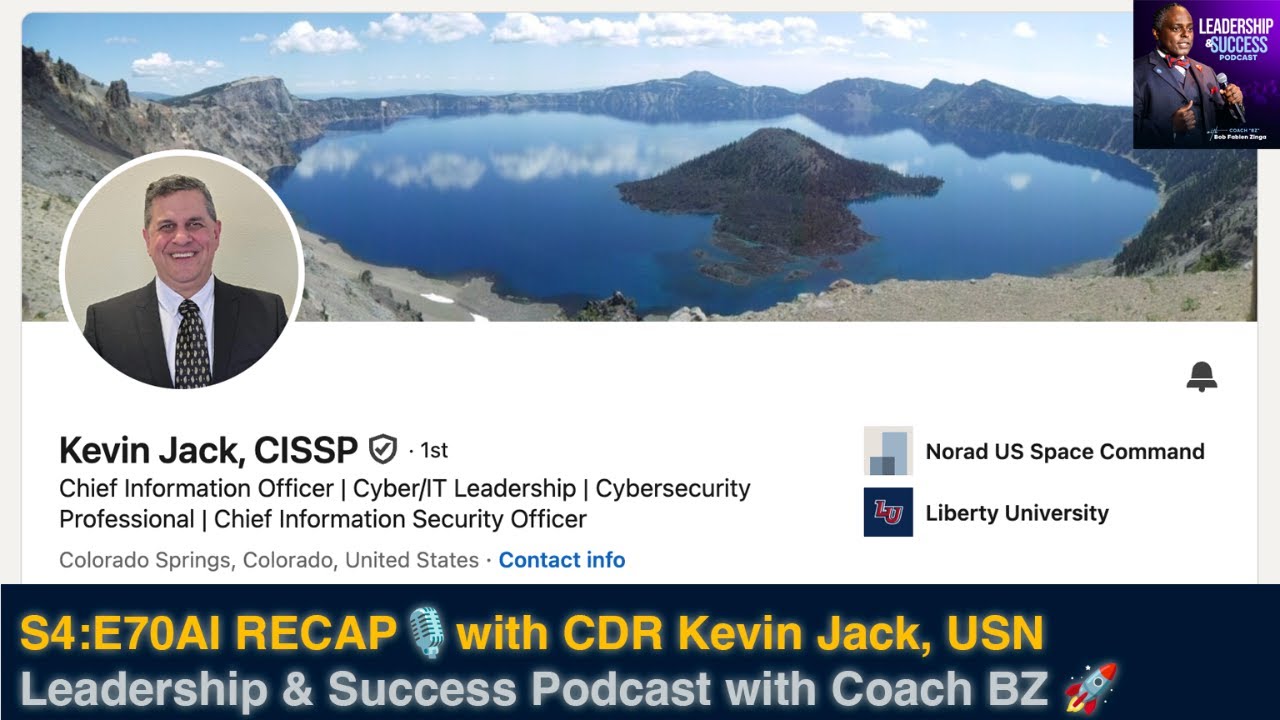
Commander Kevin D. Jack, US Navy, rose from enlisted technician to senior officer leading cyber operations for US Space Command. He manages 120+ IT personnel, rebuilt carrier networks, and pioneered defense for space assets. Jack emphasizes storytelling to make cyber risks real and mentoring the next generation.
Chapters
¡Hola!
Hi, I'm John Maxwell. When the top companies in the world are looking for trainers, speakers, and coaches, there's one name that stands above the rest, and that's Maxwell Leadership. Our certified team members have gotten proven results for companies all over the globe, and our reputation, I'm proud to say, is second to none. Some of our members have risen to the top of their profession, including the one you're going to meet today. I proudly introduce you to my friend, Bob Fabien Zinga.
Welcome to the Leadership and Success Podcast with your host, Coach BZ. If you need to develop into a better leader, this podcast is for you. If you want to achieve a greater level of success, this podcast is for you. His mentor, Dr. John C. Maxwell, said it best: everything rises and falls on leadership. We hope to inspire you today and provide you with an insight that has the potential to positively impact the trajectory of your life. Welcome to the Leadership and Success Podcast.
Welcome back to another episode of the Leadership and Success Podcast with Coach BZ. I'm your host, Commander Bob Fabien Zinga, and today I am absolutely honored to shine the spotlight on a remarkable leader, scholar, and servant of our nation, Commander Kevin D. Jack, United States Navy. Commander Jack's story is one of resilience, service, and lifelong learning. He began his Navy journey back in May 2000 as an electronics technician, working his way up from the deck plates with determination and grit. Along the way, he was selected for the highly competitive STA 21 Seaman to Admiral program, earning his commission and never looking back. Since then, Kevin has led at every level, managing IT departments of more than 120 personnel, revitalizing entire shipboard networks on a US Navy aircraft carrier, and serving as an IT services consultant across Europe with the Defense Information Systems Agency. Today, he serves at the Joint Cyberspace Operations Center under US Space Command, where he is helping shape the future of cyber defense in the space domain. But Kevin's story doesn't stop at operations. He is also a dedicated scholar holding multiple master's degrees in strategic intelligence, national security, and joint C4I systems, and is currently completing his doctorate in strategic leadership. He's also a certified information systems security professional. C-I-S-S-P, and a true advocate for servant leadership, always putting people first. Commander, beyond the medals and titles, Kevin believes in humility over pride, that the truth is always the best policy, and that you can learn something from every single person you encounter. He's a fluent Spanish and Italian speaker, a passionate mentor, and has even appeared in Armed Forces Network commercials to promote cybersecurity awareness. So today we're going to dive deep into Commander Jack's journey, what it takes to lead in the high-stakes world of cybersecurity, how servant leadership shapes stronger teams, and the lessons he's learned serving on the front lines of both technology and national defense. Stay with us, grab your notebook, and get ready for some incredible wisdom. It is my absolute pleasure to welcome to the Leadership and Success Podcast Commander Kevin D. Jack, United States Navy.
October is National Cybersecurity Awareness Month, and with technology impacting every aspect of our lives, from homes and cars to economic well-being and especially our nation's security, it's important to continue raising awareness of cybersecurity across our nation. We must ensure that we have all the resources needed to be safer and more secure online. Individuals and organizations are empowered to own your role in protecting cyberspace. If we all do our part by implementing stronger security practices, raising community awareness, educating vulnerable audiences, and training employees, our interconnected world will be safer and more resilient. Together, we can provide the lines of defense against all levels of cyber threats. Do your part.
Be cyber smart.
One of your core values is humility over pride. Can you share a story where humility helped you navigate a tough leadership challenge?
Okay, so, um, kind of looking back on that same tour while I was on the MRAS Land, that's a submarine tender. I was the division officer, and one of the times when I was in my shop with my team of people, a senior officer came in my shop and started yelling at me because of something that had happened. And if I were prideful, I probably would have swore at him and told him to get out of my shop and told him some really rude things. But as a more humble person, I simply listened to what he had to say. It was really unprofessional. That's not the right thing to do. If you need to correct something, that should be behind closed doors, not in front of everyone else, first of all. But anyway, the humility part is that I just quietly listened and let him have his anger fit, and then he walked out. And later on, I addressed it with him in person. But the guys in my shop could see that I had the humility and that I wasn't going to take things personally and explode like other people do. And they saw that they could trust me, that they could bring problems to me and that I would take it calmly and quietly and figure out how to make it better. Rather than just getting upset and exploding in a fit of anger like this guy was doing to me in front of them. So I made 05 in the 2022 promotion cycle. So I actually pinned on in December of 2020.
That is pretty cool. I think mine was April '21. Now, for those who don't realize this, now in the military, rank is extremely important. Like in the Navy, if you're an O-4, Lieutenant Commander, you are still a junior officer. Now some people say field grade officer, but no, really you are junior. But when you make O-5 and above, you become a senior officer. They say what, less than 4% of people who join the Navy achieve that rank and higher. So it's really a huge, huge achievement. Uh, how did you feel when you finally, uh, became a senior officer and the most powerful Navy in the world? And what again kept you kind of grounded and not feel like you were God or superhuman or something like that?
Well, uh, you know, I know that like you mentioned, you know, rank is really important in the military. And, uh, when you're in a meeting with a bunch of people and everyone is O5 except for you, you're the O4, you kind of ignore. They, they don't really put a lot, you know, of value in what you say just because you're kind of the low guy. So I know, and you know this as well, Bob, but, uh, you know, when, when you get selected, it's usually a lot of time before you actually put on the new rank. So, you know, they, they put me in a, in a position of even more responsibility knowing that I was selected for it But I was still wearing the rank of the previous pay grade. And so a lot of times I was the guy who was getting ignored. But then when I finally put it on, then I was already in the job and already carrying out the role and people actually paid attention and were more willing to listen.
Yes.
So that was— it was, it was nice.
Alright, everyone, thank you for being with me today. Today is Wednesday, right? September 10th. Tomorrow is going to be September 11th. That's a very special day for me and really for our nation, 9/11. We are going to commemorate that tomorrow, and tomorrow I'm gonna have a very, very special guest on that sacred day. Admiral Frank Morley, U.S. Navy retired, is going to be sharing his wisdom And we are going to learn so much from his experience. But anyway, today is the AI 10-minute recap of the hour-long conversation I had with Commander Dr. Kevin Jack, US Navy. And last time he was here, we spoke for about an hour. We talked about a lot of things, leadership insight from the war room to the boardroom. What servant leadership really looks like in the military and tech world, and wisdom from a leader who's worked the deck plate and driven strategic impact in complex environments. So kind of like me, Kevin John, when he was enlisted, and just like me, he made it to the senior officer rank of commander in the US Navy. So Kevin and I are only two promotions away from becoming admiral, right? After commander is captain, and after captain is admiral.. And it's just amazing to see people like him, servant leader, who really have, I believe, paid the price. They know what it is to lead, but they also know what it is to follow. And I think that is very, very, very important. But anyway, I will be showing snippets from the leadership conversation I had with Kevin. And really, the idea is for you to go back and actually watch the full episode, right, which is Season 4, Episode 70. All right, before I go to the 10-minute AI recap, let's do our moment of gratitude. So it's going to take less than a minute. If you would please close your eyes, put yourself in your happy place, take a deep breath if you must, And think about one thing that you are grateful for today. What are you grateful for? Today I am grateful for the rain. It doesn't rain much in the San Francisco Bay Area, but we had a little drizzle this morning, and I really love to see that. And, uh, yeah, very, very grateful for the weather today. So, uh, What a special day today has been. Okay, without any further ado, let me go ahead and play the 10-minute podcast. And if you do have a question for me, please type it in the comment, and I will be back in about 10 minutes or so. And also let us know where you are joining us from, what city, state, if outside of the US, what country. Uh, type it in the comment, that one thing you are grateful for today. And, uh, also tag, uh, someone or repost what you're watching now in your feed so that, uh, we might reach out more people. And thanks again for being with us today. Now let's go to the 10 Minute AI recap.
Welcome everyone. Today we're diving deep into a story of resilience and leadership, the journey of Kevin Jack. It's, um, a journey that really underscores how failures can be the stepping stones to success.
Yeah, it's amazing. I mean, from dropping out of high school to commanding in the Navy and even earning a PhD in strategic leadership, that's really inspiring.
Absolutely. Kevin's life is like, well, it's a roadmap for anyone who's faced setbacks. He literally said, don't be afraid to fail. It's such a powerful reminder that each failure can redirect us towards something bigger.
Yep, exactly. And what really struck me was that moment he shared about dropping out of high school. It's— well, it's not every day you hear such honesty from, you know, someone who reached such high levels of achievement in the Navy.
Right, right. Imagine starting off with that and then having the determination to go back, finish those credits, enlist in the Navy, and like he said, Setups for comebacks. It's, uh, it really changes the perspective on failure, don't you think?
Mm-hmm, definitely. It makes you, you know, rethink what failure really means. It's less about an endpoint and more about a redirection, like he so eloquently puts it.
Yeah, exactly. And then there's his time as a sailor, earning Junior Sailor of the Year in a squadron of nearly a thousand. That's no small feat. It's like he was recognized immediately for his potential, even at those early stages.
And that milestone really set the stage for his selection into the STA21 Seaman to Admiral program, which is a huge leap. But if we're talking about challenges, there was also the time he mentioned failing out of nuclear power school. That could have really ended his career.
Right. It might have been a career-ender for some people, but his ability to pivot from that setback is a testament to his resilience. It's almost like every challenge is a hidden opportunity if you're willing to see it that way.
Yes, indeed. I love that idea. Speaking of pivoting, his approach to servant leadership is another key point. Like when he rolled up his sleeves for a freshwater washdown alongside his sailors, That really illustrates his philosophy of showing, not just telling.
Exactly. That was like a practical demonstration of servant leadership. It goes to show that leadership isn't just about giving orders. It's about getting your hands dirty and earning the trust of your team.
Absolutely. You know, one interesting moment I recall was when he dealt calmly with a senior officer berating him in front of others. Instead of reacting with pride, he listened and then addressed it privately. That's a powerful lesson in humility.
Yeah, and that's something not everyone can manage. It takes like a humble spirit to let those moments roll off and then reassess how to move forward without burning bridges. Not every leader can do that, and it really gives him credibility.
Although I have to say, I wonder if sometimes being too passive in those moments could undermine assertiveness in leadership. What do you think?
That's a good point. But I think in Kevin's context, he turned that challenge into a, um, teaching moment. He showed his sailors that even when criticized, you can maintain your cool and address issues constructively. It's a balance, really. Assertive yet humble.
Right.
Mm-hmm. That balance is crucial. Now, switching gears a bit, His impact in cybersecurity leadership is something else entirely. Managing IT teams of over 100 personnel and revamping networks aboard aircraft carriers is, uh, a whole different ballgame.
Absolutely. And now, his current work at the US Space Command taking cybersecurity to space is just out of this world. Literally. It's like, um, ensuring spacecraft aren't vulnerable to You know, modern cyber threats on top of everything else.
Wow, yeah. And he makes a great point about communication in cyber defense. Storytelling, using real-life examples, it's an, um, effective way to make risks tangible for teams that might otherwise see security as just technical jargon.
Exactly. It reminds me of that analogy. It's like building a medieval castle with, um, drawbridges. You need to explain why keeping those bridges down at the right time actually keeps the kingdom safe.
Yeah, totally. That's a brilliant analogy. And then there's his focus on continuous learning. Despite his early setbacks, he's always evolving, learning new technologies and leadership strategies. It's just, um, incredibly motivating.
Mm-hmm. Yes, he really underscores the idea that if you learn the basics well, You can adapt to anything new. It's like saying, stay curious and keep evolving. And that's a powerful mantra for any leader.
Totally. And then there's the whole idea of mentorship, training up your team so that you're not the single point of failure. That to me is gold in any industry.
Right on. Always be training up the people that are working for you. That's his mantra for multiplying leadership. It's like planting seeds for a forest of capable leaders who can carry the torch when you're not around.
Yeah, absolutely. And let's not overlook family as a foundation. Kevin credits much of his success to his family, which reminds us that leadership at its core is also personal and driven by the values we cherish.
Definitely. His quote about working hard because he saw the struggle in a third-world country really brings it home. Family isn't just, um, an add-on in leadership; it's the anchor that keeps you grounded when everything else is in flux.
Mm-hmm. You know, one of the most resonant bits is his final advice: "Don't be afraid to fail." It's such a simple, honest statement that speaks to so many of us.
Yeah, it's like, uh, a reality check. Failure happens to everyone, but what you do with it matters. Whether you're a junior officer or an aspiring tech leader, turning those failures into lessons is what truly defines success.
Absolutely. And, um, that's a coaching prompt in itself. Think about a personal failure. How can you, uh, reframe that experience into a redirection? It really makes you introspect, doesn't it?
It does indeed. And then there's the call to action about mentoring, asking yourself who on your team could step into your role tomorrow and how you're preparing them today. That's such a forward-thinking leadership model.
Yep, it's a wake-up call for many leaders who might hold on to knowledge too tightly instead of, um, building a culture of shared growth and resilience.
Exactly. And that strategic approach Pairing personal development with team growth is further reinforced by his views on humility over pride. Even in the face of anger or criticism, staying calm and reaching out privately—these actions build credibility that lasts. Mm-hmm.
And it's an approach that's applicable not only in the military but like everywhere, from boardrooms to startup environments. Right.
And it's also, um, Interesting how his journey also speaks to the fusion of technology and leadership. With cybersecurity evolving and leadership needing to be agile, his philosophy of continuous learning really stands out.
Indeed. I like how he ties it all together with faith and a sense of purpose. It's not just about technical skills or leadership techniques; it's about, um, who you are at the core.
Yeah, his grounding in faith and the importance of regional values really fuels his resilience. That, together with a commitment to continuous learning, creates a model for leadership that, uh, stands the test of time.
Exactly. And all these elements— failure, resilience, service, humility, cyber leadership, mentorship, and family— they blend perfectly in his narrative to deliver one unified message: never fear failure and always lead by example. Right?
And I think one of the most inspiring coaching prompts he leaves us with is to look at our personal setbacks and see them as setups for comebacks. It's like each failure is just a detour on the path to greater success.
Yep, it's a powerful perspective, and honestly, it challenges us to reframe our own experiences. But, you know, I wonder if this kind of resilience narrative might sometimes downplay the hardships people continue to face. In their day-to-day lives. What do you think?
That's a valid point. While his story is undeniably inspirational, it may seem, um, a bit idealistic for those whose circumstances are far more challenging. I think the key is in taking the actionable lessons—humility, continuous growth, mentoring—and adapting them to our personal situations. It's about realism blending with optimism.
I've got to agree. Exactly. And that's where his approach to servant leadership really provides balance. His method of engaging directly with his team, working side by side, shows that leadership is never about detachment or ego. It's grounded in genuine connection.
Right. It's hands-on leadership at its best. And when he talks about training up your replacements, It's like you're building an entire ecosystem of leaders yourself, thus making the organization more robust and resilient.
Absolutely. It just reinforces the idea that true leadership is about preparing for the future and empowering others to step up. It's like creating a legacy, piece by piece.
Mm-hmm. And let's not forget his quirky yet profound final advice, which really hits home: Don't be afraid to fail. This simple phrase encapsulates everything—resilience, continuous learning, and the bold pursuit of growth, no matter what obstacles arise.
Yeah, definitely. It's a call to action for all leaders out there, whether in the Navy, tech sectors, or any other field. It challenges us to view every setback as an opportunity to learn and grow.
And, um, that's the beauty of his narrative. It bridges personal journey with professional excellence, and in doing so, offers a roadmap for anyone looking to make a mark in their career and personal life. Exactly.
So, as we wind down, let's pose some coaching prompts to our listeners. Think about a personal failure that taught you a leadership lesson. How did it shape you? And who on your team could step into your role tomorrow?
Perfect. Also, consider the idea of rolling up your sleeves to work alongside your team. What is one task you can do this week to, um, model that servant leadership in your everyday work?
Mm-hmm, that's key. And like Kevin's journey reminds us, stay curious, keep learning, and continuously invest in the growth of yourself and others. That's what true leadership is all about. Exactly.
Thanks for joining in on this discussion, everyone. Remember, every setback is just a setup for a major comeback if you use it as fuel for your leadership journey.
Right. Until next time, keep learning, stay resilient, and lead by example.
How has language and cultural fluency helped you as a leader, especially in Joint and International Commands?
So I think, you know, it actually has played a really large role because as I was working at— as I was working at European Command, um, I was the, again, multinational networks lead. So I actually ended up going to a lot of NATO conferences and the NATO Cybersecurity and Infrastructure folks. I did a lot of work with them. And if you don't know NATO, well, it's composed of many different European nations. So they have people from all the different nations that belong to NATO, all working at the NATO headquarters. And so I actually had the privilege of working with a lot of them in their native tongue rather than them trying to get in English and speak to me. I could speak to them in their native tongue, and then we could actually communicate a lot better. And that made it— that facilitated a lot of conversations and made it a better team environment.
That is, that is really Wonderful. With all of the travels you've done, have you ever seen in many of the foreign countries, they have like a stereotype for Americans being arrogant and proud and not really wanting to assimilate, but pretty much pushing their own cultures and norms in guest countries?
Yeah, there's definitely some places that kind of have a negative view of Americans. Um, but you know, it's, it's like anything else, you know. There's, yeah, there's some people that are jerks. Yeah, some people that are lazy. Um, but, but that, the same can be said of any other country as well. It's just, it's just a thing where a, a percentage of every population is going to be that, but they shouldn't and can't do those on, on, you know, secure networks. So a really important part of helping them to understand why they can't do things is that storytelling and, and is providing examples of here's what happened when somebody did this on one of these networks so that it gives them an understanding of what the impact is when they take actions that are unauthorized or shouldn't be happening.
That is very, very, very important. Now, a significant portion of our audience here are aspiring comparing, uh, tech and military leaders. What advice would you give to tech engineer or analyst who want to step up from technical expertise into cybersecurity leadership, or like you've— you have done?
Okay, so I think, uh, you know, one of the things that the majority of the cybersecurity industry is really pushing is certifications. And, well, I don't know if I bought fully into the value of that. I think that it is, you know, and but that's because I've been doing it for so long. I think that for somebody who's in a different career field who would like to come into cybersecurity, that might be a really good way to educate yourself on some of the things that you need to know and understand within cybersecurity to better position yourself to actually get a job. Within that area. I think that, uh, there, there is value in those, you know, Security+ and understanding, you know, some of the cloud certifications that are being offered as well that will help you just get some background and will help you better prepare, uh, yourself mentally to take on a role in that area.
Politically challenging, I guess. Uh, yeah, that's, uh, wow. Wonderful. So you, you mentioned the space command. So right there, you are shaping cyber operation at the strategic level, and you, you also have a master's degree in, uh, strategy. So what excites you the most about the future of cyber defense in space?
So I know, um, a lot of the older spacecraft that are already on orbit right now they weren't built with a whole lot of security in mind because they were just built to kind of— they were what we call a bent pipe, where it just receives something and then it just passes it right back down. It doesn't really provide extra security for it. It doesn't do much. And something that really excites me is that we're really putting a lot more effort into additional security measures for things that are on orbit. Because there are concerns about other nations taking advantage of the, of the low security on those older systems. And, uh, we're, we're making sure that we're not letting that continue to be a problem. We're, we're working hard on that.
So true. And you've also been featured in the Armed Forces Network commercial for Cybersecurity Awareness Month. I showed this short clip earlier. I believe that was in 2021. How important is storytelling and communication? All right, that's it for today. Uh, I don't see any question on LinkedIn or YouTube, so I will be back here tomorrow. I believe it's going to be— let me triple check, uh, the time tomorrow will be— yeah, 11:00 AM, uh, California time. So 2 PM Eastern time tomorrow, 9/11. Okay, so meet me here at 11 AM and we are going to have a great, great conversation with the one and only Vice Admiral Frank Morley, U.S. Navy retired. And again, tomorrow we will be commemorating the 24th anniversary of 9/11. I believe the way The day in infamy, Pearl Harbor was to the Greatest Generation, I think 9/11 is to us Gen Xers. So like I do, as is my tradition, I always take one minute of silence to remember those who lost their lives. But I must tell you, one thing I was grateful for after 9/11 was what America became, just the unity, the patriotism, and neighbors helping neighbors. That is really what America is to me, right? A dream, a country worth dying for, just the way the entire country came together. So we are going to remember that tomorrow on 9/11, and meet me at 11 AM. All right, until tomorrow, have a wonderful night.
Bye. Thank you for listening to the Leadership and Success Podcast with your host, Coach Beezy. If you like what you heard, please subscribe to our channels and come back for more wisdom nuggets on how you may develop into a better leader and achieve greater levels of success. Leadership is the most critical skill. The world will always need leaders to lead others, deploy the next disruptive technology or execute a business strategy. You may as well decide on counting yourself among the 21st century leaders. See you right here next time on the Leadership and Success Podcast.
More from Bob

S250:E4🎙️LIVE 🇺🇸America 250: President Barack Obama Leadership, Service, and the Power of Hope






S5:E157🎙️ LIVE with CMD CMSgt Dennis L. Fritz, USAF (Ret.)(Multi Tracks Audio)



S5:E156🎙️ LIVE 🇪🇸 Leadership Lessons from the FIFA World Cup 2026 Champions (Multi Tracks Audio)

S250:E3🎙️ LIVE Leadership Lessons from America’s First Documented Family of African Descent 🇺🇸📖