S4:E71AI RECAP 🎙️Live with Vice Admiral Frank Morley, USN (Ret.) (Multi Tracks Audio)
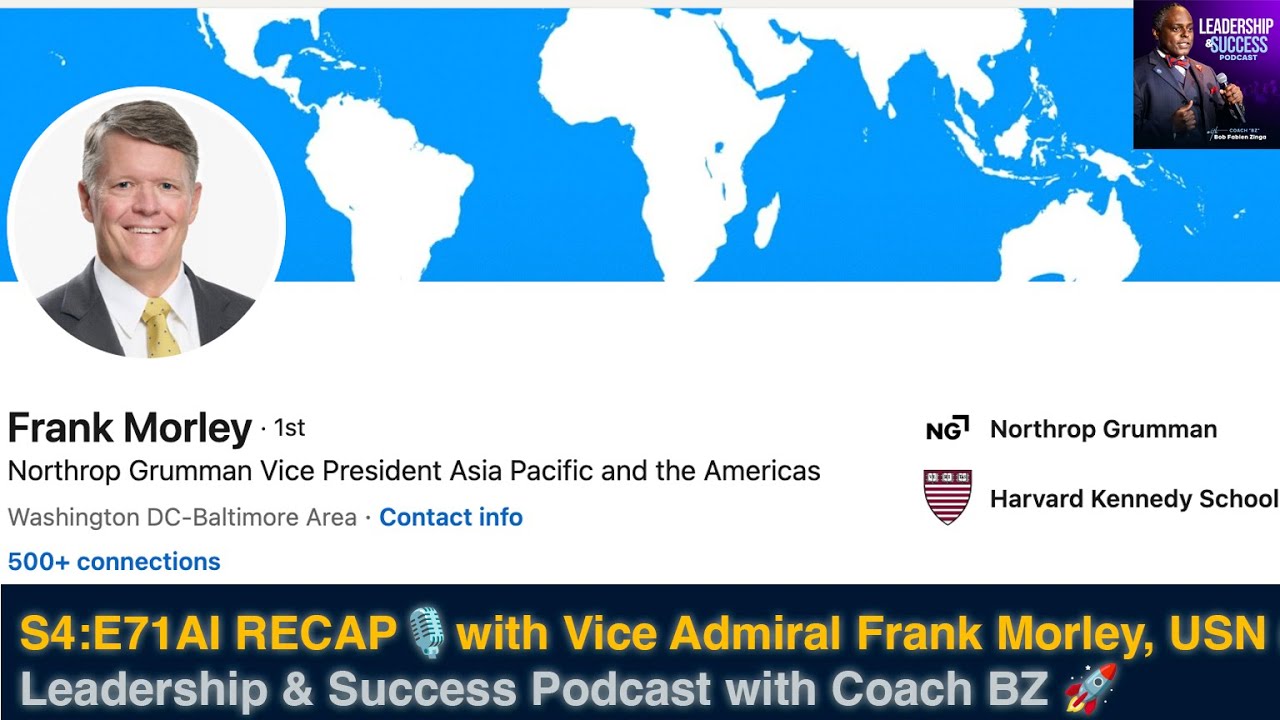
Vice Admiral Frank Morley, a retired Navy F/A-18 pilot now at Northrop Grumman, talks preparation meeting opportunity, the difference between happiness and fulfillment, and why alliances matter in defense. He practices daily gratitude and believes networking is net worth.
Chapters
Hi, I'm John Maxwell. When the top companies in the world are looking for trainers, speakers, and coaches, there's one name that stands above the rest, and that's Maxwell Leadership. Our certified team members have gotten proven results for companies all over the globe, and our reputation, I'm proud to say, is second to none. Some of our members have risen to the top of their profession, including the one you're going to meet today. I proudly introduce you to my friend, Bob Fabien Zinga.
Welcome to the Leadership and Success Podcast with your host, Coach BZ. If you need to develop into a better leader, this podcast is for you. If you want to achieve a greater level of success, this podcast is for you. His mentor, Dr. John C. Maxwell, said it best: everything rises and falls on leadership. We hope to inspire you today and provide you with an insight that has the potential to positively impact the trajectory of your life. Welcome to the Leadership and Success Podcast. If you need to develop into a better leader, this podcast is for you. If you want to achieve a greater level of success, this podcast is for you. His mentor, Dr. John C. Maxwell, said it best: everything rises.
Imagine gaining the leadership skills that could redefine your career. Join Coach BZ on the Leadership and Success Podcast, where each episode delivers practical insights from world-class speakers, military leaders, and industry experts. We dive deep into what matters most: building resilient teams, leading through uncertainty, and navigating complexity with clarity and confidence. Every conversation is crafted for aspiring leaders like you who are ready to grow, lead, and make a lasting impact. Don't miss our powerful live sessions and recent highlights. Michelle Hayward on building diverse, high-performing technical teams. Anne Leslie on leading through global complexity and cybersecurity risk. Ron Carpenter, AI, exploring faith, resilience, and AI-powered leadership. Colonel Michelle G.I. Gardner, INS, on commanding influence from the battlefield to the boardroom. Chris Robinson on shifting from drift to drive in life and leadership. And Coach Enrique Acosta Gonzalez on mentorship, legacy, and heart-centered leadership. Ready to level up your leadership journey? Tune in on Spotify, Apple, Audible Podcasts, YouTube Live, and LinkedIn Live. Join the movement toward leadership excellence. Listen now and start transforming your success.
Hello everyone and welcome back to another episode of the Leadership and Success Podcast with Coach BZ. Today we are truly honored to host a leader whose career is a blueprint for service, adaptability, and vision. My guest is Vice Admiral Frank Morley, United States Navy, retired. Over the course of 36 years in uniform, Admiral Morley served as an operational F/A-18 Hornet pilot and test pilot, amassing more than 3,500 flight hours and 750 carrier landings, flying over 35 types of aircraft. A commanding officer shaping the next generation of naval aviators and leaders, the longest-serving Director of Navy International Programs, strengthening alliances and building global partnerships, and ultimately the senior-most uniformed acquisition official in the Department of the Navy, overseeing research, development, and procurement at the highest levels. After retiring from active duty, Admiral Morley began a new chapter in service, leading as Vice President for Asia Pacific and the Americas at Northrop Grumman, where he continues to support regional security and innovation. Beyond the titles and achievements, he is a man of balance, finding joy in hiking, cycling, fly fishing, and time with his wife Elizabeth at their cottage in the mountains of New York. One of my favorite quotes from Admiral Morley is this: "We are the good guys. We are the winning team." It's a reminder that leadership is not just about the mission. It's about who we are, the values we embody, and the trust we build with others. So Whether you're a naval junior officer aspiring to command one day or a Silicon Valley engineer stepping into leadership, today's conversation will equip you with timeless insights on leading with purpose, adaptability, and courage. Stay tuned, you won't want to miss this.
Hello everybody, welcome to what I think arguably is the most exciting Quick Chat, uh, that we've seen today. My name is Rear Admiral Frank Morley. I'm the Director of Navy International Programs. Really, this is such a high-demand mission today. If you think about it, the National Defense Strategy, it's one of three lines of effort: partners and allies. Our most strategic center of gravity as a country is our partners and allies, and those with the most friends typically tend to win, right? What a wonderful symposium, and what have I learned from this symposium is that I've learned that our future is bright. What a wonderful group of students, young minds jumping into learning, advancing the art of acquisition of understanding the challenges that are there, and really just extremely motivated and thinking at a very high level.
And what is one thing you are grateful for?
Oh, I would say, you know, I pray for 3 things every day: health, happiness, and fulfillment. Wow, I love that. And so I would say right now I have all 3, so it's a good day.
Wow, health, happiness, and fulfillment. This is wonderful, uh, because there is a difference, right, between fulfillment and success, isn't there?
There is, yeah, I think so. And I think there's a difference between happiness and fulfillment, right? Um, you know, happiness is kind of— I, the way I look at it is how you approach each day and that you enjoy what you're doing in that day and enjoy the people that you're around and everything like that. And, uh, fulfillment, of course, is, I think, uh, feeling that what you're doing means something and, uh, you're part of something bigger than yourself.
Wow, that is, that is powerful. And another question I will ask is, uh, is there something about you that most people may not know about?
Boy, uh, you know, I don't know actually. Uh, uh, maybe I'll come back to that one. I'll think about that one.
Okay. Like, for, for me, for example, I've been playing the piano since I was 7 years old. Most people don't do that. And I also I've produced 2 albums when I was just a teenager.
Yeah, I don't think I have any hidden talents. I played the trumpet and trombone in school and wasn't good at either of them.
All right, so can you tell us about your leadership journey, how you came to become Admiral Frank?
Yeah, well, of course, I don't think anybody really starts out with that plan, right? So I, you know, for whatever reason, I kind of liked— was intrigued with flying at a very early age. I didn't have any family members or background to it.
All right, uh, that was a sample from the hour-long interview we had with Admiral Frank Morley yesterday. So to find out about how he became an admiral in the most powerful navy in the world, you're gonna have to listen to the entire episode. That's season 4, I believe episode 71, and it's available on all of the podcast platforms. Out there, including the replay from YouTube and also LinkedIn. And also the YouTube video, now you can listen to it in up to 12 languages. So 12 different audio. The lip sync doesn't work, but the translation is perfect. I've listened to it in French and it's very, very well translated. So you will have access to all of that. So today what we're going to do, we're going to play a 10-minute recap of the hour-long conversation. And I'm also going to play a couple of more teasers from the hour-long conversation yesterday. But before I do, let's do our moment of gratitude. So every day we want to be thankful for something. So I'm going to ask you, it's going to take less than a minute, if you would please, if you can close your eyes, put yourself in your happy place, and maybe take a deep breath. And think about one thing that you are grateful for today. What are you grateful for today? I think I am grateful for the gift of life. Life is so precious. I am so glad that I am still alive because as long as I have breath in my body, I know that there is hope for me. I may not be where I want to be, but I know I'm not where I used to be. And as long as I'm alive, there is hope, there is faith. So I am really grateful for the gift of life today. So whatever you are grateful for, please type it in the comment, but also let us know where you are joining us from, what city, what state, and if outside of the US, what country. Again, type what thing you are grateful for. And as you listen to the 10-minute recap with the Admiral, please share your 1, 2, or 3 takeaways from the episode and also one insight that you are gonna be able to apply this week. All right. Okay. So we're not gonna go to the 10 Minute AI podcast recap, and I will see you there. Also, if you have a leadership question, just type it in the comment, and I should be back in about 12-15 minutes. Here we go.
Welcome everyone to this conversation on leadership lessons from a truly remarkable career. Today, we're diving into the journey of Vice Admiral Frank Morley and his transition from fighter pilot to boardroom strategist.
I'm excited to get into this. There's so much ground to cover, from the cockpit to global partnerships and innovation leadership, right?
Absolutely. It's like, um, you've got a person who has flown fighter jets, led teams, and now guides technology and security at Northrop Grumman. And his story is filled with insights that are, uh, useful for leaders at every stage.
I know what you mean. One thing that really sticks out is his emphasis on preparation building confidence, yet tempered with humility. It's almost like saying, "Confidence without humility is a one-way ticket to arrogance." Right, exactly.
He said something akin to, "Luck is when preparation meets opportunity." And it's like, it's almost a mantra for anyone wanting to excel in any field, be it aviation, cybersecurity, or entrepreneurship.
Mm-hmm. And isn't it interesting how his early days as an F/A-18 pilot, where every mission demanded meticulous study and readiness, laid the groundwork for that very principle?
Yes, it really is. It's like, um, If you think about it, flying a fighter jet is exactly like preparing for any high-stakes situation. Both require that perfect blend of confidence that comes from knowing you've prepped and the humility to learn from every mistake.
Yep.
But I have to ask, isn't there a risk that too much focus on preparation can sometimes lead to hesitation? How do you think Admiral Morley balanced that?
Great point. He actually pointed out that without humility, preparation can easily turn into overconfidence. He talked about how aerial combat and even things like cybersecurity incident responses demand that equilibrium. And he stressed that while rigorous preparation gives you confidence, it's that same humility that keeps you open to learning and adapting. Correct.
That really resonates. It reminds me of his command lesson where he faced a full aircraft swap but focused on the mission while still uplifting his team, keeping morale high even when conditions were less than ideal.
Exactly. He said something like, "If we have the nicest looking airplanes on the flight line and they fly, we will be heroes." That statement shows deep insight into leadership. It's not just about fancy resources, It's about making things work with what you have and valuing the people behind them.
Mm-hmm.
I love that. And then there's his approach to global partnerships. He clearly underscored the value of alliances. How do you see that as applicable to today's leadership challenges?
It's really crucial. He pointed out that those with the most allies tend to win, and he not only applied that militarily, but also in the tech and innovation sectors. He said that having like-minded partners is one of a country's greatest strengths.
Yeah, right. And in today's world, where cybersecurity and tech interfuse with global politics, having trusted partnerships and networks is, um, almost non-negotiable. Would you say that's his key takeaway for aspiring leaders?
Oh, absolutely. Whether you're in military command or Silicon Valley, your network is your net worth. It's about investing time in relationships, building trust across different cultures and domains.
Indeed. Now, shifting gears a bit, I was really intrigued by his take on innovation and acquisition. Balancing rapid technological advances with the need to stick to enduring capabilities is no small feat, right?
He mentioned that while we're welcoming non-traditional tech into the defense mix, you still need to have that hardware en masse, those physical, tangible strengths. It's like he's saying, embrace the new, but never forget your fundamentals.
Mm-hmm. I appreciate that perspective, though I do wonder if sometimes leaders in tech could overcompensate and shy away from those traditional strengths. What do you think?
That's a fair challenge. In my view, his argument is that balance is key. You don't want to get swept away by innovation alone. 'While it makes sense to adopt new tools, having physical capabilities or fundamentals provides the backbone during turbulent times. It's a reminder to not throw out something tried and true in the excitement of the new.' True that.
It's a nuanced balance indeed. And then, when he transitioned into industry at Northrop Grumman, he stressed that leadership is leadership. Despite the changes in context, the human need for value, meaning, and connection remains the same.
Yes, he really hammered home that point, that human needs don't change whether you're flying fighter jets or making boardroom decisions. And his own authenticity, being true to yourself, as he shared, is what really allowed him to succeed in both worlds.
Yeah, absolutely.
Speaking of authenticity, his insistence that people are quick to see through inauthenticity seems so critical in today's era of performative leadership. Would you agree?
Certainly. He mentioned that leadership might be performative in some ways, but if you're not authentic, people spot it immediately. That's why being the best version of yourself while staying grounded with the help of mentors and loved ones is non-negotiable.
Indeed. And he even touched on the importance of continuous learning, didn't he? Unsurprisingly, despite all his achievements, he remains a lifelong student.
Yeah, that's another key takeaway. He said he's always reading, from business DNA to classic writings. It really emphasizes that no matter how high you climb, there's always room to learn and improve. And that's a point many leaders, myself included, really take to heart.
Mm-hmm.
What an inspiring model there. Leadership as a journey. Not a destination. And he even advised his 17-year-old self not to underestimate himself and to embrace reading early on. That's, um, almost timeless advice.
It is indeed. And you know, this all feeds into his final reflection on legacy, that being a good spouse, a mentor, and making a difference defines success more than any title or accolade ever will.
Absolutely, yes. That really drives home the point that leadership is about service and impact, not just achievements. And his call to action is quite powerful. Take one insight from his journey, apply it, and make a difference in your own leadership path.
Right on. It's almost like he's challenging us to integrate preparation, humility, listening, and continuous learning in our daily lives. And it leads to the question, What's one insight you'll be putting into practice next week?
Yeah, good question. For me, it's definitely the blend of preparation and humility. I'm going to focus more on really listening to my team and balancing innovation with traditional methods.
That's a solid approach. Personally, I'm inspired to strengthen my network, investing in relationships across fields. It's like building an ecosystem where every ally contributes to success.
Right.
And speaking of ecosystem, it's fascinating how Admiral Morley's career spans different domains. The way he adapted from strict military protocols to a more flexible, influence-based leadership in industry shows that the core principles remain steady. Wouldn't you agree?
Absolutely. It's like, um, leadership fundamentals are universal. Regardless of the context, the core, ah, things like trust, preparation, and authenticity remain constant.
Exactly. I wonder though, do you think his approach might face challenges in today's rapidly changing global environment where speed sometimes trumps tradition?
That's a good challenge to consider. It's true that the pace of change can put traditional values to the test, but I believe his strategy of balancing rapid innovation with solid fundamentals provides a blueprint on how to incorporate change without losing stability.
Mm-hmm.
It's an intriguing balance, a bit like walking a tightrope between agility and steadfastness. That contrast is something many leaders grapple with on a daily basis.
Exactly. And that's why Admiral Morley's legacy is so compelling. His journey isn't just a leadership playbook for a specific sector. It's a universal guide for anyone who seeks to lead with integrity in a complex world.
Absolutely. I love how every segment of his career, from fighter pilot to acquisition officer to industry leader, feeds into this holistic view of leadership. It really gives us a lot to think about and implement.
Definitely. It's like every insight he offers, from preparation and humility to building alliances and staying authentic, reinforces that leadership is an ever-evolving commitment to both self and others.
Yeah, indeed. So, as we wrap up, let's encourage our listeners: get out there, keep learning, build your networks, and always blend confidence with humility.
Amen to that! And remember, we are the good guys and the winning team when we lead with purpose, service, and authenticity.
Well said. Till next time, keep striving for excellence, and may you turn every preparation into a real opportunity.
All right, that was the 10-minute recap. Let me check if we have any questions. Okay, I don't see any questions from LinkedIn or YouTube, so that's pretty much, uh, all we are going to do today. I'm going to play a couple more teasers from the interview yesterday. Again, the goal for the teaser is to get you interested enough that you are going to go to Apple Podcasts, Spotify, or whatever your favorite podcast platform is, or right here on LinkedIn or YouTube, and listen to the entire 1-hour leadership conversation. I am sure it's going to add a lot of value to you. And I also want to let you guys know, on September 30th, at the end of the month, I am going to be joined by the one and only Octavia Gordema. She is the author of How to Change Careers on Audible and Brand Yourself for Success. And also the bestselling book Prep, Push, and Pivot. She's going to be right here on the Leadership and Success Podcast live with me on September 30th. So you can go ahead and RSVP and even start asking your question for Octavia. So I'm gonna be back here tomorrow for another podcast, tomorrow Saturday, probably gonna be about 7:30 AM California time, 10:30 AM Washington, D.C., New York. So I will see you tomorrow. I'm going to play a couple more teasers and have a wonderful weekend, everyone.
Wow.
And also after that, you became the Navy's senior most acquisition official. So how did you approach balancing the speed of innovation with risk management and accountability, especially now, right, with the rise of cybersecurity, now AI and advanced defense systems?
Yeah, you know, it's, it really is a, uh, an amazing time, an exciting time. Um, the, our defense industrial base for the first time in several decades is, is actually expanding. And, um, and so my last year in uniform, we pulled the, we pulled some data and we only looked back 10 years, and I'm sure if we look back 20 years it had been the same. But, um, I guess in 2023 it was the first year that we had— we, the Department of the Navy, had more contracts with more companies than we'd had for 10 years, probably 20 years prior. It was a decreasing number of defense companies that we, you know, worked with. That was the first year where it was actually more. And that vector continues as we bring in, you know, what's termed the non-traditional companies, the tech companies, the software companies. These emerging companies that are entering into the defense industrial base. So that ultimately is good for, uh, for the, uh, for, for the industrial base, for the country. Competition is what we're built off of. Innovation's what we're built off of. So this is an exciting time. Um, now if you look back in history, anytime there's, you know, new game-changing technology out there, whether it's the railroads or the internet or dot-com or whatever, Uh, there's a cycle. There's, there's a boom cycle, uh, then there's kind of a bust cycle, and then there's a level out as to who the real winners are and what's going to be sustainable. And so I think we're in that cycle right now for this emerging tech and very software-driven and unmanned and everything. These are all real capabilities that are going to be influential and change some of the dynamics of how we fight war. But I think we're in the boom cycle right now. We're going to figure out how much of that we need, who does it the best, and in typical free market economy, in a very healthy way, we're going to have winners and losers.
That is quite powerful. And what do you think is the secret of your outstanding success, sir?
Boy, you know, there's So, oh, who, who, you know, I think this quote, this quote, first time I heard it was from my high school football coach who claimed it as his own, but it's actually, I think, comes from a Greek philosopher if I remember last time I looked it up. But it's known to a lot of people, which is simply that luck is when preparation meets opportunity. And so, uh, I think that's pretty, uh, pretty key. Um, look, there's, there's luck involved in anyone's success. And so you've got to accept that fact that it wasn't all you that got there, that circumstances, timing, luck, etc., happened. There'll also be, you know, curves in the road that you weren't expecting, and how you react to those determines, you know, how successful you ultimately become. And it may not be down the path that you, you know, originally charted. I certainly didn't start out and, you know, with the dream to be the senior most uniformed acquisition guy in the Department of the Navy. Uh, you know, I didn't even know that existed or what that was. So, uh, certainly, you know, things change as you go along. But, um, uh, so you gotta, I think, have a just kind of a foundational grounding in understanding that. And then, and then it's about the preparation. And so, um, you know, having a passion for what you do is so, so important. You know, the prodigies in life, one, they have kind of the innate ability in it, but two, they have a passion for it, which drives them to practice that skill set hours upon hours upon hours. So if you love your work, you're going to naturally put a lot of energy into it. And so if you can find that match, that's key to success. And then, you know, Reading, we'll get into reading, I think, a little bit, but continuing to learn, continue to expand. And I think another little, little add I'll put on is, look, they, they promote you in any role, not because you're going to be the best in that next role, but because you're going to be the best in that role with potential to go further. Because organizations are selfish., and they want to keep the pool as big as they can, um, as long as they can. Uh, so they're really promoting you for your potential, not only for your ability to succeed at the next level but to go beyond that potentially. And so stretching yourself and looking at what—
looking at Thanks for watching. Until next time, don't forget to like, comment, and share.
Thank you for listening to the Leadership and Success Podcast with your host, Coach Beezy. If you like what you heard, please subscribe to our channels and come back for more wisdom nuggets on how you may develop into a better leader and achieve greater levels of success. Leadership is the most critical skill. The world will always need leaders to lead others, deploy the next disruptive technology, or execute a business strategy. You may as well decide on counting yourself among the 21st century leaders. See you right here next time on the Leadership and Success Podcast with Coach BZ.
More from Bob

S250:E4🎙️LIVE 🇺🇸America 250: President Barack Obama Leadership, Service, and the Power of Hope






S5:E157🎙️ LIVE with CMD CMSgt Dennis L. Fritz, USAF (Ret.)(Multi Tracks Audio)



S5:E156🎙️ LIVE 🇪🇸 Leadership Lessons from the FIFA World Cup 2026 Champions (Multi Tracks Audio)

S250:E3🎙️ LIVE Leadership Lessons from America’s First Documented Family of African Descent 🇺🇸📖