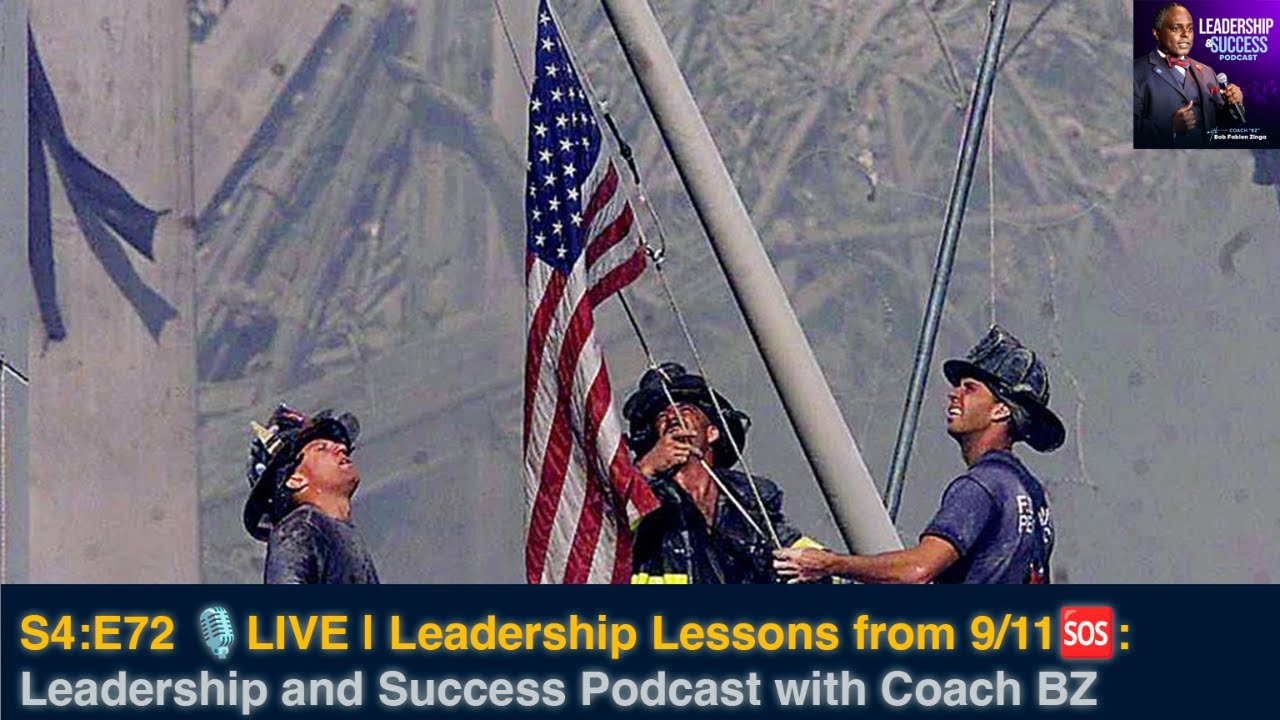
John Maxwell and cybersecurity executive Bob Fabien Zinga discuss leadership lessons from 9/11, including the government's structural response and Zinga's Ten Commandments of Resilient Leadership. They argue against over-reliance on military solutions and emphasize the need for inter-agency coordination, emotional intelligence, and psychological safety in crisis response.
Chapters
Hi, I'm John Maxwell. When the top companies in the world are looking for trainers, speakers, and coaches, there's one name that stands above the rest, and that's Maxwell Leadership. Our certified team members have gotten proven results for companies all over the globe, and our reputation, I'm proud to say, is second to none. Some of our members have risen to the top of their profession. Including the one you're going to meet today. I proudly introduce you to my friend, Bob Fabien Zinga.
Welcome to the Leadership and Success Podcast with your host, Coach BZ. If you need to develop into a better leader, this podcast is for you. If you want to achieve a greater level of success, this podcast is for you. His mentor, Dr. John C. Maxwell, said it best: Everything rises and falls on leadership. We hope to inspire you today and provide you with an insight that has the potential to positively impact the trajectory of your life. Welcome to the Leadership and Success Podcast. Imagine gaining the leadership skills that could redefine your career. Join Coach BZ on the Leadership and Success Podcast, where each episode delivers practical insights from world-class speakers, military leaders, and industry experts. We dive deep into what matters most: building resilient teams, leading through uncertainty, and navigating complexity with clarity and confidence. Every conversation is crafted for aspiring leaders like you who are ready to grow, lead, and make a lasting impact. Don't miss our powerful live sessions and recent highlights. Michelle Hayward on building diverse, high-performing technical teams. Ann Leslie on leading through global complexity and cybersecurity risk. Ron Carpenter AI exploring faith, resilience, and AI-powered leadership. Colonel Michelle G.I. Gardner-Ens on commanding influence from the battlefield to the boardroom. Chris Robinson on shifting from Drift to Drive in Life and Leadership, and Coach Enrique Acosta Gonzalez on Mentorship, Legacy, and Heart-Centered Leadership. Ready to level up your leadership journey? Tune in on Spotify, Apple, Audible Podcasts, YouTube Live, and LinkedIn Live. Join the movement toward leadership excellence. Listen now and start transforming your success. I do walking tours of the 9/11 Memorial for the 9/11 Tribute Center, and I meet people on my tours from all four corners of the globe. On every one of my tours, I mention that most people don't remember what they did Yesterday. But I have had so many guests on my tours come up to me and say that they remember every single detail about where they were and what they were doing on September 11th, regardless of where they're from.
When you talk to anybody, say, you know, and you tell them where you were on September 11th, they'll tell you exactly where they were, because even though they may not have been in the building, but they were definitely Do you remember where they were? People always remember every single moment of that day around the world because September 11, 2001 is not just New Yorkers' story, it's not just my story, but it is international part of history and a history of every single person in the world.
And what I say to my guests all the time is, that's your 9/11. 11 story, and you should tell it, because by telling it, by doing so, you help us to share history and you help us to keep the spirit of what happened here alive. I'm inspired by that. That gives me so much hope.
I believe September 11th would be the equivalent of D-Day for certain generations, or Pearl Harbor for Or when JFK was assassinated, you know, those seminal markers in your history, in your lifetime.
My cousin was in Pearl Harbor. My father, grandfather remembered Pearl Harbor. These generations will need to remember.
I think it's important to try to remember some tragedies, remember that life can be very precious and can be gone in a flash.
These are emotional memories that cannot be translated into a textbook. These are stories that we tell people, and hopefully the generation will understand this here and bring it forward to the next generation.
I feel that a lot of people use September 11th to remember the wrong things, to remember the divisions instead of what brought us together. And I think as more and more time goes by, more and more people just remember the hate that caused that act instead of the love that followed it. We were all one that day. People from New York, D.C., all over the country and all over the world. Everybody was united.
I think that's why everybody remembers where they were, because everybody's heart was here.
I remember. I remember.
I remember. I remember September 11th. I remember September 11th.
I remember September 11th.
I remember September 11th.
I remember September 11th. I got a call from my daughter who was working at Bloomberg News, and she said, "Dad, have you heard?" And I didn't know what she was talking about, and she said, "Turn on the TV.
A plane has hit one of the Twin Towers." All right, today we're going to be talking about the leadership lesson from 9/11. September 11th was a couple of days ago. So it happened, what, 24 years ago, right? September 11th, 2001. A day that really impacted my life more than any other day as a Gen Xer. I'd like to ask you, where were you during 9/11? "Uh, what do you remember from that day?" And, uh, definitely a day I believe that will live in infamy. I think for my generation, 9/11 was our Pearl Harbor. Uh, the next day, 9/12, became a defining moment, not of destruction, but of resilience, unity, and patriotism. And I think we need to go back to that day. I, uh, really like to see America united as, uh, one country on September 12th. It wasn't as divided as we are today, but I really feel as American, we have so much more in common. And really my prayer is, my heart is for all of us American, whether you are Black, white, male, female, gay, straight, whatever your national origin or your religion, first and foremost, we are US citizen. I remember when I took the oath to become a US citizen, It was in February 2006. And part of that hope was that I was becoming a citizen of this new country and I became an American first and foremost, not African American, not I-Finity American, not Congolese American, but American. I am an American and you are too. And we need to remember that we have so much more in common than what might separate us. So I really would like for us to go back to, to that unity and see ourselves as fellow citizens and really have that bond, what holds us together, right, as a country. I want us to really remember our core values as Americans. I think one of our core values in this country is liberty. That's why so many people risk their lives to come to this shore. Freedom, right? Equality, self-government, and rights, just like the founding document says, right? Rights of life, liberty, and the pursuit of happiness. And then that unity, the belief that in the United States as one indivisible nation, and that Americans are bound together by a common purpose. Our cultural value, individualism, diversity, progress, and the American dream. I've said that before, but again, America, I believe, is the only country in the world that has a dream. You know, I was born in Africa, in the Congo. I've grown with French culture. I've been in Europe many, many times, but there is no European dream. There is no French dream. There is no African dream, but there is an American dream. But this ideal that through hard work, any individual, regardless of their background, can achieve success and upward social mobility in this country, and patriotism. So I, I really want us to go back to what makes us American and really focus on that. Okay, uh, anyway, let's, let's start. Um, before I start the, uh, podcast, uh, today, I'm gonna share my screen really quick. Uh, what we are going to be talking about today, like, like I said earlier, is the leadership lesson from 9/11. You should see it on your screen now: resilience, unity, and the call to lead. I think we really need that now more than ever before in recent history, because I think I've never seen America so divided. I've been here since I was 17 years old, and that is just wrong. But anyway, so I want to appeal to your better angel, and I want you to reach out to people who may not think the way you do, may not look the way you do, may have completely different background, but reach out to them as an American. So I'm asking you, where were you during 9/11? And what core values are you going to live by. So without further ado, let's start with our moment of gratitude. I like to do this, as you know, for those who've been following this show, in the US Navy and all of the branches of the military, veterans, about what, 22, 21 people who commit suicide every single day. And I think it's really impossible to be suicidal and at the same time, right, be grateful. That's just not possible. You cannot be grateful and depressed at the same time. You cannot be grateful and highly anxious at the same time. So if you would just take a minute and maybe close your eyes if you can, put yourself in your happy place, right? Maybe take a deep breath, and take a moment to think, what am I grateful for today? What are you grateful for today? Today I am grateful for America. I am grateful for unity. It's in our name, right? The United States of America. We are one country, indivisible, united. And that's what I am very, very grateful for. So let us know what you are grateful for and type it in the comment, but also let us know where you are joining us from. And if this podcast is adding any value to you, please go ahead and tag someone or like the post that you are on now and we post it into your feed. And also, if you have a leadership question for me, go ahead and type it in the comment. All right, we are now going to go— it's going to be about 40 minutes, um, also my AI agent are going to break down the article I just showed you, Leadership Lessons from 9/11: Resilience, Unity, and the Call to Lead. I think this is a very, very important lesson for America, uh, right now. Again, you have a question for me, type it in the comment. And as you listen to the podcast, please, uh, write down, uh, up to 3 takeaways that you are taking from this episode, but also which specific insights you are going to put into practice this upcoming week. All right, let's go to the podcast now.
Welcome, listeners, to The Deep Dive. Today we're plunging into an event that remains so profoundly etched into our collective memory— September 11th, 2001.— it's a day that I think for many of us is recalled with startling, almost sensory clarity. I know for myself, I can still vividly recall the exact moment I heard the news. Yeah. The piercing sound of disbelief in the voices around me, followed by that surreal, almost deafening silence as the horrifying reality began to, you know, set in. America was under attack. That memory, even after all these years, it still sends chills down my spine.
And what's truly fascinating and deeply poignant is just how universal that experience The guides at the 9/11 Tribute Center often share that people worldwide, I mean, regardless of their background or where they were from, will tell you they remember every single moment of that day.
Wow. Every single moment.
Yeah. It wasn't just a local tragedy, you know, confined to American soil. It was really a global trauma. Yeah. It resonated across continents, making it an international event where, as one powerful reflection put it, everybody's heart was here.
That's powerful.
And for an entire generation, particularly here in the US, 9/11 became this, uh, seminal marker, a profound dividing line in history, kind of like D-Day for an earlier generation or Pearl Harbor before it.
Yeah.
Our main source for today's deep dive, Bob Fabien Zinga. He's a cybersecurity executive and Navy commander. He describes it with striking accuracy as our Pearl Harbor.
Our Pearl Harbor. Yeah.
It truly defined a moment in time for so many, and it demanded a response that would Well, shaped the next two decades, really.
Absolutely. It truly did. So as we approach the 24th anniversary of that unforgettable day, this deep dive isn't just about remembrance, although, of course, that is a crucial part of our purpose. Our mission today is to go beyond that raw memory and undertake a critical analytical examination of the profound leadership lessons that were born from that crisis.
Right.
We're here to extract those invaluable nuggets of knowledge from the sources you've shared with us. Specifically that incredibly insightful article by Bob Fabien Zinga.
Yeah, it's a great piece.
Our goal is to uncover actionable insights for leadership, you know, in times of crisis, uncertainty, and sweeping change. Principles that are just as vital whether you're navigating challenges in uniform or, say, leading a team in the business world.
And if we connect this to the bigger picture, while September 11th itself was undeniably a moment of immense destruction and just unthinkable loss, The day that immediately followed, September 12th, that became a defining moment too.
How so?
Well, not of continued destruction, but of extraordinary resilience, unity, and patriotism. That distinction between the attack and the response is absolutely crucial. Okay.
Attack versus response.
Exactly. So this deep dive will meticulously explore how both the immediate reactions and the, well, the long-term systemic responses to 9/11 illuminated these timeless truths about leadership.
Timeless truths.
Yes, truths forged in the crucible of unimaginable adversity, and they're as relevant today as they were then. They show us how tragedy can sometimes serve as an unexpected catalyst for forging extraordinary leaders and sparking profound organizational and societal transformation.
And crucially, these lessons are personally curated for you, our listener. Our aim is to help you understand what's most important in leading effectively today, armed with the wisdom drawn from one of modern history's most challenging and formative moments. So let's unpack this and truly dive deep. Let's begin by really digging into the immediate, visceral, and personal impact of that day.
Mm-hmm.
B.Z. Zinga's account, which opens our source material, is incredibly powerful. I think it resonates with so many who experienced it.
It really does.
He shares how 9/11 and the remarkable unity that just spontaneously emerged on 9/12 compelled him to raise my right hand and enlist in the U.S. Navy.
Wow.
Just like that.
Just like that. That singular decision, he reflects, completely shaped the course of his life, teaching him a fundamental truth: that leadership is tested not in calm seas but in the storm.
Mm, powerful.
It's a vivid, personal example of how a catastrophic event can profoundly alter an individual's path and deepen their commitment to service. This wasn't just a career choice for him; it sounds like it was a calling forged in crisis.
And what's fascinating here is how Bisi Zinga's intensely personal experience mirrors a widespread, almost universal sentiment across the globe.
Right.
That shared memory transcends geographical location.
Mm-hmm.
We've all heard stories, maybe experienced ourselves moments like the daughter calling her father on Bloomberg News live on air about a plane hitting the towers.
I remember that.
Or people scrambling to reach loved ones amidst the chaos. It truly didn't matter where you were. The immediate emotional impact was felt everywhere. Everywhere. And in In the very raw, immediate aftermath, the human response was equally profound and deeply communal. Our sources highlight that neighbors helped neighbors, strangers became family.
Strangers became family.
Yeah, and first responders ran toward the flames while others fled. It's a vivid, heartbreaking tableau of selflessness.
It really is.
This wasn't merely a moment of national tragedy for the US. It became an international event where, as we noted earlier, everybody's heart was here. It emphasizes that shared grief and resolve that just spontaneously bound people together. That communal response was itself an act of leadership, really, emerging from the ground up.
That's such a powerful image, the idea of strangers becoming family, rushing towards danger, or just offering a helping hand. And to you, our listener, BZ Zinga asks us to consider a similar introspective question. Where were you on 9/11? How did that moment shape your understanding of service and leadership? It's a question that prompts genuine self-reflection, doesn't it, on how such a pivotal event might have influenced your own values, your sense of purpose, maybe even your professional path.
Definitely. The ripples are still felt.
They really are.
Yeah.
In our individual and collective consciousness, shifting now from the immediate, deeply personal experience to the broader national response, we see this initial sense of shock quickly giving way to an urgent collective resolve. The Washington Post editorial from September 12, 2001, published just one day after the attacks. It was more than just reporting, wasn't it?
Oh, much more.
It was a profoundly impactful piece that framed the attacks as one of the greatest calamities in American history. It wasn't just describing, it was an urgent call for a decisive, unified national response. It captured that raw, immediate sentiment of a country reeling but also kind of steeling itself for what was coming.
Indeed. And what's fascinating is how that contemporary piece captured the immediate shock, resolve, and call to action all at once. Even amidst the still-burning rubble of the World Trade Center, the smoke billowing from the Pentagon—
The images were unbelievable.
Unbelievable. And the panicked families desperately searching for loved ones. Even then, we saw incredibly powerful examples of emerging leadership on the ground. Mayor Rudy Giuliani, for instance.
Right. He was everywhere.
He became this visible symbol of resilience for New York City and really the nation. He was almost immediately drawing praise as a wartime mayor for his visible presence at Ground Zero, his calm, reassuring press conferences, and his tireless efforts to coordinate emergency services and maintain public order when the city was in absolute chaos. Yeah.
This period, even in its overwhelming grief and confusion, showcased a fundamental leadership lesson. The ability to inspire and unite people, to project a sense of calm and direction when everything feels like it's falling apart. It's about stepping forward, taking charge when others are reeling, providing not just direction but also that crucial emotional stability.
And what I find compelling in that reflection is that leadership, particularly in such, well, unthinkable circumstances, it doesn't wait for perfect conditions or a pre-written playbook.
No, it can't.
It just emerges, it adapts, and it finds a way to galvanize people forward, often through sheer presence and conviction. It's a powerful testament to the human capacity for resilience in the face of just profound adversity.
Exactly.
So from the immediate visceral, personal, and local responses we've discussed, let's now transition to the swift and, um, monumental governmental actions that followed. These profoundly reshaped the nation's security posture. Yeah, the scale was unprecedented.
President George W. Bush's Oval Office address on September 11th, 2001, delivered just hours after the attacks, it really set an incredibly powerful and resolute tone for the country.
It really did.
He delivered those absolutely critical, reassuring words, "Our country is strong," and declared unequivocally that our military is powerful and it's prepared. It was such a pivotal moment for national reassurance, but also a signal, wasn't it, of the scale of the impending response?
Absolutely, and what's fascinating here is how Bush's address did more than just offer comfort. It effectively laid the ideological and operational foundation for the U.S. leadership's resolute stance. Oh, yeah. His solemn vow to find those responsible and bring them to justice, coupled with his emphatic statement of making "no distinction between the terrorists who committed these acts and those who harbor them." That was a key line. A very key line. It unequivocally set the tone for what would become the War on Terror, a global conflict that would define US foreign policy for decades. On the domestic front, we saw immediate, unprecedented federal actions. The Federal Aviation Administration, the FAA, issued a nationwide ground stop for all flights.
Unbelievable. Empty skies.
Empty skies, effectively clearing commercial air traffic for the first time in history. This was a colossal logistical undertaking, huge economic implications, but deemed essential for national security. Right. Simultaneously, the Department of Defense, housed in the Pentagon, which was itself attacked, went on high alert. Defense Secretary Donald Rumsfeld held an evening briefing on 9/11 itself.
Wow.
Highlighting that swift, decisive mobilization across military and civilian agencies, this was truly an early, rapid, whole-of-government crisis response, demonstrating immense capacity for coordinated action under extreme pressure.
And this rapid, immediate response wasn't just about tactical actions, right? It quickly led to some of the most significant and lasting structural changes in the history of the U.S. government.
Oh, absolutely. Fundamental changes.
Just 11 days after 9/11, President Bush appointed Pennsylvania Governor Tom Ridge as the first Homeland Security Director. That signaled the beginning of a truly massive, unprecedented reorganization of federal agencies dedicated to protecting the homeland.
Mm-hmm.
This wasn't just symbolic; it was the first concrete step towards a completely new security architecture.
And if we connect this to the bigger picture, the formal establishment of the US Department of Homeland Security, DHS, in March 2003, well, it was a truly monumental undertaking.
Monumental seems like an understatement.
It really does. It represented a colossal leadership challenge. It wasn't just about creating a new department. It involved consolidating an astonishing 22 disparate federal agencies under a single mission.
Yep.
To further coordinate and unify national homeland security efforts.
22 agencies.
22. To truly grasp the scale, think about it. This merger brought together agencies with vastly different cultures, mandates, operational histories. You had the US Customs Service, the Immigration and Naturalization Service, INS, the Coast Guard, FEMA, even the Secret Service. Wow.
Entities that had been separate for decades, centuries even.
Exactly. Entities that had operated independently for ages. This wasn't just shuffling boxes on an org chart; it was a landmark change driven by post-9/11 urgency. It was designed to break down those bureaucratic stovepipes that had hindered information sharing and coordination before the attacks.
Right, the lack of connection.
Precisely. The sheer complexity of integrating such a diverse array of entities under one unified command—well, it illustrates an unparalleled leadership challenge in organizational restructuring. It demanded a visionary approach to a completely new security architecture.
Beyond the creation of the DHS, the reforms also extended critically into the intelligence community. That community had come under intense scrutiny for its perceived inability to "connect the dots" before the attacks.
Yeah, that was a major focus.
The 9/11 Commission's devastating 2004 report delivered a powerful and urgent recommendation for a new Director of National Intelligence to oversee and coordinate the myriad intelligence agencies.
This raises an important question, rather. How do you prevent future intelligence failures when the gathering is fragmented across so many different entities? Exactly. The creation of the Office of the Director of National Intelligence, the ODNI, in April 2005 was the direct and sweeping answer. Its primary purpose was established to better coordinate US intelligence. Okay. The DNI acts as the principal advisor to the president president on intelligence matters, integrating the work of, I think it's now 18 different intelligence agencies. I'm saying, wow. Yeah. This effectively fulfilled a longstanding call for major intelligence reform that 9/11 undeniably accelerated. The goal was to foster a more unified, collaborative intelligence enterprise. And within DOD. Parallel to this, within the Department of Defense, another significant structural change was the establishment of the US Northern Command, NORTHCOM, in 2002. This new command was specifically focused on homeland defense, civil support, and security cooperation for the continental United States, Canada, Mexico, and surrounding waters. It was a direct response to the perceived vulnerabilities exposed on 9/11, providing a dedicated military command for domestic defense. Oh, that— these changes, along with other significant legislative actions like the USA Patriot Act, which was controversial, very controversial. It expanded governmental surveillance powers in the name of national security, sparking intense public debate about privacy versus security that continues today. Mm-hmm. And of course, fundamentally strengthened airport and border security with the creation of the Transportation Security Administration, the TSA. Right. We all experienced that. We do. Collectively, all these actions aimed to address the security lapses 9/11 exposed and have since profoundly defined US national security strategy. It was a complete overhaul designed to adapt to a new asymmetric threat landscape that recognized the homeland itself as a potential battlefield.
Battlefield. Okay, now let's bring in the wisdom of, well, two decades of reflection, particularly from high-level U.S. defense leaders. Our sources highlight the insights of retired Air Force General Richard Myers. He was Chairman of the Joint Chiefs of Staff right after 9/11. Right, a key figure at the time. His reflections offer some truly powerful introspection into the nation's initial strategic response.
And what's fascinating here is General Myers' candid and, um, critical insight regarding the overreliance on the military instrument of power in the immediate post-9/11 period.
Overreliance on the military. Yes.
He openly called it a huge mistake that non-military tools weren't more fully and effectively employed. He reflected on the mindset that, quote, every problem turned out to be a military problem. Mm-hmm. He suggests that diplomacy, economic measures, robust intelligence sharing with international partners, strategic foreign aid, these were often overshadowed by military solutions.
Interesting. So a sort of tunnel vision.
Perhaps. This kind of introspection now deeply informs modern military doctrine. It emphasizes the imperative of interagency unity and a conscious, concerted effort to avoid over-militarized solutions in future crises. Mm-hmm. The lesson really for military and civilian leaders alike is that complex problems require comprehensive, multifaceted solutions. You need to draw on all instruments of national power, not just the most visible or traditionally powerful one. That makes sense. This powerful self-critique offers a vital lesson in strategic humility and comprehensive problem-solving that I think transcends purely military contexts. It urges leaders in any field to look beyond their primary tools for holistic and sustainable solutions.
That makes perfect sense. You know the old saying, if all you have is a hammer, everything looks like a nail. Exactly that. And it highlights how U.S. security priorities have significantly evolved since 2001. As noted by a Brookings assessment for the 20th anniversary, The landscape of threats is constantly changing, demanding adaptability.
And if we connect this to the bigger picture, while post-9/11 counterterrorism efforts demonstrably succeeded in preventing similar attacks on US soil, and that's a significant achievement. It is. The national security agenda has broadened considerably since those initial years. Today's pressing challenges extend far beyond traditional terrorism. Like what specifically? Well, they include things like great power competition, you know, thinking about the rising influence and military modernization of China or Russia's aggressive geopolitical resurgence. Right. And also complex transnational threats like global pandemics. We've certainly seen that. Indeed. Sophisticated cyber warfare, climate change, economic instability. These diverse and interconnected threats demand entirely different leadership strategies. They require a much broader array of tools and partnerships.
So it's a constantly shifting landscape.
It is. Yet the lessons learned in the last two decades, particularly from the systemic responses to 9/11, continue to profoundly inform future decisions. 9/11 remains a crucial case study in preparedness. It showed the need for robust planning, rapid resource mobilization, and an alliance cooperation, famously prompting NATO's invocation of Article 5, its collective defense clause, for the first and only time in its history. A huge moment for NATO. Huge. It also underscored the risks of protracted conflicts, teaching valuable lessons about the long-term human and financial costs of sustained military engagement. So it's about taking those foundational insights of crisis management and applying them to an ever-changing, more complex threat landscape.
So it's not just about what did happen, but how those events continue to shape what will happen. This leads us to consider the numerous War College studies and retrospectives that offer practical, actionable insights into 9/11's profound impact on military readiness and strategic thinking. It's a continuous learning process, isn't it? Oh, absolutely.
It has to be. The consensus in military journals and academic studies from these retrospectives is clear: 9/11 profoundly underscored the critical importance of agile leadership, resilient command and control systems, and the ability to adapt strategy to non-traditional threats.
Agile leadership, resilient systems, adapt strategy.
Exactly. It wasn't enough to have well-trained soldiers; the systems supporting them needed to be equally dynamic. Concrete examples of this learning and adaptation under duress include significant rapid improvements in NORAD's air defense capability. NORAD. North American Aerospace Defense Command. They transform their focus from external threats like bombers coming over the pole to internal air sovereignty threats from within.
Ah, okay. Big shift.
Huge shift and critical upgrades to interagency communication systems, creating secure networks, joint operation centers to ensure seamless information flow across military intelligence, and civilian agencies. Breaking down those stovepipes again. Trying to, yes. These weren't just theoretical changes. They were tangible enhancements driven by the hard-won lessons of that day, ensuring that future threats could be met with a more coordinated and effective response. Mm-hmm. These reflections on national strategy and defense in turn lead us directly to the core of what BZ Zinga identifies as the 10 Commandments of Resilient Leadership. Right, the 10 Commandments. Offering timeless wisdom really for navigating any storm, whether it's personal or organizational.
Okay, here's where it gets really interesting and incredibly practical. These are the enduring, timeless truths revealed by 9/11, principles that B.Z. Zinga believes guide leaders across every spectrum, from naval junior officers stepping into command on the high seas to Silicon Valley engineers stepping into leadership roles in a rapidly evolving tech landscape. He calls them the Ten Commandments of resilient leadership., and they are truly profound in their applicability and impact.
And what's fascinating here is how these principles aren't just abstract ideas, you know, gleaned from textbooks. They are lessons learned in the crucible of 9/11, right? Forged in the fire.
Exactly. Forged in real-world, high-stakes scenarios where lives and the future of a nation hung in the balance. They provide a practical, battle-tested roadmap for leadership in any demanding environment. Mm-hmm. Highlighting that while the specific context of a crisis may change, from a terrorist attack to a global pandemic or a major cyber breach, the fundamental attributes of effective resilient leadership remain constant. They endure. They endure because they speak to the core of human and organizational behavior under pressure. Let's dive into them one by one.
Okay. First up, adapt relentlessly. Mm-hmm. On 9/11, leaders literally had to abandon the comfort of routine and preexisting playbooks in an instant. The most striking example, as you mentioned, was the unprecedented shutdown of commercial airspace across the nation. Yeah.
Grounding thousands of planes.
Thousands of planes either grounded or ordered to land at the nearest available airport. Air traffic controllers, airline personnel, they had to rewrite emergency procedures in real time. Rerouting aircraft, managing panicked passengers, coordinating with military assets. Incredible pressure. Incredible.
The core mission: save lives, protect the nation. That remained constant, but the strategies in the how shifted instantly and dramatically, demanding incredible improvisation.
So this raises an important question. How do you lead when the established playbook is literally on fire and you're operating in completely uncharted territory? Right. The core lesson here is stark. Flexibility wins. Stubbornness loses. As Ecclesiastes 3:1 wisely states, there is a time for everything, and a season for every activity under the heavens. Mm-hmm. Ancient wisdom. It is. And it speaks directly to the need for adaptive leadership. Resilient leaders recognize and quickly adapt to these changing seasons or environments. In the chaos of 9/11, clinging to outdated protocols or waiting for perfect information would have been a catastrophic error. Disaster. Instead, leaders improvised. They collaborated across agencies in ways they never had before, sharing information, making swift decisions based on incomplete but critical data. They understood that rigidity in a crisis is a recipe for disaster. So what stands out to you, our listener? Where in your leadership are you perhaps clinging to old playbooks, to familiar processes or strategies, when the environment around you clearly demands radical adaptation and a completely new approach?
Good question. Next, anticipate the storm. This speaks to foresight. Yes. While intelligence leaders had for years warned of asymmetrical threats and the potential for domestic terrorism, Few, if any, truly imagined hijacked airliners being used as precision weapons on such a devastating scale. The failure of imagination, as it was called. Exactly. After 9/11, foresight became not just a good idea but an absolute strategic imperative. The very creation of the Department of Homeland Security, the scaling of national emergency planning— Yeah. It was fundamentally about trying to prepare for and anticipate the unimaginable, even if the specific threat couldn't be pinpointed.
And the lesson here is clear: you can't predict, but you can prepare.
Can't predict, but can prepare.
Proverbs 27.12 offers a poignant truth that resonates deeply with that pre-9/11 intelligence landscape: "The prudent see danger and take refuge, but the simple keep going and pay the penalty." Wow. This ancient wisdom found chilling resonance in the intelligence failures leading up to 9/11, reminding us that constant vigilance and proactive measures are our best defense against the truly unimaginable. Mm-hmm. Resilient leaders actively cultivate foresight. They're constantly scanning for those weak signals, those faint warnings or emergent trends, long before they transform into full-blown undeniable storms. Weak signals. It's, it's about building robust intelligence networks, encouraging diverse perspectives, challenging assumptions, not just reacting to what's directly in front of you.
So think about it, listener. What weak signals are you or your team Perhaps unknowingly ignoring in your industry and market trends or within your organizational culture today signals that could potentially become tomorrow's defining crisis. Are you simply continuing to go without taking refuge?
Hmm. It's a challenging question.
Commandment number 3, master emotional intelligence. Hmm. This isn't just about managing your own feelings, right? It's understanding and influencing the emotions of others. Critically important. Think about President Bush standing atop the rubble at Ground Zero with that bullhorn, arm around a firefighter, speaking directly to the the first responders, and the nation. Iconic image. Iconic. That wasn't just defiance, it was emotional leadership in its purest, most powerful form. He spoke directly to the profound grief, the outrage, the fear, but also to the unwavering resolve. He effectively united a reeling country around a shared sense of resilience and purpose. He projected strength when the nation felt vulnerable.
And if we connect this to the bigger picture, the lesson is simple. Yet profoundly impactful. People follow calm, not chaos. Calm, not chaos. As Deuteronomy 31:6 reminds us to be strong and courageous, a leader's demeanor in a crisis is contagious. Leaders who can effectively regulate their own emotions, who can project calm and steadiness even when they themselves are internally shaken, inspire confidence and stability in others. Whether you're a military commander briefing sailors during a tense deployment, a CEO addressing a panicked workforce during an economic downturn, or an engineering lead guiding your team through a complex cyber incident. Your emotional state directly impacts the collective morale and decision-making capacity of those you lead. Mm-hmm. A practical tip for you, listener: practice deep self-awareness in crisis. When your team looks at you, what do they see? Panic, uncertainty, or reassuring sense of poise and controlled resolve? Your calm can become their anger. That's huge.
Moving on to decide with courage. On 9/11, indecision truly killed. Literally. Air traffic controllers, military commanders, they had mere seconds, sometimes less, to make agonizing decisions with severely incomplete and rapidly changing information. Unimaginable choices. Do you order a commercial airliner shot down? Do you evacuate a building with conflicting reports of further attacks? Delay simply wasn't an option. Lives, potentially national security, hung in the balance with every passing moment of hesitation. There was no time for analysis paralysis.
So this raises an important question: How do you act decisively when the stakes are so incredibly high and the information is so fragmented and scarce? Mm-hmm, yeah. The lesson is stark: indecision is the silent killer. Leaders must be prepared to make bold, values-driven decisions, often with only, say, 60% of the information they might prefer.
Right. Not waiting for 100%.
Exactly. They must understand that perfection is impossible, but action is essential. In a rapidly unfolding crisis, the courage to make a less than perfect decision quickly, to commit to a course of action and then adapt, is far more valuable than waiting for an ideal, unachievable clarity that may never come. Mm-hmm. Sometimes the decision to do something is the most critical decision of all, particularly when the alternative is paralysis.
So I challenge you, listener. Where are you hesitating today, when your people, your organization, or your mission desperately need clarity, commitment, and decisive action, not simply more perfectionism? Tough question, but necessary. Commandment #5: Communicate transparently. In the chaotic aftermath of 9/11, the leaders who communicated openly, who acknowledged the immense challenges, the sheer horror, while simultaneously charting a credible way forward, They were the ones who built true trust. Trust was paramount. Any silence, any hint of secrecy, any perceived evasion, on the other hand, just fueled fear, speculation, rumors. Transparency truly became leadership currency in that fractured environment. It was a way to stabilize a reeling populace.
And the insight here is absolutely crucial. Trust thrives on honesty.
Trust thrives on honesty.
As 1 Corinthians 14:8 eloquently asks, If the trumpet does not sound a clear call, who will get ready for battle? This biblical wisdom underscores the vital importance of unambiguous communication. In the post-9/11 environment, silence and secrecy created dangerous vacuums that fear, misinformation, and panic quickly filled. Conversely, clear, consistent, and honest communication from leaders anchored hope and provided a vital sense of direction amidst the confusion. So the practical tip: In a crisis, overcommunicate. Even if it's just to say, "We don't know everything yet, but here's what we do know, and here's our next step." Silence is often filled with fear. Well-chosen, transparent words can anchor hope and build solidarity. Okay. To you, our listener, when you speak to your team during challenging times, do your words cut through noise with clarity and candor, or do they inadvertently add to the confusion? How can you refine your message to unify, to inform, and not to divide?
Number 6, build antifragile cultures. This is a particularly powerful concept.
I think it really is. Goes beyond just resilience.
America's institutions didn't just recover after 9/11. They adapted, learned profound lessons, and actually grew stronger as a direct result of the shock. We saw massive systemic transformations in aviation security with new protocols. Agencies like the TSA, right? Interagency communication dramatically evolved. Moving beyond those traditional silos. These systems were hardened, made more resilient, not just patched over. It demonstrated a capacity for improvement born from adversity.
And this is a truly profound concept. Failure isn't final, it's fuel. Failure is fuel. Drawing from Ecclesiastes 4:9-10, which speaks of the benefit of collaboration— two are better than one. If either of them falls down, one can help the other up. We see the essence of antifragility. Okay. It's not just resilience, which means bouncing back. Antifragility, a term popularized by Nassim Nicholas Taleb, means actually improving and gaining from stress, shocks, and uncertainty. Gaining from stress. Interesting. Yeah. Teams and organizations that learn from crisis, that integrate those lessons, that openly examine mistakes instead of simply breaking under the weight of adversity, they become antifragile. They don't just endure, they evolve and become more robust. So think about it, listener.
In your own leadership, do you create a culture where mistakes are punished and hidden, or one where they're openly studied, learned from, and actively used as stepping stones for organizational growth and enhanced future capability? Big difference. Huge. Next, train for the unknown. Let's be honest, no one had a 9/11 playbook. No, definitely not. There was no drill designed for hijacked commercial airliners being flown into buildings. Yet first responders, Firefighters, paramedics, law enforcement. They were able to improvise under unimaginable pressure because they drew on rigorous prior training. Their foundation. Their foundation. Their countless fire drills, emergency medical protocols, evacuation procedures, incident command system exercises. While the scenario was new, their foundational skills and muscle memory kicked in.
And the lesson is crystal clear. The best defense is constant growth through continuous challenging training. Constant growth. Naval officers, for example, train relentlessly in worst-case scenarios high-stress simulations for a reason. It builds adaptability and decision-making under duress. Similarly, cybersecurity engineers regularly run tabletop exercises simulating complex breaches and attacks.
Not to predict the exact threat. Exactly.
Not to predict the exact next threat, but to build the mental agility and procedural muscle to respond effectively to any threat. Mm-hmm. This continuous scenario-based preparation breeds adaptability and innovative problem solving, when the actual, often unprecedented crisis hits. It's not about memorizing solutions for every single problem, but building the foundational mental and practical strength to improvise intelligently.
So a challenge for you, our listener. When was the last time you truly stretched your team with a scenario they've never seen before, pushing them to think critically and adapt rather than simply execute a known plan? Good challenge. Commandment 8: Cultivate psychological safety. Crucial. In the deeply stressful, fear-filled, uncertain environment after 9/11, teams operated under immense pressure and rapidly evolving threats. Ah, leaders who intentionally fostered open dialogue, where even junior voices felt psychologically safe enough to raise concerns, ask uncomfortable questions, offer unconventional ideas without fear of reprisal or judgment. They were often the ones who spotted critical risks, identified overlooked intelligence, or found innovative solutions that others missed. Because of hierarchy or fear.
And this raises an important question about how vital ideas and crucial warnings actually surface within an organization, doesn't it? It really does. The lesson is profound. Innovation needs courage, and courage requires safety. Great ideas, early warnings about emerging threats, the ability to pivot rapidly— yeah, they often emerge from environments where people feel truly safe enough to speak up.
It's safe to speak up.
Safe to dissent from the majority opinion, or to share an untested, potentially crazy idea without fear of judgment, ridicule, or negative career consequences. This means leaders must actively listen, reward curiosity, and protect those who challenge the status quo constructively. So ask yourself honestly, listener, does your team genuinely believe they can raise a hand, articulate a dissenting viewpoint, or share an untested, potentially risky idea without fear of being silenced, dismissed, or penalized. Is there psychological safety a cornerstone of your culture? It's very important.
Moving on to expand your network of support. Yes. The unity after 9/11 wasn't just symbolic; it was genuinely striking and profoundly operational. Federal, state, local agencies, often used to operating in their own lanes alongside countless ordinary citizens, literally linked arms. It was amazing to see. This vast collective network itself became a powerful shield against further chaos and despair, pooling resources, sharing intelligence, providing mutual aid in a way that had rarely been seen before.
And what's fascinating here is that the lesson is clear and actionable: resilience is a team sport. Resilience is a team sport. Your leadership board of directors, that circle of trusted mentors, experienced peers, even dissenting voices who challenge your assumptions, It's not optional, it's essential for navigating complex challenges.
Your leadership board of directors.
I like that. It reinforces the wisdom of Ecclesiastes 4:9-10 once more, emphasizing interdependence. Though one may be overpowered, two can defend themselves. A cord of three strands is not quickly broken. You simply cannot lead effectively, especially during a crisis, in isolation. Strong leaders understand the necessity of external perspectives and support. Support, bringing in diverse viewpoints to shore up their own understanding and decision-making. So a practical tip for the listener: proactively identify 3 mentors who inspire and guide you, and maybe 3 peers who challenge you to grow and think differently. Actively cultivate and build your network before you desperately need it, because when the storm hits, you'll rely on it.
Build it before you need it. Good advice.
And finally, measure and evolve. The continuous improvement piece.
Right. U.S. security strategy didn't just transform once after 9/11. It reshaped through a continuous, iterative process of learning and adaptation. We saw relentless after-action reports, independent commissions like the 9/11 Commission, constant drills and exercises, subsequent legislative and organizational reforms. Mm-hmm. Leadership wasn't a static endpoint of the initial response; it was an ongoing evolution, driven by data and continuous feedback loops.
And the lesson here is incredibly practical, applies to every field. What gets measured gets stronger. What gets measured gets stronger. Resilient leaders don't simply assume that resilience is inherently present in their systems or their people. They actively test it. They measure its effectiveness against new threats. They identify weaknesses, and then they deliberately strengthen it through continuous improvement. It's a cycle. It's a cycle of learning, adaptation, and hardening. This isn't about blaming. It's about learning and improving. Okay. So here's a practical exercise for you, listener. After your next significant project, or particularly after your next crisis, hold an honest and rigorous after-action review. Actively ask your team, what went incredibly well that we should replicate? What broke down and why? And most importantly, what must we fundamentally evolve and change for the future? This commitment to continuous learning and iterative improvement is foundational to true lasting resilience.
So, as we reflect on these profound leadership principles, we uncover what B.Z. Zinga identifies as one of the most enduring and often difficult lessons of 9/11: that fundamental tension between enhancing security and safeguarding individual liberties. Yes, the balancing act. We saw a massive, rapid expansion of security measures, increased surveillance, new travel restrictions, and these changes immediately ignited ongoing, vital debates over privacy, civil liberties, the appropriate scope of governmental power. This isn't a historical footnote; it's a tension we still grapple with today.
And this, for truly resilient leaders, isn't just a policy consideration; it's a profound moral imperative. Leaders must skillfully navigate these tensions with wisdom, integrity, and transparency.
Wisdom, integrity, transparency.
Understanding that the pursuit of safety can inadvertently erode the very freedoms it seeks to protect. Connecting to Galatians 5:1, which states, "It is for freedom that Christ has set us free. Stand firm then, and do not let yourselves be burdened again by a yoke of slavery." This timeless wisdom reminds us that security must never become a justification for oppression or the diminishment of fundamental human dignity. The immense challenge lies in protecting people from harm without stripping them of their autonomy, their privacy, their core freedoms. It's a huge challenge. It requires not just smart policy, but constant vigilance, public discourse, and ethical leadership. So to you, our listener, in your leadership decisions today, are you actively protecting your people's freedom and autonomy as much as you are striving to ensure their security? Mm. How do you ensure your leadership doesn't inadvertently sacrifice core values for temporary safety or compromise trust in the name of control? It's a delicate, ongoing balance that demands constant vigilance and profound ethical consideration.
In bringing our discussion to the present, it's abundantly clear that the world has not become simpler since 9/11. Not at all. In many ways, the global landscape is even more complex. Threats are more interconnected, technology moves at an exponential pace, and the stakes—in terms of global stability, human well-being—they're perhaps even higher.
Exactly. But the core message from B.Z. Zinga— and from our deep dive today is that amidst this accelerating complexity, the leadership lessons remain timeless. They endure. They endure. Leadership in crisis is not about being flawless. No leader ever is, especially in unprecedented times. It's about being faithful, faithful to the mission, to your people, and to your core values, even when the path ahead is obscured by uncertainty and fear. Mm-hmm. This enduring spirit is beautifully demonstrated by the continued tradition of the National Day of Service, now held annually around the 9/11 anniversary.
Right. The 9/11 Day Service Projects.
Yes. On the 24th anniversary, tens of thousands of Americans across the country volunteered in community service projects, actively channeling that spirit of unity, neighborly help, shared purpose seen immediately after the attacks. Mm-hmm. It's estimated that 30 million Americans participate in 9/11 Day Service activities, aiming, as the organizers put it, to rekindle the way we all felt and behaved in the immediate aftermath of the attack.
Rekindle that feeling.
Yeah, this transformation of tragedy into collective action and community strengthening, that's a powerful leadership lesson in itself. It really is. And B.Z. Zinga himself continues this profound reflection. He maintains his personal tradition of a moment of silence each year, and he's preparing for an upcoming conversation with Vice Admiral Frank Morley, continuously seeking and sharing leadership development insights drawn from these hard-won experiences. The learning really, it never stops.
The learning never stops. Hashtag tag, hashtag outro. This deep dive has truly shown us how September 11th, 2001, while a day of unimaginable tragedy, also taught us profound lessons about human resilience, the undeniable power of unity, and the enduring principles of courageous, adaptable leadership. It's a testament, isn't it, to the human spirit's capacity to not just survive, but to learn, to adapt, and to evolve stronger in the face of the storm.
And what's truly fascinating here is that the lasting impact of 9/11 isn't just in the governmental reforms or the enhanced security measures. It's in the call to ongoing personal and collective action. So as you reflect on all of this, our listener, consider that spirit of unity and resilience that emerged on September 12th. We challenge you to ask yourself, how can you honor that spirit? That sense of collective purpose and selfless action— how can you honor it in the way you lead today? How can you rekindle the way we all felt and behaved in the immediate aftermath of the attack within your own teams, your organizations, and your communities? How can you foster that same unity and resolve?
It's a powerful question, one that brings the hard-won lessons of the past directly into the challenges and opportunities of the present. Let us never forget the lessons, and let us always lead with courage.
All right, that was, uh, it for today. Let me check if there are any questions on LinkedIn or YouTube. Okay, I don't see anything. All right, I'm going to be back here tomorrow about the same time, 7:30 AM California time, Pacific time, so 10:30 Eastern time tomorrow, Sunday, and we're gonna have a 10-minute recap of this podcast. This podcast was about 40 minutes long, so tomorrow we're gonna have a 10-minute recap. So I look forward to seeing you tomorrow. But really, I believe, um, the main lesson for me is we can handle more than we think we can. I wrote a post today. I was inspired by what BK Sweeting I'd said, "Life is tough, but so are you. A little salt for a sunset is the virtue." Sometimes you may have to go through extreme difficulties and challenges, but you've got to know that you've got what it takes. All right? And my quote was, "Hold on, don't give up. You can make it. You are tougher than you think you are, and I believe in you." So this is Coach Bizzy. Until tomorrow, have a wonderful day, and please don't forget to write down 1 to 3 takeaways from this lesson, and also which insights you are going to be able to put into practice today and next week. Okay, until tomorrow, bye! Bye everybody, this is Coach Bizzy. Thanks for watching.
Until next time, don't forget to like, comment, and share Thank you for listening to the Leadership and Success Podcast with your host, Coach Beezy. If you like what you heard, please subscribe to our channels and come back for more wisdom nuggets on how you may develop into a better leader and achieve greater levels of success. Leadership is the most critical skill. The world will always need leaders to lead others, deploy the next disruptive technology, or execute a business strategy. You may as well decide on counting yourself among the 21st century leaders. See you right here next time on
More from Bob

S250:E4🎙️LIVE 🇺🇸America 250: President Barack Obama Leadership, Service, and the Power of Hope






S5:E157🎙️ LIVE with CMD CMSgt Dennis L. Fritz, USAF (Ret.)(Multi Tracks Audio)



S5:E156🎙️ LIVE 🇪🇸 Leadership Lessons from the FIFA World Cup 2026 Champions (Multi Tracks Audio)

S250:E3🎙️ LIVE Leadership Lessons from America’s First Documented Family of African Descent 🇺🇸📖