🎙️ S4:E73 LIVE – Coach BZ on the Credibility Nation Podcast
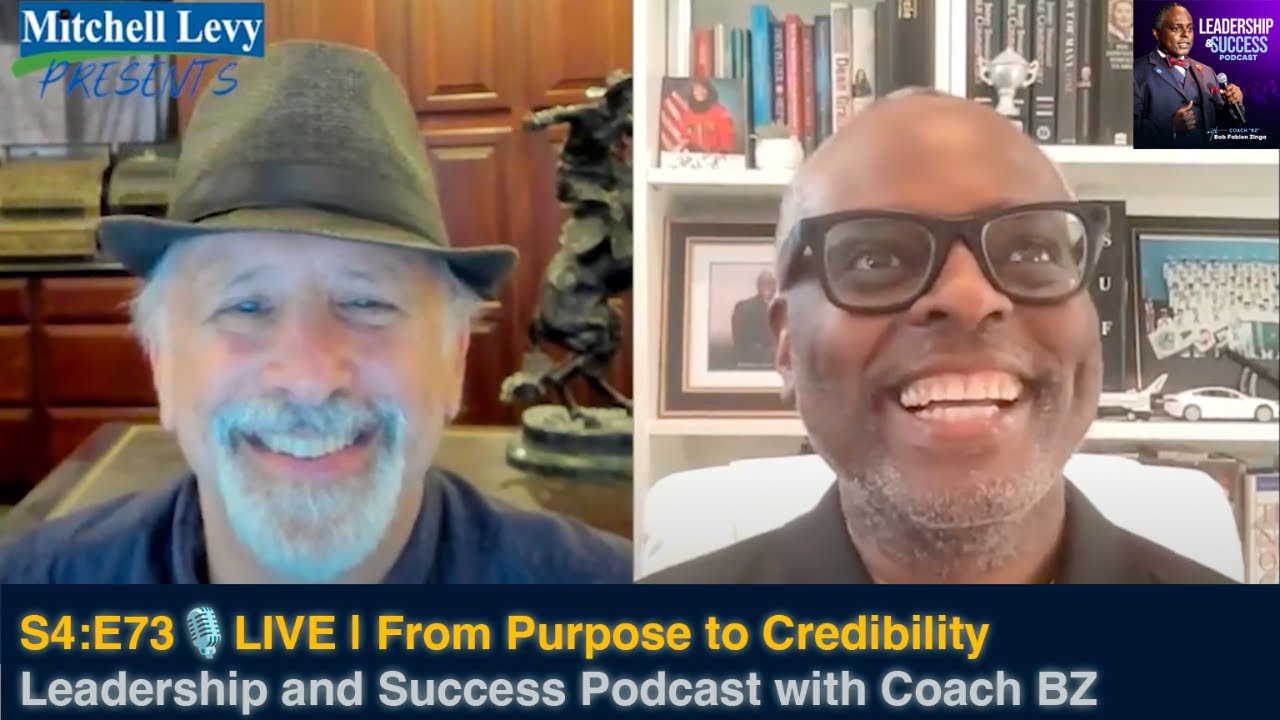
Coach BZ, a Navy information warfare officer and servant leader, discusses faith, family, and his path from STEM studies in Liberia through multiple degrees to leadership roles. He emphasizes never going to bed angry, reading daily, and helping others align with their core values.
Chapters
¡Hola!
Hi, I'm John Maxwell.
When the top companies in the world are looking for trainers, speakers, and coaches, there's one name that stands above the rest, and that's Maxwell Leadership. Our certified team members have gotten proven results for companies all over the globe, and our reputation, I'm proud to say, is second to none. Some of our members have risen to the top of their profession, including the one you're going to meet today. I proudly introduce you to my friend, Bob Fabien Zinga.
Welcome to the Leadership and Success Podcast with your host, Coach Beezy. If you need to develop into a better leader, this podcast is for you. If you want to achieve a greater level of success, this podcast is for you. His mentor, Dr. John C. Maxwell, said it best: everything rises and falls on leadership. We hope to inspire you today and provide you with an insight that has the potential to positively impact the trajectory of your life. Welcome to the Leadership and Success Podcast. Imagine gaining the leadership skills that could redefine your career. Join Coach BZ on the Leadership and Success Podcast, where each episode delivers practical insights from world-class speakers, military leaders, and industry experts. We dive deep into what matters most: building resilient teams, leading through uncertainty, and navigating complexity with clarity and confidence. Every conversation is crafted for aspiring leaders like you who are ready to grow, lead, and make a lasting impact. Don't miss our powerful live sessions and recent highlights. Michelle Hayward on building diverse, high-performing technical teams. Anne Leslie on leading through global complexity and cybersecurity risk. Ron Carpenter, AI, exploring faith, resilience, and AI-powered leadership. Colonel Michelle G.I. Gardner, INSS, on commanding influence from the battlefield to the boardroom. Chris Robinson on shifting from drift to drive in life and leadership. And Coach Enrique Acosta Gonzalez on mentorship, legacy, and heart-centered leadership. Ready to level up your leadership journey? Tune in on Spotify, Apple, Audible Podcasts, YouTube Live, and LinkedIn Live. Join the movement toward leadership excellence. Listen now and start transforming your success.
Welcome to Mitchell Levy Presents, where I dive into the essential elements of clarity and credibility. Hosted by global credibility expert Mitchell Levy, today's episode offers invaluable insights to make you think and act more credibly. Join us as we explore living your values, boosting your credibility, and leading purposefully. Hi, Mitchell Levy, global credibility expert, and I'm excited to be here. I always love the show Leaders Living Their Values. Because I get to interact with somebody that I've already had some conversations with. And I realize they're really cool and I want to expose them to you. Today, I'm with Bob Fabien Zinga, or better known as BZ. And BZ, welcome.
Thank you. I'm really glad to be here. Thank you for inviting me.
Oh, I'm good. I am glad to have you. So, who is BZ?
That is quite the question. Who is Bob Fabien Zinga? All right, so when I think about who I am, I mean, to my core, I think what drives me first and foremost, uh, I believe I am a child of God, and that's important to me. Uh, I believe there is a God, creator of the universe, and I am his child. So that doesn't make me more important than anybody else. It just means that I am as important as everybody else, right? Uh, I, I know who I am, where I come from, and kind of where, where I am going. That's kind of like at the center of me. So that's, that's, that's why no matter the difficulty of the challenges in, in life, no matter what I go through, I know that in the end I will some way, somehow overcome because I am a child of God. So, that kind of drives me with everything I do. Now, having said that, when I think about me, Bob Fabien Zinga, who I am at my core is really a husband, right? I've been married now, we got married 2001. So, it's been 24 years. This past July, we celebrated, my wife and I. And the reason why I said it, and I know right now, you know, most people, they say more than half people when they get married, they end up in a divorce and all of that. But to me and my wife, we have this commitment that no divorce will never ever be an issue in our future. No matter what we go through, we're gonna find a way to resolve it and to get back together, right? We can be angry during the day, that's fine, we are human. But before the sun goes down, we have to make up, right? And I love making up with my wife. So we are completely busy.
I'm just going to say to you, I have the exact same. My wife and I have the exact same. Like, if we disagree on anything, we'll never go to bed mad.
Yes. That really has helped us a lot. Because when you first get married, the first couple of years, you're just living on cloud land or something. But then when reality sets in, you have kids. And you have stress from work and jobs and money and all of that, you really need to get closer together, right? And then if divorce is not an option, then the only way is to find a solution to whatever you guys are going through, right? She's got me for life. I even joke sometimes, if she decides to divorce me, I'm going to divorce me with her. So I'm going to go with her. We're going to leave me. So no matter where she goes, she is my girl. So having said that, so I am a child of God, I am a husband, and I am a father. That's probably the most important thing I am, probably the most important responsibility I've ever had in my entire life. Today I am a commander in the US Navy. I was a commanding officer and I was responsible for over 156 people reporting to me directly. But that's not as important as me being a daddy, right? If my daughters— I have two of them— they call me any time of the day or night, they need anything, I drop absolutely everything and they are my priority, right? And then I guess the last thing, the way I see myself, I guess I am a servant, right? I want to add value. I learned this from my primary mentor, John C. Maxwell, where he says I have great value. I value people and I add value to people. So, I want to be one of those people who always find a way to add value. I want to serve. And I would like for it— I feel really great if someone gets to know me and their life is elevated because they got to know me. That really means a lot to me. I was able to serve them. In some way. So that's, that's really, I believe, who I am to my, to my core.
I love that. Thank you. So what does the word elevated mean? Well, so if you, as a servant leader, right, you want to elevate somebody, elevate them to what?
For what? Okay, what reason? Things get better. Because another thing I'm very passionate about is really developing leaders. I think we need leadership more now, more than ever before. I like to help people kind of, you know, figure out their purpose and live on purpose, right? Do the things that are most important, but many times people don't make the time for, right? Because we just get busy with with life and we get so distracted. So basically, starting by really understanding what your core values are and then living them out day in and day out. This is who I am, this is what I stand for, and anything that's not aligned with my values, that's not for me. And if it's aligned with what, what I believe, who I am, then that is what I am going to pursue. So I have my own dream, I have my own goals, and I am aligned to my values. So basically, when I elevate the life of people around me. It's kind of like iron sharpens iron. It's me helping them live out their value, maybe bringing some accountability if needed, right? And then they do the same for me, right? That's, I guess, what I would call— for example, I have a mastermind group here in the Bay Area. We meet about every 2 weeks or so. For the people who get into my mastermind, usually I tell them, okay, just give me one solid year now. You have to make the commitment. Again, things happen in life and all of that, I understand. But if you can, if you give me one year of your life and we go through this, we meet every other week and I'm making time for this, we talk about leadership principle and how to apply that to your life, your life is going to be completely different a year from now than what it is now. It has to be because you're gonna have to grow professionally, personally, and then you're gonna be, uh, in tune with who you are, your values, and then adding value to other people. And people are going to notice that. So that's kind of what I, what I mean about elevating, uh, someone's life. Uh, not, not be like everybody else, but kind of be uncommon, be set apart, focus on your, on your vision and your mission, if that makes sense.
Got it. Hey, I, I, I thank you for that. And, you know, I, I started thinking to myself, there's something I want to hear. I want you to talk about your two daughters. Yeah, tell me about them.
Who are they? Naomi and Zoe. And Naomi just graduated from, uh, college last year, May of last year. We are so proud of her. So I guess in our family, she's the third Zinga to graduate from college, which is really huge. And her sister is following after her. She's in the 12th grade now. That's part of the reason why I cannot leave the Bay Area because she has to finish, complete her school. She goes to the Leadership Public School here. She's doing very, very well. And actually, she's already been accepted to a university here in Liberia, and she didn't even apply, which is pretty strange. But anyway, I am hoping they're actually going to find the scholarship money for her. But anyway, we are in that stage of life now. So I guess by next year she will be done with high school. But like I've told both of my kids, right, at minimum they have to have a bachelor's degree. I don't care if they go for master's or PhD, that is extra. But as a minimum, I think a bachelor's degree is going to really prepare them for life no matter what they do. And that's what I am committed to paying for. So high school is not enough. They do have to have a bachelor's degree. Degree. Even if they decide, you know, to be, I don't know, working at McDonald's and serving fries and burgers, that is fine. There is no shame in any work, but you need to have that education. Because one thing I have learned, my godfather used to tell me, right, an education is something nobody can ever take away from you.
No one.
Something that you have learned that's going to be with you for the rest of your life no matter what. When I came to this country, I was 17 years old. Initially, I wanted to become a medical student, so I was pre-med. I did biology and chemistry as an undergrad. I was in the University Honors Program Student Association, so I had an honors thesis. So I graduated with special honors, and then I skipped the master's and I went for the PhD in microbiology, which I didn't complete. I am ABD, all but the dissertation. But But later on, I earned to have a master, a Master of Science in Management and then a Master in Business Administration. And I think I would probably go for my doctorate. And we've talked about maybe one way I could do it sooner than I thought. But it's something I feel like I eventually will need to do because I guess I am addicted to learning. Right. It's really amazing right now. How much knowledge we have, especially with, you know, in the age of artificial intelligence, looks like knowledge is everywhere. But being curious and being interested in certain things and trying to be the best at whatever field that is, I think that is important. Always being in pursuit of something, never being satisfied. Now, it doesn't have to be academic knowledge or having a diploma or all of that. Most of my learning I've really done on my own, on online classes, YouTube, books on tapes, Audible, and all of that, seminars and conferences. That is really how I have learned most of my life. But knowing what you want to learn and then doing everything you can every single day learning something in that subject. One of my mentors told me, on average, it takes what, 10,000 hours or so to become an expert at anything. So if you don't know anything right now, you're completely novice about the subject, if you start and you work on it every single day, within 5 years, 10,000 hours, you will become an expert. And everybody who's an expert in that field right now started as a novice. They didn't know anything about that field when they first started. So if they learn, you can learn too. Right. So, but anyway, having said all of that, so education is extremely important to me, to my family. It's one of my family core values. And yeah, so my kids, whether they like it or not, they're going to have to get a bachelor degree. And after that, it's going to be up to them.
Got it. So by the way, for the younger audience, the books on tape is the old school style of learning. And of course, you know, Audible or anything else is the way we learn today or online courses. Tell me about who are your two daughters as humans?
Oh, sorry, say that again.
Who are they as humans?
As humans?
Yeah, you basically talked about where they were in their stage.
Oh, yes. Well, my wife and I, we've tried very, very hard. We really wanted to develop and help raise people who are caring, right? I think that's important in this world. Someone who cares, who has some sense of empathy, right? It's not just about me, myself, and I, but it is also about your neighbor and do what you can to build a community and leave it better than you found it. So that has been really a focus in our education. Actually, for the majority of both of their life, they've been homeschooled. So we decided to just take the education on our own. And of course, I was working full-time. My wife was the one who did most of the homeschooling, but I was a participant as well, where we could teach them our values and also, you know, whatever they needed to learn, whether it was science, history, math, or whatever. And like I say, I come from the STEM world, so I'm very good with science, technology, engineering, math, and all of that. And my wife is very much into art, music, and all of that. So, I feel like our kids really got a good complementary education in our household. So anyway, being a caring adult, responsible, that was very important to us. And that's exactly what we are seeing as they developed into young women. We couldn't be prouder. Prouder of the two of them. And actually, no, I guess they, they are both Gen Z. I am a Gen Xer, but I've learned a lot from my daughters about their new generation. Because one thing, when I became a commanding officer— I don't think that's ever happened in the history of the Navy— but it's like you are the commanding officer of a command with like 5 generations working together at the same time. From Gen Z all the way up to the greatest generation. Some people, for whatever reason, they don't want to retire. So it's like, wow, how do you lead such a multi-diverse workforce? That was a challenge and something I really needed to learn quickly. And my daughters definitely helped me understand Gen Z, what's important to them, what motivates them, and how to care for them. Because of the way I grew up, when I joined the Navy 20 years ago, I mean, when I went to boot camp, the drill sergeant was like 2 inches from my face and shouting obscenity and stuff. But today, if you do that, these kids, they're like, no, they want timeout, they are hurt and all of that, they get triggered. So it's completely different world, right? But I really needed to be able to work with them coach them, help develop them, and, uh, make sure, you know, they stayed on, on track with the mission, uh, and the, the vision of, uh, my organization. But, but anyway, I guess what I, what I was saying, even though my wife and I have been mentors and teachers to our kids, but in many ways they have taught us a lot too.
So nice, nice. All right, so you talked about being an expert, and expert comes after 10,000 hours of, of focus. Tell me about where's your expertise today and where do you want to apply it?
Okay. I guess for me, it kind of started when I was 17 years old. That's when I got to the US and I was kind of going to start on going to college and trying to figure out what I'm going to do with my life. So that was 1995, 1996. I got here, that's when the internet just exploded, right? It was this brand new thing. Everybody was talking about website and how it was going to change the world. So I kind of saw intuitively how technology was really going to be something I needed to become an expert at, no matter what my field of study was. Initially, it was becoming a medical doctor, but even as a medical doctor, my idea, once I become a medical doctor, maybe I will do medical research, I'm gonna have my own practice. And if you're gonna do that, there is no way you can do biomedical sciences without technology. There's just no way you can do that. So that would have been a part of my life no matter what I did. So that's definitely one area I wanted to master. And another one was leadership, right? I felt like leadership was extremely important because you cannot do much with just yourself. If you want to do great things, you have to collaborate with other people, right? You have to create synergy with other people of same mind so you can do much more than you guys can do individually, right? So if you are going to do something great, have a great business or great enterprise, whatever it is that you do, you are going to need help and you're going to need to learn to lead, to work with people. And so I felt like leadership was extremely important. Again, at 17 years old, I was thinking if I become a medical doctor, maybe I will have nurses and hire other doctors and stuff. I would need to know how to manage and lead people. So technology leadership. And then the last thing that came to me was, um, uh, business operation, right? You're gonna need to know how to run a business profitably, whether or not it's a medical practice or whatever, whatever it is. You need to understand money, how to use a PLM statement and be profitable. So business operation, technology, and leadership. So from then to now, basically in my future, I was trying to direct my life in such a way that I would learn those things. Now again, when I went to school, I didn't learn any of that. What I learned was biology and chemistry, you know, hardcore sciences. Nothing to do with leadership, nothing to do with technology, nothing to do with business operation. But I would choose my elective. And again, another one of my mentors told me, in life, your success really depends on the other 8 hours, right? Most people, they work for 8 hours, they sleep for 8 hours, but really success depends on the remaining 8 hours. What do you do with the remaining 8 hours of your life every day? Right. Being consistent. So I was very, very careful what I did with my 8 hours a day outside of school and sleeping and all of that. So I would study again, subject I am interested in, which is business, technology, and leadership. So I've read over 2,000 books, probably almost close to 3,000 books by now. I mean, you can name them. I have read there. Their, their book. I love reading biography books about business and technology. Like, every day I, I read. Again, another thing my mentor John Maxwell taught me, you know, 5 practices that successful people do every single day: read, write, ask questions, think, and file. I do that every single day. And recently I've been making my writing a lot more public by publishing on LinkedIn. But even if I just do it for myself, that's a practice I have to do every single day. But anyway, that's kind of like a long way to answer what you asked. But basically, I made sure that as I got older, right? And another thing my mentor told me, Brian Tracy, was 5 years from now, you're going to be 5 years older. There's nothing you can do about it. So you may as well 5 years from now get a degree like an MBA. 5 years from now, you may as well get a certification. 5 years from now, you may well have a successful business. So what do you want? And start focusing on that. And hopefully 5 years from now, even if you don't reach your goal, you're going to be much closer to it than if you just let life take you wherever the the winds go. So kind of having that in mind, then I would make sure again to study technology, which I didn't know that then, but after being a poor student, PhD graduate student assistant, my stipend back then was like $1,000 a month. I still wonder how I was able to survive on that. But anyway, I got married. I had a baby on the way. I had to find a full-time job. And the only full-time job I could find in Tuscaloosa, Alabama at the time was a PC tech assistant. So that's what I did. And since I was in tech then, you know, I became a system administrator, a manager, a director, and eventually a chief information security officer. So technology became the thing I did, how I paid the bills. And then doing that too, at first I was an individual contributor and before I knew it, I had 2 people reporting to me and then 5 and then 10 and then eventually 156 people. So leadership became crucial, especially after I joined the US Navy, which I believe is a leadership organization that just happens to have a bunch of hardware. But anyway, so that kind of became part of it. And then with the business, at one point, it was very difficult for me to find a job. I asked everywhere. Where you would go have interview, but no, no, no, no offer. And I'm like, okay, so nobody wants to hire me. I'm going to hire myself. So I became a consultant. So especially after I earned a bunch of Microsoft certification, then I started having clients. I would do website for them, sell Microsoft software, and just do a whole bunch of things. But then, okay, I need to learn how to make this small business profitable. Again, I got into books, learning, and things to learn how to do with them and how to do my taxes and all of that. And then eventually I earned my master's degree when I moved to Silicon Valley in 2014. So I started the master's and 2 years later in 2016, I had earned it. But another thing that kind of pushed me into going into the master's degree program, the MBA, was because the first Silicon Valley company I worked for, I felt like the technology, specifically the cybersecurity department function, was out of sync with the business. Uh, it looks like we were doing security for security's sake, but not really doing security to support the the business, to drive business growth. So I think that was really a huge miss. So, and I found that out because when I was trying to tell engineers what to do, they would completely ignore me. So, but until I started speaking their language and saying, again, going back to my core, I am a servant leader. I want to serve you. I want to add value to you. I feel your pain. What can I do to make your life better. By saying things that way, then I was able to talk to them and work together, and then they would help me out too and do whatever it is it was they were doing in a more secure and safe way. But anyway, that's where I really understood, you know, you cannot just be a technologist and speak technology and try to make things happen. You need to be part of an organization and add value and the business understand business language. So again, that was an Another thing that kind of, you know, uh, uh, got, got me to, to get into the business program.
Nice. So, so by the way, when, when somebody goes to your LinkedIn profile, the, the title they're going to see is Information Warfare Commanding Officer for the Navy.
What—
that's such a powerful title. What is that? Who is, who is that person?
Yeah, so I am an IP officer, information professional. Uh, the Navy only started this designator in 2001, is when we got stood up, and I joined as an IP officer in 2007. That's when I, I was accepted. I was an ensign. Uh, and then when I joined the reserve, we were very small, no more than 200 IP officers in the entire world. So very, very small community. So basically, as an IP officer, what we do, we kind of are the blue team for the Navy. We take care of the IT for the entire Navy, whether it's software development, database integration, the infrastructure, cybersecurity, knowledge management, all of it. That is what we do. But then in 2010, So 3 years after I became an officer, the Navy decided, uh, we don't want to have all of the information, uh, related, uh, designator to be silos, right? To be doing their own thing. Want to bring them together under what they called at the time Information Dominance Corps. So that was us IPs, but intel, intelligence officer, uh, oceanographer was brought in, cryptologic officer, and then space, um, people work, work, working in space. So they brought us into Information Dominance Corps, and then the Navy found out that, uh, the Navy doesn't dominate anything in the information warfare domain. So we, we, we branded ourselves to information warfare community. So, uh, when I started as an NCO, as a lieutenant junior grade, as a lieutenant, even as a lieutenant commander, I still saw myself as an information professional officer first and foremost. That was my tribe. That was who I was. But when I became a commander, that kind of changed, right? Uh, I went from being hands-on information professional officer to now becoming an information warfare, uh, officer, right? Uh, meaning I don't just see— I don't just represent the, the members from my tribe, but from all of the other four tribes from information warfare community as well. Because when you are a senior officer, it doesn't matter what your tribe is, you are expected to lead not just IP officers but intel officer No, uh, MITOC officers and everybody else, because they, they look at your warfare pin. Actually, let me see. This is, uh, the warfare pin you get when you qualify to become an information warfare officer. So when, when they see that on your chest, they already have an assumption on your expertise and what you know. And it's not just IP, it's the broad information warfare tribe. So basically, as an information warfare commander, I am a commander in the US Navy in the information warfare community. Got it.
All right. Thank you for that. So I have two last questions. Stick around if you're still here. Stick around because the second one is always the fun one. Not you. I'm talking about everyone else. But of course you're going to be here. First, if people were really interested and want to learn more, what's the best way for them to reach out to you?
That would be my LinkedIn. Profile. So Bob Fabien Zinga, LinkedIn in Bob Fabien Zinga.
Perfect.
Thank you for that. All right. So the last question would be, if based on this conversation and how it went, is there a question that you wanted to be asked, or is there a question you'd like to ask yourself?
Uh, I know I've read your book about, uh, SIPOP. I think it's definitely a game changer. And I think it's kind of important to be able to succinctly get to, you know, what I guess to be the essence of your customers, right? Customer point of possibility. I think that is a very good way of thinking about business and who your customers are. But I guess For me, for the majority of my experience, my background, yeah, I've had my own small business at times, but for the most part, the way I made money, I was an employee, right? Either for the US Navy or a Silicon Valley company or a corporation. I guess I am saying all of this to say maybe one question, something I would like to make clear is even if you do not own a business, I believe you still have customers because your customer could be your internal customer, like your colleagues, the people who work for you in your organization or the other function within your organization. So those would be your customer as well. And I think it's important to be clear about the customer point of possibility, not just with external customer from your business, but also the people you work with and your colleague.
Yeah, dude, I absolutely love that. I'm going to say so. So I want to share something and I'll do it super quickly. I wanted to share these are the 10 values of credibility.
Yeah.
And credibility is the quality which you're trusted, known, and liked. And you didn't have to talk about any of them specifically. And you talked about and demonstrated all 10 of them. So I'm just going to say congratulations. Specifically on your last comment, one way to think about it is the way you talked about your daughters. They are the customers of you and your wife producing a conscious human that's going to add value to society.
Yes.
And I just thought I'd share that.
One more thing, you just reminded me of something. So I am originally from Africa, and for some reason, a lot of African parents, including mine, they want all of their kids to be doctors or lawyers. I don't know why. Actually, I know why. It's because They like money. Once you're a doctor, you're a lawyer, you are respected in society and you make a whole bunch of money. I think that is the drive. Now, I didn't want to be a doctor because my parents wanted me to, but they definitely very much encouraged it. I remember when I was maybe 7 or 8, 9 years old, I actually wanted to become a minister. That was my desire. My dad said, absolutely not. He says, one, if you become a priest, you won't give me any grandchildren. Children. And then two, you will be poor. You're gonna have to do, you know, vow of poverty and all that. So no, not, not in my family, not in my lineage for those. And then when I eventually say doctor, oh yeah, absolutely, we want you to be doctor. We're going to do everything we can to support you. And then my sister, she was supposed to become a lawyer and all of that. Again, I, I understand that. I do not judge my parents. You know, if when you know better, you will do better. But that's definitely not the kind of father I want it to become to my children. I think every child really needs to do what God has called them to, right? What they were born to do, really follow their purpose, not just passion, but purpose, right? And whatever that purpose is, and that's what we try to do with our daughter, trying to figure out what that is and then support them no matter what that is, whether they make a lot of money or not. Because I feel like the goal in life is not to make a whole bunch of money, but really to make a difference, to have an impact on people. That is really the goal, whether you have a million-dollar estate or not. Anyway, I felt like that was important.
So Bob Fabien Zinga, thank you so much for joining us today. It was amazing to— it's always amazing to exchange and interact with you. And You were as fabulous in this show as I could have possibly thought you would be. So thank you.
I appreciate that. Thank you.
You're welcome. Hey, listen, for you in the audience, you're still here. This is now your time to take action. This is your time to take the aha message that really resonated with you, to share it on social media, to share this with your friends, colleagues, family who really need to hear this. And thanks so much for joining us. Thanks for listening to what Bob, BZ, had to say. And looking forward to seeing you at the next episode of Leaders Living Their Values. Take care, everyone. Bye now. Thank you for tuning in. We hope you found value in today's episode. Like, subscribe, and share your aha moments on your preferred platform. Remember, credibility starts with clarity and living your values. Learn more at MitchellLevy.com. Until next time.
Thank you for listening to the Leadership and Success Podcast with your host, Coach BZ. If you like what you heard, please subscribe to our channels and come back for more wisdom nuggets on how you may develop into a better leader. Become a better leader and achieve greater levels of success. Leadership is the most critical skill. The world will always need leaders to lead others, deploy the next disruptive technology, or execute a business strategy. You may as well decide on counting yourself among the 21st century leaders. See you right here next time on the Leadership and Success Podcast with Coach BZ.
More from Bob

S250:E4🎙️LIVE 🇺🇸America 250: President Barack Obama Leadership, Service, and the Power of Hope






S5:E157🎙️ LIVE with CMD CMSgt Dennis L. Fritz, USAF (Ret.)(Multi Tracks Audio)



S5:E156🎙️ LIVE 🇪🇸 Leadership Lessons from the FIFA World Cup 2026 Champions (Multi Tracks Audio)

S250:E3🎙️ LIVE Leadership Lessons from America’s First Documented Family of African Descent 🇺🇸📖