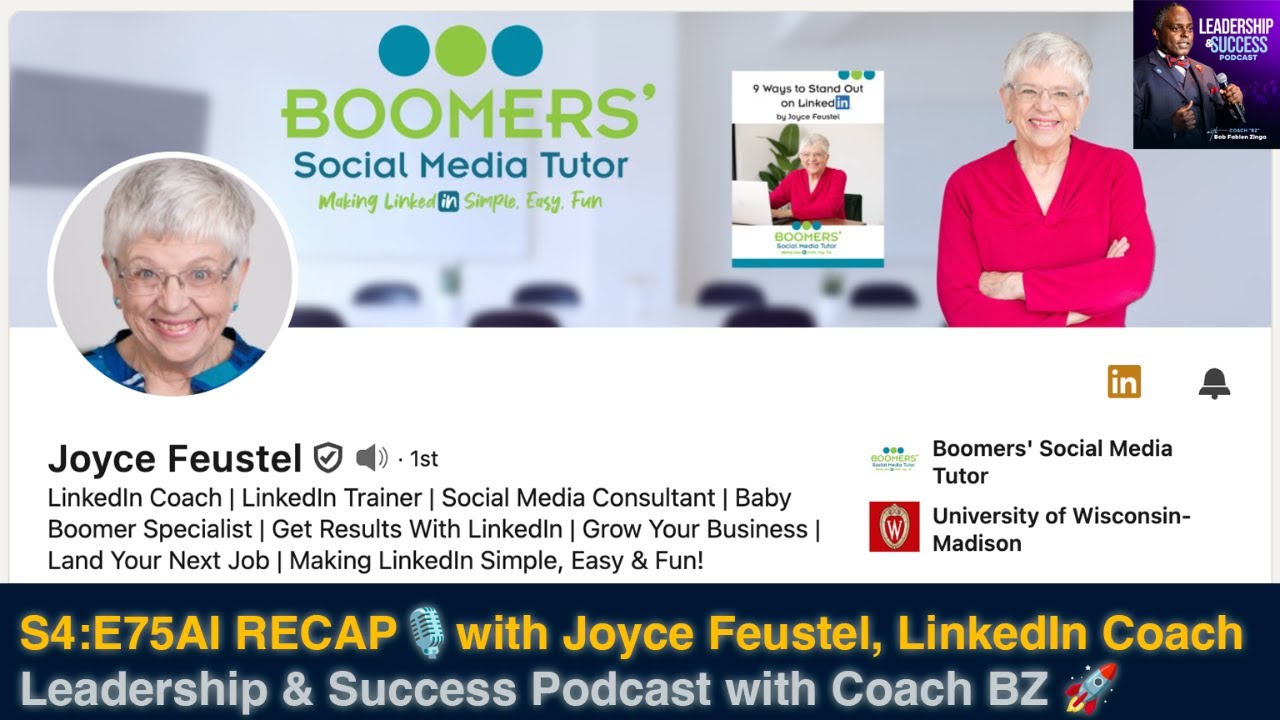
Coach Bob Fabien Zinga talks with LinkedIn expert Joyce Feustel about reinvention after 60, building authentic presence online, and using AI tools to reach wider audiences. She shares concrete tactics: customize your profile URL, use newsletters, make your client the hero of your story, and download her free ebook "9 Ways to Stand Out on LinkedIn."
Chapters
Hi, I'm John Maxwell. When the top companies in the world are looking for trainers, speakers, and coaches, there's one name that stands above the rest, and that's Maxwell Leadership. Our certified team members have gotten proven results for companies all over the globe, and our reputation, I'm proud to say, is second to none. Some of our members have risen to the top of their profession including the one you're going to meet today. I proudly introduce you to my friend, Bob Fabien Zinga.
Welcome to the Leadership and Success Podcast with your host, Coach BZ. If you need to develop into a better leader, this podcast is for you. If you want to achieve a greater level of success, this podcast is for you. His mentor, Dr. John C. Maxwell, said it best: everything rises and falls on leadership. Leadership. We hope to inspire you today and provide you with an insight that has the potential to positively impact the trajectory of your life. Welcome to the Leadership and Success Podcast.
Greetings, I'm Joyce Foystall. Founder of Boomer's Social Media Tutor. Over the past 10 years, I have tutored over 1,200 business owners and job seekers on LinkedIn and Facebook. By using my services, they become more productive and effective with their use of social media, especially on LinkedIn. Over 300 of my clients have written me recommendations on LinkedIn, making me the most recommended LinkedIn tutor in the Denver metro area. In addition, Influence Digest Media named me as one of the top 15 LinkedIn experts in Denver in 2023. As someone who trained to be a teacher, it truly touches me when I see my clients have those light bulb moments as they start to understand how to use a social media site or get better at it if they're already on it. It is so incredibly rewarding for me to see this transformation in my clients as a result of working with me. After just a couple of sessions, they start to look forward to using the site like LinkedIn or Facebook instead of dreading spending time on it. They are proud of how they show up on these sites, navigate them with ease, and share such thoughtful and well-written posts. And I'm proud too.
Wow, that, that is just, uh, awesome. And by the way, uh, we have heard from Lynn Williams And she said coming in from Philly and she's grateful. Oh, Liz here!
Oh, golly! Oh my God, I'm glad you were able to come. She's a pretty sharp cookie too on LinkedIn.
Yeah. So Liz, if you can tell us one thing you are grateful for and also if you have a question for Joyce. Thank you so much for being here with us. So my next question for you, many professionals fear change, right? Especially later in life. So what gave you the courage to reinvent yourself?
Well, you know what's interesting? You would say it just like that. When I worked at the College for Financial Planning, a lot of my clients that I set up with financial planning courses and certificates were older. They already had their certificate as a CFP® or some other certificate, and they needed continuing education. So somehow I would— how I think maybe came out that I was older than my voice sounds. So say I was like at that time, late 50s, early 60s. And they go, wow, you sound like in your 40s or 30s. I said, oh yes, yes. And then I said, well, how old are you? And then he'd say like 75 or something. I said, wow, what? You're still— why are you still working? And then they said something really profound, like, why not? If you have your wits about you and you have a job, especially like theirs, it doesn't have a lot of physicality to it.
Yes.
And you love what you do and you're making a difference in people's lives, why in the heck would you retire?
Wow, that is really something. Because I was born and I grew up in Africa. I came to the US when I was about 17 years old. And the way I grew up, we— one of our customs was really filial piety, right? We really have great respect for our elders. But basically, if someone is as old as my mom and dad, I consider them like an uncle or aunt. But anyway, I was really shocked when I became a commanding officer in the most powerful navy in the world right there. At the Global Network Operations Security Center in Suffolk, Virginia. I was working with like 5 different generations in my unit, from baby boomers all the way down to Gen Z, so my kids. I'm Gen X myself. So it's really a challenge in 2025 or 2024 being able to work with not just 2 or 3, but like 5 different generations of people with All right, that was the teaser from the episode, Season 4, Episode 75 with Joyce Fustal. So you just got a clip and I really would like for you guys to go back and listen to the hour-long conversation. This one here today is going to be the 10-minute recap. It's all done by artificial intelligence. And thank you so much for being here with us. So before we get started, let's do as we do here, as is our custom, a moment of gratitude. It's just gonna take less than a minute. I want you to think about something that you are grateful for right now. So if you would close your eyes if you can, maybe put yourself in your happy place and take a deep breath if you want to, and think about one thing that you are grateful for today. I think today I am really grateful for freedom. Freedom. Freedom is really something, isn't it? And one reason why I think America is a special country is because of our Constitution and the Declaration of Independence, our founding document, how they eloquently said, right, all men are created equal. It's that idea of equality and freedom and opportunity for all people. And that is really, really, really powerful. So I am very, very grateful for freedom today, which includes freedom of speech as well. So let me know what you are grateful for and type it in the comment. And actually, most of the time when I do this AI recap, I do it by myself. It lasts about 20, 25 minutes or so. But today I have a very, very special guest who doesn't need any introduction. So ladies And gentlemen, would you please help me welcome back Joyce Hustle? How are you doing today, Joyce?
Well, a little bit better than when I saw you on Friday, and I said I was grateful for my health. I am very grateful for my family, um, in particular right now because I've been down in bed really with a cold. So I've got my husband and our adult, um, daughter that lives here too. And, um, yeah, and I'm grateful for my pets even though I haven't been well enough to walk the golden retriever and the lab pit mix. So that's the whole family. Well, and the cat, you know, my daughter has a cat.
That is really, really great. I really love pets, especially dogs. Maybe I like dogs better than cats. I shouldn't say that publicly, but anyway, I, I, I grew up playing with dogs, but my, my wife, when she grew up, she didn't have any pets at all. So I felt like I, I needed to, uh, change that. So when our kids were about, I don't know, 10, 11, we finally got a Shih Tzu, but we call him a Hitsu because he's male. But anyway, Shaggy, just a bundle of joy, and it's really been great having a family pet. It really makes a big difference keeping everybody happy and just, you know, loving. Because what I love about dogs specifically. Now my daughter has a cat now, but I think one big difference between the two, the dogs, as soon as they see you, they just love on you no matter what. They don't really need anything back from you. But it looks like in my experience, cats, they tend to kind of be alone. They don't really need you to be around for much of anything. But anyway, it's really wonderful to have pets. So for those of you listening to us live, please let us know what you are thankful for, and also if you have a question for Joyce. So Joyce, before I play the 10 Minute AI podcast, is there something that you would like to say just about the recording we had a couple of days ago, or just anything on your mind?
Well, I always like to stress the concept that you can reinvent yourself at any age of your life. I mean, within reason. And so often I think people feel like they're washed up by 50 or 60. Give me a break, you know, you could live to 100. I mean, my husband has this friend just passed away recently, just 4 months away from being 100 years old.
Wow.
Yeah, wow is right. And we were all hoping that Bobby could make it to December 24th, but she slipped away a few months before. That woman brilliant. I mean, she wrote poetry and she wrote— she organized a poetry group in her assisted living that my husband and my daughter would go and support. That— whatever. So I say, with so many tools at our disposal, depending on the work we do, again, we can be really almost anyone we want to be. But you also have to have a tribe. I think you have to have people around you to reinforce that you're on a good track. Maybe you're going to change the track here and there. I think that I've been blessed to assemble different groups, different communities in the business world that have really been cheerleaders for me, and that's made a huge difference.
Wow, that is really, really, uh, powerful. And another thing I, I want to show our guests before we go on the 10-minute recap, I'm gonna show you. You should be able to hear yourself speaking in a completely different language. So this is what we recorded on Friday. As you can see, this is in English, and if I go to our YouTube channel, they can click on audio track and I can hear you in perfect French.
That's so cool.
This is a perfect translation of what you said in English. And then if they want to, they can translate to Igbo. I don't even know how to speak Igbo, but here we go. I do have a daughter who speaks a little bit of Korean because of K-pop. So here is you speaking in Korean. Isn't this crazy? What I know, you can speak in Hindi too, which is spoken in India. But anyway, I just wanted to show people that they can actually go to the YouTube channel, and if they don't speak English, or English isn't their first language, or if they are learning a new language— like my wife is still learning French— so she can just change it from English to French and then read the caption, and they can listen to you in pretty much any language spoken around the world. Isn't that amazing?
That's fabulous.
Very good. Okay, so we are going to go to the 10-minute AI recap now, unless you wanted to share one more thing before we do.
No, I don't. I'm fine.
Okay, very good. So let's do this, and then we're going to come back in about 10 minutes, and then you can give us your free takeaway. But really, what you just said, that was the biggest takeaway for me. It doesn't matter how old you are, right? You can do what you were born to do. You can still, uh, go ahead and go after your dream. You are such an inspirational figure. This is just amazing. And on top of that, it's on my favorite, uh, social media, uh, portal, LinkedIn. This is just amazing. So thanks so much for being here. Here we go.
Welcome to this session on leadership and reinvention, where we dive into some truly inspiring insights about stepping up no matter your age. Let's kick it off with that unforgettable line: "If you love what you do and you're making a difference in people's lives, why in the heck would you retire?" Yeah, that line really caught my ear.
It sets the tone for the whole discussion, right? Reinventing at 64, it's bold and so refreshing.
Absolutely. I mean, it's like, um, you're challenging the status quo. Joyce Fuestel, for instance, shifted from a 17-year sales career to launching her coaching business full-time at 64. It speaks volumes about how reinvention isn't bound by age.
And that background from Wisconsin, from working in teaching and sales, it just reinforces that resilience is universal. It's a reminder that sometimes the perfect moment to pivot is right when you think it's too late.
Exactly. It's like the journey itself becomes a powerful testament to lifelong learning and adaptability. When you see someone say, "If you've got your wits about you and you love what you do, then why would you ever retire?" It really hits home that leadership is about service, persistence, and authenticity.
Yeah, and speaking of authenticity, I was intrigued by her tips on LinkedIn, especially the step about customizing your URL. It sounds so simple, but it really makes a difference. What do you make of that?
Oh, for sure. I mean, customizing your LinkedIn URL might seem trivial at first, but it's like it immediately tells people you care about your personal brand. It's not just a random string of letters and numbers. It's a mark of your professional identity. It's a basic yet powerful way to stand out online.
True, though I do wonder if the emphasis on such small details sometimes overshadows the importance of genuine content and storytelling. Storytelling. Not every leader can just fix a URL and suddenly become compelling online, don't you think?
That's an interesting point. I mean, sure, the URL is just one piece of the puzzle. It's, it's like a part of a broader strategy where authenticity and consistency in your messaging build real connections, both online and off.
Yeah, definitely. Right. And that ties in with her observation about LinkedIn limiting connection request notes to 5 per month. It forces more intentional outreach. I find that shift from quantity to quality in networking really fascinating.
Absolutely. When you have to be intentional, like, um, reaching out via email or really engaging with someone's posts before connecting, it elevates your overall presence. It's a clear nod to, you know, meaningful relationships over just having a massive network.
Exactly. And that kind of discussion is so pertinent for military leaders and tech innovators alike. Whether you're briefing an admiral or leading a cyber defense team, your communication, your authenticity, that personal touch, it all counts.
Right on. And speaking of communication, Joyce's background as a distinguished Toastmaster really shines through. Her emphasis on listening, giving feedback, and genuine engagement is a reminder that leadership isn't just about speaking, it's about connecting.
Absolutely. I love that emphasis on connection, which brings me to her mentorship work. Mentoring millennials and Gen Z leaders through Toastmasters clubs is such a cool example of intergenerational learning. It's almost as if she's saying leadership transcends age.
Exactly. And it's It's like by actively mentoring younger leaders, you're not only sharing wisdom but also fostering a culture of growth and resilience. That kind of connectedness is critical, whether you're in a boardroom or, say, commanding a team at sea.
Now, here's something that really got me thinking. Her candid remark about personal relationships, don't marry your boyfriend, he's not the one, it's such a raw, honest reflection that connects both personal choices and professional resilience. How do you see that fitting into the leadership narrative?
That's a bold piece of advice, isn't it? I think it succinctly illustrates that personal decisions deeply affect your overall trajectory. It's like you've got to choose the people who lift you up in all facets of life. And that kind of honesty and vulnerability is essential because it grounds leadership in reality.
Yeah, I mean, it definitely challenges the typical polished image of leadership that we see online. But isn't there a risk in mixing personal life so openly with professional advice?
I can see that concern. However, I think what she's showing is that clarity in your personal life paves the way for clarity in your professional life. It's, um, about making choices that resonate with your true values and not just following the norm.
That's fair. Absolutely. And that brings us back to the core of her message. It's never too late to reinvent yourself and lead with authenticity, regardless of the obstacles or doubts you might face.
Right, exactly. Her journey from a teacher to a 17-year sales career and then into full-time coaching at 64 is a masterclass in persistence. It's all about transforming failure into fuel for future success.
Speaking of failure, her reflection on losing an election really hit home. It's such a humbling moment that teaches you to reset and move on, rather than taking rejection as the final verdict.
Indeed. I mean, it's like every setback is just part of your feedback loop. When she said, "Failure humbles you," it wasn't just a throwaway line. It was a powerful reminder that failure is just a stepping stone to improvement.
True. And that kind of resilience is particularly relevant for leaders in high-pressure environments. Whether you're steering a ship or maneuvering through the challenges of cyber defense. Persistence is mission critical.
Absolutely. And speaking of mission critical moments, her point about prioritizing health and gratitude really resonates. She's proud of her excellent health at 76, and that's not just about personal pride. It's a leadership lesson in taking care of the most important asset—yourself.
Right. Right, because if you're not healthy, then you can't be the leader your team needs. It's a lesson that applies across every field, from military to tech.
Exactly. And let's not forget how she ties that into practical strategies, like creating customized LinkedIn profiles and engaging powerfully with her connections. It's a blend of digital savvy and old-school values— authenticity, service, and persistence.
I'm also impressed by her list of influences: Simon Sinek, Stephen Covey, Dale Carnegie, among others. It's like she's curated the best of both worlds— timeless leadership principles and modern digital strategies. That's a recipe for success at any age.
Indeed, it's like, um, by mixing classic leadership lessons with current trends, she creates a compelling blueprint for anyone aspiring to lead. And her free ebook, "9 Ways to Stand Out on LinkedIn," is a concrete takeaway that offers practical advice, not just fluff, but actionable steps.
Yeah, exactly. I also really appreciate how her story bridges different worlds—military leadership, tech innovation, and everyday mentoring. It reminds us that leadership is more about connectedness than about titles or age. Totally.
It's fascinating how these universal principles—reinvention, persistence, and connection—tie in across every professional sphere. It's— it's like a common thread that weaves through every success story, whether on the battlefield or in the boardroom.
Absolutely. And it calls everyone to action. Be intentional, be healthy, and be genuine in your pursuits. That's a message that honestly, any leader can take to heart.
Right, and that's the big takeaway here. Whether you're a Navy officer or a Silicon Valley engineer, leadership isn't dictated by age, rank, or even technology. It's about resilience, commitment to continuous learning, and most importantly, the courage to stand out as your authentic self.
Exactly. I love that. It's clear that real leadership is a dynamic journey. Full of risks, reinventions, and yes, even some humble stumbles along the way. But each step, each decision, builds the leader you become.
Absolutely. So, in wrapping up this discussion, remember: reinvention is not bound by age, persistence transforms failures into growth opportunities, and authentic connection forms the cornerstone of impactful leadership. Thanks for this engaging chat.
Thank you. It's been truly enlightening exploring these ideas. Here's to embracing change and leading with courage and authenticity, no matter where you are in your journey.
Catch you all next time, and remember, keep pushing those boundaries, stay healthy, and never be afraid to reinvent yourself.
Until next time, lead boldly, connect deeply, and keep making a difference.
All right.
Hey Joyce, welcome back. So first of all, what do you think of the 10-minute recap?
Is that pretty good? Oh, fascinating. I've just never had this happen to me, so I'm stunned in terms of what people, or AI as you said, pick up on. And so validating, though I would say when the gal said something about, oh, that was one little thing she showed us, but we need to talk about content and storytelling. Yes. And if I would totally want to reinforce that point, because if you're not providing value to people through your content, what's the point of being on LinkedIn and the people who are your people too? So keeping that in mind all along. And the storytelling is really critical. I know a gal here in the Denver area where I live, Amanda Gerber, and she is very big on the— um, okay, I forget his name. It's a storytelling book. Should have been more prepared for this, but it's a whole format around how to make your client the hero. You may be familiar with it. And at any rate, it's You know, it's also interesting since this has the AI component here, how AI has helped me, and I use ChatGPT to tailor the content that I'm creating. And that is something I'm grateful that I'm bold enough, you might say, curious enough, willing to try something that's— a couple of years ago, nobody hardly even talked about it. Well, I think it was 2022. Would say it's— wow. So that's been fascinating. My AI helps me find my own voice in a sense, you know. So that's kind of very empowering. So I like, you know, I really like so much— there's something else— that clarity in our personal life leads to clarity in our professional life. Yes. I haven't thought about Jim Marcy in a long time. Jim Marcy and I dated from 1964 Let me think this through. To 1969. Wow. And he went to Vietnam. I was at the University of Wisconsin where the people were protesting the war. When he came back, you know, our differences became very transparent. And it was just, we really weren't meant to be together. But in a small town America, you know, you had this guy, sweet guy, very funny, all that. My dad. But in the end, it was— I went through another boyfriend too. You got to keep sifting and winnowing, right? That's a phrase of the University of Wisconsin. And then fortunately enough, you know, at age 23, I found my true love that I was meant to be.
Yes.
So yeah, it's so interesting how you gotta pay attention and be grateful for the opportunities you get. I mean, I met him by chance just because I was on a bus going to Chicago. Wow. I got a job at this meatpacking place. I mean, it's a good 5 to 7 minute speech, so I won't go all the way there. But it was just really a chance encounter that led me to that job.
That is really fascinating because you know what? I always ask my wife, right? We listen to the interview and I said, hey, what do you think about Joyce saying that don't marry your boyfriend? My wife says, well, she's absolutely right. So you have so much wisdom. So It's really amazing. A lot of the things that you teach, that you tell people, it's not very complicated. It's actually pretty easy. It's actually simple. But I feel like what needs to happen is people need to not just listen to it and understand it in their brain, right? But actually be able to actually do it, put it into practice and kind of see the benefits of it. It's just amazing. So what do you think? Actually, Let me give you what I think are my takeaway from the hour-long conversation we had. I think number one, reinvention is possible at any age, right? It doesn't matter how old you are, right? You can still reinvent yourself. And health and gratitude fuel leadership. No, without health, I think you can just forget about it. Nothing else matters, right? So persistence matters more than perfection, especially when you mention all of the setbacks you had running for office. And all that. But if you can learn from those failures, I think you become a better human being. And authenticity, that's important because it builds influence on LinkedIn and in real life. And servant leadership creates legacy. So that's very important. I think we are here to serve, to add value. And then you talked a lot about mentorship as well, especially when it comes to bridging gener— generation. And also, when we talk about mentorship with generation, usually people think The younger people always learn from the older people. But I must tell you, many times I've been taught by my own children. They've taught me a lot, especially about Gen Z and what to look for, how to motivate them and work with them. It really goes both ways, in my opinion.
I don't know. Oh, yeah, I would not know Google Drive at all if it wasn't for that Toastmasters club. Wow. They put all the documents up on Google Drive and like, walk me through this one. I'm like, I just don't use it for work like a lot of people would and other groups. So that's just a very clear-cut example of something I'm so grateful that I know what I'm doing.
Actually, having said that, I want to make sure people understand they can get your free ebook, 9 Ways to Stand Out on LinkedIn, completely free. All they have to do is go to boomersocialmediatrainer.com/9waysstandlinkedin, right? And they can get it for free. This is, this is just amazing, all of the value you give to complete strangers. That's really great. And then the other one is communication is the cornerstone of command, I believe. And also community involvement, it strengthens leaders. And finally, connection defines legacy. The relationships you build and nurture will outlast your rank, your position, or your title, whether in your life or on LinkedIn. Okay, what are your 3 takeaways before we play the Are We Meaningful teaser and end the show today.
Well, I want to go back to that content because in my ebook I have quite a bit about po— what's a post, what's an article. So I think it's— you really need to be authentic and careful and insightful, you know, when it comes to the messaging you're doing on any platform. We'll stick to LinkedIn here, that's the main one I'm talking about. I think you also need to engage with what other people are doing on LinkedIn, as was mentioned by the woman in the video, because that's so important. That's part of the whole point of LinkedIn is to be networking and being each other's cheerleaders, like I was saying before. And I think to take risks, try new things like the LinkedIn newsletter. I hesitated for a long time and finally I thought, well, geez, Joyce, why don't you just launch into it. You've been blogging since 2012, you know. Yes, this is not that different. So sometimes you let a little thing feel like a big obstacle, and in the end you just have to suck it up and do it.
And by the way, while you were speaking, uh, Joshua Meyer is, uh, coming to us from Arizona. And thank you so much for being here, Joshua. And let us know if you have a question for Joyce before we end. The show today. And also let us know one thing you are grateful for. Thank you so much for being here with us. I mean, I am just overjoyed, Joyce. I mean, you have more energy than most 30-year-olds I see these days. I can say a lot. Yeah, it's really wonderful. Just know that love of life, that passion, and really helping your neighbor. I mean, it really shows in everything you do. And what I also really love about you is how you keep learning, but also you go after these emerging technologies like artificial intelligence. I mean, my parents, my own dad and mom, they passed away now, but they had absolutely no idea what AI was. So, but just to think someone like you was actually leaning in and forward and really making sure you are using all of the technology out there to get your message across. I mean, that's very, very Inspiring. This is just great. Okay, one last word before we end the show and we go to the last two teasers I prepared for today.
I just want to say, keep your energy up. Do the best you can. Even when I've had a tough weekend, but when there's an opportunity given to you, step into it. Be bold. Like I said about taking risks, just do it, and then all kinds of things could come along you had no idea that were there. Wow, just do it.
That's the Nike, uh, thing. Yeah, it is, it is so true. Sometimes people are just scared to take advantage of opportunity. Something, as I think Oprah is the one I, I first heard say it. I don't know if she's the one who came give you the idea, but it's like, uh, success is when preparation meets opportunity, right? So you need to keep prepared, and when the opportunity presents itself, you have to take action, right? Be bold, just do it, and keep your energy up. That is, that is wonderful, wonderful. All right, uh, I could be speaking to you forever and ever. This is supposed to be a much, much shorter podcast, not a, not a second interview. One last thing you, you, that comes come to mind you want to share before we go to the outro I have and we end the podcast?
I'm good. I feel like so— I appreciate you, Bizzy. This has been such a blessing. It really has been.
Thank you. Well, last thing I want to say for everybody watching us, please, please, please follow Joyce on LinkedIn.com in Joyce Hustle Social Media Trainer. So Coach Joyce. Not only follow her, she's actually open to you connecting with her, which is really huge. That means you can be a first degree connection. And once that happens, you can just ping her and you can be able to message each other and she's reachable. Because I remember, I just, uh, I think the first message I sent to you was like on Wednesday, I believe, after talking to Chris. And immediately, like within an hour or two, you had already accepted my, uh, request, which is really, really awesome. So very, very grateful, uh, for, for that. So go to her website again and make sure to download the ebook So that's boomersocialmediatutor.com and click on the link to download the wonderful ebook, packs of tips, 9 Ways to Stand Out on LinkedIn. All right, thank you so much, Joyce. So this is gonna be it for our live communication here, and I'm gonna play 2 teasers from our 1-hour-long podcast. And again, I encourage everybody to please go and listen to the full, uh, podcast, right? Season 4, Episode 75. All right, thanks, thanks again, Joyce. I really love you. I am really, really so glad that you were able to be with us. Thank you so much. Yeah, me too. Fascinating. So who influenced you to take on leadership roles?
Oh, well, I'll start with my mom and dad. My mom and dad were co-presidents of the PTA in our little town of Manamore, Wisconsin, once I got to go to town school. Yay me! And my dad was moderator of the church board. My mom was the head of the Sunday school. My grandpa was on, and I think my dad too, on our local town— local town board. My mom was on the library board. I always thought that everybody did that that's the rent you pay, you know, for being on this place called Earth. So yeah, it was really my parents.
That is amazing. So how do you mentor new leaders?
Well, that's a really powerful question because one of my challenges is that I want to just do stuff rather than hand it off to someone and say, okay, go go for it. I spend time with them on Zoom. I answer their questions. I show them if they have to go to a certain website to do something, how it goes. And then I just give them all kinds of positive feedback or constructive criticism as needed. I mean, right now, Bizzy, I'm in a Toastmasters club that most of the members, they probably 75%, are under the age of 45. And our entire leadership team all Gen Zs and millennials except for me have only been in the club for less than a year, some for just 6 months. Wow. Yes. Isn't that something? And so it's really being a good role model for them and saying, okay, here's how it goes. Oh wow, I love the way you redid the budget to the treasurer. It looks so much— I like it so much better than what I did. So, wow. Yeah, just— well, the first part is to recruit them. So that's why I feel LinkedIn gives us so many opportunities to learn things. Wow.
And talking about multiple generations, I know my kids, they're all Gen Zs. They left Facebook once their grandparents got on it.
Yeah, they're too kind of old-fashioned for that.
Yeah. So talking about LinkedIn, so there is a gift we're going to be giving everyone. You've written this book, 9 Ways to Stand Out on LinkedIn. So that's an ebook we're going to be giving away today. Uh, what is one timeless tip, uh, and one new tip that professionals should apply to today from the 6th edition of, of your book?
What is one tip that's in that 6th edition? Okay, it's a really basic one. In your LinkedIn profile, it shouldn't have a bunch of random letters and numbers after your name. You look like a Rookie, right? What is that about? But most people don't even know that that might make him look like a rookie, or even where to go to customize— is the proper term— their LinkedIn URL. That's what I can— I show them that first chapter, I believe, right up there.
So, uh, how can leaders use LinkedIn not just for visibility but also for influence and connection?
Well, I think the first thing is, it's who you connect with. So you want to go back to the basics. So a leader needs to be in touch with other leaders. So you could go and use the search function, for example, look for a job title of somebody you want to get to know, look for the industry they're in. Go to— you want a second-level person, meaning you're not connected to them yet, and then see who the shared connections are and ask. I like to ask that person to introduce me to the person I found in the search results. Now, if you're bold— and I'm pretty bold, but not that bold— to just click on the connect button, say, oh, I hope they like me, I hope they say yes. I don't know. One of the tricky things that LinkedIn has done recently, frankly it pisses me off, is that you can only send a note with an invite 5 times a month, mind you, 5 times a month. Otherwise you have to pony up $40 a month minimum for the career level of premium. LinkedIn money grab here. But any rate, what I would do, if you know that person, I would email them and say, I'm sending you a LinkedIn invite. Yes, you know, to expect it. So I think I would also Well, I think the groups aren't as active as they used to be, but that's another place to go. There might be some group that is more active than others. You can find leaders there.
All right, this is, uh, the going to be the end of the, uh, podcast. Now Joyce is still with us, so because she's here, I need to give her one last word before we end podcast. Anything else comes to mind, Joyce? Anything else you want to share?
Well, I like that leader's question about connecting with them on LinkedIn. And, you know, I have a client who wants to be on a corporate board where they're paid. So that is one where you really want to narrow in and find out who else is on corporate and be very clear in your headline, your LinkedIn headline. Yes. What you have to offer if when you're looking for a very specific type of role. Yes, that's true always, but especially in this case, we noodled a bit and probably went to AI. And it could be something like governance or other types of terms that are perhaps relevant to a particular industry. Yes. So I think that makes me— for some reason I think of that as, uh, using LinkedIn as a way to land a position not a lot of people are looking for. You know, we did probably. So yeah, and where you could do informational interviewing, you know, hopefully with people like, how did you get on that board? Yes. Or just go to the, the website of that entity and see who's on their corporate board, if that's publicly available, and then reach out to those people and say, hey, I'm kind of interested in doing what you're doing, a little information. I don't know, it's sort of a research project.
Wow, that is really, really powerful. Really, with LinkedIn, there is no limit, you know, what, what you can do and where you could go. I, I think the last thing I'm gonna say, it's really would be almost the same if you don't write an actual book, like a a book that's going to be like an Amazon bestseller for all of us to learn more about LinkedIn. Have you started working on that project yet? Like a full book, even self-published? No, not right now. Okay. Okay. Okay. But it would be great if you did because you have so much knowledge. Yeah, it is really wonderful what is possible, right, with LinkedIn and your brand. Okay. This is it for today. This podcast is going to be almost as long as the original one. But you have just so much knowledge and wisdom, and it's like I can talk to you all day and all night. But again, Joyce, thank you. Thanks so much for being with us today. Thank you from the bottom of my heart. I'm so glad and happy that you were able to make it. And really, for all of the knowledge that you are sharing to all of us, Gen Xs and Zs and millennials and everybody else, we can definitely learn from you. Thanks again.
Thank you. It's been great.
All right, folks, thank you so much for being with us. So this is it, and I'm gonna see you back here tomorrow. And tomorrow I actually have a live podcast. Let me see. No, I believe it's at 2 o'clock, I believe, Pacific time. But anyway, I'm gonna be on the podcast every single day on LinkedIn. And thanks again for being with us today.
Bye. Thank you for listening to the Leadership and Success Podcast with your host, Coach Beezy. If you like what you heard, please subscribe to our channels and come back for more wisdom nuggets on how you may develop into a better leader and achieve greater levels of success. Leadership is the most critical skill. The world will always need leaders to lead others, deploy the next disruptive technology, or execute a business strategy. You may as well decide on counting yourself among the 21st century leaders. See you right here next time on the Leadership and Success
More from Bob

S250:E4🎙️LIVE 🇺🇸America 250: President Barack Obama Leadership, Service, and the Power of Hope






S5:E157🎙️ LIVE with CMD CMSgt Dennis L. Fritz, USAF (Ret.)(Multi Tracks Audio)



S5:E156🎙️ LIVE 🇪🇸 Leadership Lessons from the FIFA World Cup 2026 Champions (Multi Tracks Audio)

S250:E3🎙️ LIVE Leadership Lessons from America’s First Documented Family of African Descent 🇺🇸📖