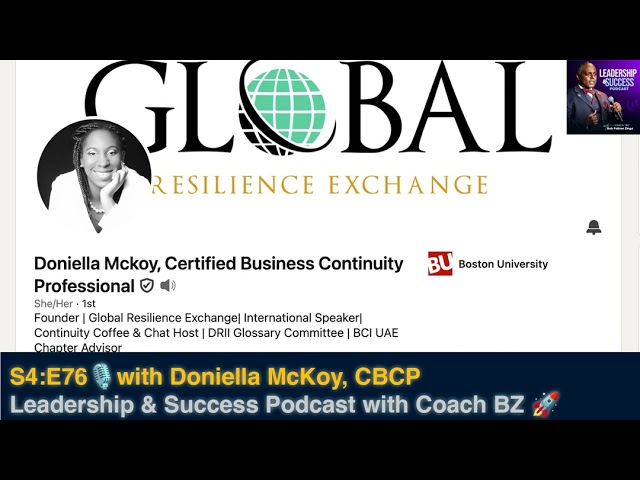
In this live episode of the Leadership and Success Podcast, host Coach BZ (Bob Fabien Zinga) interviews Daniela McCoy, a globally recognized resilience leader, educator, and community builder. The conversation traces Daniela’s career—from her master’s in healthcare emergency management at Boston University, through FEMA Corps, roles in New York City’s Office of Emergency Management, and her current position as Business Continuity Program Administrator for Senior Health covering five countries. She discusses the importance of community, founding the Global Resilience Exchange and Continuity Coffee and Chat, and her award for Diversity, Equity, and Inclusion. The dialogue explores leadership lessons from high‑stakes emergencies (Ebola, COVID‑19), cultural competency in global continuity work, mentorship of the next generation, systems‑thinking, and the cautious adoption of AI in risk analysis. Daniela shares personal motivations, values, and legacy aspirations, including her sorority involvement, reading habits, media recommendations, and advice on career pivots, curiosity, and staying true to one’s standards. The episode emphasizes gratitude, the power of authentic community, and practical guidance for emerging resilience professionals.
Chapters
Hi, I'm John Maxwell. When the top companies in the world are looking for trainers, speakers, and coaches, there's one name that stands above the rest, and that's Maxwell Leadership. Our certified team members have gotten proven results for companies all over the globe, and our reputation, I'm proud to say, is second to none. Some of our members have risen to the top of their profession, including the one you're going to meet today. I proudly introduce you to my friend, Bob Fabien Zinga.
Welcome to the Leadership and Success Podcast with your host, Coach BZ. If you need to develop into a better leader, this podcast is for you. If you want to achieve a greater level of success, this podcast is for you. His mentor, Dr. John C. Maxwell, said it best: everything rises and falls on leadership. We hope to inspire you today and provide you with an insight that has the potential to positively impact the trajectory of your life. Welcome to the Leadership and Success Podcast.
Hi everyone, my name is Daniella McCoy and thanks for joining the Fast Forward to hear my journey. I am an adjunct instructor at the University of Alaska Fairbanks campus and I teach business continuity and crisis management through the Homeland Security and Emergency Management program. At the School of Management. My journey started when I earned my master's degree at Boston University in healthcare emergency management. When I completed that, I joined FEMA Corps, and I believe I was a part of the first class for FEMA Corps, so shoutouts to them. I learned a lot about how federal government operates, um, with FEMA, in my eyes, being the premier Emergency Management Organization. Um, I was able to go to FEMA headquarters in Washington, D.C. and see some major exercises, which is a great experience. I also got to go to Texas and work with the unaccompanied minors, and I was in Texas during the Ebola breakout. From that experience, I definitely learned that I wanted to focus on planning and preparedness, and my journey has, uh, stayed true to that thus far. So when that program was complete, I was hired as a continuity of operations planner at the Office of Emergency Management in the City of New York. Um, so my day job was working with agencies to really plan and prepare for resiliency. Um, so every agency has a different mission statement, which is fine. But in the city of New York, we all have to come together to be able to provide, you know, whether you live there or work there, we need to be able to provide, um, support. So in the Emergency Operations Center, I was the ESF-8 coordinator. So that's health and medical specifics. I work with hospitals, dialysis, uh, centers, adult care facilities, really anyone who had a focus on, um, health. And the interesting part about healthcare emergency management is there truly is a lot of different layers to healthcare. You know, it's not just doctors and nurses, it's also, um, the security. It is the people who cook food for the patients. It's the people who will transfer them from floor to floor. It's the people who make sure that the hallways bedding is changed and clean and clear. Um, so really taking into consideration all the things that healthcare takes to be efficient was really what we focused on in the emergency operations center. Eventually, I relocated to Philadelphia, Pennsylvania, and I am now the business continuity program administrator at Health Partners Plans. Um, as a business continuity program administrator, I am a planner. I work on plans with different departments. I am the great communicator, public speaking for sure, talking to senior management, executive leadership. I am an editor. I am the tech person. I do it all as a department of one. I think that's very common for a lot of the emergency management and business continuity folks Sometimes you don't have a large team surrounding you and you really have to hold the fort down. So I also help with corporate communications and getting those messages out. I think one of the things that aspiring emergency managers should consider doing— I'll never tell you what to do, I'll just make a suggestion— is to really connect with others. Building relationships is so important and it has to start with you. It starts with just messaging someone on LinkedIn. In. It starts with, you know, liking a post, commenting on a post, showing up to speed networking, going to conferences if you can afford that. But really learning from others' mistakes and taking their advice is really going to put your foot forward. And you don't have to have a degree in emergency management or business continuity. So I would really recommend really understanding the value of your skills and then showing how they're transferable. Curable and making sure that your resume reflects that. Good luck in your journey and thank you for joining this Fast Forward.
All right, everyone, I am so grateful today. I have a very, very special guest for you. You just heard a little bit from Daniela McCoy a second ago, but before we get started, let's do our moment of gratitude. It's going to take just a second, less than a minute. We want to be grateful for one thing every day on the Leadership Success Podcast community. So if you would close your eyes if you can, or if you want to, put yourself in your happy place, take a deep breath if you want, and think about one thing that you are grateful for today. I think today I'm grateful that I woke up this morning and I had my right mind, right? Because somebody last night somewhere went to sleep, but they are not gonna wake up today, but I did. And somebody else may wake up, but they are really in turmoil, depression, anxiety, and they're really out of their mind. And I am in my right mind, and I'm very, very grateful for that today. So let us know what you are grateful for and type it in the comment, and also let us know where you are joining us from what city, uh, what state, and then if you're outside of the US, uh, what, uh, country. So really, I appreciate you, um, being here. So to today, I have a very, very special guest. So let's see, uh, I'm excited to welcome Daniela McCoy today, and, um, she's a globally recognized resilience leader, educator, community builder to the Leadership and Success Podcast. And, uh, One thing you guys may not know, she's also the number one female content creator in the USA. That is quite a great achievement for risk and resilience on LinkedIn. So she's a corporate business continuity manager for the Americas at Senior Health. Daniela leads program across 5 countries, guiding her team to a 2025 BCI Business Continuity Team of the Year nomination, which I believe she just won. She's gonna tell you all about it. And also she's the founder of the Global Resilience Exchange and Continuity Coffee and Chat, connecting resilience professionals worldwide. And, uh, uh, this will be a powerful conversation in leadership, resilience, and building communities at last. So without any further ado, ladies and gentlemen, let me bring Daniela McCoy. How are you doing today, Daniela?
I'm well.
I'm so excited to be here. Thank you for taking the time to invite me and to schedule me. It's I'm really looking forward to today.
Fantastic. All right. Okay. That's my fake crowd clapping. It came in a little bit late, but anyway, it is all good. So I guess to get started, is there anything you are grateful for today? What is one thing you are grateful for on this beautiful Saturday?
One thing. I am grateful for many, but I will share one thing. Right now, I'm grateful for an active community, um, for the people who reach out, for the people who invite, the people who check in, um, the ones that are making sure community stays strong by really doing what they need to do to create it.
Fantastic. That is, that is, that is so important, especially in days like now. I think a community really means everything. And, uh, what is one thing about you that most people may not know about?
Um, one thing that people may not know about me is that I am a ferocious reader, and this year I won, um, the Adult reading club at my library for 2021. Wow.
Fantastic. No, that is so great. Can you walk us through your journey into business continuity and resilience? What first inspired you to pursue this path?
Sure.
So I saw a movie named I Am Legend with Will Smith, and I was traumatized. I was like, what? How could this happen? How come the people didn't get out safely? Who's supposed to do that? I'm going to be the person who does that. I had no idea that emergency management existed. I didn't know about the resilience industry, but I would just Google evacuation occasionally, trying to figure out, like, how are we going to fix this? And I found my master's degree program at Boston University, the Healthcare Emergency Management program. And I went, I applied to one graduate school, I got into one graduate school and I graduated. And it was, I mean, the textbooks were like my favorite books. I was totally into it. And I'm a little bit of a nerd. So I went to like science camp growing up. And so healthcare emergency management was really up my alley and really allowed me to work in my gifts.
Wow, that is, that is really wonderful. And the other thing too is, um, when you look at your extensive resume, you have worked in the public sector, the private sector, nonprofit, higher education, federal sector, so all over the place. What lessons have you carried between those very different environments?
Everybody has problems. Um, it sounds crazy, but everyone has problems, and a part of my role in resilience is to I like to say, allow things to bend but not break. And so if you don't understand the problems or the issues or the concerns, you're not really going to be able to do that role well. And so you have to listen to what the issues are. And people tend to run away from issues. They don't want to be concerned. I don't quite have that luxury. So across all the sectors, there's always some kind of issue, and sometimes it's not your organization's fault. Your leadership. Sometimes it's completely out of your hands, but at the end of the day, you still have to deal with it.
Yeah, that, that makes sense. And currently you are at Senior Health, right? You lead continuity program across multiple countries. What are unique challenges of building resilience at a global scale?
Cultural competency. Um, so when I talk about active community, it's the fact that I know a guy in Mexico City that if something's happening in that region, I can to talk to him, right? And he can give me the 411. I don't have to pretend to know all the things about these countries. I can go to the source. So creating that community is really important. Um, and then understanding, like, things that may be a red flag for me, it's just another walk down the lane for them, right? And so addressing real issues, not making up fake issues, by understanding the culture of each of those countries, those facilities is really important. Wow.
And you have big news, nominated for the 2025 TI Business Continuity Team of the Year Award, and, uh, I believe you just won that. So what made your team stand out?
Our collaboration, to be honest. Um, so we were shortlisted for the BCI Americas Award. Uh, we did not win it, but I won award for for diversity, equity, inclusion.
Okay.
Thank you. I think just in general, our ability to collaborate, and there's— even though I'm the youngest in service on the team, there's no one who's really higher than the other. We can absolutely have a candid conversation, open conversation, and whoever is the best to handle that situation,. It doesn't matter if they've been there a year or 10 years. We let that, you know, go with our priorities. Wow.
That is quite fascinating, having a highly performing team and diverse team, and especially in your case, working in so many different countries at once. Now, the award you did get on diversity, equity, and inclusion, Inclusion. Can you tell us a little bit more about that? I'm sure you must be super, super proud because that was quite a competitive award, wasn't it?
Thank you.
Yeah, um, so I won that award for the work that I'm doing with the Global Resilience Exchange and the Continuity Coffee and Chat. I am deeply committed to creating a community where there are really no borders. I don't care if you're in the UAE or if you're in the USA. I don't care if you speak Portuguese or Italian. We are all in the same field. We all are dealing with similar issues. You know, the apple doesn't fall too far from the tree. So there's a lot of things that are quite similar across corporations across the globe. And so the opportunity to speak with like-minded people in a diverse session, which sounds, you know, a little bit strange, is really, really valuable. Um, and so that's what I'm working to create. I'm going to continue to do it, but it's really nice to get the acknowledgment. Um, you know, working with people of all years of service, I find that very important. Um, people with different languages, different genders, um, different focuses, different industries even. So it's quite a diverse group. So I'm really proud of that because I didn't think, you know, I just did it on a whim and it's been going since 2021. And wow, I'm still happy to do it.
Yeah, for yours. Yeah, and your YouTube channel, youtube.com/globalresiliencex. So I want everybody to please, uh, subscribe. And talking about that, so you founded the Global Resilience Exchange, uh, what gap did you see in the profession that led you to create them?
Uh, resilience is a coming-of-age type of industry, right? So you have plenty of people that have never heard of a business continuity professional, right? That makes me sad. But what also happens is I talk to people who have no idea what my role is who want to give me advice. It's a very strange situation because they don't know what I'm doing, but They love to tell me what to do. And that is not unique to me, but many of my colleagues. And so the Continuity Coffee and Chat was like, oh man, I don't want to have to wait till the next conference to be able to interact with my colleagues and peers who have amazing insights. Why do I have to wait half a year for that? And so we meet monthly. And then when I moved abroad, I was like, this is a global audience now. I'm encouraging everyone. You know, my, my group is getting larger. And so the Global Resilience Exchange was really an opportunity for folks to pick each other's brains who have sat in the seat that you're sitting in or will sit in the seat that you're sitting in. And I think that adds a lot of value.
Yeah. Can you say a little bit more about the importance of community where it's not just technical expertise, right? Because you are really building a global community online? Why is that really important?
Yeah, so, um, I, I think what's important is remembering the human as the professional, right? And so I believe that we were not meant to do things by ourselves. Um, you know, Ecclesiastes 4 says two is better than one, and so I'm very much, uh, interested in how do we come together in order to propel ourselves and to support community. And so when you're thinking about a global community, so there's, there's something unique that I do. It's my Continuity Coffee and Chat. Cameras on, people yapping away, we do introductions in the beginning, we get to connect. The Global Resilience Exchange, absolutely no cameras. And people are like, oh, my camera's not working. I'm like, listen, there's some cultural things that would make it less comfortable for folks to have their camera on. So I run a session that's specific to absolutely no cameras. So people don't have to feel like, oh man, I should really turn my camera on, or I'm not going to show up because I have to put my face on, I have to put my hijab on, or whatever it is, right? Or I'm not in a good location to be on video. I'm removing those barriers so that we can come together. And so I think it's something very small, right? Like not allowing cameras. But also invites and makes it more inclusive.
Yeah, I really love your cultural awareness, especially being an American, uh, because I've traveled the world as an American and in many other countries sometimes I feel like we are too arrogant and we try to impose our own culture on other people and things. So just you being emotionally aware and making everybody feel comfortable regardless of where they come from, I think that's really a big, big, big deal. Thank you. That's wonderful. So you've taught emergency management from New York to Alaska to Abu Dhabi. I'm sure most Americans don't even know where Abu Dhabi is, but what has teaching others taught you about leadership?
The most interesting thing about being a lecturer, instructor, professor, whatever your title is, is you can give out an assignment to 100 students and you will get 100 different answers unless you're teaching math, you know. And I think that's so important to bring into the profession because there's, you know, like they say, a lot of ways to skin a cat. So when you're thinking about how you're serving your community, you also have to recall the fact that your community is varied, it's diverse, it understands differently. So So University of Alaska is an interesting demographic. You get a lot of adults, adult learners there, which is, you know, a different layer. And Abu Dhabi, it was English as a second language. And so crisis, disaster, emergency, these are all very specific terms that don't necessarily have an equal translation. So you're trying to portray or persuade people that they have to think a certain way in ways that they've never had to think before, right? And that's the whole point of being a student, is for us to be able to help them to grow and get to that next level. If they knew it already, they probably wouldn't have to be there. So I think it helps with, um, giving grace, slowing down, right? These people don't know it yet, so how are you going to get them there? Um, but then also, how are they going to use that information to benefit their community positively. And so teaching across, you know, the city, Alaska, Abu Dhabi, you get the opportunity to share the joy, I think the joy of resilience, to people that I would never get a chance to talk to. And so I take it very seriously when I'm in the classroom that it doesn't just stay in the classroom.
No, that is very powerful. And I want to acknowledge Robert from Florida. Thank you so much for for being here, Robert. Let us know what you are grateful for today, Robert, and also if you have a question for Daniela. And also would like to acknowledge Mohammed from Pakistan. Thank you so much for being here. Same thing, let us know what you're grateful for today and also if you have a question for Daniela. Thank you so much for being here. So that's what I really love about this LinkedIn platform. It's a global audience. You have no idea who's going to show up and who's going to interact. With you. So let's focus about the next generation for, for a second since you are an instructor, a professor, and it's important for you to also help kind of develop the next generation of leader in emergency management. So how do you mentor them, the next generation of resilience professional, and what qualities do you look for in rising leaders?
Curiosity. People who want to gain more knowledge are going to do better. So at my point of my career, I know business continuity. The best thing that I can do is learn the business, right? So I need to learn biopharmaceuticals, right? That makes me able to administer business continuity me better. So I have to be curious about the things that I don't know. Um, and when you're— when I'm talking to my mentees, I'm always looking to see what are they asking me, you know. Is it something they just got from ChatGPT? Is it something that's, you know, intrinsic? Is it internal? Are they trying to put something in place and they're looking for guidance? So I think curiosity is really important. And I cannot stress this enough, people are willing to help the young, the youth, right? They love to be able to impart the knowledge. Once you get, you know, to be more seasoned, people are going to start saying, well, why don't you know that already, right? Um, we're a little bit less kind. That's a different story. So when you're young, take advantage of the fact that people are willing and able to assist you and support you. It's your time to just soak up all that knowledge and information.
Now, you have supported major emergency with FEMA, including Ebola back in 2014. I remember that was a pretty big deal. So what leadership lesson did you take from those high-stakes experiences?
Um, so being in healthcare emergency management, even though that is my degree, I am a non-clinical medical professional. And if I had known that the pandemic, COVID-19, coronavirus is going to come, I would have really thought about Ebola differently. During Ebola, we went straight to the clinicians, to the scientists, and really were like, well, what's happening here? How do we deal with this? Right. And then we kind of did a 180 when it came to the pandemic. It was like the doctors don't know. We're going to just do what we feel. And so it's a really interesting contrast throughout my career to see those two major events. But I think what's important is really utilizing the experts. And it's not just the experts on paper, but the people who have the ability to express technical or complex issues for the average person. So I can't teach someone, you know, something that just won't resonate with them. It's not— they're not going to retain it. And so when you're dealing with the public, you really have to figure out who's going to break it down in a way that people can understand and take action.
Yes. Now, you, you mentioned the, uh, global COVID-19 pandemic. I think, uh, for people of my generation, Gen X, uh, 9/11 definitely is— was a huge, huge impact. But COVID-19 was probably one of the biggest, uh, impact of people in my generation too. We're never going to forget that. So, uh, in moment of uncertainty, you even talked about the expert, like during COVID-19, the expert didn't even know because it was all so new and they were figuring out at the same time the public was. So with all of the uncertainty, the the chaos, the fear, and all of that, what anchored you as a leader?
I am, I try to be a very hopeful and optimistic person, but it has to be rooted in logic. So there was a bet at work when we're gonna get back to work, right? And everyone's like, oh, we'll be back by the summer. And I'm like, absolutely not, right? And that's based on my training, you know, looking at pandemics at a graduate level. But I knew that that was not possible because as soon as the summer hit, everybody was going to be outside, and they were going to be outside together, which means that things were going to still spread, right? And I said that to them like, no, no, no. And then at the end, they're like, wow, how did you know that? And I think human behavior is something that is often missing from these overall issues, right? How are people going to react? So you mentioned fear before. I don't think people really understood the level of fear that people have across the world, right? People, their family members are perishing, their jobs were taken away from them. It was so many levels of fear. And so when people don't have access to their normal routines, they start to act in strange ways. That's not strange in itself because we know people will do what it takes to survive. And so human behavior, I think, is really crucial in trying to figure out how you're going to be a leader, right? Is it a time for me to console someone? Is it a time for me to push someone? Is it a time, um, for me to step back and understand how I'm feeling? Because you can't pour from an empty cup.
Yes. Yes. And I'm assuming during the epidemic, people like you in crisis management, doctors and first responders and all of that, they were really working double shifts. I mean, it's— you guys are really my heroes. It's just incredible, the work that you all did to keep us safe and applying whatever wisdom and understanding knowledge we had. At the time. So for that, thank you. It's incredible being in your line of work. So as a top-ranked content creator for risk and resilience, again, the number one female content creator on LinkedIn, right, right here, what motivates you to keep sharing your insight publicly? And also because I think for many people, right, they are afraid sometimes for what people are going to think about what the creative is an article, a post, or whatever. So I guess when you first started doing it, how did you kind of get over that anxiety or fear? And then what motivated you to keep doing it?
Keep it short, keep it short and sweet. Give people less to pine about. But I think my motivation came from a place of being bullied, that my voice or my experience was irrelevant or could not be possible. So I am from New York. I lived in an area that had no sidewalks, no streetlights. We have well water.. And I remember having to learn a new address because we were getting on the 911 system. We were a rural box when I grew up, so I know two addresses, right? And my express train is about 72 minutes from Grand Central. So that is proper New York City. I'm not that far away. And so when people are like, no, people don't live like that, um, we have no police sports, we have no Wi-Fi, you know what I mean? And so, wow, I made it my mission to let people know people are living like this now, today, right? This is a real experience. This is— I grew up in a real community. I had to take the small bus to school because, you know, the roads were too windy for the, for the big bus. And so I want to share that when, when we talk about diversity, it's also a diversity of experience. It's not just gender, color, religion, etc., etc. And so if my emergency management, you know, community, the professionals, the politicians are making decisions but they don't know my experience, it's impossible for them to make a decision good for me and my family. And so you have to share that experience with folks and let them know, hey, there's another way of living, of experiencing life., you know, daily routines. And so I just really wanted people to understand that even in New York, very fairly close to New York City, I have well water. You know, I had to worry about if the well was gonna go dry.
That is quite amazing because I remember when I came to America, I was 17 years old. The only images I saw in the movies was New York City, the Big Apple, or Los Angeles and all of that. And then I ended up in a small city called Tuscaloosa in Alabama. I'm like, what in the world is this? I'm still in Kansas. But yeah, it is quite amazing the diverse experience people may have across this country. So when we started the podcast, you said you were grateful for community. So you are a proud member of Zeta Phi Beta. Congratulations. So how has sisterhood and service influenced your leadership style?
So the interesting thing about being in a sorority or fraternity, right, like today, whether I was in an organization or not, I can go volunteer for sure, right? People are always looking for volunteers. But when you commit yourself to an organization such as Zeta Phi Beta Sorority Incorporated, now you're moving with a group, right? You're moving with a different kind of set of resources.. And so when you go to that community or that event, you know, you're rolling deep, so to speak. And what you can accomplish in that group setting versus as an individual is just way more powerful. And I think that's the beauty of being in a sorority or a fraternity.
That is, that is really wonderful to see. I think building community is always great. So we do have a question from Mohammed from Pakistan, if you remember, he says, How do you balance making decisive choices as a leader while still encouraging input and collaboration from your team? And by the way, we also got a hello from Knight Commander A1C Jason. He's coming from George Washington Masonic Memorial in Alexandria. Thanks so much for being here, Jason. Really appreciate that. So back to Mohamed's question, how do you balance all of that?
I think there's a time and place for everything. So this isn't the perfect answer, but there are times where as a leader you are going to make the decision and you're going to have to have built the relationship with your team in advance that they know that you're doing the best that you can with what you got. And then be practicing how are they going to communicate with you and how you're going to communicate with them. For instance, during a travel ban, Um, each of the coordinators will go and say, this is what we're concerned about, this is what we're thinking about. At the end of the day, it's still the commissioner's decision to enact that travel ban, but we know that we were able to participate in providing that knowledge. And so I think sometimes that decisive leadership may seem like it's coming from one person, but in the background a lot of things are happening, but you have to create that team dynamic to make sure that that communication is flowing.
Very good. Now, with emerging technology, and I think AI is probably the most impactful one we've seen in a very long time, what role do you believe technology, especially emerging tech like AI, will play in strengthening or challenging resilience programs?
Yeah, so what I am looking—
Oh, also, sorry, sorry. Before you answer, I remember you and I, we both went to an online class about AI. I think Mindvalley, I believe, did that maybe about a month ago. So I know you kind of keep up with technology, which is really, really great for people listening to us now, because there are few people that I know who are afraid to try anything new. They want to keep things exactly the way they were.
Right.
But sometimes, even if you are afraid or even if you don't understand, I think it's important to start getting the skills on whatever is emerging because that's going to be the future. But anyway, I just wanted to mention that. Back to you.
Yeah, yeah. So we did attend the Mindvalley AI Summit. I guess it was last month or maybe a little bit more. I think the important thing is, so in my industry, it's all about risk and mitigation, right? So I will not sit here and say I am absolutely implementing it 100%. I am cautiously exploring. I don't know where the data is going. I don't know how it could be used against me or my organization. And so I'm being very cautious right now. I'm low-hanging fruit. I'm using it on LinkedIn. I'm using it on YouTube. I'm using it to learn. And so I think there's some things that we can do to kind of dip our toes in the water of artificial intelligence. And I think also, I always like to say AI is not new. It's it's just the wide acceptance of AI is what we're seeing right now. And so in terms of like innovative technologies, I'd love to be able to use AI to help me with my risk analysis and threat intelligence gathering systems. You know, what are the triggers, what I should be looking at. And I think in the future, if we, you know, can get comfortable with AI, it's going to be how is it impacting our supply chains. Is there something that could notify us in advance? So working where I am now, IV bags, healthcare, I need IV bags, I need the needles to draw the blood. I don't know where those come from, but AI can help me figure out that process and identify— we call them single points of failure. If this doesn't work, it's going to basically crash the system. System. So I think it's a way to gather knowledge quickly. But there are still hallucinations, there are still inaccuracies. And I absolutely, absolutely will scream this from the mountaintops. AI should not replace human intellect. You have to actually read it and understand it and be able to challenge it because I use it to go to Tennessee. A couple weeks ago, did an itinerary, and it told me, yeah, go to the museum on Monday.
And I was like, but the museum is closed on Monday.
They're like, oh yeah, that's true.
Yeah, true. I think, uh, human oversight is so critical, especially in defense, right? When we're talking about very powerful weapon, and, uh, you don't want to minimize, right, killing innocent and all, all of that. You would definitely want to have human oversight. But definitely AI has increased productivity, I think, across all industry. Okay, we are about to switch now, go to the second segment of the show. Before I do, is there any question I haven't asked you for the first segment that I should have asked you?
No, I'm so pleased with how things are going. So let's keep it going.
All right, so what is the greatest lesson you have learned so far?
Don't get good at something you don't like. Um, humans like to pigeonhole you. So my first career out of school was workers' compensation insurance, and I, I believe I was the first person to get a job out of my class. Everyone was like, oh, that's great, that's awesome. I did not grow up wanting to be an insurance adjuster. I'm just gonna say that, no shade. But I still get recruiters to this day like, hey, I saw you have experience with workers' comp. Do you want to do this? And it's like, I haven't done that in almost 20 years, right? So if I had stayed and did that because it was a stable paycheck and the company had a good name and things like that, I probably would have been stuck there. So don't get good at something that you don't like. As well as pivot quickly and intentionally. So a lateral move is still a move, right? And so if that is what's available to you, especially in business continuity emergency management, there's not a lot of higher levels. Sometimes you just have to go to another organization. You do have to understand how that pivot and being intentional could create your career.
That is, that is very powerful, very good advice. So, uh, what is the, uh, greatest, uh, leadership, uh, advice you have ever received?
Uh, take care of your people and they will take care of you. If you don't take care of your people, they will still take care of you, but not in the way that you want. Um, and that was said by retired Major General Alfred Flowers.
Wow.
A book out, Servant Leaders. And so I think that's, that's really important, right? The way that we talk to people, interact with people, care for people, how we make them feel is really going to define your ability to be a leader. If people don't like you, eventually you're going to get pushed out.
That is so true. And in the military, we say mission first, but people always. And one crazy story I've heard during Vietnam, because when you are an officer, sometimes it can get over your head if you are not grounded. But in reality, at least in the Navy, I believe it's the senior enlisted, the chiefs, those are the people who really run everything, they know everything. So if you are not nice to them and you think you are the big shot and you are nasty and a jerk and all of that. Let's just say that there were some junior officers who went to Vietnam and they never came back. And, and I mean, I'm not saying that it happened on purpose, but sometimes their own stupidity or arrogance really got them killed when they should have really listened to the senior enlisted. So really, the way you treat your people, taking care of them, you're right, then they will come back and take care of you the right way. But anyway, so as a As a leader, what are you learning right now?
I am focused on systems thinking. I'm very interested in creating systems that can exist without me. And I know it sounds crazy, but I'd love to work myself out of a job, that all the systems are in place, that it works, people understand it, and that it can just continue doing, you know, meeting that mission meeting that goal. And so I've been reading a lot about systems thinking, you know, on YouTube, watching videos, hearing about it, and trying to figure out how I could put that in place. So right now, you know, I'll do it with the Global Resilience Exchange, and then, you know, that's kind of my testing ground, so to speak, but then implementing it into, you know, my professional activities.
So, uh, how has failure shaped your life?
I think about failure more in the terms of lessons learned. I grew up with my mom always saying, you don't need to make the same mistake someone else made. Learn from their mistakes. And so I love talking to people and hearing about the highs and lows that they're going through and trying to, like I said, pivot, intentionally pivot to be able to learn from those lessons. I think in terms of failures, I think about the systems, like the systemic systems that are in place, especially in the US, that make it hard for underestimated people to succeed. And I think that's a failure in general, not for me specifically. But you have a large group of the population that hasn't been given the resources that they need to, you know, maybe find the cure to cancer or to HIV, or, you know, to figure out how to do a surgery even more efficiently. And so I think that failure shapes me in terms of trying to fix the system.
Can you, uh, share a moment where your values were tested as a leader and what you learned from that experience?
Sure. Um, So sometimes living or operating in a remote world, it comes down to a game of telephone, a he said, she said. And you're thinking to yourself, how did this person get to this conclusion? Right? And you get flustered and you get frustrated. And this issue is like following you around and you're like, I don't even think I said that. I don't even remember this conversation. And so you get a little bit discouraged. But I think understanding your integrity, right? So yeah, I don't remember saying something like that, but no, I couldn't have said something like that because I'm not that type of person, right? And so understanding who you are, being self-aware, your integrity, um, you know, you're thinking you're feeling attacked, and but at the end of the day, it's to push you to be even stronger with how you are going interact with people, how you're going to carry yourself. And I think that's important to really understand who you are.
Absolutely. And, uh, who are some of the people that you are following now? Some thought leaders, some of your mentors that we should know?
Yeah, so my mentors are, um, Simon Contini. He is, uh, in Abu Dhabi right now. He's had a really awesome career, uh, between military service and technology services and what he's doing in resilience for the Business Continuity Institute in the UAE. I also love talking with my friend Frank Perlmutter. He built his own software and really helped the industry to be able to show their value. And so that's someone I try to talk to regularly. He's actually going to be hosting the next book club for the Global Resilience Exchange and how to have a more, you know, finding passion in your life. So he's retired now and basically he's just like, at some point it's enough, right? And a lot of us struggle with understanding when it's enough. And so I think that's a really good book and he's a really great resource to be able to talk with.
Okay, so if you could choose 3 people to have dinner with, who would you choose and why? They could be alive, dead, or mythical figures.
So, um, Regina Benjamin, which is the 18th Surgeon General. Um, I just think she's awesome. She's also a member of Delta Sigma Theta Sorority Incorporated. Uh, Calvin Drayton, he was the former First Deputy Commissioner at New York City OEM. And that's more of a— I wish when I was working with him, I had picked his brain more. He has passed since, so God bless his soul. But he was just such a wealth of knowledge and so well respected, super classy, and just like, you just wanted to do your best when you were around him. And so I think he was an amazing leader. And then it would be a toss-up between Shonda Rhimes and Issa Rae. I know they're totally different industry for me, but these are women that, you know, Issa Rae started just recording in her apartment and she was just like, I have a story to tell, I'm going to tell it. And she's closer to my generation. But Shonda Rhimes, I read her autobiography, Year of Yes, and I just think, wow, when we start saying yes to things, how doors open.
Yes.
But also You know, saying yes to exercise and the pain of exercise also means saying no to being unhealthy or overweight. And so both of those is really, I thought it was a really good book.
Very inspirational. Uh, so talking about books, uh, what have you read lately that we should read, or which book do you recommend?
So I was in a book club when I lived in Abu Dhabi and, uh, we read the book Educated by Tara Westmore, and I was like, I don't want to read this. I'm in a school already. I don't want to read about education. But that was mind-blowing because it really shows you how everyone comes from somewhere different and you really can't judge. She had no formal training. She didn't have a birth certificate. Her parents didn't believe in medication. She just lived in a, you know, what some of us would call a very small world, and she basically broke out and went abroad and ended up going to Oxford. And she's really self-taught. She dealt with different abuse and things like that. And if you talk to her, you'd be like, oh, this is an educated woman. I, you know, I can't believe that. But her story was really breathtaking. I went, where's the sequel?
Yes.
What I'm reading right now is The Devil Never Sleeps by Juliette Kayman, and that one has been really relevant to my profession. And it's the idea that issues are going to continue to come, the devil is working, and that we as resilience professionals and really just people in the community have a duty to really understand how to mitigate and to prepare because something will happen.
Yes, you mentioned a book earlier. Let me see, for some reason my computer is—
So I'm reading that now, I'm reading that concurrently, but I had the pleasure of seeing Major General Alfred Flowers, retired Major General, probably like 2 weeks ago speaking He's a beautiful baritone voice. You kind of just want to like, you know, hug him after. But, um, he is one of the longest serving, um, uh, folks in the Air Force. And so he has some really great insights and stories. So I'm looking forward to— I've only done about 2 or 3 chapters in his book, but after hearing him speak, I immediately had to get his book.
No, that is, that is really fantastic. What about, uh, YouTube? Channels?
Anyone right now? I really am enjoying The Big Think.
They do.
So I like short content. If I have to sit for more than like 30 minutes, you may lose me. So I think The Big Think does a good job of giving you the snippets. Now there could be a part 1, part 2, part 3. I can handle that, breaking it up. But it's things about negotiation, how the mind works, how the body works. Systems thinking, um, and just what is the big picture and, um, how to iterate and how to create your own life experiments to get you from where you are to where you want to be. So I've been enjoying that, that channel.
Okay, and of course Global Resilience X, people need to subscribe to that. Absolutely. And what, what about movies? Anything you recommend?
Um, movies that I like— I love Shutter Island. Um, I thought that was a really good psychological thriller with Leonardo DiCaprio. And I like, um, Glass and Split, and I'm forgetting the other one in that trilogy. Things that make you think, things that, you know, when you think about it, you're like, why couldn't it be this way? Why, why are people like this? Or Why can't we accept people for the way that they are or the way that they want to be? And so, um, I find those to be, um, really great. And right now I'm also— there's a segment on National Geographic, uh, Khalil Greene. He's a— I think he's a Gen Zer, but he's done a really good job on looking at history and, you know, not modernizing it but helping the modern folks understand the implications of it and why it still matters. So, um, wow, that's been something I've been following.
That is pretty cool. And finally, what about, um, music, songs, anything you recommend?
So I, I like Lauryn Hill as an artist. I think she's very authentic, um, she's spiritual. One of my favorite artists right now is Peter Collins. That one, he's not very well known, but his voice is almost angelic. Yolanda Adams, I love Kirk Franklin, and I like a lot of lo-fi music, so just instrumentals and just, you know, kind of staying calm. So I have quite a range.
Good. So is there maybe a song, a book, or a movie that would be your life's theme or like an anthem?
So I thought about this and I actually like asked a few people, you know, I asked ChatGPT and I was like, what would it be? So ChatGPT told me Beyoncé's I Was Here. And I love that because it's very inspirational and it's about legacy at the end of the day. I really like people to think about Danielle and be like, she tried her best. It's not necessarily that she accomplished everything, but she tried her best. She made her mark. She made room for other people. And her message was heard. And so I think that that's super important. I love Everything Is Everything by Lauryn Hill. And that's just understanding that we can't control everything that's happening. After winter must come spring. Yes, we are a part of this. It's not about us.
Yeah, so I was here talking about legacy. Uh, if you had one day and only one day to live, what would you have liked your final contribution to be?
To make someone feel joy, to make someone feel loved. I think there's a lot of people who don't feel heard, don't feel seen, don't feel included. And I've had those moments where I'm like, I'm not sure if I'm supposed to be here. Right. And I think offering that to someone can change your whole perspective. I think we have to take a look at what social media is doing to us as people, how we feel, how we interact with each other, how authentic those interactions are. And so you're putting something out on the internet but that may not be who you are, and then people aren't able to connect with you sincerely. And whose fault is that, right? It's a part of the system. But if we can be more authentic, if we could be more encouraging to each other, um, and really be there for each other, I think it makes a big difference. So if I could just be there for someone to put a smile on their face, and I, I think the joy and the love of God that's in me, to be able to share that with someone else I would be happy.
No, that is very, very insightful. Thank you so much for sharing. And when you wake up in the morning, is there one problem you would like to solve?
Uh, connect— connectivity. Being connected, right? You have people who are waking up that don't even check their phones because they know no one's going to call them. You know, no one's going to look for them. No one cares about them, whether that's true or not. And so I think connecting people to resources or to community, I think, is really beneficial. I think isolation and depression is probably one of the biggest problems that we're seeing. When you don't have someone to bounce ideas off or to help recalibrate you, right, I think that can lead to some negative outcomes.
Okay, we are getting close to the end of the show. We have about 5 minutes left, and, uh, one question I have for you is, uh, how can we add value back to you?
So I'd be really pleased if folks would connect with me on LinkedIn as well as subscribing to the Global Resilience Exchange channel. What I'm doing there is providing, um, my reflections and recaps and interviews from a resilience perspective. And so I just attended DRJ Fall 2025. And so this next bunch of videos are going to be interviews with folks that are in the industry, what they're seeing, how they want the industry to grow. And I hope it's a positive interaction for folks to be able to see. Um, because I think, yes, I'm a business continuity professional for my organization, but my organization is also in a community, and so that community needs to be supported.
All right, so is there, uh, any question I should have asked you that I haven't asked yet as we come to—
um, so one thing that I like to do that I'm very intentional about doing is curating my algorithm. I am a millennial and I am on social media. There's no ifs, ands, buts about it, right? But one thing that I do is I curate my algorithm. So I'm making sure that I'm liking and watching positive videos, inspirational videos, events that allow me to connect with people. I am absolutely rejecting the shenanigans that can be on social media. And I get all the time, people are like, how did you find out about this event? I've been living here for 5 years and I didn't even know this. It's because I curate the algorithm. And so if you are going to use social media, which I think there's a lot of benefits to it, make sure you're understanding what's coming into your sphere and make sure you're protecting your peace.
Wow, that is very, very important, especially for young people. Especially now, because as you know, especially younger people, they get radicalized on social media. And the bad— I mean, social media I think is great, but there is also a sinister side to it, right? Because those big companies, they want to make money, and sometimes they don't really care about how it affects especially young people. And you can start by watching a certain video clip or something, and then they feel like, okay, this is the kind of things you like, and then they give you more and more and more and more of the same, and then you feel like the entire internet is about this thing when that's absolutely not true. And sometimes, unfortunately, you may get into some clique and groups that are extremely unhealthy, especially again for teenagers. So we do have to be careful. So thank you for sharing that. Okay, as we come to the end, very, very quickly, what is the most rewarding aspect of your life experience so far? Don't think too long.
My most— so I am really proud. I'm really happy for the experience to be able to live abroad. Um, yes, I think that opened up a world for me, um, not just in terms of, you know, experiencing other cultures. Absolutely, I did that. Um, but my confidence in myself to move somewhere where the language— my language is not English, uh, where I had no family, no friends, and I just you know, did it. I know I can handle myself. And I think that translates into my career very well during crisis, during uncertainty. You know, I, I am very confident in my ability, but also my ability to ask for help because there were some things that I just could not understand or do.
Yes.
By myself when I was abroad, able to own that skill of collaboration, but also confidence.
That is very powerful, especially if you have a blue passport, you are a US citizen, pretty much the entire world is open to you. So travel. Because when I lived in Tuscaloosa, Alabama, I met quite a few people who were like, "I was born here, I'm gonna die here," kind of thing. And they've never been more than maybe, I don't know, 100 miles from where they were born. I think that's kind of sad. America itself is a big, big country, but you really need to go abroad and see how other people live. Like sometimes my kids, like all of the teenagers, they sometimes complain and stuff. I'm like, okay, you keep complaining, I'm going to send you to one of those third world countries and you're going to see what life is really like. And then let's see how you feel when you come back here. But I just think it just opens your mind. You are curious and you kind of see we are in a very, very big world. The world is much bigger than just the USA. So thanks for sharing that. Okay, I think this is probably the most important question I have for you. If you could go back and give a piece of advice to your 17-year-old self standing at the edge of this incredible career you have had, uh, what would you say to the 17-year-old Daniela?
Um, 17, where was I at 17? Um, I think what I would say is to keep your standards high. Um, and I'm thinking of a Bible verse Uh, Job 22, and it's about submitting to God and being at peace. And I think that, um, one of my prayers is that, Lord, order my steps. I try not to ask for things because the things that he has placed in my life I could not have imagined. And so if I'm work— walking in purpose and doing the things that I'm supposed to, making sure that I have those standards to not get into the shenanigans, you end up reaching levels that you probably could not see. So I would just say, yeah, stay focused, keep your standards, um, and it's okay. Not everyone is going to be your friend, and not everyone's going to be your friend forever.
Yes.
Um, and that people are rooting for you. They want to see you succeed, even if they're not in your ear all the time. Um, you're a representative of your community, and there are people who are cheering for you.
Wow, that is, that is powerful. Okay, we are coming to the very end, uh, very, very quickly. What did you want to be when you were a kid?
I wanted to work for Health and Human Services, and I wanted to be like the Health Secretary. I know I'm, I'm a geek at that age, science, science camp and all the things. But yeah, I wanted to work for HHS And they have a, um, an ASPR. ASPR is one of the divisions for, uh, preparedness. So that was once upon a time.
That can still be possible with a line of work that you are doing now, definitely.
That is true.
That is true. Okay, so what are 3 adjectives describing you as a child?
As a child, uh, cool, um, like just calm. Um, curious and organized.
As an adult?
As an adult, uh, I don't know the cheer— I don't know that the adjective for this, but I, I'm a cheerleader now. Um, encouraging. So I'll say encouraging as well as, uh, thoughtful. And compassionate.
Very good. Okay, that's the very end of the podcast. And the last question I have for you: what is one word that represents our shared experience on this podcast today? Um, invigorating. And I think mine is just grateful. I am so grateful and honored that you took the time to be here. I think we've been talking for almost 2 or 3 months to get you on this podcast, and we finally did it. So thank you, thank you. I appreciate that. And yeah, I think you really had a lot to teach to the audience. And we can definitely learn a lot from your experience. So thanks again for being here, Daniela. Really appreciate that.
All right. Thank you so much.
All right, folks, thanks so much for watching us live on LinkedIn and YouTube. This is it for today, and I'm going to be back here tomorrow. I think I will have the 10 Minute AI recap from the podcast we had yesterday with LinkedIn Coach Joyce. She was really, really fun. She's in her 70s now, but it's as if she was just in her 20s. She is so full of energy and strength and joy. And when I grow up, I want to be just like her. And I think I will have a 10-minute recap with Daniela day after tomorrow, so on Monday. And also we are going to have a few other interviews coming up this week, almost every day next week. Make sure to join us here on the Leadership and Success Podcast. This is our host, Coach BZ, and thank you so much for being with us today. Bye.
Thank you for listening to the Leadership and Success Podcast with your host, Coach BZ. If you like what you heard, please subscribe to our channels and come back for more wisdom nuggets on how you may develop into a better leader and achieve greater levels of success. Leadership is the most critical skill. The world will always need leaders to lead others, deploy the next disruptive technology, or execute a business strategy. You may as well decide on counting yourself among the 21st century leaders. See you right here next time on the Leadership and Success Podcast with Coach BZ.
More from Bob

S250:E4🎙️LIVE 🇺🇸America 250: President Barack Obama Leadership, Service, and the Power of Hope






S5:E157🎙️ LIVE with CMD CMSgt Dennis L. Fritz, USAF (Ret.)(Multi Tracks Audio)



S5:E156🎙️ LIVE 🇪🇸 Leadership Lessons from the FIFA World Cup 2026 Champions (Multi Tracks Audio)

S250:E3🎙️ LIVE Leadership Lessons from America’s First Documented Family of African Descent 🇺🇸📖