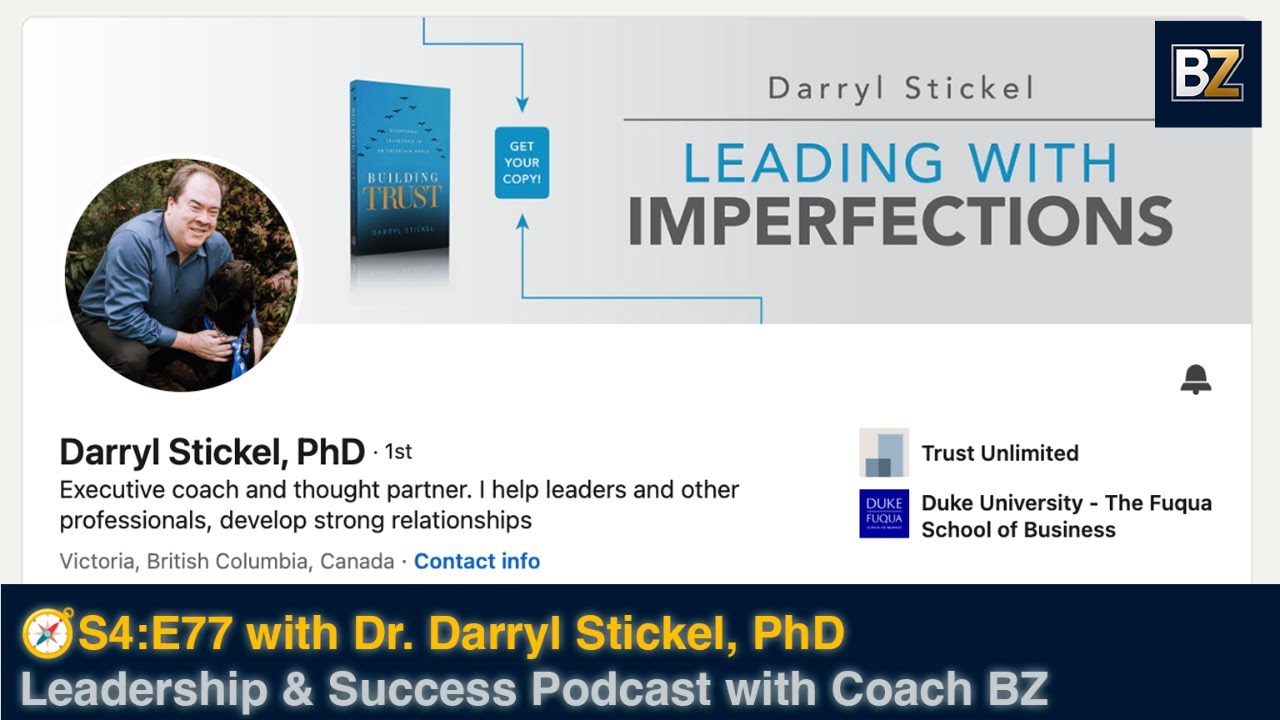
Dr. Darryl Stickel, a Duke-trained PhD and former McKinsey consultant, shares his trust model: perceived risk equals uncertainty multiplied by vulnerability. He went blind from a hockey injury and now runs Trust Unlimited, helping leaders rebuild trust through four levers: context, benevolence, integrity, and ability.
Chapters
Hi, I'm John Maxwell. When the top companies in the world are looking for trainers, speakers, and coaches, there's one name that stands above the rest, and that's Maxwell Leadership. Our certified team members have gotten proven results for companies all over the globe, and our reputation, I'm proud to say, is second to none. Some of our members have risen to the top of their profession, including the one you're going to meet today. I proudly introduce you to my friend, Bob Fabien Zinga.
Welcome to the Leadership and Success Podcast with your host, Coach Beezy. If you need to develop into a better leader, this podcast is for you. If you want to achieve a greater level of success, this podcast is for you. His mentor, Dr. John C. Maxwell, said it best: everything rises and falls on leadership. We hope to inspire you today and provide you with an insight that has the potential to positively impact the trajectory of your life. Welcome to the Leadership and Success Podcast.
Hi, my name is Daryl Stickel. I'm one of the world's leading experts on the topic of trust. What makes me say that? Well, it's because I wrote my doctoral thesis on building trust in hostile environments at the business school at Duke, worked at McKinsey and Company, and I've devoted the last 20-plus years of my career to helping people better understand what trust is, how it works, and how to build it. I'm trying to raise awareness, and my aspiration is to work with you on your podcast to try to spread the word about how important trust is and some probable pragmatic things that we can do to build it. A lot of people are talking about the importance of trust, But few are talking about steps we can actually take. I've been on a number of podcasts, over 50. I've got my own podcast called The Imperfect Cafe. And my aspiration is to be one of the best guests you've ever had. To do that, I'll talk about what excellence looks like for you. And we'll work together to create something that really has impact for your listeners. What will that look like? Well, it can be a general conversation about trust, how it works and how to build it, the model that I use. It can be at a deeper level where we dive into what matters for your listeners, what trust looks like and how it impacts them in whatever avenue they are progressing, from parenting to leadership to marketing to executive coaching or sales. Whatever seems to be the biggest bent for your listeners. Even deeper, we can look at specific problems that your listeners are facing or that you're seeing in the world that's impacting them, and I'll talk with you real time about how to solve those problems and take steps to build stronger relationships. They say a picture's worth a thousand words. Hopefully this video is worth more than that.
All right everyone, uh, thank you so much for being with me today. This is Coach Bizzy. We are Monday, uh, it's about, uh, 10:40 here in California. Uh, thank you for being here. Uh, we're gonna get started like, like we normally do. It's gonna take a bit of a moment, uh, with our moment of gratitude. So get ready. If you can, um, close your eyes, put yourself in your happy place, and, uh, take a deep breath and think about one thing that you are grateful for today. And, uh, I think every day when I wake up in America, I am just grateful for freedom. I think freedom is so important, uh, freedom, freedom of speech, freedom to pursue happiness, freedom to pursue whatever opportunity I decide. But I think that's really what represents America. I think that's why America is this very, very special country. I grew up in Africa, I've lived in Europe, and I've come to the US, but I— and I've traveled around the world, but I feel like there is really no other country like the US. That's part of the reason why I joined the US Navy, to really defend that freedom, not just here, but around the world. The world as well. So let us know what you are grateful for. And I really do appreciate that. So you heard a little bit about my guest earlier. So it's really a great pleasure for me to have Dr. Darryl Stickell with us today. Trust is the foundation of leadership. And in today's world, few understand it better than Dr. Stickell. So he's the founder of Trust Unlimited, former McKinsey consultant, Jook PhD, and one of the world's foremost experts on trust. And I am thrilled to welcome him to the Leadership Success Podcast today for an inspiring live conversation on how leaders can build resilient teams, deeper connection, and high-performance culture rooted in trust. Please, ladies and gentlemen, help me welcome to the Leadership Success Podcast, Dr. Dale Stickle. Welcome. Dr. Sikol, how are you doing?
I'm doing well, better now that I'm here with you.
Fantastic. What is one thing that you are grateful for today?
So there's actually two, and it's my sons. My sons mean everything to me. And I'm blessed to have seen them grow and develop into two fine young men.
That is so wonderful. I have two daughters myself. Yes, there is nothing more important in life than their future and what they mean to us. And, uh, what if— what is one thing about you that most people may not know about?
I'm kind of an open book. Um, I have a son who's joined the Navy. I'm legally blind, but most folks tend to know that.
Wow.
Thank you. Thank you so, so much for sharing. I appreciate that. Can you tell us kind of about your leadership journey?
Yeah, I was born and raised in a small town in northern British Columbia, Canada. Isolated, harsh winters. And I grew up believing that if you could help people, you should. And because we're so isolated, we had this tendency to pull together. You know, people realized that you had to rely on your neighbors. And so I grew up, uh, in a community where you looked out for each other. And when I was 17, I was playing junior hockey and I got attacked by a fan with a club. And he shattered my helmet, knocked me unconscious. Apparently I stopped breathing 3 times on the way to the hospital. And wow, I knew that I was losing my sight. Um, so my plan had been to train my brain to think for a living, and now all of a sudden I couldn't think at all. And so I had this prolonged sense of despair and lost hope, and it provoked a sense of empathy in me that's uncommon. And so eventually I went to university, um, I was studying in Victoria, and Bob Fabien Zinga, I'd be sitting on the bus and a complete stranger would sit next to me and say, I'm really having a hard time. And so I started to think about what is it that allows people to open up to me, and I started down the path towards becoming a clinical psychologist. So I worked with families in crisis, troubled teens, worked on crisis lines. And was trying to hone those skills. And then I reached a point where I realized that a lot of these folks had taken a long time to get to the place that they were, was going to take them a long time to get out of it if they ever did. And I thought that was driving me crazy. And so I shifted, went into public administration, did a master's degree And I was working in Native land claims in British Columbia, and they would ask me these deep philosophical questions like, what is self-government? What will the province look like 50 years after claims are settled? The last question they asked was, how do we convince a group of people we've shafted for over 100 years that they should trust us?
Hmm.
And Bob, I thought that was a really good question. And so I went to Duke, went to business school, wrote my doctoral thesis on building trust in hostile environments. And wow, you know, I had two of the world's leading experts on trust on the committee, and they sat me down afterwards and they said, you know, when you first came to us, we thought, too big, too complicated, he never solves it. We'll give him 6 months and he'll come crawling back to us. 6 months in, you were so far beyond us, we couldn't help anymore. All we could do is sit and watch. And here we are years later, we think you've solved it. And so I left there and joined McKinsey and got a chance to apply the concepts that I've been theorizing about. And McKinsey said to me, you've got really great client hands, we're going to send you the worst places possible. And so I would find myself in places where hostile takeovers have taken over, or, or people were just having a hard time getting along. And I learned And then 2001, I was involved in an accident, ended up another concussion, and just couldn't work those hours anymore. And so I started my own little company called Trust Unlimited, and I started helping people better understand trust. And I helped the Canadian military try to figure out how to build trust with the locals in Afghanistan. Helped private sector companies, finance, construction, mining, nonprofits, public sector, and all over the globe. I taught for Luxembourg, um, and this whole time I'm just continuing to learn how to apply this and teach people and how to help them better understand.
Wow, that is very powerful. Your story is very, very touching, really a story of resilience. And actually, when you talk about trust, as a cybersecurity executive, I think that's really one of the main things we do is to make sure that, you know, other organizations trust whatever organization we work for, that we care about their data, their privacy, their security. Really everything we do in the tech world really is based on that trust because nobody's gonna buy from you, nobody's going to partner with you if they do not trust you. So trust is so important. Now, you have been called a trust savant, and with a PhD work you did at Duke University on building trust in hostile environment, which I guess would relate in the military too, we go to a lot of hostile environments sometimes. How has that shaped your life mission?
So through all the trials and tribulations, I felt that God had a purpose for me, that he was forging me. And when I show my work to academics who are studying trust, they say, no one else talks like And when I talk to real people about it, they say, of course this is how it works. How, how did you get a PhD? Because this is just common sense. So my life has been devoted to trying to get the signal through the noise, trying to help people better understand and create a better world. And so I feel like I have a sense purpose, that there's something I'm meant to do.
Wow, that is powerful. That is very, very powerful. So you've worked at McKinsey, like we mentioned during the, uh, introduction. You've coached executives worldwide, and you founded Trust Unlimited. Can you share a pivotal story where you saw trust, or the lack of it, and change the course of an organization?
Yeah, there's been a few of those. I was hired by a company in Luxembourg to help train their senior executives. And it was going well. And then they asked me to spend some time with their senior board of directors. And I said, sure, I'd be happy to spend the day with them. The day before, they sat me down and said, oh, by the way, the two unions are going to be there as well. I said, well, that'll be different. And I said, yeah, so you know, we've been in court for the last 5 years and everybody hates everybody. And I said, wow, you're so— you go back to that, throwing me in the river. And so I found myself standing in front of these folks who've had a long history of dispute, and I have to convince them that they need to get along. And we spent the day walking through the model, and at the end they all stood up, shook hands with each other, shook hands with me, said it's the first time we've had hope in 5 years. Wow. And 6 months later, they signed a new collective bargaining agreement that they're all pretty happy with.
Wow, that is pretty amazing. Wow. So talking about trust then, uh, what do you think separates leaders who are merely acceptable and those who are exceptional when it comes to building trust?
So I think a lot of times leaders feel like they can't make mistakes, that they have to be perfect, which leads to them micromanaging, because that means that no one else can make mistakes either, and it crushes any sense of innovation or adaptation. And so leaders need to be able to step forward and and acknowledge that they're not perfect. Yes. And part of that, you know, when I talk to leaders, I'll say to them, are you the same leader you were 5 years ago? And they'll say, God no, I've learned and grown and developed. And I say to them, do you think you'll be the same leader 5 years from now? And the response is always, I hope not. So that means you're going to step away from the things that got you where you are and into the things that are going to make you great.
Yes.
But you learn skills. And so what you should be saying to your people is, I'm going to grow, evolve, and develop. I'm going to get better. Along the way, I will stumble. I may fall. My expectation is that you'll be there with me, helping me back up. Yes, dusting me off and help me learn from those experiences. Because that's exactly what I'm going to be doing for you.
Hmm.
So in that case, then, how can a leader recover from a breach of trust? What would you recommend? To err is human. Nobody is perfect. But I guess when I was a junior officer, one of my best mentors, a commanding officer at the time, said, you know, while you are a junior officer, this is the time for you to make all kinds of mistakes because everybody knows you are super green. You don't know anything yet. However, the more senior you become in the Navy, especially as you get more qualifications and you get more responsibility, then people have very, very high expectations. Of you. So, uh, especially in this podcast, again, I am really focusing on aspiring leaders in the military and in tech. Uh, what would your advice be if someone, uh, breaches trust, and how would they recover?
So trust is the willingness to be vulnerable when you can't completely predict how someone else is going to behave. Without some level of vulnerability, trust is irrelevant. And so if we fail, that means we've let someone down. We've caused them pain because they were vulnerable to us. If we want to recover, we need to acknowledge that thing, apologize. For the event, even if it wasn't our fault. And then we need to make a credible commitment that we're going to do our best to have that not happen again, and take steps to show them that we're serious about that.
Hmm, that is quite insightful. And like you mentioned, your son just joined the Navy. What would you advise naval junior officers preparing for command, uh, on building trust quickly, especially in high-pressure, high-stakes environment?
So building trust is a matter of understanding where does uncertainty come from, where does vulnerability come from, how do I take steps to manage it. And so I've been taking steps to reduce uncertainty. And we do that by clarifying roles, getting feedback around what excellence looks like. You know, Bob, we all have the ability to build trust. Some are just better than others. Those who aren't very good have a lever that they pull. And often it's the ability lever. You should trust me because I'm the captain. Or because I'm Lieutenant.
Yes.
Um, I have X number of years of experience. I have these credentials. That's the ability lever. Over and over, those who are better at building trust have multiple levers, and those who are really good have multiple levers and they know when to pull which one. And so if I want to build trust quickly, I go first. So I make myself a little bit vulnerable, and then I seek ways to show benevolence, which is one of the other levers, right? Benevolence is having someone's best interest at heart, having their backs. Yes.. And so I acknowledge, if I'm a young officer, look, I'm still learning, just like you are. I'm going to make the best decisions possible. And I aspire to be a great leader. But I'm a work in progress.
Wow, that is, that is quite insightful. So keeping that, that thought, and I like the idea of having several levels What about for the other half of my audience, Silicon Valley security engineer or analyst who would like to transition into a C-level tech role? What can they do to establish credibility and trust with teams who may have been their peers just weeks before?
Well, again, I like to include other people in the conversation. And so saying your your previous peers. I want to be a really good boss. I know that I can't do that without understanding what you think a really good boss looks like. So you've had bosses in the past, what made them good? So we start to define excellence together, and then we're transparent about it.
Wow, that's powerful. Wow. Okay, uh, I like that a lot. Can you walk us through your trust model and what are the key components and how can leaders start applying it right away? And I believe it's also well described in your Building Trust, uh, best-selling book on Amazon.
Yeah, I try to write the book in a way that everyone can read it. And I wrote it so that if I go away, what I know doesn't. And so, as I was saying, trust is the willingness to make yourself vulnerable when you can't completely predict how someone else is going to behave. And so that has elements of uncertainty and vulnerability baked into it. And when we're deciding to trust someone, we ask ourselves two fundamental questions. First is how likely am I to be harmed, which is perceived uncertainty. Second is, mm-hmm, if I'm harmed, how bad's it gonna hurt, which is perceived vulnerability. Those are the basis of trust. So it's uncertainty times vulnerability gives us a level of perceived risk, and we each have a threshold of risk that we can tolerate. And if we go beyond that threshold, we don't trust. If we're beneath it, then we do. And so if we think about—
wow—
early relationship, uncertainty is high, which means that vulnerability has to be low. As that relationship gets deeper, the range of vulnerability we can tolerate starts to grow. In our deepest relationships, We have just a sliver of uncertainty. And then you have a huge range of vulnerability.
Yes.
And so to build trust, we just need to understand, where does uncertainty come from? How do we take steps to reduce it? Where does vulnerability come from? How do we take steps to help people manage it? Wow. So uncertainty comes from us as individuals and from the context we're embedded in. And context is just the rules of the game, the formal and informal mechanisms of social control. And so one of the things I learned about helping the Canadian military in Afghanistan was that context plays a huge role early on, and it carries more freight than us as individuals. And that's why we have rules and regulations in the Navy, right? We have a set of predetermined expectations so that people can jump to tasks quickly. And it's why in cybersecurity, we have rules that we set up for algorithms, for systems, for how we're going to program so that everyone can predict. And if we think about it, there are times we trust people without knowing anything about them. You go to a doctor's office, they say take off your clothes, and you do. I've tried that in other places, Bob. Doesn't work. And if we take that example, same two people dressed the same way and shifted it from a doctor's office to a gas station restroom, it goes from credible to creepy in a heartbeat.
Yes.
And so context is one of the levers we can pull. I can explain the rules to you. I can explain how I'm constrained. Makes it easier for you to predict my behavior.
Wow.
Within us—
wow, that—
oh, sorry, please, please continue.
That is, that is quite powerful what, what you just said.
Yeah. And I was one of the first to talk about context. Apparently there's research coming out recently that talks about it, but 20 years ago, that was my thesis. Wow.
That's powerful.
And then 3 more levers lie within us as individuals. There's benevolence, which is having someone's best interest at heart. There's integrity. Do I follow through on my promises? Do my actions line up with my values? And there's ability. Do I have the competence to do what I say I'm going to do?
Wow, that is powerful.
Powerful.
So what do you think is one small daily habit that leaders can practice to increase trust with your team?
So there's— being vulnerable promotes a sense that it's safe to be vulnerable. And so my advice to anyone is when you want to build trust, go first. We see in the world that Vulnerability hasn't really gone down over the last decade, but uncertainty's bouncing all over the place, which makes it really— and it's why trust levels are some of the lowest levels we've ever measured, because asking people to be just a little bit more vulnerable is harder than it's ever been. And so we need to be intentional and thoughtful Because people interpret the world through stories, and so we need to be aware of the stories they're telling, share our stories with them, and start with a little bit of vulnerability. So in the Navy, that might look like, hey, when I was in your role, I made a bunch of mistakes. One of them was the following. Or there are moments where this job is hard, right? And I just did a workshop for the Canadian Navy, and we talked about the challenges that come in a military setting, particularly around integrity, because it could be hard to make promises that you could follow through on when you're involved in a highly uncertain environment, and you don't always have control. So you need to be careful about what commitments you make, what promises you make. Only focus on promising about things that you have control over, things like the effort you're putting or that you'll look out for your crew.
Wow, that is extremely insightful. So the last question I'm going to ask you for this first segment before we go to the second segment is, in an era of artificial intelligence, emerging tech, remote work, and global uncertainty, what does the future of trust look like?
So trust levels are the lowest we've ever seen. Um, yeah, with artificial intelligence and social media, we have lost the ability to learn about trust, about building relations. We need to be more intentional than we've ever been. Bob Fabien Zinga, I could make stupid mistakes and be an idiot multiple times in a row, and people were stuck with me. And so I had to learn, grow, and adapt. Eventually someone would take me aside and say, you're being an idiot. We've lost that. And so now if we make a mistake, we're just cut loose. And so I think unless we're intentional, things are just going to keep getting worse. Wow.
That gives us a lot to think about. Is there a question I should have asked you for the first segment that I haven't asked yet?
Was that the full model? Because I got you through uncertainty and vulnerability. Yes, but after we make the trust decision, we have a perceived outcome, and that feeds back into our next interaction. And in the middle of all this is our emotional states. 99% of trust research treats people like they're rational actors, and I don't know if you've met people before, Bob, We're not always rational.
Yeah, definitely emotional.
Yeah, and the more emotional we become, the less rational we are.
Yes.
Hmm, that is powerful. Yeah, because I remember when I, when I was growing up, you know, people used to say women are a lot more emotional than, than men, but that's definitely not not true. We are all emotional beings.
We are. And failing to take that into account is why some of these disputes are so resilient.
Yes. Wow. Okay, thank you, thank you so much for sharing this. It's really impactful. I'm really glad you are here. So the second segment, we're going to be focusing more on leadership. What is The greatest lesson you think you've learned so far?
Hmm, that there isn't a silver bullet, that people need different approaches. Some need firm authoritarian approaches, some need a softer touch. Um, We can't be aware of that unless we include them in the conversation. Yes.
Wow, that is powerful conversation. Yes. Okay, and, uh, now you've got a PhD from Duke and your life is very inspirational and you've shown a lot of resilience, and I think that you were able to overcome. What, what do you think is the secret of your success?
I think it's a combination of things. I mean, a hard road can be a good teacher if we let it. And having the right story in place, you know, we interpret the world through stories.
Yes.
I mean, I've got challenges. I'm legally blind, you know, I'm followed through challenge. Um, there's, there's been significant pain through a good portion of my life. Being able to reframe that as part of my growth, and something that makes me stronger and better, allows me to persevere.
Hmm.
Wow, that is, that is powerful. I had another guest a couple of weeks ago, Eddie Bright Jr. And he said that on the other side of your pain, uh, that's where the blessing is. There is, there is growth. Sometimes you're going to be able to help a lot more people just because of what you went through. But while you're going through it, sometimes you don't realize it, but there is a blessing on the other side. That is, uh, quite powerful. So, uh, what's the greatest leadership advice you have ever received, do you think?
I guess it would have come from theater. No one else knows the lines, and so as long as you don't overcommit, as long as you're able to Express confidence, people will follow. And that confidence needs to come from the people you lead, right? That we can accomplish something. Yes. A lot of times, you know, my son was on a baseball team. And he was hoping to get a baseball scholarship, and he said to me, we've got a young team, we're gonna get our brains beat in, we're gonna lose just about every game. And I said, well, you need to redefine success around things that you have control over. And so you want to get a baseball scholarship That means that you need to do well in school, but you also need to be a good teammate. You need to continue to develop your own skills. You need to have a good relationship with the coaches so that they'll advocate for you.
Hmm.
And we revisited that multiple times, right? He'd come home and say, oh, we, we just got crushed. I'd say, but how are you doing against things you have control over? Hmm. You'd say, well, I've made the All-Star team, and my coaches love me, and I'm a good teammate. I teach the young guys. Yes, I help them improve. I really enjoy seeing them be successful.
Wow, that is quite powerful. And as a leader, what, what are you learning now?
I'm still learning how to get the signal through the noise, how to have— how to get people's attention. Right. So when I talk about trust, if I get the chance, to solve people's problems, they realized, okay, this is powerful, it has impact. But when we first start talking about it, people assume that I'm going to be walking them around with blindfolds or cross-eyed holes, or they're going to be falling off things or singing Kumbaya, and they don't know that there's a real science behind it. But there's an art to— and so getting people to actually take those first steps to try something new. I'm still trying to get better at helping people strive and learn. Hmm.
That is Very good. And what is the greatest investment you have made in yourself, you think?
Again, I'm gonna go back to the story. You know, it's easy for us to have a negative story about self. Yes. Um, and that positive narrative, you know, when it comes to my kids, I have a relentlessly positive narrative. Which allows me to interpret new information about them in the best way possible. Can I have that same positive narrative about myself?
Wow.
Can I give myself grace?
Hmm. That is powerful. So it's really all about reframing? I guess you've said it in many different ways, but how do you interpret what is happening to you, and how do you reframe your experience in a positive way that's going to empower you to move forward?
And how do you help others reframe for themselves?
Yes.
Wow.
All right, so I have this card. I like to show it. On one side it says Success, on the other side it says failure. I really believe success and failure are two sides of the same coin. We know all about your successes, but how has failure shaped your life?
So I keep learning, um, you know, when, when we do podcasts or we do interviews, I need to keep being aware of how I get better, or if I flopped at something, I can't let it prevent me from trying in the future. So I talk sometimes about internal and external locus of control. When I was teaching undergrads, I would talk to them about this, and I'd say An internal locus of control means you're master of your own destiny. You're an actor in the world. An external locus of control means you're buffeted by the winds of fate. Things happen to you. And I'd say, how many of you here have an internal locus of control? And all the hands would go up. It's a stirring sight. And then I say, this is awesome. Listen, that means that if you fail this class or if you don't do— it's not because I didn't teach it properly or the test was too hard. It's all you, baby. And they kind of go, oh no, wait. And I say, yeah, we've got an internal locus of control when we're successful and an external locus of control when we fail. My sons have never played a sporting event. Where their team lost, that the ref didn't suck. And what we need to do is look at the reasons we succeeded. Look for hints about the context that helped us be successful. And then when we fail, look at things we could have done differently, signals we could have seen. Ways we could have improved our performance.
Wow, that is, that is quite powerful. I think in, in the Navy we learned that as extreme ownership, right? If, uh, we fail, it's because of us, and if we win, it's because of us too. But as a leader, when we do win, I share credit with the entire team, and if we do fail, it's I as a leader who has failed. And, uh, I kind of COVID and shield my own team. That's pretty much how we, we are taught leadership in the Navy. That's, that is, uh, very insightful. So now, who are some of your thought leaders, people you, uh, follow that we should know?
So I love mentors, Adam Grant and Scott Galloway. Um, yeah, Amy Edmondson. Who does work on psychological safety. Um, those are kind of the main ones that I lean on.
Very good. Uh, yeah, I know all of them, and I am connected to most of them. Dr. Amy, I believe she's, uh, Harvard. And yeah, yeah, I've, I've read her book. She's made psychological safety very famous. Okay, so if you could choose 3 people to have dinner with, it could be alive, dead, or mythical figure, who would you choose and why?
Oh, it's a good question, Bob. Um, well, I'm kind of enjoying our conversation. Would you be open to having dinner with me? Sure. Okay, so you're one.
Oh, this is the first time it's ever happened. I've been doing this for 4 years. Nobody has ever selected me. But yeah, I definitely would have dinner with you. I would learn a lot more about trust for sure.
How about we join with Socrates?
Yes.
Because I love his line of thinking.
Yeah. And what I love about Socrates, all I know is that I don't know anything, right? It's— that's definitely something I learned from reading is writing. It's just the humility and the knowledge and being conscious of what you do know and what you still have to learn. It's incredible.
Well, and for me, growing up where I grew up, the fact that I know certain things makes me no better than anyone else. It actually puts a responsibility on me. To help others understand the world the way that I do.
Wow, that is powerful. Okay, and who would be the third person on the dinner table?
Can we have God?
Because yeah, I've got some questions.
Why are things so hard? Hmm, you know, what lesson do we need to learn?
Wow. Yeah. And going back to the question I asked you about, how has failure shaped your life? In my experience, when I succeed, I don't learn very much out of my successes, right? And it's when I do fail that I really, really learn a lot. And when, when things are easy, again, I don't learn very much. But when things are challenging, that's usually when I go. So sometimes it's painful, sometimes you may have to cry, but again, on the other side of that pain, I think, is where the blessing is if you just don't give up. But, but yeah, that would be a very interesting question to ask God for, I'm sure.
Wow.
Okay, so what, what are you reading right now? Which, which books are you reading, and which one would you recommend?
So I'm a big fan of Thinking Fast, Thinking Slow by Kahneman. Um, yeah, one of my favorite books is Exit, Voice, and Loyalty. I just thought of that. It was written in the '60s, talks about how economists think about how we respond to failures. Versus Political Scientists.
Um, do you remember the author of that one?
Uh, it's escaping me.
I will, I will find it on Amazon and add it to the article we're gonna write about this. That's pretty fascinating. I don't think I've read this one before. I will add it to my reading list. Pretty cool. Any, any other book you would recommend? Actually, I think that is one we absolutely have to recommend, this one here.
Yes.
Right. Building Trust by Dr. Dale Stickle. Exceptional Leadership in an Uncertain World.
And I really tried to make it so that people got the whole model. And they got recommendations for how to pull the different levers. Really, when we're training people and coaching people, we have a very practical applied approach that goes through and says, okay, so here's how you show someone benevolence. Because a lot of times when I talk to leaders, I'll say benevolence, integrity, and ability, and they'll say, I do that.
Yes.
And my response will be, says who? Because Bob, if it's me telling you I'm benevolent, that carries a lot less freight than you thinking it. And for me to get you to think it, I actually have to have the conversation with you.
Powerful. So which, which podcast would you recommend?
I like Raging Roberts with Scott Galloway. Um, that's the main one I'm listening to right now.
Okay, I think there is one more. This one here, The Imperfect Cafe, with Daryl.
Yeah, we're trying to talk to people about shedding that notion of perfection. Whether you're a parent or a leader, people need to see how you handle it when things go wrong.
Powerful. Are there any YouTube channels that you would recommend? If not, that's That's okay. Yeah, not off the top of my head because it seems like YouTube has now become the number one, um, media, uh, channel in the entire world platform. Uh, more people go on YouTube than they, they go on cable and everywhere else. It's incredible.
Well, part of the challenge for me, Bob, is that I want my message to get to everyone. And if they hear that I'm listening to one side or the other, it's going to alienate and—
I'll follow them. Yeah.
And so we're in an environment where it's hard for me to be that vulnerable because— no, no, yeah, because the message really resonates for both sides.
Yes.
Um, and I don't want to lose half of North America.
Yes. Yeah, I think it was Michael Jordan who said why he wasn't getting political, because he says Republicans need sneakers too, but which makes perfect, perfect sense. But I believe Scott Galloway, I know he's only on a couple of, um, podcasts, is usually pretty insightful except when he tries to be very funny. But, uh, yeah, uh, cool. What about, uh, Music or movies? Any songs or movies you would recommend?
Yeah, I like Sara Bareilles' Brave, which is basically about speaking up, being brave, making ourselves a little bit vulnerable. Yes.
Any movie?
Well, I saw you ask one of your other guests, what movie would describe their life, or book, or song.
Yes.
And gotta admit, I thought the Book of Job, but, uh, I think again Finding Happiness with Will Smith, um, because there's a story there of perseverance. Yes. And while he was seeking happiness for himself, I really want to have positive impact on the world. I want to make it a better place for my sons and your daughters.
Yes.
And I think we need to pull together to do that.
Powerful. Yeah, it's very, very inspirational movie. I think, uh, you are probably the sixth person who's recommended for this year alone. Uh, great, great movie because I think I was a lieutenant junior grade when my commanding officer kind of taught me how to look for leadership principles in movies, which was pretty, pretty cool. So I don't really watch a lot of movies, but when I, when I do, I always try to see what's the lesson here, what can I learn from this, even if it's a fictional story. But, uh, cool. Okay, so, uh, What have you done that we should do?
So I consistently try to find positive narratives for others. And right now I'm focused on something called the Aspiring Men's Program. It's something that's early stages of development. Young men are in dire straits right now. They make up, yes, 80% of the suicide rate. Their mental health is not in a good place. They are underrepresented in advanced education, overrepresented in substance abuse and addiction.
Yes. And Yeah, and another big worry I have— I have two daughters, but some of the boys I see, they really don't have mentors or people they can learn from. And sometimes they're also very lonely. They just play games in the basement all day long and don't really have any relationship with human beings, only AI chatbots, whatever they watch on social media, which is sad.
I'm focusing my work on helping them build strong relations so they become more resilient, so they can thrive. The opposite of addiction isn't sobriety, it's connection. And says that—
says that one more time, please. This is powerful.
The addiction is not sobriety, it's connection.
Wow.
And when I was telling you before that we've kind of lost that ability to learn and evolve and figure out how to build strong relationships. I want to teach people that. And I'm starting with them. I've been working on it with executives for years. But I think there's a real need.
That is powerful. Now we talked about the pursuit of happiness, but I definitely believe that strong relationships leadership is definitely a very core component of that.
Wow, powerful.
Okay, let me ask you this. If you had one and only one day to live, what would you have liked your final contribution to be?
So one of my colleagues and friends said, I wish that America could just sit and listen to you for a couple of hours. I would like my work to become mainstream. And for everyone to know how to be thoughtful and intentional about building strong relationships with each other.
Powerful, powerful. Yeah, that will definitely make our world a better place for sure. Me being in the military, I strongly believe, you know, and support and defend the Constitution, and especially the First Amendment. And, uh, you know, I would fight and even, you know, be willing to die for the right of people to say things that absolutely do not agree with, uh, because I think that's really what makes us, you know, America, I think, the leader of the free world so far.
And it's getting harder to have conversations.
Yes, which is really, really sad. We have to be tolerant of other people's perspective and definitely never ever resort to violence. You know, we need to keep talking and also being willing to have an open mind and change your belief too, you know, if needed. But yeah, I think you are absolutely right. We absolutely need to go back there. So what is one problem when you wake up in the morning you would like to solve?
I think it goes back again to getting the signal through the noise. So we see that young men are engaged in mass shootings, assassination, uh-huh, and I have to think that it's because they don't feel like they can make change in the world. They, they feel isolated and desperate. And like they have nothing to lose. I'd like to change that. Wow.
It's powerful. Definitely something we, we need now more and more. But this is something you care a lot about. I care about that too. For the average person listening to us right now. Is there anything that everybody can do to kind of help solve this problem, you think? Well, I'm thinking mentorship is probably key. But yeah, sorry.
Yes, right. I think we need to change our story. You know, there's this narrative out there that young people don't want to work hard, that they don't care. That they're disengaged. And that story has been told since the '30s. Hmm. And what we need to realize is that the context has changed. The rules have changed.
Yes.
When you and I were younger, we had this belief that if we worked hard, everything would work out. They don't believe that anymore. The social contract has been broken. And when billionaires get on social media and say, you just need to work hard, what they hear is, you need to work harder so I make more money.
Yeah, yeah. Wow.
So we need a positive story about them, that they're doing the best they can in the environment that we've created.
Mm-hmm. Wow, that is, that is powerful. So we, we end of our podcast now, almost out of, out of time. Uh, how can we add value back to you? You've been so generous with your time and your wisdom.
Well, I would be thrilled if folks shared this podcast. Um, buy the book, read it.
Yes.
Reach out. Uh, you can reach me at daryl@trustunlimited.com. Um, check out the website, The Imperfect Cafe. The website's called Trust Unlimited, and there's blogs there. Help me be intentional about bringing the message to the world. I, I feel like I'm dropping grains of sand in the ocean. People need to help me pick up my big rocks.
Yes. Wow, powerful. And, uh, again, I want everybody to follow you on LinkedIn, so that's linkedin.com/in/dale-stickle-phd, so people can follow you. Very easy to, to remember. Okay, uh, is there a question I should have asked you for the second segment that I haven't asked yet?
This has been a great conversation.
Fantastic. Yeah, so here then is my last question for you, serious question, I guess the most important question. If you could go back and give a piece of advice to your 17-year-old self standing at the edge of this incredible career you've had, what would you say to 17-year-old Dale Stickle?
I would have said it's going to be hard, but it's gonna be all right. Hmm.
Powerful.
It's going to be all right. Well, I mean, I really love your positive narrative. We definitely need to do more of that. So very, very quickly now, I know we are at the end of our session, but this is going to be really quick. What did you want to be when you were a kid?
I don't know. I think an airline pilot.
Okay. I think a lot of kids did, and that's not what you are now, which is perfectly fine. So 3 adjectives describing you as a child.
Confident. Friendly.
One more. Don't think around. Curious. Okay, what about as an adult?
Engaged. Still curious. Tired.
Okay, well, I think you're still confident and very friendly too as an adult, but good. Okay. Fantastic. And then the very last question, this is the last one, we're gonna shut down this podcast. What is one word that represents our shared experience on this podcast today? What word comes to mind?
Hopeful. Hopeful.
Yeah, I think it's everything that you really teach about trust. I think learning to trust even a stranger, being positive and having a positive impact on environment, that's really what I'm getting out of this this wonderful leadership conversation. So thank you so much, uh, they all— Dr. Stickle, thank you for being here, and, uh, really, uh, appreciate you making the time to share your wisdom and, uh, experience with us. Thank you.
Thanks for having me.
All right, everyone, this is it on Leadership and Success Podcast today, Season 4. Today was episode, I believe, 77. Wow, we've had 77 episodes since the beginning of this year. So I'm gonna be back here, uh, tomorrow, I believe, so around 11 o'clock, and I'm going to have Chris as my guest. And then I'll be back again on Wednesday, and I'm going to have Coach Houston as my guest. So make sure to follow me on LinkedIn and find out when I'm going to be back. And I don't see any questions on LinkedIn or on YouTube. So until tomorrow, have a wonderful, wonderful rest of your day. Thanks again for being with us today. Bye.
Thank you for listening to the Leadership and Success Podcast with your host, Coach BZ. If you like what you heard, please subscribe to our channels and come back for more wisdom nuggets on how you may develop into a better leader and achieve greater levels of success. Leadership is the most critical skill. The world will always need leaders to lead others, deploy the next disruptive technology, or execute a business strategy, you may as well decide on counting yourself among the 21st century leaders. See you right here next time on the Leadership and Success Podcast with Coach
More from Bob

S250:E4🎙️LIVE 🇺🇸America 250: President Barack Obama Leadership, Service, and the Power of Hope






S5:E157🎙️ LIVE with CMD CMSgt Dennis L. Fritz, USAF (Ret.)(Multi Tracks Audio)



S5:E156🎙️ LIVE 🇪🇸 Leadership Lessons from the FIFA World Cup 2026 Champions (Multi Tracks Audio)

S250:E3🎙️ LIVE Leadership Lessons from America’s First Documented Family of African Descent 🇺🇸📖