S4:E77AI RECAP🎙️LIVE with Dr. Darryl Stickel, PhD
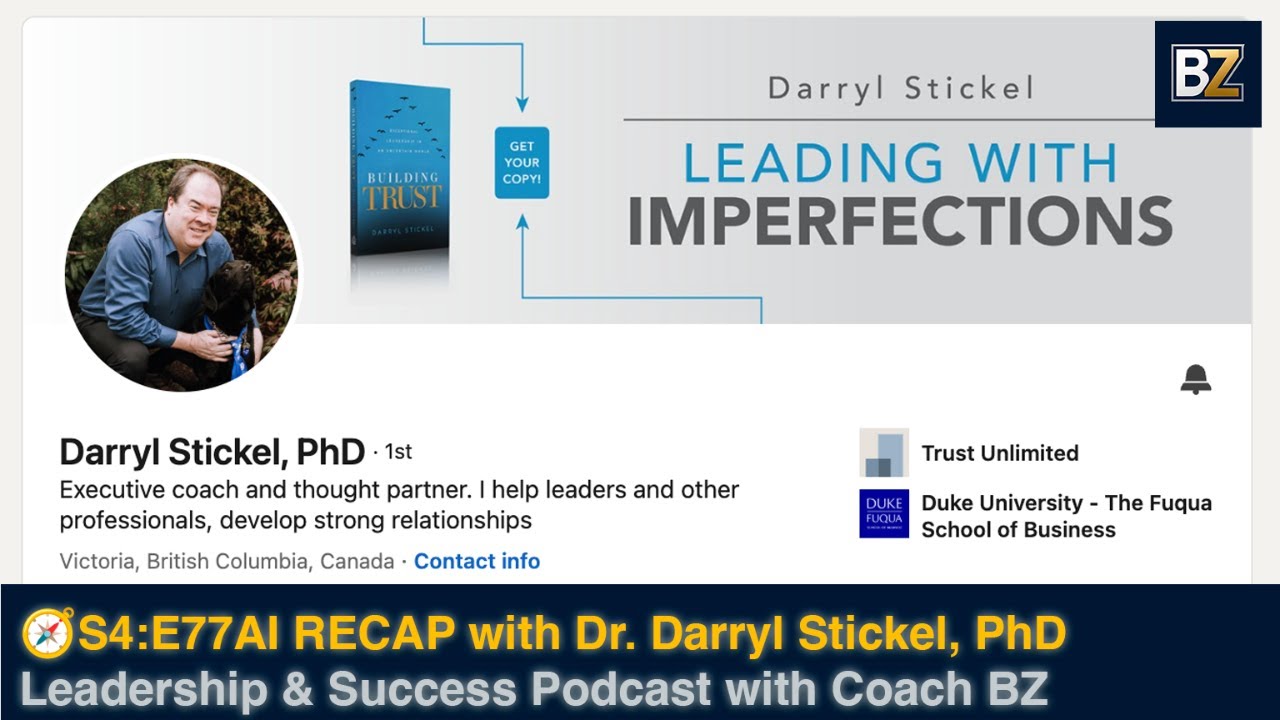
Coach BZ interviews Dr. Daryl Stickel on trust and leadership. Stickel's model: uncertainty times vulnerability equals perceived risk. He argues leaders must practice calculated vulnerability and transparency to build trust, and launched the Aspiring Gents Program to combat loneliness and addiction among young men through mentorship.
Chapters
Hi, I'm John Maxwell. When the top companies in the world are looking for trainers, speakers, and coaches, there's one name that stands above the rest, and that's Maxwell Leadership. Our certified team members have gotten proven results for companies all over the globe, and our reputation, I'm proud to say, is second to none. Some of our members have risen to the top of their profession, including the one you're going to meet today. I proudly introduce you to my friend Bob Fabien Zinga.
Welcome to the Leadership and Success Podcast with your host, Coach BZ. If you need to develop into a better leader, this podcast is for you. If you want to achieve a greater level of success, this podcast is for you. His mentor, Dr. John C. Maxwell, said it best: everything rises and falls on leadership. We hope to inspire you today and provide you with an insight that has the potential to positively impact the trajectory of your life. Welcome to the Leadership and Success Podcast.
Imagine gaining the leadership skills that could redefine your career. Join Coach BZ on the Leadership and Success Podcast, where each episode delivers practical insights from world-class speakers, military leaders, and industry experts. We dive deep into what matters most. Building resilient teams, leading through uncertainty, and navigating complexity with clarity and confidence. Every conversation is crafted for aspiring leaders like you who are ready to grow, lead, and make a lasting impact. Don't miss our powerful live sessions and recent highlights. Michelle Hayward on building diverse, high-performing technical teams. Anne Leslie on leading through global complexity in cybersecurity. Risk. Ron Carpenter, AI exploring faith, resilience, and AI-powered leadership. Colonel Michelle G.I. Gardner-Ince on commanding influence from the battlefield to the boardroom. Chris Robinson on shifting from drift to drive in life and leadership. And Coach Enrique Acosta Gonzalez on mentorship, legacy, and heart-centered leadership. Ready to level up your leadership journey? Tune in on Spotify, Apple, Audible Podcasts, YouTube Live, and LinkedIn Live. Join the movement toward leadership excellence. Listen now and start transforming your success.
Hi, my name is Daryl Stickel. I'm one of the world's leading experts on the topic of trust. What makes me say that? Well, it's because I wrote my doctoral thesis on building trust in hostile environments at the business school at Duke, worked at McKinsey and Company, and I've devoted the last 20-plus years of my career to helping people better understand what trust is, how it works, and how to build it. I'm trying to raise awareness, and my aspiration is to work with you on your podcast to try to spread the word about how important trust is and some probable pragmatic things that we can do to build it. A lot of people are talking about the importance of trust, But few are talking about steps we can actually take. I've been on a number of podcasts, over 50. I've got my own podcast called The Imperfect Cafe. And my aspiration is to be one of the best guests you've ever had. To do that, I'll talk about what excellence looks like for you. And we'll work together to create something that really has impact for your listeners. What will that look like? Well, it can be a general conversation about trust, how it works and how to build it, the model that I use. It can be at a deeper level where we dive into what matters for your listeners, what trust looks like and how it impacts them in whatever avenue they are progressing, from parenting to leadership to marketing to executive coaching or sales. Whatever seems to be the biggest bent for your listeners. Even deeper, we can look at specific problems that your listeners are facing or that you're seeing in the world that's impacting them, and I'll talk with you real time about how to solve those problems and take steps to build stronger relationships. They say a picture's worth a thousand words. Hopefully this video is worth more than that.
With artificial intelligence and social media, we have lost the ability to learn about trust, about building relationships. We need to be more intentional than we've ever been. Bob, when I was young, I could make stupid mistakes and be an idiot multiple times in a row, and people were stuck with me. And so I had to learn, grow, and adapt. Eventually someone would take me aside and say, you're being an idiot. We've lost that. And so now we make a mistake, we're just cut loose. And so I think unless we're intentional, things are just going to keep getting worse.
Wow. That gives us a lot to think about. Is there a question I should have asked you for the first segment that I haven't asked yet?
Was that the full model? Because I got you through uncertainty and vulnerability.
Yes.
But after we make the correct decision, we have a perceived outcome. And that feeds back for us into our next interaction. And in the middle of all this is our emotional states. 99% of trust research treats people like irrational actors. And I don't know if you've met people before, Bob, but we're not always rational. Yeah.
Definitely emotional.
Yeah. And the more emotional we become, the less rational we are.
That is—
Oh, well, that was Dr. Daryl Stickler. And thanks so much for being with me today. Today will be a 10-minute recap of the wonderful hour-long leadership conversation I had with Dr. Stickler. And thank you— I mean, Stickler. And thank you so much for being with with me today. Let's do our moment of gratitude. It's gonna take less than a minute. If you would close your eyes, put yourself in your happy place, take a deep breath, and think about one thing that you are grateful for today. And today I am grateful for my family, my wife and my two kids. I don't know where I would be without them. I'm so grateful to God every single day that I had a life partner with me. Whatever we go through, we go through it together, and it is just a blessing. Type in the comment what you are grateful for today, and I really do appreciate that. And also let us know where you are coming from. And this is going to be again just an highlight of the full episode, so I am asking you guys to go back to my podcast list and look for Season 4, Episode 77, live with Dr. Daryl Stickle, so you can hear the full conversation. So for the next 10 minutes, let's hear what my AI agent have to say about the insightful leadership conversation I had with Dr. Daryl Stickle for Season 4, Episode 77.
Today we're diving into leadership built on trust, especially when the environment's downright hostile. We're talking lessons from someone like Dr. Darryl Stickell, trust expert, coach, and someone who's been through some serious adversity.
Totally. Trust really is the foundation, isn't it? Mm-hmm.
Exactly. It's like, well, trust is that willingness to be vulnerable even when you can't predict someone's next move. It's a calculation. Uncertainty times vulnerability equals risk.
Right, and if that perceived risk gets too high, you just, you know, pull away. But if it's manageable, you lean in. That's a powerful equation.
Absolutely, and Dr. Stickle makes it clear. He talks about building trust by, uh, going first. For example, military leaders are often taught to say, trust me because I'm your captain. But the real magic comes from being vulnerable, showing benevolence, and sharing a bit of yourself. And that vulnerability is key.
Sure does. It's pretty counterintuitive too. Leaders usually want to appear in control, but being willing to admit mistakes or weaknesses really wins over people in the long run.
Yeah, it's like, uh, think about it. If you're a leader in a tech startup, you're not just relying on your credentials. Instead, you can say, I want to be a great boss, and let's define excellence together. That, my friend, is relational authority.
Right on. And that transparency builds credibility while inviting your team to invest trust upward. It's a beautiful shift from positional power to genuine connection.
And speaking of connection, Dr. Stickle's own story is so inspiring. Growing up in northern British Columbia, Enduring isolation and harsh winters, then facing a life-altering event at 17. That's the kind of adversity that, uh, really teaches you the value of community.
Yeah, it really does. Turning personal tragedy into purpose, transforming pain into a mission, that's extraordinary.
Exactly. His dissertation on building trust in hostile environments wasn't just academic. It was drawn from decades of real-life experience. And, uh, you see, that journey informs every piece of advice he gives.
Mm-hmm. And what about his formula on trust? Uncertainty times vulnerability equals perceived risk? I mean, that's so grounding.
Yes, it's deceptively simple. It's like, if you remove the uncertainty by managing vulnerability, you reduce risk. Leaders who embrace vulnerability, uh, who even show a little humility, are more likely to foster connection and resilience among their teams.
I like that. But don't you think there's a risk of oversharing? Like, maybe some leaders might make trust-building a tad too personal, risking professionalism.
That's a fair point. But Daryl's message isn't about oversharing for the sake of it. It's about calculated vulnerability. He suggests starting small, clarify roles, Share relevant personal stories and promise only what you can realistically deliver. It's about making trust habitual.
Right, got it. So trust is built slowly, day by day, through consistent actions.
Exactly. And when trust is broken, recovery is all about accountability. If a leader missteps, owning that mistake and apologizing, even if it wasn't entirely their fault, is crucial to repair that bond.
Yeah, and that echoes in both military and tech environments. In high-stakes scenarios, recovery isn't just about damage control. It's about learning and growing stronger.
Absolutely. Dr. Stickle's lessons for military leaders, for instance, revolve around showing vulnerability and benevolence to quickly build trust. It's not just demanding, follow me because I'm in charge. But leading by example.
True. And in tech, where you're managing former peers, inviting feedback by saying, "What do you think a good boss looks like?" genuinely shifts the culture, making it more collaborative.
Right. It's kinda like saying, "We're all in this together." And that's the essence of co-creating expectations. Instead of being simply handed orders, the team feels like they're co-designing their pathway to success.
Exactly, and that approach counters the whole idea of top-down authority.
Yep. And then there are those daily habits that reinforce trust. No grand gestures here, just clear expectations, consistent behavior, and even, um, owning your imperfections. Daily choices that build up a culture where trust compounds over time.
It almost feels like nurturing a garden every day. A little watering here, a little pruning there, and over time you get a flourishing ecosystem of trust.
Well put. It's like, uh, every small act, every admission of error, every genuine share adds up to a culture of resilience. That's why Dr. Stickle emphasizes dropping big egos at the door and focusing on connection.
And speaking of connection, his focus on addressing loneliness and addiction, especially among young men, really highlights trust as not just a workplace tool, but a societal need.
Right, he says the opposite of addiction isn't sobriety, it's connection. It underscores trust's deep human dimension beyond just management and leadership.
That really resonates. It's a call to invest in people and relationships, even when you're dealing with a remote or uncertain future.
Exactly. He warns us that trust levels are at an all-time low, And unless we're intentional about building connections, things might just get worse. It's a pressing reminder as we navigate an era of constant disruption.
Yeah, and if you think about it, whether you're in the Navy, running a startup, or even at home with your family, trust is the super glue that holds everything together.
Absolutely. His call to action is simple: reflect on who trusts you and why, and what daily habits you're using to build trust. It's a personal challenge for every leader.
For sure, and I love that he makes it so personal, asking, "What can you do today to be a little more vulnerable?" That not only makes leadership more accessible but also more inspiring.
Yeah, it's like turning a stumbling block into a stepping stone. And there's this underlying theme of hope throughout his talks. It's hard sometimes, but it's going to be all right.
Mm-hmm. I appreciate that resilience. It's refreshing to see a leadership model that doesn't pretend perfection but instead embraces imperfection as part of growth.
Exactly. And this isn't a one-size-fits-all approach. It's tailored advice. Whether you're a military officer or a Silicon Valley engineer stepping into management, the principles are universal.
Totally universal. Vulnerability, transparency, accountability, and connection. Although, I do wonder sometimes if there's a risk for leaders to be too vulnerable in highly competitive industries.
That's a fair challenge. Sometimes, there can be a tightrope between being authentically vulnerable and oversharing strategic weaknesses. Dr. Stickle definitely emphasizes calculated vulnerability, which means knowing your context and your audience.
Yep, that balance is crucial. It's about sharing what builds trust without compromising your position.
Exactly. And as we look to the future, especially in times of disruption and remote work, the emphasis on trust becomes even more paramount. Leaders must actively cultivate connection, be it through regular virtual check-ins or honest team dialogues.
It's like investing in long-term sustainable relationships, and that in turn builds a resilient culture that can weather any storm.
Right, it's all about creating a shared network of care. And even beyond business, these lessons remind us that trust is essential in every sphere of life. Sometimes it's not just a leadership skill, it's a calling—to bring hope and connection wherever we go.
Mm-hmm, well said. And that's exactly the kind of thinking that can transform not just organizations but entire communities. I'm inspired to rethink my own approach to trust-building. Me too.
There's a real urgency to embrace these principles—vulnerability, empathy, and consistent accountability. Let's all, as leaders and as people, take that extra step to be a little more connected, even in hostile environments.
Absolutely. Thanks for breaking all that down. It's been an engaging dive into the heart of trust.
Anytime. Let's keep pushing this conversation forward and building environments where trust truly thrives.
All right, everyone. Thank you so much for being here. And I encourage everyone to please follow Dr. Stickle. And his LinkedIn is in derrol-stickle. And also make sure to subscribe to his podcast as well, The Imperfect Cafe by Daryl Stickle, and follow him on LinkedIn. Okay, thank you so much for doing that. So I don't see any question on LinkedIn or YouTube, so I'm gonna play two more teasers from the hour-long leadership conversation we had with Dr. Daryl Stickle. And, uh, that's gonna end the show today. Again, I encourage you to go back and watch Season 4, Episode 77 to listen to the full podcast. Thanks again for being with us today.
Consistently try to find positive narrative for others. And right now I'm focused on something called the Aspiring Gents Program. It's something that's Early stages of development. Young men are in dire straits right now. They make up 80% of the suicide rate. Their mental health, hmm, that's not in a good place. They are underrepresented in advanced education, overrepresented in substance abuse and addiction. Yes.
And yeah, and another big worry I have, I have two daughters, but some of the boys I see, they really don't have mentors or people they can learn from. And sometimes they're also very lonely. They just play games in the basement all day long and don't really have any relationship with human beings, only AI chatbots, whatever they watch on social media. Which is sad. Yeah.
I'm focusing my work on helping them build strong relations so that they become more resilient, so that they can thrive. The opposite of addiction isn't sobriety, it's connection. Hmm. And say that, say that one more time, please.
This is powerful.
The opposite of addiction is not sobriety, it's connection.
Wow.
And when I was telling you before that we've kind of lost that ability to learn and evolve and figure out how to build strong relationships. Mm-hmm. I want to teach people that. And I'm starting with Yamaha. I've been working on it with executives for years, but I think there's a real need.
We have to be tolerant of other people's perspective and definitely never ever resort to violence. We need to keep talking and also being willing to have an open mind and change your belief too if needed. But yeah, I think you are absolutely right. We absolutely need to go back there. So what is one problem when you wake up in the morning you would like to solve?
I think it goes back again to getting the signal through the noise. So we see that young men are engaged in mass shootings, assassinations. Mm-hmm. And I have to think that it's because they don't feel like they can make change in the world. They, they feel isolated and desperate and like they have nothing to lose.
Hmm.
I'd like to change that. Wow.
Bye everybody. This is Coach BZ. Thanks for watching. Until next time, don't forget to like, comment, and share.
Thank you for listening to the Leadership and Success Podcast with your host, Coach BZ. If you like what you heard, please subscribe to our channels and come back for more wisdom nuggets on how you may develop into a better leader and achieve greater levels of success. Leadership is the most critical skill. The world will always need leaders to lead others, deploy the next disruptive technology, or execute a business strategy. You may as well decide on counting yourself among the 21st century leaders. See you right here next time on the Leadership and Success Podcast with Coach BZ.
More from Bob

S250:E4🎙️LIVE 🇺🇸America 250: President Barack Obama Leadership, Service, and the Power of Hope






S5:E157🎙️ LIVE with CMD CMSgt Dennis L. Fritz, USAF (Ret.)(Multi Tracks Audio)



S5:E156🎙️ LIVE 🇪🇸 Leadership Lessons from the FIFA World Cup 2026 Champions (Multi Tracks Audio)

S250:E3🎙️ LIVE Leadership Lessons from America’s First Documented Family of African Descent 🇺🇸📖