S4:E78🎙️ LIVE with Chris Irving 🚀 (Multi Tracks Audio)
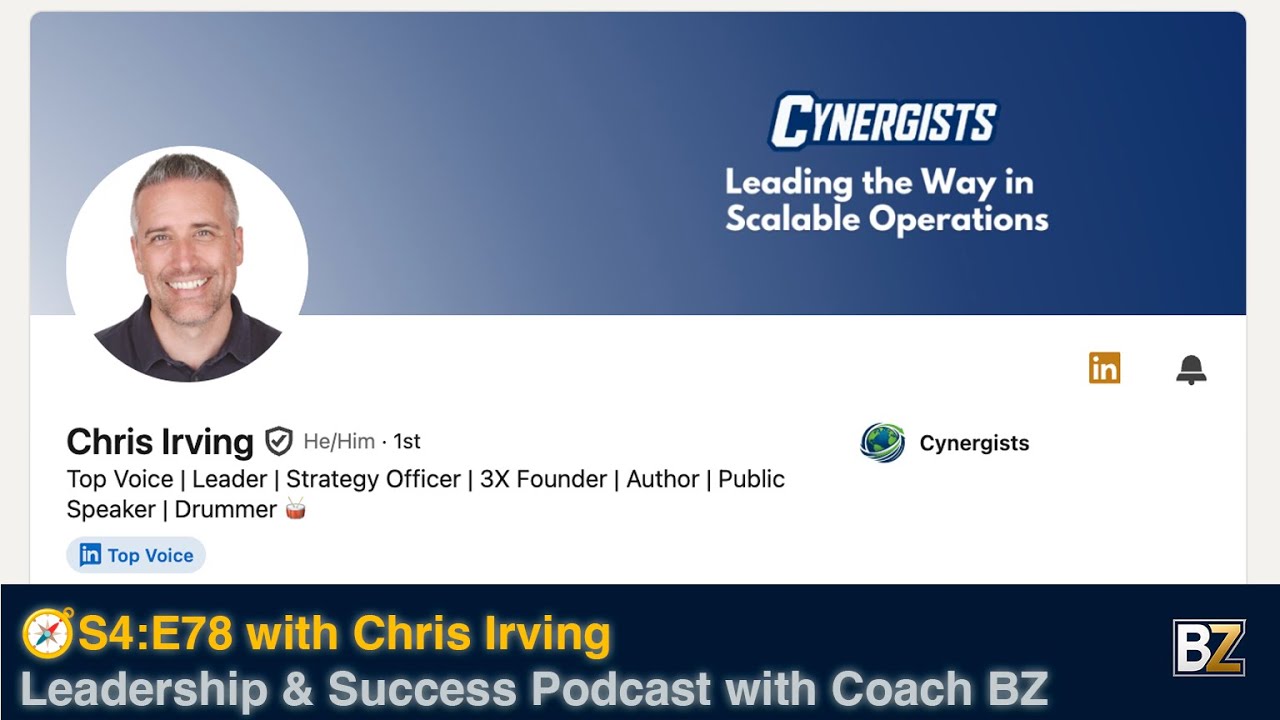
Chris Irving, founder of Genius Networking and Chief Strategy Officer at Synergist, talks about building his AI-powered platform, scaling through outsourcing and repeatable processes, and running Milpreneur, a nonprofit supporting veteran entrepreneurs. He credits Atomic Habits and servant leadership as core to his approach.
Chapters
Hi, I'm John Maxwell. When the top companies in the world are looking for trainers, speakers, and coaches, there's one name that stands above the rest, and that's Maxwell Leadership. Our certified team members have gotten proven results for companies all over the globe, and our reputation, I'm proud to say, is second to none. Some of our members have risen to the top of their profession, including the one you're going to meet today. I proudly introduce you to my friend, Bob Fabien Zinga.
Welcome to the Leadership and Success Podcast with your host, Coach BZ. If you need to develop into a better leader, this podcast is for you. If you want to achieve a greater level of success, this podcast is for you. His mentor, Dr. John C. Maxwell, said it best: everything rises and falls on leadership. We hope to inspire you today and provide you with an insight that has the potential to positively impact the trajectory of your life. Welcome to the Leadership and Success Podcast. Imagine gaining the leadership skills that could redefine your career. Join Coach BZ on the Leadership and Success Podcast.
I am the owner of Genius Networking. We're a networking group in Denver. We're branching out into other cities, um, soon to be in Chicago and Dallas and a few other places. Uh, which is really fun. And so I've created a, helped build, I was the product manager for an AI platform that's called Genius Connect. Um, it's just, it's a way to get warm intros to people. It's really cool. And then, uh, the other thing I do is I'm the sales director for Synergist. We are a virtual assistant placement company. We don't place people with our clients. We manage them on our end. For our clients. And then if you guys have anyone that you'd refer my way that is looking for any type of marketing— I know a lot of people in here do marketing, but if there's any pieces of marketing that you don't touch and you want someone that you can refer those clients to that's going to treat your clients really well and pay you for it, let me know. Glad to help them out.
Hi everyone, this is Coach Bizi. First, I want to apologize for Running a little bit late today. Our technology wasn't working the way it's supposed to, but it looks like it is back and working now. So without any further ado, just to save on time, let's do have our moment of gratitude. That is very important to me. And as you know, the reason why I do this every time we meet is because in the military, it's about 21, 22 veterans who die every single day. And In my opinion, right, you cannot be suicidal and be grateful at the very same time. So if you would just take a quick moment, we can do it in less than a minute. If you can just maybe close your eyes, put yourself in your happy place, and take a deep breath and think about one thing you are grateful for today. I think like most days, I am really, really grateful to be living in America and really grateful for freedom. Freedom is really what I am very grateful for today. The freedom we have to be ourselves, to pursue happiness, and the freedom to just be an American today. So let us know what you are grateful for and type it in the chat. And thank you so much for your participation. So now, without further ado, I'm going to be introducing to you Chris Irvin. So he's a LinkedIn Top Voice, Free Times founder, Chief Strategy Officer at Synergist, and, uh, he's the creator of Genius Networking, and he's joining us today to impact how authentic connection, scalable system, and servant leadership can transform career, companies, and community. So ladies and gentlemen, please help me welcome from Denver, Colorado, Chris Irving. Hey, Bob. Chris, you should be coming on my screen now. Here we go. All right. We are going to, um, make up for the time. So sorry for all of the technical challenges we had today. I've never had so much technical challenges. But first, okay, uh, to get started, um, what is one thing you are grateful for today, Chris?
Uh, to keep it real simple, man, I'm just grateful I woke up this morning. Every day is another day to take, take advantage of and just explore the world and be awesome. And so It's another one of those. Even though it's raining here in Denver, I don't even care. It's not—
Yes, that is so true. Most of the time I am grateful I can just breathe. That's wonderful. So what is one thing about you that most people may not know?
Well, it's on my LinkedIn, so you probably could figure it out if you did any exploring about me. But I'm a drummer. I've been a drummer for almost my whole life. I started in 5th grade. My grandpa sent me his drum set in the mail from New York to Denver, and I was like, don't do that.
He's like, I have to, I must.
I was like, don't.
Don't do it. And it showed up on my doorstep, two giant boxes. I set it up all wrong. He came to visit a week later, he's like, no, no.
Wow.
Yeah, yeah.
So you pretty much taught yourself how to do it, no lessons or anything?
He taught me my first lesson. He showed me how to— he was in a big band, a swing band, so he taught me the, a jazz beat. Yeah, this is the first thing you're going to learn on a kit. And then he went upstairs and he left me alone and I figured it out after like, I don't, I'm not even gonna admit how long it took, but when I finally got it, I was like, yeah, that's it. And he came down, he's like, yep, good job. I was like, sweet, wonderful.
Wow, what a story. Can you tell us about your leadership journey?
Yeah, for sure. So I've, I've been a leader in sales for quite a long time. My, uh, my path has been for through many different products and many different, uh, strategies and different, different types of companies, different types of sales orgs. But I've sold 401 plans. Well, if you go even further back, I sold glasses in college. Then I sold like, um, 401 plans. And then I sold a bunch of SaaS platforms, different phone systems. I sold people for a while as a recruiter. That was fun. And I took all of those skills into the business that I currently own called Synergist.
So, wow, that is, that is pretty amazing. Now, you are also the founder, right, of Genius Networking? Yeah, you've pretty much reimagined the way to properly network. Can you tell us, was there a moment when you realized networking needed to be reimagined? And what inspired you for Genius Networking in the first place?
Yeah, so I started because I was in staffing and I wanted to get in front of people because that's, that's what you need. You need to have a lot of people and know a lot of people. And so I started, uh, the group because I saw a need in my city in Denver, Colorado. There was not any type of like fun event for B2B networking that I could find at the time. So now there's a few of them now, but at the time I couldn't find one, so I created one not thinking anything of it, just thought it was going to be small and intimate and have a few people show up and that was all it was going to be. And it turned into this like apparently there was a need for it because there's Within less than 2 years, we're about to hit 2 years in 2 months. 2 months from now will be at 2 years, and there's almost 1,900 members. So pretty, pretty good track record. Um, lots of fun people that show up. I get to meet a lot of cool people. Most of the people that come to my events, I don't even know them. So, uh, if you're trying to get in front of people, start a networking group. It works very well. It's not— it wasn't hard. I actually didn't even have to promote it very much. I'll take almost no credit. I've told some people to come to my events over the course of the last couple of years, but most of it is meetup.com has done most of the work. I just post it and people come.
Wow, that is pretty amazing. Now, you are also a proud dad, a drummer like you mentioned, but you are a snowboarder too. So how do these passions fuel your creativity and, uh, leadership style?
Oh man, so especially being in a band, like everything that every band I've ever been in, which were— there's many of them, there are a lot of like rock and punk bands back in college days and beyond. And a lot of the bands I was in, every single one of them, I was in charge because no one else wanted to be in charge. They're like, I don't want to lead this group. Even the lead singers didn't want to. So they're like, someone had to step up. And I was always the one to step up, but I always made it a democracy. And so I do the same thing with my group. It's like, hey, if you have an idea that's better than what we're doing, tell us. I want to know. I need to know everyone's ideas, but I always start, personally, I like to start with individual conversations instead of a group conversation, 'cause no one will give opinions in a group, but individually they'll tell you anything. And then when you take it to the group, I can say, hey, so-and-so had a really good idea about this, and I thought this idea was really good about this, so that we can draw, like force them to talk and get them to say, yes, I, yeah, I did have that idea. It makes them feel good, but it also is a good idea. They should be promoted for that, right? Or at least be recognized for it.
That is powerful, especially on giving credit, right? To whom credit is due. That's really, I think, a big part of being a wonderful leader. It's very interesting because I was in the band too when I was a teenager playing the keyboard. Same thing, nobody wanted to lead, so I ended up being a band master or leader. Pretty cool. So now you've helped a lot of companies grow pipeline by what, $35 million? That is a lot. And you've turned around underperforming partners as well. What do you think is your secret for building scalable systems that drive results without burning people?
Sure, yeah, it's, it's all about being real, you know. People don't trust you if they don't think you're being real. So it's just being real and, and, um, showing up every day and just doing your job and, and being real, dude. Honestly, that's all I am. That's all I've ever done. I'm not here to BS anyone. It's, it's, it is what it is, and I'll tell you the truth every time. And as long as you follow through on expectations and, and things that you say you're going to do, it all comes together. So, um, to me, I think that's like the driving force, is just being authentic.
Wonderful.
Now, a lot of people who are listening to us now are either in the military or in high-tech. Uh, what practical advice would you give them for for creating repeatable processes that empower their teams?
So a lot of it is consistency, right? And I think most people will start something and then not see the results they're expecting, and so they'll give up. Or they'll have something on a to-do list for a really long time, and then it just gets pushed down and pushed down, but it stays on the list because there's a reason, right, that it stays on the list. Like, you want it done, you just can't get to it because there's not enough time in the day. So repeatable processes, like, I know consistency is this, is like redundant almost in what you just said, but I think that's, that's really what it comes down to. Um, outsourcing that to a company that can handle it for, you know, a price point that makes sense for you is the easiest way to maintain consistency because you don't have to put it on your to-do list and then keep pushing it to the next day.
So what do you think is the biggest mistake you've seen leaders do when they try to scale their businesses? And how can they avoid it?
Honestly, it's a hard, it's a hard one. The hardest thing in the world when, when leaders try to scale is that they are afraid to let go. Because it depends on the size of the org. If it's a bigger company, it's easier for them to let go of things. But if it's their baby that they've, they've birthed this company, and it, and they've brought it into toddler, and now it's like a 5-year-old, 10-year-old child, it's really hard to separate from the day-to-day processes. And I feel like a lot of people get stuck. So getting stuck in the weeds and not allowing someone to come in and say, I can help do these menial tasks that are repeatable, that are easy for you to train on, and they can easily take it off your plate just so that you can think about working on your business instead of in your business. I think a lot of people are focused on being inside and they, they can't get out of it. And the only way you can grow is to get out of it It's the only way to grow because you only have so many hours.
Wow, that is very powerful. And I think it also applies to the first-time manager or leader when it comes to delegation, right? I remember when I first became a manager, it was very difficult for me initially to just let go and let my people do the work I used to do so well. Because you think like, I can do it better than you, faster than you, and you just want to keep doing it when you really should, like you say, start thinking on the business but not in the business and be more, uh, strategic, right? That's, uh, something—
it's empowering, honestly, for, for the business leader. It's empowering because not only are you helping them grow and get better at what they do, and that makes you feel better about it, but also you can stop thinking about it. As soon as they figure out the process, if it's a repeatable process, as soon as they learn how to do it the way you want it done, you know it's going to continue that way. What we do with, with that at Synergist is we actually we create SOPs. So every time we have a process and it's been solidified and this is, this is working over here, and SOP is created behind that, that way if that person that is your admin or whoever it is that's helping you, if that person quits, gets hit by a bus, like something, something happens, they're no longer around, somebody else can come in without a whole, like, we're not starting over with training, right? You have, you have guidelines to go off of with your standardized operating procedures that you can now follow, and that's less training. There's still training involved. It's a new person into a process they've never done, so there's still some training, but way, way easier.
Wow, that is quite powerful. I think it's something they really drive into us, uh, in the Navy for sure. Like, one of my mentors also told me, right, the one of the way he knows if you're a good leader is if you step away from the office for like a week or two, just go away, go on vacation or something, and if things keep working the way they're supposed to, you're a great leader. But if everything falls apart because you're not there, then you are a very, very bad leader. And, uh, correct that.
Well, well, maybe not, maybe not a very bad, but maybe there's some things you can improve on, right? There's ways that we can always get better. I think that we're all, all of us are growing, you know. I feel like everyone has imposter syndrome at certain points in your career. Everyone feels it. And so you're going to step in a room where you're— people are going to feel— you're going to feel like everyone has more power or they're maybe more skilled or something. Oh, it happens to everyone. Uh, but I think getting through those moments and, and just continuing on and knowing that you're not in the wrong room, it's okay. Like, you're going to learn a lot by being in that room, right?
So, uh, you mentioned imposter syndrome. That's something that comes up quite a bit. What are your suggestions or tips for fighting or handling impostor syndrome?
Lean into it hard. Hard. Learn everything you can during that time. And if you come out as the guy that is an imposter at the end of it, at least you— or the woman— at least you learned as much as you could from it so that the next time you're in that room, it doesn't feel as bad. You're like, oh, I kind of get what's going on.
That's good advice. Never heard that. So with Genius Networking, so it's not just about making introduction, but you're actually creating value through authentic relationship, which is pretty awesome. So what does authentic connection mean to you, and how do you teach others to build it?
Yeah, I mean, authentic connection is just being your true self and, and not showing up as someone that you think people want you to be. So to me, it's about your inner journey and figuring that out for yourself. And I feel like as we grow in our careers and in our lives and we have experiences, you get better and you understand things more. And it just— I think it just kind of happens. So like, you know, you have the old grumpy man, that's like the old grumpy man, and then you have the old nice man. It's like their path is different, right? The old grumpy man's just like, I now know who I am and this is, this is it, right? And you have to the nice old man, and he's awesome too, but he had a different path. Right. So I feel like just being your true self, I feel like we learn who that is as we get older. And I'm only 44, but at 44, I know myself far better than I could ever say I knew myself at 30 or especially at 20. I did not know who I was at 20.
That's so true. Looking at your experience, you've led through a whole bunch of turnaround growth phases and startups. What mindset shift do you think, uh, help you stay resilient and optimistic through uncertainty and setbacks?
Yeah, I think it was Napoleon Hill said like a lot of people get like 90% of the way there and then they just give up. And it's like that 10, that extra, that extra push at the end is what really drives things to, to be, to actually be functional, working, profitable, all the things. Um, so getting to that place in your career and figuring that out and like, and just getting to the 90% isn't enough. You got to keep going. I just, I just know that if you keep going— like, for example, Synergist, my company, is fairly new. We're not— we've been around for less than a year. We're a 9-month-old company. Um, we're doing well, we're in the black, revenue is good, things are high, like, things are good. Um, but it wasn't always that way for those 9 months, right? So getting to this place, uh, we're we just had to keep pushing and pushing and trying different things and like, how do we go to market with this, this idea we have? And so one of the things I would say is, had we given up at the 90%, which we're, we're pretty much like, we're beyond that now, but had we given up, the fruit on the other side of that 10% of extra work is so much worth it. Just, just stick with it. It's going to be worth it.
Yeah, I believe in Think and Grow Rich. Napoleon Hill talks about being free fit. From gold and then giving, giving up when you are so close.
Kick it in, kick it in, stay the course, kick it in. Now another thing too is like synergist. I found this to be really cool. So I feel like a lot of people are— you're on social media and you're posting and you've got all this stuff happening, your businesses, you have all these things happening, but you're not getting a lot of love online. There's, there's a couple reasons for that. We don't have to get into too, too detailed, but if you're not getting likes, you're not getting shares, you're not getting comments and you're asking for those things but it's not happening, it doesn't really matter right now. I feel like the environment that we're in with social media is that there's just so— there's too much supply. AI has made it easy for us to create this content, so a lot of people are pushing content all day long. And what ends up happening is less people are seeing it, but you're getting less likes and stuff because there's too much stuff out there. Supply is high, demand's down. What I will tell you though is with Synergist, we post daily. We post many times a day on all platforms. We are out there, right? I have a marketing— part of my staff is marketing, that they do our marketing for us. Um, I was in a conference in Orlando a week or two weeks ago. I was at a conference, 3 people came up to me and said, oh, you work for Synergist? I, I know that company. One of them lived in Canada, 2 of them lived in Florida, and I live in Denver. And I was like, amazing, what we're doing online is working. We don't get a lot of love, we're not seeing the traction, you don't— I'm not seeing it. We see the impressions and it's working, but people know who we are, so the brand recognition is there, which is super cool. So if you're, if you're putting out a lot of social media and you feel like you're not getting anywhere and it's going into a void, don't worry, just keep going, keep doing it.
So consistency again. Now you've, you've mentioned AI, so how do you see AI, automation, and remote work kind of shaping the future of company like, uh, synergies like marketing, networking, and business growth?
It's completely different. Yeah, AI is taking over. It does everything that— I mean, on marketing, for example, we used to have to figure out who an avatar was. Who is it that you need to sell to? AI can tell me in about 3 seconds, right?
Wow.
We used to have to create messaging that was going to hit a certain person. We have systems in place that can write messages for individual people now. So it's not— we're not writing messages for the greater group of, uh, roofing or plumbing or accountants or whatever the vertical that we're going after. We don't have to do that. Now we write messages that are specific for that individual person. So based on their psycho— well, first we start with firmographics and demographics. From there we go their psychographics, and from that we can say, how does this person think? And then we write a message that's specific to that person's brain so that the email campaign is run by AI individually to each person.
Now that is amazing. I mean, it's just amazing what emerging technology can do. It's almost as if you're living in a dream or something.
Wow, that's insane. And without AI, my company couldn't exist because what we're doing right now is all based around AI. So we're able to help any vertical, any company, anyone to do anything they need with marketing or anything else. And the way that we are doing that is through AI, all the tools we use.
That is pretty incredible. Okay, I'm going to ask you one last question for this first segment before we move over to the second segment. I've heard you many times talking about treating your team like gold so they can treat the business like their own.
Real fast, real fast, Bob, you have some clicking going on again.
Okay. Is this better?
Still hear it.
That is strange.
There we go. That's better. I think we fixed it.
Okay.
Sorry, I just didn't want that. It was pretty loud. Okay.
Exactly. So I have heard you say many, many times that, you know, you want to treat your team like gold so that they can treat the business like their own. So how can leaders practically create a culture of ownership and accountability? How do you do it?
It's all through empowerment. They have to feel like their ideas matter, and they do matter, right? They have to actually matter. But it's all empowering your staff and making sure that they have a voice and that If they're struggling, I'm listening. If they are doing well, I'm listening, right? No matter what they're up to, I'm listening. So that when they come to me, they know they can come to me with anything and not feel nervous about whatever it is. Even if it's something that they feel like they did wrong or they're gonna get in trouble for, I'm like, "Just tell me. We'll work through it. We'll figure it out." You know? So empowerment is huge. It builds a better staff. It builds a better culture. It builds, everything's better. You just got to, you have to put the trust in the people so that they can actually deliver. If the trust isn't there, you're not going to get the same results.
Okay, and when you put the trust in the people, how do you keep them accountable?
Um, I don't, I'm not a proponent of micromanagement. I've been micromanaged in my career and I hated it. I don't like when people breathe down my neck and stare at me. I don't like it. So personally, like I think empowerment gets you there. We have KPIs, we manage things like other companies would as well. So we have annual reviews, we still check in, we do all the things. I just don't believe in micromanagement. So personally, like keeping them accountable is just based on KPIs, that's all we do.
As long as they meet or exceed your standard.
Yeah, as long as they're close, even if they're below, it's like, okay, it's a teachable moment, like that's fine. Not everyone's gonna hit their KPIs and that's okay. Some of it's out of their control. Like CSMs can't control retention every time. There's things out of their control. There's not much they can do sometimes, right? And so I realize that. And as a human, I know that everyone makes mistakes and it's fine. We can work through it.
Basically, you are using empathy and common sense as well. So that is wonderful. Okay, so we are running out of time. Let's go to the second portion of the podcast. This is a question I ask everyone. Actually, before I do, was there something else you wanted to say about, uh, Senior, just a bit before we go to the second?
Just— yeah, yeah, thanks. I appreciate the, the time, um, just to tell a little bit about what my company does. So we're taking a different approach to— I know that in the intro it said virtual assistants. We don't really place virtual assistants. It's not really what we do. We don't even like to call our staff that because they're— that's not what they are. They're not just assistants. They're actually very highly trained, college educated, they live all over the world and they're really, really smart and they're really good at what they do. You can hire us as a company, you can pay a dollar amount per month and get access to everyone. So instead of saying I need to buy, I need to pay for an admin for 20 hours a week and I need to buy or pay for salary for a bookkeeper for a few hours and try to figure out how I'm going to manage that and see if I can even find someone to do that. And then I also need marketing done and all the things, right? So all the different departments, we manage all of them for you in-house. So they're managed, managed by us for tracking hours, tracking payroll, and all that kind of stuff. And then on your end, you're managing processes and expectations of— it's your staff, but they stay with us. We hire-fire for you. We don't charge to hire, so you give us your skill set you care about, we will find the right people and bring them in and manage them on our end for you. And then you just have a monthly rate and you get access to the whole team. So that's, that's how we manage it.
That is amazing. Okay, all right, on to the second segment. Uh, what is the greatest lessons you have learned so far?
Sorry, um, greatest lessons I've learned so far? That's, that's a loaded question. I mean, there's— I think the best thing that I've learned in my career is how to treat people. Like, honestly, it's like I know how people want to be treated because I would want to be treated like that. And so that's, that's probably the best lesson I've learned. I've been treated very poorly in past positions to the point where I was like, I think I probably have some, like, emotional distress still over it. It's like, still hurts me. So it's like, how do I not do that and make sure that we, you know, we can grow and be a good organization and care about each other? You know?
Wow.
That is Powerful. Now, you've been extremely successful, like serial entrepreneur, at, at least 3 companies that you've helped found. Uh, what do you think is the secret of your success?
Oh dude, grit. Working every, every hour of every day that I can. I, I have an 8-year-old daughter, so I spend as much time— if, if I'm with her, I'm with her. But other than that time of my day, it's always thinking about how to be better, faster, smarter, all the things that make business better. So it's constant grind, never-ending. But that's also like, I like it. My— that's how my brain works. I enjoy that. So like, if that's not a path, that's not a path for everyone, and I get that. Some people want 40 hours and then don't tell me anything about work, also fine. But if you're going to go down the path of starting companies, it's— you can't do 40 hours. It's all the time.
Makes sense. So what, what do you think is the greatest, uh, leadership advice you have ever received?
Um, good question. I, I don't, I don't, I don't— nothing comes to mind immediately. I think it's like all the things that I've said so far are all things that I, I try to implement as a leader, and I've learned all that throughout my career. So I wouldn't say there's any one thing.
Yes, actually, something that comes to mind is what we are taught in the Navy, right? Mission first, people always. So you really have to take care of your people and your people will take care of the mission. Because from everything you've told me, you really care a lot about people and how they feel. Now, even when I said, oh, they need to meet or exceed expectations, you're like, no, no, even if they go below, that's okay. It's a teaching moment, see? So you're not accusing them and making them feel bad. It's like, hey, we can learn from this. So you pretty much turn everything into a positive experience for your people, and that's really wonderful to see.
Yeah, not to say that we don't have moments where things go wrong and we have to take action. Like, that happens too. But we try our best to give people the benefit of the doubt and treat everything like a trainable moment in every scenario possible.
Yes.
And then if it comes to it and we have to let people go, or if we have to do things, it's part of business.
No, no, no. Very good. Also remind me of something Oprah said once. No, people will not remember what you said, but they will never forget the way you made them feel. Yeah, but I think especially in Silicon Valley, I feel like we need to have a lot more emotional intelligence, but because I feel like our IQ is off the chart, but the way we treat people sometimes is not— we can do better. Let's just put it that way. Okay, so what, what are you learning right now?
Um, so I'm actually reading a book called Atomic Habits. It's a little bit older of a book, but it was actually recommended to me by my brother, and I was like, all right, I'll check it out. And I'm kind of stuck in that one right now. Lots of cool things that keep you— keep the grit, right? Keeps you like, keeps you going. And that's exactly what we've been talking about this whole time. It's like consistency and grit and staying the course. And so I'm probably speaking that way because I'm reading this book. That's probably— that's where my head's at. But it's true. All of it's real.
Wow. Fantastic. Now, I'd love to show this little coin here. I have, uh, on one side it says success, on the other side it says failure. So I believe success, failures are two sides of the same coin. We know about all of your successes, but how has failure shaped your life?
Yeah, I mean, not everything works the first time. Not everything works at all, right? Some things don't ever work. So actually, one of them, you put a video at the beginning of this for a platform that helps create called Genius Connect, which actually is no longer in service, like it's defunct, right? Um, that platform had a— I thought it had a really cool idea, but we had a great idea behind it, just didn't end up taking shape in the way that, um, I expected. And then the market didn't, didn't want it in the way it was delivered. So interesting, uh, how that, that kind of stuff happens. But, you know, with that, it's, it's just a— it's just another thing that Okay, didn't work. That's all right. Dust it off, move on, you know. Different iteration of a platform that's similar, we could try. I haven't done that yet, but I'm busy with other endeavors right now. So for the networking group, it's called Genius Networking. If you're in the Denver area, we do events every month. Check us out on Meetup. But it's, it's, you know, networking is awesome. Never gonna end with that, never gonna stop that. But the app just didn't work. So I try my best just to move on. Like, that's all you can do, move on.
Well, how do you build that resilience, right? You, you almost have, uh, that thing where you just, you know, get, get back up and you, you keep going even if you have to come up with another idea. That, that grit, I guess some, some people call it that. How do you develop it?
Um, I think it's because I'm so busy with so many things that for me, I'm like, I, I have other stuff I'm working on too. So I have many different, like, cold, like, irons in the fire right now. And because of that, when something doesn't work, I'm like, okay, that's one, one of the many. It's not that big of a deal. So I have, I have focus on many things. If I was only focused on that one thing and driving for, for revenue and that was my only income source, I would have been devastating. I would have been very difficult to take, but it wasn't. And it's so— it's okay. I have many things happening. So for me personally, I just like to stay constantly busy. I always have ideas, I always have things happening. I, I bring teams in to help me do the things I don't know. That's the biggest part, is like, yes, of course, outsource, outsource. Get, get it off your plate, send it to someone that does know. Don't try to learn. It's way faster. It's actually cheaper in the long run because you will have less failures because that team already knows what they're doing. Give it to someone that knows. That's the best thing in the world.
Wow, that is powerful. Delegate and look for experts. Okay, let us know, uh, who are your mentors or thought leaders? Which people are you following now that we should follow as well?
Um, I don't really follow anyone. I don't know. I, I like, uh, okay, there's a few people I do like. I like Gary. Gary Vee. I like him because he stays ahead of what's happening, the trends that are happening in marketing. He likes to say he has predictions about things, but really it's not, it's that he knows 'cause he hears from everyone, so he kind of understands it. I like him for that reason, but I'll be honest with you, man, I was at this conference, Tony Robbins, Martha Stewart, like there were some big people speaking. I didn't hear a word from 'em 'cause I was too busy as an entrepreneur. I didn't care about what they were saying. Like, it's not that I couldn't have gotten a lot of nuggets and walked out with more wisdom. It's not that at all, because I don't— it's not that I don't believe that. I know that would be true. What I needed from that was more people to talk to that I can work with and partner with and show them how my business operates and, and try to work together. So I was in the hallway the whole time. So I'm a different breed. I don't follow people for their advice, tech, usually. I, I, I just don't. It's just not in my head. What I care about is meeting people and driving more relationships.
Wow, that is really, I think, a major key in your success— the authentic networking and really building relationships instead of just being superficial, right? And also, even on LinkedIn, you have like more than 10,000 followers, which is really great. And you're a top voice, like I said at the very beginning, which is Pretty awesome. So how do you take that from face to face, like even the meetups you have in the Denver area, how do you translate that to social media? Is there maybe a couple of tips you could give to my audience?
I don't do a lot on social media. I'm like the worst social, the worst guy to talk to because it's funny because my company does a lot of marketing for our clients. We are an outsourced company. You send your business, you come to me for people, I place those people and you can have them for hours and they can do all this stuff. Right. Because of that, I've outsourced my social media. I don't even know what goes on it. Wow. All of it has been pushed away from my thoughts and my to-do list. So I don't want to think about it. It's too much.
Awesome.
I don't know. I couldn't tell you.
Again, go to the expert. Very great. Okay, so if you could choose 3 people to have dinner with, Who would you choose and why? They could be alive, dead, or mythical figures.
Um, Barack Obama. Is it the same dinner?
Yes, the same.
They're all at the same dinner with me?
Yes.
Yeah, Obama and, um, Trump.
That would be an interesting conversation for sure.
And maybe Clinton. I'll just put them on and be like, tell me why you don't like each other. Let's sort this out.
Yeah, yeah, that would be— I think I'd like to be a fly on the wall for that, that one.
I'm not even a very political person. I just think it would be a very interesting conversation. Yes, maybe if you come to like— who knows, maybe they're friends at the end of this. I have no idea.
Yeah, yeah, who knows. As far as books, you, you already mentioned James Clear, uh, Atomic Habits, a great book. I highly recommend that. Uh, is, is there anything else you would recommend as a podcast, music, movies, or YouTube?
Um, yes, Scaling Up Success is my synergist. It's my brand's podcast. So my business partner Ryan Van Ornum, um, he actually hosts and runs this podcast. We bring on people that are from all walks of life. We've had NFL players, NBA players, WWE. We've had professional musicians. We've had some, some pretty cool people that have joined our podcast, and we ask them questions about like what they're doing with their business right How are you scaling up? So yeah, I would check that one out.
Fantastic. What about movie or music? Any song or movies you recommend?
I am 100% stuck on Conor Price right now and Nick Dee. They are white hip-hop rappers and they're so good.
So good. Oh, very good.
Yeah, I would check those guys out for sure.
Thank you so much. And, uh, what is one action you have taken that has positively impacted your life?
Um, I had a kid. It's like the best thing in my— I've ever done. I've had— I had a kid, and my daughter's my life outside. I know I talk about work a lot, but that's what we're here for. When I'm— when I'm not here and I'm not working, I don't think about it. I just spend time with her, and it's— it's amazing. Yeah, it's the best thing I've ever done.
I definitely can relate to that. When, uh, we knew that our daughter was on the way, it really turned me from a boy to an adult, like overnight. Now I have to think not just about me, myself, and I, but what about this kid? What, what is she doing?
Exactly. Yeah, exactly. Like, my whole— every night is focused on her. Every night, every, every weekend, it's all focused on her, right? Yeah.
So what is one action that you are thinking about taking that you believe will positively impact your Um, good question.
Not sure. I'm constantly making changes and shifting things all the time. Like, as the, the thing I would recommend anyone that's starting a company, has a company, is a serial entrepreneur, so anyone, learn as fast as you can and shift as fast as you can because learning tax is real and it costs a lot of money if you don't get out of it as fast as possible. So as soon as you see something's not working the way you would expect or hoped it would work, change it, drop it, do something, get away from it because it's not going to help you. So that's where, um, like my company right now, we're making a pretty big shift. We're changing the way that we're going to market. Honestly, we've changed our whole strategy. So, um, the conversation about that started 2 days ago, we already implemented it yesterday.
Wow.
That's, that's how we operate because I have a— I can outsource all of this, right? So So I've implemented the changes. They're not created yet, but it's being created today and over the course of this week. So by the time next week comes on Monday, 5 days from now, we will have a whole new marketing strategy and it'll be totally different. And we feel like it's a good move. We feel like it's a positive change and it's better for us and our customers. So everyone wins. So yeah, and that shift is we're giving you access to our team instead of managing it for you. We're gonna let you manage our team. Customers. And, and that goes back to, uh, Bob, your, your point earlier where you don't want to work in the business, right? But it's so hard to let go as someone that owns a company. It's so hard to be like, yeah, you, you take it.
Yes, yes.
I, I don't like it. I, I'm a kind of— I'm a guy that likes to sit in the weeds. I don't like getting out. I really want to be there. But as soon as I pulled myself away from that and I stood up and saw that there's like this bigger thing happening, I was like, oh, that's actually more fun to think about. And so as soon as I got out of the weeds, it was— it changed my view of everything, right? As it should.
That's powerful.
And, and that's what we're doing for our customers. We're letting them do the same thing. Get out of the weeds. Let me help. Let me show you what it feels like when you get to stand up and get away from those weeds. Yes, it's so much more fun.
Well, that is really powerful. That's really something I learned when I came to Silicon Valley, right? Even the agile methodology of building soft software. Because in the military, sometimes, no, with the waterfall method we use, maybe once a year or twice a year we make changes. But in Silicon Valley, almost every day, like every week, they have sprints and stuff. It's, it's just amazing. And getting data back and then making decisions based on the data you receive and the feedback. And something isn't working, you know, sunk cost, and you go to the next thing. Agility really allows you to be a lot more successful, maybe fail faster, but then win a lot more too, I think.
Yeah, fail fast. Fail as fast as you can. As soon as you can fail, do it. Like, it's very important. Get those failures in. Get them in quick, right? As soon as you fail, you can actually start to gain. But there's no gaining until you fall down. You got to fall down to stand up.
Very good. So if you had one day and only one day to live, what would you have liked your final contribution to be?
I would spend the whole day with my daughter. And whatever, I would make it a, uh, yes day. She could do anything she wants.
Yes. Yeah, that is, uh, probably the most important thing in life— families and relationships. So, uh, when you wake up in the morning, uh, what is one problem you would like to solve?
Um, like, I wear black shirts every day. I eat a bagel for breakfast every day. Like, I don't— everything I do is like so like it's just easy. I don't make, I don't make decisions about my life. I can focus on my business. So whatever the problem is, there's gonna be something that I'm fixing for my company every day.
Very good. Wow. Yeah, you remind me of Steve Jobs, right? He didn't want to think about what he would wear, so pretty much wore the same thing all the time so he could just focus on innovation.
That's huge, dude. Thank you, I appreciate that. That's a massive compliment. And, um, I hope I can do anything even remotely similar to Steve Jobs.
Yeah, I think the industry really misses him a lot because Apple, I don't know what happened, but they're way, way behind the 8-ball. Like on artificial intelligence, they still have Siri when everybody else is doing generative AI. Now they're thinking about partnering with OpenAI or something. It's like, where is the genius, the innovation? They used to be number one on everything, but I don't know, I guess they're gonna find their way soon. Okay, so this is pretty much it for the podcast. We have about 4 minutes left, so an important question for you is how can we add value back to you?
So I've got a couple of things I'm working on. Like I said earlier, I have so many things, so many irons in the fire right now. One of them is Synergist, so synergist.com, you can see on the bottom of the screen there. You can follow me on LinkedIn, Again, I don't post a whole lot on there, but feel free to schedule time with me if you wanna talk about how you're scaling your business and how you're trying to get out of the weeds. I'm here to help. My staff at Synergist can take over all of your to-do list. We can handle anything that's on there. Doesn't matter what it is, we can do it and do a great job of it. So check out our website. Yeah, thank you for throwing that up, Bob. And another thing aside from all of this that, Bob, I actually didn't even tell you about this, Um, we actually have a nonprofit as well that's part of our brand, so it's called Milpreneur and it's for military entrepreneurs. So if anyone here wants to check out what we're doing there, go to milpreneur.com, M-I-L-P-R-E-N-U-E-R.com. I think that one, um, and, and go see what we're working on there. We're helping military, uh, anyone that that is a veteran, it's hard to come back to civilian life, as any veteran would know. I'm not personally one, but my business partner Ryan is. So thank you for pulling that up. Yeah, milpreneur.com. And so reintroducing yourself or getting back to— M-I-L-P-R-E-N-U-E-R. Getting back to civilian life is a struggle, right? Not everyone, but a lot of people struggle. And so here, I'll throw it in the chat for everybody.
Oh, did I misspell it? And this is pretty important for my audience, because I'm like I say, I really focus on people.
Yeah.
And so this is something like I want to offer this to your group as support for you. That's, that's the point. So with Millpreneur, what we're doing there, let me see if I can find it. I'm sorry, that's not working, guys.
Okay, I got it. I think I—
okay, sorry, we didn't talk about this in advance, so there's a little bit. Yeah, but yes, here we go. So with Millpreneur, um, what, what we do here is we are accepting donations, right? Um, we have a networking group that's actually part of this as well that's donating to us. And so what the goal here is to be able to support anyone that's coming back to civilian life starting your own company, trying to grow your own company, all of those things. So you can actually, um, on our website, it's not live yet, so this is kind of a little bit half-baked, but if you go back up to the top, um, in the header, and don't, don't click yet, but there's an apply button, and that will become live in the future. When that is live, you'll be able to fill out an application to get support from us, and then, wow, we will actually fund, help fund your company to grow and scale. So So that's one of the things we're doing and would love to have anyone that's looking for support go ahead and go there and hit apply. That will be live within the next couple of days.
Wow, that is really, really wonderful. Thank you. Thanks so much. That really means a lot to the people in my audience. So is there a question I should have asked you that I haven't asked yet before we end the show? Sure. Is there any— Any question?
No, I don't, no, I don't think so.
That was very extensive. We're gonna end very, very quickly. I think the most important question I ask is, uh, if you could go back and give a piece of advice to your 17-year-old standing at the edge of this incredible career you've had, right? So 17-year-old Chris Irving, what would you tell to him?
Okay, all right. So this, this is— I actually had this question asked to me by someone on my team, asked me this during like We play games on Fridays, and so that was asked me last Friday.
So, uh, wow, awesome.
My answer is actually kind of sad. It's really sad. I used to work for a mortgage lender when I was 17. I was working for a mortgage lender. I was processing applications, I was closing loans, I was doing the things working for a mortgage lender, and I never bought a house until I was in my 30s. If I could go back to 17 and be like, dude, buy a condo, a house, and then another condo, and then 5 more houses, my career would have been totally different. So I wish I could go back because the growth in Denver since then until now, it's like 10 or 12x. It's insane.
Yes.
Yeah.
Wow, wow, that is quite, quite an advice. Yeah. And I know, but some people too, they feel like, well, if I buy a house, it's going to be so expensive to keep up and all of that. But you're saying about, you know, all, all of the, uh, increase you will, you will add on the appreciation of, of your house. I mean, it's gonna make it worth it.
Yeah. And it's not 10 or 12x generally. That's not, that's not the case. But the, the one home I bought did end up being that because we, we did a remodel. And so for us, the way that we did our flip ended up working out really well, where we got about a 10x return. It was insane. But wow.
Anyway, no, that is, that is, that is really great. Okay, then very, very quickly, uh, What did you want to be when you were a kid? Don't think too long.
Rockstar.
Rockstar.
Okay, easy answer.
You did play the drums, so you kind of lived that life. Okay, what are 3 adjectives that described you as a child?
Well, real fast, I actually was a rockstar too, so that part was— I did do that, which was fun. Um, 3 adjectives that describe me as a child? Oh man, really quick, curious, Adventurous.
Probably playful, I can tell.
Yeah, jovial.
Jovial. Okay, what about as an adult?
Curious, adventurous, jovial.
Okay, same thing. Very good. Okay, very, very last question. What is—
I'm just an old child.
That's good. That's wonderful. What is one word that represents our shared experience on this podcast today? One word that comes to mind.
One word, um, exemplary.
Okay, I think mine will be enlightened. You've really enlightened my—
oh, thank you, thank you.
And we didn't get any question for you, but a LinkedIn user, I don't know who, said, uh, thank you for your service. I think when we were talking about Milpreneur. So for me too, thank you so much, and I really appreciate everything you do for the military community. I care a whole lot about those people, and it's not always easy, but, uh, yeah. We really owe it to people like you, patriots, to really help us out because some of my fellow veterans, they really need a lot of help to transition back into regular life. It's not easy.
It's not easy.
All right. Thank you so much, Chris. I really appreciate your time. So we went 3 minutes over, but I really enjoyed the time we spent today. And thank you so much for speaking to my audience today. I appreciate it.
For sure. Thank you for having me on. It was a pleasure. It was very nice to to see you again, and great questions, man. Thank you.
Good. Thanks. All right, everyone, this was really great. Uh, we had a wonderful, wonderful time with, with Chris. So remember, he really said the one book he wants you guys to purchase or to read, Atomic Habits. I think at least 7 other people on the podcast this year alone have, uh, recommended that, that book. I think I'm gonna start a, uh, a, uh, a master's program on studying that book soon. But anyway, I'm going to be back here tomorrow and I'm going to have Coach Martin Houston. So he's going to be all the way from Tuscaloosa, Alabama, where I used to live. You do not want to miss it. He's a football celebrity over there. But yeah, so don't miss that tomorrow. And then later this week, I am going to have the one and only Sharon Lechter here on the podcast. She's the co-founder for the Rich Dad Poor Dad brand. So she will be here, and I will also have Captain Select Desmond Walker. He's really one of the best commanders in the Navy right now, and it's really wonderful to see people like him rising up from being enlisted all the way to commander and beyond. So you absolutely do not want to miss it. Okay, this is it for us today, and We're gonna see you tomorrow. Thanks again for being here with us. Bye-bye.
Thank you for listening to the Leadership and Success Podcast with your host, Coach BZ. If you like what you heard, please subscribe to our channels and come back for more wisdom nuggets on how you may develop into a better leader and achieve greater levels of success. Leadership is the most critical skill. The world will always need leaders to lead others deploy the next disruptive technology, or execute a business strategy. You may as well decide on counting yourself among the 21st century leaders. See you right here next time on the Leadership and Success Podcast with Coach BZ.
More from Bob

S250:E4🎙️LIVE 🇺🇸America 250: President Barack Obama Leadership, Service, and the Power of Hope






S5:E157🎙️ LIVE with CMD CMSgt Dennis L. Fritz, USAF (Ret.)(Multi Tracks Audio)



S5:E156🎙️ LIVE 🇪🇸 Leadership Lessons from the FIFA World Cup 2026 Champions (Multi Tracks Audio)

S250:E3🎙️ LIVE Leadership Lessons from America’s First Documented Family of African Descent 🇺🇸📖