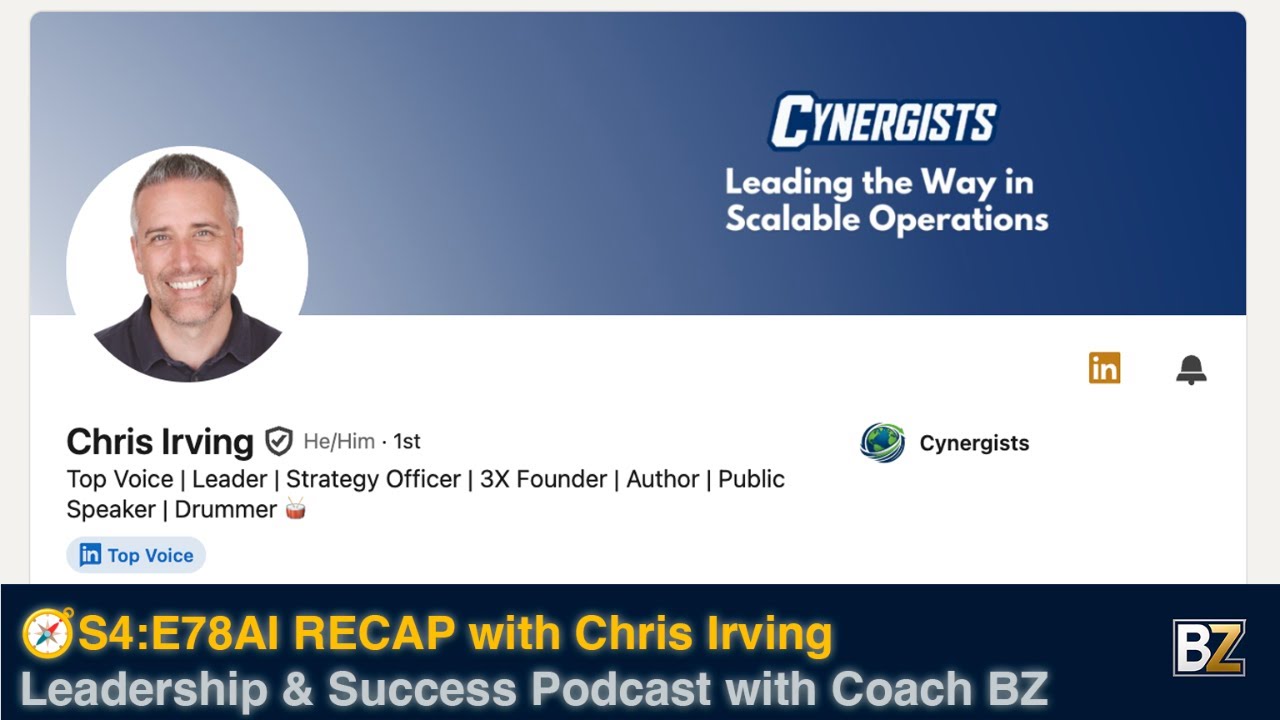
Chris Irvin, founder of Genius Networking, built a B2B networking platform to nearly 1,900 members in under two years using AI to generate warm introductions. He discusses how AI reshapes marketing and sales, why trust and vulnerability matter in leadership, and why soft skills will matter more as AI handles routine work.
Chapters
Hi, I'm John Maxwell. When the top companies in the world are looking for trainers, speakers, and coaches, there's one name that stands above the rest, and that's Maxwell Leadership. Our certified team members have gotten proven results for companies all over the globe, and our reputation I'm proud to say, is second to none. Some of our members have risen to the top of their profession, including the one you're going to meet today. I proudly introduce you to my friend, Bob Fabien Zinga.
Welcome to the Leadership and Success Podcast with your host, Coach BZ. If you need to develop into a better leader, this podcast is for you. If you want to achieve a greater level of success, this podcast is for you. His mentor, Dr. John C. Maxwell, said it best: everything rises and falls on leadership. We hope to inspire you today and provide you with an insight that has the potential to positively impact the trajectory of your life. Welcome to the Leadership and Success Podcast.
I am the owner of Genius Networking. We're a networking group in Denver. We're branching out into other cities, um, soon to be in Chicago and Dallas and a few other places, uh, which is really fun. And so I've created a— helped build— I was the product manager for an AI platform that's called Genius Connect. Um, it's just, it's a way to get warm intros to people. It's really cool. And then Uh, other thing I do is I'm the sales director for Synergist. We are a virtual assistant placement company. We don't place people with our clients. We manage them on our end for our clients. And then if you guys have anyone that you'd refer my way that is looking for any type of marketing, I know a lot of people in here do marketing, but if there's any pieces of marketing that you don't—
Can you tell us about your leadership journey?
Yeah, for sure. So I've, I've been a leader in sales for quite a long time. My path has been through many different products and many different strategies and different types of companies, different types of sales orgs. But I've sold 401 plans. Well, if you go even further back, I sold glasses in college. Then I sold 401 plans, and then I sold a bunch of SaaS platforms, different phone systems. I sold people for a while as a recruiter. That was fun. And I took all of those skills into the business that I currently own called Synergist.
So wow, that is, that is pretty amazing. Now you are also the founder, right, of Genius Networking? It looks like you've pretty much reimagined, um, the way to properly network. Can you tell us, was there a moment when you realized networking needed to be reimagined? And what inspired you for Genius Networking in the first place?
Yeah, so I started because I was in staffing and I wanted to get in front of people, because that's, that's what you need. You need to have a lot of people and know a lot of people. And so I started, uh, the group because I saw a need in my city in Denver, Colorado. There was not any type of like fun event for B2B networking that I could find at the time. So now there's a few of them now, but at the time I couldn't find one. So I created one not thinking anything of it, just thought it was going to be small and intimate and have a few people show up and that was all it was going to be. And it turned into this like apparently there was a need for it because there's Within less than 2 years, we're about to hit 2 years in 2 months. 2 months from now will be at 2 years, and there's almost 1,900 members. So pretty, pretty good track record. Lots of fun people that show up. I get to meet a lot of cool people. Most of the people that come to my events, I don't even know them. So if you're trying to get in front of people, start a networking group. It works very well. It's not— it wasn't hard. I actually didn't even have to promote it very much. I'll take almost no credit. I've told some people to come to my events over the course of the last couple of years, but most of it is meetup.com has done most of the work. I just post it and people come.
Wow, that is pretty amazing. Now, you are also a proud dad, a drummer like you mentioned, but you are a snowboarder too. So how do these passions fuel your creativity and, uh, leadership style?
Oh man, so especially being in a band, like everything that every band I've ever been in, which were— there's many of them, there are a lot of like rock and punk bands back in college days and beyond. And a lot of the bands I was in, every single one of them, I was in charge because no one else wanted to be in charge. They're like, I don't want to lead this group. Even the lead singers didn't want to. So they're like, someone had to step up. And I was always the one to step up, but I always made it a democracy. And so I do the same thing with my group. It's like, hey, if you have an idea that's better than what we're doing, tell us. I am the owner of Genius Networking. We're a networking group in Denver. We're branching out into other cities, soon to be in Chicago and Dallas and a few other places, which is really fun. And so I've created a— helped build— I was the product manager for an AI platform that's called Genius Connect. It's just, it's a way to get warm intros to people. It's really cool. And then Uh, other thing I do is I'm the sales director for Synergist. We are a virtual assistant placement company. We don't place people with our clients. We manage them on our end for our clients. And then if you guys have anyone that you'd refer my way that is looking for any type of marketing, I know a lot of people in here do marketing, but if there's any pieces of marketing that you don't touch and you want someone that you can refer those clients to, that's going to treat your clients really well and pay you for it, let me know. Glad to help them out.
This is Coach Bizzy. First, I want to apologize for running a little bit late today. Our technology wasn't working the way it's supposed to, but it looks like it is back and working now. So without any further ado, just to save on time, let's do have our moment of gratitude. That is very important to me. And as you know, the reason why I do this every time we meet is because in the military, it's about 21, 22 veterans who die every single day. And in my opinion, right, you cannot be suicidal and be grateful at the very same time. So if you would just take a quick moment, we can do it in less than a minute. If you can just maybe close your eyes, put yourself in your happy place and take a deep breath and think about one thing you are grateful for today. I think like most days, I am really, really grateful to be living in America and really grateful for freedom. Freedom is really what I am very grateful for today, the freedom we have to be ourselves, to pursue happiness, and, uh, the freedom to just be an American today. So let us know what you are grateful for and type it in, in the chat. And thank you so much for your participation. So now, without further ado, I'm going to be introducing to you, uh, Chris Irvin. So he's a LinkedIn Top Voice, uh, Freed Times founder, Chief Strategy Officer at Synergist, and he's the creator of Genius Networking, and he's joining us today to unpack how authentic connection, scalable system, and servant leadership can transform career, companies, and community. So ladies and gentlemen, please help me welcome from Denver, Colorado, Chris Irvin. All right, this is Coach Bizzy. I'm gonna be here live, so that was, uh, a highlight from the hour-long leadership conversation I had with Chris last week. So today is going to be the 10-minute AI recap. So for those who are busy, I'm just gonna give you, uh, 10 minutes to, uh, do so. All right, please type in the comment what you are grateful for today, and also if you have a leadership question for me, you're gonna type it in the comment and I'm gonna get back to you in about 10 minutes or so. And also, I would very much appreciate it if you can tag a colleague, a junior officer, or somebody you think within your sphere of influence who might benefit from this podcast. Please tag them, repost this event in your own feed, and I very much appreciate that. Okay, without any further ado, let me bring to you my AI Agent, they're going to break down for you, they're going to give you in 10 minutes what Chris and I talked for about an hour. Here we go.
Welcome everyone to this conversation on leadership and trust. Today we're diving into insights around building trust in hostile environments, drawing from Dr. Daryl Stickel's experiences and lessons. It's all about vulnerability, empathy, and intentional leadership in uncertain times.
That's right. There's so much depth here, especially the idea that trust depends on our willingness to be vulnerable, even when the risks are high.
Exactly. You know, Dr. Stickell's journey, from overcoming personal tragedy in northern British Columbia to becoming a leader who champions trust, is pretty inspiring.
Yep.
It really highlights how our early challenges can shape our capacity for empathy as leaders.
Um, yeah. His experience with head trauma and losing his sight, for instance, wasn't just a setback. It became a source of insight that fueled his passion for building trust.
Right. And his dissertation at Duke on building trust in hostile environments laid that framework out. It's like trust is calculated as uncertainty times vulnerability equals perceived risk, isn't it?
Exactly.
And if that risk is too much, we pull back.
I love that formulation. It makes trust feel like a measurable, almost strategic currency in leadership.
Absolutely. And what's really fascinating is how this translates into practical actions for leaders. Whether you're in the military, in tech, or even running a startup, trust isn't built solely through credentials or directives. Sometimes you need to go first, be vulnerable, and show genuine benevolence.
Yes, like when Dr. Stickle advised naval junior officers to take first steps by admitting their vulnerabilities. It breaks down the traditional 'trust me because I'm the captain' mindset and instead builds trust on shared humanity.
Definitely. And we see that shift not just in military circles but also in technology. Tech leaders are being urged to ask their teams for input on what excellent leadership looks like It's a move from positional authority to relational authority. Yeah, that connection essentially builds a stronger following.
It's interesting. Some might argue that this level of vulnerability undermines the traditional image of a strong leader. What do you think about that?
That's a fair point, but I'd argue that, um, true strength lies in having the courage to admit imperfection. Dr. Stickle's idea is that trust compounds through daily habits. Clarifying roles, sharing personal stories, and even acknowledging mistakes before they snowball.
Absolutely, Anna.
It's a proactive process.
I get that. Though I wonder, isn't there a risk that too much vulnerability might be seen as weakness? How do leaders balance that?
Well, it's like, um, a delicate balance. The key is to be vulnerable in ways that build trust, rather than invite exploitation.
I feel like everyone has imposter syndrome at certain points in your career. Everyone feels it. And so you're going to step in a room where people are going to feel— you're going to feel like everyone has more power or they're maybe more skilled or something. It happens to everyone. But I think getting through those moments and just continuing on and knowing that you're not in the wrong room, it's okay. Like, you're going to learn a lot by being in that room, right?
So you mentioned imposter syndrome. That's something that comes up quite a bit. What are your suggestions or tips for fighting or handling imposter syndrome?
Lean into it hard. Learn everything you can during that time. And if you come out as the guy that is an imposter at the end of it, at least you— or the woman— at least you learned as much as you could from it so that the next time you're in that room, it doesn't feel as bad. You're like, oh, I kind of get what's going on.
That's good advice. Never heard that. So with Genius Networking, so it's not just about making introduction, but you're actually creating value through authentic relationship, which is pretty awesome. So what does authentic connection mean to you, and how do you teach others to build it?
Yeah, I mean, authentic connection is just being your true self and, and not showing up as someone that you think people want you to be. So to me, it's about your inner journey and figuring that out for yourself. And I feel like as we grow in our careers and in our lives and we have experiences, you get better and you understand things more. And it's just, I think it just kind of happens. So like, you know, you have the old grumpy man, that's like the old grumpy man, and then you have the old nice man. It's like their path is different, right? The old grumpy man's just like, I now know who I am and this is, this is it, right? And you have to the nice old man, and he's awesome too, but he had a different path, right? So I feel like just being your true self, I feel like we learn who that is as we get older. And I'm only 44, but like at 44, I know myself far better than I could ever say I knew myself at 30 or especially at 20. I did not know who I was at 20.
That's so true. Now, looking at your experience, you've led through a whole bunch of turnaround growth phases and startups. What mindset shift do you think helped you stay resilient and optimistic through uncertainty? And so how do you see AI, automation, and remote work kind of shaping the future of companies like Synergies, like marketing, networking, and business growth?
It's completely different.
Yeah.
AI has taken over. It does everything now. I mean, on marketing, for example, we used to have to figure out who an avatar was. Who is it that you need to sell to? AI can tell me in about 3 seconds, right?
Wow.
We used to have to create messaging that was going to hit a certain person. We have systems in place that can write messages for individual people now. So it's not— we're not writing messages for the greater group of, uh, roofing or plumbing or accountants or whatever the vertical that we're going after. We don't have to do that now. We write messages that are specific for that individual person. So based on their psycho— well, first we start with firmographics and demographics. From there we go to their psychographics and from that we can say, how does this person think? And then we write a message that's specific to that person's brain so that the email campaign is run by AI individually to each person now.
That is amazing. I mean, it's just amazing what emerging technology can do.
It's crazy.
It's almost like as if you're living in a dream or something. Wow.
That's insane. And without AI, my company couldn't exist 'cause what we're doing right now is all based around AI. So we're able to help any vertical, any company, anyone to do anything they need with marketing or anything else. But the way that we are doing that is through AI, all the tools we use.
That is pretty— it was very difficult for me initially to just let go and let my people do the work I used to do so well, because you think like, I can do it better than you, faster than you, and, uh, you just want to keep doing it when you really should. Like, like you say, start thinking on the business but not in the business and be more, uh, strategic, right? That's—
it's empowering, honestly, for you, for the business leader. It's empowering because not only are you helping them grow and get better at what they do, and that makes you feel better about it, but also you can stop thinking about it. As soon as they figure out the process, if it's a repeatable process, as soon as they learn how to do it the way you want it done, you know it's going to continue that way. What we do with, with that at Synergist is we actually we create SOPs. So every time we have a process and it's been solidified and this is, this is working over here, and SOP is created behind that, that way if that person that is your admin or whoever it is that's helping you, if that person quits, gets hit by a bus, like something, something happens, they're no longer around, somebody else can come in without a whole— like, we're not starting over with training, right? You have, you have guidelines to go off of with your standardized operating procedures that you can now follow, and that's less training. There's still training involved. It's a new person into a process they've never done, so there's still some training, but way, way easier.
Wow, that is quite powerful. I think it's something they really drive into us, uh, in the Navy for sure. Like, one of my mentors also told me, right, the one of the way he knows if you're a good leader is if you step away from the office for like a week or two, just go away, go on vacation or something, and if things keep working the way you're supposed to, you're a great leader. But if everything falls apart because you're not there, then you are a very, very bad leader.
Well, maybe not. Maybe not.
All right, so this is it. I see, uh, Aaron likes— thank you so much for being there. I just asked you if you wanted to come, uh, live for a couple of minutes and we can talk about leadership and trust if you wanted to. You didn't have to, but I sent you a link to the Goon Room. Aaron said that trust is being spread not just into the human realm, but also into the technology we are working with. And that is so true. So I think really what I got by talking with Chris, he's really a master, right, at marketing and networking. Again, he is a top LinkedIn voice on Blue Badge, which is pretty amazing. But I think it's really how to scale with us, right? When you've been in the startup world, like myself, it is really easy to be so busy and working on so many things that it's chaos all over the place. But, but really, when you can focus on sales and marketing and actually scale without chaos, that is, that is really, really big. And Chris revealed to us real systems that help teams win without burning out. So that's very important. It's, I think it's true in the military, it's true in tech and whatever industry you are in. So he also talked about the power of networking, right? Genius Networking Playbook for Creating Connections That Save Time and Spark Growth. And I think your network, the network is your net worth. One of my mentors used to say that all the time. And that's why you should use social media platform like LinkedIn to be able to network with people you may not know and who might be able to add value to you, and you add value back to them. And he also talked about the human side of strategy, right? Why treating your team like gold creates the culture that drives results. And I think it really makes a big, big difference how you motivate your team, how you inspire them, and how you really prioritize the people, not just the work, but the people, right? In the Navy, I've learned mission first, but people always, because you're going to be unable to accomplish your mission, which is why you are on the payroll. That's the job you were hired to do. But you really, really need to be able to motivate your people. Okay, I believe I have a surprise guest for you right here and right now. Aaron, how are you doing, my friend? Thank you so much for being here.
I'm doing well. How are you doing, Bob?
Thank you. Thank you so much for watching. From time to time, I always like to interact with the audience. When I started 4 years ago, I think I was the one and only person talking to myself on the first podcast. The second one, I believe my wife was the only other person listening in. So I'm really glad you are here. You are a great leader. I'm not going to take much of your time, but I don't know if you had a chance to actually watch the entire episode with Chris, but based on everything I have shown today, what are your thoughts on leadership, trust, networking, and connection?
Sure, sure. Okay, so As far as leadership goes, uh, yeah, um, it's a vital aspect of business. And then trust— trust is built inherent within how you lead, in my opinion. If you lead with a passion, a desire to change, to bring the world into a better place, for the most part, you can trust those that come. You always have to watch your back. It's an— it's inherent in human nature to always always do what's best for yourself. But for the most part, if you're capable of inspiring those that you're leading, that, that's where I find that trust is most beneficial. And go ahead.
No, that is so true. You said inspire those you lead. One of my primary mentors tells me that leadership really at its essence is nothing but influence, right? You have to be able to influence people, sometimes even people who may not report directly to you. Like in the military, we have chain of command, and if you know who your boss is, who the CEO is— and I was very fortunate in my career, I had the chance of becoming a commanding officer in the Navy— but the thing is, you don't even have to have a title, right? You don't have to be anybody's boss in order to inspire them and to influence them to do the right thing. What What do you think in your experience is one of the keys that will allow you to really have a positive influence on the people who report to you so they can focus on work? Like one other way to say this, General Colin Powell, one of my great mentors, the late general, said, with the science of management, right, you can potentially get people to produce up to 100% of what they are able to do for your organization. However, if you use leadership, you can go to 110%, meaning, It's above math, it's above theory. And I've really seen this in the military where the person to your right and to your left is actually willing to die for you. I don't know where you work, but in some cases that is vital.
So yeah, I mean, um, and actually, uh, yeah, so the way that I do it and the way I'm needing to do it is I'm offering the capability to change the world. Um, the technology that we're working with, everything that we're doing is 100% going to impact every single aspect of the world. So what I offer is what I hope people want to make a better future. So that is, uh, how I have the capability to do so is it's an interesting story, but, uh, not one that I share publicly.
Um, no, I, I, uh, understand. But thank you so much for taking the time and for sharing out of your wisdom. I think I need— we need to set up time where I'm gonna have an hour with you and we're gonna talk about—
yeah, absolutely. No, no, I mean, send me the message and, uh, yeah, sure.
I mean, I think that is really, really key, right? Because If all people do is wake up in the morning and go to work just so that they can pay their bills, they're probably only going to give you 20-25% of their effort. That's it. Do the bare minimum so you don't fire them, so they keep working, and do the very, very minimum so they can get paid. But when you're talking about possibility of changing the world, like when you have a vision that is greater than yourself, that's exactly what the military has been able to do. Basically, when I at least 20 years ago, they brainwashed me and they put this big vision, huge vision out there. Hey, it's not just for you, it's for your country, right? It is for, for your family.
I can say this, at least, uh, that is actually who I am working hand in hand with as well. So, wow, we're definitely, um, yeah, as I said, the technologies are here to where we're— it's time that if you want to actually make a change and make a difference in this world. It's, it's possible. And, uh, so yeah, let's do it.
Really, really exciting. Okay, uh, one word before— thanks again for being here. I always love to—
absolutely, absolutely. No, no, absolutely. It's been, uh, it's been a long time. I've been extremely busy, uh, the last couple months, so, uh, haven't had a chance to do anything really other than work. And so it's been, uh, it's good to— it's good to hop on here.
And it's really wonderful when someone is really passionate about their work, because I think as a leader, two things I always try to do. One is create the environment where people who work with me actually want to be there, right? They actually want to come to work.
No, it's a requirement.
And then once they show up, then I really want them to do the very, very best they can. As long as they do that, I think we are going to be fine. Okay, thank you. Thank you so much. In just these few moments, you've given us a lot to think about.
And for those listening, especially the aspiring leaders in tech and in the military, I can assure you that artificial intelligence, as well as some other technologies that have not been named in this, are going to be playing a role in the future.
So before I let you go, let me ask you this, because I think a lot of the people I mentor, they want to become a leader. They are like, well, 10 years ago, I knew what I wanted to do. I go to school, I get the green stamp, then I get into a startup or tech, I'm guaranteed a job. But now we're seeing AI taking away a lot of jobs.
Absolutely.
We don't need the developers anymore because AI can do all of the coding for you.
I was a computer scientist. So in all, the way I talk about computer science nowadays is sad.
Honestly, I Okay, what do you tell to someone who's going to school right now and who's looking into getting this, this, this field? What, what do they need to prepare for? What's going to help them out?
Somebody in school should be focused on utilizing— well, basically they should be 100% utilizing artificial intelligence in every capacity. It is going to be— it's still young, it's only 8 years old. This is a young intellect, and therefore By— you give it another 10 years, it's going to be incredibly powerful. So you give it another 5 years, it's going to be another incredibly powerful. So by the time they get out of school, I would 100% say no matter what you study, no matter what, literally, it could be psychology all the way to anything in technology, it will be integrated with artificial intelligence. And therefore, schools, schools need to 100% be changing to a degree to incorporate that as well.
Um, wow, and that is powerful.
No, it's important. Other, other fields will of course be in play as well. You will have the engineering fields, such as mechanical engineering is going to be incredibly important. Um, and then the sciences, there's going to be probably, like Sam Altman said today, the 8th generation of GPT will hopefully have the answer to quantum physics, which is, um, quantum gravity. It's the solution that we're currently missing and don't have in our physics. So potentially new science coming. Yeah, there's a whole lot, a whole lot still to come.
This is really, really exciting. But, but yeah, but I, I, I think you are, you are right. I think Harvard Business Review, as you said, right, AI will not replace all, all jobs, but those people who use AI, right, will definitely be, uh, it's going to evolve.
And then you, you have, of course, robotics, which is going to introduce— I mean, you're going to be replacing warehouses, you're going to be replacing a lot of the jobs that we're doing currently. Yeah, I mean, a lot of the jobs are going to evolve. We're going to have a complete economic and global shift in the way we do business.
It's true.
What I said today, some— to somebody else, we truly probably have not seen a revolutionary shift like this since probably the Industrial Revolution. Yeah, I mean, you could potentially say with the car, but I think it's even greater than that. So we're— it's, it's a word— it's an interesting time we live my friend.
It is. So I guess for the, uh, aspiring leaders listening to us right now, I would say get into AI for sure. But number two, I think you also need to develop, uh, soft skills, leadership skills.
Yes, it's important to be, uh, educated in all fields. I mean, it's— that's, that's kind of the— where I am. I, I'm to a degree a polymath, and so I'm focused on multiple fields.
And so it's important All right, so that's exactly why you should go to college, I think. Not to get all of the answers, but to learn how to—
no, to learn how to learn. That is key. Always ask why. Always ask why. That is important.
True, because another one of my mentors said, people who know how to do things will always have a job, but people who know why will always be their boss. And, uh, that is so great.
That's a great quote, man. That's a great quote.
All right, so, uh, Aaron, thank you so much for, uh, being here. So we're going to try to schedule time where I can have you for a full hour. We're going to talk about leadership, technology, and where this world is going to. I think you can add so much wisdom to the aspiring leaders listening to this podcast because I am here every single day. So we are going to try to find a time that works for you. But thanks again for being here.
No, it's been great to officially meet you face to face. Yeah, I look forward to talking further, man.
And also, I must tell you, I am a member of a lot of LinkedIn groups. Yours is the loudest and the best. You always have something good every single day, which is just awesome.
Sounds— I appreciate that, my friend. I appreciate it.
So thank you so much.
And hey, I'll talk to you soon.
Have a good one. All right. Uh, that was, uh, Aaron, everyone. And soon I'm gonna be, uh, interviewing too. And, uh, Before I close for today, I want to give one more announcement. Tomorrow at 10 AM, I'm going to have a great interview with the one and only— let me find her— uh, Octavia. Here we go. So let me bring, uh, here just a second. So I am going, going to be, uh, speaking with, uh, 10 AM my time, so 1 PM, uh, Eastern Time. So, uh, make sure to join us, uh, tomorrow. I believe it's going to be episode 83, Season 4, Episode 83, with Octavia Godemar. So you do not want to miss it. 10 AM, live on LinkedIn and YouTube. Thanks again for being here. So see you tomorrow. Bye-bye.
Thank you for listening to the Leadership and Success Podcast with your host, Coach BZ. If you like what you heard, please subscribe to our channels and come back for more wisdom nuggets on how you may develop into a better leader and achieve greater levels of success. Leadership is the most critical skill. The world will always need leaders to lead others, deploy the next disruptive technology, or execute a business strategy. You may as well decide on counting yourself among the 21st century leaders. See you right here next time on the Leadership and Success Podcast with Coach BZ.
More from Bob

S250:E4🎙️LIVE 🇺🇸America 250: President Barack Obama Leadership, Service, and the Power of Hope






S5:E157🎙️ LIVE with CMD CMSgt Dennis L. Fritz, USAF (Ret.)(Multi Tracks Audio)



S5:E156🎙️ LIVE 🇪🇸 Leadership Lessons from the FIFA World Cup 2026 Champions (Multi Tracks Audio)

S250:E3🎙️ LIVE Leadership Lessons from America’s First Documented Family of African Descent 🇺🇸📖