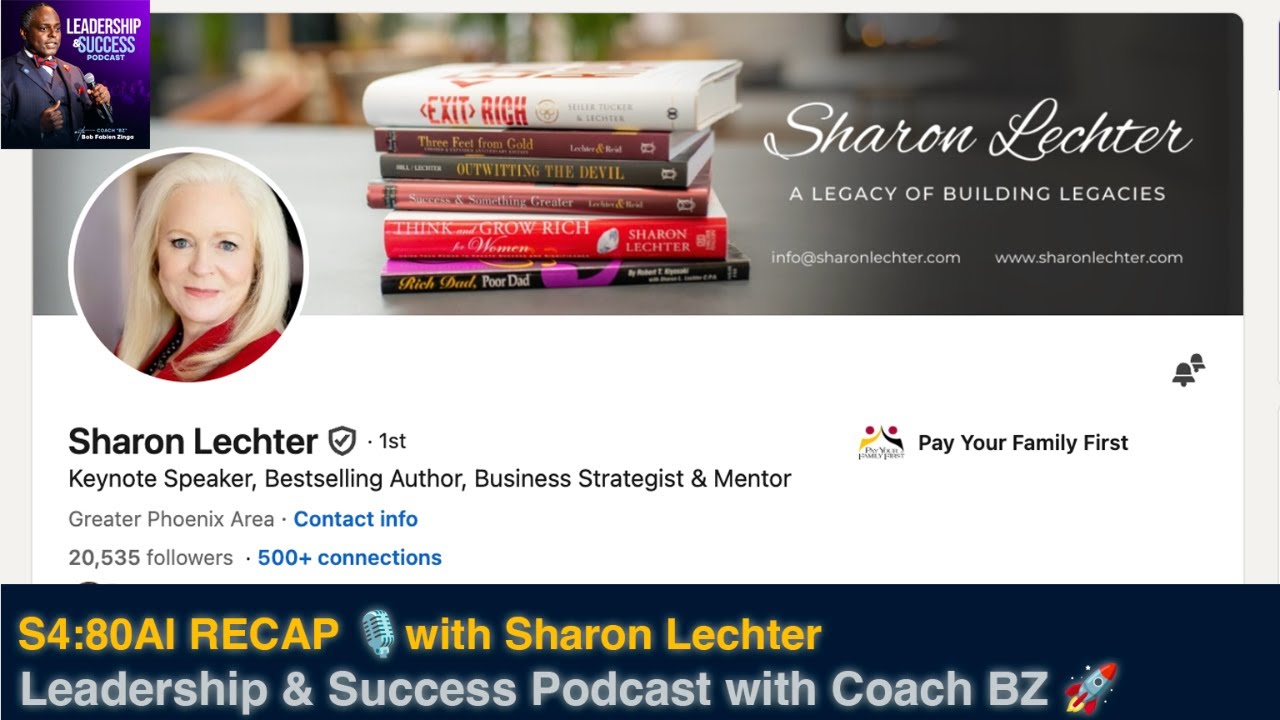
Sharon Lechter, financial educator and author, talks about leaving accounting after her son's death in 2012 to start the Play Big movement. She teaches the difference between assets and liabilities, uses a daily Abundance-Tracking-Method, and believes treating yourself as CEO of your life is the foundation of leadership.
Chapters
Hi, I'm John Maxwell. When the top companies in the world are looking for trainers, speakers, and coaches, there's one name that stands above the rest, and that's Maxwell Leadership. Our certified team members have gotten proven results for companies all over the globe, and our reputation, I'm proud to say, is second to none. Some of our members have risen to the top of their profession, including the one you're going to meet today. I proudly introduce you to my friend Bob Fabien Zinga.
Welcome to the Leadership and Success Podcast with your host, Coach BZ, where we help you lead with purpose and succeed with impact. If you're ready to grow into the kind of leader others want to follow, this podcast is for you. If you're determined to elevate your success and leave a lasting legacy, this podcast is for you. As my mentor, Dr. John C. Maxwell, reminds us, everything rises and falls on leadership. Our goal is simple: to inspire you, challenge you, and equip you with insights that can transform the trajectory of your leadership journey. Welcome aboard to Welcome to another episode of the Leadership and Success Podcast with Coach BZ.
Imagine gaining the leadership skills that could redefine your career. Join Coach BZ on the Leadership and Success Podcast, where each episode delivers practical insights from world-class speakers, military leaders, and industry experts. We dive deep into what matters most: building resilient teams, leading through uncertainty, and navigating complexity with clarity and confidence. Every conversation is crafted for aspiring leaders like you who are ready to grow, lead, and make a lasting impact. Don't miss our powerful live sessions and recent highlights. Michelle Hayward on building diverse, high-performing technical teams. Anne Leslie on leading through global complexity and cybersecurity risk. Ron Carpenter, AI, exploring faith, resilience, and AI-powered leadership. Colonel Michelle G.I. Gardner-Intz on commanding influence from the battlefield to the boardroom. Chris Robinson on shifting from drift to drive in life and leadership. And Coach Enrique Acosta Gonzalez on mentorship, legacy, and heart-centered leadership. Ready to level up your leadership journey? Tune in on Spotify, Apple, Audible Podcasts, YouTube Live, and LinkedIn Live. Join the movement toward leadership excellence. Listen now and start transforming your success.
Podcast where I ask you, uh, what do you think is the greatest lesson you've ever learned?
The greatest lesson I've ever earned— learned? Well, probably adding value to people's lives every day. That's probably because that's really been the, um, the star, the, the North Star for me for my entire life. But then also, when I left public accounting, I was very successful, but one of my clients invited me to leave public accounting to go into a company that was buying out of bankruptcy. And I still remember going back to my condo. Back then we didn't have PCs or cell phones, so it was the old yellow legal pad. And I had pros and cons, and it didn't help me a bit because I could choose either. I could argue both sides. I could stay where I was, stay in public accounting, but I wasn't in control of my own life. I was working incredibly long hours. Or I could take the risk and step into a world of the unknown. My hand took off across the top of the page and said, why not? That is my second guidance word. Why not take the path less traveled? Why not solve a problem or serve a need? The most successful businesses all solve problems and serve needs. And so why not was my trigger that made me leave public accounting at that time. And I still use— I— it is still my trigger today. That's, you know, the why not. I was mad about negativity. Why not do something about it? So I did the ATMs. This year I was— because so many people were stressed out about investing, so I said, okay, serve— solve a problem, serve a need. So I'd literally just finished in a complete course called Investing in Uncertain Times. Wow. And that Investing in Uncertain Times is all about equities, real estate, um, Bitcoin, digital currencies, forex trading, gold and silver, tax situations, building a business. So I went through it, 9 segments.
Wow, that is so crucial and so important. Another way we've raised our daughters One of them graduated from college last year. Thank God. It's so expensive, colleges these days, but they really need to be independent and really think about, you know, their own careers and their own goals. So let me switch a little bit on talking about leadership and resilience. In 2012, most tragic thing happened to you. You faced with devastating loss of your son. Which led to the Play Big movement. How did that experience reshape your definition of leadership, resilience, and purpose?
Well, number one, you don't wish it on anybody. You're not supposed to outlive your children. When it happened in December of 2012, my life stopped. I was living in neutral, in a world of numbness for a while. I even thought about retiring. But, uh, I got pushback from family and friends. I even heard my son in my ear saying, get over it, Mom, there's more for you to do. You're still here for a reason. And, and that's why I decided to get back out there. I created the Play Big Movement. There's a private Facebook group that anybody can join, but it really is to show people that you're still here for a reason, no matter what happens to us, whatever mess happens in your life, whether it was a death, a divorce, a financial setback, an illness, you're still here. So turn that mess into your message, and then that message can become your mission. And when that's your mission, you're going to become somebody else's miracle.
Hmm.
And so I turn my tragedy into fuel for me to help other people find a better pathway. And but I didn't want to do it alone.
All right, everyone, good morning. Today we are going to have a 10-minute recap of the wonderful leadership discussion I had with Sharon Lechter. What an insightful woman. She is the brain behind the Rich Dad Poor Dad brand. And before we do that, let's do our moment of gratitude. This is part of the show where we just take a moment to be grateful for something. So if you would put yourself in a grateful state, close your eyes if you want, maybe take a deep breath. And think about one thing you are grateful for today. What are you grateful for? I think today I am grateful for life. I am grateful that I am still alive. I am still here. Uh, I believe that as long as I have breath, right, I have hope. So my tomorrow, I believe, will be better than my today and my yesterday. So, uh, let us know what you are grateful for. Uh, type it in the comment and also let us know where you are joining us from, what city, what state, and which country if you are outside of the US. So I'm now going to have my AI agent go ahead and give you a 10-minute summary recap of the hour-long conversation I had with Sharon. And after that, I'm going to play two more tapes, two more highlights from the interview we had. And if you have any questions for me, Please type it in the comment. See you guys soon.
Welcome everyone. Today's discussion dives deep into leading with purpose. I'm inspired by Sharon Lechter's powerful insights, especially from her journey from Rich Dad to Play Big.
I'm excited. There's so much here about taking control of your life. What's the first point that really resonated with you?
Well, One of the first lessons is that you are the CEO of your life. Sharon emphasizes that leadership begins from within, controlling your thoughts, words, and actions. It's all about taking extreme ownership, right?
Absolutely. And that idea seems to ring true for both military officers and Silicon Valley engineers. It's a reminder not to just coast along.
Exactly. And then there's the idea that financial freedom isn't just about a paycheck. It's built on assets that feed you versus liabilities that eat you. It's like, um, you have to change the way you think about wealth. You're investing in assets that create lasting freedom.
That's a powerful mindset, focusing on building businesses, investments, or even digital innovations rather than just chasing dollars. But, uh, don't you think sometimes it oversimplifies the challenges people face?
I hear that point, and it might seem a bit simplified at first glance. However, Sharon's perspective is about establishing a strategic direction, turning the mindset toward long-term sustainable success instead of temporary fixes, a sort of empowerment that redefines success.
That makes sense. And speaking of empowerment, Sharon's message on women stepping into their financial power is really striking. Her stats are pretty sobering, with percentages that show how crucial it is for women to claim financial responsibility.
Oh yes, absolutely. She points out that a high percentage of women eventually end up solely responsible for their finances. So her call to action is clear: educate yourself, build credit under your name, and never abdicate your power financially. It's a real wake-up call.
Yeah, it sure is. And then we get into one of the most moving parts of her talk: turning your mess into a message. Losing her son in 2012, um, that was a pivotal pivot point for her.
Right. That personal tragedy became the catalyst for her mission. She transformed her deepest pain into a compelling message, a source of strength. It really shows how even in our darkest moments, we can find purpose and serve others. It's a testament to resilience.
I love that idea, using hardship to fuel your impact. And it also ties into her notion of having a definite purpose, always asking, "Why not?" It's such an empowering question.
Definitely. The "why not" mindset challenges us to step into uncharted territory. It questions why we shouldn't pursue our dreams or solve a new problem, a real push against conventional limitations. It's like opening the door to endless possibilities.
And it's interesting how this approach applies across various fields. Whether you're in uniform or coding in Silicon Valley, everyone can benefit from a clear purpose and the willingness to take risks.
Exactly. Then there's also the idea that legacy is built daily. Sharon reminds us that leadership isn't just about achievements or finances. But about the daily impact and value that we add to others' lives. It's, um, profoundly human. Every small act contributes to your legacy.
For sure. The way she recalls her father's nightly question, "Have you added value to someone's life today?" It's amazing how simple yet transformative that can be.
Indeed, that question serves as a moral compass. And then we move to the notion of turning fear into fuel. She eloquently states that worry is essentially prayer for what you don't want. It's about taking that fear and channeling it into, um, focused energy that morphs into faith.
That's such a refreshing perspective. Instead of letting fear paralyze you, you let it propel you forward. It's like using your weaknesses as, um, stepping stones to success.
Yeah, that's a great way to put it. And then she draws on the classic insights of Napoleon Hill in Outwitting the Devil. Sharon modernizes his ideas to show how fear, doubt, and societal pressures keep many of us from realizing our potential. It's a call to reclaim control of our thoughts.
It's intriguing how she ties Hill's age-old wisdom to current challenges, emphasizing discipline and self-ownership. But sometimes I wonder if relying too heavily on this outwit the devil framework might oversimplify deeper social issues. What do you think?
I get that concern, but Sharon isn't suggesting a one-size-fits-all solution. Rather, she's offering a framework, a blueprint for reclaiming personal freedom by mastering our inner dialogue and pushing back against negative influences. It's more about personal empowerment than a cure-all.
That clarification really helps. Moving on, another key lesson is the power of association. Sharon notes that whether partnering with giants like Disney or networking in Silicon Valley, the company you keep accelerates your growth.
Absolutely. She drives home that successful businesses, and by extension, successful leaders, are built on collaboration and problem-solving together. You want associations that stretch you and elevate you. It's all about being intentional with your network.
Right. And for those with leadership roles, be it in the Navy or in tech, it's crucial your network is as ambitious as you are. It reinforces resilience and innovation day by day.
Exactly. And then, as a final wrap-up, Sharon leaves us with a compelling reminder: leadership begins inside. You can't lead others effectively if you haven't mastered leading yourself first. It's a principle that really goes back to the core of who we are.
It makes you think, doesn't it? Every decision, every habit counts. And by taking control, not only do we build financial and personal resilience, but we also leave a lasting legacy.
Right you are. It's a holistic view where disciplines like mastering your finances, developing assets, and even transforming personal trials become interconnected threads in the tapestry of your life. And that tapestry, in turn, defines your legacy.
What's really exciting is that these insights aren't just for one group. They resonate across military leadership, tech innovation, and everyday personal growth.
Yes, exactly. Leading with purpose is universal. It's like, um, you're crafting your own narrative by challenging conventional wisdom every day and turning setbacks into set setups for a bigger comeback, a narrative where every mistake becomes a lesson and every fear fuels your journey.
That transformation is what makes Sharon's teaching so relatable. The call to action is be bold, be disciplined, and be intentional.
Absolutely. And there's also an invitation to tap into daily guidance through tools like Sharon's ATM, daily deposits of abundance, tips, and mentoring, so that you continue to grow and stay aligned with your purpose. It's a smart way to keep the momentum going.
That's a neat blend of accountability and continuous learning. I find it quite innovative, especially in how it merges practical advice with a mindset shift.
For sure. And I love how throughout all these lessons, the recurring theme is self-discipline. Whether it's controlling your thoughts, building assets, or curating your associations, discipline lays the foundation for freedom. Self-discipline really creates the structure for success.
It seems like every message circles back to the idea that leadership is a personal journey, one that starts with taking command of your life's direction.
Exactly. It's deeply personal. And in a way, it's also about service. Servant leadership, to be precise. Sharon's career reflects that, from advising presidents to championing financial literacy among women and young leaders. It's service with a purpose.
Right. And that service-oriented mindset is crucial, especially for those of us in roles where leading by example directly impacts others.
Definitely. It's about adding value every single day, which creates a ripple effect in personal lives, careers, and communities. That's the real legacy.
Yeah.
So if there's one takeaway we can hold on to, it's to start with yourself, understand and own your purpose, Harness discipline, and let every challenge fuel you forward.
Perfectly summed up! Sharon Lechter's insights, from being the CEO of your life to turning fear into fuel, provide a masterclass in universal leadership that applies everywhere.
Well said! Thanks for this in-depth discussion. These ideas give us plenty of— um, food for thought on how to lead with purpose every day.
All right everyone, uh, thank you so much for watching. So this is it. I don't see any questions on YouTube or on LinkedIn. So what I will do now, let me remind you guys, uh, first of all, yesterday I had this incredible leadership conversation with my mentor, the one and only, uh, Shelley Ashenbow. You absolutely have to watch it. It's episode 97, season 4, episode 97. So please go back and watch the full episode. It's available on LinkedIn and everywhere, podcasts are available. And tomorrow I'm going to come back and I'm going to have a 10-minute AI recap from the conversation I had with Captain Select Desmond Walker, US Navy. Incredible, incredible man. So proud of what he is doing. And you're going to get the AI 10-minute recap for that tomorrow. Also coming in November, and check my LinkedIn profile, I will have the offer of The Future Begins with Z. If you want to learn about Gen Z, these are my children, my daughter, make sure to come for this podcast with Dr. Tim Elmore. Okay, very, very important because I believe Gen Z is the future. They are a little different and you have to understand them, you have to encourage them, and you have to lead them. And they are led a little bit differently than the previous generation, I think. I know when I was the commanding officer for, uh, NAV Network Command, uh, Suffolk, Virginia, I really, uh, I had both of my daughters being my greatest teachers in understanding how to encourage and to lead Gen Z sellers because they definitely are very different than Gen Xs. All right, this is it for now. If you have a question for me, make sure to tag me and type it in the comment. And I also encourage you to go back and watch the full 1-hour episode with Sharon, Lector. That's season 4, episode 80. And, uh, thank you so much for being here. I'm going to play, uh, two more highlights, and that should do it for today. Thank you so much for watching.
Bye.
Well, thank you for that. I get asked that question a lot, and I'm going to tell you what my normal answer is, and then I'll give you an answer to the— that you're hoping for. But my normal answer is I try not to look back. Um, I wouldn't be who I am today if it weren't for all the things that have happened to me in my life, positive and negative. Of course, if I could change losing this child, I certainly would do that. But, um, I think we have to not look back. We need to look forward. You're the— you're in the driver's seat. You have your hand on the steering wheel, your foot on the gas. You have a huge windshield. You can go anywhere you want. The rearview mirror is very small because we're just supposed to learn from the past. And so I don't know— I wouldn't know who I would be today if I went back and changed myself at 17. However, the advice I give to 17-year-olds today is that you can be anything you want, you can do anything you want if you apply yourself and you find the right mentors and you keep learning. And always focus on, on solving problems, serving needs, and buying, building, creating assets. Go after the asset, not the paycheck, not the income. Build the asset that creates the income.
Wow, that is very, very, very powerful. Now, is there a question I should have asked you, Sharon, that I haven't asked yet? Anything else you wanted to share before we end?
Well, I would invite people to reach out to me with any questions. I, as I said, I have lots of online programs. If you're, if you're stressed out about money, we have a, um, a Money Mastery program all the way up to Essential Components of a Successful Business. So lots of programs. Um, I also We also have one-on-one mentoring. I have a mentoring retreat at our ranch here in Arizona. So please reach out to us to see how we can serve you. That's our goal is to support you and elevate financial well-being of all of you.
And on getting into their first job.
Well, I think it's important to understand it's not what you do for your paycheck that determines your financial future. It's what you do with your paycheck that determines your financial future. With every dollar You have a choice. Do you keep it and have it work for you, or do you let it flow through your fingers and lose it? And we're, we're very consumerism-minded, so people are taught to buy what you want, put it on credit, and that's where you start digging yourself a hole into bad debt. So understanding the importance of holding on to it and investing that money, and then doesn't mean you can't Enjoy buying wonderful things, but buy it from the cash flow from the assets, not from the money when you earn the dollars.
Wow, that is a big distinction. But really, everything you teach, I think, is simple, not simplistic. But I guess the secret really is in the execution, isn't it?
Yeah, I talk about my favorite, my favorite word on earth is assets. I said yes, I say assets are sexy. You are financially free when the income from your assets exceeds your monthly expenses. You know, you're, you're, you're taken care of. Your assets are providing for you. If you get sick, the money's still coming in. And so you are financially free when the income from your assets exceeds your monthly expenses. That's why I say assets are sexy. And then I add, the older you get, the sexier they become.
Yes.
Wow. Especially for, for young people, I think we, we think that one asset would be like buying a house, but— Bye everybody, this is Coach Bizzy. Thanks for watching. Until next time, don't forget to like, comment, and share.
Thank you for tuning in to the Leadership and Success Podcast with your host, Coach Beezy. If today's episode added value to your leadership journey, be sure to subscribe, share, and join us again for more wisdom nuggets on how to lead better and achieve greater success. Remember, leadership is the most critical skill of our time. The world will always need leaders to inspire others, drive innovation, and execute meaningful strategy. So why not count yourself among the bold leaders shaping the 21st century? Until next time, stay inspired, stay committed, and keep leading with excellence.
More from Bob

S250:E4🎙️LIVE 🇺🇸America 250: President Barack Obama Leadership, Service, and the Power of Hope






S5:E157🎙️ LIVE with CMD CMSgt Dennis L. Fritz, USAF (Ret.)(Multi Tracks Audio)



S5:E156🎙️ LIVE 🇪🇸 Leadership Lessons from the FIFA World Cup 2026 Champions (Multi Tracks Audio)

S250:E3🎙️ LIVE Leadership Lessons from America’s First Documented Family of African Descent 🇺🇸📖