S4:E81AI RECAP (VIDEO) LIVE with CAPT (SEL) Desmond Walker
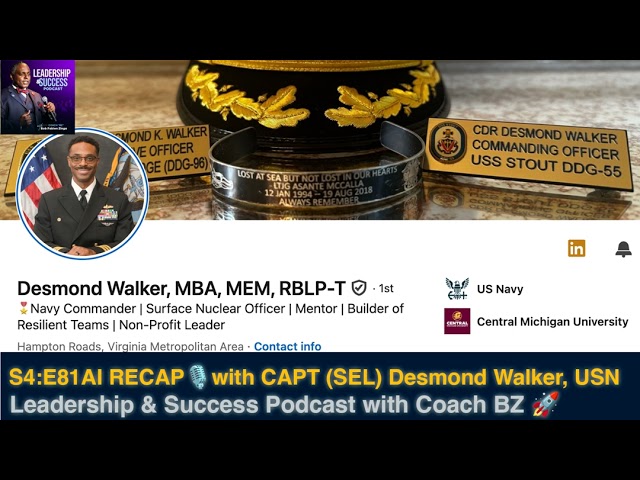
Captain Desmond Walker, a former enlisted sailor who commanded the USS Stout, discusses his rise through the Navy and his leadership philosophy. He distinguishes mental health from mental fitness, emphasizing daily habits like sleep and meditation. Walker shares his "5 Ps" framework for leadership and the importance of mentorship and representation for Black naval officers.
Chapters
Hi, I'm John Maxwell. When the top companies in the world are looking for trainers, speakers, and coaches, there's one name that stands above the rest, and that's Maxwell Leadership. Our certified team members have gotten proven results for companies all over the globe, and our reputation, I'm proud to say, is second to none. Some of our members have risen to the top of their profession, including the one you're going to meet today. I proudly introduce you to my friend, Bob Fabien Zinga.
Welcome to the Leadership and Success Podcast with your host, Coach BZ. If you need to develop into a better leader, this podcast is for you. If you want to achieve a greater level of success, this podcast is for you. His mentor, Dr. John C. Maxwell, said it best: everything rises and falls on leadership. We hope to inspire you today and provide you with an insight that has the potential to positively impact the trajectory of your life. Welcome to the Leadership and Success Podcast.
Again, like, prior to this, the guy coming to the officer ranks in the wardroom and stuff had to have an OD board a couple of times, had to have a surface warfare board a couple of times. My prospective nuclear engineering officer exam I didn't make it the first try, I had to go a second time, which was even harder because they added layers to it to validate your level of knowledge and your understanding of the information. And so, you know, I've got my own version of scars and lumps and trying to press and power through. And so, but again, like I said, if you never get too high, never get too low, then you chalk it up as another lesson to the game and you keep moving forward.
Hmm, let me ask you this. I'm gonna go on a limb. When you went to boot camp, did you know how to swim back then?
No.
Okay, so you're just as crazy as I am. Of all of the branches of the military, I used to swim when I was a kid, but then I got scared of the water. It was psychological, really. I don't know why. Maybe I almost drowned once. But anyway, I didn't swim from the time I was maybe 6 years old to the time I joined the Navy. And then the Navy had to give me a year. They told me Okay, Bob Fabien Zinga, you're going to have to learn how to swim, qualify as a third-class qualified swimmer. But if you don't do it within 12 months, you are out. So then I did everything I had to do to be able to do that. So tell me about that experience.
Well, it'll be real quick too. So in boot camp, I'm a negative buoyancy guy, so swimming was already hard. But by the end of boot camp, I had those dungarees, get that air and water, pop them things off real quick. And get my flotation device going. I was treading water like some, hey, put my arms out and kick and move my arms. Hey, there's a minimum for a reason and I met it. But it was a lot of effort, a lot of extra time in the pool. And then the same thing for, you know, when I got to the ROTC, I took a swimming class. I had an extra class in my curriculum that wasn't a part of my degree plan, but I took a swimming class to make sure I can get through those requirements. Doing what you got to do to achieve the goals you want to accomplish.
Wow, that is very powerful. And for the junior officers listening, I would say you absolutely have to take care of your mental health. I know when I first joined the Navy 20 years ago, nobody wanted to talk about mental health because you're going to lose your security clearance and the Navy is going to kick you out. But today it's a different Navy. Yeah, it's definitely important. If you need help—
Can I say something about that real quick?
Raise your hand and ask for help, please.
So it's interesting you bring that up, but one thing I talk to my crew about as well too, and this is, I'm not slamming mental health or anything like that, characterization is really important in today's age, especially with social media allowing people to create virtual realities and different social constructs that lie to them. For me, I go, there's a difference between mental health and mental wellness, right? You know, getting counseling, you know, going to seek professional help, you know, to validate what's going on with you physiologically. That's one piece of it, but I talk to my crew a lot, and I would bring my independent duty corpsman and my chaplain, into that conversation as well. Like, let's talk about mental wellness. You know, it's very easy to say physical standards are like this because of diet and exercise. Yes, right. But physical, physical health is I'm going to do my PHA, I'm going to get my shots. But what's physical fitness? Physical fitness is I got to make time to go work out. Physical fitness is If I got a choice between the carbs and the protein and the sugar, I got to make some choices. And so what do you— what's your mental fitness like? Are you taking 15 minutes to meditate? Are you getting the 6, 7, 8 hours of sleep on the ship? Are you choosing Wi-Fi or going to study? Are you choosing working out or going to, uh, get some extra training? Yes, the fitness piece of the mental part, it doesn't get enough conversation.
In my—
that's just my opinion, you know, the emphasis on mental fitness. The support is there, the support is great. Supporting people gets most of the conversation, but I'm a big personal accountability kind of guy. And where, where is your role in your fitness?
Wow, that's powerful, right?
All right everyone, today is Friday, October 3rd, and thanks so much for joining me. This is Coach Bizzy coming to you from the San Francisco Bay Area, and this is another episode of the Leadership and Success Podcast. So today we are going to have a 10-minute AI recap of the wonderful leadership conversation I had with Captain Select, the Desmond Walker. Uh, actually, this was one of the longest, uh, podcast episodes we've ever had. It was about an hour and a half when it normally lasts an hour. But this is why I am giving you guys, uh, 10 minutes recap of the wonderful conversation, uh, we had. And one thing he said, I think probably the most important thing, especially for junior officers listening to me right now, your mental health is extremely important, all right? And you have to take care of yourself. Unfortunately, right now we still have a huge epidemic in the military of 122 people commit suicide every single day, veterans in this country, and that's just not acceptable. So if you need help, dial 988 or 911, but there are people out there you you can speak to. Speak to a chaplain, speak to your commanding officer, speak to your chiefs. Reach out to someone. It's very, very important. That's part of the reason why this podcast now, our new tradition is what we call the moment of gratitude. So we want to take a moment, less than a minute, to just reflect and be grateful about one thing today because It's impossible to be suicidal and grateful at the same time. Impossible to be depressed and grateful. Impossible to be anxious and grateful at the very same time. Okay, let's do this. If you would, close your eyes, put yourself in your happy place, take a deep breath, think about one thing that you are or you learn through the experience and the mistakes of other people. So that's some of my adventures throughout my career today. Let us know what you are grateful for and, uh, type it in the comment. And also let me know where you are joining us from, what city or what country if out of the US. And also please tag someone you believe will benefit from this podcast and thank you for liking this post and subscribing to whatever platform you use and adding a positive review. I really do appreciate that. Okay, now let's go to the 10-minute podcast recap again for my conversation with Captain Select Desmond Walker.
Here we go. Welcome to our leadership journey chat. Today we're diving deep into the story of Captain Desmond Walker, a leader who transformed from an enlisted sailor to commanding officer.
I'm really excited about this. It's a tale of resilience, authenticity, and commitment to others.
Absolutely. Captain Walker's journey, starting from Hollandale, Mississippi, is truly inspiring. He, like, never really set out to be a leader. You know, he just kind of stumbled into it.
Yeah, right. His candid admission that he took a test, skipped class, and ended up in boot camp really sets the scene.
Exactly. And, um, it's like his early life wasn't preordained for command. It was chance meeting after chance meeting that propelled him into a nearly 30-year career with 8 deployments and command at sea.
What's fascinating is the evolution from enlisted sailor, where he learned leadership on the deck plate, to the officer role. That period in the Seaman to Admiral 21 program really laid out the foundation.
Right, right. He talks about how his LPO, Patrick Jones, gave him responsibility, and by his second deployment, he was already leading 18 people. It's like, um, small tasks build up into major responsibilities.
Absolutely, and it clearly reflects that leadership begins with doing the small things well. But I do wonder, don't you think sometimes the emphasis on starting small might underplay the need for visionary planning and leadership?
That's a valid point. But I think Kapt Walker's narrative really shows that every major decision is built upon those, like, everyday moments of responsibility. Mm-hmm.
True. The foundation is critical. And his integration of academic qualifications, degrees in electronics technology, engineering management, and an MBA adds another layer to his leadership approach, doesn't it?
Totally. He saw education as a force multiplier. It's like, um, translating complex institutional guidance into practical steps for his sailors.
Yeah. And speaking of translating, his experience at the Pentagon, where he learned to blend military operations with corporate strategies, really bolstered that.
Exactly. It's like, um, he bridged the gap between the high-level Navy directives and the day-to-day actions of a sailor. This is where understanding, say, the CNO's guidance uses real-life strategies to enforce those orders.
Yep, and that brings us to his command at sea. I mean, commanding USS Stout under the Command by Negation model is a fascinating approach.
Oh, absolutely. Imagine having 700 days where every decision is challenging, and yet you empower your chiefs and department heads, telling them to, um, let those horses run.
Mhm, it's a stark reminder for any leader: trust your team and don't micromanage. But I do have to ask, do you really think this hands-off approach always works, especially in high-stakes scenarios?
I get your point, but in Captain Walker's case, it's about empowering the experts around him. Sure, there are risks, but by setting clear boundaries, He allowed those with the deepest technical knowledge to operate at their best.
Yeah, that definitely emphasizes the balance between guidance and freedom, a principle many modern leaders can appreciate.
For sure. Then there's his three-tiered leadership philosophy, defining and owning the standard, the 5 Ps: Programs, Policies, Procedures, Processes, and People. And a daily mindset geared towards accountability.
Mm-hmm. The 5 Ps are such a strong framework. I love how he makes that applicable not just in the Navy but even in Silicon Valley.
Right. It's like, um, universal leadership advice. And then we have his very touching moment with Lieutenant Junior Grade Asante McCullough.
That part really hit home for me. Losing a mentor, especially one who represented genuine kindness and positivity, must have deeply influenced his perspective on leadership.
Definitely. He even wore a bracelet with Lieutenant Junior Grade McCalla's name as a constant reminder of the personal impact leaders have.
Yeah, it's an incredibly humbling reminder that leadership is not just about decisions. It's about, you know, influencing lives.
Absolutely. And then there's his physical resilience through Spartan races. Completing 11 races between 2018 and 2022. It's like, um, using physical challenges as a metaphor for mental toughness and leadership endurance. Mm-hmm.
That's really something. It's a perfect illustration of how pushing your physical limits translates into leadership readiness.
Exactly. Plus, his emphasis on mental fitness versus mental health is, um, A crucial piece of advice. Leaders have to manage, you know, the discipline of routine. Sleep, meditation, study, all of it.
And it's refreshing because he highlights that mental fitness isn't just a luxury. It's essential in high-stress, demanding environments.
Right. It's about maintaining a balance, ensuring you're prepared to make clear decisions, whether in the boardroom or out at sea.
Mm-hmm. Speaking of balance, his idea of humble confidence is really powerful. Believe in yourself, yet know you don't have all the answers.
Totally agree. It's like, um, encouraging others while keeping your ego in check. A remarkable trait for any leader striving for both respect and approachability.
Yeah. And let's not forget his views on diversity, inclusion, and representation. The way he reflects on being a Black naval officer and the importance of visible leadership really sets a precedent.
Absolutely. It's transformative to see a leader from, um, a modest background in Mississippi become a beacon of possibility for sailors and for professionals everywhere.
Mm-hmm. Representation does more than just inspire; it transforms organizational culture, right?
Yes, it does. And his relentless commitment to mentoring reminds us to, um, bloom where you're planted.
That phrase, bloom where you're planted, resonates deeply. Leaders can apply it whether they're at a high-ranking military post or starting out in any field.
Exactly. It's about making the most of every situation, no matter how limited the wiggle room might seem.
Yeah. You know, one of his final pieces of advice really strikes a chord. 'You can do it. Just don't quit.' It's simple but so impactful.
Absolutely. That's the essence of resilience—consistency, character, and care for people. It's a masterclass in servant leadership. Mm-hmm.
Well, this conversation definitely gives us a lot to reflect on. Capt. Walker's journey reminds us that leadership is about daily commitment, empathy, and the humility to keep learning.
Indeed, each lesson from his story, like, um, the importance of small responsibilities or the strength gained through personal challenges, applies to leaders in every sphere.
Yes, and it's, um, a call to action. Define the standard, own it, and ultimately, become the standard yourself. Absolutely.
His narrative isn't just about success in the military; it's a blueprint for anyone stepping into leadership roles. Be it in the military, Silicon Valley, or beyond. Mm-hmm.
Here's to taking his words to heart and shaping our own journeys with a blend of resilience, empowerment, and a little bit of that humble confidence. Couldn't have said it better.
Thanks for this insightful dive into leadership and the lessons of Captain Walker. Until next time, keep striving and remember, you can do it. Just don't quit.
Alright, so that was the 10-minute recap of the hour-and-a-half-long leadership discussion I had with Commander Desmond Walker. And if you would please type into to the comment, uh, 1, 2, 3 highlights from this session. I really do appreciate that. And also, by the way, this week Captain Select Walker is going to be my friend in the spotlight, so you can find it on my LinkedIn and find out more about this American hero, really outstanding naval officer. And I'll be back here tomorrow, and I'm gonna have a live session with, uh, Captain— let me see, it's not showing up. Okay, here we go— with Captain, uh, Michael Salehi. It's going to be 4 PM Pacific time, so 7 PM Eastern time. I hope you can join us live. Uh, we are going to learn so much, uh, about this senior naval officer. Going to be Saturday, uh, tomorrow. All right, um, I don't see any question for me or comments right now, so I'm gonna play a couple of more highlights from the hour and a half long leadership conversation I had with Captain Select Walker. Again, my encouragement is for you to go back and listen to the full episode, season 4, 84. It is really a wonderful episode. Especially for aspiring junior officers who are dreaming of command at sea or at shore one of these days. So until then, I will see you tomorrow.
Here's more highlights from Commander Desmond Walker. And I just like what the recruiter was saying about an opportunity to work and serve And that was also too, MSMS was very demanding academically. And not that I was tired, but I did want to do something different. I wasn't a stranger to hard work. And so I ended up doing the late entry program in the Navy shortly after the ASVAB. And so graduated in May and was in boot camp by July because I decided I wanted to go to the Navy and do something instead of going to college and continuing education. Even though the— Wow. The high school experience prepped me for college very well.
That is amazing. So did you consider the few of the— the Marines or the Air Force? No.
The only recruiter came to campus was Navy. So it was Navy or nothing. Pretty cool.
And it was a chance to see the world. Yeah, that is really fascinating because for me, 9/11 was really what touched me a lot. I wasn't a US citizen at the time, but my wife was, and we had a baby on the way, and I wanted to do something to help protect our way of life. But I talked to everybody, the Army, the Air Force, and every other branches. But very, very quickly I found out that the Army and the Marines was not for me. I thought those people are just killers, right? They don't really use much of their brain. At least that's what I thought at the time. I'm like Air Force, Navy, yes, those people are really nerds just like I am. We can use our brain and really do do a lot of great, great things for this nation. But of course, I wasn't eligible yet because I didn't have my green card. But anyway, they kept saying no, no, but I kept coming, coming back like with Terminator. I'll be back. So once I got my green card, then I knew for sure that the Navy was the place for me. Now, you all degrees in electronic technology engineering management and an MBA too. And I'm wondering, like me as an IP officer in the Navy, they don't care about my MBA at all. I got my MBA for the job I do for Silicon Valley, but they do care about my Master of Science. But I wonder, does your, um, designator, your community care about MBA, or did you just—
No, well, I would say it's that I wouldn't look at it that way. Um, the kind of— let's kind of break it down a little bit, you know, the So that performance really was the difference maker and not that I was missing something that was already expected.
That is really, uh, fascinating. So as a, uh, first time, uh, CEO, commanding officer of the USS, uh, Stout, right? DDG 55. What was the most challenging leadership decision you had to make and what did you learn from it?
See, there you go. You got me making decisions. I'm not in command anymore. I don't appreciate that question at all. Out of 700-some days in command, which one was the most challenging? How about all of them?
Yes, yes. But I'm sure you reached out to some of your mentors, right?
Oh man, the group chats and the emails and the phone calls was flying the whole time. I'd say probably, probably the most, let me see, probably a challenging decision was probably towards the, we were trying to finish a lot of training certifications just before deployment and it required a few weeks of, early days and late nights for all of us in some capacity to meet all those requirements. And, but we got through it, we did it well. Our results resonated with the assessors and it ended up being very foundational for first showing that we proved ourselves how resilient we can be when we really have Thank you for listening to the Leadership and Success Podcast with your host, Coach Beezy.
If you like what you heard, please subscribe to our channels and come back for more wisdom nuggets on how you may develop into a better leader and achieve greater levels of success. Leadership is the most critical skill. The world will always need leaders to lead others, deploy the next disruptive technology, or execute a business strategy. You may as well decide on counting yourself among the 21st century leaders. See you right here next time on the Leadership and Success Podcast with Coach BZ.
More from Bob

S250:E4🎙️LIVE 🇺🇸America 250: President Barack Obama Leadership, Service, and the Power of Hope






S5:E157🎙️ LIVE with CMD CMSgt Dennis L. Fritz, USAF (Ret.)(Multi Tracks Audio)



S5:E156🎙️ LIVE 🇪🇸 Leadership Lessons from the FIFA World Cup 2026 Champions (Multi Tracks Audio)

S250:E3🎙️ LIVE Leadership Lessons from America’s First Documented Family of African Descent 🇺🇸📖