S4:E82 AI RECAP🎙️ LIVE: Building Trust and Cultural Awareness (Multi Tracks Audio)
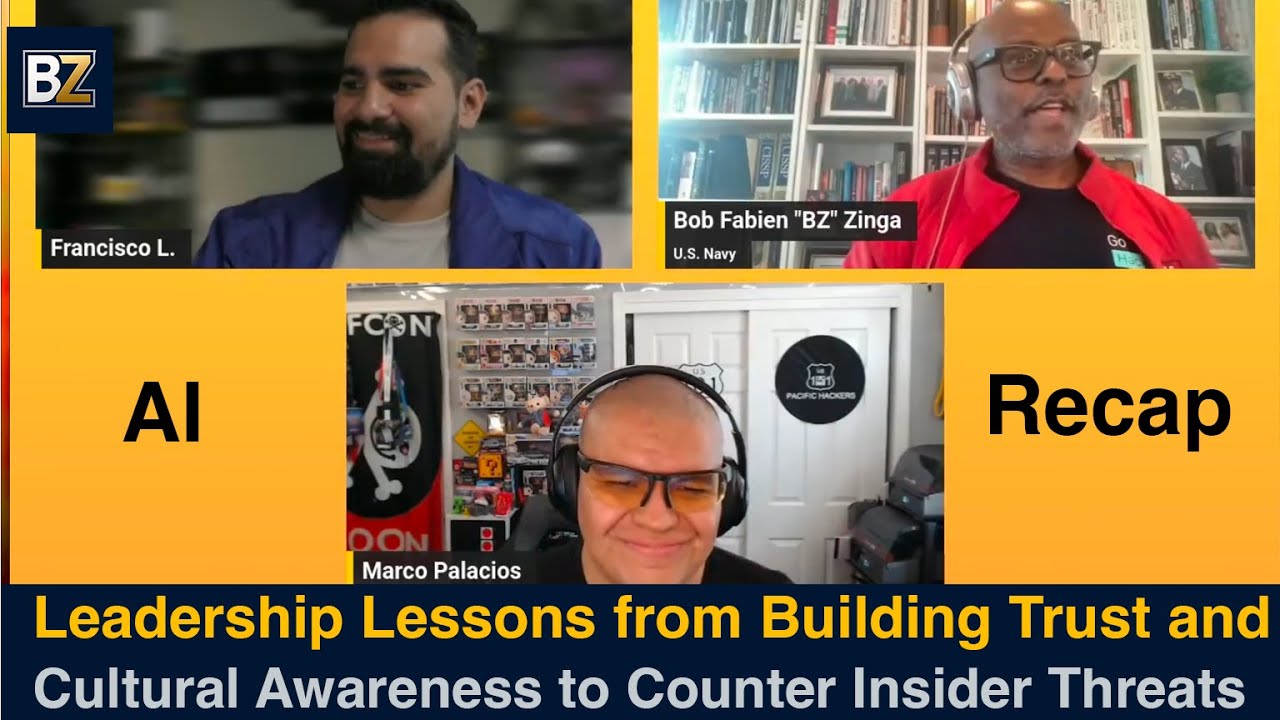
Coach Bizzy and security experts recap Season 4 Episode 82 on building trust and cultural awareness to counter insider threats. They cover John Maxwell's leadership philosophy, phishing-training practices, and why diversity matters in national security. The core message: security is a people problem that requires psychological safety, transparent communication, and leaders who model empathy.
Chapters
Bazinga!
Bazinga! Bazinga!
Zinga zinga zinga zinga zinga zinga zinga zing boom! Zinga zinga zinga zinga zing boom! A funny melody that keeps you singing. Zinga zinga zinga zinga zing boom! And in your memory it keeps on ringing.
Zinga, zinga, zinga, zinga, zinga!
¡Hola!
Hi, I'm John Maxwell. When the top companies in the world are looking for trainers, speakers, and coaches, there's one name that stands above the rest, and that's Maxwell Leadership. Our certified team members have gotten proven results for companies all over the globe, and our reputation, I'm proud to say, is second to none. Some of our members have risen to the top of their profession, including the one you're going to meet today. I proudly introduce you to my friend Bob Fabien Zinga.
Welcome to the Leadership and Success Podcast with your host, Coach BZ. If you need to develop into a better leader, this podcast is for you. If you want to achieve a greater level of success, this podcast is for you. His mentor, Dr. John C. Maxwell, said it best: everything rises and falls on leadership. We hope to inspire you today and provide you with an insight that has the potential to positively impact the trajectory of your life. Welcome to the Leadership and Success Podcast.
Like Marco says, the culture will depend from command to command, from organization to organization. But within your culture, though, making sure that people have that psychological safety where they can speak up and not feel like if they do, something bad is going to happen to them. This way they can let you know, hey, there might be a problem here. I think we need to focus on that. And when people make mistake, and they will, I think you need to also show some grace, but give them opportunity to maybe go back to the training, but really give them a positive experience and not feel like if I do one mistake, I am done with, because in an environment like that, I feel like it's not going to help you in the long run, but especially making it fun, because I think If people do the right thing, just as an example, last organization I was the head of cybersecurity and IT directly, artificial intelligence startup in San Francisco. One thing I used to do every quarter, I will have a phishing campaign, right? I would send them a phishing email and making sure to see that they understand the training, they're not gonna click on links, they're not gonna click on attachment. Now, for a few people who did, we say, okay, not a big problem, go back and do this training again, 5 minutes, 10 minutes.
It's not like hours and hours.
And then for the people who did the right thing, not only they didn't click on the link, not only they didn't click on the attachment, but they also reported it to security. Those people, they went above and beyond because by doing that, I'm telling everyone in the enterprise, now security can go back and find that email because if they send it to one person, they probably send it to all of us or at least a couple more people. So we can go into our mail server and delete that email from the sender or the email that has the same title. This way nobody can even see it or do that. And then I would give them a—
Because they stole all their IP and basically the products they were trying to sell, you know, another Chinese company were selling it. The same thing for cheaper, right? And guess what? Like, as a consumer, well, you want to go for whatever is cheaper if they're providing the same service and product, right? So anyways, enough, enough to say on that because we can go on and on. But the whole point about this is the fact that, uh, you know, people need to know what happens if you do harm, or like, if, if you click on that link, what happens if you click on that link? What happens you know, when you open that attachment, where does it go? Like, how is people like looking into that, um, and stuff like that?
So yeah, yeah, I gotta, I gotta, I gotta add that movie to my watch list. I recently rewatched Black Hat with Chris Hemsworth, the Thor actor.
I love it.
So I'm definitely gonna put that in my watch list. You mentioned, uh, Marco, you mentioned— I think this makes a fantastic segue and transition— you mentioned AI and Bob, you mentioned earlier the shared responsibility model, which reminds me a lot about AWS and learning about the AWS— they have the shared responsibility model. With the advent of AI and how big it is becoming nowadays, and it's, you know, it's even not just on a professional, corporate level, but a lot of regular users and people back at home, I mean, like, My mom sends me sometimes questions like, oh, this is what ChatGPT told me. I'm like, okay, well, take it with a grain of salt, Mom, whatever you do. And, you know, take it with a grain of salt. Don't go just listening into what it says. Developers are using these tools to develop nowadays. You know, what risks do you think? And I know, Bob, I know you've done some work with with AI too in Cuba and in Puerto Rico.
Hi everyone, this is Coach Bizzy. Today is Sunday, October 5th. It's about 6 or 7 PM here in California, so about 9 or 7 PM on the East Coast.
Thank you for being with me.
Without further ado, let's start So our moment of gratitude. This is something we do every time we meet, and we want to take 1 minute to just be in the state of mind that we are grateful for something, anything, every single day. So if you would close your eyes, put yourself in your happy place, And think about one thing that you are grateful for today. What is it? Go ahead and type it in the comment. For me today, I am really grateful for my wife, uh, Dimitria Zinga. She is such a rock, such a support for myself and our family. Without her, I really have no idea where I would be, what I would be today. So today, Dimitria, I'm very, very grateful for you.
All right.
Thanks for writing it down in the chat, and also let us know where you are coming from, what city, what state, and if outside of the US, what country. And also, if you have a question for me, go ahead and type it in the comment, and I will be back in about 10 minutes or so, and I'm going to be able to answer your questions. And also, if you would please like the event you are watching, we post it in your feed, and tag a colleague or a junior officer or somebody within your sphere of influence who might benefit from the podcast today. Today is going to be the 10-minute AI recap of the podcast we had, episode 82, which was about building trust. So we are going to do that today. So I've got my AI agent ready to go. They're going to speak to you for about 10 minutes or so, and I'll be back.
Welcome to the podcast, everyone. Today we're delving into the intricate world of countering insider threats through trust and cultural awareness, with a special focus on honoring Hispanic and Latinx contributions in national security.
I'm really excited about this topic. What really jumps out first is the idea that insider threats actually begin with people, right?
Absolutely. It's like, um, insider threats aren't just about malicious actors or disgruntled employees. It's about understanding the human factors behind unusual behaviors. It's about recognizing that cultural differences can easily be misinterpreted.
So, for instance, when someone logs in at odd hours or displays what might be seen as unusual work habits, it might not always be a red flag. It could just be a cultural nuance.
Right, right. The discussion really drove home that point. What looks like unusual access behavior or even financial stress might in some cases be a misinterpretation of cultural or familial obligations. It's, um, crucial for leaders to learn the difference between a real risk and a cultural misunderstanding.
I think that's where trust really comes in, isn't it? Leaders need to balance Um, vigilance with empathy. Without that trust, you end up with a surveillance culture that fosters fear rather than safety.
Exactly. And the approach shifts from a command-and-control model, like you'd often see in a military setting, to one of shared responsibility. A model where every employee feels like they're part of the solution.
It's a bit like, uh, you know when you're playing on a team where everyone's pitching in, rather than having one person just barking orders, right?
Yeah, exactly. The idea is to empower people through education and transparency. Instead of just dictating rules, leaders can explain the rationale behind policies, like why reporting a phishing attempt is celebrated.
That reframing really resonates with me. Instead of security being a burden, it becomes a tool for empowerment. But I, uh, sometimes wonder, aren't there risks in letting employees take on too much responsibility without a well-defined structure?
That's a fair point, and it's a balance. While, um, empowering employees is key, there has to be a robust framework that supports accountability. We're not just saying, go figure it out. We're ensuring that each person understands their role in the bigger picture.
Yeah, I see that. It's, um, almost like you're designing a system where when everyone understands the why behind security measures, it leads to a culture of trust.
Right on. And speaking of culture, the conversation clearly emphasized how leadership sets the tone. Leaders must model the behaviors they want to see. Vigilance balanced with trust, inclusion, and understanding.
Yeah, that's key. It's interesting how the panel linked cultural awareness to insider threat detection. In a way, misinterpreting someone's cultural behavior could lead to false positives. That seems like a critical lesson for not just security professionals, but, um, for leaders in any field.
Exactly. Misunderstanding cultural norms, like family obligations or different communication styles, can easily masquerade as potential insider threat indicators. And that's why cultural competence is non-negotiable.
Mm-hmm, totally. I remember an analogy. Imagine you're baking a cake with a secret ingredient. If you don't know about that ingredient, you might think the taste is off. Similarly, misinterpreting cultural signals without context can skew risk assessment.
Haha, yes, it's like, um, you're trying to detect a real threat, but you wind up catching harmless quirks instead. And, uh, that not only wastes resources but can erode trust among teams.
And trust is foundational. Without it, employees may hide mistakes or feel undervalued, which could actually open up more vulnerabilities.
Absolutely. The panel really highlighted that with trust, security becomes a shared responsibility rather than a punitive measure. When people see security as a collective mission, they're more likely to, um, engage and report potential issues without fear.
I'm also really intrigued by the discussion on using AI. It seems like an enormous double-edged sword, both empowering and risky.
Right. The AI factor is fascinating. On one hand, AI can automate data exfiltration or even generate deepfakes that erode trust. But on the other hand, it also offers new tools for insider threat detection. It's like, um, the same tool can be used for good or ill depending on how it's managed.
I get that, and it puts even more emphasis on having clear policies around AI usage in the workplace. It's not just about technology, it's about ensuring that employees fully understand what's acceptable and why.
Right, and education is crucial. Leaders need to instill a sort of trust-based vigilance. Employees should feel safe reporting mistakes related to AI risks rather than hiding them out of fear. It's really a whole culture change.
I think that's where the idea of shared responsibility comes into the picture again. A thorough, inclusive approach where every individual is informed and empowered to act securely.
Exactly. And another key takeaway was how diversity itself acts as a great security asset. The conversation really honored Hispanic and Latinx contributions, and it's striking how diverse teams naturally reduce blind spots.
Yes, that completely makes sense. Right. Diversity leads to a broader range of perspectives, which in turn means better intelligence gathering, more creative problem-solving, and improved resilience overall.
That's it. And sometimes people think diversity is just a social value, but in the realm of national security, it's downright strategic. Bilingual skills, cultural fluency, These are all tangible advantages when countering insider threats.
I totally agree. Although I do want to point out, sometimes I wonder if there might be a potential pitfall in overemphasizing cultural differences. Could that lead to stereotyping if not handled carefully?
That's a really important challenge to address. We're not talking about pigeonholing people. Instead, it's about developing cultural competence to avoid misinterpretation. It's, um, about appreciating nuance rather than making assumptions.
Exactly, exactly. So in a way, it's a balancing act, using cultural awareness to enhance security without unintentionally reinforcing biases.
You got it. And that brings us back to leadership. Leaders need to model this balanced approach. By doing so, they not only help in risk detection but also inspire trust and enable a resilient, inclusive environment.
It seems like a recurring theme is that leadership isn't just about enforcing rules. It's about, um, building a culture where people feel valued and safe.
Exactly. Trust becomes the foundation upon which security is built. Think of it like constructing a bridge. If the supports aren't strong, if trust is missing, the whole structure can collapse.
Right, right.
It's like Um, without trust, even the best tools or policies can fall short.
And honestly, in today's fast-evolving threat landscape, that trust is more critical than ever. From insider threats to AI-generated challenges, it's the human element that holds the key.
Absolutely. And to wrap it up, the discussion really served as a call to action for leaders at all levels. It's about reflecting on how we build trust being proactive in addressing cultural blind spots, and always championing inclusivity.
I love that. It's like a roadmap for not just cybersecurity professionals, but any leader aiming to inspire resilience and trust among their teams.
Yes, it is. And, um, one of the standout messages was that security is ultimately a people issue. Technology and policies will always evolve, but the human dimension, Trust, culture, and community is what truly counters insider threats.
Yeah, indeed. This really challenges the traditional view, doesn't it? Instead of seeing insider threats solely through a technological or policy lens, we're embracing the complexity that comes from human interactions and cultural dynamics.
Exactly. And by honoring the contributions of Hispanic and Latinx professionals, we're reminded that diversity is a strategic asset. It broadens our perspectives and ultimately makes our security frameworks more robust.
Absolutely correct. I think this conversation gives each of us, whether in cybersecurity, the military, or the private sector, a lot to reflect on. How do we build trust today? How can we ensure that cultural differences are seen as strengths rather than vulnerabilities.
Right. And that's the real takeaway. It's a call for leaders to invest in people, to foster environments where every team member feels seen, heard, and empowered. That's how you truly counter insider threats and honor heritage simultaneously.
Exactly. Thanks for this deep dive. It's been thought-provoking and, um, really inspiring to see how cultural awareness and trust fundamentally transform threat detection and leadership.
My pleasure. Let's all take a moment to think about how we can apply these insights in our own teams, building not just secure but truly resilient cultures. Until next time.
Until next time. Stay safe, lead with trust, and embrace the diversity that makes us strong.
All right, everyone.
Thank you so much for being here with me. That's going to be the end of, uh, our episode today. I don't see any question on LinkedIn or on YouTube, but one thing I will say, for me, one of the main takeaways is that leadership is not just about guarding secrets or stopping threats, right, when it comes to cybersecurity or national security. It's also about building an environment where people feel safe, where they feel valued, where they feel inspired to give their very best. That's really what leadership is all about, in my opinion. That's really the take-home message. But let me know if you would type into the comment, what are your takeaways from this episode? What have you been reminded of? Or what did you learn that's new? Free takeaway from the conversation. And most importantly, which leadership insights you're going to be able to apply this week. All right, thanks again for watching. I'm gonna play a couple more highlights from the episode and that's gonna bring from the full conversation we had, which was Season 4, Episode 82, right? That's the one we did on trust and cultural awareness. And that should be the end of the episode today. Thanks again for being with us.
I just want to add really one thing that I just to also summarize what he said. While networking also invests on not just learning the technical skills but the soft skills, okay, that's very important because it doesn't matter what industry you're in. You're like one of my former college professors used to say, if you can explain it to my grandma, I can understand. Then you're doing, you know, a good— you're going to be a good communicator. So, again, it doesn't matter what it is. If my grandma can understand it, then, yeah, you can do it. So that's it.
Awesome. Yeah, thank you so much. Thank you guys so much for that. I love all those points. As somebody with a technical background, I would 100% say that networking with my university, colleges, community around me has definitely been an important part of my career. And I encourage everybody in the audience and everybody out there, if you're a technical person and you're more to yourself, try to be more open or find a friend who is outgoing and step out there, network, connect with your community, connect with your college, connect with your university, your company. But yeah, go ahead and network. With that said, I think we're coming up on time, guys. I want to thank you both for being here today with me. A wealth of— I've been sitting— it's like a lecture for me. I've been sitting here learning from you guys a ton. You guys have brought up some fantastic points.
If everybody is white, everybody is middle-aged, and everybody is male, then it's like, okay, that's not me, so it's probably not possible. And I also really I truly believe all of our industry should reflect the diversity in our country. And that just makes sense. But talking about the benefit of diversity, let me think of 3 or 4 things I think that are really important, especially when we talk about national security or cybersecurity. One is the broader perspective and problem solving, right? Cognitive diversity, having people who think completely different, that really adds so much to the organization. And in cybersecurity and national security, adversaries tend to exploit blind spots, right? But when you have a diverse team, it's less likely to think in a single-channel way. So that really adds a lot. Stronger trust and engagement as well. When people feel like you can be who you are and you are part of the team. So by becoming a sailor, a member of the U.S. Navy organization, doesn't mean that you are no longer Black or Hispanic. You are still that, but you are also one of of us, you wear our uniforms. That provides psychological safety, you know, you belong here. And then there is improved performance and outcome. I mentioned earlier, I believe it was McKinsey and also the Harvard Business Review, they did studies and consistently teams that are diverse, they outperform homogeneous team in profitability, which businesses like that, making money, creativity and decision quality, always, always outperform from them. And then finally, if I can add one more, is also that heritage as a source of resilience as well. Your cultural values, like I said, for example, generally speaking, in the Hispanic community, you know, familismo, family, royalty, but also ubuntu, right? I am because we are. So that built into a framework of resilience and ethical responsibility. So heritage stories of migration, sacrifice, overcoming adversity, Inspire perseverance in teams facing modern challenges. So I think because of all of that, diverse teams are a must. We must be. But the thing for me is you do have to be intentional about leading a diverse team. Otherwise, all you're going to get are, you know, white male on your team, because that's where you look, but you have to be very, very intentional.
I want this team to be as diverse as possible so we can Thank you for listening to the Leadership and Success Podcast with your host, Coach Beezy. If you like what you heard, please subscribe to our channels and come back for more wisdom nuggets on how you may develop into a better leader and achieve greater levels of success. Leadership is the most critical skill. The world will always need leaders to lead others, deploy the next disruptive technology or execute a business strategy. You may as well decide on counting yourself among the 21st century leaders. See you right here next time on the Leadership and Success Podcast with Coach BZ.
More from Bob

S250:E4🎙️LIVE 🇺🇸America 250: President Barack Obama Leadership, Service, and the Power of Hope






S5:E157🎙️ LIVE with CMD CMSgt Dennis L. Fritz, USAF (Ret.)(Multi Tracks Audio)



S5:E156🎙️ LIVE 🇪🇸 Leadership Lessons from the FIFA World Cup 2026 Champions (Multi Tracks Audio)

S250:E3🎙️ LIVE Leadership Lessons from America’s First Documented Family of African Descent 🇺🇸📖