S4:E84AI RECAP 🎙️LIVE with CAPT Michael Salehi, USN (Multi Tracks Audio)
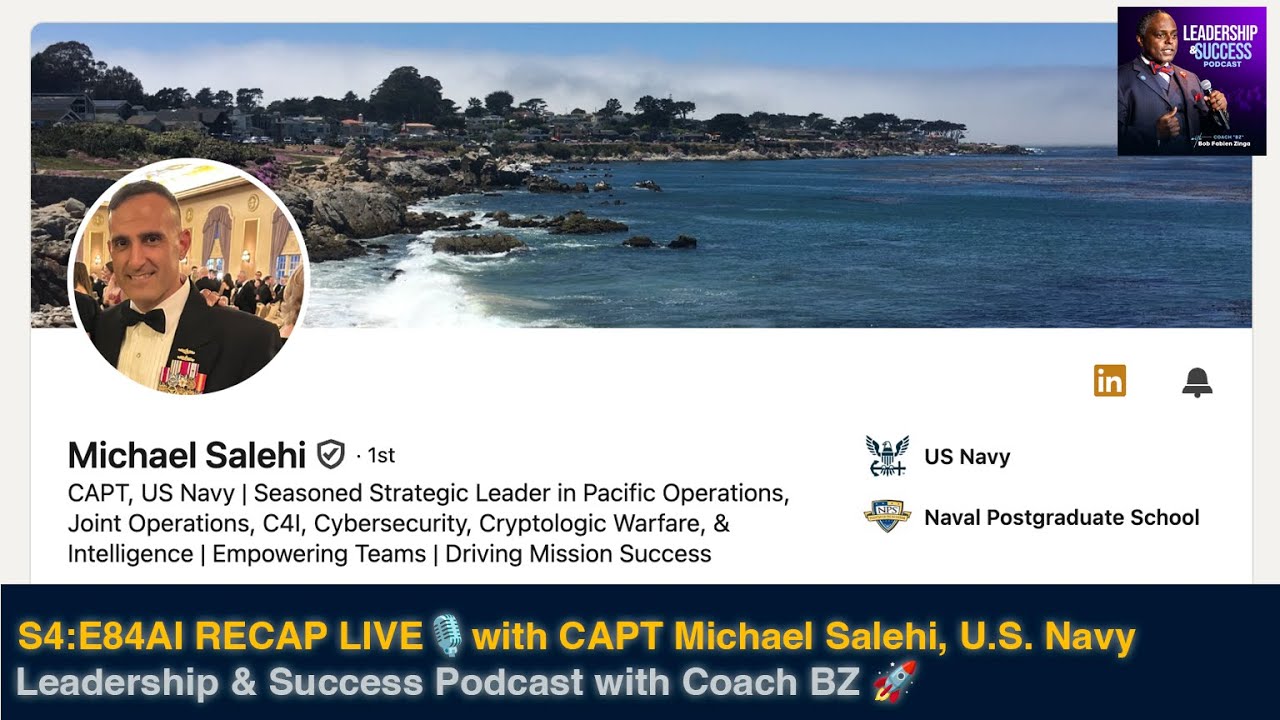
Captain Michael Salehi, a 26-year Navy veteran who led cyber operations and intelligence missions, says rank is rented and trust is earned. He stresses daily self-reflection, learning to follow before you lead, and bouncing back from failure. On AI in warfare, he warns it needs human guardrails: man plus machine, not machine alone.
Chapters
Hi, I'm John Maxwell. When the top companies in the world are looking for trainers, speakers, and coaches, there's one name that stands above the rest, and that's Maxwell Leadership. Our certified team members have gotten proven results for companies all over the globe, and our reputation, I'm proud to say, is second to none. Some of our members have risen to the top of their profession, including the one you're going to meet today. I proudly introduce you to my friend, Bob Fabien Zinga.
Welcome to the Leadership and Success Podcast with your host, Coach BZ. If you need to develop into a better leader, this podcast is for you. If you want to achieve a greater level of success, this podcast is for you. His mentor, Dr. John C. Maxwell, said it best: everything rises and falls on leadership. We hope to inspire you today and provide you with an insight that has the potential to positively impact the trajectory of your life. Welcome to the Leadership and Success Podcast.
Hi, I'm Captain Michael Salehi, United States Navy. For over 26 years, I've served at the intersection of cyber operations cryptologic warfare, and global intelligence. From my early days on the deck plates of the USS Philippine Sea to commanding the Navy's largest communication station in the Pacific, I've had the privilege of leading teams across the fleet. Our mission was simple: keep the force connected, resilient, and ready anytime, anywhere. Leadership at sea, in special operations, and in major command has taught me one thing above all: rank is rented, trust is earned. And I'm looking forward to sharing those lessons with you on the Leadership and Success Podcast. And as a leader, you've got to walk that walk too. I've made mistakes and I've told my sailors, I'm like, I made a mistake. I'm a human being. Like, I'm a captain. I'm going to make little mistakes here and there too. If you think I'm a robot, dude, you're, you're, you're lost. So be transparent about your mistakes. Hold yourself accountable for that. Your troops will learn to appreciate and respect you if you come forward and tell them that you messed up also.
That is so powerful. Be accountable. Because the other thing too is if you try to hide it, the mistake may become critical, whereas if you fess up right away, there's a lot of time to change things and improve. So we have another question from the audience. Omina El Maki, she is from UAE.
Wow.
United Arab Emirates, working in the higher education sector at the university. She's passionate about uncovering the key drivers behind effective leadership and exploring what shapes and sustains great leaders. So, Sarah, what are key drivers behind effective leadership?
You know, effective leadership, I think, is being very self-aware and, uh, self-critiquing, right? Uh, I, I spent a lot of time do an introspection about how I could be more effective in what I do. And I'll put it to you this way, after every day when I'm driving home from work, I hot wash, I go through my head what I did and if I did it right and if I need to improve. So if you could just self-critique yourself, do a lot of reading, listen to podcasts, but trying to learn more about the art of leadership and knowing who you are and what motivates you. Because if you can't lead yourself and understand yourself, you can't lead other people. So you have to be 100% clear on who you are as a person, what values you hold dearly to you, um, what are your goals. And then at that point, you can lead other people. Um, but I think a lot of it, first and foremost, is just leading yourself. Right? And also knowing how to be a good follower. A lot of people think that nobody talks— and I wrote about this the other day— nobody talks about being a good follower. You have to be a good follower to be a good leader, because anywhere in any organization you go, you're going to follow somebody. You're, you're going to be accountable to somebody else. The way you can make yourself a really good leader is being a good follower and providing forceful backup to your boss, right? Because you're, you're in those shoes. A lot of people think that nobody talks— and I wrote about this the other day— nobody talks about being a good follower. You have to be a good follower to be a good leader, because anywhere in any organization you go, you're going to follow somebody. You're, you're going to be accountable to somebody else. The way you can make yourself a really good leader is being a good follower and providing forceful backup to your boss, right? Because you're in those shoes. So learning about yourself, learning about what you did, hot washing and like gaming what you did before, and also just being a really good follower and learning to be a good follower is going to make you and set the keel, the foundation, if you will, for being a good leader, in my opinion.
Wow, that is powerful, sir. And Stephen Robinson says, powerfully say, well shared. I constantly tell myself there is more to what I know in life. That is great. All right, so, so what are you learning right now?
Um, a couple things. Uh, I— part of, part of my growth from a technical perspective is I'm studying to be a certified information security manager. So I'm, I'm, I'm working towards my CISM side of it, uh, so my technical side. Uh, the other things I'm learning right now is I'm learning just that, about how I take what I've learned in the military as I'm transitioning and how I'm gonna be able to apply it. And, and who am I? The Navy's given me a bit of an identity, but I still need to know in my heart, in my core, like, who am I? So I'm doing a lot of self-reflection. I've, I've joined another organization to help me with my transition. So there's a lot of things from the softer side, if you will, that I'm trying to learn and how I could transition that to become effective in the, in my next career path. So, and I've always believed about, you gotta nurture both as a leader, your, your softer skills and your technical side, right? Mm-hmm. You can't, you, there's two sides of it. You wanna, I'm not saying be a technical expert about things, but things that do, that maybe don't come easily for you, those harder skills that people are gonna be briefing you someday, you have to understand, harness that, but also harness the power of who you are as an individual for your growth. And that's what I'm kind of doing right now.
All right everyone, thank you so much for being with me today. Today is Tuesday, October 7th. It's about 7 AM here in California, so 10 AM on the East Coast. Thanks for being here with me. So we are going to start with our moment of gratitude. This is going to take less than a minute, so let's take a moment to be grateful for something. If you want, go ahead and close your eyes and put yourself in your happy place. Take a deep breath and think about one thing that you are grateful for today. I think today I am grateful for freedom. Freedom is so precious. Let freedom ring, let freedom ring, like the old, uh, legal spiritual says. I think we were all born for freedom. And, uh, I am grateful that I live in a country where I am free, free to make my own decision, free to choose my own destiny, uh, free to have agency. Uh, I am grateful for freedom today. So what are you grateful for? Type it in the, uh, comment and I appreciate that. And also let us know, um, where you are coming from, what city and state, and if outside of the US, what country. And, uh, I would also appreciate it if you can like the, uh, post, subscribe to the podcast, and also tag a colleague, a junior officer, shipmate, uh, somebody you know who's going to benefit from this, um, podcast. So now let's go back. I'm gonna show you a 10-minute recap done by my AI agent about the hour-long conversation I had with Captain Michael Salihi. And, uh, after that, I'm gonna play a couple more highlights from the, uh, outstanding, uh, leadership conversation I had with the, uh, captain. Here we go.
Welcome everyone. Let's jump right into this insightful discussion on leadership, where rank is merely rented and trust is earned. The journey we're unpacking today spans from the deck plates of a Navy destroyer to the boardrooms of cybersecurity executives. Showcasing how service and leadership intertwine.
That's right. It's all about how leadership is really a blend of humility, resilience, and relentless service. It's fascinating how the lessons we hear here come straight from experiences that have truly tested the bounds of trust and accountability.
Absolutely. I mean, when Captain Salehi talks about gratitude as the foundation of leadership, it's like he's saying that every interaction and every moment is a seed for future growth, wouldn't you say?
Yeah. Right. And that gratitude, it's not just a polite statement, it's active. It sets the tone. It's like starting every meeting with a moment of appreciation, which over time builds a culture where each person feels valued.
Exactly. And then there's this idea of purpose coming before position. You know, growing up with immigrant roots, his story really drives home that leadership is about integrity and purpose. It's like, uh, you don't wait for permission to step up. You pivot with purpose, even when things don't go as planned.
Yeah, I found that particularly compelling. It reminds us that sometimes extremes, like not landing your dream in one arena, just open unexpected paths. What do you think about that pivot from flying F-14s to spearheading cryptologic warfare?
It's a classic example of adapting to circumstance. Exactly. I mean, it's like when you face a setback, you need to take a step back and find the new opportunity hidden in the challenge. And his pivot back then is a lesson at every level, be it military or technology.
Right. And that's where his growth mindset comes in too. Embracing discomfort, challenging yourself, and asking tough questions even when you're not sure you have all the answers. That's where true mastery happens.
Yep, that's a core element. The conversation also stresses leading through trust and empowerment. When Captain Salehi mentions that trust is built by being humble and approachable, going onto the deck plates and really connecting with team members, it's a powerful reminder that micromanagement just doesn't work in high-stakes situations.
I agree, though I respectfully challenge one angle here. Do you think there's ever a risk that being too relaxed about control might lead to chaos? I mean, sometimes structure is vital.
That's a fair point, but I believe his message is about balance. It's not about being lax, it's about ensuring that people feel empowered enough to speak up, which in turn builds trust. It's like structure is there, but it's flexible enough to allow creative problem-solving.
Mm-hmm, right, exactly. It's that delicate balancing act. And then you have this ideas of the man plus machine perspective, where AI is seen not as a replacement, but as a tool to augment human judgment. It's intriguing how seamlessly he brings in technology to redefine leadership in modern times.
Totally. It's like he's saying, this is not man versus machine. It's man plus machine. And that synergy is imperative, whether you're dealing with cyber operations in the Navy or decision-making in Silicon Valley.
And it's interesting to see how he bridges two seemingly disparate worlds: military rigor and the agility of industry. That blend, strict standards with the flexibility to move fast, really sets the foundation for, oh, success in any field.
Yes, absolutely. And when you talk about resourcefulness, His anecdote about being pulled aside by his chief on the deck of the Philippine Sea truly resonates. Instead of being discouraged, he learned that leaders don't need to have all the answers. They just need to know how to find them.
Right on. That moment is such a raw, honest reminder of a key leadership trait: knowing the limits of your own knowledge. Plus, it shows that admitting vulnerability can actually be a source of strength rather than a liability.
Indeed. And then there's the idea of caring deeply but without lowering standards. It drives home the message that compassion and accountability go hand in hand. Leaders are called to raise their team's performance without compromising on excellence.
Yes, I've always felt that compassion is a strength, not a weakness. It fosters an environment where you can expect high performance, but also know that your well-being matters.
Right. And that brings us to the concept of "Mission First, People Always." Even in high-pressure environments, success isn't just about hitting targets; it's about mentoring the next generation. That legacy building is perhaps the most enduring aspect of leadership.
Yeah, absolutely. It goes beyond just checking off a "mission completed" list; it's about building leaders who can eventually stand in your stead. That's a legacy that truly matters.
And on that note, his advice on simplifying tasks really struck a chord. Often, we overcomplicate everything, but simplifying complex issues not only clears the path for action but also empowers others to take decisive steps.
Yes, simplicity is empowering. When a leader cuts through the noise and makes things clear, it creates a cascade of understanding and efficiency across the team.
Also, I love the segment on followership. The idea that you can't truly lead if you can't follow. I mean, understanding both roles gives you a holistic sense of responsibility and respect throughout the chain of command.
Correct. That humility of being a good follower is, um, so underrated. It's a skill that's essential in creating cohesive teams where every role is recognized.
And then, the final layers. Integrity over reputation, putting family first, and staying resourceful. Some of his most poignant advice, like never worrying too much about reputation and leaning on your family as your anchor, speaks volumes.
Yes, exactly. I particularly appreciated the emphasis on integrity being a currency of leadership. It's not what others say about you, it's who you are when no one is watching. That's timeless advice.
Right, and it kind of loops back to his overarching theme: leadership is stewardship. Whether you're out on the high seas or sitting in a boardroom, the mission and the legacy are intertwined with how well you serve your people.
And what a powerful reminder it is. True leadership is measured by the leaders you leave behind. That's the real test of any leader's effectiveness.
Exactly. I'm reminded of the simplicity of that phrase. Rank is rented, trust is earned. And it's all wrapped in this deep, almost poetic reflection on how hard work, service, and humility pave the way forward.
Yeah, it really encourages us to rethink our own roles. Whether we're in a high-tech industry, a military setting, or even a startup, these lessons on balance, trust, and resourcefulness are universal.
Absolutely. And what's even more engaging is how Captain Salehi integrates his personal journey into these broader lessons. It's not just a theory, but a lived experience, from the early influences of his immigrant roots to the high stakes of cyber operations.
Mhm, exactly. That's true. And it's striking how he challenges perfectionism too. That idea of acting on 40 to 70% of the information and owning the risk rather than waiting for complete certainty. It really pushes leaders to be decisive in an environment that's constantly changing.
Yes, that Colin Powell rule encapsulates it perfectly. Leaders are meant to take action, even amidst uncertainty. It's a call to embrace risk, learn from mistakes, and adjust quickly.
Right, absolutely. It makes you realize that waiting for perfect conditions is the enemy of progress. And his point about learning from failure, like getting punched in the face, resonates on so many levels.
Totally. And then there's the significant focus on health—mind, body, and character. If you neglect one, you weaken the other two. Almost like a leadership triad that binds everything together, ensuring you're always at your best, both physically and mentally.
True, and that all ties into ensuring sustained excellence. You can't lead effectively if you're burnt out. So, prioritizing sleep, exercise, and ethical integrity isn't optional; it's strategic. Exactly.
And finally, mentorship. His take on learning from juniors and seniors alike, even from Gen Z, challenges our assumptions about hierarchy. It's a lesson in humility and continuous improvement.
Yeah, absolutely. I agree. Mentorship, in every direction, builds a richer tapestry of ideas and perspectives. It reinforces that leadership is not about a title; it's about creating an environment for everyone to thrive together.
So, as we wrap up, what stands out is that leadership is a continuous journey, a blend of service, trust, adaptability, and above all, genuine care for the people you lead. Whether you're out at sea or in the tech world, these lessons are truly universal. Yes, indeed. Absolutely.
And for anyone listening, I encourage you to think about one lesson from this discussion that resonates with you. How can you apply that insight in your workplace this week? That small change might just be the first step towards a legacy of real leadership.
Couldn't agree more. So, Whether you're a military officer, a cybersecurity leader, or someone just starting on your leadership path, remember: leadership is stewardship, trust is earned, and every challenge is an opportunity to grow.
Mm-hmm, exactly. Well said. Here's to applying these insights and forging a path where every leader uplifts the next. Thanks for tuning in, and keep leading with integrity and courage.
All right everyone, thanks again for being here. I'm gonna also let you guys know that tomorrow I will be back and we are going to be talking about a speech from Yolanda Renee King. She is the granddaughter of Reverend Dr. Martin Luther King, Leading with Legacy speech. She gave at the UN when she was only 14 years old. I think there's a lot of leadership lesson we can get from that speech. So that's going to be, uh, tomorrow, Wednesday, uh, 6:30 AM. And, um, let's see, I will also be back later this, uh, uh, month, uh, in a couple of weeks. I will have my mentor Shelley Archambault. She's going to to be here. She's the author of a bestselling book, Unapologetically Ambitious, and you absolutely do not want to miss it. She's a Fortune 500 board director, top voice here on LinkedIn, strategic advisor, and former CEO, and bestselling author. You absolutely want to be here for that. All right, I'm gonna play a couple more highlights from the leadership conversation I had with Captain Michael Salehi. And I don't see any question on LinkedIn or YouTube, but again, as you replay this, let us know where you are coming from, what city and state, which country, and also one thing you are grateful for. Thank you so much. Okay, next question. I have this coin which I love. One side it says success, the other side it says failure. So I believe success, failures are two sides of the same going. And we know about all of your successes, all the great things you have done, but how has failure shaped your life?
Ah, wow. Um, failure is tough. I mean, we all fail. Um, what I learned about failure is that the doors are never shut. Um, I think people take failure and, uh, you know, Mike Tyson had a very famous quote, and I'm going to quote him on this because I've done it a million times. Everybody has a plan until they get punched in the face. So what really defines your character is what you do after failure that matters the most. For me, it's pick yourself up, dust yourself off, and keep pressing forward. So as a leader, leaders should think about mental and physical stamina, mental stamina, and the ability to be resilient. So for me, it was all about like taking failure in perspective because every time I've failed, I've got back up and I've realized, especially in the Navy, the Navy can be very forgiving at times too. But I know that if you work hard and you recover, doors do open, right? Failure, I get it. It's a spectrum of failure. But, and, and I look at that too. Like, I look at sailors oftentimes, if I've ever had to take the captain's mask, like, I look at their character after they have failed and I'm like, How is he or she doing after they went to MAST? And if I see that there's growth in there, I will go— I will reward them, I guess you could say, or I will give them opportunities to continue their path. That to me speaks volumes because those are the people we want leading this country in the future, is ones that are going to get kicked in the dirt, but they're going to get themselves back up and get right back in the fight. And that's this type of resilience that we need from people.
So anyway, so another question I have for you, sir. You've published on unmanned and autonomous systems. Where do you see the intersection of artificial intelligence, autonomy, and cyber in shaping the future, uh, battlespace?
Yeah, I mean, I think anybody who's done AI— AI is definitely just the next high ground. I think Whoever is gonna be able to integrate AI the fastest, but also the most securely, is gonna win. And it's not just how we incorporate AI into battles, but economics, politicals, all elements of natural, of instruments of power, the DIME criteria. Whoever could integrate that, I think is gonna be successful. But here's the challenge with AI is you can't put AI without any type of guardrails. And what I mean by guardrails is, you know, AI is gonna help us move faster, no doubt about that, but you can't abrogate human judgment with the utilization of AI. Everybody knows who's played with AI, it does make mistakes, right? AI does hallucinate. And if you don't put the guardrails on it, think about the magnitude of how much mistakes can be exponentially propagated from one place to the other if you don't put the proper guard posts that are in place. So it's not man versus machine. It's really what you got to think about AI is man plus machine is what's going to keep AI going.
Thank you for listening to the Leadership and Success Podcast with your host, Coach BZ. If you like what you heard, Please subscribe to our channels and come back for more wisdom nuggets on how you may develop into a better leader and achieve greater levels of success. Leadership is the most critical skill. The world will always need leaders to lead others, deploy the next disruptive technology, or execute a business strategy. You may as well decide on counting yourself among the 21st century leaders. See you right here next time. Next time on the Leadership and Success Podcast with Coach BZ.
More from Bob

S250:E4🎙️LIVE 🇺🇸America 250: President Barack Obama Leadership, Service, and the Power of Hope






S5:E157🎙️ LIVE with CMD CMSgt Dennis L. Fritz, USAF (Ret.)(Multi Tracks Audio)



S5:E156🎙️ LIVE 🇪🇸 Leadership Lessons from the FIFA World Cup 2026 Champions (Multi Tracks Audio)

S250:E3🎙️ LIVE Leadership Lessons from America’s First Documented Family of African Descent 🇺🇸📖