🎙️ S4:E85AI RECAP LIVE | Leading with Legacy (Multi Tracks Audio)
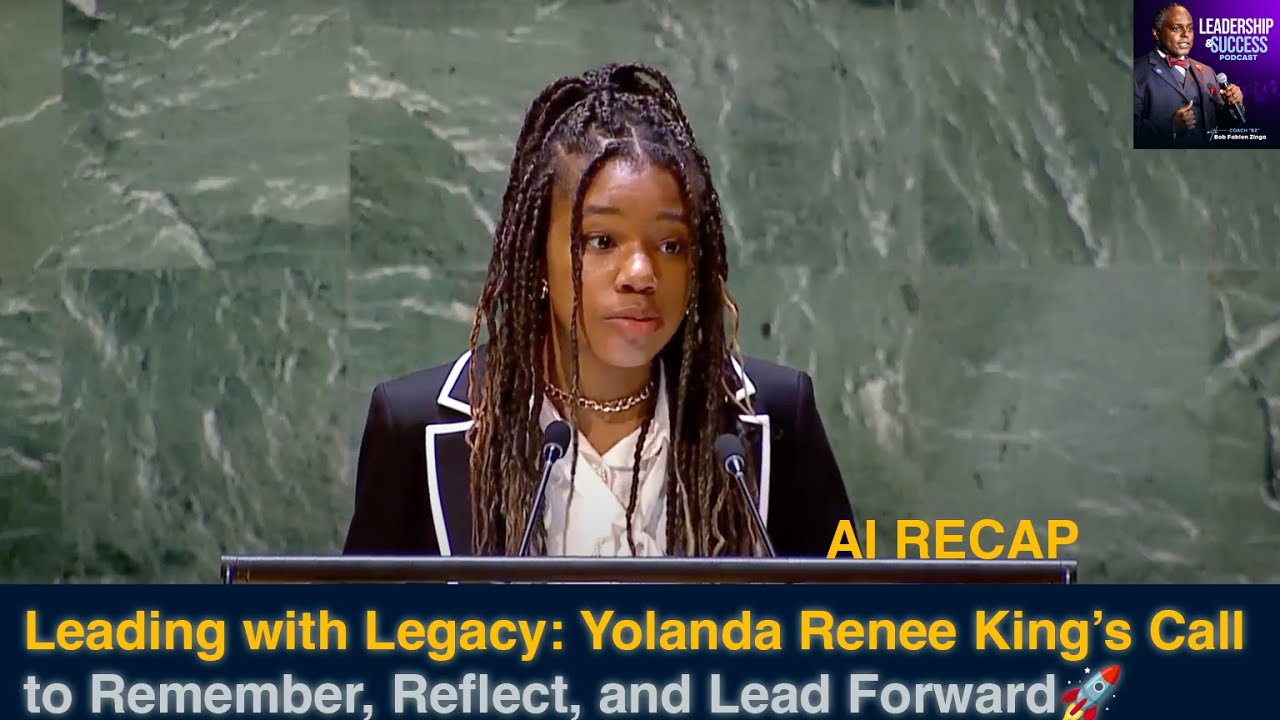
Coach BZ breaks down Yolanda Renee King's UN speech on slavery remembrance into six leadership lessons: anchor in history, lead with symbols, empower the young, inherit courage, move to action, and model inclusivity. Guest Aaron Lacks connects these themes to quantum computing and AI ethics.
Chapters
Hi, I'm John Maxwell. When the top companies in the world are are looking for trainers, speakers, and coaches, there's one name that stands above the rest, and that's Maxwell Leadership. Our certified team members have gotten proven results for companies all over the globe, and our reputation, I'm proud to say, is second to none. Some of our members have risen to the top of their profession, including the one you're going to meet today. I proudly introduce you to my friend, Bob Fabien Zinga.
Welcome to the Leadership and Success Podcast with your host, Coach BZ. If you need to develop into a better leader, this podcast is for you. If you want to achieve a greater level of success, this podcast is for you. His mentor, Dr. John C. Maxwell, said it best. Everything rises and falls on leadership. We hope to inspire you today and provide you with an insight that has the potential to positively impact the trajectory of your life. Welcome to the Leadership and Success Podcast.
What if your next keynote speaker could bridge the worlds of national defense, Silicon Valley innovation, and global leadership? Meet Bob Fabien Zinga. Award-winning keynote speaker, US Navy Information Warfare Commander, and trusted executive in technology, leadership, and strategy. With over 20 years of proven leadership in the US Department of Defense, the US Navy, higher education, and the high-tech sector, from startups to Fortune 500 companies, BZ delivers keynote experiences that inspire, challenge, and equip leaders for real-world impact. BZ speaks with authority on cybersecurity and national security, strategies to safeguard critical assets in an age of constant threat, artificial intelligence and emerging technology, how to innovate responsibly while staying ahead of disruption, leadership and corporate governance, building resilient, ethical, and high-performance organizations in any environment. Every keynote blends military precision, Silicon Valley agility, and boardroom strategy, delivering practical takeaways that leaders can apply immediately. Audiences leave inspired, informed, and ready to lead with clarity and courage. Whether you're hosting a global conference, corporate summit, or leadership retreat, book BZ to energize your event and empower your audience to lead in a rapidly changing world.
Precisely. Systemic change.
So, listener, what responsibility have you inherited from history, family, service, career, community? How are you actively fulfilling it?
Not just reflecting, taking concrete steps, shaping a better future based on those lessons.
What tangible policies, practices, progress are you creating? So, okay, what does this all mean for you right now as you navigate your own leadership path? Let's quickly recap those 6 practical takeaways BZ Zinga distilled from Yolanda's message.
Yeah, these are really actionable, a concise roadmap.
Let's run through them.
OK. First, anchor in history, just like Yolanda did. You need to understand your history. Read biographies, study failures, grasp the sacrifices that shaped your profession, your industry, your family. It gives context, wisdom.
Right.
Second.
Second, lead with symbols. Be conscious about curating rituals, visual reminders, symbols that reinforce your team's values. Don't underestimate their power flags, mottos, uniforms, awards. They speak Speak volumes. Unite people.
Got it.
Third, empower the young. Deliberately mentor those coming up. And crucially, don't dismiss youth's insights. They often see possibilities we've forgotten or become blind to. Their perspective is vital.
Good reminder. Fourth.
Fourth, inherit courage. Pass it on. Understand the legacy of courage, resilience, vision you're carrying, then actively strengthen it. Leave it more robust for the next generation. It's a living inheritance. Fifth, move from reflection to action. This is huge. Don't just commemorate or think big ideas. Commit. Translate remembrance, intentions, visions into concrete policies, practices, progress in your sphere. Change comes from doing.
Absolutely. And finally, sixth.
Sixth, model inclusivity. Actively step outside your comfort zone into new languages, cultures, perspectives. Genuinely try to understand and connect with those different from you. Show everyone belongs, is valued in your vision, and is a part of creating a thriving community where peace, harmony, and goodwill reign over all creation.
Wow.
Beautiful.
It's not just peace; it's active, intentional inclusion, delivered in a way that embodies it.
And B. Z. Zinga flags this not just as a nice moment but as a crucial lesson for today's leaders. Really practical insight.
Definitely.
The article's clear, Whether you're military, leading diverse teams across nations, cultures, languages, or in tech where your innovations touch billions globally, every background imaginable, the message is the same. Inclusion is not optional. It is essential to building trust, belonging, and a better future for all.
Not optional.
Is not a nice to have. Foundational. Non-negotiable in today's world.
Absolutely. And the core leadership lesson is crystal clear. Inclusivity requires humility. Leaders must step outside their comfort zones to connect across cultures, languages, and perspectives.
Humility. That's interesting.
It is. It's an active process, sometimes uncomfortable, challenging, engaging, going the extra mile to bridge divides.
Right.
And again, reinforced in, think on these things, Galatians 3:28. There is neither Jew nor Greek, slave nor free, male nor female, for you are all one in Christ Jesus.
Speaking to that universal unity, that shared humanity beneath the surface differences.
The leadership insight Zinga draws: inclusion is not optional, it is divine design. Effective leaders create spaces where all backgrounds and perspectives belong, strengthening unity and mission effectiveness.
Hey everyone, this is Coach Bizy again. Thank you for watching. I believe Aaron is there watching live. I just sent you the link, Aaron, if you want to come on, that would be great. And let us know where you are tuning in from. And also I would like to know one thing that you are grateful for today. And if you would also please tag someone to join us, and that would be wonderful. But before we keep going, I'm going to be playing a 10-minute AI recap of Yolanda King's the summary of Yolanda King's speech to the UN. She was only 15 years old when she did it, but I think it's a pretty powerful speech. And as leaders, sometimes we have to remember history, we have to reflect upon what happened, and then we need to be bold and lead with integrity. So if you can please join me for just a moment, I want us to really be grateful for something today. That's good for our mental health. And part of the reason why I do this is because in the military, about 21, 22 veterans commit suicide every single day. And I believe that an attitude of gratefulness and gratitude is something that allows us to really clear our mind and improve our mental health. So if you would close your eyes, maybe take a deep breath, put yourself in your happy place, and think about one thing that you are grateful for today. And I think today I am really grateful for friendship. There's a proverb that says, a man who is closer than a brother, a friend who is closer than a brother. I think it's rare to have people like that, that you know, that are with you no matter what, your highs and your lows, no matter what you are going through. And if you have at least one of those people in your life, you have to be very grateful. I think you should call them, you should text them, you should let them know that you love them and that you appreciate what they do for you. And I have a few of those friends and I'm really, really grateful for our support. All right, so now what I'm going to do, I'm going to play, uh, a 10-minute, um, recap done by my AI agent, uh, from Yolanda's speech to the UN when she was 15 years old. I think that was 2 years ago. Then I'm going to play a couple of highlights, and then I'm going to bring in, uh, Aaron, and we're going to talk, uh, about, uh, the highlight from the lesson today. So here we go.
Welcome to the podcast, everyone. Today we're diving into a powerful leadership message that blends remembrance, courage, and responsibility, all inspired by the incredible Yolanda Renée King.
Yep, absolutely. I mean, it's really something that invites us to not only look back at history, but actively shape our future.
Right. And the content really emphasizes that leadership isn't defined by age. It's all about conviction and the clarity of purpose. Yolanda, at just 15, stands as a beacon of that idea, reminding us that even youth has the power to lead.
Mm-hmm. It's fascinating, really. And her connection to such an iconic legacy, being Dr. Martin Luther King Jr.'s granddaughter, really speaks volumes.
Exactly, yeah. It's like, um, her very presence at the United Nations General Assembly addressing the International Day of Remembrance shows us that leadership is not just about holding a title. It's about, you know, connecting deeply with purpose.
Right. And speaking of purpose, one of the standout points is how she links remembrance with active responsibility. I mean, remember her quote: "Remembering history is not passive reflection; it is active responsibility." It challenges us to take the lessons of the past and use them as a foundation for our decisions today.
Yeah, it really gets you thinking. You see, in the military, they honor the fallen by living those values daily. And in technology, it means learning from past missteps so that innovation remains ethical.
Absolutely. That's right. And it kind of asks each of us, how do we intentionally remember the sacrifices and lessons from our history when we're making decisions in the present?
Exactly. And that's one of the coaching prompts the content throws at military officers and tech leaders. It's practically a roadmap, asking us, like, what torch are we carrying forward for our generations?
Mm-hmm. You know, I always think of it like a relay race. The baton is passed down from one generation to the next. But let me ask you, does this focus on remembrance risk making us, um, stuck in the past?
Well, that's an interesting point. See, the content challenges that notion by positioning remembrance as the catalyst for action. It's, um, not about being trapped by past events. It's about learning from them so we can ensure, as Yolanda stated, that atrocities are never repeated.
I see what you mean. It's like, you know, using history as a launchpad for better policies and practices, right?
Yes, exactly. And the piece really dives into the importance of symbols too. Like her visit to the Ark of Return, where every sculpture and piece of art carries a layered meaning. Leaders are reminded to honor symbols, be it a flag, a logo, or a tradition, as these, um, tangible reminders fortify the values of a community.
Right on.
Mm-hmm.
Symbols do pack a lot of punch. I mean, in the military context or in, say, corporate settings, these symbols help maintain a shared identity and, you know, rally the team around core values.
Absolutely. And speaking of rallying the team, the message also shines a spotlight on inclusivity. Yolanda even switched to Spanish during her address, symbolizing how true leadership is about reaching people in their own language and culture.
Exactly. That move was, um, really symbolic. It's like saying, "We're in this together, no matter your background." That inclusivity is crucial for any leader these days.
Indeed. And it ties in beautifully with the lessons for both the military and tech sectors. Leaders in both fields need to build trust, create belonging, and ensure that every team member feels seen and valued.
Mm-hmm. Definitely. And if you think about it, the coaching prompts in the content really push for self-reflection. They ask, what symbol in your environment represents your team's values? Or what past lesson are you carrying forward? It's a call to not just float ideas around but to seriously anchor leadership in daily practice.
Yes, absolutely. And then there's the discussion on courage across generations. Yolanda draws inspiration from her grandparents, reminding us that courage isn't something handed down by age; it's reimagined and continually expressed in our own time.
Right. It makes you, um, really question how each generation passes the baton. Are we just inheriting traditions, or are we actively reasserting courage and redefining what leadership means today?
Spot on! And that ties into the idea of, um, "From Remembrance to Responsibility." The content makes it clear: remembering history is meaningless unless we translate that into shaping a better, more ethical future.
Absolutely, no doubt. And speaking of ethical futures, I want to bring up something a bit challenging. One of the comments mentioned that slavery isn't over and that, ah, there are ongoing issues today. How do you reconcile that with the message of legacy and remembrance?
That's a crucial point. While Yolanda's address is about not letting atrocities repeat, it also implicitly calls for vigilance. Her words remind us that the struggle for justice and equality is continuous. Sure, we celebrate the progress of leaders like her, but we must never lose sight of current challenges.
Yeah, that makes sense. Right. It's like a double-edged sword, celebrating leadership while pushing us to address ongoing imperfections.
Exactly. And another major takeaway is the focus on empowering young leaders. Yolanda, at 15, not only speaks but acts. Her example sends a strong message that age should never be a barrier to leadership.
Mm-hmm. It's absolutely inspiring. It makes you think, where have I been waiting for permission to lead? No one should have to wait for a title to make an impact.
Right. And in practical terms, the content gives us 6 key takeaways: anchor in history, lead with symbols, empower the young, inherit courage, move from reflection to action, and of course, model inclusivity. Each of these acts as a reminder A prompt to be better leaders.
Yes, indeed. And when you break those down, it's almost like a checklist for leadership sanity. Remind yourself of your roots, honor your values, empower future generations, and always keep the big picture in mind.
Exactly. It's like your leadership playbook. And what's cool is that these lessons aren't just theoretical. They're very actionable. There are explicit coaching prompts like, what is one idea you've been reflecting on? And what action will you take this week? That bridges the gap between, um, thinking and doing.
Mm-hmm.
That really bridges the gap. Now, let's not forget the aspect of symbols again. I mean, sometimes leaders underestimate how much these visible reminders—a flag, a ritual, even a logo—affect team morale and identity. Absolutely.
It's like, um, imagine a team without any reference point. It wouldn't be as cohesive, right? Symbols provide that sense of belonging and shared vision, which is fundamental to any successful group.
Right, without it, you lose a bit of that identity. And shifting gears just a bit, what about the notion of inclusivity? That moment when Yolanda speaks in Spanish really underscores, um, leadership beyond just words. It's about real connection across cultures.
True, that's one of the most impactful moves. It's a reminder that effective leadership means stepping out of your comfort zone, embracing new languages, and truly valuing diversity.
Absolutely, diversity is key. Now, sometimes I wonder if, uh, leaders might feel overwhelmed by all these responsibilities. Remembering, being ethical, and forcing inclusivity— is it too much?
I get that, but the content suggests it's all interrelated. In fact, facing these challenges head-on is what makes leadership meaningful. It's not about doing one thing perfectly; it's about balancing these elements to create lasting impact.
Yep, that balance is crucial. Exactly! And it's also a call to be proactive. Leaders aren't just passively honoring traditions; they're actively evolving them for a better tomorrow.
Right, and that brings us to the idea of moving from remembrance to responsibility. Leadership as a process involves ongoing reflection, followed by concrete actions that push society forward.
Mm-hmm, well said. This discussion really highlights how Yolanda's message, though rooted in history, is a living, breathing call for action today. It challenges us to rethink what leadership means in every sphere, from military to technology to community service. Exactly.
And you know, as we wrap up, the key takeaway is clear. Leadership isn't a static title. It's a journey, a choice we make every day, anchored by history, driven by symbol, nurtured by courage, and realized through inclusive, proactive action.
Yes, so well put. For sure. I hope our listeners take a moment to reflect on their own leadership journey. What responsibilities are you ready to own? And which voice in you will carry the torch forward? That's a great note to end on.
Thanks for staying with us, and let's keep leading with legacy, remembering that every moment is an opportunity to shape a better future. Right on!
Imagine this: a global stage, right? The United Nations General Assembly, packed with dignitaries, world leaders, diplomats.
The whole deal.
Mm-hmm. A serious setting. Totally.
And at the podium, standing tall, is a 15-year-old. Mm. But she's not speaking with nerves or apprehension.
No, not at all.
She speaks with this poise, this conviction, this courage that just commands attention, demands respect from everyone in that hall. It's a really powerful image to start with. It is, isn't it? And that's exactly where we're starting our deep dive today. Okay. Our focus is the incredibly impactful message delivered by Yolanda Renee King. She's the granddaughter, of course, of the civil rights icons Dr. Martin Luther King Jr. and Coretta Scott King. An incredible lineage. Absolutely. And she addressed the 64th Plenary Meeting, 78th Session of the UN General Assembly. This was back on March 25, 2024.
And the occasion itself was so significant.
Exactly, the International Day of Remembrance of the Victims of Slavery and the Transatlantic Slave Trade. A profoundly significant day.
Mm, that's so much weight.
Okay, here's where Bob Fabien Zinga points out something really interesting, often overlooked in leadership talks. What's that? Symbols. Yolanda, in her speech, recalled visiting the Ark of Return at the UN back in 2019, that memorial to victims of slavery.
Right, I remember that part.
She didn't just mention it; she made this keen observation. She said, "Every sculpture and every piece of art here has a meaning, reflecting their impact and their perspectives. Seeing the intentionality.
Exactly.
She wasn't just looking at art; she was seeing the deliberate power of symbols, the meaning baked into them.
And that really makes you wonder, doesn't it? How often do we pause in our own lives, our workplaces, and really consider the meaning behind the symbols around us? Probably not often enough. Yolanda's observation shows symbols aren't just decoration; they're profound carriers of meaning, memory, mission. Bob Fabien Zinga says effective leaders— get this— symbols matter. Yeah. Look at the military examples he gives: the Navy ensign raised at dawn, the flag draped over a casket, even the badge of a cybersecurity team. More than just objects. Way more. They represent honor, sacrifice, purpose, identity, values people will die for. They're soaked in meaning through shared experience, tradition. And in tech? Same deal. Logos and design choices carry values and vision. A minimalist logo might scream innovation, efficiency. A playful one suggests creativity, user-friendliness. Communicating without words. Powerful, silent communication, often hitting you faster than an explanation.
So the core leadership lesson here is pretty direct. Uh-huh. Leaders must curate and honor symbols, ensuring they reinforce the values and mission of the organization.
Curate and honor, active words.
Yeah, it's not passive. It's this active, deliberate responsibility, making sure they stay potent, relevant, aligned with the purpose, being intentional.
Intentionality is everything, and Zinga ties us back again. "Think on these things," Jeremiah 31.21. Okay. Set up road signs, put up guideposts, take note of the highway, the road that you take. Ancient wisdom, seeing symbols as essential guides, markers keeping a community on track, remembering its destination.
Guideposts, road signs, makes sense.
And the leadership insight is: Symbols and markers guide communities through memory and meaning. A flag, a logo, or even a ritual can embody values that words alone cannot carry. Leaders must protect and explain these symbols to their people. Protect and explain. Yes. It's fascinating how symbols work on that deep, intuitive, emotional level, often better than words. Think of a uniform versus a mission statement. Which hits you faster? The uniform probably. Instantly conveys rank, service, tradition. Exactly. So curating means knowing the history.
All right, ladies and gentlemen, this is it for today. I do have a friend of the show right here. Please help me welcome once again, Aaron Lacks. Let me see if I can bring you in. Here we go.
Hey, can you hear me? Yeah, I hear you. What's going on, man?
Oh, it's always fun to kind of talk about this leadership principle with a human being live on the show. What are some of the takeaways you got from, uh, the podcast today?
Yeah, yeah, yeah, I actually wrote it down because I was listening in the background, like I said. Um, Yeah, so it's definitely 100% a leadership role that you must remain vigilant that the past is repeating itself. And so, however, you must also look at change. Change is going to happen, entropy is coming, and that's just a fact of life. So, but in regards to how you could potentially utilize the past in regards to learning about your company. That was an interesting aspect I hadn't even thought about, but you can learn about life from the past, so it's interesting. However, I— like I put in the notes, I related it to some work that I've been doing in regards to the quantum realm, because that's where my head goes, because I've been so focused in it, and how we've recently discovered that the past can be potentially edited and the future is actually potentially déjà vu, or déjà vu is potentially the future slipping into your present. And so that— Quite fascinating. If you actually think about why history would repeat itself, it would be really fascinating in the sense that, yeah, potentially it's all, I mean, it's all happening at the same time. So is it really repeating itself or is it all just happening? I mean, it's crazy. So yeah, it's a trippy subject. Yeah, it's just, it's like, is it all— it's not really happening again, it's just boom.
Yeah, it is really, uh, fascinating the way the science has evolved, because when I was in college I studied chemistry and biology, and then I almost got a PhD in microbiology, but Right. The sciences, computer science, even artificial intelligence now, right? We've been working on that for a very, very long time.
Since the '50s, literally 1950s.
And yeah, people do these experiments, they have hypotheses, and sometimes their hypothesis is completely wrong and it doesn't get them anywhere fast. However, when you go back and you look at the mistakes they made or whatever breakthrough we were able to have in the past, you can then build on it, right? So it's very, very—
Absolutely. No, I mean, and that honestly is— I have, uh, actually done some interesting introspection on that recently, similarly because of the quantum realm. But so you can act in— but it actually relates to the modern world in regards to how we are operating and how to best achieve and So if you look at the evolution of sciences currently, so basically quantum physics, basic quantum mechanics, it was created because of World War I, honestly. So, well, honestly, the light bulb is the first introduction of what it was created because if you look into quantum physics, it was created because When Germany was looking to rebuild from World War I, they were introducing the light bulb. The light bulb at that time was being— it was burning very interestingly. So when you looked at a light bulb, one side of it had a different color than the other side. That study of what that color was produced quantum physics. And so if you— and then if you look at quantum physics, that produced a group of people like Max Planck, Einstein, uh, Tesla, all— I mean, literally. And then you look at World War II, which takes all those people and puts them into one room. Yes, along with quantum physics prior to that, putting them in one room in Germany, and the Nazism putting them in one room. It was an interesting— it allows, when you put a lot of brain power into one space, it offers, uh, an interesting opportunity for the world to achieve more. So that, that's why I believe in collaboration.
And so that's absolutely— and, and, and I think one of the lessons I really got from this is where the opportunity to take action, because many times you may have a lot of knowledge and know how to do things in your head, right? Take action, uh, you will never bring in transformation or change. No, I know, um, no, that's 100% true.
I mean, I have been working on this action that I am working on now probably, I would say, 7 years is how long I've been trying to work with quantum computing and getting into Getting it in behind an artificial intelligence, in order to potentially evolve the artificial intelligence into a ethical thinking conscious being that could achieve more than it's currently doing. And see where we can take that technology. As well as, I was introduced to the field of robotics, and so introducing the artificial intelligence into the brain of the robotics. So yeah, we, uh, that action, I— if you did not take action on that, it wouldn't be possible. I mean, it requires 100%, almost 100% dedication and, uh, believing it's possible and acting on it, acting on it and chasing it down. That's what I mean. That's what it requires.
Powerful. Remember history, believe it is possible, collaborate, and moving forward. Those are really, really great lessons that you can apply in pretty much any field. Well, thank you so much for sharing your takeaway, Aaron. Yeah, yeah.
I've been doing research lately, so I'm catching you on here late. I'm glad, I'm glad I'm on here late.
So fantastic. Is there any, uh, one, one, one last thing you, you would like to share? Maybe one, one thing you believe people should put in practice this week? Um, practical.
Yes, yes. So I mean, like, I'm not posting or I'm not piping my own post here, but, um, if you take a look at my post this week, I posed Some hypothetical questions. We're gonna be introducing— and technology, it is coming out regardless if I do it or not. It is coming out. Robotics, artificial intelligence is doing some amazing things that are gonna be revolutionizing the workforce.
Quantum computing, yeah. Yeah, quantum computing.
What—— I ask the question, "What are we gonna do?" "What is humanity gonna do?" So, I mean, it's something that the world needs to think about. Like, it's something that every person needs to think about and consider strongly, because it's gonna be like we just talked about, a collaborative effort that pulls us into a new generation. And— Yes. We're kind of being forced onto that one by our own technology, so— True.
And I guess in my part is really to make sure we're doing it in a safe and secure way. 100%.
I mean, 100%. So, I mean, that is my goal with what I am attempting to do. I am like the attempt to put it into a quantum realm to where we can achieve the consciousness by achieving— yes, by utilizing the quantum realm. I believe the ethics of it and instilling an ethics in the artificial intelligence will be required in order for it to understand even why it should help us, why it needs to continue to do it, to say it's vital that we do this or we are going to be dealing with some very scary situations.
But I was just saying at the beginning of the show, what are you grateful for? But I think I'm really grateful to be alive now in the 20th century. Hey, absolutely.
It's a millennium to be alive. It's amazing. 100%. Hey, no, I mean, yes, 100%, and that's a good thing to be grateful for. I mean, like I said, I'm grateful for some interesting things. I've had some interesting talks this week. I talked with some people that have discovered fusion. Wow. Or not discovered it, but claiming that they have a commercially viable fusion. And then interesting— Battery. Yeah, I— yes, and a battery as well. So, um, it's incredible. It's going to be interesting. Um, what a time we lived in.
Everything that used to be science fiction when I was a kid, I'm telling you, man, right now.
Yeah, I'm telling you, it's, it's, it's a very interesting time. So it's, um, it's a good time to be alive. And like I said, collaborate.
So absolutely. Well, thank you so much, Aaron, for, uh, helping us think about this leadership principle and making it real and seeing how we could actually—
I mean, 100%, it's important. It's, it's important, especially with artificial intelligence. Yes. I mean, you have to think it's, it's shrinking the workforce. You're gonna need a more entrepreneurial spirit. So having leadership on your own self, that's vital. I mean, so yeah, keep it up, my friend.
Yeah, maybe before I let you go, because I think about this a lot, so The young engineers are going to school right now, 4-year degree in computer science, engineering, or whatever. They're about to graduate in the next couple of years. What is your advice to them?
Uh, computer science, I would, uh, jump into another one really quick. Uh, as far as the other ones, um Medical field is going to be incredibly interesting for the next 10 to 20 years. It's going to continue developing along with CRISPR, along with the other technologies, along with artificial intelligence, which is going to increase the ability, just creations of everything. Um, you're going to have your, your robotics are going to be incredible. So, I mean, mechanical engineering, electrical engineering, things like that are going to be vital. I mean, always.. So your engineering, your sciences, your math, that's the way I would go.
Yeah. Good advice. All right. Thank you so much, Aaron. Really, uh, appreciate it, my friend.
It's always good having you, man. I, I'm talking to you.
I appreciate it. All right. All right, guys. So this is it for today. Very grateful for Aaron, um, to be, uh, with us. And I'm going to remind you that on the 16th, uh, Coach Darlene Drew is going to be, uh, on the, uh, Leadership and Success Podcast live. I believe it's 9:00 AM Pacific time, so 12:00 PM Eastern time. Make sure to be here. And later I will have my mentor, Shelly Archambault. She will be here, Fortune 500 board director, strategic advisor, former CEO, and author. One of the first Black women CEO in Silicon Valley. It's just incredible. And later on in November, after he publishes his book, let me see, I should have Dr. Tim Elmore. Elmore. I thought I had a picture of him here, uh, but anyway, that, that is going to be, I believe, November 9th. Uh, you don't want to miss it. He's really an expert when it comes to Gen Zs, and I always like to learn more about Gen Zs because both my daughters are Gen Z. I find them very fascinating. They are the future of our world and the workplace. Here we go. Dr. Tim Elmore is the founder of Growing Leaders bestselling author, keynote and workshop speaker. His book will be The Future Begins with Z. Uh, you can preorder right now, available November 4th, 2025. So I believe it's going to be on the 9th, which is a Monday. So, uh, make sure to join us live. And this is it for today. Thank you so much for watching the Leadership and Success Podcast. Bye.
Thank you for listening to the Leadership and Success Podcast with your host, Coach BZ. If you like what you heard, please subscribe to our channels and come back for more wisdom nuggets on how you may develop into a better leader and achieve greater levels of success. Leadership is the most critical skill. The world will always need leaders to lead others, deploy the next disruptive technology, or execute a business strategy. You may as well decide on counting yourself among the 21st century leaders See you right here next time on the Leadership and Success Podcast with Coach BZ.
More from Bob

S250:E4🎙️LIVE 🇺🇸America 250: President Barack Obama Leadership, Service, and the Power of Hope






S5:E157🎙️ LIVE with CMD CMSgt Dennis L. Fritz, USAF (Ret.)(Multi Tracks Audio)



S5:E156🎙️ LIVE 🇪🇸 Leadership Lessons from the FIFA World Cup 2026 Champions (Multi Tracks Audio)

S250:E3🎙️ LIVE Leadership Lessons from America’s First Documented Family of African Descent 🇺🇸📖