🎙️ S4:E86 LIVE — Leadership Lessons from General James Mattis
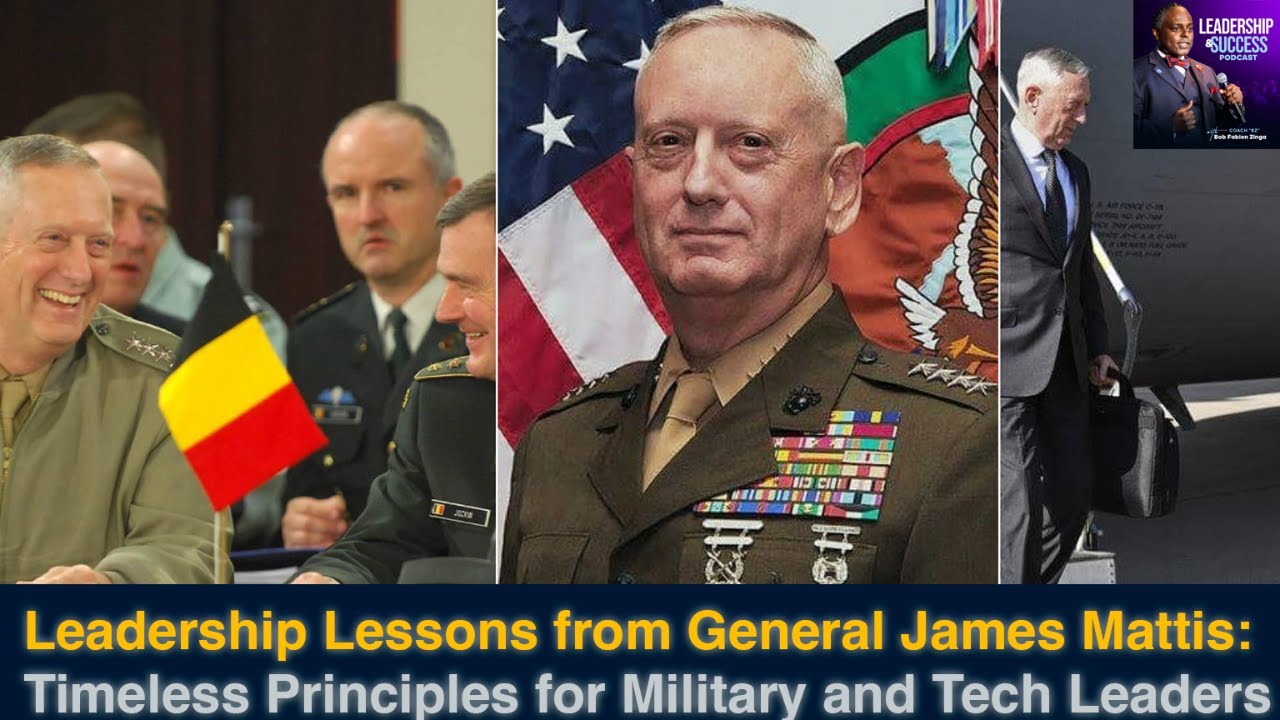
In this live episode of the Leadership and Success Podcast, host Coach BZ (Bob Fabien Zinga) guides listeners through a detailed breakdown of eleven leadership principles derived from General James Mattis’s combat‑tested philosophy. The show opens with a brief gratitude exercise and a promise to use an AI agent to synthesize Mattis’s ideas. The conversation then moves through each principle, pairing Mattis’s original insight with concrete business‑tech examples. Core themes include ultimate accountability (the buck stops with the leader), serving the mission over personal preference, shaping culture through what is rewarded, building deep trust through affection, the four‑step Washington method (listen‑learn‑help‑lead), coaching versus commanding (distinguishing honest mistakes from indiscipline), empowering ownership via clear mission intent and autonomy (mission command), replacing command‑and‑control with command‑and‑feedback, finding common ground through intellectual humility, and embodying physical and moral standards. The episode concludes with reflective coaching questions for listeners to assess their own leadership practice and a call to action to apply the principles immediately. Throughout, the tone is conversational, instructional, and motivational, with a consistently supportive and enthusiastic sentiment toward applying military‑grade leadership in civilian organizations.
Chapters
¡Hola!
Hi, I'm John Maxwell. When the top companies in the world are looking for trainers, speakers, and coaches, there's one name that stands above the rest, and that's Maxwell Leadership. Our certified team members have gotten proven results for companies all over the globe, and our reputation, I'm proud to say, is second to none. Some of our members have risen to the top of their profession, including the one you're going to meet today. I proudly introduce you to my friend, Bob Fabien Zinga.
Welcome to the Leadership and Success Podcast with your host, Coach BZ. If you need to develop into a better leader, this podcast is for you. If you want to achieve a greater level of success, this podcast is for you. His mentor, Dr. John C. Maxwell, said it best: everything rises and falls on leadership. We hope to inspire you today and provide you with an insight that has the potential to positively impact the trajectory of your life. Welcome to the Leadership and Success Podcast.
Hey everyone, this is Dan Coach Bizy. Thank you so much for being with me today. Today is Tuesday, right? October— not Friday, Friday, October the 10th. It's about 6:53 in California, so almost 10 o'clock on the East Coast. So thanks for being with us today. Today we are going to have a leadership lesson from one of the speeches that the General James Chaos Mathis gave, uh, I kind of break it, break it down and, uh, kind of show how his life and his leadership philosophy would apply to you no matter what industry you are in. But before we get started, I get a reminder, let's do our moment of gratitude. It's gonna take but a second. Let's, um, take just a moment about, um one thing today that we are grateful for this morning. Then close your eyes, put yourself in your happy place, take a deep breath, and think about one thing you are grateful for today. Today I am grateful to be alive, because as long as I am alive, there is hope. Let me know what you are grateful for, type it in the comment. Now what I will do is, uh, I am going to, um, get my AI agent to give you a breakdown of General Mattis' leadership philosophy. It's going to take about 30 minutes or so. In the meantime, if you have a question for me, type it in the comment. Uh, I appreciate it if you can tag someone who's going to benefit from this podcast. And also let me know where you are joining us from, what city, what state, and if outside of the US, what country. Thank you so much. See you in about 30 minutes.
Welcome back to the Deep Dive. We're here to really break down proven wisdom, get right to the core of it, and give you that actionable knowledge you can use like right now. And today we're diving deep really deep into leadership, specifically the timeless principles from General James Mattis.
That's right. And this isn't some, you know, theoretical exercise you'd get in a seminar. No, this is drawn from real command experience. We're talking 11 truths forged under, well, incredible pressure— combat, high-level strategy.
And the amazing thing is how widely they apply. Military, sure, but also the boardroom, a tech startup, moving at lightning speed.
Mm-hmm.
It fits.
It really does. And what's fascinating, I think, is that we're not just looking at generic management styles. These are codified expectations, almost a blueprint for what Mattis himself called servant leadership.
Servant leadership. Okay.
So our mission today really is to give you a shortcut to understanding these 11 points. We want to move past the anecdotes, interesting as they are, and get straight to the application.
How do you do this?
Exactly. What does real service actually look like in practice? And spoiler alert, It demands action, not just theory. It means embedding certain behaviors deep into how you operate daily.
Behaviors like?
Things like profound responsibility, unwavering service, and that really necessary humility. It needs to be in the DNA of the organization.
That phrase, action over theory, that feels critical because when you look at these 11 principles, they kind of stack up, don't they? There's a hierarchy.
There is.
And where do we absolutely have to begin? What's the one non-negotiable foundation? The thing that's separates a real leader from just someone with a fancy title.
You've nailed it. We have to start with the bedrock. Principle 11: Responsibility rests with the leader.
The buck stops here.
Absolutely. It's non-negotiable. If you strip away everything else, all the management jargon, this is the irreducible minimum. This is Leadership 101.
It sounds so obvious when you say it. But then you look around, right? You see successful teams, companies.
Mm-hmm.
When things go well, hey, everyone wants credit.
Oh, yeah, the victory lap.
But when things go wrong— a big data breach, a product launch bombs, financials look shaky— suddenly, that management structure looks like a very, very efficient blame-shifting machine.
And that's the test. The difference between actual leadership and just, well, managing is entirely measured by how you handle failure. Mattis had this quote about it, and it's just incredibly powerful, sums up accountability perfectly. He said, while you can delegate decision-making, the responsibility for ultimate failure, if you're sinking the ship and it runs aground, you're still responsible.
Boom.
Wow. That lands hard. That's the burden of command, isn't it?
It is.
It means the leader's mental load, their moral load, it's always heavier than anyone else's. Let's just pause on that for a second. The gravity of it. If you're the CEO, the general, the head of engineering, and someone 3 levels down, a junior person, makes a catastrophic mistake, costs millions, you don't just get to fire them and wash your hands.
No, absolutely not, because you were responsible for the training, the environment, the process, the oversight, whatever allowed that failure to happen.
It tracks all the way back up.
That ultimate accountability, you can't outsource it. You can't delegate it away. The leader owns the outcome, good, bad, ugly, and they must never, ever pass the blame.
Never.
When a crisis hits, the team has to know without a shadow of a doubt that their leader is already standing there taking the heat. Owning it.
The second a leader starts pointing fingers, right, blaming the market, blaming other teams, blaming the people executing, they stop leading, right? They just become a politician trying to manage perception, spin control.
And the team sees it instantly. They know, they watch, and they calculate consciously or not. Is it safe for me to take a risk here to innovate, or will I be thrown under the bus if it goes wrong? Exactly. It all depends on whether you, the leader, are willing to stand up and take the hit for their innovative mistakes. That's why we start here.
So the question for you listening right now.
Yeah.
Can you honestly say you're prepared to take ultimate responsibility for every outcome in your area? If not, well, in the Mattis framework, you're not leading yet.
You might be facilitating, coordinating, but not leading.
That's a tough high bar.
Yeah.
Okay, so accountability is the foundation, but being accountable often means Well, doing things we really don't want to do, things we might even hate.
Ah, yes.
Which brings us to the next idea, which really digs into the humility required for real service. Principle 2: Leadership means responsibility, not preference.
This one cuts right through the modern idea that leadership should always feel good or be, you know, personally fulfilling every single second.
Right. Like it's all about passion projects.
Exactly. General Mattis apparently despised minefields. I mean, who wouldn't? Dangerous, slow, terrifying work.
Yeah, understandable.
But he emphasized that your personal feelings, they don't matter. The mission, the service, that comes first, always.
The quote you shared earlier is so blunt, it's great. It doesn't matter whether you like this specific moment or not. A leader's job is to take care of problems.
That's it.
I want to contrast that sharply with a lot of the leadership talk we hear today. It's all find your passion, get in your flow, do what you love.
And look, those things aren't bad in themselves, but leadership— fundamentally, it's about uncomfortable service. It's not always fun.
You're like the team's immune system.
That's a good way to put it. You're there to fight the infection, no matter how messy or unpleasant the fight gets.
So, for a tech leader today, what's the equivalent of the minefield?
Oh, it could be having that really difficult, maybe gut-wrenching conversation with a star engineer who's brilliant but toxic to the team culture.
Yeah, that's hard.
Or maybe it's killing a product line you personally championed, poured your heart into, because the data, the market just says it's not working. You have to make the tough call against your own preference.
It's about stepping into the minefield of those hard decisions. Layoffs, reorgs, budget cuts.
Yeah.
Telling a long-serving employee they're not meeting the standard anymore.
Those are the moments.
These uncomfortable, necessary actions are what define leadership, aren't they? Yeah, because they force you to override what you want to do or what feels safe or what maintains personal attachments.
Absolutely. The application is crystal clear. Don't dodge the hard stuff. You can't delegate the minefield. You have to walk into it yourself. You have to own it and model that resilience needed to handle the mess. The second you start trying to optimize your job just for your own comfort, you're failing the people counting on you.
They need you to navigate the danger.
Leadership demands the humility to do the jobs nobody else wants to do, the tasks everyone else shies away from. You serve the mission, not your comfort zone.
Okay, so let's put those first two together. You've got ultimate responsibility, Principle 11, and you've got the willingness to sacrifice your preference for the mission, Principle 2.
Right.
That combination, that builds your personal moral authority to lead. But that authority doesn't mean much if the environment around you is broken.
Exactly. Which leads us logically to the next piece. How does the leader actively shape the environment? And we have to start with culture, that invisible force. Principle 3, culture. You get the behavior you reward.
This isn't just about, you know, posters on the wall with core values.
Definitely not.
This is about what actually happens day to day.
Yeah.
What gets noticed, what gets praised, what gets people promoted, What are the real rewards and consequences?
Because those observable things, they define what success really looks like in your organization.
Good.
And here's the kicker. If you passively tolerate bad behavior—
Actively endorsing it.
You got it. That passive tolerance is probably the single most corrosive thing for a culture.
It really is.
The source material nails this law of consequence. Whatever your leadership rewards in your organization, that's the behavior you're gonna get. Simple as that. If you want ethical behavior, you'll get it. If you tolerate unethical behavior, you'll get that too.
Let's unpack that idea of rewarding behavior because it's subtle sometimes. In tech, for example, you see this pattern, the chaos hero.
Oh, the firefighter. Classic, right?
The person who waits till the last minute, maybe even causes the crisis, then pulls an all-nighter, saves the day, and gets showered with praise. Huge visibility.
Textbook unintentional reward. You're celebrating the person who puts out the fire, not the person who prevented it in the first place.
The fire marshal who did the boring, meticulous planning.
Exactly. You're rewarding instability instead of the discipline and process adherence that would have avoided the drama altogether. Mattis saw this in the Marines. How did they build such high standards?
How?
By consistently rewarding the right behaviors. Discipline? Taking initiative, integrity. Those were the things that got you recognized, promoted, trusted with more responsibility.
So for a leader in, say, a company today, mm-hmm, you say you value collaboration, uh-huh, but you keep promoting the person who hoards information, plays politics, and wins by competing internally.
Then your actual culture values competition, not collaboration.
Yeah.
Your actions speak way louder than your mission statement.
You have to align the rewards, the praise, the promotions, the cool assignments, align them with the behaviors you genuinely want.
You have to reward the engineer who built that stable, well-documented system, even if it wasn't a dramatic 3 AM save. It demands real reflection from the leader.
What am I accidentally rewarding? Am I rewarding speed that cuts corners on quality? Am I rewarding an aggressive style that tanks team morale?
Crucial questions. And once you have that baseline culture of discipline starting to form, You need something else, something deeper for resilience. Human connection.
Which brings us to a principle that might sound surprisingly warm. Principle 5: Affection builds resilient teams.
Yeah, this one often raises eyebrows, especially coming from a military context like the Marine Corps. It feels counterintuitive.
Affection? Really? That sounds— well, soft. Maybe too personal for a highly disciplined unit, let alone a competitive company.
I get that reaction.
Are we talking about, like, everyone being best friends, or is it more deep professional mutual care?
Mm-hmm.
How do you stop this from just becoming a nice culture where underperformance gets ignored?
That's the absolute key question to ask here. And no, it is emphatically not about just being nice or overlooking poor performance. Forget that.
Okay, so what is it?
It's about building bonds that go way beyond the paycheck, beyond the transactional. I do this, you pay me contract. It's a profound mutual commitment to the safety, the well-being, and the success of the person standing next to you.
So it's about trust. Deep trust.
Deep trust. Mattis observed that under extreme fire, yes, discipline and skill were essential, non-negotiable, but the units that truly excelled, that pushed through unimaginable stress, the difference maker was, in his word, affection.
Meaning?
Meaning that gut-level feeling of, "I will not let my buddy down." That commitment to each other is what kept them going even when terrified or hurt.
Okay, I can see that now. It's the bedrock of psychological safety, isn't it?
Precisely.
It allows people to take risks, to speak up, to try things because they know, truly know, their team has their back. It's what turns a group of capable individuals into a single unit that can actually weather a storm.
Think about it in business terms. A massive server outage hits at 2 AM. What happens?
Depends on the culture.
If it's purely transactional, people might do their bit, clock out when their shift ends, worry about covering their own backs for the postmortem.
Right. Self-preservation.
But if there's that foundation of affection, that mutual care, people step up automatically. They volunteer. They take ownership of problems slightly outside their lane. They stay late, not because they have to, but because they genuinely care about the team, the mission, and the other people in the trenches with them.
That deep care transforms basic competence into real resilience.
It does. And you can't get that deep, genuine trust unless you First, show that you value people's perspectives, their contributions, their well-being.
Which leads us perfectly into the next one, Principle 9: Listen, Learn, Help, Lead. The so-called Washington Method.
Yes, a fantastic 4-step process credited to George Washington, apparently. It's a brilliant sequence for any leader needing to build credibility, especially with a new team or maybe one that's a bit resistant.
A structured way to earn trust.
Exactly. And the key is you can't just jump to the end. You have to go through the steps. The mantra is simple: you listen, you learn, you help, and then you lead.
OK, let's break that down. Step 1, listen. What does real deep listening look like for a leader? Because we all think we listen.
Right. But it's usually passive listening while we're just waiting for our turn to talk or formulating our brilliant counterargument.
Guilty as charged.
Sometimes we all are. Active listening here means your goal is understanding. You want to grasp their world. Their constraints, their worries, their ideas, their opportunities. You're trying to see the situation through their eyes. So if you're an exec who hasn't written code in 10 years, you have to genuinely listen to the engineers who are wrestling with that tangled legacy system today, understand their reality.
Okay, step 2, learn. How's it different from listening?
Listening is the input, learning is the processing, the synthesis. You take all that raw data you gathered from listening and you integrate it, you internalize it, you connect it to the bigger picture, the mission.
You Genuinely try to understand their domain.
You have to. You can't just assume your title means you know everything. Learn the context of the problem before you dare try to solve it.
Makes sense. Then step 3, help. This feels like where the leader really starts earning their stripes, earning that trust.
Absolutely. This is where you provide tangible value. And meaningful help isn't always just, you know, throwing budget at something.
Right. What does it look like?
Often it's providing things only the leader can provide. Running interference, getting political cover, removing bureaucratic roadblocks, securing scarce resources, defending the team from unreasonable demands from elsewhere.
Providing air support, basically.
That's a great analogy. You offer your expertise, yes, but more importantly, your positional power in service of their success. You give them the tools, the protection they need.
And only after you've done those 3 things Listen deeply, learn genuinely, helped meaningfully. Only then do you get to step 4, lead.
By that point, you've earned the right. You're not just leading because of the org chart. You're leading from a position of earned respect, proven support, demonstrated understanding.
And this method feels crucial today with how complex work is. Matrix organizations, specialized expertise.
Totally.
If you, the listener, just parachute into a situation and start barking orders without understanding the specific challenges your cross-functional partners are facing. Forget it. You'll get compliance at best, maybe outright resistance.
Zero buy-in.
You have to walk in their shoes first, understand their world before you try to change it. It's a theme we'll touch on again, actually.
Okay, so we've built the environment. Disciplined culture based on rewards, deep trust based on affection, and that listen, learn, help sequence.
Yeah.
Now, how does the leader manage the day-to-day? Especially when things inevitably go wrong.
Right. Execution and failure.
Yeah.
Which brings us to a really critical distinction Mattis insisted on. Principle 4: Coach more than you command.
Coach more than command.
But the key, the absolute hinge point for this principle is being able to tell the difference between an honest mistake and a lack of discipline, because how you respond has massive consequences.
Okay. Explain that. Why is that distinction so vital?
Because if you punish honest mistakes, You kill innovation. People stop trying new things. They play it safe. Your organization stagnates.
Makes sense.
But if you tolerate indiscipline, if you let standards slide, let people cut corners consistently, your organization collapses. It loses integrity, capability, everything. So you have to know which is which, when to mentor and when to enforce the standard firmly.
Mattis was explicit about this, wasn't he?
Very. He said something like, One of the most important things for a leader is to tell the difference. If it's a mistake, you coach them. If it's a lack of discipline, you cannot tolerate it. We really need to define those terms clearly for everyone listening.
Let's do it. What's a mistake in this context?
A mistake is an error in judgment, a wrong calculation, a technical approach that didn't pan out. It happens when someone is pushing the boundaries, trying something new, operating at the edge of their current skills.
Give me an example.
An engineer tries a new algorithm to optimize performance, but it turns out to have edge cases they didn't foresee. Or a marketing team launches a novel campaign based on solid research, but it just doesn't connect with the audience.
OK, those are learning opportunities. You coach through those.
Exactly. You treat them with patience. You analyze what went wrong, what can be learned. These mistakes are the tuition fee for growth and innovation.
Right. Now contrast that with a lack of discipline.
Lack of discipline is fundamentally different. It's not about knowledge or skill. It's about character, ethics, or willful disregard for known essential standards.
Like what?
Cutting corners on mandatory safety protocols or security checks, ignoring clear compliance rules, repeatedly failing to meet basic commitments like deadlines or showing up, blatant dishonesty, disregarding ethical guidelines, that kind of thing.
That's the line.
That is the non-negotiable line in the sand. You coach the technical mistake with mentorship and resources, You might even welcome certain mistakes as proof people are trying. But indiscipline, irresponsibility, indifference to standards— you cannot tolerate it ever.
You have to address it swiftly, firmly.
Because if you don't, you're implicitly telling everyone else that the standards don't actually matter. And you're teaching your junior leaders the wrong lesson too. You need them to recognize and confront these patterns before they poison the whole team.
OK, let's make it concrete. Your team ships code, it breaks in production. If they followed all the testing protocols, but the underlying architecture just couldn't handle the load.
That's likely a mistake. Time for coaching on scalable architecture. Learn from it.
But if they skipped the mandatory integration tests because they were rushed?
That's a lack of discipline. That requires accountability immediately because they violated a known standard and put the mission at risk. One is a failure of execution due to knowledge gaps. The other is a failure of adherence, maybe due to attitude or cutting corners. Big difference.
Huge difference. Okay, so creating that safety for honest mistakes while holding the line on discipline, that allows people to take appropriate risks, which leads us to how you actually delegate work. Principle 6: Empower ownership through clarity.
Yes, we see so many leaders, so many organizations just stuck in endless micromanagement cycles. It's exhausting for everyone.
Grains energy kills initiative. How did Mattis manage this, especially in the military where you might think control is everything? How did he empower people?
He was a master of what's called mission command. He deeply understood that true motivation, real innovation, it skyrockets when people feel genuine ownership over the mission, not just like they're cogs following orders.
So how did he achieve that delegation?
He operated with basically 3 key mandates for his leaders when giving out tasks or missions.
Okay, what are they? Let's get Specific.
First, the leader must state the mission clearly, the what, and crucially, the why. Everyone involved needs to understand the objective and the bigger strategic purpose behind it.
Not just build this feature, but build this feature because it solves this customer problem and helps us achieve this strategic goal.
Exactly. Know the intent. Second, and this is the game changer, give teams autonomy over the how.
Ah.
Clarity on the what and why, but freedom on the how. That's the magic formula, isn't it?
It is absolutely the blueprint for unlocking intrinsic motivation. Mattis himself said it beautifully. He said, I was very clear about what I wanted them to do, but I left room for them to decide how.
And the result?
Once they owned the order, they fought for it like it was theirs because it was.
Wow.
When you give people the how, you transfer ownership. And that ownership, that feeling of this is mine, It fuels commitment, creativity, problem solving.
Yeah.
Way beyond what rigid instructions could ever achieve.
It respects their intelligence, their expertise, their professionalism. They're closest to the ground. Let them figure out the best path up the mountain. So that leads to the third mandate, which flows directly: ensure ownership fuels motivation and innovation. When your engineering team feels like that new system architecture is their baby, their creation.
They'll defend it, they'll perfect it.
They'll fight for its stability, its elegance, its security with a passion you just don't get if they feel like they're just assembling something based on your overly detailed top-down blueprint.
So the question for you, the listener, again, are you truly empowering ownership by defining the goal and the why, then getting out of the way on the how?
Or are you smothering their initiative with constant check-ins, prescriptive instructions, basically micromanaging, killing their ability to own it.
And if you do trust them with the how, that fundamentally changes the communication dynamic, right? It can't be just top-down orders anymore.
Exactly. Which brings us neatly to Principle 7: Command and feedback, not command and control.
Command and control feels like the old way, very hierarchical.
It is. Mattis saw that traditional rigid command and control model as fundamentally flawed for the modern world. Too slow, too brittle, can't adapt fast enough.
So what's the alternative? Command and feedback.
Yes. He pushed this hard. The Marines teach us command and feedback, he said, because that's how you unleash people.
Okay, why is feedback the key differentiator here? Why is it better than control?
Well, think about what command and control assumes. It assumes the leader at the top has perfect information.
Which they never do.
Never. And it assumes the situation on the ground isn't changing.
Which it always is.
Always. So control centralizes all decision-making, all authority. Initiative dies below the top level. Command and feedback, on the other hand, acknowledges reality.
What's the reality?
That the leader's initial plan, the initial what, is just a starting point. It's an estimate. And the people actually doing the work, executing the how, they have the crucial real-time information. They see the obstacles, the opportunities, the changes.
—And leader needs that information back urgently.
—Needs it to course correct. So the actionable process becomes: set clear goals, the what and why. Give people the space and autonomy to act, the how. And then critically, maintain constant two-way feedback loops. These aren't just status updates then. No, much more than that. These feedback loops are how the team tells the leader, "Hey, that constraint you mentioned, it's worse than we thought," or, "We found a shortcut." "Can we adjust the plan?" or "We need different resources than we anticipated." It allows for adaptation. It demands it. Command and control stifles that vital upward information flow. Command and feedback relies on it, and by relying on it, you unleash the team's collective intelligence and adaptability. You build resilience.
Okay, we've talked a lot about the leader and their direct team. Yeah. What about interacting with others, allies, partners, maybe even rivals or other departments you have to work with? Often involves disagreement.
Yes, which brings us to Principle 10: Finding Common Ground. And this one requires a specific kind of humility—intellectual humility, professional humility. It can be really tough in high-pressure, competitive settings. What's the core idea? Matt has hammered this home. You have to operate from the assumption that even the people you disagree with might be right.
Oof, that's a big ask, especially when you're convinced you are right. Think about internal company dynamics. Engineering thinks sales is promising the impossible. Finance thinks R&D is burning cash irresponsibly. Sales thinks product isn't delivering fast enough. How do you bridge those gaps?
They often feel like canyons. It takes deliberate effort. The mandate isn't just "be nice." It's about rigorous intellectual empathy. The quote lays out the process: "Walk in their moccasins." Understand their perspective deeply. Know their arguments so well you can explain it yourself. Only then, after you truly understand where they're coming from, can you effectively find common ground. This isn't about weak compromise. It's strategic empathy.
Let's dig into that middle part. Know their arguments so well you can explain it yourself. What does that actually mean in practice?
It means you have to invest real time and energy to understand the other side's world, their pressures, their incentives, their constraints, their goals. So if I'm arguing with finance about my project budget, you need to understand their budget pressures from the CFO, their reporting requirements, the regulatory landscape they operate in, the financial models they're judged by, maybe even better than they understand your specific technical challenges.
Only when I can demonstrate that deep understanding of their world do you earn the credibility to negotiate effectively.
Then you can start looking for solutions that respect both sets of constraints, solutions that optimize for the overall mission, not just your piece of it.
It requires humility, respect, and being genuinely open to the possibility that you might learn something, that they might actually be right about some things.
Exactly. Without that, collaboration across boundaries just breaks down into tribal warfare. And really, all 10 of these principles we've talked about, from owning the ultimate failure to coaching mistakes to empowering the how, finding common ground, they all kind of culminate in the leader's personal conduct. How so? Because your authority, your credibility to do any of these things, it flows directly from who you are and how you behave. Which brings us to Principle 8: Physical and Moral Example.
This feels like maybe the most demanding one of all. Mattis believed the leader has to physically and morally embody the standards they expect from others.
Or they lose all credibility.
Instantly. It's brutally simple, isn't it? You can't ask your team for something you're unwilling or unable to do yourself.
In the Marines, the example was often physical. If an officer couldn't keep up on a run, couldn't do the pull-ups, couldn't carry their share of the load, especially helping out a struggling Marine— Their unit had problems. Almost always. They lacked credibility. Uh. Why should I push myself to meet this standard if the person enforcing it doesn't live it themselves? The team sees that disconnect immediately.
Okay, but translate that for today's leader. Maybe in an office, a lab, a startup, pull-ups probably aren't the main requirement. Right.
The specific benchmark changes, but the principle remains absolute. The demand for stamina, resilience, ethical rigor, that's universal.
So what does the physical example look like outside the military?
It translates to things like mental stamina, resilience under pressure, energy management. Can you show up consistently? Can you handle long, tough, strategic debates without fading or getting frazzled? Can you model healthy work habits that promote endurance, not just short-term burnout sprints?
If the leader is constantly overwhelmed, disorganized, flying off the handle, the team absorbs that instability.
They mirror it. So the physical example is about demonstrating the capacity to handle the demands of the role. But even more important is the moral example.
Absolutely paramount.
If the leader is known, even suspected, of cutting ethical corners, shading the truth, manipulating numbers, playing favorites, exploiting loopholes—
That rot spreads instantly.
It filters down through the entire organization at lightning speed. People think, well, if the boss does it, it must be okay, or at least it's how you get ahead here.
And you lose all moral authority.
Completely. How can you enforce Principle 4, cracking down on lack of discipline, if your own discipline is questionable? How can you build a culture based on rewards for integrity Principle 3, if you yourself lack integrity. Leadership is fundamentally unfair in this way.
You have to hold yourself to an even higher standard.
Physically, mentally, and especially morally. Your ethical compass must be true north. Unimpeachable. That's the burden and the foundation of trust. Wow.
Okay, that's 11 massive principles. Accountability, service over preference, culture, affection, listening, coaching, empowerment, Feedback, common ground, and finally, the personal example. How do we tie this all together? What's the overarching philosophy?
It all comes back to that idea of servant leadership in action. Mattis constantly emphasized that command isn't a right, it's a privilege. And it's a privilege that has to be earned and repaid every single day through service to those you lead.
So these 11 points aren't just a checklist of management techniques.
Not at all. They're facets of a single identity, a way of being. For a military officer, they're a constant gut check. Am I truly responsible? Am I coaching effectively? Am I setting the right example? Am I serving my people or am I expecting them to serve me?
And for the leader in business and tech navigating constant change, market pressures, disruption, this whole framework is a powerful call to shift focus. How so? Maybe away from just abstract strategy decks and financial models and towards the concrete actions of leadership. The human element. Are you fostering growth? Are you truly empowering your teams? Are you supporting them, running interference for them?
And understanding that this service is precisely what gives you the moral authority to hold people accountable when necessary. They accept the tough calls from a leader they know genuinely cares and serves.
So the core truth, the distillation of Mattis's approach.
It's simply this: leadership is service, period. You don't lead for the glory. You don't lead because it's comfortable or suits your preferences. You lead to serve others, to protect them from external threats, yes, but also from internal dysfunction or toxicity. And ultimately, you lead to create the conditions where they can succeed. That's the synthesis of all 11 principles. Hashtag outro.
This has been just an incredibly rich and practical deep dive, really getting into the weeds of what effective leadership costs and how it's conducted. Before we wrap, we want to leave you, the listener, with a few focus questions, coaching questions, really, to help you apply these ideas starting today. Okay.
First one, think honestly, how are you actively learning leadership right now in your current role, your current environment? Are you seeking out those hard lessons, the humility, the responsibility, or are you kind of coasting, maybe avoiding the tough stuff? Good question.
Second, take a hard look at what behaviors you are actually rewarding right now, today, through your praise, your recognition, your promotions. Intentionally or unintentionally.
Remember, if you tolerate sloppy work or unethical shortcuts, that's exactly what you're endorsing. That's the behavior you'll get more of. Third, how do your people genuinely perceive you? Do they see you as a coach, someone who develops them, who tolerates honest mistakes while holding the line on discipline?
Or do they see you more as a commander, someone who just punishes failure, maybe stifles creativity because people are afraid to make a mistake?
And finally, Are you truly empowering ownership? Are you crystal clear on the what and why and then giving people real autonomy over the how?
Or are you defaulting to micromanagement, checking in constantly, dictating methods, basically smothering their initiative and slowing down their ability to adapt and innovate?
Because leadership, as General Mattis so powerfully reminds us, it really is the most enduring apprenticeship. It's never done. A constant journey. Defined by humility, by responsibility, and by service. The standards are always rising and you're never really there.
So we'll leave you with this final thought to wrestle with, something provocative maybe that ties back to this whole idea of the leadership journey. If the resilience of your team, their ability to withstand pressure and bounce back, is ultimately a direct reflection of your leadership, then what specific part of that lifelong apprenticeship, the humility part, the responsibility part, the service part, What part do you need to consciously focus on starting today to make your team noticeably stronger, more capable, more resilient tomorrow?
All right. That's it. And for me, one major takeaway is what I've learned in the Navy: mission first, but people always, right? To lead the people, you have to care for the people, you have to serve the people, and then I believe you can lead. So leadership is influence. My primary mentor says, Dr. Maxwell, nothing more, nothing less. Influence the people around you. And those people don't have to report directly to you. They could be your peers, and they could be your people who are above you in the chain of command, uh, you have to be able to influence them. All right, I don't see any, uh, question on LinkedIn or YouTube. All right, uh, until, uh, tomorrow, I'm gonna be back. We're gonna do a 10-minute recap of what General Mattis has taught us about leadership out of his incredible experience. And until then, uh, have a wonderful day.
Bye. Thank you for listening to the Leadership and Success Podcast with your host, Coach Beezy. If you like what you heard, please subscribe to our channels and come back for more wisdom nuggets on how you may develop into a better leader and achieve greater levels of success. Leadership is the most critical skill. The world will always need leaders to lead others, deploy the next disruptive technology, or or execute a business strategy, you may as well decide on counting yourself among the 21st century leaders. See you right here next time on the Leadership and Success Podcast with Coach BZ.
More from Bob

S250:E4🎙️LIVE 🇺🇸America 250: President Barack Obama Leadership, Service, and the Power of Hope






S5:E157🎙️ LIVE with CMD CMSgt Dennis L. Fritz, USAF (Ret.)(Multi Tracks Audio)



S5:E156🎙️ LIVE 🇪🇸 Leadership Lessons from the FIFA World Cup 2026 Champions (Multi Tracks Audio)

S250:E3🎙️ LIVE Leadership Lessons from America’s First Documented Family of African Descent 🇺🇸📖