🎙️ S4:E86AI RECAP LIVE — Leadership Lessons from General James Mattis
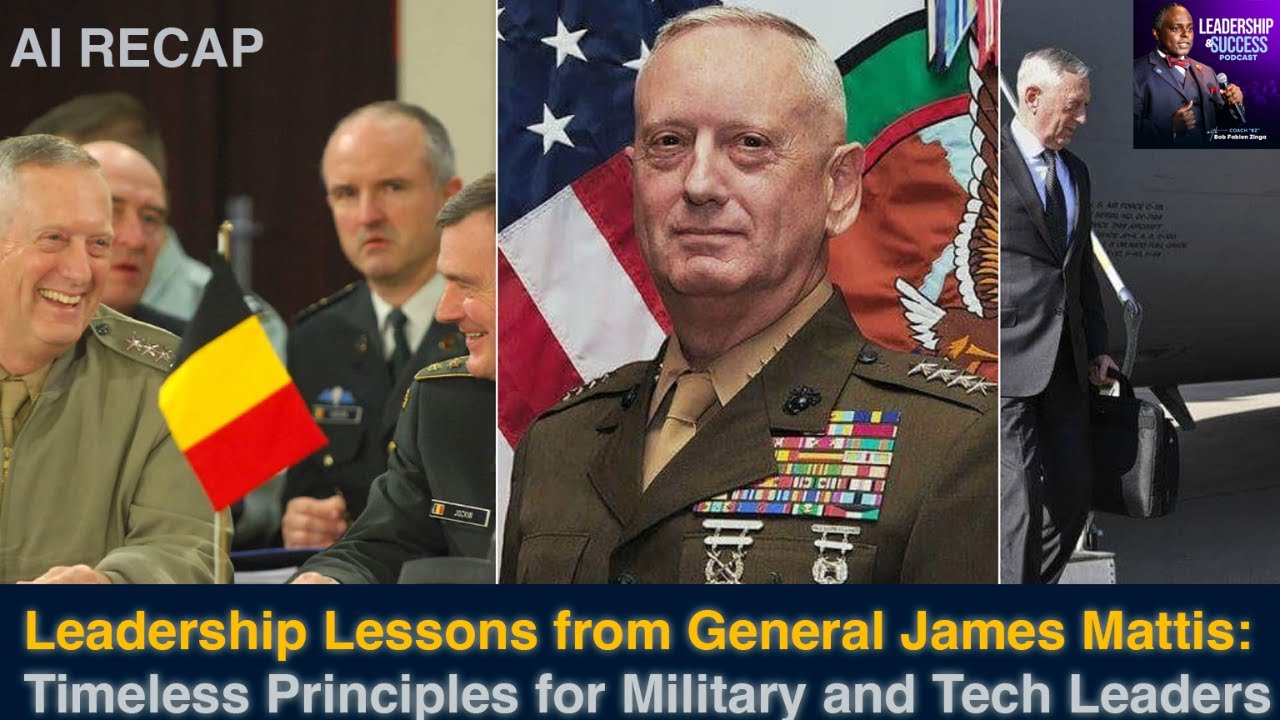
The episode is a live podcast hosted by Coach Beezy (Coach BZ) featuring a panel discussion that distills General James Mattis’s leadership principles for modern business and tech environments. The conversation opens with an introduction by John Maxwell and a brief gratitude moment, then moves into a systematic breakdown of Mattis‑inspired principles. The panel outlines three core mandates of mission command: (1) state the mission’s what and why, (2) give teams autonomy over the how, and (3) let ownership fuel motivation and innovation. They discuss how rewarding the right behaviors shapes culture, warning against unintentionally praising “chaos heroes” who fix crises rather than prevent them. The dialogue contrasts traditional command‑and‑control with a “command‑and‑feedback” model that relies on two‑way information loops, enabling rapid adaptation. Affection and deep trust are presented as the foundation of resilient teams, creating psychological safety that drives people to go beyond the call of duty. The panel then outlines the “Listen, Learn, Help, Lead” sequence as a servant‑leadership framework, and stresses the importance of intellectual humility and strategic empathy to find common ground across competing internal stakeholders. Throughout, the speakers emphasize lifelong learning, continuous adaptation, and the servant‑leader’s responsibility to model the values they expect. The episode concludes with a call to action for listeners to apply these principles, subscribe, and reflect on their own leadership practices.
Chapters
Hi, I'm John Maxwell. When the top companies in the world are looking for trainers, speakers, and coaches, there's one name that stands above the rest, and that's Maxwell Leadership. Our certified team members have gotten proven results for companies all over the globe, and our reputation, I'm proud to say, is second to none. Some of our members have risen to the top of their profession, including the one you're going to meet today. I proudly introduce you to my friend Bob Fabien Zinga.
Welcome to the Leadership and Success Podcast with your host, Coach Beezy. If you need to develop into a better leader, this podcast is for you. If you want to achieve a greater level of success, this podcast is for you. His mentor, Dr. John C. Maxwell, said it best: everything rises and falls on leadership. We hope to inspire you today and provide you with an insight that has the potential to positively impact the trajectory of your life. Welcome to the Leadership and Success Podcast.
Which leads us to how you actually delegate work. Principle 6: Empower ownership through clarity.
Yes, we see so many leaders, so many organizations just stuck in endless micromanagement cycles. It's exhausting for everyone.
Grains energy, kills initiative. How did Mattis manage this, especially in the military, where you might think control is everything? How did he empower people?
He was a master of what's called mission command. He deeply understood that true motivation, real innovation, it skyrockets when people feel genuine ownership over the mission, not just like they're cogs following orders.
So how did he achieve that delegation?
He operated with basically 3 key mandates for his leaders when giving out tasks or missions.
Okay, what are they? Let's get specific.
First, the leader must state the mission clearly, the what, and crucially, the why. Everyone involved needs to understand the objective and the bigger strategic purpose behind it.
Not just build this feature, but build this feature because it solves this customer problem and helps us achieve this strategic goal.
Exactly. Know the intent. Second, and this is the game changer, give teams autonomy over the how.
Clarity on the what and why, but freedom on the how. That's the magic formula, isn't it?
It is absolutely the blueprint for unlocking intrinsic motivation. Mattis himself said it beautifully. He said, I was very clear about what I wanted them to do, but I left room for them to decide how.
And the result?
Once they owned the order, they fought for it like it was theirs because it was.
Wow.
When you give people the how, you transfer ownership. And that ownership, that feeling of this is mine, it fuels commitment, creativity, problem solving way beyond what rigid instructions could ever achieve.
It respects their intelligence, their expertise, their professionalism. They're closest to the ground. Let them figure out the best path up the mountain.
So that leads to the third mandate.
Which flows directly. Ensure ownership fuels motivation and innovation. When your engineering team feels like that new system architecture is their baby, their creation, they'll defend it, they'll perfect it, they'll fight for its stability, its elegance, its security with a passion you just don't get if they feel like they're just assembling something based on your overly detailed top-down blueprint.
So the question for you You get the behavior you reward. This isn't just about, you know, posters on the wall with core values.
Definitely not.
This is about what actually happens day to day. What gets noticed, what gets praised, what gets people promoted, what are the real rewards and consequences?
Because those observable things, they define what success really looks like in your organization. And here's the kicker. If you passively tolerate bad behavior—
actively endorsing it.
You got it. That passive tolerance is probably the single most corrosive thing for a culture.
It really is.
The source material nails this law of consequence. Whatever your leadership rewards in your organization, that's the behavior you're gonna get. Simple as that. If you want ethical behavior, you'll get it. If you tolerate unethical behavior, you'll get that too.
Let's unpack that idea of rewarding behavior because it's subtle sometimes. In tech, for example, you see this pattern, the chaos hero.
Oh, the firefighter. Classic.
Right. The person who waits till the last minute, maybe even causes the crisis, then pulls an all-nighter, saves the day, and gets showered with praise. Huge visibility.
Textbook unintentional reward. You're celebrating the person who puts out the fire, not the person who prevented it in the first place.
The fire marshal who did the boring, meticulous planning.
Exactly. You're rewarding instability instead of the discipline and process adherence that would have avoided the drama altogether. Mattis saw this in the Marines. How did they build such high standards?
Wow.
By consistently rewarding the right behaviors. Discipline, taking initiative, integrity. Those were the things that got you recognized, promoted, trusted with more responsibility.
So for a leader in, say, a company today, mm-hmm, you say you value collaboration, uh-huh, but you keep promoting the person who hoards information, plays politics and wins by competing internally.
Then your actual culture values competition, not collaboration. Your actions speak way louder than your mission statement.
All right, everyone. Thank you so much for being here with me today. Today is Saturday, October 11th. It's about 10:30 here in California, so 1:30 on the East Coast. So let's do our moment of gratitude. It's only going to take a minute. This is where we want to be grateful for one thing today. So if you can, close your eyes, put yourself in your happy place, take a deep breath, and think about one thing you are grateful for today. I think today I am grateful for the gift of life. I am so grateful that I am still alive today, and as long as I am alive, there is hope for me. So let us know what you are grateful for and type it in the comment. I appreciate that. And, uh, today we are going to do the 10-minute summary of the hour-long leadership talks that General James Mattis, um, callsign Chaos, had. And we are going to break it down to the 10 most essential minutes. So I'm gonna have my AI agent do that. And while, while I am doing this, um, please let us know where you are coming from, what city, what state. Let us know what you are grateful for and, uh, tag someone you know in your sphere of influence who might benefit from this podcast. So here we go with the, uh, podcast summary.
Welcome everyone to our conversation on leadership. Today we'll be diving into some timeless principles inspired by General James Mattis and how they resonate with modern military and tech leadership.
I'm excited. So what do you think stands out as the core message from these lessons?
Well, one of the key points is that leadership is— it's like a lifelong learning process. You never really finish learning, whether you're commanding Marines or leading tech teams. Every new role means you have to adapt, learn new dynamics, and even face fresh challenges.
Yeah, that's interesting. I mean, it's like you start as a student of leadership and gradually become a teacher, right?
Exactly. And what General Mattis emphasizes is that each leadership experience functions as a classroom. Whether it's a boardroom or a battlefield, you're continuously learning through responsibility.
Yeah, that makes sense. I also noticed a recurring theme about taking ownership, not just delegating, and truly being accountable for decisions.
Right on. Um, his point that responsibility rests with the leader is crucial. Even if you pass on decision-making, the ultimate responsibility stays with you. You can't just blame others if things go wrong. It's about stepping up, whether it's in the military or a tech startup where challenges can be unpredictable.
I like that. So in essence, it's a call for servant leadership. You lead not for glory, but to guide and help your team.
Absolutely. And that brings me to another important set of lessons. Leading with affection and building resilient teams. General Mattis mentioned that even in the worst circumstances, the affection and trust the team has for each other can be the key to survival and success. It's a reminder that relationships and genuine care are at the heart of effective leadership.
Interesting. And it's almost like saying, if you reward ethical behavior, you get ethical behavior. There's that point about culture. You get the behavior you reward.
Yes, exactly. Um, culture. The idea is that the environment you cultivate determines the actions of your team. If you reward collaboration, initiative, and ethical decision-making, those behaviors become the norm.
Yeah. Now, what about the coaching versus command debate? I remember Mattis made a clear distinction there.
You're spot on. He advocates for coaching over pure command. Not every mistake should be, um, met with harsh punishment. Sometimes it's a learning moment and a chance to mentor someone. It's like, if it's just a mistake, coach them, but if it's a lack of discipline, then you must act decisively.
Hmm, I do wonder though, sometimes the balance can be tricky. What if the line between a mistake and indiscipline is blurred?
That's a fair point. In my experience, it really comes down to clear communication and consistent standards. The leader must set the example and clearly define expectations so that the team knows where the boundaries lie.
Yeah. So essentially, by being both a coach and a strict standard bearer, you empower your team. This seems especially relevant for tech leaders who often try to micromanage.
Exactly. Um, it's about empowering ownership through clarity. When you clearly state the mission and then step aside, you're allowing your team to take charge of the how. It's about giving them the sense of ownership that fuels innovation.
I love that approach. Kind of like setting the stage and then letting your actors improvise their brilliance.
Yes, it's like, um, you set the script for what needs to happen and then let them direct their own scenes. And that ties back into the idea of continuous improvement. Every new environment is a new lesson, a new opportunity to refine both leadership and execution.
Right. Now, one analysis here I find really engaging is how the lessons blend military discipline with tech innovation. Like, while in the military, the physical aspect is crucial, Pull-ups, stamina, accountability. In tech, it's about mental resilience and ethical fortitude.
Yeah, exactly. It's fascinating because even though the environments differ dramatically, the core principles such as resilience, decisiveness, and the willingness to shoulder responsibility remain the same. It's like comparing two sides of the same coin.
Mm. I appreciate how these leadership lessons encourage not only doing but truly embodying the values you wish to see in your team.
Right, which is reflected in the principle physical and moral example. In the Marines, if a leader couldn't meet the physical standards, their credibility would drop. Translating that to tech or business, it's about embodying resilience and ethics, even if pull-ups aren't literally required.
Yeah, yeah, it reminds me of how leaders are expected to lead by example, setting the tone for work ethic and character, not just through instructions but through personal behavior.
Absolutely. And then there's the concept of "Listen, Learn, Help, Lead." It emphasizes that true leadership begins with listening. You learn from others, help them improve, and then guide them forward. It's a sequential, almost organic process.
Mm, that resonates with me. But don't you think in a fast-paced tech environment, taking the time to listen might get compromised?
That's a great critique. In high-pressure settings, it can be very tempting to bypass listening for quick decisions. But if you're not genuinely engaging with your team's perspectives, you risk making uninformed decisions that can harm the overall culture. There's a balance to be struck, and effective leaders invest that time.
Yeah, true. It's a challenge but ultimately necessary, right? Because if you fail to listen, you disconnect from the very pulse of your team.
Exactly. And then there's the idea of finding common ground. Even when you disagree, stepping into someone else's shoes, understanding their perspective, can lead to more cohesive outcomes. That's humility in action.
Mm, that's a rather refreshing aspect, especially in environments where strong personalities clash often. It's like saying empathy can bridge those gaps.
Indeed. And with all these themes, from lifelong learning to showing affection and accountability, it really encapsulates what it means to be a servant leader. You're not out there for personal gain or glory. You're committed to serving your team and guiding them to success.
Yeah, I also noticed how accessible these lessons are. They're applicable whether you're a Navy officer or, um, a Silicon Valley engineer stepping into leadership for the first time.
Right. These principles transcend the specifics of military or tech. They're universal. The applications, like not assuming past success, guarantees future effectiveness are reminders that every leadership role is unique and demands constant adaptation.
And that reminds me of another point mentioned about rewarding behavior. It's a powerful concept. What you incentivize shapes your organization.
Absolutely. By intentionally rewarding the right behaviors, like ethical decisions, teamwork, and ingenuity, you shape a culture that mirrors these values. It takes a lot of thought and deliberate action on the leader's part.
Yeah. Now, shifting gears a bit, there's also that nod to modern professional interfaces. The initial glimpse of a table with navigation like Home, My Network, Jobs, Messaging. How does that tie into this leadership conversation?
Oh, good catch! That snippet Although brief, reminds us that these leadership lessons are often shared across platforms like LinkedIn. It's a signal that leaders today need to harness these timeless principles and share them in modern digital spaces, connecting with a global audience.
Mm. So, in a way, it shows a convergence of old-school wisdom with the new world of digital connectivity.
Yes. And it's particularly exciting because learning and leadership are now more accessible. Platforms spread these ideas far and wide, and leaders like Bob Fabien B. Zinga are using them to coach professionals across sectors, from cybersecurity to military command.
Yeah, I find it remarkable how General Mattis's principles can be repackaged for a diverse audience. It seems like whether you're facing cyber threats or battlefield challenges, the need for servant leadership Accountability and continuous learning is constant.
Absolutely, and that's what makes this discussion so rich. It's a blend of strategic thinking, humility, and the relentless pursuit of excellence. It challenges us to constantly refine not just our methods but our mindset as leaders.
I love that perspective. It's like leadership in any field is the art of balancing structure with empathy. Of steering the ship while still inviting input and nurturing individual growth.
Exactly. And let's not forget the powerful reminder, "You lead to serve others," that underpins everything, from the unwavering integrity of a Marine to the innovative spirit of a tech leader.
Yeah. So, as we wrap up, if you had to pinpoint one transformative leadership lesson from General Mattis, Which would you choose?
I'd say it's the principle of lifelong learning, because it encapsulates the idea that every day presents an opportunity to be better, to listen more intently, and to serve with greater empathy. Whether in a high-stakes operation or a board meeting, keeping that mindset can transform both you and your team.
Mm, that makes a lot of sense. It's a continually evolving journey, one where every decision, every mistake, and every success is a lesson in leadership.
Exactly, and that's what makes leadership so dynamic and, frankly, so rewarding. Each lesson builds on the last, creating a blueprint not just for professional growth but for personal integrity as well.
This conversation really highlights that great leadership, whether in the military or tech, isn't static. It adapts and evolves with every challenge and triumph.
Yes, And it also reminds us that at its core, leadership is about connection—about listening, learning, and leading by example.
Thanks for the engaging discussion. I hope our listeners are feeling inspired to reflect on their leadership approaches and maybe even take a few bold steps toward empowering their teams. Absolutely.
Remember, every day is an opportunity to learn something new and to help your team grow. Thanks for tuning in, and here's to leading with character, courage, and compassion.
Yeah, or are you smothering their initiative with constant check-ins, prescriptive instructions, basically micromanaging, killing their ability to own it?
And if you do trust them with the how, that fundamentally changes the communication dynamic, right? It can't be just top-down orders anymore.
Exactly, which brings us neatly to Principle 7: Command and Feedback. Not command and control.
Command and control feels like the old way.
Very hierarchical. It is. Mattis saw that traditional, rigid command and control model as fundamentally flawed for the modern world. Too slow, too brittle, can't adapt fast enough.
So what's the alternative? Command and feedback.
Yes. He pushed this hard. The Marines teach us command and feedback, he said, because that's how you unleash people.
Okay, why is feedback the key differentiator here? Why is it better than control?
Well, think about what command and control assumes. It assumes the leader at the top has perfect information. Which they never do. Never. And it assumes the situation on the ground isn't changing.
Which it always is.
Always. So control centralizes all decision-making, all authority. Initiative dies below the top level. Command and feedback, on the other hand, acknowledges reality. What's the reality? That the leader's initial plan, the initial what, is just a starting point. It's an estimate. And the people actually doing the work, executing the how, they have the crucial real-time information. They see the obstacles, the opportunities, the changes.
And leader needs that information back. Yeah. Urgently.
Needs it to course correct. So the actionable process becomes set clear goals, the what and why. Give people the space and autonomy to act, the how, and then critically, maintain constant two-way feedback loops. These aren't just status updates then. No, much more than that. These feedback loops are how the team tells the leader, "Hey, that constraint you mentioned, it's worse than we thought," or "We found a shortcut, can we adjust the plan?" or "We need different resources than we anticipated." It allows for adaptation. It demands it. Command and control stifles that vital upward information flow command and feedback relies on.
Align them with the behaviors you genuinely want.
You have to reward the engineer who built that stable, well-documented system, even if it wasn't a dramatic 3 AM save. It demands real reflection from the leader.
What am I accidentally rewarding? Am I rewarding speed that cuts corners on quality? Am I rewarding an aggressive style that tanks team morale?
Crucial questions. And once you have that baseline culture of discipline starting to form, You need something else, something deeper for resilience—human connection.
Which brings us to a principle that might sound surprisingly warm. Principle 5: Affection builds resilient teams.
Yeah, this one often raises eyebrows, especially coming from a military context like the Marine Corps. It feels counterintuitive. Affection? Really?
That sounds— well, soft. Maybe too personal for a highly disciplined unit, let alone a competitive company. I get that reaction. Are we talking about, like, everyone being best friends, or is it more deep professional mutual care?
Mm-hmm.
How do you stop this from just becoming a nice culture where underperformance gets ignored?
That's the absolute key question to ask here. And no, it is emphatically not about just being nice or overlooking poor performance. Forget that.
Okay, so what is it?
It's about building bonds that go way beyond the paycheck, beyond the transactional, I do this, you pay me contract. It's a profound mutual commitment to the safety, the well-being, and the success of the person standing next to you.
So it's about trust. Deep trust.
Deep trust. Mattis observed that under extreme fire, yes, discipline and skill were essential, non-negotiable, but the units that truly excelled, that pushed through unimaginable stress, the difference maker was, in his word, affection. Meaning? Meaning that gut-level feeling of, "I will not let my buddy down." That commitment to each other is what kept them going even when terrified or hurt.
Okay, I can see that now. It's the bedrock of psychological safety, isn't it? Precisely. It allows people to take risks, to speak up, to try things because they know, truly know, their team has their back. It's what turns a group of capable individuals into a single unit that can actually weather a storm.
Think about it in business terms. A massive server outage hits at 2:00 AM. What happens? Depends on the culture. If it's purely transactional, people might do their bit, clock out when their shift ends, worry about covering their own backs for the postmortem. Right. Self-preservation. But if there's that foundation of affection, that mutual care, people step up automatically. They volunteer. They take ownership of problems slightly outside their lane. They stay late not because they have to, but because they genuinely care about the team, the mission, and the other people in the trenches with them.
That deep care transforms basic competence into real resilience. It does.
And you can't get that deep, genuine trust unless you First, show that you value people's perspectives, their contributions, their well-being.
Which leads us perfectly into the next one, Principle 9: Listen, Learn, Help, Lead. The so-called Washington method.
These feedback loops are how the team tells the leader, hey, that constraint you mentioned, it's worse than we thought, or we found a shortcut, can we adjust the plan, or we need different resources than we anticipated.
It allows for adaptation. It demands it.
Command and control stifles that vital upward information flow. Command and feedback relies on it. And by relying on it, you unleash the team's collective intelligence and adaptability. You build resilience.
OK, we've talked a lot about the leader and their direct team. Yeah. What about interacting with others— allies, partners, maybe even rivals or other departments you have to work with?
Often involves disagreement. Yes, which brings us to Principle 10: Finding Common Ground. And this one requires a specific kind of humility— intellectual humility, professional humility. It can be really tough in high-pressure, competitive settings. What's the core idea? Mattis hammered this home. You have to operate from the assumption that even the people you disagree with might be right.
Oof, that's a big ask, especially when you're convinced you are right. Think about internal company dynamics. Engineering thinks sales is promising the impossible. Finance thinks R&D is burning cash irresponsibly. Sales thinks product isn't delivering fast enough. How do you bridge those gaps? They often feel like canyons. It takes deliberate effort.
The mandate isn't just "be nice." It's about rigorous intellectual empathy. The quote lays out the process: "Walk in their moccasins." Understand their perspective. Deeply. Know their argument so well you can explain it yourself. Only then, after you truly understand where they're coming from, can you effectively find common ground. This isn't about weak compromise. It's strategic empathy.
Let's dig into that middle part. Know their argument so well you can explain it yourself. What does it actually mean in practice?
It means you have to invest real time and energy to understand the other side's world, their pressures, their incentives, their constraints, their goals. So if I'm arguing with finance about my project budget, you need to understand their budget pressures from the CFO, their reporting requirements, the regulatory landscape they operate in, the financial models they're judged by. Maybe even better than they understand your specific technical challenges. Only when I can demonstrate that deep understanding of their world do you earn the credibility to negotiate effectively. Then you can start looking for solutions that respect both sets of constraints, solutions that optimize for the overall mission, not just your piece of it.
It requires humility, respect, and being genuinely open to the possibility that you might learn something. That they might actually be right about some things. Exactly.
Without that, collaboration across boundaries just breaks down into tribal warfare.
Thank you for listening to the Leadership Success Podcast with your host, Coach BZ. If you like what you heard, please subscribe to our channels and come back for more wisdom nuggets on how you may develop into a better leader and achieve greater levels of success. Leadership Leadership is the most critical skill. The world will always need leaders to lead others, deploy the next disruptive technology, or execute a business strategy. You may as well decide on counting yourself among the 21st century leaders. See you right here next time on the Leadership and Success Podcast with Coach BZ.
More from Bob

S250:E4🎙️LIVE 🇺🇸America 250: President Barack Obama Leadership, Service, and the Power of Hope






S5:E157🎙️ LIVE with CMD CMSgt Dennis L. Fritz, USAF (Ret.)(Multi Tracks Audio)



S5:E156🎙️ LIVE 🇪🇸 Leadership Lessons from the FIFA World Cup 2026 Champions (Multi Tracks Audio)

S250:E3🎙️ LIVE Leadership Lessons from America’s First Documented Family of African Descent 🇺🇸📖