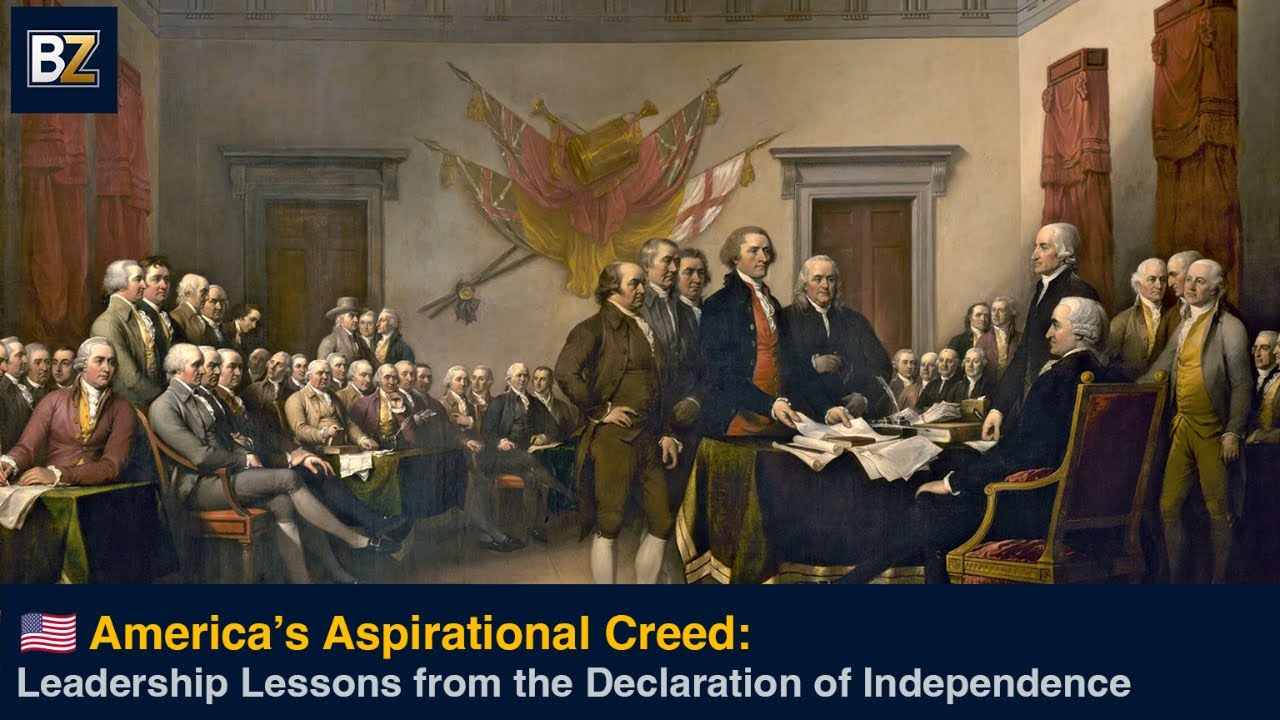
In this episode of the Leadership and Success Podcast, host Commander Bob Fabien Zinga (Coach Bizzy) frames the United States Declaration of Independence as an "aspirational creed" and extracts seven timeless leadership lessons from it. After a brief promotional plug for the AI Marketing Summit and introductions from Lucy Little, John Maxwell, and other hosts, Zinga leads a deep dive into the historical paradox of the Declaration: its bold claim that "all men are created equal" contrasted with the reality of slavery, exclusion of women, Native peoples, and people of color. He cites figures such as Crispus Attucks, the First Rhode Island Regiment, Frederick Douglass, and Martin Luther King Jr. to illustrate how marginalized groups have repeatedly sacrificed to push the nation toward its promise. The episode then translates this history into seven concrete leadership principles – courage, vision, coalition‑building, integrity, hope, sacrifice, and inclusion – each illustrated with biblical references, historical anecdotes, and practical reflection questions for listeners. Zinga emphasizes that leadership requires conviction over comfort, continual stewardship, and an ongoing commitment to expand inclusion. The show closes with a personal pledge from Zinga about his American identity, a reminder of the upcoming AI Marketing Summit, and teasers for future guests (Dominique Shelton‑Lapczyk and Coach Darlene Drew), ending with a call for audience engagement.
Chapters
Hey, hey, Lucy Little here, and I'm excited to announce the third annual AI Marketing Summit this year. This is the AI Marketing Summit 2025, and you're invited to attend absolutely free. If you've ever wondered how you can leverage artificial intelligence to grow and scale your business or start your own ¡Hola! ¡Hola!
¡Hola!
Hi, I'm John Maxwell. When the top companies in the world are looking for trainers, speakers, and coaches, there's one name that stands above the rest, and that's Maxwell Leadership. Our certified team members have gotten proven results for companies all over the globe, and our reputation, I'm proud to say, is second to none. Some of our members have risen to the top of their profession, including the one you're going to meet today. I proudly introduce you to my friend, Bob Fabien Zinga.
Welcome to the Leadership and Success Podcast with your host, Coach BZ. If you need to develop into a better leader, This podcast is for you. If you want to achieve a greater level of success, this podcast is for you. His mentor, Dr. John C. Maxwell, said it best: everything rises and falls on leadership. We hope to inspire you today and provide you with an insight that has the potential to positively impact the trajectory of your life. Welcome to the Leadership and Success Podcast.
What if your next keynote speaker could bridge the worlds of national defense, Silicon Valley innovation, and global leadership? Meet Bob Fabien Zinga, award-winning keynote speaker, U.S. Navy Information Warfare Commander, and trusted executive in technology, leadership, and strategy. With over 20 years of proven leadership in the US Department of Defense, the US Navy, higher education, and the high-tech sector. From startups to Fortune 500 companies, BZ delivers keynote experiences that inspire, challenge, and equip leaders for real-world impact. BZ speaks with authority on cybersecurity and national security, strategies to safeguard critical assets in an age of constant threat, Artificial intelligence and emerging technology: how to innovate responsibly while staying ahead of disruption. Leadership and corporate governance: building resilient, ethical, and high-performance organizations in any environment. Every keynote blends military precision, Silicon Valley agility, and boardroom strategy, delivering practical takeaways that leaders can apply immediately. Audiences leave inspired, informed, and ready to lead with clarity and courage. Whether you're hosting a global conference, corporate summit, or leadership retreat, book Bizzy to energize your event and empower your audience to lead in a rapidly changing world.
Hola everyone, this is Coach Bizzy. Welcome to our daily podcast. This is the Leadership and Success Podcast with Coach Bizzy. Alright, let's get started with our moment of gratitude. This is something we do as a tradition every time we meet. We're gonna take just a moment and we want to be grateful for one thing today. So what are you grateful for? If you would put yourself in your happy place, close your eyes, take a deep breath, and think about one thing that you are grateful for today. I think today I am grateful for my family, my wife and my two kids. I don't know what my life would be without them. So what are you grateful for? Type it in the comment. And today we're going to be talking about a very special subject. In about a year, White America will be 250 years old. And I have written a series of essays about our complicated history. And today I'm going to be talking about America's aspirational creed. Leadership lesson from the Declaration of Independence. The Declaration of Independence is such a powerful, powerful, powerful document, and I thank God that I am a U.S. citizen. So that's another thing I'm very grateful for today. But we're gonna be going through some of the leadership lessons from that wonderful document. 1776. America's story is one of aspiration. Courage and leadership in motion. The Founding Fathers, they declared that all men are created equal, setting a North Star that generations have fought to fulfill. What's interesting is when they first penned those words, America had slaves. People who look like me were not created equal at all. White women were not created equal. That was only about white men and white men who had land. And with time, though, we've been living up to the aspiration of our founding document. That's really what I would like to celebrate. So this special episode, we will unpack how those same principles— courage, vision, unity, integrity, hope, sacrifice, and inclusion— still guide great leaders in the Navy, in business, in technology, and in life today. So you're going to be learning about the Declaration of Independence, uh, doubles as a timeless leadership manifesto. We're going to be learning about the role of courage, risk-taking, and moral conviction in driving change. How to lead teams toward inclusion, progress, and shared purpose, and why leadership is not about perfection but continual growth and service. And I think that's really the story of America to me, continual growth and service. All right, that's what we're going to be talking about. I'm going to have my AI agent do it. It's going to be about 25 minutes or so. So if you have a question for me, please type it in the comment and also let me know where you're coming from, what city, what state. And which country if outside of the USA. I also appreciate it if you like the event and repost it in your, your personal feed, and then if you can also tag someone from within your sphere of influence that might benefit from this podcast today. Here we go.
Something a little different. We're taking a document most of us think we know, the Declaration of Independence, and well, looking at it completely fresh.
Right. Most people probably file it away, you know, as history.
Mm-hmm.
1776, something you maybe dust off for the Fourth of July.
Exactly. But the source material we're diving into today, it's this really fascinating analysis written by a Navy commander who's also a cybersecurity executive.
And the argument is pretty bold. It says we should stop treating the Declaration like just a historical artifact.
And start seeing it as what? —like a manual?
More like a living blueprint. Ah. Something actionable, you know, for leadership, for commitment right now, today.
Okay, let's really unpack that. There's a quote in here from Brig. General Stephen L.A. Michael that seems key. He says, "Our founding documents, like the Declaration, were written not because of where we were, but where we aspire to be." That single idea completely reframes it, doesn't it?
Right. It stops being a snapshot of 1776 reality.
And becomes more like a mission statement, a destination they were aiming for even if they weren't there yet.
Precisely. And if you look at it that way, its power isn't just in what it said, but maybe even more in what it didn't yet achieve.
The source calls it America's aspirational creed.
Yeah, the birth certificate of freedom, sure, but maybe like a birth certificate with a promise attached, a promise that wasn't fully funded on day one.
Okay, that leads us straight to the big one, the phrase All men are created equal. I mean, in 1776, that just wasn't reality, was it? Not even close. So Dr. Martin Luther King Jr.'s framing of it as a promissory note, that feels spot on. What does that mean for a leader today? Building your whole vision on a promise, you know, right from the start is kind of unpaid.
Well, it means the work is never truly done, right? And maybe that's the heart of real leadership. If your mission is just a, a task list you complete, Well, you finish it and move on. But if it's an aspiration, a promise, then you're always driven by that gap, the gap between the ideal you're reaching for and the reality you're currently in. And that's what we see through American history, isn't it? Generations of people, leaders in all sorts of ways, just pushing and struggling, often at great cost, to try and make that initial promise real.
So let's stare right into that gap, that massive contradiction at the very beginning. We hold these truths to be self-evident, that all men are created equal. When those words hit the parchment, who are they actually talking about?
Yeah, the reality was stark. We're talking almost exclusively about white men and men of property in that.
So completely excluded were—
Women, Native Americans, and of course, millions of African Americans held in slavery. I mean, think about it. A declaration of freedom signed by men who literally owned other human beings.
The irony is just staggering. So how does a document born from such exclusion become Aspirational? How does it become this engine for change?
It seems paradoxical. It is. But the power might lie in the sheer audacity of the statement itself. Calling equality a self-evident truth, that's such a radical, absolute moral claim. Once it's written down, it's out there. It creates a kind of moral benchmark, maybe even a liability, for the nation. Future generations couldn't easily argue against expanding equality, without directly contradicting the nation's own founding creed.
So the very boldness of the claim, even amidst the hypocrisy, became the leverage point.
Exactly. It became the foundation for people later on to say, "Hey, what about us? This promise applies to us too." It fueled the demand to close that gap between the words on the page and the reality on the ground.
It's like they wrote a check they couldn't cash yet, but someone kept the receipt.
That's a good way to put it. And the source points to Frederick Douglass as one of the first and most powerful people to basically demand payment.
Right, the 1852 speech. "what to the slave is the Fourth of July?" Mm-hmm.
That's such a critical moment for understanding this idea of aspirational leadership. Douglass stands up, on the day everyone's celebrating freedom, and just confronts the hypocrisy head-on.
He didn't pull any punches, calling the celebration a sham, pointing out the blatant contradiction of celebrating liberty while millions were enslaved. That must have been incredibly uncomfortable to hear. Deeply uncomfortable.
It was a searing critique. Yeah. And that's often what leadership requires, right? Pointing out the difficult truths. The places where reality doesn't match the stated values.
But here's the crucial part, the leadership lesson. He didn't just condemn and walk away.
No, and that's the genius of it. He ends the speech with hope. Despite the blistering critique, he says, "I do not despair of this country.
I leave off where I began, with hope." So he models this idea: you hold the nation, or maybe your organization, accountable to its highest ideals, using those ideals as the standard. You don't throw the ideals out because they aren't being met.
Precisely. He established this powerful tradition. Challenge the failures by appealing to the promise. Don't dismiss the promise itself.
And that same approach, that same strategy really, comes roaring back in the Civil Rights era.
Absolutely. Dr. King masterfully picked up that same thread. He wasn't demanding something entirely new. He was essentially saying it's time to make good on the original contract.
The promissory note idea again?
Exactly. He framed the entire struggle around that concept—the nation needing to finally honor the check it wrote in 1776. He famously dreamed of a nation that would "rise up and live out the true meaning of its creed." Which is strategically brilliant, isn't it?
It frames the movement not as paring something down but as fulfilling something foundational. It puts the burden on the nation to live up to its own words.
Yes, it forces a confrontation with its own identity. And that moral weight, that consistency with the founding principles, was undeniably crucial.
Leading directly to landmark changes. Right.
It provided immense moral and political force, contributing directly to the Civil Rights Act of 1964, the Voting Rights Act of 1965. It demonstrates that the Declaration's real power isn't static; it's in its ongoing use to push for greater inclusion.
Not just for African Americans, but for every group that has since stepped forward to claim their share of that promise.
Exactly. Women seeking suffrage, LGBTQ+ individuals seeking equal rights, people with disabilities, the list goes on. The Declaration wasn't just about separating from Britain; it inadvertently became a commitment to keep wrestling with—and expanding—the meaning of liberty and equality right here at home.
Okay, so if the Declaration is this aspirational creed, this unpaid promise, let's talk about the price paid. Because the history you're outlining suggests, well, it's often the people excluded from the promise who sacrifice the most to try and make it real.
That's one of the most profound and, frankly, sobering parts of this story. It's this recurring theme. Yeah. Those with the least stake in the current system often demonstrate the deepest faith in its potential.
They're essentially investing, sometimes with their lives, in the hope that the promissory note will eventually be honored. Yes.
Paying the price up front on faith. And the source gives us some really powerful early examples, starting even before the Declaration.
Crispus Attucks.
Crispus Attucks. A man of African and Native American descent. Killed in the Boston Massacre, 1770. He's widely considered the first martyr of the American Revolution.
So before the ink was even dry on the Declaration, the fight for American ideals—liberty, self-determination—was already involving and costing the lives of the very people those ideals didn't fully include. Right.
He was memorialized as the first to defy, the first to die for liberty. It highlights this pattern: the deepest commitment often comes from the margins, from those still waiting for full inclusion.
And this continues right into the Revolutionary War itself. The source mentions the First Rhode Island Regiment.
Ah, the Black Regiment from 1778. This is just a stunning example. They recruited about 140 African American soldiers, some already free, some enslaved. And the enslaved soldiers were offered— Freedom. Their freedom in exchange for military service. Think about the immense risk they took.
Death in battle, obviously, but also—
Also capture. If the British caught them, they wouldn't be treated as prisoners of war. They'd likely be sold back into permanent slavery, probably somewhere even harsher.
Yet they signed up. They fought.
They fought with distinction. They essentially bought their freedom and the freedom of the new nation with their courage and their blood. It demonstrates this incredible, almost unbelievable trust in the fragile promise of the Revolution.
That decision to fight for a freedom you yourself don't possess feels like the core moral engine driving this whole expansion of the creed.
And you see it again and again. Fast forward to the 20th century, World War II. Over a million Black Americans served. Yes, fighting against fascism overseas. Think of the Tuskegee Airmen, the 761st Tank Battalion units that proved their incredible valor time and time again.
All while facing segregation and discrimination back home and even within the military itself.
Exactly. They were fighting for the idea of America, the promise of the Declaration, not necessarily the reality they lived in day to day. They were fighting for what America could be. And it wasn't just military service, right?
The source emphasizes broadening this.
Absolutely. We have to include the suffragists fighting for decades, facing ridicule and imprisonment, just for the right to vote, finally achieved with the 19th Amendment in 1920.
Indigenous leaders defending treaty rights, tribal sovereignty, community survival.
All of it. Every movement that has pushed back against the initial, narrow assumptions of the Founders, demanding that the self-evident truth of equality be applied more broadly. Progress hasn't come from comfortable consensus. It's always been driven by these challenges, often from the very groups initially left out.
It really puts Lincoln's description of the Declaration into perspective. Right.
He called it a rebuke and a stumbling block to tyranny and oppression. It acts like a permanent moral compass, doesn't it? A standard.
Something you constantly have to measure yourself against.
Exactly. Every time someone advocates more justice, more inclusion, more opportunity, they are, in a way, invoking that 1776 creed. It's not just history. It's the active benchmark for whether the nation is living up to its own definition of itself. He keeps pushing, demanding we aim higher. Okay, this is where it gets really practical.
The source takes this deep history, this idea of an aspirational creed and sacrifice, and distills it into 7 concrete leadership lessons. This feels like the core of turning the Declaration from philosophy into an actual playbook. Exactly.
We're shifting gears now from the what and the why to the how. How can a leader today, facing, you know, market uncertainty, internal divisions, resistance to change, how can they actually use these principles?
Because the risks might seem different—we're not talking treason anymore—but maybe the underlying dynamics are similar. That's the argument.
The existential risks of 1776 translate into the risks leaders face today: risks to reputation, to career, maybe to organizational survival. Personal comfort. But the need for courage, vision, coalition-building—that's timeless.
Alright, Lesson 1: It starts with that famous closing line, "risking their lives, fortunes, and sacred honor." That wasn't just rhetoric, was it? Not at all.
It was literally treason. Signing that document was potentially signing their own death warrant. So, the first lesson is foundational: real leadership demands courage. It demands a willingness to step out of the safe zone.
To take risks. But the source emphasizes calculated risks. How does a leader today know the difference between being courageous and just being reckless?
That's the key, isn't it? Yeah. In 1776, the calculation was arguably simpler. The risk of inaction—continued oppression—was clearly greater than the risk of action—rebellion. For modern leaders, it's maybe murkier?
It can be.
But the calculation should always tie back to core principles and the mission. Is this risk necessary to advance our fundamental purpose? Is inaction actually the more dangerous path in the long run? Often, delaying a tough decision is the riskiest move of all.
Because the problem festers, or the opportunity is missed. Exactly.
The Source connects this to just moving forward even when things are uncertain. It mentions Joshua 1:9: "Be strong and courageous. Do not be afraid." It's about acknowledging the fear, the uncertainty, but acting anyway because the principle at stake demands it.
So the reflection for you, the listener, is pretty direct. What's that big, important decision you're putting off right now? Maybe it's a difficult conversation, a needed reorganization, a strategic pivot.
Something that feels risky because the outcome isn't guaranteed. Mm-hmm. Ask yourself, is delaying it actually riskier?
What's the cost of not acting courageously right now? Okay. Lesson 2, vision. The Declaration wasn't just a list of complaints. It painted a picture of the world they wanted to create based on those self-evident truths, right?
It gave them a North Star, a clear, compelling destination. And that's absolutely crucial for any leader. You have to articulate where are we going and why does it matter?
This sounds obvious, but it's amazing how many organizations or teams lack that clarity.
You get these vague mission statements full of jargon and nobody can remember, let alone feel inspired by. Compare that to the Declaration's core. Life, liberty, pursuit of happiness. Simple, powerful, memorable. That's the kind of clarity that fueled a revolution.
The source mentions Habakkuk 2:2 here. Write the vision, make it plain.
Yeah, make it so plain anyone can understand it instantly. If your vision needs a long explanation, it's probably not clear enough to guide people through tough times.
But wait, how do you do that in a complex world? A global company, a government agency? Things are complicated. Can you really boil it down to one simple sentence without losing crucial nuance?
That's a fair challenge. I think the key, looking at the Declaration, is that the aspiration is simple and powerful, but the context or strategy can have detail.
Ah, so the why is simple; the how can be complex.
Exactly. The Declaration had this simple aspiration— equality, liberty— but then it listed specific grievances to provide the context and justification. For a leader today, your team needs to be able to state the core purpose, that North Star, in maybe one sentence.
So everyone knows the ultimate goal, right?
That shared understanding is what allows people to adapt, to make decisions, to persevere when obstacles pop up, because they never lose sight of the fundamental aim. Clarity fuels resilience.
Lesson 3 gets into the nitty-gritty of execution, building coalitions. Jefferson, Adams, Franklin— they weren't dealing with a unified bloc. They had 13 colonies.
All pretty suspicious of each other, often with competing economic interests, different cultures, different priorities. Mm-hmm. Getting them all to agree on something as radical as independence? That took serious work.
Negotiation, compromise, finding common ground where it wasn't obvious.
Absolutely. And that's leadership, right? Finding a way to frame the mission so that everyone, even with their different perspectives and goals, can see how they benefit from the the effect of success, how their interests align with the bigger picture.
The source mentions the actual editing process of the Declaration as an example compromises were made.
Yes, famously, language condemning the slave trade was removed to appease Southern colonies. It highlights the messy, difficult reality of coalition building for a greater, though perhaps imperfect, immediate goal.
Okay, but here's the pushback I often hear in, say, business settings: bringing in all those diverse stakeholders, especially the ones who might disagree or slow things down, Mm-hmm. Isn't that inefficient? Don't leaders need to move fast? Ah, the classic tension.
Speed versus resilience. And I think the lesson here, especially in high-stakes environments, is that resilience built through consensus almost always wins out over fragile speed. Explain that.
How does consensus build resilience?
Think of it like that cord metaphor the source uses, from Ecclesiastes: "A cord of three strands is not quickly broken." A decision forged through negotiation, incorporating different viewpoints, is tougher. It's already stress-tested.
Whereas a decision made quickly by a small, homogenous group—
might be easily snapped when unexpected pressure hits, because it hasn't accounted for those other perspectives or potential weaknesses. Building a coalition isn't just about being inclusive; it's strategic risk management.
So, actively seeking out dissent isn't just tolerance; it's intelligence gathering. Finding your blind spots. Precisely.
Who are the people you need at the table, specifically because they challenge your assumptions? Those challenging voices are often the ones who see the iceberg before you hit it.
The reflection question then becomes really pointed: Whose critical perspective are you currently missing, maybe even avoiding, that could actually make your project or your team stronger in the long run?
Lesson 4 brings us back to values but connects them firmly to action. The Founders laid out their principles—liberty, justice, self-governance—and then they acted.
Decisively. They didn't just talk about violations by the Crown; they declared independence and prepared for war. The action followed the principle.
And that's critical for leadership integrity. You have to define your non-negotiables, your core values, and when those lines are crossed, you have to act. Otherwise, the principles are just—words.
Talk is cheap, basically. Exactly.
Integrity builds trust, and trust is everything. If your team sees you compromising on stated principles when things get tough, that trust evaporates instantly.
Okay, but let's make this real. Imagine a leader sees a clear violation of principle, maybe unethical behavior, cutting corners on safety, but acting on it means, say, losing a major client or angering a powerful figure. That's immense pressure. Where does the strength to act come from?
It has to come from focusing on the long-term cost of inaction. Losing that client might hurt now, but losing your team's trust because you compromised your values, that's potentially fatal to the organization's health down the road.
It's about the corrosive effect of inconsistency. Yes.
The source references James 5:12, essentially. Let your yes be yes and your no be no. Radical consistency. Your team needs to know that your principles aren't conditional.
So the principle isn't just a guidepost, it's a commitment. It binds the leader's actions, and that predictability builds psychological safety for the team.
Beautifully put. If you say safety is number one, then every decision has to reflect that, even when it's inconvenient or expensive. The practical challenge here is tough.
Define maybe the top 3 principles that actually guide your leadership decisions, the ones you'd risk something for.
And then— Share them! Openly, let your team know what your non-negotiables are. That vulnerability, that clarity builds incredible trust.
Lesson 5 feels like it circles right back to that core idea of aspiration. The American experiment, trying to live up to all men are created equal, has been a long, hard struggle, generations long. Absolutely.
Nearly 2 centuries just to get to the major civil rights legislation. That kind of sustained effort requires incredible resilience. And the fuel for that resilience, the source argues, it's hope.
We saw that with Douglas and King, right? Acknowledging the grim reality, the failures, the hypocrisy.
But never giving up the belief that the promise could still be fulfilled, that the nation could live up to its creed.
Is hope then a leadership strategy, or is it just about managing emotions?
I think it's absolutely strategic. Hope isn't blind optimism. It's not ignoring the problems. It's the deep conviction that despite the current difficulties, the mission is still worthwhile and ultimately achievable. And the leader's role is to communicate that conviction. Constantly. Especially when things are tough. When a project hits delays, when funding gets cut, when morale is low, the leader has to be the keeper of the hope. If the leader gives up, the team follows.
It's like you have to hold both realities in your head at once. Acknowledge the struggle is real but keep pointing towards the possibility of success.
Think about running a marathon, right?
Right.
At mile 20, everything hurts. The finish line seems impossibly far. Hope is what helps you break it down. Just get to the next water station. Just keep moving while still holding on to the vision of crossing that finish line.
The source mentions Isaiah 40:31 about renewing strength. Soaring on wings like eagles.
It's that idea of finding strength even in exhaustion, fueled by the belief in the ultimate goal.
So, a practical tip for leaders listening: if your team is feeling beaten down, maybe share a story.
Yes, a story of perseverance. Maybe from the company's own history, maybe a historical example. Remind them, "We've faced tough times before and we got through them. We can do this too." Connect that abstract idea of hope to something tangible.
Alright, lesson 6. This one feels really intense because it connects directly back to people like Crispus Attucks, the soldiers in the Black Regiment, people who made the ultimate sacrifice.
It frames leadership fundamentally as service. And service, almost by definition, requires sacrifice.
The source says sacrifice of reputation, comfort, or ego.
Right. In 1776, the sacrifice was potentially life itself. Today, for most leaders, it's different, but the principle holds. It means putting the mission, the team, the organization's well-being ahead of your own personal gain or comfort.
Okay, I need to push here a bit. The source mentions John 15:13. Laying down one's life. In a modern work context, isn't there a danger that this glorifies burnout? That it suggests the best leaders are the ones who sacrifice their health, their families, their entire lives for the job?
That's a really important clarification. The sacrifice shouldn't be interpreted as self-destruction or neglecting personal well-being. It's more about the sacrifice of the self-serving ego, meaning letting go of the need for personal credit, meaning taking responsibility when things go wrong. Even if it wasn't solely your fault. Meaning prioritizing mentoring someone on your team even when you're busy.
So it's sacrificing your comfort zone, maybe your desire to always look good, your convenience.
Exactly. It's choosing the harder right over the easier wrong, especially when the easier path benefits you personally but harms the collective. It's sacrificing your ego when you admit you were wrong or promote someone else who might be better suited for a role.
So the greater good isn't necessarily some abstract ideal. But the concrete health and success of the team or the organization you're leading.
That's the essence of servant leadership. And the practical challenge the source poses is immediate and personal. What comfort may be your need for control, your schedule's convenience, your desire for affirmation? Can you consciously set aside this week to better serve your people or your mission? That's the daily practice of leadership sacrifice.
And the final lesson, Lesson 7, brings us right back to the beginning. The ongoing expansion of that aspirational creed, "All men are created equal," became the lever used by suffragists, civil rights leaders, everyone fighting for broader justice.
Which means the work is never finished. Inclusion isn't a box you tick; it's a continuous, active process.
A journey, not a destination. Exactly.
An inclusive leader is always looking for ways to expand opportunity, to bring more voices to the table, to create an environment where everyone feels they belong and can contribute fully. The moment you think you've achieved inclusion is probably the moment you start sliding backward.
The source references Galatians 3:28, this idea of fundamental unity beyond distinctions. How do leaders move inclusion from feeling like a compliance task, something HR handles, to being seen as a core driver of excellence?
By focusing on the results. Diverse teams, where different perspectives are genuinely welcomed and debated, consistently make better decisions. They identify risks homogeneous groups miss. They innovate more effectively.
So inclusion isn't just the right thing to do; it's the smart thing to do for performance.
Absolutely. A leader committed to this actively scans their team, their meetings, their processes, and asks, "Whose voice isn't being heard? Who's being marginalized, maybe unintentionally?
Where are our blind spots because certain perspectives are missing?" It's a proactive search, not just waiting for problems to surface. Yes.
If you're not actively working to counter historical patterns of exclusion and amplify marginalized voices, you are by default allowing those patterns to continue.
So the final practical step is small but continuous.
Take one concrete action this week. Maybe it's deliberately calling on the quiet person in a meeting. Maybe it's restructuring a process to be more accessible. Maybe it's seeking feedback specifically from someone whose background differs from yours. Small, consistent actions keep moving the needle toward fulfilling that aspirational creed within your own sphere of influence.
Wow. Okay. Those 7 lessons provide a really powerful framework. It takes the Declaration from this historical icon and makes it immediate, actionable.
And the source ties it all together with this idea of personal commitment, especially thinking about its author, a military officer. It connects to the oath.
The oath to defend the Constitution. Right.
The point being, when someone takes that oath, they aren't swearing allegiance to a perfect document or a perfect history. They're committing themselves to the aspirational vision that the Constitution, built on the Declaration's foundation, represents.
So the oath itself is a commitment to that ongoing, unfinished work of fulfilling the promise.
Exactly. It's a personal pledge to the future, not just a nod to the past.
C.D.R. Zinga, the author, puts it very personally. He talks about his hope being renewed, about America rising up to live out the true meaning of its aspirational creed.
That really captures the essence of stewardship, doesn't it? It's this deep sense of responsibility to leave things better than you found them.
To ensure future generations inherit something more just, more free. Yes.
An America, or maybe an organization, or even just a team that is safer, freer, more just and prosperous for all its people, regardless of race, gender or national origin, as the author puts it. That's the stewardship obligation to keep pushing towards that ideal.
So if we had to boil down this whole deep dive into one core message, For a leader listening right now, what would it be?
I think it comes down to this: leadership is ultimately about choosing conviction over comfort. It's not about reaching some static state of perfection; it's about having the conviction to constantly drive progress, even when it's hard.
Keeping hope alive, like Douglass urged.
Yes, and constantly wrestling with that gap between the aspiration—that incredible, radical vision of equality and liberty—and the current reality. You have to decide, are you actively challenging the status quo to get closer to the creed, or are you passively defending the status quo, which often means working against the creed? There really isn't a middle ground. Hashtag tag outro.
Well, this has been genuinely eye-opening. We've taken the Declaration of Independence off the pedestal, dusted it off, and found, well, a surprisingly relevant and challenging leadership playbook focused on those core themes.
Courage, hope, and that relentless drive for inclusion.
It really underscores that its power lies in that very incompleteness, that unfulfilled promise. It puts the responsibility squarely on each generation. Yeah, the responsibility of stewardship.
Are we going to pick up the mantle and keep pushing to close that gap?
We talked a lot about the immense risk the Founders took, putting everything on the line—lives, fortunes, and sacred honor.
An existential level of commitment to a principle.
So maybe that's the final thought we should leave everyone with, something to really chew on.
Okay. What foundational principle in your work, in your community, in your own life is so utterly non-negotiable, so central to your vision of what's right that you would be willing right now to risk your reputation, your comfort, maybe even your current position to defend it? What's your sacred honor line? That's the kind of commitment the Declaration viewed this way seems to demand.
All right, thank you so much for watching. This is Commander Zinga. I'm about to speak to you for just a moment before we end the show today. So, um, again, celebrating America's 250th birthday, July 4th, 2026. So in less than a year now, we will do that. So I think it's important to kind of go back, look at our history and be honest with ourselves, right? It doesn't make sense to whitewash history or pretend that things that happened didn't happen. Slavery did happen, and slavery was very, very bad, but we are in a much better place right now. I think we are still aspiring to live out the full meaning of our Constitution and our founding documents like the Declaration of Independence. So I think really my message today is to let everybody know that if you are going to lead, you do have to have some core values. You have to lead by conviction, right? Not always by comfort. And it's really about progress but not perfection. We are not perfect, but I believe that America is the best country in the world. No questions about that. I was born in Africa, I lived in Europe, and I've come to the US. So I say I am African by birth, right? French by culture, and American by choice. I chose to be a US citizen. I chose to wear the uniform of our country because I believe America is the greatest country in the world, the only country in the world with a dream. There is no Congolese dream, no African dream, no European dream, no French dream, but there is the American dream. And I believe that American dream needs to be available. The opportunity needs to be there for everybody, white, black, yellow, red, anybody, gay, straight, Christian, non-Christian, it doesn't matter who you are, where you come from, you are included when we said all men are created equal. And that's really what I believe leadership is really all about. I remember when I made O-5, I became a commander in the most powerful navy in the world. That was in 2021, 4 years ago. I said, "Today is the day when my hope is renewed in America, rising up to live out the true meaning of its aspirational creed. We hold this truth to be self-evident. All men are created equal, including women or people of color. No one is left out." Today, I resolve to do whatever I can for my daughters, and future generations to inherit America in a better shape. I founded in 1996, that's when I moved to the U.S. I want America to be safer, freer, more just, and prosperous for all its people regardless of race, gender, or national origin. That includes veterans, that includes disabled people as well, and it is really for everybody. It includes gays, it includes transgender, it includes anybody who is a U.S. citizen. This country is for you. All right, I'm going to stop there. I want to remind you, tomorrow morning I'm gonna be here with the one and only Dominique Shelton-Lapczyk. You don't want to miss this. Tomorrow morning, she's the CEO of Global Data Innovation, and you absolutely want to be here. She has so much to teach us. And then day after tomorrow, on Thursday, I'm gonna be speaking with Coach Darlene Drew, Maxwell Leadership Certified Coach. She's a teacher, she's a trainer, she's a keynote speaker. She helps leaders increase productivity and employee performance through leadership development and empowering public speaking. So you absolutely need to listen to her. All right, until tomorrow, have a wonderful day. And if you are watching the replay, I don't see any comment on YouTube or LinkedIn, let me know what you are thankful for. Let me know where you you come from, and also give me your top 3 takeaways from this podcast episode. Thanks again for being here. See you tomorrow. Bye-bye. Bye everybody, this is Coach Bizzy. Thanks for watching. Until next time, don't forget to like, comment, and share.
Thank you for listening to the Leadership and Success Podcast with your host, Coach Bizzy. If you you heard, please subscribe to our channels and come back for more wisdom nuggets on how you may develop into a better leader and achieve greater levels of success. Leadership is the most critical skill. The world will always need leaders to lead others, deploy the next disruptive technology, or execute a business strategy. You may as well decide on counting yourself among the 21st century leaders. See you right here next time on the Leadership and Success Podcast with
More from Bob

S250:E4🎙️LIVE 🇺🇸America 250: President Barack Obama Leadership, Service, and the Power of Hope






S5:E157🎙️ LIVE with CMD CMSgt Dennis L. Fritz, USAF (Ret.)(Multi Tracks Audio)



S5:E156🎙️ LIVE 🇪🇸 Leadership Lessons from the FIFA World Cup 2026 Champions (Multi Tracks Audio)

S250:E3🎙️ LIVE Leadership Lessons from America’s First Documented Family of African Descent 🇺🇸📖