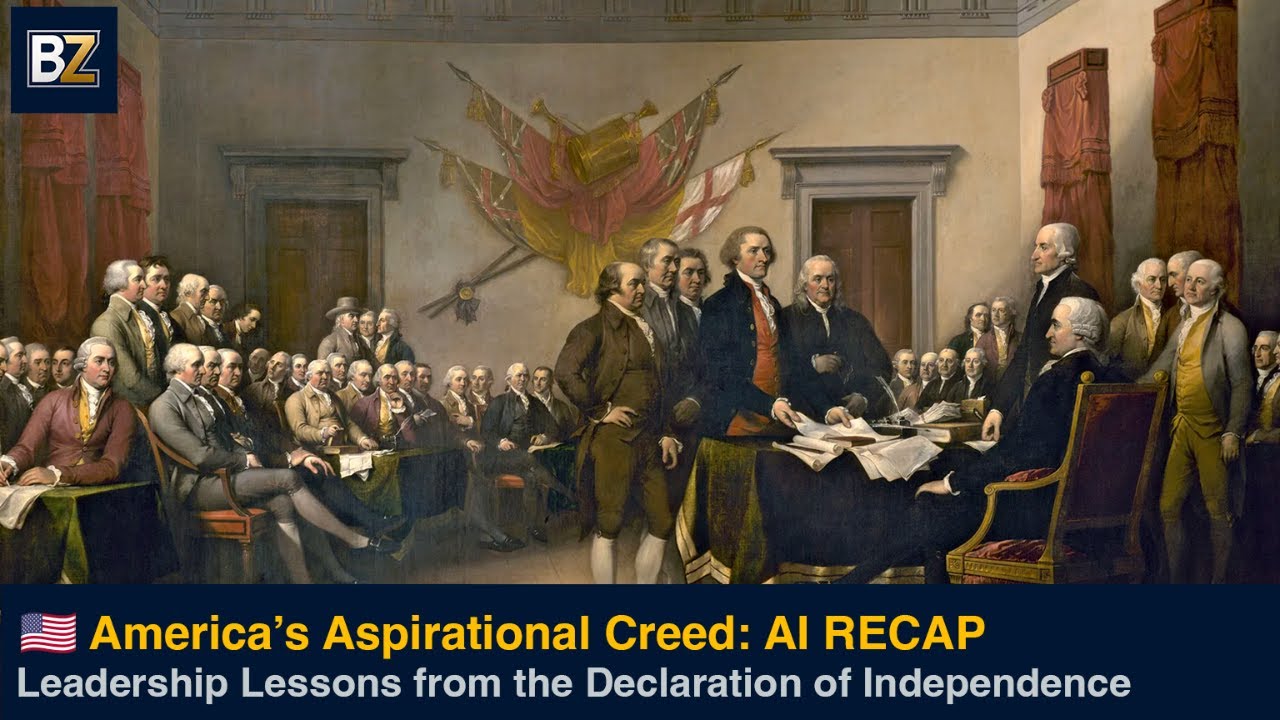
In this episode of the Leadership and Success Podcast, host Coach BZ (Bob Fabien Zinga) frames the United States’ founding documents as a timeless leadership manifesto. The show opens with an endorsement from John Maxwell and a promotional pitch highlighting Zinga’s unique blend of Navy information‑warfare experience, Silicon Valley insight, and executive speaking. Zinga then delivers a personal narrative of his 21‑year Navy career, rising from the lowest enlisted rank to commander, and explains how his oath to the Constitution fuels his leadership philosophy. Using an AI‑generated 10‑minute recap, the conversation with AI co‑hosts Drew and Beth extracts seven core lessons from the Declaration of Independence and related historical speeches: (1) courageous risk‑taking, (2) an aspirational vision (the “North Star”), (3) coalition‑building across diverse stakeholders, (4) steadfast adherence to core principles, (5) hope as a resilience engine, (6) personal sacrifice for the collective mission, and (7) a continuous drive toward inclusion. The hosts discuss how these lessons apply to modern corporate, military, and cybersecurity contexts, acknowledging the founding documents’ original exclusions while emphasizing their capacity for evolution. The episode closes with a gratitude ritual, a call to action for listeners to reflect on which lesson resonates most, and a teaser for the next episode featuring mentor Shelley Archambault, a Black female Silicon Valley CEO and author. Throughout, the tone remains inspirational, conversational, and proudly patriotic, underscoring a belief that America’s creed of liberty and justice remains a living promise that leaders must actively realize.
Chapters
Hi, I'm John Maxwell. When the top companies in the world are looking for trainers, speakers, and coaches, there's one name that stands above the rest, and that's Maxwell Leadership. Our certified team members have gotten proven results for companies all over the globe, and our reputation, I'm proud to say, is second to none. Some of our members have risen to the top of their profession, including the one you're going to meet today. I proudly introduce you to my friend Bob Fabien Zinga. Bob Fabien Zinga.
Welcome to the Leadership and Success Podcast with your host, Coach BZ. If you need to develop into a better leader, this podcast is for you. If you want to achieve a greater level of success, this podcast is for you. His mentor, Dr. John C. Maxwell, said it best: everything rises and falls on leadership. We hope to inspire you today and provide you with an insight that has the potential to positively impact the trajectory of your life. Welcome to the Leadership and Success Podcast.
What if your next keynote speaker could bridge the worlds of national defense, Silicon Valley innovation, and global leadership? Meet Bob Fabien Zinga, award-winning keynote speaker, U.S. Navy Information Warfare Commander, and trusted executive in technology, leadership, and strategy. With over 20 years of proven leadership in the U.S. Department of Defense, the U.S. Navy, higher education, and the high-tech sector, from startups to Fortune 500 companies, BZ delivers keynote experiences that inspire, challenge, and equip leaders for real-world impact. BZ speaks with authority on cybersecurity and national security, strategies to safeguard critical assets in an age of constant threat. Artificial intelligence and emerging technology: how to innovate responsibly while staying ahead of disruption. Leadership and corporate governance: building resilient, ethical, and high-performance organizations in any environment. Every keynote blends military precision, Silicon Valley agility, and boardroom strategy, delivering practical takeaways that leaders can apply immediately. Audiences leave inspired, informed, and ready to lead with clarity and courage. Whether you're hosting a global conference, corporate summit, or leadership retreat, book BZ to energize your event and empower your audience to lead in a rapidly changing world. What if your next keynote speaker could bridge the worlds of national defense, Silicon Valley innovation, and global leadership?
That's what prepares us to face the constant turbulence outside.
Which inevitably comes.
Right.
Which brings us to Principle 5: How leaders handle that turbulence. It's the courage to pivot. Leading through change.
Yeah, this section really dives into that core leadership tension, doesn't it? The pull between clinging to what worked in the past—
The comfort zone.
Versus the often uncomfortable need to adapt to what's happening right now. The sources are pretty blunt. Adaptation isn't optional if you want to endure.
There's a really sharp observation here, one that makes you stop and think. Leaders go where the people are, not the other way around.
What does that mean exactly?
Well, I don't think it means compromising your core values, but it does mean you have to acknowledge the reality on the ground, the actual threat landscape, the real market conditions, your team's current capabilities, even if that reality forces a change in direction that feels painful or inconvenient.
So both Maxwell and Sinek are really emphasizing that leadership isn't just about holding steady, maintaining the status quo.
No, it's about constant adaptation to better serve the mission. Because sticking to the way we've always done it is basically a finite mindset.
It's a guaranteed way to become irrelevant, especially in volatile fields like defense or tech.
Let's look at that Sinek team example during the COVID disruption.
Good one. Yeah, their main business big in-person leadership events essentially vanished overnight.
So what did they do? They didn't just wait and hope things went back to normal.
Nope. They pivoted hard, reimagined their whole delivery model, shifted rapidly to virtual events, created new kinds of online content.
The key insight there, I think, is that they changed the—
how—
the way they delivered their service.
Right.
The delivery mechanism, the structure.
But they held fiercely onto their why, that just cause of inspiring better leaders.
Hey everyone, this is Coach Bizzy. Thank you so much for joining me today. Uh, today is what, October 22nd? It's about 7 AM here in California, and we're going to be talking about a very important subject today. So I'm gonna give you a 10-minute recap of the podcast I had a few weeks ago about America's aspirational creed, leadership lesson from the Declaration of Independence. Let me share my screen. This is based on the article I wrote, America's aspirational creed, and one of the quotes I want to read to you from General Stephen Michael. It really speaks to me. It says Greatest on the planet, no other nation like it. It all starts with that Constitution of ours, written not because of where we were, but where we aspire to be. That is so, so powerful. So I believe that history isn't just about the past, but it's a masterclass in leadership, right? From the courage of 1776 to the challenge of today, the Declaration of Independence stands as one of the world's greatest leadership manifestos. Its authors are our forefathers, and they risk everything to proclaim that all men are created equal. But of course, back then, that wasn't true for every man. Blacks weren't included, women were not included, Indigenous Native Americans were not included. And the thing for me is America is really a dream, and I believe the best nation on the planet, because one thing that we do here is, uh, with time, we make that statement true for each and every citizen. And that is very, very powerful. That's part of the reason why I wanted to become an American and why I'm proud to be an American, why I'm so proud to wear our nation's uniform. America is really a dream worth fighting for. So today I'm going to have, uh, my AI agent Drew and Beth, uh, kind of give you a 10-minute summary of the original hour-long live episode. This is perfect for busy professionals who want deep insight in less time. So, uh, but before we do, uh, let's do our moment of gratitude. That's, um, our custom on the show. We want to be thankful, uh, every single day we meet. And this podcast is not broadcast daily. And part of the reason why I do this is because, uh, my fellow veterans in the military— about 21, 22 veterans die of suicide every single day. It's an epidemic. And, uh, I think it's impossible to be suicidal and, uh, be grateful at the very same time. So if you would please, uh, join me, you can close your eyes if you want and, uh, put yourself in your happy place. Maybe take a deep breath, and think about one thing you are grateful for today. I think today I am very, very grateful for my family, my wife and my two kids. I don't really know who I would be without them. I really owe everything I am to my family, so I am very, very grateful for them. So let us know what you are grateful for and then type it in the the comment. Also let us know where you are coming from, what city, what state, and if you're outside of the US, uh, what country. And if you have a question for me, type it in the comment as well. And I also appreciate it if you invite someone, tag someone to join us, like this event and repost it in your feed, and follow all of my updates. I really do appreciate that. So here we go. We're going to now have Joe and Mary to go ahead and give you a 10-minute recap.
Welcome, everyone. We're diving into some really compelling leadership insights drawn from America's founding documents and their evolution over time.
I'm excited to get into this. We're talking about leadership that goes way beyond just managing teams, right?
Exactly. It's about embracing risk with courage and having an aspirational vision. Just like our founding fathers did, despite the, uh, glaring shortcomings at the time.
Mm-hmm, absolutely. It's fascinating how they took a bold stand, knowing full well the personal cost.
Right, and that boldness is, uh, a primary leadership lesson. Leaders today can learn from their willingness to risk everything for a higher purpose.
Yep, but, uh, I wonder, do you think that kind of risk-taking fully applies in our modern corporate settings?
Great question! I'd say yes, though it's more, um, calculated now. Today's leaders are encouraged to take smart, mindful risks rather than diving in blindly, especially in environments like cybersecurity and tech where innovation is king.
Yeah, that makes sense. And speaking of vision, the content really stresses how effective leaders articulate a clear aspirational goal.
Exactly. It's, uh, like having your own North Star. The Declaration didn't just list grievances; it painted a vivid picture of a future where liberty and equality are universal.
Right. And that aspirational vision fuels progress over generations. You see, leaders like Frederick Douglass and Dr. Martin Luther King Jr. tapped into that very idea, urging America to live up to its promises.
Absolutely. And that's a tremendous point. Even though the founding documents were, um, deeply flawed and exclusionary from the start, they served as a kind of blueprint for progress.
Mm-hmm.
So it's like the documents set an ideal that we're continuously striving to achieve, even if we haven't reached it yet.
Exactly. And this ongoing striving is, um, the essence of hope and resilience in leadership. It tells us to acknowledge faults while pushing forward for a better, more inclusive future.
Yep, I appreciate that perspective, but isn't it a bit overly optimistic to rely on hope as a leadership strategy in challenging times?
That's a fair challenge, but hope isn't naive. It's a foundation for perseverance. Leaders need to instill hope in their teams to fuel creative problem-solving, even amidst setbacks.
Hmm, I see. I can get behind that. And another clear lesson from this discussion is about rallying diverse stakeholders, a coalition-building strategy.
Exactly. Take Jefferson, Adams, and Franklin, who united 13 diverse colonies with very different interests. That's as relevant today as it was then, building bridges between differing viewpoints to work towards a common goal.
Right. It reminds me a bit of modern boardrooms, where you need to align varied opinions to drive meaningful change.
Absolutely. Collaboration is key. And think about how different leaders from the civil rights movement, for example, harnessed that same spirit to enact lasting reforms.
Exactly. And then there's the importance of staying anchored in core principles, like liberty, justice, and equality. That theme runs so deep in the founding creeds, doesn't it?
Yes, it does. And it's crucial. Leaders must define their non-negotiables and then act decisively when those principles are challenged. I mean, hey, if you're not willing to stand up for your values, then you're missing the essence of true leadership.
Yeah, I totally agree. And it's interesting how the content even weaves biblical verses into the discussion, emphasizing that courage and vision are timeless values.
True. The biblical insights like, "Be strong and courageous," remind us that leadership isn't about ease. It's about, um, stepping into uncertainty with conviction.
Exactly. It's all interconnected. Courage, vision, and the willingness to sacrifice for a greater good. How do you see sacrifice factoring into modern leadership?
Sacrifice is, uh, perhaps the hardest part. Historically, we see leaders like Crispus Attucks and, uh, countless unsung heroes who, even when denied rights, fought for freedom. Modern leaders, whether in the military or in cybersecurity, understand that sometimes, your personal comfort or reputation must come second to the collective mission.
Yep, absolutely. And that kind of sacrifice, putting the greater good first, instills a deep sense of responsibility throughout an organization.
Exactly, which brings us neatly to the final major lesson: the commitment to continuous progress toward inclusion. It's about acknowledging past limitations and, um, actively working to include everyone.
Mm-hmm, totally. And that's something even our founding documents didn't fully get right at the start, but they left room for evolution.
Right you are. The evolution from exclusion to inclusion, whether regarding race, gender, or heritage, is a sign of true leadership, one that adapts and grows.
Yes, indeed. I find it, um, quite inspiring that leadership as portrayed here is seen as a living, evolving practice rather than a static set of rules.
Exactly. And it's also a personal call to all leaders out there to not just pass on an inheritance of freedom but to actively shape a future that is safer, freer, and more just. Absolutely.
Now, when I think of these lessons, I get this image of a leader drafting a vision statement, then rallying a coalition of diverse voices, and finally, gently pushing boundaries while staying true to their values.
Yes, it's like painting a future one bold brushstroke at a time, each stroke representing courage, determination, and a commitment to continuous improvement.
I really like that analogy. And I'd add that it's not just about grand gestures. It's also about making those everyday decisions that reinforce the founding ideals in our modern context.
Right, exactly. Every decision, every conversation, every policy that makes inclusion a priority is a step toward fulfilling that aspirational creed.
Right on. But, um, I have to respectfully challenge one point. Sometimes in striving for inclusiveness, there can be a tendency to dilute core principles. Do you think these two can ever conflict?
That's a thoughtful critique. While there might be tension in certain scenarios, true leadership finds a balance. Core principles like justice shouldn't be compromised, but rather reinterpreted to include everyone. It's not about dilution. It's about expansion of the original promise.
Mm-hmm, that makes sense. I can agree with that perspective. It's more evolution than compromise.
Exactly. It's, um, a continuous journey rather than a final destination. Leaders must keep asking, "How can we better live up to these ideals?" And that question is as important today as it was in 1776. Right. So, for every listener out there, which leadership lesson—courage, vision, unity, principle, hope, sacrifice, or inclusion—would resonates most with you in your own journey.
Yeah, that's the real call to action. Absolutely. It's a reminder that leadership isn't just a title. It's a commitment to constant growth and striving to make the world a little better every single day.
And remember, it all starts with embracing where we are and daring to envision where we could be if we lead with courage and heart.
Mm, exactly. Well, thanks for this thoughtful discussion. It's like a masterclass in leadership drawn from history and molded into our present challenges.
Anytime. And to everyone listening, keep pushing forward. Take those calculated risks, rally your teams, and always, always let your vision guide you.
Right. Keep that spirit alive. That's it for today's insight-packed session. Stay bold, stay visionary, and keep embracing progress. Even when it's messy.
Thanks for joining us today, everyone. Until next time, keep learning, keep leading, and remember that every step you take builds toward a better future.
Take care and keep that leadership flame burning strong.
All right, that was the 10 Minute AI Recap. Thank you for watching. And again, this was based on the article I wrote about America's aspirational creed, Leadership Lessons from the Declaration of Independence. There is another quote I would like to read from my article. Let me make it a little bit bigger. Here we go. Okay. I love what one of our founding fathers says, Patrick Henry, right? Give me liberty or give me death. I really do believe that all human beings were created and intended to be free, and if I cannot be free, then I'd rather be dead. All right, and that was really the spirit of the revolution. Freedom. And I think that's really what America stands for. That's what America represents around the world. Even as a seller, part of my seller's creed is to support and defend democracy and freedom around the world. That's pretty powerful. I think everybody was meant to be free, and that's really what America has stood for. And also the Negro Spiritual, which Martin Luther King cited over and over again during, I believe, the greatest speech ever I Have a Dream, when he says, "Free at last, free at last, thank God Almighty, we are free at last." We were really born from freedom. And President Barack Obama once says, "It was a creed written into the founding document that declared the destiny of a nation: Yes, we can. It was whispered by slaves and abolitionists as they blazed the trail toward freedom: Yes, we can. Yes, we can. It was sung by immigrants as they struck out From distant shores and pioneers who pushed westward against an unforgiving wilderness. Oh yes, we can. It was the call of workers who organized, women who reached for the ballot, a president who chose the moon as our new frontier, and a king who took us to the mountaintop and pointed the way to the promised land. Yes, we can. To justice. Yes, we can. To equality. Extremely, extremely moving. I think President Obama gave a speech in New Hampshire when he lost. He won Iowa, and then in New Hampshire he lost to Hillary, Secretary Hillary Clinton. And that was one of the best speeches, I believe, back then Senator Barack Obama gave about what America stands for. And the last quote I'm gonna leave, uh, actually Two more quotes from myself is, "For all their flaws, our founding documents have guided generations. I see our founding creed not as a description of a perfect past, but as a promise, a call to realize a future where liberty and justice truly extend to every citizen." And I believe as a leader today in 2025, that is really what our job is. If you're going to lead in the military, in high tech, or whatever industry you are in, I think part of your responsibility as a citizen of this country is to make sure that we realize this future for liberty and justice for all today. And at least that's something I really take very, very seriously. And that's the type of country I want to build. That's the America I am very, very proud of, that I am willing to give my life for. In service to my country in the US Navy. And the last quote I am going to leave you is something else I wrote about. I think I wrote this when I made O-5, when I became a commander in the US Navy. So that's a senior rank. As many of you have followed me and know my story, I joined the Navy 21 years ago this week, It was October 2004, so 21 years ago. So I got in as an E-1, which is the lowest rank in the Navy, most junior enlisted rank. I was a seaman recruit, and after boot camp I became a seaman. And then it took me about a year and a half and I had an opportunity to become an officer. So I was an ensign. And then in 2021, in April, I became a commander. That really was my dream. When I went to boot camp in 2005, uh, I made up my mind one of two things were going to happen to me in my career in the Navy. Either I would become a senior enlisted, which is chief and above, E7, E8, or E9. That was my goal if I remained enlisted. But if I had the chance to become an officer, then my goal was to become a senior officer commander or above. And I achieved that goal April 2021. So that was 4 years ago. And in the Navy, as an officer, every time you get promoted, you have to take the oath of office again. And again, our oath is to support and defend the Constitution of the United States, not a man, no, not a doctrine. It's the Constitution. And then we follow the lawful orders of those appointed over us. So on that day, this was April 2021, when I just made commander and achieved an unrealistic dream, being from another country and being Black and coming to America when I was 17 and then going through boot camp and having that vision of what my future would be like and finally achieving it. So I said, today is the day when my hope is renewed in America. Wising up to live out the true meaning of its aspirational creed: "We hold these truths to be self-evident, that all men are created equal." This includes women and all people of color. No one is left out. Today, I resolve to do whatever I can for my daughters and future generations to inherit America in a better shape—safer, freer, more just, and prosperous for all its people, regardless of race, gender, or national origin. And again, that's what I really believe is the leadership manifesto for every single American leader today. We really need them to make this American dream true for everyone, be all inclusive. Diversity, equity, inclusion, belonging. I think every single American deserves it, whether you are gay or straight, whether you are trans or not, whether you're male or female, Black or white, it doesn't matter. You are a U.S. citizen and this Constitution is for you, right? Justice for all. And really, to me, America, if you have to put it in one word, it's really freedom. Okay, I am going to stop now, and thank you so much for being with me today, and I'm gonna see you again tomorrow. And tomorrow is going to be a very, very special day. Uh, let me get my mouse here. Okay, here we go. Because tomorrow I am going to have my mentor right here, the legendary, the one and only Shelley Archambault. She's going to be here. She's the best-selling author of Unapologetically Ambitious, and she's going to be with us tomorrow, first day, uh, 7 AM Pacific Time, California, 10 AM Eastern Time. Fortune 500 board director, strategic advisor, former CEO, and author. She's really the first or one of the first, uh, Black, uh, women CEO in Silicon Valley, a tech company. She's just amazing and she's taught me so much. I'm so, so grateful, uh, to have been, uh, mentored, uh, by her. And she will be here tomorrow and you don't want to miss it. Please RSVP and type in all of the question you need her to, uh, answer. We, we're gonna dig deep into the book, uh, background and then her leadership philosophy, what made her Shelley and why she's so overwhelmingly successful. And not only that, but she's opening up the door now and helping a lot of people like me, helping to mentor us so we can reach our goal and kind of get to the next level. So I really do appreciate it. And before I go, I also broadcast live on Twitter, and there is a gamer there, Indoor John KpxDT9, just saying hi. I just want to acknowledge it. The people on Twitter, they don't pay too much attention to what we are talking about here, but anyway, whenever they interact with me, I just want to acknowledge it. Okay, this is it for now, and I'll see you tomorrow with my mentor Shelley. Bye everybody, this is Coach BZ. Thanks for watching. Until next time, don't forget to like, comment, and share.
Thank you for listening to the Leadership and Success Podcast with your host Coach BZ. If you like what you heard, please subscribe to our channels and come back for more wisdom nuggets on how you may develop into a better leader and achieve greater levels of success. Leadership is the most critical skill. The world will always need leaders to lead others, deploy the next disruptive technology, or execute a business strategy. You may as well decide on counting yourself among the 21st century leaders. See you right here next time on the Leadership and Success Podcast with Coach BZ.
More from Bob

S250:E4🎙️LIVE 🇺🇸America 250: President Barack Obama Leadership, Service, and the Power of Hope






S5:E157🎙️ LIVE with CMD CMSgt Dennis L. Fritz, USAF (Ret.)(Multi Tracks Audio)



S5:E156🎙️ LIVE 🇪🇸 Leadership Lessons from the FIFA World Cup 2026 Champions (Multi Tracks Audio)

S250:E3🎙️ LIVE Leadership Lessons from America’s First Documented Family of African Descent 🇺🇸📖