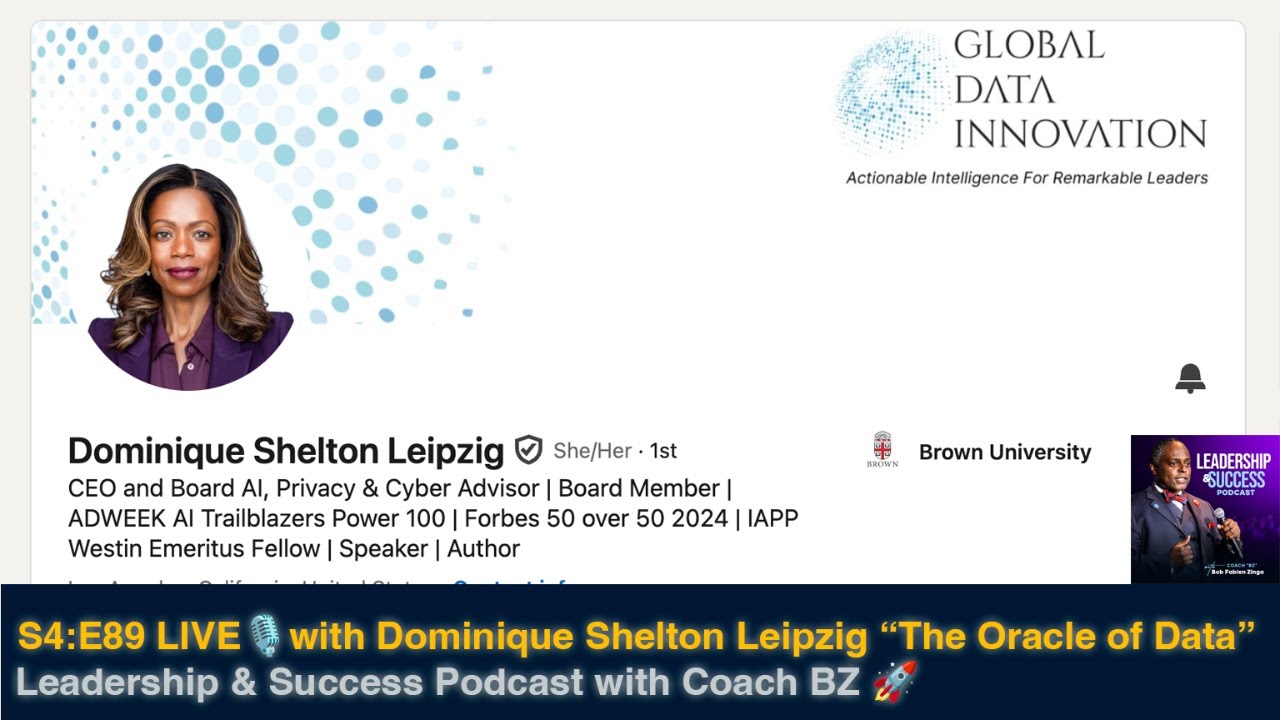
In this episode of the Leadership and Success Podcast, host Coach BZ (Bob Fabien Zinga) interviews Dominique Shelton‑Leipzig, founder and CEO of Global Data Innovation and author of the award‑winning book Trust: Responsible AI Innovation, Privacy and Data Leadership. The conversation opens with an introduction by John Maxwell and a brief pitch for the podcast’s leadership focus. Dominique shares macro trends in AI (projected $7‑10 trillion economic impact) and cyber‑risk (costing $9.5 trillion, comparable to a top‑three GDP nation). She outlines the mission of Global Data Innovation: to help CEOs and board members harness data responsibly while avoiding negative headlines. Her career path—from international‑relations studies, early privacy work at Yahoo, to two decades of litigation and policy advising—is recounted, highlighting the evolution of privacy and AI governance. The core of the interview is the TRUST framework (Transparency, Responsibility, Understanding, Security, Transformation) presented as a mnemonic for board‑level AI oversight: Triage, Right data, Uninterrupted testing/monitoring, Supervising humans, Technical documentation. Dominique discusses how high‑performing boards differ from checkbox‑driven ones, emphasizing board‑CEO collaboration, digital literacy, and investor expectations (BlackRock, ISS, Glass Lewis). Representation in C‑suite and boardrooms is argued as essential for global market relevance. The dialogue moves to leadership lessons, personal failures, mentors, recommended reading (Harari, Murakami, Leave the World Behind), movies (Matrix), and practical advice for emerging leaders. Dominique concludes with a focus on mentorship, a call to action for listeners to engage with her free resources, and a personal reflection on compassion as the defining trait of great leadership.
Chapters
Hi, I'm John Maxwell. When the top companies in the world are looking for trainers, speakers, and coaches, there's one name that stands above the rest, and that's Maxwell Leadership. Our certified team members have gotten proven results for companies all over the globe, and our reputation, I'm proud to say, is second to none. Some of our members have risen to the top of their profession, including the one you're going to meet today. I proudly introduce you to my friend, Bob Fabien Zinga.
Welcome to the Leadership and Success Podcast with your host, Coach BZ. If you need to develop into a better leader, this podcast is for you. If you want to achieve a greater level of success, this podcast is for you. His mentor, Dr. John C. Maxwell, said it best: everything rises and falls on leadership. We hope to inspire you today and provide you with an insight that has the potential to positively impact the trajectory of your life. Welcome to the Leadership and Success Podcast.
What if your next keynote speaker could bridge the worlds of national defense, Silicon Valley innovation, and global leadership? Meet Bob Fabien Zinga, award-winning keynote speaker, U.S. Navy Information Warfare Commander, and trusted executive in technology, leadership, and strategy. With over 20 years of proven leadership in the U.S. Department of Defense, the U.S. Navy, higher education, and the high-tech sector. From startups to Fortune 500 companies, BZ delivers keynote experiences that inspire, challenge, and equip leaders for real-world impact. BZ speaks with authority on cybersecurity and national security, strategies to safeguard critical assets in an age of constant threat, artificial intelligence and emerging technology, how to innovate responsibly while staying ahead of disruption, Leadership and corporate governance: building resilient, ethical, and high-performance organizations in any environment. Every keynote blends military precision, Silicon Valley agility, and boardroom strategy, delivering practical takeaways that leaders can apply immediately. Audiences leave inspired, informed, and ready to lead with clarity and courage. Whether you're hosting a global conference, corporate summit, or leadership retreat. Book BZ to energize your event and empower your audience to lead in a rapidly changing world.
From Nasdaq's MarketSite, I'm your host Christina Ayanian, and joining me today is founder and CEO of Glow of Global Data Innovation, Dominique Shelton-Leipzig. Dominique, thank you for joining us. Welcome to Nasdaq. Hi, Christina.
Great to see you.
Great to see you too. Now, you are an internationally recognized attorney advising clients on cybersecurity, AI, and digital innovation. What are some of the top trends that you're seeing in this space across the board? So the biggest trend I'm seeing is the adoption of AI, and this is exciting.
It's going to bring $7 trillion to $10 trillion to our global economy.
So this is outstanding if the proper governance is in place to be able to ensure those results. So I'm excited to get information into our leaders' hands about how to do that. Going off of that point, what is the mission of Global Data Innovation? So our mission is to really be the destination for leaders, CEOs, board members to maximize opportunity with data, to reach exponential growth, but block and tackle and avoid being the headlines that we see in a negative way. It's really interesting because it seems like you're acting as a trusted partner for your clients. It's exactly it. And, you know, I've seen too many times, Christina, where the well-meaning governance efforts are ineffective.
And if we look at our global economy, cyber, for example, has cost our global economy $9.5 trillion.
$5 trillion this year alone.
If you put it differently, if cyber was a country, it would be the third largest in GDP behind the US and China.
So effective governance is what we're talking about to get to exponential growth and keep that money for our economy. So it's safe to say that data leadership is so important and crucial in this day and age. It's critical for the viability of our economy as well as our companies and their reputations. And what—
All right everyone, this is Coach BZ. I am very, very excited to be with you again today. I have a very, very special guest, but before I bring her on, let's do our moment of gratitude. This takes but a moment, and as you guys know, I love to be grateful for at least one thing every single day. And part of this is because in the US military, unfortunately, about 21, 22 people commit suicide every single day. And I believe it's impossible to be grateful and suicidal or depressed or anxious at the very same time. So, if you can take a moment, think about what are you grateful for today. What is that one thing that comes to mind? Today, I think I am grateful just for connection, the great people that I met, especially through LinkedIn, who add a lot of value to me, but I try to add some value to them also. One of my mentors told me, right, Your network is your net worth. And that is so true. And I'm gonna be bringing a very, very special person to you today. Before I bring her on, let me see if I can introduce her. She's so fantastic and spectacular. Really, it is quite a privilege for her to be on the Leadership Success podcast. Dominique, she's the CEO of Global Data Innovation. She's the author of the award-winning book Trust: Responsible AI Innovation, Privacy and Data Leadership, and the Forbes 50 Over 50, Adweek AI Trailblazer, Power 100, LA Times Legal Visionary. Known as the Oracle of Data, she has trained over 50,000 professional advice companies with a combined market cap of over $3 trillion and counseled US policymakers shaping the nation's AI legislation. Ladies and gentlemen, please help me welcome Dominique Shelton Lespeig. Hey Dominique, how are you doing today?
I am great. So nice to see you, Coach Dizzy.
Fantastic. I am so glad and excited that you are here with us. Let me— to get started, is there one thing that you are grateful for today?
Yeah, I'm grateful for the work that we get to do in this moment. Incredible opportunity here as we are at a crossroads in technology. And all of us, all of your mentees listening and other colleagues, and we have an opportunity right now to shape the future and really rewrite history. So I'm excited for all that we can do.
Well, and is there something about you that most people may not know about?
Uh, let's see, I, I don't get a chance to talk about my family as much as, uh, in the commensurate way that they are so important in my life. So people don't know that I'm very close to my husband, my mother, my sister, and when my father was alive, him as well, as well as a very large extended family. So that is, uh, maybe something that's not as well known.
Wow. Okay. To get started then, uh, you said that your mission is to bring people and technology together to achieve great outcome for all. Where did that sense of purpose originate for you?
You know, it really is a culmination of everything that's brought me to this particular moment, Bob. So when I look back on my career, uh, started 34 years ago, uh, I didn't and see all the different strains that would come together. So you and I were talking when we were in the green room. I was always interested in international affairs. I was an international relations major at Brown University, as well as French civilization. And I cared about globalism so much I did my junior year study abroad in Lyon at l'Université de Lyon II. Then went to Georgetown because of my interest in international, but interestingly enough then, this was all, you know, pre-internet. I graduated from Georgetown in 1991, but while I was there, one of my favorite courses was a course called Privacy in American Law. It was taught by Professor Anita Allen, who is now at UPenn, an amazing privacy scholar, and I know she was recently in Oxford. Follow her career, but she was really a trailblazer. But it wasn't until 1998 when I was working as outside counsel in a boutique law firm that doesn't exist anymore, a little firm called Folger Levin and Kahn, and we worked as outside counsel to Yahoo. One of the former part— one of the former associates at the firm had gone over to Yahoo, and that firm, which had just 70 attorneys, including partners and associates. So we were tiny, but our outsized role in terms of helping the company navigate what was then a new strain of litigation and investigations that centered around privacy after the acquisition of GeoCities. So, by Yahoo. So that whole trajectory, and I stayed at that firm for 10 years until, almost 10 years until 2007. The introduction to privacy in the late '90s, early 2000s, uh, as working as outside counsel for this tech company, uh, that was my first, um, introduction through the litigation lens, uh, primarily of, uh, representing clients in this. And then I spent 22 years litigating, um, uh, these types of cases, uh, privacy, cyber, and then towards the end of my time in Big Law, I spent 12 years after that, right around 2014, mostly advising companies on how to avoid these issues. And then in 2019, I represented the CEO of the California Chamber of Commerce in the negotiations around the business-friendly terms in the California Consumer Privacy Act. So really there, That's where I realized our CEO and board community need our support. They need our help. Those of us such as yourself, Bob, who spent careers in cyber privacy data issues, we owe it to our leaders to share what we know in a business way to help the business and society move forward.
That is really impressive. Let's talk about your award-winning book. This one here, so Trust, right? Get Abstract Book Award Business Impact for 2024. What inspired you to write that book?
You know, what inspired me was really this time and period of life I was just talking to you about. I could see that with artificial intelligence, we were about to replay Bob all of the things that we had already been through 25 years ago with respect to data security and privacy. So let me just say here, in 2001, when I was a baby partner, I literally was just 10 years out of school and just had become a partner. We were working with the legal department and the IT managers. Back then, there wasn't a privacy leader in legal and there wasn't an IT there wasn't a cybersecurity or CISO, Chief Information Security Officer. This is just the IT people and the legal department. But we knew back then, Bob, the 6 things companies needed to do to be resilient to cyber attacks. Not that we could stop criminals from coming in to the, trying to get the keys of the kingdom from companies. But we knew back then that starting with an actionable data inventory that companies could find a heat map of the documents and the data that were critical to revenue operations and strategy. And they could go lock that down, encrypted at rest, encrypted in use, and protect themselves with defense in depth. And, you know, Bob, I kick myself every day from that 2001 time period. Because back then I thought someone is going to tell our CEO and board community how straightforward this is. So I just worked with who I was, you know, charged to work with. And when I think back on that period and here it is, 2025, the past 10 years, cybercrime has cost our global economy $60 trillion. $60 trillion. That's over double our US GDP. So if we had gotten that information into our leaders' hands 25 years ago, think about what we could have done with that $60 trillion, Bob. So I could just see in 2022, as I was starting to imagine and get ready to launch my first Digital Trust Summit to convene public company CEOs and board members together to tackle data, and we were going to talk about enterprise use of AI, and as I was planning that in the summer of 2022, in the fall of 2022, I could see the same patterns again coming up around generative AI. There was paralysis in terms of governance. What should we do? There were questions from leaders about whether we would stifle innovation by putting common sense governance in place. And I could just see we're about to have a full repeat of privacy and cyber misses at scale, except this time, instead of losing $60 trillion over 10 years, I could easily foresee us tripling that number in a matter of a year or two. So I— I realized that all of this time that I'd spent in my career up to this point, you know, ever since 1998 working on data issues. So really two-thirds of my career have been spent on this, that I had to step forward and put a guide together that would tell our leaders how— it's written for CEOs and board members, but anybody can read it— how our business people can actualize and implement actionable, effective governance that works in their environments. So that's why I wrote the book.
Well, that is quite powerful. And you also created the TRUST framework: Transparency, Responsibility, Understanding, Security, and Transformation. How can leaders use your framework in making decisions daily?
Yes, so I'm excited to to talk about that. So the TRUST framework is a mnemonic that I created to take the book TRUST, which has— covers legal trends in 100 countries, 6 continents. Many of them are— those different legal trends are on my website. You can read about those at globaledainnovation.com. But the word TRUST, I use that as a mnemonic to help our CEOs and board members remember how they could have actionable and effective governance. The T stands for triage. When it comes to AI, making sure that there are use cases that actually are worth the endeavor. In other words, that they will impact revenue operations and strategy. So triage, do we have the right use cases? And also, once we know we have the right use cases, for which, ahead of time, there's a conversation with the CFO, for which there can be measurable return on investment. Once we know we have the right AI use cases, the T in TRUST is a risk ranking of the AI along the legal frameworks that will be, that the AI use cases will be subject to depending on the jurisdiction where they'll be deployed. Employed. So that's the T in TRUST to triage both the— do you have the right use cases from a business standpoint? And also, are you following your legal obligations in terms of risk ranking and comparing those with your own enterprise risk management? The R in TRUST has to do with the training data, and it stands for right data. A board member and a CEO can ask, do we have the right data to train. That means data that is correct and for which we have rights to train, meaning IP rights, privacy rights, business rights, and cybersecurity safety. I mean, do we have the right data to train with to begin with? Now, many CEOs and board members will ask me, well, just a second, we don't know what data, say, OpenAI used to train their model or Gemini or Google or AWS. And the good is you don't need to know that. What deployers, companies that are building applications on top of large language models that are made available by our tech companies, they only need to know if the data that they are feeding into their own application is right, that it's correct, and they have rights. That counterbalances what's going on in the whole wide internet because as we know, there's a lot of inaccuracy in the whole wide internet. So that governance on what it is the company is training with is essential. Uh, the U in TRUST stands for uninterrupted testing, monitoring, and auditing. And this part, Bob Fabien Zinga, is super important because especially for generative AI, uninterrupted testing, monitoring, and auditing will catch model drift or model degradation. So generative AI, it's trained on the whole wide internet, and so it can generate a response no matter how much fine-tuning and training you do before it's deployed. Over time, it will degrade, it will drift, and the uninterrupted testing, monitoring, and auditing allows companies to be notified of that drift jump in, and then the S in TRUST, Supervising Humans, SWAT team can jump in and use the last team in TRUST technical documentation of the, you know, logging data from the training and the logging data from the uninterrupted testing, and they can use the technical documentation of the last team in TRUST to correct the model. So we don't have to have all of the negative headlines that you see which scare people, which spook our investors, and which scare our employees. We don't need to have those things at all with this control in place and the supervising humans in order for them to correct a model, they need the last T in TRUST, technical documentation. You know, our large language model experts, when they were testifying, before Congress and also meeting with leaders in Europe and LATAM and Africa, they explained is if AI, generative AI, is working on something essential like our power grid or our water supply, and it needs to be corrected because it's drifted, the technical data scientists need that technical documentation to correct the model. So that is trust. That is— effective governance. And there's a bunch of KPIs associated with that. That's the subject of the patent that's pending for the trust framework. But board members and you listening as employees or leaders in your companies, if you get in a trust mindset, which is basically just a roll-up of the key essential elements of the NIST framework, the legal frameworks in 100 countries, ISO, OECD, if you get in a trust frame of mind and make sure that this is embedded in the tech stack that you're operating, you're going to be in great shape.
Wow, that is quite powerful and, uh, comprehensive. Now, you've advised, uh, companies with a combined market cap of over $3 trillion. What separates high-performing boards from those merely checking boxes?
The key separation I see is a collaboration between the board and the CEO. The board needs to have the independent capability to accompany the CEO to identify opportunities with generative AI, for example, and other technologies, and also to look around corners and help the CEO see where there might be blind spots. What does that require of the board? Well, it requires what I just read, BlackRock and proxy advisors, investors like BlackRock and proxy advisors like ISS and Glass Lewis have changed their investment stewardship guidelines. And they're calling for the same thing. They're calling for disclosures about how the board stays is fluent in generative AI, how the board demonstrates digital literacy, what training the board gets on a regular basis to oversee and exercise oversight over generative AI. Those are the types of things. And, and the other thing our investor community is going to be asking come proxy season, which is, uh, going to be the first quarter for most public companies in 2026. They want to know what frameworks the board is using to be able to exercise oversight. They don't want the boards to just be dependent on what the management reports because unfortunately we've seen some of the statistics from August where MIT reported that 95% of generative AI deployments by companies these days are failing. So with that, it's not sufficient for board members to just rely on reports from management in light of these MIT reports that spooked our markets and tanked our stock market in August. Investors are going to be looking for the board to show that they have that— they have that capability. And the last thing I'll say, I'm excited because next week We will be launching our AI war game that's in LMS format. We already do them at our Digital Trust Summit and we do them for boards live, but we're launching an LMS version that board members can take remotely and groups of, you know, 20 senior leadership and boards can get trained at the same time and be able to say something in their proxies about what they're doing.
Wow, that is really, uh, powerful. And by the way, I have your LinkedIn URL below for people to, uh, follow you and reach out to you. Uh, you also co-founded the network Diversify the C-Suite and Boardroom. Why is representation at this top still so critical in 2025?
Well, you know, representation is part of excellent business. So let me just give you an example in the context of AI. So the growth markets for most companies are not the US or Europe where there are aging populations. The growth markets where, where products are going to be consumed at scale are where there's population growth happening. That is in the Global South, that is in Africa, the African continent, Latin America, those are the growth areas. Now think about this for a second. If there is, say, generative AI that we are producing that does not recognize, say, different skin tones and things like that, right? And you look at generative AI in other jurisdictions, like China that's been over in Africa and in other jurisdictions in global South, etc., for decades. Okay. And their AI recognizes different skin. Guess what? The Middle East, Africa, LATAM, Asia. Guess what product is more likely to garner adoption, sell in a jurisdiction. So that's just common sense, a lot of it, but it's, it's the importance of having excellence in, in a boardroom, at the C-suite level, as a CEO. That's important, and it involves everything that those leaders bring to the table, which involves a worldview, and that worldview often will just be impacted by who you are. I know the things that I see in technology just come very instinctively, and I'm sure other people— your, your view, Bob, is unique to you. And that's why it's so important to have a plethora of voices around the leadership table to be able to identify, spot, mitigate, and excel. On those issues.
That is really something. So the last question I have for you for the first segment is, uh, you've trained over 50,000 professionals on AI, privacy, cybersecurity. What patterns do you see among the next generation of leaders?
Well, I— what I see in the next generation is enthusiasm, uh, curiosity, a commitment to learning and getting it right. I do see an interest across generation, by the way, established professionals, I train a lot of CEOs, board members. There is a general recognition. We don't want to repeat what we did in the early 2000s, what happened with social media, et cetera. There is a desire to anticipate and mitigate and avoid harms prevent harms, uh, and take steps to accelerate success with data. And that's what my company is all about.
Well, that is quite something. And by the way, I have, uh, someone here, uh, who's watching us from New York. Uh, yeah, it looks like it's Daniela McCoy. I've interviewed her before, so she's waiting. Hey Daniela, let me know if you have a question for Dominique, we, we are now going to go over to the second portion of the podcast where we kind of focus on leadership. I guess my first question for you would be, what is the greatest lesson you have ever learned, you think?
I think the greatest leadership lesson is what you have internally. Uh, I would say being myself, being yourself. Every leader has a different style. Not try to push yourself into a leadership persona that you don't— that doesn't reflect you. So let me just give you an example. When I first came out of school, I was a litigator. In 1991, when I graduated from law school, I joined the litigation of a big large global law firm. And I, back at that time, litigators, a lot of them were mostly men, former football players, super tall. And I remember coming into the department and really nobody looked like me at all. And, you know, the style there was to be like very pugnacious, get into the courtroom and, you know, prior to getting into the courtroom, letting the other side have it and, you know, expletives. And that just wasn't my style, right? And so I had to embrace my style, which was to educate more than yell or posture. That was ever something I was comfortable people with. And it turned out that that education style worked in the courtroom. It worked in my counseling practice when I started counseling CEOs and board members. It worked when I founded my global data innovation departments at two global law firms. And then it works now as I educate our Fortune 100 on the opportunities, the incredible opportunities to ensure ensure that their AI is doing exactly what they expect it to do, that it's having measurable return on the investment, and that it's not causing any collateral harm like getting in the way of relationships with customers, employees, or business partners.
Well, you've been so successful. No, just got, uh, You will see the Agenda Future 50. So these are the 50 board members for Fortune 500 companies that the people should be watching coming up. You were part of Forbes 50 Over 50. You've written 4 books and bestsellers. You had the TEDx talk. You are part of the AI Trailblazer Power 100. I mean, on and on and on and on. You are just killing it. What do you think is the secret of your success?
I would just say that in all that you detailed there, Bob, I feel like I haven't worked a day in my life. In pure honesty, it's been an absolute curiosity fest. A discovery journey, and I remain so passionate about what I do, and especially right now where we are in a crossroads. And you and I, especially with your background as well, and all the people listening, those of you in the privacy, cyber, AI area, data area, look, we are right now in the, in the process of writing the history that we are going to live with for the next 25, 50 years. So the see something, say something situation is critical because once the systems are built, you know, going backwards, we learned from this in cyber, trying to graft on governance and safety measures and protocols after the fact leads to the $60 trillion loss that we already experienced in cyber. Right now is the time for you guys to use your voices and your, your, what you've seen before and lessons learned and work towards solutions. The trust framework is a solution to the potential harm associated with model drift, where we have situations like in the state of Florida where predictive policing model that was deployed in a school because they were trying to identify mass shooters that would come into schools and try to kill all the kids, right? So that it came from a good place. But when the AI misidentified kids singing happy birthday as being violent risks, and when the AI misidentified identified slang as being predictive of violence. 18,000 students went from a learning trajectory literally to a Bob, a pathway to prison. This already happened with AI. We can't let that happen with the knowledge that we do have. You know, just, you know, just recently one of our major global retail pharmacies, their vendors' AI was misidentifying paying customers, some of them loyalty card members, as criminals. So not only did that lead to an FTC investigation and being banned from using AI for 5 years and one of the catalysts for that company to seek bankruptcy protection, but leaving aside those financials, humiliating the customers, escorting them out the store, how is that good for for business. And so that's why all of us who have our knowledge, it's up to us to say, hey, let's get— what if the UN Trust had been in place at that company where the company standards, the security guards, what they use to follow, uh, criminals in the store, if that had been coded in as accuracy into the AI so that when the AI started following paying customers, the Supervising humans, the S in trust, could have been alerted that these company standards were not being followed. And they could have then taken the technical documentation, the T in trust, and correct the model. You don't have to have tens of thousands of people like the state of Tennessee that spent $400 million on their algorithm to one of our big four firms. Wow. It's excellent. Only to have a judge rule in last August, in August 1994, that the AI had to be stopped and enjoined from being used because it was denying life-sustaining Medicare and Medicaid benefits to tens of thousands of needy Tennesseans in error 92% of the time. These are just a few, these are just a few of the stories that are in my proprietary database with over 1 million unique weighted attributes of errors that are preventable, avoidable, bad for business. And that's why I want to encourage all of you to look at your mandate not as a chore, not as a job, but as a remit to rewrite history. And that's what's on the table right now.
Wow. Very, very powerful. It's really amazing. I don't know. AI, cybersecurity, privacy can have a real business impact on any of the organizations out there. So what do you think is the greatest leadership advice you have ever received?
Gosh, you know, I was— I had another answer I was going to give you when we were thinking about this, but I'll give you a personal one. You know, when I first started my career in 1991. I was at a fork in the road. I was interested in international law. They didn't— back then, it's changed now, but I wanted to litigate as well. So back then, international litigation meant, you know, working at The Hague, arguing human rights cases and so forth, which I thought was very important. But I also felt like maybe I should get some business training and go go to a law firm first. The other option I had really thought about was, you know, some other type of community service, not just the public international law, but some other type of community service like Southern Poverty Law Center or some one of the public interest type law firms. And I'll never forget my father, who unfortunately passed away in 1999, but was really one of my— amazing mentors and, you know, sort of a lifelong coach. He said to me, he said, Dominique, look, sometimes the most radical and unconventional thing you can do is go work in corporate America. And I still believe that the opportunity to impact billions of people's lives, which is the level that I operate in now. I really don't want to work on projects unless it has the opportunity to impact billions of people's lives. And that happens through the corporate work, being able to talk to a CEO and help shape their thinking around trust so that it can be implemented and not only just save jobs and lives of the people that CEO is responsible for, but also their customers and the investors in our global economy as well. So I think so. I think that's the best advice, was to maybe go someplace where there's less people that look like you so that you can have the impact that your point of view could bring.
Wow, quite powerful. Okay. As a leader, what are you learning right now? I know leaders are learners.
Yeah, you know, I am learning right now, spending a lot of time studying what our CEO and board community need to get to a place of rapid acceleration in their ability to oversee data. And that means right now AI, right? So I'm really a study. It's like, it's basically like, I'm in the lab all the time testing, thinking about what ways that we can up-level our CEO and board community that are non-technical leaders. I'm not talking about the ones that are already technical from the tech companies that understand everything, but I'm talking about the CEO that comes from comes from an MBA background or the CEO that comes from a chief marketing office background or an HR background that's leading the company, leading a public company, and is in charge of setting strategy for generative AI and setting the tone. How do we support that leader and surround that leader with the support, the information, the business structure to be able to deploy at scale without waking up like the CEO of McDonald's had to with, you know, suddenly their vendors' AI they were using for resumes and applications has an AI-fueled breach in 64 million resumes are, you know, exposed. Fortunately, that was by a white hat. But still, we don't want our leaders to have to wake up with a shock value, as the CEO of one of our big logistics companies in the UK did when the name of her company was trending on X because the chatbot suddenly started cursing out customers and criticizing the company. We don't We need these shock things do not need to happen. We need to regularize this. So I think a lot about how to make tech, translate tech into the enterprise business issue that it is. Our investors are calling for our leaders to, you know, BlackRock, ISS, Glass Lewis, they're calling for our leaders to use a framework framework to lead in AI. And that's why I came up with the Trust Framework so that they can slip into that and assume their leadership strength, power. And also it's going to be great for society when things are accurate.
Absolutely. We're going to come back to it, but everybody needs to absolutely get a copy of this award-winning book, Trust. All right. And let me ask you this. So we know all about your successes. I love this quote on one side. Success, but on the other side it says failure, and you have so many successes, but I'm sure you've had to go through failure at times to get to where you are now. So how has failure shaped your life?
Failure is an integral part of growth. Um, look, I have so many failures that I can, uh, for every award that you read, there, there might be 10 failures that, uh, happened along the way for each one of them. And there's been— been really honored to have, uh, 39 awards over my 34-year career. But I, you know, you could have 10 failures, uh, for each one of those. Okay, so, um, you won't succeed in anything if you don't try. And, uh, being comfortable and sitting in what didn't work, uh, that you can then just be better, stronger the next time. I will also say that things that I thought were terrible failures at the time, when I look back on it today, strengthened me in ways that I, I wouldn't be the professional that I am today had I not had those failures. So I would just say there's so many that happen along the way of you know, on the— from the daily, oh boy, I didn't get to everything on my to-do list, or the, you know, consequential once a quarter or once every 10, 25 years you got something. But the point about this is that it's not about having the setback. It's about reviewing it and learning from it and then strengthening that part of yourself, whether it's professionally and personally, to move forward. Because I do believe, Bob, I mean, you talked about gratitude and something we are grateful for this morning. I think that's a wonderful way to start because we are here to do— I believe very strongly that I'm here to perform the purpose of what I'm doing right now, using my technical skills, my governance skills, my communication skills, my aptitude to bring different strains together for solution, driving results. I'm here to be doing exactly what I'm doing right now. And we all have different reasons that we are here to do things. I want to encourage everyone to find what those are, and then the failures along the way, just fold those in so that you can keep pushing towards what you're meant to be doing, and then do it.
Powerful. Who are some of the people who have impacted you? Mentors, thought leaders, people that you follow that we should follow as well?
Yeah, so I gave you, um, some suggestions of people. Let me just back up on people to follow. I think Isabel Busquets at Wall Street Journal has been doing some really great writing about trends, what's going on in the companies. I think that is a great resource. I also think it's great to take a step back from the day-to-day to get into some of the novels. I like Yuval Noah Harari. I also mentioned some Murakami and some other books that I think people should read. I also I think the podcast, The Circuit, is a great one to listen to. She actually interviews a number of CEOs and many of the CEOs in Silicon Valley, which I still feel like Silicon Valley is sort of the tech hub. So Emily Chang, yes, really love her. And then in terms of mentors that have shaped me, many of them are are actually not tech leaders. I would start with my parents. Those were really my strongest mentors and my mother still is. Well, my dad was, and my mom and dad were, well, my dad was alive until 1999. He was so much also a law school graduate and worked in a company. So he gave me a lot of tips and things to think about and strategizing as I built my career. I would say now my husband, in addition to being, you know, love of my life, is also such an incredible leader. And I've learned so much from him. And I do see him as a mentor as well in terms of, you know, what Adam has— the millions, if not billions of people's lives that he's actually impacted through his work as a person. Producer and his books. So yeah, I would say those personal mentors have been the ones most important.
Powerful. And if you could have dinner with 3 people, it could be alive, dead, or mythical figure, who would you choose and why?
Yeah, I mean, I would say Christine Lagarde. I just think, you know, as the president of the European Bank, her leadership, also her trajectory starting out as an attorney and in big law, and then all that she is now leading and now getting into digital currency. She's talked about Europe, an incredible leader. So I would love to have her at the table. I think it would be really great to also also have a leader like Martin Luther King at the table, Mahatma Gandhi, people who have lived incredible struggle but been able to move legions of people towards a common goal. And I think they're interesting because right now in technology, we need to move all of our, not just CEO and board community that I focus on, but also our employees, the most junior person in the company. We need to move them in a trust mindset so that we have generative AI technology that works for us, not against us, that works for our companies, not costing $60 trillion like what we had cyber. So I'm excited for the moment to have those conversations. And then, you know, I think it would just be really super fascinating to speak to one of our, you know, tech leaders. I think the tech leader that I think would be great to have at dinner is Daniela Modi, who's one of the founders of Anthropic. I know she's talked a lot about the importance of trust and transparency. And having her at the table, bringing that technical component would be like, that would be a perfect, perfect dinner.
Fantastic. So let's talk about books that you will recommend. Before we do, again, I want everybody to get a copy of Trust. Absolutely. And I know you would recommend, I think this was your first book, Transform, that has Create Tangible Assets for a Post-DATA World. And then you also have two editions of the book that is not on Amazon. You have to go to the IAPP to get it, Implementing the CCPA: A Guide for Global Businesses. So in addition to your own book, which other books would you recommend?
Yeah, I love the book I told you we were talking about earlier, Leave the World Behind. I think that book really goes a long way for us to kind of reimagine society, reimagine what things can happen, what can happen when we don't pay attention to the kind of trust framework that I'm talking about. So that is where things could go. I love Yuval Noah Harari, his Nexus book, which is really like sort of, you know, Sapiens, of course, was amazing, but this Nexus book, really is talking about artificial intelligence. I think those are great books to start ideating and thinking about what kind of society we want, because we are in the process right now of creating the society that we and our children and our grandchildren and our— and their grandchildren and our societal world will be living with. So I'm excited for us to think about artificial intelligence in that way. So What I like about that one is it's a way to— yeah, okay. Yes, Mo Gadot, amazing. He spoke at my first Digital Trust Summit that I held in 2023. Just a visionary leader coming from the standpoint of training so much of the generative AI back at Google back in the day. Now he has a happiness project, but this is a great way to start thinking about cohabitating with our AI and thinking about it as actually how we're going to live. Okay, yeah, Haruki Murakami, this book my husband actually gave me back when we were dating. It's this double vision sort of blurring of the one side of the world as, you know, which side is reality, like the moon world or the, the world that we're in. Uh, so I just love that, um, that duality. And also, you know, dealing with stepping into different time zones. And, you know, there's all, there's, there are all these different, you know, science fiction, yes, theories that we're living in, you know, multiple different, um, living in multiple different realities. So love that book.
That's something. And the book you mentioned, Leave the World Behind, there is also a Netflix movie of the same book.
Yeah, I also recommend it, and I recommend reading the book first, then watching the movie. This was actually from President Obama's production company and Michelle Obama. But I love— when I read the book and then I found that there was a film on it, I was really excited to watch the film. I think you need to read the book to be able to understand all the nuances in the film, but the film is amazing.
And there is also one other movie you recommend.
Matrix.
Yes.
This goes into everything we were talking about, not just the technology, but what we believe about what we can do with our own brains, our own intention. And I'm really encouraging everybody listening, those of you who are in the tech space or who are interested in privacy, AI, cyber, really seeing your role as not limited to the one task on your desk, but more expansively think about what your contribution could be to shaping how the world we live.
That's powerful.
Wow.
OK, we have about 5 minutes left. I think I can land this plane. Pretty soon. Uh, if you only had one day to live, what would you have liked your final contribution to be?
You know, helping everybody be who they— the best that they can be. I think that would be my final contribution because, you know, I've been really fortunate, um, to have 39 awards over my 34-year career. What would really, uh, give me satisfaction is to see legions of other leaders emerge and knock it out of the park, have 70 awards, 100, or have plethora of awards. So that's the reason I do have my mentoring program. And I'm just launching a Career Ascend program for leaders, whether they're mid-career, late career, pivots, newer in career. I just want everyone to be able to flower and grow to their maximum potential. So if anybody's interested in that program, just DM me or my other mentee who's kind of helping me lead this, Moji, and we will get you a survey about, you know, just crafting the coursework now and really want to get your impressions.
No, that's very important. It's part of the reason why I do these this podcast also thinking about the next generation. More than likely, I'm going to be retiring from the Navy this, this year, and I'm thinking a lot about what the future is going to look like when I am gone. And same thing, eventually I will have to retire from Silicon Valley as well. So people can follow you, uh, linkedin.com in DominiqueSL, uh, and also I believe I have, uh, your company website. Let me find it, uh, it's at— okay, here we go, global— yeah, globalinnovation.com. They can find you there as well. So that was going to be one of the last questions I ask you: how can we add value to you? So people need to follow you, and if they are interested to be mentored by, by you, uh, DM you. Is there any— anything else you would like the audience to do to bring value back to you?
Yeah, you know, uh, I put a lot of free things on my website at globaledainnovation.com. There are frameworks for both the trust framework we talked about, but the cyber framework, you know, pretty soon in California, privacy and cyber impact assessments are going to be required to show reasonable security. So I have a framework there. And yeah, just, just stay connected if you're interested in these issues and Certainly, thank you, Bob, for all you are doing with the Coach BC podcast and your leadership in the Navy and with cyber and all the education you're doing with your speaking. It's really incredible.
Okay, we have a couple of minutes left. So let me ask you, is there a question I should have asked you that I haven't asked yet?
Um, you know, I guess I have a question for you.
Okay.
What made you decide, with all that you have accomplished, uh, with your cyber background in the Navy, uh, speaking and impacting, uh, so many leaders and corporate— in corporations with your leadership, what made you decide to, um, have the, I guess, humility to bring, um, other leaders and amplify their leadership on your podcast?
Well, I think it's very similar to what you are doing with your mentorship program. I think about 5 years ago, I realized I will not be here forever, right? I truly stand on the shoulders of giants. Like, for example, in the US, this book I love, I need to write an article about this book, Golden Thirteen. This wasn't too long ago. This was only in 1943. My father was born there. That's when the very first Black officer were allowed to get a commission in the Navy. That's not a long time ago. It's pretty recent. So like you say, representation does matter. And there are people like, I'm sure you see his picture up there, Colin Powell, way up here. One of my big heroes. It really makes a big difference when you see a 4-star general looks just like you. And then that makes you say, okay, it's, it's a possibility. Because when I joined the Navy, I was at the very bottom, E-1 enlisted. That was the lowest rank in the Navy. I went from that to now becoming a senior officer, a Commander O-5. But one of my inspirations was General, you know, the late General Colin Powell. So basically what I'm trying to do is, uh, that's also why I volunteer in a couple of nonprofit boards to try to diversify cybersecurity. I came to Silicon Valley about what, 11, 12 years ago, and still, no, it was mostly white, you know, tech area. So now I'm seeing more and more female, which is good. We definitely need to see more people of color at the highest level, right, at the C-suite and board. So yeah, but basically it is a way for me to give back and I really love to amplify the work of people like you. I think the work you do is very important. And you also happen to be a woman and a person of color, but people need to know about all of the great things that you are doing. So that's really why I am doing this. All right, so you've taken my time. Can you give me a couple more minutes? We are almost ending this. So probably the most important question I'm going to ask you throughout this entire podcast. This is really the reason why you are here. Uh, if you could go back and give a piece of advice to your 17-year-old self standing at the edge of the incredible career you've had, what would you say to 17-year-old Dominique?
Everything is going to work out. Uh, I would say not sweat the small stuff, and even big stuff seem like the biggest thing, uh, and then literally in the rearview mirror it becomes small. So really just focusing on the next, focusing on the future.
Wow, that is, that is very, very powerful. And one reason why I think it's the most, uh, important question in the podcast and why I say 17 years old, because that's how old I was when I came to the US. I had a lot of dreams, but I had no idea how I'm going to be able to accomplish all of those things. So thank you for that. Okay, then really, really quickly, don't take too much time to answer. What is one word that defines great leadership?
Compassion.
Compassion. Okay, okay. Uh, morning routine or practice that keeps you grounded?
I like to meditate in the morning. I just do a little thinking.
Okay, next. Book or quote that changed your life?
Uh, gosh, um, let's see, Love in the Time of Cholera.
Uh, yeah, very good. And, uh, what, uh, who inspires you most today?
I say my family.
Very good. And then finish the sentence: leadership is forward-looking. Very good.
Okay, what did you want to do when you were Oh, I wanted to be a lawyer.
That's exactly who you are. Oh, bravo. Okay, 3 adjectives describing you as a child.
Uh, I would say talkative, curious, and always trying to really find solutions so that everything was a win-win. And I'm like that today as an adult. Uh, really the same. I'm always looking for—
Excellent.
Yeah.
All right, this is the very, very last question. What is one word that will present our shared experience together on this podcast today?
Marvelous.
Thank you, thank you so much. I'm so grateful you've been our teacher today, Dominique. I'm really glad for everything you've been able to accomplish and what you're going to be accomplishing even, even more. Thanks so much for taking the time to speak to my audience today. Thank you.
Thank you for having me, Bob.
All right everyone, that was Dominique Shelton. And Leipzig, and she is just such an inspiration, and I am so, so glad she was able to take the time to speak to us today. And I'm going to remind you that later this week, actually tomorrow, I'm going to be speaking to Coach Darlene, Darlene Drew, so you don't want to miss it. It's going to be tomorrow morning, first day. And, uh, it's gonna be, uh, another outstanding, uh, episode of the Leadership and Success Podcast. Okay, until then, uh, have a, uh, wonderful day and thanks again for watching. Bye-bye everybody. This is Coach Bizzy. Thanks for watching. Until next time, don't forget to like, comment, and share.
Thank you for listening to the Leadership and Success Podcast with your host, Coach Coach BZ. If you like what you heard, please subscribe to our channels and come back for more wisdom nuggets on how you may develop into a better leader and achieve greater levels of success. Leadership is the most critical skill. The world will always need leaders to lead others, deploy the next disruptive technology, or execute a business strategy. You may as well decide on counting yourself among the 21st century leaders. See you right here next time on the Leadership and Success Podcast.
More from Bob

S250:E4🎙️LIVE 🇺🇸America 250: President Barack Obama Leadership, Service, and the Power of Hope






S5:E157🎙️ LIVE with CMD CMSgt Dennis L. Fritz, USAF (Ret.)(Multi Tracks Audio)



S5:E156🎙️ LIVE 🇪🇸 Leadership Lessons from the FIFA World Cup 2026 Champions (Multi Tracks Audio)

S250:E3🎙️ LIVE Leadership Lessons from America’s First Documented Family of African Descent 🇺🇸📖