S4:E90 🎙️LIVE with Darlene Drew (Multi Tracks Audio)
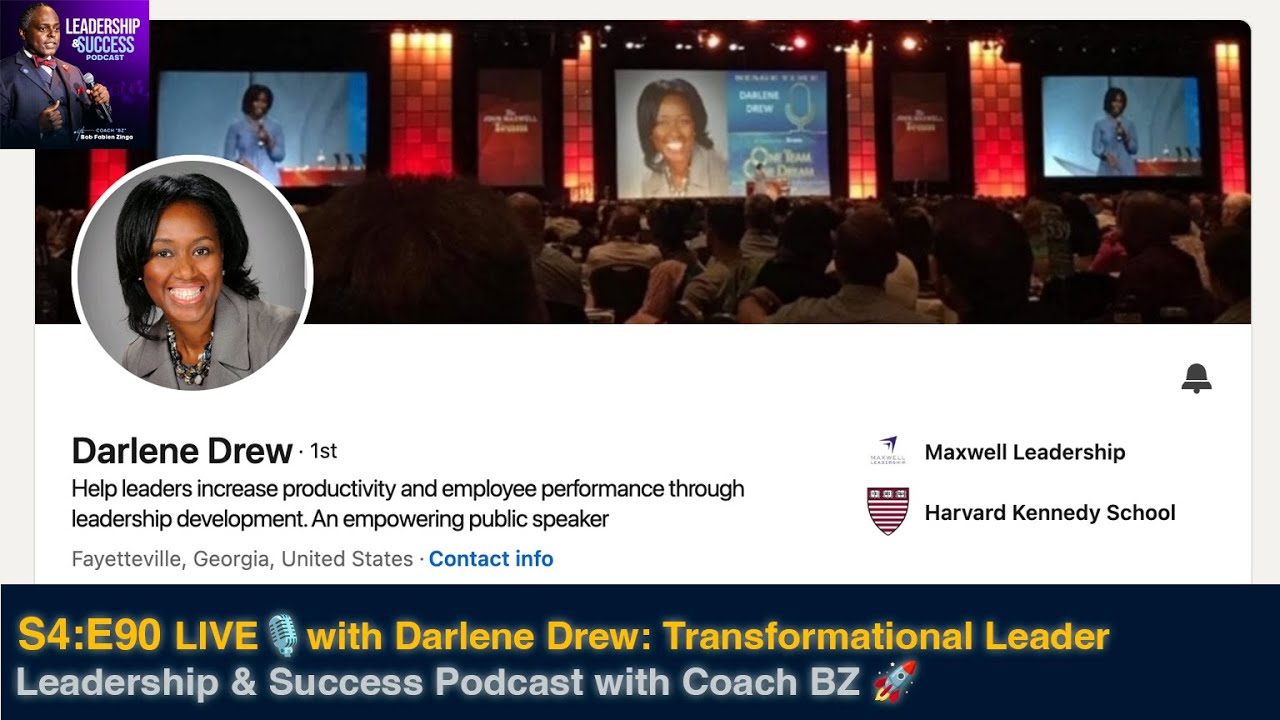
Darlene Drew spent 32 years with the Bureau of Prisons and became the first female warden of USP Atlanta. She shares three core rules: don't teach what you don't know, don't lead where you won't go, don't ask for what you aren't willing to give. Now she coaches through the John Maxwell Team and Leadership Conditioning LLC.
Chapters
Hi, I'm John Maxwell. Hi, I'm John Maxwell. When the top companies in the world are looking for trainers, speakers, and coaches, there's one name that stands above the rest, and that's Maxwell Leadership.
Our certified team members have gotten proven results for companies all over the globe, and our reputation, I'm proud to say, is second to none.
Some of our members have risen to the top of their profession, including the one you're going to meet today.
I proudly introduce you to my friend, Bob Fabien Zinga. Welcome to the Leadership and Success Podcast with your host, Coach BZ. If you need to develop into a better leader, this podcast is for you. If you want to achieve a greater level of success, this podcast is for you. His mentor, Dr. John C. Maxwell, said it best: everything rises and falls on leadership. We hope to inspire you today and provide you with an insight that has the potential to positively impact the trajectory of your life. Welcome to the Leadership and Success Podcast. Hey, Kelly de la Sala, Program Director for the John Maxwell Team, and we are at the International Maxwell Certification 3-day event on Advanced Leadership Training, and I'm here with my dear friend Darlene Drew. Darlene, welcome. Thank you, thank you, I appreciate it.
Awesome to be here with you.
So Darlene, you joined the program in December of 2017, but it was kind of at a unusual moment. You retired. That's right. So I think the question really is, is why? You know, what were you looking for then? You know, or what would you need? Maybe help us understand that. Okay. I was looking for training, and I, I have always been very passionate about training and developing people, and I've always been a huge fan of John Maxwell. I've been buying his books, been making it mandatory reading for my staff. When they said, hey, we don't have time, I'll— we'll make sure you get the break for it. So I've just I've just always been engrossed in John Maxwell and his material. So I happened to be Googling him to find out what's up with John, what does he have going on next? And then I found out that it's John Maxwell and this big world. And I joined because it was just an easy fit for me. All about training, the values that the John Maxwell team is all about is something that I've been about. So it was just an easy transition to go from my prior life in my career to doing what I love to do on a daily basis. Upon joining the team, I also joined mentorship and had the benefit of additional resources. And, uh, we're all about adding value to people, and that's what I've done with clients. And this particular client was really an industry from my prior career, so I was hesitant about going back doing something that I had done for so long. And it was just a matter of servicing them, training, providing training. Each time they asked me, I said yes. And this happened one year and another year And then last year, December, uh, then I was asked, um, how about writing us a proposal? And I said, a proposal? Yeah, write us a proposal, put together the training plan and tell us how much you want.
Right.
And then he said, and don't underestimate your value, Darlene, you're worth it. And that's what I did. I wrote it up, I sent it, and they said, you got it, and sent me the check. It was just that simple, all as a result of The content, that being available and adding value, and then people wanting to give back to you. I'm like, where does this happen other than the whole culture of what we're about here with the John Maxwell Team?
All right, everybody, that was our coach Darlene Drew, and she's here with us. She's in the house. So before we get started, let's do what we do as a custom, our moment of gratitude. That's very important to me. As you know, in the military, about 21, 22 people, veterans, commit suicide every single day. And I believe it's impossible to be grateful and be suicidal at the very same time. So let's just take a quick moment and think about something grateful for right now. So if you can, you can close your eyes, take a deep breath, put yourself in your happy place, and think about what am I grateful for I think today I am really grateful for my mother, Pauline Zinga. She was my mentor, she was my protector, and I still miss her. She passed away in 2021 during the pandemic. The great thing about that though is her legacy lives on. Everything she taught me, her faith, her courage, and her life philosophy is still here with me, and it's something I can pass on to my two daughters. What are you grateful for today? All right, I am now going to introduce someone who really doesn't need any introduction. Our guest today, she is going to teach us, and she has so much, so much to offer to us today. So you need to mark your calendar because Darlene's journey started from being the youngest of 11 children to a groundbreaking federal leader and a transformational coach. Her life is proof that leadership is not about position, but about influence, impact, and inspiration. Today we are going to learn how Darlene became the first female warden of USP Atlanta in its 110-year history, leadership lessons from her 32 years of federal service with the Bureau of Prisons, why she believes your strongest weapon is your communication skills, The 3 principles that shaped her leadership journey: don't teach what you don't know, don't lead where you won't go, and don't ask for what you are not willing to give. And we're gonna learn how she empowers others today as an executive director with the John Maxwell Team and founder of Leadership Conditioning LLC. So ladies and gentlemen, without any further ado, let me welcome Coach Darlene Drew. All right, Darlene, good morning. How are you doing today?
I am well, thank you. How are you?
Wonderful. Actually, today is a special day, isn't it? What, what day is it today?
It is my birthday.
Your birthday? I can't believe it. Okay, I'm gonna try. To you, happy birthday. To you, happy birthday, dear Darlene. Happy birthday to you. All right, this has never happened on the Leadership and Success Podcast before, so it's the first time. Happy, happy birthday.
Thank you, thank you.
So if I may ask you, uh, what is one thing that you are grateful for today?
Yeah, similar to what you said, today it of course is my birthday, as you just shared, and my husband passed away around this time last year in September. And what I'm grateful for was that God blessed me with such a soulmate, blessed me with such a person that loved God, loved people, and loved, loved me. And so that has been one of the biggest, biggest blessings of my life. And I count it all joy that God brought us together.
Well, thank you so much for sharing this. And I know I didn't send this to you in advance, but since you mentioned it, I feel like there are people in the audience who have had some terrible losses as well. In my case, I think my mother, I still think of her, it's been 4 years now. Looks like it's a hole that will never be filled, but I do have hope, I know I have faith, and I know one day I will meet her again, but most importantly, see everything she's taught me by example and what she did. I think in my life, my mother was probably the first feminist I have ever met. Growing up in Africa, I mean, it's much different than here in the US. It's really patriarchy. They, they, they, like my own father, when I was growing up, he used to say women are good for two things only, making babies and cooking food, basically. But my mom was like, absolutely not. So she showed me that a woman can do anything a man can do, if not better. But anyway, what I wanted to ask is, There are people here, they still need to lead, for those in the audience navigating grief while still carrying on leadership responsibility. What practices, mindset, or sources of faith have helped you find comfort, hope, and the strength to keep leading through pain?
One of the various reasons why I continue to lead is because I believe that I was called to do it, that it was something from the inside out, that I was led spiritually, that that's where I belong. And so, of course, it was an evolving process moving up the career ladder to, to be in a leadership role. But I've always had a lot of feelings and thoughts about doing things right and being the example that you want to see. And I believe that was answered spiritually by God saying, well, you go and you be that.
Wow. Say that again. Being the example you want to see. Yes. That's powerful. Wow. I guess one of the best definitions of leadership I have ever seen, because some people, they feel like for them to be a leader, they need to have a title, they need to have a bunch of direct reports. But really, leadership has nothing to do with that.
No, no, I am a strong opponent of that mindset that a position or title is merely that. It's a title. Leadership is something that you earn and you have the responsibility of serving and working with people, not this idea that you're to be saluted, that you're better than someone else. No, you are placed in a position with the expectation that you lead, and people should expect that from those who are in these leadership roles.
Wow. And you were the youngest of 11 children and the first in your family to graduate college. Wow. That's, that's huge. How did those beginnings shape your perspective on resilience and leadership?
It shaped my perspective from watching my parents and watching my siblings and how they were navigating life. So because our family was so large, I didn't have to go outside the home to, to, to learn things because I was learning from watching them. Being the youngest, I was a typical youngest child, pretty much spying on everybody, watching what they were doing and actually making decisions about my life as I watched siblings and deciding, oh, I saw that, I don't want to do that, or I saw that, I like that. And it really led me to, you know, making the career choices that I made. My parents were the hardest working people that I have ever known. They were leaders who never called themselves leaders. They, of course, called themselves parents, but they led us. And I'm just blessed to have had them.
Wow. So when you faced challenges finding your first job, let's be frank, this world is pretty much made for men, but you definitely found your way. What kept you going and how did that persistence fuel your later success?
Sure. Thank you for that. When I applied for my first position, which was a correctional officer, and I got a non-selection letter back, I'm waiting to get that letter that says congratulations. Well, that's not what it said. It said you are not selected. And at that point, I was at a place of disbelief. Meaning I didn't believe that they got it right. So the younger me picked up the phone and called the human resource administrator whose name was on that letter. And, and I said, I think you should give me another review, go back and look through my files. And so we went— he did that and it went from you're not hired to congratulations, you're hired. And throughout that career, I was regularly having to be persistent to achieve the things that I wanted and to be afforded the opportunities that I had in my mind of what I wanted to do.
That is really powerful. What did it mean for you to step into a role that has always been held by men? What unique challenges did you face as a trailblazer and how did you overcome resistance?
Well, a number of things. I understood, or I was aware that staff saw those of us who were females and in warden, in a warden position differently. People watch TV, people have this image in their head, and I didn't fit that image. But what I did fit is I understood what my responsibilities were, and I had the confidence that I could do what was necessary in a position as a warden. In the Bureau of Prisons is warden, likened to a CEO at any other organization, that I'm here, I belong here, I'm leading here, let's get to work and do what we're here to do.
That is, that is really, really powerful, especially also the fact that you've kept that door open for other women to then become warden after you. That's just a great testament to your leadership. Now, one thing I love about you, which you say very often, I think probably John talks about this too, is your 3 principles, right? Don't teach what you don't know, don't lead where you won't go, and don't ask for what you are not willing to give. That's really the essence of leadership. Can you share maybe a story or two of where each principle guided your leadership?
Yes, I stand by that. It means everything to me. And what I saw over the years is You've heard of the fake it to make it verbiage. Fake it to make it. Well, don't teach what you don't know debunks that. I've seen people try to fake it to make it and really misrepresent themselves by pretending that they have the knowledge that they don't. Same thing, don't lead where you won't go. For those who have the opportunity to be in leadership positions and you're saying, you go here, you go there, But they're not willing to go. And so my belief is that we have the responsibility to go to the places that we ask other people to go. And certainly, last but not least, if you're not willing to give it, what you're asking those who you have the privilege to serve, then it's really wrong for you to ask for it. So don't teach what you don't know, don't lead where you won't go, and don't ask for what you won't give. Staff are looking to see, if you're doing what we're asking them to do. So that's my perspective, and it's from observing and seeing it happen so many times and happening the wrong way.
Hmm. Actually, when you just said that, I'm reminded of being a parent as well. I have two daughters. When they were a kid, you know, sometimes you want to say, do as I say but not as I do. That never, never works because kids will always do what their parents do. They do what they see always. And I think Same thing with employees and when it gets to leadership. Now, another thing that's pretty amazing with your journey, after 32 years in the Bureau of Prison, you retire, but then you transition into leadership coaching with the John Maxwell team. How did all of that work out? Like, how did you become an executive director with the Maxwell Leadership?
It was a natural and easy transition. I knew that when I retired from the federal prison system, that I would be speaking, coaching, training somewhere. I anticipated, planned to start my own business. But there was one thing I knew how to work in prisons. I knew how to oversee prisons. I knew leadership. But what I wasn't familiar with or versed with or had the experience was starting my own business. So there I was transitioning. And because I was an advocate of John's books, I decided to Google John. And when I Googled John, that's when I found out about the John Maxwell Team and I was like, wow, perfect. So I immediately joined the Maxwell team, uh, and the rest is history for me. And it's been a wonderful experience.
That is really, uh, amazing. My, uh, Papa John's, uh, story— I was 17 years old. I think the first book I ever read that he's written was, uh, this one, The 21 Irrefutable Laws of Leadership, which is, uh, one that I'm using now with the Maxwell Bible as curriculum for the fourth season. Of the Leadership and Success podcast. But really, the book literally changed my life. And then I remember when I met him for the first time in Birmingham, Church of the Highlands, he was the guest speaker. And like they say, the rest is history. I joined the Maxwell Leadership Team shortly after that. But now, from your experience in the correction leadership, is there maybe one or two leadership principles that you think is kind of universal that you've learned the 32 years that you were in the correctional facilities that applies in the boardroom, in the military, and in every other industry?
Yes. And it's— I mentioned it earlier, be the example that you want to see. I think that's very, very important. I know that that's important. One, because staff are always paying attention to those who are in leadership roles for various reasons. Some are paying attention to learn, some are paying attention to bring it back up later. And use it as leverage. And it's very important with understanding that. And I would also add, knowing that as a leader, people's eyes are on you all the time, even when you're not in the work environment. When you go to Kroger's, they're looking. When you go into CVS, it's on you all the time. So when we raise our hands and say, if you want someone to go, I'll go, understand that you're being monitored everywhere you go. So, wow, that's how we stand it and embrace it is my perspective on it.
So do the right thing no matter what, even when you think nobody is watching, because somebody is always watching. Because they're watching. Wow, powerful. Now, for women and minorities who aspire to lead, like you, what advice would you share about navigating environments that may not always be welcoming to them?
Yes, one, I would say, if for any, any woman that is inspired, then do it. Do it with the understanding that there are going to be obstacles along the way. But what I would say about the obstacles is understand them. It's not the first, it won't be the first or the last time encountering obstacles. But if you know that you belong, if you know that this is where I'm supposed to be, then you do it and you do it to the best of your ability, understanding that there are other women paying attention. And it's necessary for us to break through those barriers, to, to, to slay those glass ceilings, right? In order to add to the respective work environments. It's not necessarily going to be easy, but if you know that it is your why, if you know that it's what you're called to do, it's worth it.
Wow. Powerful. We are now going to switch over to the second segment, and the first question I'm going to ask you What do you think is the secret of your success?
The secret? Well, I don't think it's a secret, but I will say I would describe it as persevering. Persevering from the time that I started, from you're not hired to you're hired to growing up in the prison system. Why is a cute little gal like you working in a place like this? You don't belong, all the way up to becoming a ward and being asked, what should we call you? My response, what did you call the guy before me? So with that understanding that this is where I belong, I am assigned to be here for a reason, and we have a responsibility for the other women that are paying attention to us, that are being inspired even when we don't know it, that's watching, then it also is not just exclusively about us. So what I would say is do what you know that you're called to do. Understand that there will be obstacles there, you know, eat your Wheaties and keep going forward because you belong.
Wow, fantastic. And actually, uh, someone from the, uh, audience, Pamela, she says she's watching. Hey Pamela, uh, let us know where you are joining us from, uh, what city-state or which country. And also, if you have a question for Coach Darlene, please, uh, type it in the comment. I'm gonna make sure I ask her before the show is out. Thank you so much. And as a leader, I know that leaders are learners. What are you learning right now, Doreen?
I am learning how to write a book. I've been a writer forever. And actually, right after I retired, I started writing and then I stopped. And what stopped me is I got to some pain points that it was— I just wasn't ready to reflect there. I stopped and then I picked back up. With it last year, and I'm learning to write with the benefit of a writing coach. So I'm really, really excited about it, and that's what I'm doing.
That is really wonderful. I mean, the power of a book, right? Like I say, sometimes you can be mentored by someone and you've never met them, you've never talked to them, but you've read their book and you kind of get their knowledge passed on to you. And sometimes they may even pass away earlier with, We talked off camera in the green room about Maya Angelou, one of your heroes, one of mine too, and especially the poem she wrote, "See I Rise." It still affects me and impacts me today. She's now long passed away, but she still speaks through her work. So it's really, really powerful what a book can do, the impact you can have even on generations of people you will never meet and you will never get to see. Now I also have this coin here, let me see, I thought it was down here. Anyway, I have the icon on one side, it says success, on the other side it says failure. Here it is, I'd like to show it for just a second. So this side says success and the other side says failure. I truly believe success and failure are two sides of the same coin. Actually, I believe that for you to succeed greatly, you have to fail even more, and that's gonna eventually lead you to success. How has failure shaped your life?
The way it's shaped my life is it's made me more determined. It's, it's caused me to get back up again and again and again and continue to pursue whatever has been the goal in front of me. When I was started working in the, in the prison system, after being told that I wouldn't be hired, I failed firearms not once, not twice, 3 times, to the point that the firearms training instructor said, you know, you're going to be going home. That only made me more determined. So that's one example. Obviously, I didn't go home. I stayed 32 years later, and it took perseverance and understanding that this is where I belong and to keep going.
That is so powerful, actually. It reminds me when I first joined the Navy. Of all of the branches in the military, I chose the Navy and I didn't know how to swim. So they gave me 12 months. No, Simon Zinga, you're gonna have to learn how to swim or we're gonna kick you out. So I did what I had to do and I started swimming. And like they say, the rest is history. But wow, it's really incredible how successful people sometimes go through challenges. But like you say, they just don't quit. They keep coming back up again and again and again until they eventually succeed. That's, that's a powerful lesson. So who do you know that we should know? Who are some of your mentors or thought leaders that you follow that we should know about?
Well, for sure, well, you already know John Maxwell is one. And then I started, I started following, I always say his name wrong, but Don Yaber. I started listening to his podcast. Yes, because I love the fact that he uses the corporate environment. And I love the fact that he also includes athletes because I've been, you know, for a long time I was anti-athletes. I had my own bias. I thought they didn't do the work. They were just passing them in school. But my husband, who was an athlete, told me that I got it wrong. And so I have this interest in learning about their lives and their learns. So those—
Wow, powerful.
And then I have an amazing mentor. Her name is Janie Jeffers. And also, yes, Maya Angelou is also a mentor. She has gotten me through some challenges in my life. So I've always kept her books and her poems close to me. You may write me down in history with bitter, twisted lies. May trod me in the very dirt, but still like air, I'll rise.
Wow, powerful, powerful, powerful. Wow, it's, yeah, it's, it's, uh, it's very, very, very touching. It's, uh, incredible. Uh, you really are the wildest dream of your ancestors. It's incredible. If only they knew what you would have become today. It's, uh, beyond, beyond, beyond words. Wow, that is, that is very, very Powerful. If you could have dinner with 3 people, alive, dead, or even mythical figure, who would you choose and why?
Oh, I love that. I get to, to talk about these people that I love. Dr. Maya Angelou would certainly be one. I love her, love her. Nelson Mandela would be another person. Commonality of what he endured working in a prison environment and me working, him being incarcerated, not working. Yes, he working prison environment. I, I think he's amazing. And Michelle Obama. We both grew up outside of Chicago, literally about 12 blocks from one another. So wow, he would be another person.
Yeah, everybody you've mentioned doesn't need an introduction. Actually, you didn't even have to say why. Everybody would completely understand. Are there any books that, uh, you've read that you would recommend to my audience?
One of the books I love is Dear Talitha by Brené Brown. I love that book. And it centers on having tough conversations. And oftentimes in leadership, particularly when people are first starting, but even tenured leaders, having those tough conversations with direct reports is most of the time been very difficult for a lot of people. And she lays it out detailed, play-by-play. And I think leaders can really benefit from, from what she puts in her book. It's literally a playbook for having those tough conversations with people.
So if there was a song, a book, a movie that would be your life's theme or anthem, what would it be?
It would be a poem, and you've already heard it.
My anthem is "I Rock." Yeah, that is beautiful. Okay, what I'm gonna do, I do have a short clip of that poem. I think it was done by the one and only— I never skipped me now— she's the number one tennis player in the world. Okay, I know her. Anyway, I'm gonna find the video. Maybe I will play it at the end. It's very, very inspirational. And also, by the way, Pamela Denee says she's coming to us from Chicago. That's your hometown. Look at that! Wonderful. So if you had one day and only one day to live, what would you have liked your final contribution to be?
To developing people. Developing people. Yes.
And when you wake— so good.
Growing, taking my growth and, you know, taking it and developing other people through my experience.
Fantastic. And when you wake up in the morning, is there one specific problem you would like to solve?
Yes, disparate treatment. I believe that people, all people, should be treated properly. Disparate treatment is something that pains me, always has, and was part of the reason that I seized the opportunity to be in a leadership role, because you want to do more than talk about it. You want to be positioned to do something about it.
Wow. So is there one action you have taken that has positively impacted your life?
One action, I would say when I went to grad school, it was, uh, initially I wanted to go to law school and then I didn't. 20 years later, I went to grad school and I loved it, and it just further, further cemented inside of me the importance of taking advantage of not just talking about the things that you want to see change, but being equipped and educated to make those changes.
Wow, that is powerful. I remember my godfather used to tell me, get an education because nobody will ever, ever be able to take it away from you. That is powerful. So is there an action that you are thinking about taking that you believe will positively impact your life?
I would say I'm going to write a lot of books.
Yes.
Once I get— first I got to make the first hurdle. So, you know, I'm, I'm, I, I'm— but yeah, I, I, I really look forward to affecting the lives of people through, you know, the books like John has. It won't be that many like his, but there's just a lot of power and influence in those books, and they, they're there forever when we're long gone.
So throughout all of your coaching experience, what do you think is the one message that you really want to take to your client that's going to make a difference?
Yeah, I would say be the change that you want to see. It's easy for us to look at various things that's happening and, and talk about it but not do anything about it. And so for those that I have the privilege to serve, that the clients that I presently work with and those that I will be working with, that's something that I initiate those Conversations, ultimately, you know, asking, what's your vision? What do you want?
Yes.
Let's talk about you and what are the things that you recognize that you can do better? And then let's put together a plan of how it's going to affect your organizations in a positive way.
Wow. Powerful. Okay. We are getting toward the end of the show. That's where I ask you, how can we add value back to you? Actually, before you answer that, Pamela from Chicago says, uh, do you offer mentoring for women? I have admired and followed you for over 45 years and would love the opportunity to glean from your journey. So you definitely need to write a book for Pamela, for sure. So how can we add value back to you?
Yes, um, starting here, you know, I'm, I'm on LinkedIn and I believe in starting with relationship building. And, um, how about us connecting on the LinkedIn platform and nurture and build relationships and allow it to grow and evolve from that. I think that's the most important place to start.
Wow. And for those again watching and listening, it's linkedin.com/darlene drew, so you cannot miss it. Please, uh, follow her and reach out. So do you offer mentoring for women?
I absolutely do. Yes, I'm very passionate about mentoring for women. Yes, I do.
All right, Pamela, you've got your answer. Connect with Coach Darlene on you will not be disappointed. Wow. So is there a question I should have asked you, Coach Darlene, that I haven't asked yet?
You've asked such great questions. I would say here's one people have asked me this. Why did I continue to stay working in the federal prison system, particularly my last assignment when it was so challenging? That would be a question. Question.
Would you answer that, please?
I will. That, that third assignment that I was in as, as warden at the United States Penitentiary Atlanta, where I was the first, I stayed in that position because I knew that it was bigger than me. I stayed in that position for anyone else, any other women that also desired to be a warden. I stayed in that position so that people would know that it's not easy, but it's worth it. Stay focused and doing what you believe, spiritually speaking, that God has called you to do and trust it.
Wow, that is powerful. What I really love about you is not just you living your life for you, but it's really for people who are going to be coming after you. Like we say in the Navy, we do stand on the shoulders of giants. Like even in my own story, These are the Golden 13, the first 13 Black officers in the US Navy. That was only 1943. My father was bomber, so it's not that long ago. People with my skin color were not allowed to be officers in the most powerful navy in the world. It's like, I want to die for my country, I want to go to war. They're like, no, no, you're Black, we don't want you. But today we can be, and same thing with women too. Women weren't allowed to join, and now we have women in service, even in combat roles. There are definitely those environments that really were not meant for people like you, but what I'm saying with your example is you have to keep moving forward. Nobody's going to stop you unless you stop yourself. So I believe there is room at the top for you. My own journey, I started as a seaman recruit, that's the lowest rank in the military, but I had examples like, I think you can see his picture up here, General Colin Powell, one of my great mentors, and it's like I see him, he looks just like me, he's a 4-star general and chairman of the Joint Chief of Staff. If he can do it, I can do it too. So you really need to, that's why I really believe that representation does matter. You being the first woman warden in the USP, that is huge because then other people, including my daughter, I know that that's not what they want to do, but if they wanted to, they could use you as an example, say yes, me too, I can do that too. So that's a very, very, very powerful leadership message. Anything else you'd like to add about how you've been such a great shining example of what's possible?
Thank you. I would say repeat what you said in terms of continue to move forward. There will be people along the way that will discourage you, that will tell you that you don't belong, that will ask you, why are you here? I got that a lot. And even when you start your own businesses and things of that sort and you're networking and going to different, different events, what's important is to know what you're purposed and called to do. I can't say that enough.
Wow.
You need to do it. Nobody promised that it would be easy, but continue to do it when you know that it's what you're supposed to do. It'll work out. It'll work out.
Know your purpose and know your call. That is very, very, very powerful. Well, yeah, I really do believe that all things are possible. The sky is the limit. I think, uh, Dr. Willie Judd is the one who says, right, a setback is a setup for a comeback. And, uh, that's really the champion mentality. Okay, we are bringing this to a close, so I'm, I'm gonna ask you— this is probably the most important question of this entire podcast, if you could go back and give a piece of advice to your 17-year-old self standing at the edge of the incredible career you've had at USP and now as an executive coach, what would you say to 17-year-old Darlene Drew?
I would say to Darlene, uh, pursue your dreams, and as you're in pursuit of them, be yourself, be a builder, be better, and be ready. That's what I would say. Darlene.
That is powerful. Okay, what is, uh, one— okay, let me ask you this first. What is the most rewarding aspect of your life experience so far?
Oh, of my life experience, I would say the most rewarding has been my God matching me and my husband, putting us together. I knew that he was going to be my husband when I saw him, but I also knew to trust God and that he who findeth a wife findeth a good thing, and that he will find me. So I would say that obedience is better than sacrifice, spiritually speaking, and be patient, be still, and what God has for you will come. Trust God.
Wow, that is powerful. Trust God. Okay, so To end the show, this is going to be quick. What is one word that defines great leadership?
That defines great leadership? I would say phenomenal.
Phenomenal.
Okay.
Yeah.
Morning routine or practice that keeps you grounded?
A morning routine. I'm structured. I start out with prayer, I start out with devotion, and then everything else comes after that.
Fantastic. Okay, a book or quote that changed your life?
That changed my life? I would have to go back to Maya Angelou. I've been following her since I could read, so yes, I've always been inspired by her.
All right, so who inspires you the most today? Is that Maya? Someone else?
I would say Maya would still be my top person, even though she's not here. Her books are here. And so I—
what, what, after we are done with the interview, I'm gonna go ahead and I have a video I'm gonna play, uh, still. I, I was— it's definitely a point that has definitely impacted me, uh, greatly, for sure. So I finished the sentence: leadership is—
leadership is influence, leadership is setting an example, leadership is about serving people.
I know that was probably more No, that's, no, that's, that is, that is, that is, that is great. That's exactly what Dr. Maxwell teaches. And, uh, what did you want to be when you were a kid?
I wanted to be a Soul Train dancer. That was the first thing I wanted to be. I wanted to be a Soul Train dancer, but I realized that I couldn't make a living out of it. So I moved on to the next thing.
But did you, did you actually get on the Soul Train show? I think it was a show.
No, I did not. In Chicago, actually, Soul Train, the original Soul Train started in Chicago and then it went west. So, but I realized that I wasn't going to make it, but it's where I started.
Okay, okay. But did you at least, I guess there was also specific dance back in the day, but did you at least know the moves? Were you able to do it?
Yes, yes, absolutely. I got in dance contests, all of that. I did all of it.
Fantastic.
Sure did.
I think there is something about having a dream and then being able to realize that dream, even though that's not what you're doing today. So 3 adjectives describing you as a child.
Say that again.
3 adjectives that describe you as a child.
Okay. Curious, determined, and interesting.
Okay. What about as an adult?
As an adult, I would say more determined, um, strong, and one more, uh, what's one more, um, grounded.
Very good. All right, I only have one last question to ask, so before I ask it, I'm going to ask you one last time: is there any other question I should have asked you that I haven't asked yet?
No, I think you covered it.
All right, so I think we covered it all. So this is the very last question, and then I'm gonna find Seal's "I Rise" and I'm gonna play it for the audience because it's such a powerful, powerful, powerful poem. So what is one word that represents our shared experience on this podcast today?
Exceptional.
Thank you. I think I'm just so grateful, grateful, and I am really, really grateful that you you came on the show today, and I think you have so much to teach to the next generation. So we definitely need your book, and I know Pamela Denise wants to read that book as soon as it is published. And there are so many people out there who need to learn from your experience and your expertise. So Coach Darlene, thank you, thank you so much for being on the Leadership and Success Coach today.
It's been a pleasure. Thank you.
Thank you. Wow, people, this, this was really a treat. So I am really grateful you guys were here today. It looks like tomorrow we may have 3 episodes of the Leadership and Success Podcast. I am still finalizing now. And Pamela Denise, thanks again for being with us today. I always love to get some feedback from the audience to make sure I am not just talking to myself here. So I will be back tomorrow, but before I do, let me find— if you just give me a second, I'm gonna find that poem that Coach Darlene has been talking about over and over again. It is— I think it is worth it. Just hold on just a second. So I am going to find and upload it. I believe I have it here. Let's see. No, I don't see it here. I know I have it downloaded on my computer. Let me find it. English is impossible. Okay, here we go. I found it.
Yay!
Okay. I am going to play this poem for you, "Still I Rise," while it is loading. Again, I think, you know, it is worth it. It is going to take a minute here, but I think you absolutely have to listen to the word because it's one of those poems that could to really change your life. Because I really believe in life, and which is actually what my book is going to be about, The Ten Commandments of Resilient Leadership. Because when I look back over my life, I've been saying no a bunch of time, And it really takes somebody to be persistent. There's got to be a way to get to yes, right? And no doesn't mean never. All it means is not right now. It's kind of like when you have an obstacle and you're like, okay, is there a way around it? Is there a way I can blow up whatever is preventing me from getting to where I am going? But In the poem, I think the part that really touches me the most is when Maya Angelou says— actually, here we go. The video is ready, but before I get there, let me pause it for just a second. The part that speaks to me the most is when she says, "Leaving behind nights of terror and fear, I rise into a daybreak that's wondrous clear. I rise bringing the gift that my ancestors gave. I am the dream and the hope of the slave. I rise, I rise, I rise. Okay, here we go, let's watch this.
The issues which face us all are not just how to survive, obviously we are doing that somehow, but really how to thrive, really thrive with some passion, some compassion, some humor, and some style. This poem is called "And Still I Rise." Now every person in this auditorium has gone to sleep one night or another, or gone to gone to bed one night or another with fear or pain or loss or terror, unhappiness, grief, insecurity. And yet each of us has awakened, arisen, seen another human being, and said, "Morning, how are you?" "Fine, thanks, and you?" Now wherever that abides, whether it's behind the kneecap and the bend of the elbow or between the teeth, wherever that is, lives, there we will find our nobleness. Not nobility, I think that's a pompous word, but the nobleness of the human spirit. That we rise. You may write me down me down in history with your bitter twisted lies. You may trod me in the very dirt, but still like dust I'll rise. Does my sassiness upset you? Why are you beset with gloom just 'cause I walk as if I have oil wells pumping in my living room? Just like moons and like suns with the certainty of tides, just like hope springing high. Still I rise. Did you want to see me broken, bowed head and lowered eyes, shoulders falling down like teardrops, weakened by my soulful cries? Does my sassiness upset you? Ha ha ha! Don't take it so hard just 'cause I laugh. As if I have gold mines digging in my own backyard. You can shoot me with your words, you can cut me with your lies, you can kill me with your hatefulness, but just like life, I rise. Does my sexiness offend you? Oh. Does it come as a surprise that I dance? As if I have diamonds at the meeting of my thighs. Out of the huts of history's shame I rise. Up from a past rooted in pain I rise. A black ocean leaping and wide, welling and swelling and bearing in the tide. Leaving behind From nights of terror and fear, I rise. Into a daybreak miraculously clear, I rise. Bringing the gifts that my ancestors gave, I am the hope and the dream of the slave. And so— Wow! There I go.
Thank you for listening to the Leadership and Success Podcast with your host, Coach Beezy. If you like what you heard, please subscribe to our channels and come back for more wisdom nuggets on how you may develop into a better leader and achieve greater levels of success. Leadership is the most most critical skill. The world will always need leaders to lead others, deploy the next disruptive technology, or execute a business strategy. You may as well decide on counting yourself among the 21st century leaders. See you right here next time on the Leadership and Success Podcast with Coach BZ.
More from Bob

S250:E4🎙️LIVE 🇺🇸America 250: President Barack Obama Leadership, Service, and the Power of Hope






S5:E157🎙️ LIVE with CMD CMSgt Dennis L. Fritz, USAF (Ret.)(Multi Tracks Audio)



S5:E156🎙️ LIVE 🇪🇸 Leadership Lessons from the FIFA World Cup 2026 Champions (Multi Tracks Audio)

S250:E3🎙️ LIVE Leadership Lessons from America’s First Documented Family of African Descent 🇺🇸📖