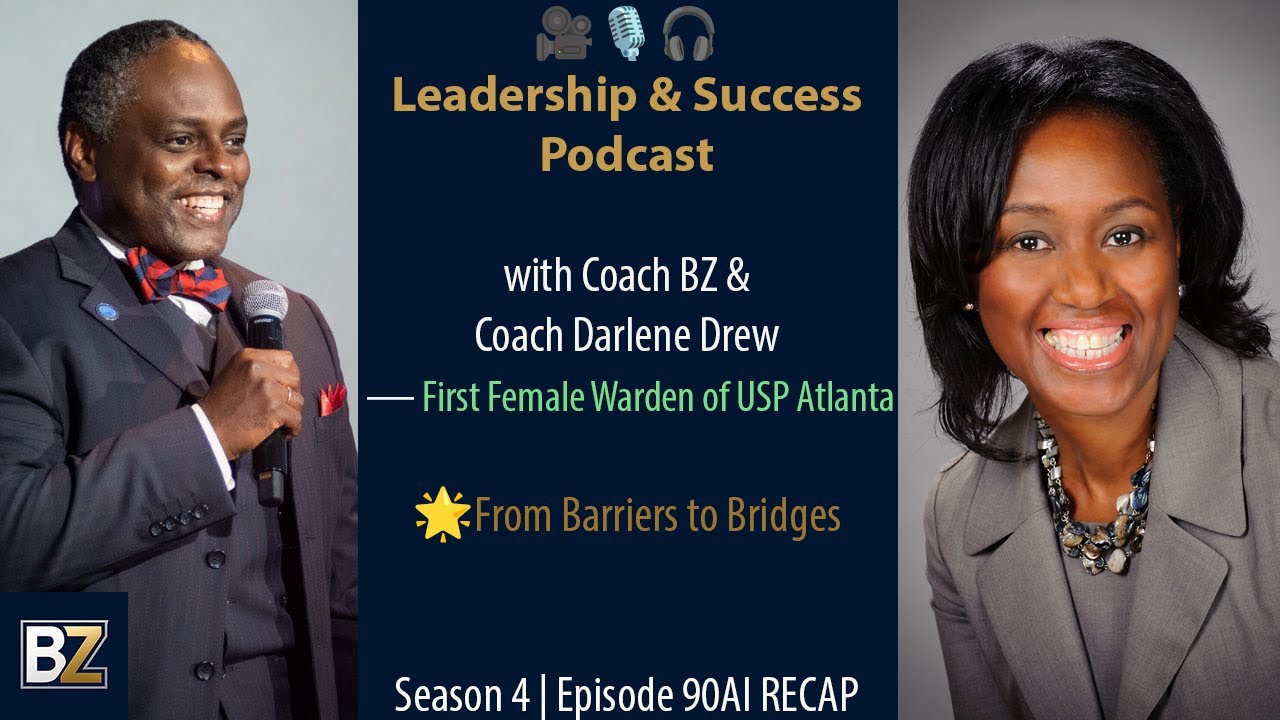
Darlene Drew, the first female warden of USP Atlanta, shares the three leadership laws she lives by: don't teach what you don't know, don't lead where you won't go, don't ask for what you won't give. She failed firearms qualifications three times before building a 32-year career, and now coaches executives through the John Maxwell Team.
Chapters
¡Hola!
Hi, I'm John Maxwell. When the top companies in the world are looking for trainers, speakers, and coaches, there's one name that stands above the rest, and that's Maxwell Leadership. Our certified team members have gotten proven results for companies all over the globe, and our reputation, I'm proud to say, is second to none. Some of our members have risen to the top of their profession, including the one you're going to meet today. I proudly introduce you to my friend, Bob Fabien Zinga.
Welcome to the Leadership and Success Podcast with your host, Coach BZ, where we help you lead with purpose and succeed with impact. If you're ready to grow into the kind of leader others want to follow, this podcast is for you. If you're determined to elevate your success and leave a lasting legacy, this podcast is for you. As my mentor, Dr. John C. Maxwell, reminds us, everything rises and falls on leadership. Our goal is simple: to inspire you, challenge you, and equip you with insights that can transform the trajectory of your leadership journey. Welcome aboard. To another episode of the Leadership and Success Podcast with Coach BZ.
Imagine gaining the leadership skills that could redefine your career. Join Coach BZ on the Leadership and Success Podcast, where each episode delivers practical insights from world-class speakers, military leaders, and industry experts. We dive deep into what matters most: building resilient teams, leading through uncertainty, and navigating complexity with clarity and confidence. Every conversation is crafted for aspiring leaders like you who are ready to grow, lead, and make a lasting impact. Don't miss our powerful live sessions and recent highlights. Michelle Hayward on building diverse, high-performing technical teams. Anne Leslie on leading through global complexity and cybersecurity risk. Ron Carpenter AI exploring faith, resilience, and AI-powered leadership. Colonel Michelle G.I. Gardner-Ins on commanding influence from the battlefield to the boardroom. Chris Robinson on shifting from drift to drive in life and leadership. And Coach Enrique Acosta Gonzalez on mentorship, legacy, and heart-centered leadership. Ready to level up your leadership journey? Tune in on Spotify, Apple, Audible Podcasts, YouTube Live, and LinkedIn Live. Join the movement toward leadership excellence. Listen now and start transforming your success.
All people should be treated properly. Disparate treatment is something that pains me, always has, and was part of the reason that I seized the opportunity to be in a leadership role because you want to do more than talk about it. You want to be positioned to do something about it.
Wow. So is there one action you have taken that has positively impacted your life?
One action? I would say when I went to grad school, it was— initially, I wanted to go to law school, and then I didn't. 20 years later, I went to grad school and I loved it. And it just further, further cemented inside of me the importance of taking advantage of not just talking about the things that you want to see change, but being equipped and educated to make those changes.
Wow, that is powerful. I remember my godfather used to tell me, get an education because nobody will ever, ever be able to take it away from you. That is powerful. So is there an action that you are thinking about taking that you believe will positively impact your life?
I would say I'm going to write a lot of books.
Yes.
Once I get— first I got to make the first hurdle. So, you know, I'm— but yeah, I really look forward to affecting the lives of people through, you know, the books like John has. It won't be that many. Like his, but there's just a lot of power and influence in those books, and they, they're there forever when we're long gone.
So throughout all of your coaching experience, what do you think is the one message that you really want to take to your client that's going to make a difference?
Yeah, I would say be the change that you want to see. It's easy for us to look at various things that's happening and, and talk about it but not do anything about it. And so for them, it is my birthday.
Your birthday? I can't believe it.
Okay, I'm gonna try.
To you, happy birthday to you, happy birthday dear Darlene, happy birthday to you. All right, this has never happened on the Leadership and Success Podcast before. So it's the first time. Happy, happy birthday.
Thank you. Thank you.
So if I may ask you, uh, what is one thing that you are grateful for today?
Yeah, similar to what you said, today it of course is my birthday as you just shared, and my husband passed away around this time last year in September. And what I'm grateful for was that God blessed me with such a soulmate. Blessed me with such a person that loved God, loved people, and loved, loved me. And so that has been one of the biggest, biggest blessings of my life, and I count it all joy that God brought us together.
Well, thank you so much for sharing this. I know I didn't send this to you in advance, but since you mentioned it, I feel like there are people in the audience who have had some terrible losses as well. In, in my case, I think my My mother, I still think of her. It's been 4 years now. Looks like it's a hole that will never, never be filled, but I do have hope. I know I have faith, and I know one day I will meet her again, but most importantly, see everything she's taught me by example and what she did. I think in my life, my mother was probably the first feminist I have ever met. Growing up in Africa, I mean, it's much different than here in the US. It's really patriarchy. They, they, they like my, my own father when I was growing up, he used to say women are good for two things only, uh, making babies and, uh, cooking food basically. But my mom was like, absolutely not. So she, she showed me that a woman can do anything a man can do, if not better. But, uh, anyway, um, what I, what I wanted to, uh, uh, ask is there are people here they still need to, uh, lead, you know, for, for those in the, uh, urgent navigating a grief while still carrying leadership responsibility.
All right, this is Coach Bizzy. This was an highlight of the interview we had with Coach Darlene Drew. So today is going to be the 10-minute recap done by AI. But before we, uh, do that, I am reminded, uh, for our moment of gratitude. This is the part of the show every time we meet, we where we just take a minute to be grateful for one, one thing. So if you would, put yourself in your happy place, close your eyes if you must, take a deep breath, and think about one thing you are grateful for today. I think today I am grateful just for life, life and liberty. In one of the founding documents of the U.S., the Declaration of Independence, talks about life, liberty, and the pursuit of happiness. Just living in a country where that is possible. I am glad that I am alive because, because I am alive, I know I can work for freedom and I can work to find my passion in life and do what I was called to do. The reason why I was put on this earth. So I wish that for each and every one of the people listening right now. And if you would please type in the comment what you are grateful for today. And now we are going to go into— first I'm going to play a 5-minute AI review and then 10-minute AI highlight of the conversation I had with Coach Dallin Drew. You really need to go back and watch the entire episode. There are so many things, uh, I've learned or was reminded, uh, by, uh, Coach Darling. So that's season 4, episode 90. So what you are going to learn is, uh, why leadership is influence and not position, the 3 timeless principles that guided Coach Darling's historic career as the first female warden of USP Atlanta. Don't teach what you don't know. Don't lead where you won't go, and don't ask for what you are not willing to give yourself. Our perseverance can turn no into a yes, and our faith sustains leaders through loss, adversity, and transition. How to be the example you want to see and lead with integrity when no one else is watching. All right, let's, uh, first, uh, watch the 5-minute, uh, Gracias. With you.
So, what does it really take to break down a barrier that's stood for over a century? It's not just about getting a title; it's about having a calling. Today, we're gonna dive into a real masterclass on leadership, all inspired by the incredible journey of Darlene Drew, a true trailblazer who turned barriers into bridges. Just let that sink in for a second. For 110 years, the top job at the U.S. Penitentiary in Atlanta was held by a man. And then along came Darlene Drew. Her story isn't just inspiring, you know, it's like a practical blueprint for how to lead with this incredible sense of purpose, especially when you're the first one through the door. So that's really the big question for us today, isn't it? What can we learn from her? Over the next few minutes, we're going to unpack the core lessons from her amazing 3-decade career in federal service. And trust me, these are lessons that can apply to literally any of us. Alright, let's start at the beginning. For Darlene Drew, leadership wasn't some title she was just handed. No, it was a skill that was forged in— well, maybe the most unlikely of places: her own childhood home. Can you imagine that? The youngest of 11 kids, she was constantly watching, learning, figuring out ways to influence the people around her. That was her first training ground. Her leadership foundation was being built long, long before she ever had a formal position or a badge. And you know, that whole experience really shaped her core philosophy—that leadership isn't about the position you hold. It's about who you are. It's all about leading from the inside out. I love this quote because it just completely flips the script on what power is. For Drew, leadership isn't about authority; it's about service. You don't get to demand respect because of your title; you earn trust through your actions and how you connect with people. And there's a really crucial difference here. A title might get you compliance, you know, people doing what they're told. But a powerful sense of purpose? Well, that inspires commitment. That makes people want to follow you. This really gets to her idea of leadership integrity. Whether you're in the office, at the grocery store, wherever, your character is always on display. Your team, your family, your community—they see the real you. And that's the person they're deciding whether or not to follow. Okay, so of course, a journey like hers was not a walk in the park. It wasn't a straight line. In fact, her whole career was pretty much defined by how she responded to setbacks, turning every no into a yes. Now, this is a moment I think we can all relate to—a flat-out rejection, right at the very start. For a lot of people, that would've been the end of the story. But nope! 'Not for Darlene Drew.' And this? This is the pivot point. Instead of just internalizing that no, she chose to challenge it. It was such a proactive, confident move that really tells you everything you need to know about her character. Seriously, can you imagine the confidence it took to say that? This wasn't arrogance at all; it was this deep, profound belief in her own worth and her own potential. She wasn't asking for a handout; she was demanding a fair look. So here's the key takeaway: that one single phone call set the tone for her entire 32-year career. She learned that what other people think of you doesn't have to define your own worth, and that a no is often just feedback, not a final failure. And that mindset? Oh, it was tested again and again. For example, early in her career, she hit another huge hurdle. She failed her firearms qualification. Not once, not twice, but three times. They literally told her she'd be sent home. And yet, look at the result. The contrast between that repeated failure and her ultimate career is just staggering, right? It's this powerful testament to her resilience. A setback, as she says, is just a setup for a comeback. But here's the thing about Darlene Drew's leadership—it wasn't just about her own success. It was about what she could build for the people who would come after her. This quote right here gets to the absolute heart of what a legacy is. When she became the first female warden at USP Atlanta, she knew her role wasn't just a job. It was a responsibility to prove it was possible, to hold that door wide open for the next generation of women. You see, there's a fundamental difference in mindset here. A positional leader is happy just to occupy a position. But a legacy leader? Someone like Drew, sees their role as stewardship. They aren't just occupying a seat; they're preparing it for the next person, making sure the mission will outlast them. So, how can we actually apply these lessons? Well, Darlene Drew basically distilled her entire philosophy into a simple but really powerful playbook for leading with integrity. Her playbook pretty much comes down to 3 laws. First, authenticity. Don't pretend to know something you don't. Your real experience is your real authority. Second, courage. Don't ask your team to go somewhere you aren't willing to lead the way. And finally, humility. Don't ask for a standard of commitment that you aren't willing to give yourself. Ultimately, her whole philosophy just boils down to this one simple idea: true authority doesn't come from giving orders. It comes from being a living, breathing example of the values you talk about. It's all about action, not just words. And that leaves us with a final, really powerful question to think about. Leadership isn't just about your own climb to the top. It's about whose path you're clearing for the future. What bridges are you building for the people who are gonna follow in your footsteps?
Welcome to the podcast. Today we're diving into some truly inspiring leadership insights. From overcoming personal barriers to building bridges for future leaders. Let's jump right in.
Absolutely. There's so much to unwrap. What really struck you about these leadership lessons?
Well, one of the strongest themes is leading from purpose, not just from a title. It's like, you know, real authority comes from service and influence, not the rank you wear.
Right. It's about being that example that others naturally follow. Regardless of hierarchy. I mean, when you say, "Be the example you want to see," that really resonates.
Exactly. And it's interesting because Darlene Drew emphasizes that leadership is entirely about behavior. She stresses that leadership is earned through consistency, humility, and competence. Yeah. It's not just a badge or a position.
Sure, but don't you think sometimes titles can still matter, especially in bureaucratic settings like the military?
I get that, but she really shows us that authority should never be confused with control. For example, she was the first female warden at USP Atlanta, and she didn't lead by command and control. She led by service. Her example illustrates that true leadership ignites when you lead from within.
Makes sense. And there's that powerful moment where she turned a rejection into an opportunity, turning "no" into "yes." How do you see that playing out in everyday leadership?
Oh, absolutely. That story where she recounted getting a non-selection letter and then making a call to challenge it really captures the essence of perseverance. It's like every no is feedback, not a final verdict.
Yeah, it's a reminder that setbacks can serve as setups for success if you're persistent enough. But I sometimes wonder if that approach might risk coming off as too pushy. What do you think?
That's a valid question. I mean, there's a fine line, but her key point was respectful persistence, challenging closed doors without burning bridges. True. It shows that you can be tenacious without being aggressive. I see.
Another aspect that really stood out to me was her insistence on leadership integrity, doing the right thing even when no one is watching. That's pretty tough in our fast-paced, results-driven world.
Definitely. And it's kind of like, um, your grocery store cashier or the person at CVS is always watching. It's a reminder that our true character is defined by everyday actions, however small they might seem.
It's so relatable. Our actions off the clock set the tone for who we are when we lead. And speaking of integrity, She laid out 3 laws for leading with it. Can you break those down?
Sure thing. The 3 laws are: don't teach what you don't know, don't lead where you won't go, and don't ask for what you're not willing to give. Right. They basically challenge leaders to be authentic, brave, and generous. It's like a triple check on your character.
I love that. It almost feels like a leadership recipe that dismays the notion of fake it till you make it. It's more like live it till you earn it.
Precisely. And moving on, there's a really heartfelt segment about leading through grief and loss. Darlene Drew's experience of losing her husband and yet continuing to lead with gratitude and anchored by faith shows a tremendous depth of resilience. It really highlights that vulnerability can coexist with strength. Totally.
It reminds me of um, how our toughest moments can often forge the strongest leaders. But sometimes I wonder if emphasizing personal loss might risk overshadowing other aspects of leadership. What's your take?
I see that point, but I think it's about balance. Her experience shows that drawing on personal faith and vulnerability can encourage others who are facing similar trials. It humanizes leadership. It allows leaders to connect on a deeper level, making the journey less solitary. That makes sense.
And what about her idea of building bridges for those who come after you? That's such a powerful legacy-building concept.
Totally. That concept is about leaving a pathway open for future leaders so they can rise, especially women who might face more obstacles. When she said she stayed on as warden for the sake of other women, it wasn't just about her career. It was about paving the way.
Yeah, it's as if leadership for her is not just a personal achievement but a responsibility to a community. It reminds us that today's success should be a stepping stone for tomorrow's possibilities.
Exactly right. And then there's the dynamic shift from corrections to mentoring across multiple sectors. Darlene's journey from breaking barriers in the penitentiary system to empowering leaders through the John Maxwell Team shows that leadership is a perpetual calling. It's not just a job, it's a lifelong mission. For sure.
It also shows that leadership can be reinvented. It's like evolving from one phase of service to another, always adapting while staying true to your values. Yes.
And speaking of evolution, one of her most striking quotes is about Rising despite failures. Failing firearms 3 times and then persisting. It's almost cinematic in its determination. That story is a living example of a setback is a setup for a comeback.
Her resilience is truly inspiring. And it got me thinking, how do you ensure that these lessons in leadership remain accessible without making them feel too idealistic or unattainable?
Great point. I think she breaks it down practically. Every lesson comes with a coaching takeaway and even a reflection question, like asking, where in your current role can you serve before you're promoted? It's all about making it actionable rather than being lofty ideals. These are everyday practices that anyone can adopt.
Yeah, that approach definitely bridges the gap between theory and practice. And I appreciate how she weaves in elements of faith, integrity, and service, tying them back to concrete examples in different fields, whether military, tech, or even corporate settings.
Absolutely. And she even incorporates biblical verses and prompts to rethink leadership as something that transcends titles and metrics. It's like a spiritual and practical merger that gives leaders not just a strategy, but also a moral compass.
I really like that. It reminds me that leadership is as much about who you are internally as it is about what you do externally. And with topics like turning no into yes and resilience in failure, it's almost like a toolkit for overcoming adversity. Exactly.
It equips you to see every challenge as a classroom. And it's not just about bouncing back, it's about using that experience to elevate others too.
That idea of legacy resonates deeply. Building bridges for future leaders means creating a more inclusive, compassionate world. But do you think there's a risk of oversimplifying complex challenges by framing them simply as stepping stones?
You know, that's a fair critique. In some cases, the struggle is multifaceted, and one can't just see a failure as a neat stepping stone. Yeah. However, what Darlene emphasizes is the continuous effort. Each obstacle becomes a lesson when you approach it with perseverance and reflection. It's not a magic cure, but a mindset shift.
I get that. It's about the underlying principle of growth, infusing challenges with purpose rather than just accepting them as setbacks. I really appreciate that balanced perspective.
Totally. And let's not forget her call to action: rise and lead by living your truth, being authentic, and always ready to serve. Right. Whether you're a military officer, engineer, or CEO, these lessons push you to think of leadership as an evolving journey, not a destination.
Absolutely. It's about continuous learning and mentoring. And that idea that you're paving the way for someone else is powerful. It's not just about self-advancement but about fostering environments where everyone can shine. Exactly.
And it encourages us to question, who are we inspiring by the way we lead? Even in our daily choices, our behaviors set the stage for those around us, both in the boardroom and in our communities. Yeah. Reflection questions like, who inspired you to believe leadership was possible? Really challenge us to think beyond ourselves.
Right. That always gets me thinking. And as we wrap up, what would you say is the one golden nugget from this conversation that leaders can take to heart? Oh, that's a tough one.
But I'd say it's the idea that leadership is a calling from the inside out, a blend of purpose, resilience, and integrity. Whether you're facing rejection, loss, or pushing for change against all odds, Leading from the heart turns every barrier into a bridge.
Well said! That mix of grit and grace is what truly makes an enduring leader. Thanks for the insightful chat. It's been a real masterclass in leadership lessons.
Thank you. And remember, lead from purpose, overcome setbacks, and always build bridges for those who come after you. Until next time, keep rising, leading, and inspiring.
All right, this is it for our podcast recap today. I don't see any question on LinkedIn or YouTube, so even if you're watching via recap, please type in your question. Let us know where you are coming from, what city, what state, what country, and also what are the highlights you took from the lesson today. And again, we want to encourage you to go back and watch the full episode, Season 4, Episode 90. And please do follow Coach Darlene Drew, LinkedIn.com/darleendrew. And thank you again for being here. But really, for me, the biggest highlight for the entire interview is your philosophy, right? Lead with authenticity. Don't teach what you don't know, because authenticity builds authority. And lead with courage. Don't lead where you will not go. Courage precedes glory. And number 3, uh, lead with humility. Don't ask for what you won't give because humility precedes influence. All right, so powerful. And, uh, until, uh, next time. So I'm gonna be back here tomorrow, I believe. Tomorrow we are going to have a 10-minute recap from the interview I had with Professor Amira Barger. So that's going to be tomorrow, Sunday, around the same time, 9:30 AM Pacific time. And we are going to have a 10-minute AI recap of Season 4, Episode 91 with Professor Amira Barger. You do not want to miss it. Okay. Before I check out, I'm going to play one more short highlight from the interview I had with Coach Darlene Drew, and then I'm going to play a 2-minute summary of a favorite poem by the late, great Maya Angelou, "Still I Rise." And that will be it.
Thank you so much. Bye. Staff are looking to see if you're doing what we're asking them to do. So that's my perspective. And it's from observing and seeing it happen so many times and happening the wrong way.
Hmm. Actually, when you just said that, I'm reminded of being a parent as well. I have two daughters. When they were a kid, you know, sometimes you want to say, do as I say, but not as I do. That never, never works because kids will always do what their parents do. They do what they see always. And I think Same thing with employees and when it gets to leadership. Now, another thing that's pretty amazing with your journey, after 32 years in the Bureau of Prison, you retire, but then you transition into leadership coaching with the John Maxwell team. How did all of that work out? Like, how did you become an executive director with the Maxwell Leadership?
It was a natural and easy transition. I knew that when I retired from the federal prison system, that I would be speaking coaching training somewhere. I anticipated, planned to start my own business, but there was one thing I knew how to work in prisons. I knew how to oversee prisons. I knew leadership, but what I wasn't familiar with or versed with or had the experience was starting my own business. So there I was transitioning, and because I was an advocate of John's books, I decided to Google John. And when I Googled John, that's when I found out about the John Maxwell Team. And like, wow, perfect. So I immediately joined the Maxwell team, and the rest is history for me. And it's been a wonderful—
And the Wimbledon champion of 2015, Serena Williams.
You may write me down in history with your bitter, twisted lies. You may trod me in the very dirt, but still like dust I rise. Just like moons and like suns, with the certainty of tides. Just like hope springing high, still I rise. Did you want to see me broken, bowed head and lowered eyes, shoulders falling down like teardrops, weaned by my soulful cries? Out of the huts of history's shame I rise. Up from a past that's rooted in pain, I rise. I'm a black ocean leaping and wide, welling and swelling. I bear in the tide, leaving behind nights of terror and fear. I rise into a daybreak that's wondrously clear. I rise. Bringing the gifts that my ancestors gave. I am the dream and the hope of a slave. I rise. I rise. I rise.
Thank you for tuning in to the Leadership and Success Podcast with your host, Coach BZ. If today's episode added value to your leadership journey, be sure to subscribe, share, and join us again for more wisdom nuggets on how to lead better and achieve greater success. Remember, leadership is the most critical skill a skill of our time. The world will always need leaders to inspire others, drive innovation, and execute meaningful strategy. So why not count yourself among the bold leaders shaping the 21st century? Until next time, stay inspired, stay committed, and keep leading with excellence.
More from Bob

S250:E4🎙️LIVE 🇺🇸America 250: President Barack Obama Leadership, Service, and the Power of Hope






S5:E157🎙️ LIVE with CMD CMSgt Dennis L. Fritz, USAF (Ret.)(Multi Tracks Audio)



S5:E156🎙️ LIVE 🇪🇸 Leadership Lessons from the FIFA World Cup 2026 Champions (Multi Tracks Audio)

S250:E3🎙️ LIVE Leadership Lessons from America’s First Documented Family of African Descent 🇺🇸📖