S4:E91 🎙️Live with Amira Barger (Multi Track Audio)
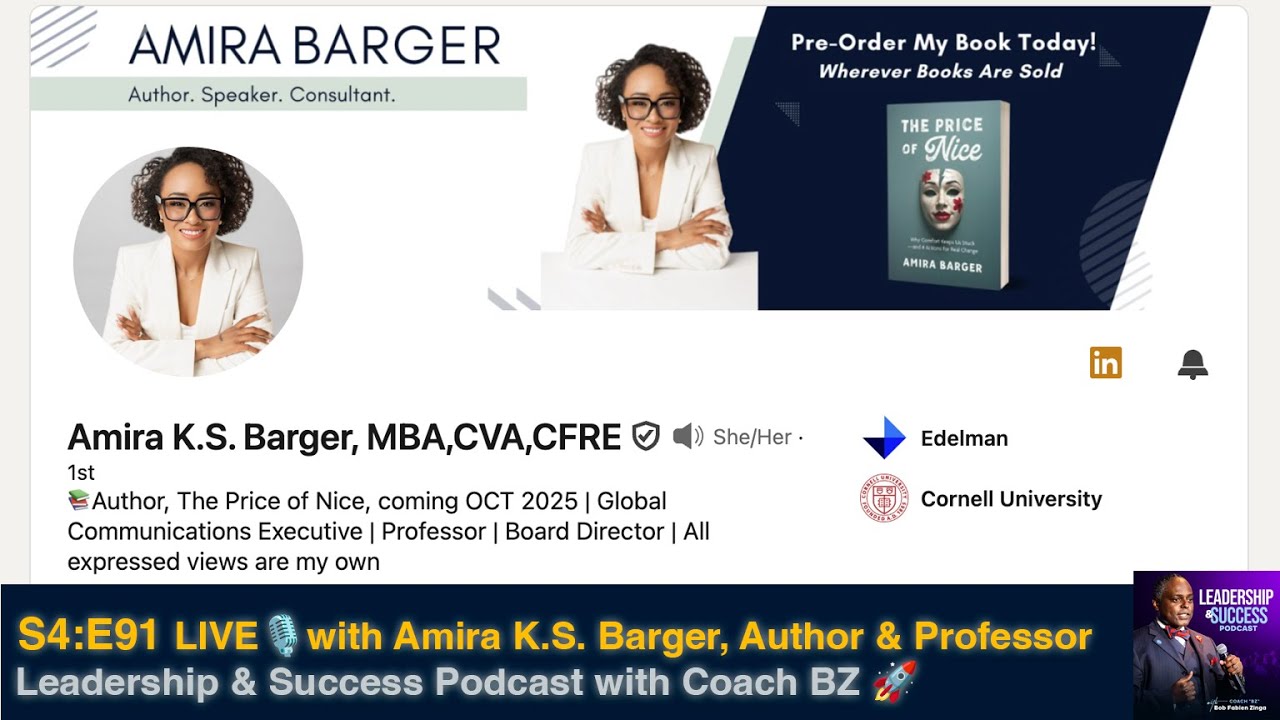
Amira Barger, EVP of DEI communications at Edelman, discusses her book The Price of Nice and why niceness can trap organizations into inaction. She shares a framework for moving from awareness to action: think, feel, do, revisit. Barger draws on her journey from Guam to opening the Bernard J. Tyson School of Medicine to show how courageous communication drives real change.
Chapters
Hi, I'm John Maxwell. When the top companies in the world are looking for trainers trainers, speakers, and coaches, there's one name that stands above the rest, and that's Maxwell Leadership. Our certified team members have gotten proven results for companies all over the globe, and our reputation, I'm proud to say, is second to none. Some of our members have risen to the top of their profession, including the one you're going to meet today. I proudly introduce you to my friend Bob Fabien Zinga.
Welcome to the Leadership and Success Podcast with your host, Coach BZ. If you need to develop into a better leader, this podcast is for you. If you want to achieve a greater level of success, this podcast is for you. His mentor, Dr. John C. Maxwell, said it best: everything rises and falls on leadership. We hope to inspire you today and provide you with an insight that has the potential to positively impact the trajectory of your life. Welcome to the Leadership and Success Podcast.
Amira Barger is the EVP and head of DEI communications for the health sector in the United States at Edelman. She is— this is my favorite line of the whole night— she is known to say the quiet parts out loud on racial, health, and gender inequity. Like, was that my outside voice? I love that. Amira's fearless authenticity knows no bounds, and I'm super excited for you all to witness that tonight. Amir. So here's, here's the story. When our team received your nomination and first, first brought it to me, they and I initially thought you were an internal DEI practitioner, which I hang out with DEI practitioners all day long. Love, love, love them. But your role has an even greater reach than that, am I correct?
It does.
Tell us about that.
Yeah, so I work across every industry, um, at Edelman, namely health. Health is my first love. I don't lead our internal DEI work, but I get to work with governments, nonprofits, and Fortune 500 companies all across the world to think about both the internal employee experience in terms of inclusion and belonging, and then also the consumer experience. How are we providing services and products? And one of the reasons I got into the healthcare sector in particular with Edelman, I— we have a lot in common. We both wore the color of the year. We both spent a lot of time in Orange County. We were both pastors' kids.
Oh wow.
That one you didn't know.
Yeah.
And so as a child of ministers, we actually spent a lot of time um, in the middle of the Pacific, in the middle of nowhere, on the tiny island of Guam. And I'm the second eldest of 8 children. Healthcare was one of the toughest areas for us because of the lack of access, because of the astronomical cost. It grew this passion for healthcare for me, which is why I entered the world of healthcare at Edelman. And I've had a lot of great experiences to help people, and one of my favorites is actually right here locally. I led the team that opened the Bernard J. Tyson School of Medicine for Kaiser Permanente right here in Pasadena. Thank you.
Thank you.
So there were a lot of crazy experiences and learnings. But one of the reasons I love what Kaiser Permanente is doing is that it is so much of the work that my parents tried to do. They are specifically focused on matriculating physicians of color, Black and brown and Indigenous and AAPI. Physicians that look like the communities that they serve. And I love that as a Black woman who has only just 2 years ago found a physician that looks like me. I know how difficult it can be, and less than 5% of U.S. physicians are Black. And I don't know the numbers on Indigenous, Latinx, or AAPI, but better bet your bottom dollar they're abysmal as well. And so we need places like Kaiser Permanente to grow the next generation of physicians to make sure we all have access to healthcare. And that's what I get.
All right, uh, that was, uh, Professor Amira Barger, and, uh, we're gonna have her in just a second. So for the time being, uh, let's do what we do here on the Leadership and Success Podcast. As is our custom, we're gonna have our moment of gratitude. That's where we just take a moment to be grateful for one thing each and every day. So My question for you is, what are you grateful for today? All right. The way I like to do it, if you would put yourself in your happy place and close your eyes if you want and take a deep breath and just think, what am I grateful for today? I think today I am grateful for the power of connection. One of my mentors told me that my network is my net worth. Worth. And I am so glad that I get to meet so many wonderful people across Silicon Valley and across our country and around the world. People who add value to me, but I try to add value back as well. So that's what I'm grateful for today. What are you grateful for? And type it in the comment. And if you have a question for my guest, please type it in the comment as well. And also let us know where you are coming from, what city, what state, and which country if outside of the United States of America. All right. Let me introduce our guest really quickly. So today I think is going to be a transformative conversation with Professor Amira Barger, award-winning executive vice president at Edelman, author of the book that is now being published. You need to get a copy, The Price of Nice, right, by Berrett-Koller Publishers. She's a professor, a board director, shaping the future of equity-centered leadership So today we're gonna be unpacking why niceness can become a comfort trap that prevents authentic change, how courageous communication can advance inclusion, justice, and impact, the 4 actions that move leaders from awareness to real transformation, and listen from Amira's journey across healthcare, academia, and global communication, how to lead with integrity, empathy, and data-driven design thinking. So ladies and gentlemen, without any further ado, Help me welcome Professor Amira Barger.
Thank you, thank you so much for—
Okay, here we go. All right, Professor Amira, how are you doing today?
I'm doing well. It's Friday, it's sunny and beautiful out, and I'm here in conversation with you. Thank you for having me.
Oh, this is so wonderful. Thank you so much for being with us today. I am so privileged and honored to have you here. And what is one thing that you are grateful for today?
I love this question. It's such a good grounding moment. I am grateful for well-being and the outdoors. I, you know, this last weekend I just did a hike with my family here in the Bay Area up to Mount Tamalpais, and we ate pancakes at the West Point Inn. So you do a long hike and then you get the reward of pancakes at the end of it. It was beautiful, and I'm just grateful for, you know, health and the ability to do that with the people that I love.
Yeah, and, uh, talking about the weather, I know we had a little rain yesterday. I was very, very grateful for that. We don't get much rain in the Bay Area.
That's right.
That's wonderful. And, uh, what is something about you that most people may not know about?
Oh, I would have said that I'm the second eldest of 8, but you just showed, um, that wonderful video from, uh, 2024. So let me— I go with a different one. Um, I also said that my parents were pastors. You know, I think one thing that's interesting that's more about my family than me is almost everyone in my family is a black belt except for me. Yeah, because I wanted to be a gymnast and an ice skater back in the '90s, and so I was like, oh, I'm not gonna practice martial arts. But I might pick it up now in my adult life. It's something I've been thinking about, like to try on for size.
That is something. And is that in karate? Which martial art?
In taekwondo and kaji kenbo.
Wow, that is impressive. Very, very impressive. Can you tell us a little bit about your leadership journey, how you got to be where you are today?
I will take it back to the very beginning because I think so much of our childhoods shape who we are and how we lead. I grew up, I mentioned in that video you just showed, as a child of ministers, and that has really shaped some of the way that I lead and how I show up in the world today. And so as a child who grew up in a very small place and a child of ministers who tried to help people with not just their, their faith journey, but the everyday needs, including health, health was the hardest. And so I always knew I wanted to find a way to be part of a solution to get people the healthcare that they needed because I believe that it's a right that everyone should have access to. And so I thought I was going to be a physician for many years. In fact, I spent most of my undergraduate career through my junior year as a pre-med student. And a professor that I was in conversation with in an intro to business class I was required to take noticed that I had a knack for communication and influencing and Through a series of informational interviews and conversations, I came to realize that there were other ways that I could make good trouble in the world and put good into the world and healthcare without being a physician, because the dream of being a physician and the reality of being a physician were very different. I learned in my schooling and I ended up switching in my junior year to a marketing and communications degree. And those last 2 years of college were very busy because I was not only taking classes at my 4-year university, junior college, so I could grad time. I didn't want to spend more than 4 years in college. And I launched from there into the world of nonprofit organizations. I was actually a professional communicator and fundraiser in the world of nonprofits and public health for over a decade before I came back into the world of corporate America where I spend my time now. And so much of being the second eldest of 8 children, which I mentioned, and I'm also the oldest daughter. So there's one brother above me, but I'm the oldest girl, which means I'm the family manager oftentimes, and I'm the boss, no matter what they try to tell you. And that definitely shaped me as a leader of caring for the people entrusted to me and leading in a way that I'm modeling the behaviors and in some ways giving people permission to practice what they need and to show up how they need to in the world as well.
Wow, that is really, really powerful. I guess we, we both were pre-med in college.
Oh, I love that. I didn't know that about you.
Yeah, I wanted to be a medical doctor as well. Actually, I almost got a PhD in microbiology. Uh, but I guess I'm what you would call the ADA, right? All but ABD, all but the dissertation. Anyway, what's— what is my word? And also, in my family, I was the oldest. I had a younger sister and a younger brother. I always felt that responsibility of, you know, helping raise them with my parents, I guess. So I guess I was a leader since I was a little kid. At least I felt that responsibility anyway. Wow, that is really fascinating. Now, in your book, The Price of Nice, that is such a bold, bold, big title. What personal or professional experience first made you realize that niceness was holding people and organizations back?
So many things. I often go back to childhood because, again, it's so much of what shapes us. And so one of the first moments, at least in adulthood, where I had that epiphany was, you know, I think many of us grew up with our favorite fairy tales and bedtime stories on repeat. For my daughter, she's 12 and a half now, so there are no more bedtime stories. She doesn't ask for that. She reads to herself. But for many years, her favorite was Llama Llama. And every single night she would ask us to read her that story, so much so that at one point my husband actually had it memorized word for word.
Yeah.
And along the way, I also think, like me, many people have had sort of this aha moment that forever alters your perception of the stories that you have been told or handed, and it brings you to question things that you may have always accepted and has accepted as true. So for me, Goldilocks— Goldilocks was one of those moments where I, for whatever reason, I just sit and think sometimes, was sitting there and I thought to myself, Goldilocks is a trespasser and a thief, not some innocent lost girl. And then it happened again, and it hit me with The Giving Tree. That was also one of my favorite stories as a kid, where this tree gives of itself every year to this boy for all the things that he needs— a stump to sit on, a house to build. And I thought, The Giving Tree is sold to us as a story about generosity, and giving, it was actually a master class in toxic relationships and self-sacrifice. That's what I thought to myself. And so these stories that have shaped how we understand the world, and they continue to until we stop, step back, and think to question them. That's exactly what I wrote an entire book about, is to help people to consider the world beyond what we've been conditioned to accept.
Wow, that is very powerful. Being a great communicator, I guess storytelling is extremely powerful in the way, you know, we have our belief and we kind of filter out everything that we come in contact with. So, uh, in your book, you do challenge all of us No, challenge the beliefs that comfort equals civility. So how can leaders learn to embrace discomfort as a pathway to growth rather than a threat?
Practice it in micro-actions along the way. I often tell people when I'm talking about the progress that we need and practicing nice versus nerve, and nerve is the antithesis of nice, not mean, which is what people think. I'm not— I didn't write a whole book to ask people to be mean. The antithesis of nice is nerve. And when you're practicing nerve, I often, you know, liken it for people to a muscle. And like any muscle, you have to use it or lose it. If you don't, it will atrophy. So you have to go outside, you have to go to the gym, you have to move your limbs for those muscles to be engaged and warmed up and to help you get stronger over time. And so sometimes I practice Nerve at a 1 on the dial, sometimes it's a 10 on the dial, depending. And that dependency is context. Who I'm in community with, who I'm sitting across from. Am I in a place or an institution that is safe for me to practice nerve and to speak up? And I want people to take micro actions. The change I'm asking for isn't always, you know, rebellion and throwing the tea into the bay or turning over tables. Sometimes that's the change we need. Sometimes that's the kind of nerve we need. And other times it's the micro actions of, in a meeting, force yourself for the next 3 meetings you have to ask one more question. Ask one more question that elicits greater conversation, thinking, or consideration. The next time you hear someone interrupted in a meeting, in the meeting, back them up and say, actually, I was really interested in what Bob was saying. Bob, can you go back and explain more of what you meant.
Powerful.
The next time someone says the quiet part out loud, or the uncomfortable thing, instead of pulling them aside in the bathroom saying, I love what you said, I had the same question, I agree, say it in the room. Wow. You know what, I agree with what Amira just said, and here's why, and I'd like to back her up. Those are micro actions, small behavior shifts that we can each make that is practicing nerve or courage. It's moving beyond comfort for the change that we need, for the progress that we need in conversation, in our workplaces, in relationships. So think of it that way. Every micro action you take builds momentum, and it gives other people a model for the behavior, and in some ways it gives other people permission to do the same. Next time.
Wow, that is very, very powerful. And in my own experience, I've definitely seen it with people of color and women most of the time, where they don't want to speak, they just stay quiet, and then, but they never really say it in the room like, like you just said. That's, that's very, very powerful and affirming. Now, as a DEI strategist, that's, no, Diversity, Equity, and Inclusion, I guess it's becoming a 4-letter word these days, but you are an executive leader. What do you see as the most persistent misconception organizations still have about diversity work?
Oh, that's a really good question. The most persistent, um, that it is something that is relegated to leadership. I talk about diversity, equity, inclusion as the behaviors that we all need to participate in and shift and the ideas that we all need to unlearn and relearn. And I think too often we see diversity, equity, inclusion as something the DEI team does, something HR does, something leaders do. We all collectively have a role to play in advancing diversity, equity, inclusion, and in shifting our personal mindsets so that we create environments and a world where more people have the opportunity to live their potential because they are not stifled or told to shrink because of some layer of their identity. And so I think more people need to show up that way, that every one of us has a responsibility and we all have accountability in the work of advancing diversity, equity, and inclusion. It's not a leadership, um, responsibility only. And we are all leaders in our own right in some way, shape, or form, but Each of us needs to be doing something towards advancing diversity, equity, inclusion.
So Professor, why do you think diversity is important? Why is that critical? Why is that something that we should really be trying to implement within our teams?
Because it's a reality. You know, one of the things that I often pause people on is the definition of diversity. People think diversity means those people over there. Diversity is the collection of all of us. That's the reality. It's important because it has to do with all of us. And we should all care. And I think if we live in a world, particularly in these corporate spaces, where diversity is only seen as something for Black and brown, disabled women, or LGBTQ+ people, we will never take the steps forward that we need. Diversity is literally the collection of all of us. That includes traditional power-holding groups, i.e., white men. Diversity is something that affects all of us. We all need to care, and we all need to have skin in the game of advancing it.
Wow, that is, that is quite powerful. And I know there's been so many studies from McKinsey, Harvard Business Review, where Diverse teams are a lot more performant than—
Yes, they're more innovative. They ask different questions and they perform differently and they're more likely to have psychological safety. In fact, one of the number one performance indicators of teams is psychological safety being present. And in order for that to be present, we need to have a growth mindset and the open-mindedness as people to have people show up in ways that cycle, that telling the truth, telling the truth and living your truth are safe, expected, and rewarded. And we don't have that right now.
That's definitely where we should be. So having said that, I remember just a few years ago, 5 years ago, everybody was, the idea, the idea, we're gonna spend a whole bunch of money, try to be as diverse as possible. But of course, now that we have a new administration, it looks like they didn't mean any of it. So how do you help leaders move them from performative inclusion, statement and hashtag and all of that, to authentic structural change?
We have to start with behavior. I was just in a conversation earlier this morning where I talked about psychological safety, for example, and too often leaders see it as an emotion that we're fostering instead of a condition that we are engineering. Meaning that psychological safety, diversity, inclusion, those things require structural change. That means policies, practices, behaviors, and beliefs. So we often start in institutional structures with the behavior. And I'll ask, you know, how does inclusion show up in Who gets hired, heard, or, or helped in this culture, in this organization? And we shift from statements to systems— things like sponsorship, transparent pay, feedback loops in our organization that close the gap between what we say and what we do. And the measure of inclusion is often the repetition, not rhetoric. There are too many words and statements that aren't backed up by action and repetitive action that we can consistently count on by organizations.
Wow, that is, that is powerful. So going back to storytelling, you've written for MSNBC, Fast Company, Wigan Communications, and on and on. Uh, from your perspective, what role does storytelling play in advancing equity and justice?
Oh, it's everything because storytelling is communication. Communication is how we connect as human beings. As a communications practitioner, that's the other hat I wear in addition to DEI, I learned many years ago that what people will do at any given moment in time is determined by how they see and experience the world. And how we see and experience the world is determined by the stories we are told or not told. Storytelling is everything. It dictates how people see and live in the world, and then what action they will take. And if the action we want them to take is to be more open-minded, if the action we want them to take is to invite more people in, that means we have to tell different stories than the dominant ones that have been told for generations, for millions of years, right? We have to retell. So storytelling is how we make the invisible visible, and it turns dating into empathy and empathy into action. And in every justice movement we can think of, stories change what laws couldn't reach. They change hearts, which help change behaviors. And that's why I say stories don't just describe the world, they build it. You know that quipped saying, words shape worlds?
Yes, it's true.
It really is true. And who was it? Um, I'm gonna forget his name. Ludwig something said that, um, my language is the limits of my world, something along those lines. I'll find the exact quote and put it in the chat. But the words that we use really do shape the world and our experiences. And that's part of why I work at this intersection of DEI communications and engaging employees, because I know that it takes the communications and the storytelling piece for us to even begin a conversation about moving forward.
Yes, that is so, so powerful. You are correct. Ludwig Wittgenstein, I think, is the name.
Thank you.
Yes. The limit of my language means the limit of my world.
That's it.
So powerful. So You describe yourself as a behavioral communication consultant. How then do you help organizations translate values into behavior that actually change culture? Because in my opinion, my core values are my core values. That's who I am at the core. It doesn't matter who's president, who's not. It doesn't matter which administration, what country I live in, what culture. I am who I am and I believe what I believe. So, but it looks like for a lot of organizations, depending on the winds of the economy, politics, or whatever, they keep changing their value and what they stand for. So how do you help organizations actually translate who they are, what they value into behavior that affects the culture?
You know, it's not enough to understand what your values are. That's a good starting place and really important because your values help dictate your behavior. But you also then have to understand how do those come out in action. And that means you have to have a set of principles by which you operate. Right. And so a value of mine, for example, is insatiable curiosity.
Right.
And a lot of companies, I think, have that value stated. You know, curiosity is something we value. What does that look like in behavior? And so a principle we might have in practice as a company is that Like I said earlier, in every meeting, our culture is that we ask one more question. We don't leave the meeting until we ask one more hard question. That could be a principle and an action for how you live that value. So understand your values, certainly. But how are you going to act on your values is the piece that so many, both individuals and institutions, miss. They don't have a set of operating principles for how they move through the world. And it can be simple things. Like, I teach my child, we leave people and places better than we found them. You leave a restaurant, you fold your napkin, you push your chair in, you put your forks on the plate. That's a principle. That's how we as a family move through the world, right? And that taps into the values that we hold. But there are behaviors that we are shaping that dictate how we move through the world. I have a code for how I live, a code. Leave people in places better than you found them. And we need to translate that better as institutions as well. What is the code by which you operate that helps you stand firm and stand 10 toes down on those values when the winds change so that you're not swaying with everything and not deciding to move with every change of leadership or administration or social or cultural construct that pops up.
Wow, powerful. And back to, to your book. So it just came out, uh, almost on 10/28, 10 days. Yeah, it's, it's, it is, it is really, uh, amazing. But one, one thing you, you talk about are the 4 actions for real change. Can you walk us through, through those?
Yeah, absolutely. So it's think, feel, do, and revisit. And those are rooted in sociology and psychology. We use them in the world of communications and marketing all the time. It's actually how we build campaigns for communication and advertising is what do you want people to think such that they will feel such that they will do, and then how do we get them to repeat those behaviors. It's that same core idea. And so I love that framing, and that's why I've chosen to wrap so much of the promising practices I put in the book into that 4-part framing because it works. And so think piece is to very simply, you could call it challenge inherited beliefs. You have to think about, and I think about this all the time and doing a lot of reimagining of my own life and beliefs of, is this what I believe because I actually chose to or because it was handed to me? To me, right? So challenge inherited beliefs. The feel piece is reconnect to what you're feeling, to empathy, not to ego. So as you are practicing nerve, the discomfort that rises within you, where is that feeling coming from? And to unpack it so that you can better understand yourself, um, and why you might be taking the actions you are or not taking the actions you might want to. Do, very simply, is to act, do and say, right? Even when it's imperfect, but to take one step, whatever the next step is, it's about progress, not perfection. And the revisit piece, reflect and refine, because progress needs maintenance. It's a cycle. There's no point at which we will arrive. The progress that we need, the growth that we need is cyclical. And we think and we feel and we do and say over and over and over again. You learn with every step. And that's really what I'm hoping to impart with the promising practices, I call them, in the book is a set of tools that help people in a cyclical way progress and to change their minds, change their ideas, and change their behavior.
Wow, that is really powerful, very insightful. And which of those 4 actions—think, feel, do, and revisit—tends to challenge leaders the most, you think? And why?
I think a lot of it is the feel piece, right? I think there are so many moments where we come into a pause where we're thinking about a belief or a challenging conversation, or we think, oh, I need to have that difficult conversation with someone. So like, sometimes the think part comes easily. It's the feel part, because I mean, I wrote a whole book about nice because I believe we are culturally obsessed with comfort. I think that's where the playing nice comes into play is because we're maintaining the status quo. We're maintaining the comfort that we feel. We don't want to rock the boat. We don't want to hurt anyone's feelings. We don't want anyone to dislike us, right? Because we love the comfort that we feel. And so moving through the discomfort that comes up with asking questions, challenging, disrupting progressing, growing, because growth and comfort don't coexist. You change and you grow in discomfort. Um, that's really hard for people to do, and it takes a lot of head and heart work to move through discomfort and to get past the feel phase in order to do taking action and new actions and adopting new behaviors.
Wow, that is very powerful. And then another thing I really love, White, is the practicality of your book. No, I know you are a professor, we use a lot of theory framework and things, right? I feel like in life, especially in this podcast, I, I like to put it where I guess the, uh, what is it, the rubber meets the road. Yeah, practical, and, and people can really, uh, get, uh, you know, a huge benefit out of it. So I guess the follow-up for me would be, if nice keeps us stuck, right, What does courageous communication look like in practice?
It's truth told with care, right? Like I said, I'm never asking people to be mean, but I am asking people to take action and to tell the truth. It's asking, you know, what needs to be said that no one is saying and having the nerve to say it in service to the group, in service to greater change, in service to greater humanity. I think a lot about— people often will talk about the opposite of nice is kind, and I think that's not far enough. Kindness is still the goal, but how we get there is through courage and nerve. But the way it was described to me, sort of the difference between nice and kind that I thought was helpful framing, and I mentioned in the book, there was a tweet back in 2015 where someone said, the difference between nice and kind is the difference between a Californian and a New Yorker. And as a native Californian, Californian, I fully accept and agree with them. So they said, let's say you're cold, you're walking outside, you're cold, you didn't bring a jacket, and you say aloud, I'm freezing cold, I don't have a jacket. A Californian would walk by and say, I'm so sorry you're cold, that's really sad, and keep walking. A New Yorker might come to you and say, you're dumb, you left the house without a jacket, that was foolish. They take their jacket off of their back and hand it to you. That's kind. They took action. Were they a little gruff and rough around the edges in how they delivered the message? Fine, sure, whatever. But they solved your problem. They took action. They helped you progress. You're not cold anymore. That's the kind of world I want to live in. Like, we can massage the message later, but at the end of the day, someone took action and they solved the problem. They helped progress come. And I think that's important as a storyteller's framing for people to have is in the world we live in where we're socialized to play nice and we're socialized to love comfort. When someone asks the hard question, when someone says the disruptive thing or challenges, we feel like they were mean. We feel like they're angry. We feel like they're the difficult person. But in reality, they're the person trying to keep you from being cold and freezing outside. They're challenging and disrupting in service to the greater good. There might be some discomfort felt in the immediate moment, but that discomfort is small in comparison to the discomfort you will feel if no change and no progress comes, if you're outside and you freeze to death.
That is powerful. So the last question I'm going to have for this segment is, If every listener left this episode with just one action to take tomorrow, actually today, to take right now to create real change, what would you want it to be?
Just one. Let's see. Let's see. Let's see. Let me think. Let me think. I'm thinking. Just one is so hard. I— because there are so many good ones. Yeah.
Okay.
Let's say 2. 2. I would say ask more questions. I think that's really important. I love people who question everything. I think we should all be questioning everything all the time. That's how I even came to a place of questioning, is Goldilocks really the innocent party here? She did break in and steal their food and then tried to blame them. And point the finger, it's because I was asking questions. I was in a space of inquisition. So ask more questions is important. Question everything. And then the second thing I would say is don't do this work alone. It's so helpful to be in community with people. Like we started at the top of the call, why is diversity important? Having people who can reflect back what they hear you saying or ask you different questions or give you a different perspective is important. So do the work of trying to progress with someone. I, I do it with the therapists and with the friends in my life. Whatever structure you choose, if it's your people in your life, a community group, um, a coach, a therapist, you name it, don't do this work alone. You need to be in community and conversation with others who can offer perspective and offer questions that get you thinking about things in a more expansive way.
That is powerful. So now the second segment of the show, uh, what do you think is, uh, the most, uh, important lesson you've ever learned? Ever?
Wow, no one's ever asked me that question.
Good. Or one of the— maybe the greatest lesson you have learned?
Yeah, well, I think it's that everything is constructed, and I think that's important because— and it takes me back to the book, how I write about how nice is a social construct. And what is a social construct? It's literally a made-up rule. Think about borders. What are borders? Imaginary lines we drew. In the ground. Time— what is time? Money— what is money? Race— these are all made-up rules. They're not inherently or empirically true. We make them up, and we collectively agreed to them as the rules that we live by. And if something can be constructed, it can also be deconstructed, which is why I wrote a whole book about nice, because we need to deconstruct it. And that's what I've been doing the last 20 years, from deconstructing my obsession with being the nice girl to my faith, even to my beliefs about justice and the world and the workplace. If something can be constructed, it can be deconstructed. And those micro actions that I'm taking and hopefully giving others the blueprint for and the permission for, they build the momentum that we need to deconstruct and to build something greater, because I don't believe the world that we have today is the one that many of us want, and I don't think it's the best version we have. And if we need to reimagine the world, it means people need to be in the headspace to understand that we can deconstruct and then reconstruct something new.
That is very powerful, definitely, and give the people back their agency. And because sometimes in life you kind of feel like you are overwhelmed, there's nothing you can do. And so having said that, then what do you think is the greatest leadership advice you have received so far?
It wasn't necessarily a specific piece of advice someone gave me, but it was a lesson that I've learned through just life in the communities I've been in. And I talk about this a lot, that I've never been a leader or wanted to follow a leader who wanted a kingdom to rule. I've always wanted a foundation to build on and a future to build towards. And so I talk a lot about— in the— I don't need subjects to rule, and that's weird behavior to me. And I think a lot of leaders move through the world that way. Yes, it is my role as a leader to lay one brick in the foundation, maybe three bricks, but everyone has a responsibility to lay a brick. We are all bricklayers. My brick looks different than your brick, than the next person's brick, but we all get to participate in building this thing together. And so I don't follow or subscribe to leaders who are looking for a kingdom to rule and subjects to oversee. I look for leaders who are building towards something and looking for others to build alongside them.
That is very, very powerful. Really the essence of servant leadership. And I really love the way you do storytelling with imaging. It really brings it home.
It helps me. I'm a visual thinker. I need to see it in things that I understand. So whenever I can paint a picture, I try to.
That is quite powerful. So what do you think, with all of the accolades you've had, what do you think is the secret of your success?
Oh, I think it's important to be honest and say sometimes it's a little bit of luck. I don't think enough people talk about that, like, oh, I did this and all these things. Yeah, there are things I did and actions I took, but also it's a little bit of luck and timing, um, in the universe and, uh, privilege. So that's part of it. Um, the secret to success I think has always been community. I've never gotten somewhere on my own. It was someone saying my name in the room, or just someone being the shoulder to cry on during a hard period in career. It was someone referring me, someone giving me an idea, um, or a prompt, or asking me a question that made me think differently. It's always going back to community for me, is that— that's the point of all of this, is, you know, we live this life with other humans. And we each pour into one another. And it's about the mutuality and the reciprocity that comes with building relationships with people. I have something to give and you have something to give. We both have skin in the game. And I think that's really important to remember. So it's been not going it alone ever.
That is quite powerful. So as a leader, what are you learning right now?
Ooh, it's not lonely at the top. And if it is, I would posit that you're doing it wrong. I think it's such a typical thing to say, especially in corporate America, that, oh, it's lonely at the top. And there's a lot of waxing poetic about how, you know, as a leader, it's so lonely, and no one understands. And I, I can't bring people in because, you know, I have to do this on my own. And, you know, people don't understand the hard decisions I have to make. And I just, I don't accept that. I don't. I think if it's lonely at the top, you are doing it incorrectly. I really believe that because I have never found that to be true. Are there hard moments? Yes. But there is relationship in and with people. That's something that I'm still working through the entirety of my thoughts around it. But So far where I've gotten is I don't accept that it's lonely at the top, and I think a lot of people must be doing it wrong.
Very, very insightful. And I know one, one of the biggest, most challenging jobs I've ever had was becoming a commanding officer in the U.S. Navy. You are really at the apex of your career, and you are the last person who makes— no, the buck stops with you, right? It is, it is such a huge responsibility. Yeah, at that time, I guess depending on how you, you view things, you may think Man, I am so lonely. I am the only one here and I have to make the last decision. But the truth is, you do have a team, you have an executive officer, the senior leadership that you can reach out to and then together come up with, because you don't have all of the answers, right? Any leader who says they have all of the answers, they are lying, right? Like you say, it takes a community.
Yeah, and I think it's the reason why it comes up for me is because We live again, social constructs. We live in a corporate space where so much is about hierarchy. And I think that's why I refuse to accept it is if you see yourself as the top of the hierarchy, of course it's going to be lonely. That's not how I view leadership. Um, like I say to my people, no one works for me. That's weird language to me. Um, we are partners. In everything that we do. Despite my, my title and the position, it's not about the hierarchy. It's about the, the mutuality of we all have something to pour into this. As a leader, it's my job to ask different questions, to resource you with what you need to be great. And so it's, it's the hierarchy and the power differential piece for me that has me saying I don't accept that it's lonely at the top. It must be that you're doing it wrong.
That is powerful. Definitely a better way to look at it. So we know about all of your successes, but how has failure shaped your life? I like to show this little coin I have. This side says success, this other side says failure. So two sides of the same coin. Can you tell us about how failure has impacted you?
It makes lessons really durable, let me tell you. When you have an experience, um, it's something that you don't forget. And I think a story is the best way to tell it. And so one way that I felt is in workspaces, there are these things that we colloquially call sacred cows. A less insensitive way to say it would be darling systems, right? And in one organization that I worked at, we had a sacred cow, and it was our CEO. Marty, we will call him. And, you know, the sacred cows are the rules, habits, leaders, the things that you don't touch or change. You don't challenge them. They're so sacred that this is how we've always done it, this is how it has to be. And this CEO was that, you know. He was considered this visionary in the community, but within our organization, he would not accept feedback or critique, and he really bristled at that. And he only surrounded himself with yes people. And for a long time, I was a yes person. And our executive team and our board of directors, one way that we failed was that we never challenged his behavior. We would talk about it and talk about him, but we never directly addressed it. Even our board who had the actual power and the most power, they were certainly of the same mind that me and the other executives were about his behavior, but they never took any action or did anything.
I wonder if they were trying to be nice. My goodness.
They were. Exactly. And that's my point is we failed. That's why I wrote a whole book about it because I've failed enough times that these lessons are now durable. And, you know, we had this big meeting coming up and we were going to Capitol Hill in DC to sit down with Congress people to try and secure $9 million for a project we were doing. And so we're in the room and our CEO finishes our pitch. And he says, we're sitting across from Congresswoman Jackie Speier, who's our rep here out in San Francisco. And he says to her at the end of the pitch, well, Jackie, I don't know, maybe I'm just sipping my own Kool-Aid. And here's the thing. Congresswoman Speier was an aide to her congressperson way back when in the '70s. And that little phrase has to do with the Jonestown Massacre. That was 900 people. There was a mass unaliving and a cyanide-laced beverage. And so Jackie looks at him, Congresswoman Speier, and she says, 'You really shouldn't say that to me. And by the way, it was Flavor-Aid, not Kool-Aid.' So the one person in the world that you shouldn't say that phrase to— which a lot of people don't know the origins of that phrase— he said that phrase to the one person you shouldn't say it to. And it cost us. It cost us an embarrassment in that moment in relationship. Um, she was cheeky about it because I think she's heard it enough that she, she was as kind as one can be about it, but also still firm and like, um, really? Did you really just say that to me? Um, and so that's the cost of playing nice, I think. And that's where I failed for so much of my career, hence that now I wrote a whole book about it, is I played nice for a really long time. And I valued the comfort that I had come to know, as opposed to the discomfort of rocking the boat, asking questions, or pushing back, or aligning with people who could push back. And in this instance, it could have been our board of directors, we could have made a plan, you know, and set things right in terms of the CEO and his behavior. And that was just one small iota of his behavior. And so failure has shaped me in that those lessons become so durable. Um, and I try as best I can to fail forward, just meaning take the failure as it's happened and determine what can you learn from it and what were the patterns that led to it, right? So that's the thing I can control is— and I still journal a lot, and part of the journaling process for me is about rooting out those behaviors of How did this situation, this failure that I'm now sitting in, how did this come to be? What were the patterns of behavior that led to it? And how can I move differently the next time around?
Really, really powerful. Thank you so much. So now I'm going to ask you about some people that you know that we should know, some of your mentors or thought leaders. I believe you mentioned this one.
Why should we follow her? Dr. Blackstock. I work in the world of healthcare too, and she is such a, um, huge voice right now for, um, all health, but especially Black women's health and what it means to be a physician and an academic in these spaces where there isn't psychological safety, where it isn't safe for us. So that's— she's a great follow. This one, bell hooks. So many gems through her books and her life as she lived, um, an activist, a thinker, um, and she gave me one of the most powerful lessons I give to my daughter, which is that It's not that people don't see your power, it's that they see it and they don't want it to exist. And that's part of why they try to silence you and stamp you out because they see that—
One more time, please. One more time. That's really—
It's not that people don't see your power, it's that they do and they don't want it to exist.
Wow. That is really something. Charles Duhigg. Yes, he wrote a great book.
It's on the image. They're Super Communicators. And one of the framings in the book that I love is that we're often in one of three kinds of conversations: a practical, an emotional, or a social conversation. And if you understand that, it can help you reframe how you're in conversation and community with people. Someone is seeking empathy in an emotional conversation, maybe don't jump into the practical of solutions and the task list of things they need to do. So that's a great read. Adam Grant, he's just a great thinker, a lot of great nuggets here and there about framing of how to think about leadership and the psychology around it, backed up with a lot of research and studies, um, so that it's data-driven, which I think is important and helpful to the conversations we're having today about, uh, the workplace. Michelle Mi-Jung Kim, she has a book called The Wake Up, and it's one of those books that Every time I pick it up, I learn something different from it. So that's a great read. She's an amazing facilitator, consultant, and activist also in, in the world outside of corporate spaces.
This one doesn't need the introduction.
No, everyone knows Noam Chomsky. He wrote with Edward Herman the book Manufacturing Consent, which is up here. So that's why I'm looking over there. I talk a lot in the world of communications about Propaganda and Manufactured Consent. And this book was really transformative for me around mass media and moving people at scale and what it means to behave in advance and fall into the trap of compliance from the powers that be. So it's a good thinking book. It'll make you think.
It's thick, quite, quite, quite timely. And finally, this one Mariam Kaba, who said hope is a practice or discipline.
Hope is a discipline. That's where I learned that from. Because I think in corporate America, many of us have heard the quip saying, you know, hope is not a strategy. And I also reject that. But Mariam talks about it as a discipline. Hope is a discipline, something that requires action that we must practice. And it has use and it has purpose. And I think too many people wish it away as mushy and emotional, but it is transformative.
All right, so if you could choose 3 people to have dinner with, who would you choose and why? They could be alive, dead, or mythical figures.
Bell Hooks, she's no longer with us, such an amazing writer and thinker who's just so fills I feel a kinship with her, though I never had the pleasure. bell hooks, for sure. Two more. Malcolm X. I don't feel like that requires explanation. I'm a little more Malcolm, a little less Martin. I'll leave it at that.
I hear you. One more.
Today, I really would love to sit down with Michelle Obama. I really would.
Yeah, I know I had a book here. Yes, you don't need to say any anymore. All right, so what are some, some of the books? So you've already mentioned this one, Manufacturing Consent, Super Communicators.
I'm looking up here on my stack, um, there's one called, um, Made to Stick. It's something that a lot of marketers and communicators have read, but it's about how messages are made to stick. Um, Resmaa Menakem's— yes. My grandmother's hands. That's where I learned about the difference between clean pain and dirty pain, which has a lot to do with this idea of comfort and discomfort and how we move through the world. So definitely pick that one up. The Moth podcast and YouTube page, a storytelling— I talked about storytelling. It's a storytelling podcast. Oftentimes they will go around the country and people have like 5 minutes to tell a story based on a theme. The theme could be growing, childhood lessons learned, and hearing people from all walks of life, the stories that they tell. I learn so much, and when I'm in a thinking mode, it's just something that I put on in the background. So The Moth is great. A million different TED Talks. There's one of my favorites is the, the Danger of a Single Story. Everyone should go look up that TED Talk and listen to it.
Definitely would. And of course, we want everybody to purchase the book. Please do.
I finally got the physical copies. Yeah, that's wonderful.
Uh, we only have about 5 minutes left, so let's, um, take this plan down. Let me see. Okay, let me ask you quickly, uh, if you had one and only one day to live, what would you have liked your final contribution to be?
Trying to think of how PC to keep it. If it were right here, right now, today, I would say there are quite a few systems I would burn to the ground very happily.
Very good. And what is one problem you would like to solve when you wake up in the morning?
Oh, that's such a good question. You know, I'm gonna keep it simple because it is actually how I live my life. Um, it's less a problem and more who can I bring joy to today, quite honestly, is with every human that I interact with, I want to leave them better than I found them. That's really truly how I try to wake up every day.
Yes. Wow, powerful. Okay, we are coming to the end. So the question I'm going to ask you is, how can we add value back to you? Thank you so much for your time and giving us so much wisdom and insight today. Appreciate it.
Please buy my book. It's my book, baby. And I've spent, you know, the last year writing it. And I really believe it is, you know, my love letter to those truth tellers and change makers or those who want to be. And that's what I would love for people to do, is to read the book and be in conversation with me about it. That would be the most beautiful gift you could give me right now, is to go get a copy of The Price of Nice.
Absolutely. I highly, highly recommend it. And they can connect with you on LinkedIn. Yes, please. And you also are pretty active on TikTok as well, right? Yes, very. Fantastic. Okay. All right. Is there a question I should have asked you that I haven't asked yet? We have about a couple minutes left. Yes. Is there another question I should have asked?
What's the price of silence, right? Because I wrote the whole book about the price of nice because I think people need to truth tell more. And if you shrink and you stay silent, what is the price of that? And for me I really think it is, and it might feel grand to some people, but it is a tax on humanity, your humanity and all of our humanity, because silence is expensive. It costs trust, it costs innovation, it costs your sense of self and belonging. And the world doesn't get to realize the— the world doesn't get the opportunity to realize your potential when you shrink and stay silent.
Powerful. All right, so if you could go back and give a piece of advice to your 17-year-old self standing at the edge of this incredible career you've had, what would you say to 17-year-old Amira?
It's the same thing I say to my daughter every morning. She's 12 and a half, and every morning, uh, the mantra I leave her with is, "I love you, have a good day, and don't do anything I wouldn't do," which isn't much. And the reason Yeah, I grew up in a very sheltered bubble as a pastor's kid. That was a part of it, part of my conditioning. But I also grew up in a very small place that was 30 miles long, 8 miles wide. And in my socialization as a child, I was taught to fear people that weren't like me and ideas that were outside of my parents' set of beliefs. And I don't want my daughter to carry that. I've since expanded my world and the things and people I was once taught to fear are the most beautiful things and people I've ever known and experienced. And so I want her to be brave. It's permission to her to try, to fail forward, to ask more questions, and to make her own mistakes and know that her community will be there to catch her. So don't do anything I wouldn't do, which really isn't much.
That is, that is powerful. I love it. Okay. We are going to end. This is going to be really, really fast. One word that defines great leadership is—
one word. Oh, one word that defines great leadership. Oh, community. Okay.
Morning routine or practice that keeps you grounded.
Oh, coffee. I've got it right here. The ritual of coffee.
Book or quote that changed your life. Manufacturing Consent.
Book changed my life. That is powerful.
And, uh, who inspires you most today?
My daughter Audrey, truthfully.
So finish your sentence: leadership is transformative. Okay. What did you want to be when you were a kid?
A pediatric oncologist.
Okay, that's not what you're doing right now, but at least you were pre-med, right?
So, right. And I'm still in healthcare in some way. I'm doing communication, so I get to help them. That is wonderful.
So what are 3 adjectives describing you as a kid? Oh, as a kid?
Yeah. Um, defiant. 2 more. Divergent. Mm-hmm. Mouthy. Okay. As an adult? As an adult, the same.
Okay. Very good. Very good. Few people keep exactly the same. So that's—
I'm consistent if nothing else.
Quite consistent. Okay. Very last question then. Uh, what is one word that represents our shared experience in this podcast today? One word. Ah, joy. Okay. Yeah, I think I'm just grateful. I'm so grateful that you are here, Professor Amira Boudra. Thank you so much for being here and teaching us today. This has been really wonderful. Thank you. Cheers. Thank you. All right, everyone, this was a great, great, great podcast. I hope you've been taking notes. And I'm actually going to be back today. Today is going to be kind of amazing. I'm gonna be talking to my friend Carson Hady. He is a managing director at Microsoft, but also a best-selling author. He's a master salesman. He's gonna be here within the hour. And then after him, I'm gonna have one more podcast with my buddy, a fellow Navy commander. He's retired now, submarine CEO, Commander Tony Grayson. So, you don't want to miss this. I'm gonna have them back to back, very, very unusual, but That's how my day is shaping today. So see you in just a little bit, and thank you so much for being with us today.
Bye. Thank you for listening to the Leadership and Success Podcast with your host, Coach Beezy. If you like what you heard, please subscribe to our channels and come back for more wisdom nuggets on how you may develop into a better leader and achieve greater levels of success. Leadership is the most critical skill. The world will always need leaders to lead others, deploy the next disruptive technology, or execute a business strategy. You may as well decide on counting yourself among the 21st century leaders. See you right here next time on the Leadership and Success Podcast with Coach BZ.
More from Bob

S250:E4🎙️LIVE 🇺🇸America 250: President Barack Obama Leadership, Service, and the Power of Hope






S5:E157🎙️ LIVE with CMD CMSgt Dennis L. Fritz, USAF (Ret.)(Multi Tracks Audio)



S5:E156🎙️ LIVE 🇪🇸 Leadership Lessons from the FIFA World Cup 2026 Champions (Multi Tracks Audio)

S250:E3🎙️ LIVE Leadership Lessons from America’s First Documented Family of African Descent 🇺🇸📖