S4:E93AI RECAP 🎙️LIVE with CDR Tony Grayson, USN (Ret.)
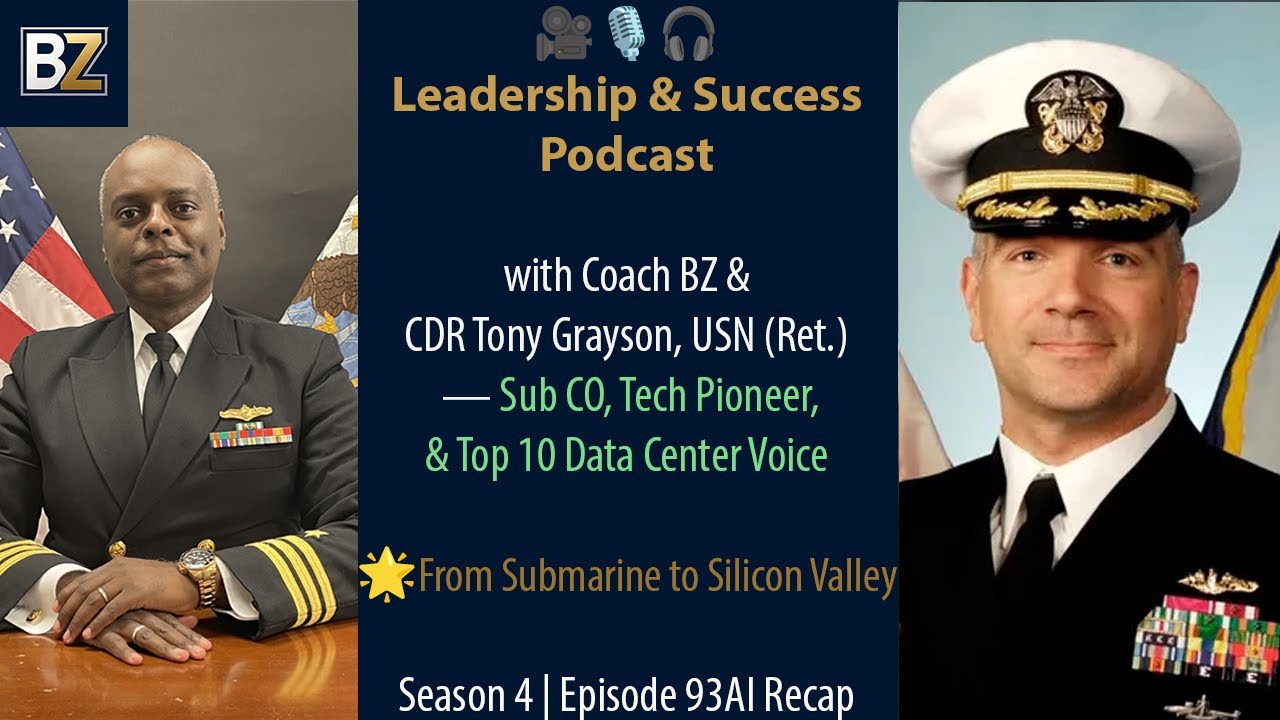
The episode opens with Coach BZ’s promotional pitch for the Leadership and Success Podcast, featuring endorsements from John Maxwell and a preview of upcoming guests. The core interview centers on retired Navy Commander Tony Grayson, who shares how his experience commanding a nuclear submarine forged a leadership philosophy built on "command by negation," servant leadership, and learning from controlled failures. Grayson explains how he transitioned those principles to the civilian tech world, leading a modular data‑center company that supports AI infrastructure. He discusses the importance of delegation, self‑reflection, influence over authority, humility, and grit, and highlights his Stockdale Award as peer‑validated proof of his leadership impact. Technical insights cover AI inference versus training, power distribution challenges, micro‑reactor concepts, and ethical safeguards such as digital provenance. The episode also includes a gratitude moment, a civic‑duty voting reminder, and a schedule of future podcast guests. The AI‑generated 5‑minute overview and 10‑minute recap distill these themes into five actionable takeaways for listeners.
Chapters
Imagine gaining the leadership skills that could redefine your career. Join Coach BZ on the Leadership and Success Podcast, where each episode delivers practical insights from world-class speakers, military leaders, and industry experts. We dive deep into what matters most: building resilient teams, leading through uncertainty, and navigating complexity with clarity and confidence. Every conversation is crafted for aspiring leaders like you who are ready to grow, lead, and make a lasting impact. Don't miss our powerful live sessions and recent highlights. Michelle Hayward on building diverse, high-performing technical teams. Ann Leslie on leading through global complexity and cybersecurity risk. Ron Carpenter AI exploring faith, resilience, and AI-powered leadership. Colonel Michelle G.I. Gardner-Ins on commanding influence from the battlefield to the boardroom. Chris Robinson on shifting from drift to drive on life and leadership, and Coach Enrique Acosta Gonzalez on mentorship, legacy, and heart-centered leadership. Ready to level up your leadership journey? Tune in on Spotify, Apple, Audible Podcasts, YouTube Live, and LinkedIn Live. Join the movement toward leadership excellence. Listen now and start transforming your success.
Hi, I'm John Maxwell. When the top companies in the world are looking for trainers, speakers, and coaches, changes, there's one name that stands above the rest, and that's Maxwell Leadership. Our certified team members have gotten proven results for companies all over the globe, and our reputation, I'm proud to say, is second to none. Some of our members have risen to the top of their profession, including the one you're going to meet today. I proudly introduce you to my friend, Bob Fabien Zinga.
Welcome to the Leadership and Success Podcast with your host, Coach BZ, where we help you lead with purpose and succeed with impact. If you're ready to grow into the kind of leader others want to follow, this podcast is for you. If you're determined to elevate your success and leave a lasting legacy, this podcast is for you. As my mentor, Dr. John C. Maxwell, reminds us, everything rises and falls on leadership. Our goal is simple: to inspire you, challenge you, and equip you with insights that can transform the trajectory of your leadership journey. Welcome aboard to another episode of the Leadership and Success Podcast with Coach BZ.
In a certain thing, and that's fine. So how can you find something that they will be successful in? It could be catered to their needs and their wants.
That's true servant leadership. So as a leader, what are you learning now?
I think I learned— I, I was probably arrogant 4 years ago and thought I could run a business. I got super lucky where I, uh, I was with Chris under Compass, and he let me fail a lot and gave me the mentorship that I needed. I think really it's learning how to run a business has been the thing. And it really comes down to sales and it's not yourself selling an idea, you're selling a hue of what they need. So it really, you're selling to the person across from you, not the idea of what you have. And I think, but that is also transformative on leadership too. I think if you think, you know, in the end we're all humans, we're all dealing with humans and is, and that's dirty and that's mucky and it's not easy. As soon as you recognize that, I think it's. It's much easier to make decisions and run something than it is otherwise. And I think it's— I think that's really what I learned. It's how to do that kind of stuff, how to honestly lead, how to honestly come up with a strategy, how— what sells, that kind of stuff. Don't just jump on the bandwagon and make a business.
Powerful. Always trying to find a win-win for everyone involved. And who are some of the people that you know that we should know, some of your mentors or thought leaders?
And I've been super lucky, you know, it's like Joe Cava from Google, Brian Cox from Stack, um, you know, Carrie from Colt. I mean, I have so many leaders in our industry who are CEOs who I've been able to call and ask questions. I mean, the biggest one recently was Chris, who, like I said, took a chance on me, uh, taught me how to lead and, and let me know when I screwed up and, and let me fail and and let me learn how to actually run a business. I, like, if I would have— my business would have failed if it was just me back in the start if I didn't have that kind of leadership and oversight. So I've been super fortunate. But the big thing is, don't be afraid to ask those leaders if you— like, what's the point of you trying to figure something out? And I used to consider this micromanaging, but wouldn't it be better if you asked your boss if they've done something before and they can give you advice? On. And they might have an idea that, you know, instead of you spending 3— like how disheartening it is, you work hard for 3 weeks and you do something and it's not what was wanted. But if you would have asked that question, if you would have had, you know, the, the gumption and putting aside your ego to ask the question ahead of time, you know, has this worked before? Have you done something like this? What are you actually trying to get? You would have stopped that free waste in 3 That is so true.
And, uh, you were also awarded the Vice Admiral James Bond Stockdale Award for inspirational leadership. Uh, what does that recognition mean to you personally, and what leadership philosophy does it represent?
I'll probably take that one to the grave with me, and probably it doesn't really matter, you know, whatever recognition I have. That one matters the most to me because it's voted on by peers. You can't put yourself in for it, your boss can't put yourself in for it, and you're— there's only 2 selected each year, and that's out of all the COs. So it's all the SEAL COs, all the aviation COs, all the SPO COs, all the limited duty COs, all that kind of stuff. And, you know, to me, yeah, I, I really do think You know, I know it's most people pay it lip service, but I really do think that was a function of my crew. They made it very easy. I had a very good team that once I finally, you know, got my poop in one sock and realized that I could do it myself, that I really need to empower and train them. That really made all the difference in the world. Wow. Like I said, it's, it's very tough to put that aside, but that's probably, you know, one that I will recognize most and like most. Because—
All right, everyone, this is Coach Bizzy, and today is Tuesday. Today is voting day. Like I've said on LinkedIn earlier today, if you live in California, I believe 33 states out of the 50 are voting today. If you haven't voted yet, please do so. Thank you to those who did vote by mail or who voted early. Thank you so much. But it's very important to vote. If you are a U.S. citizen, it's really your civic duty. And even more than that, if you are a woman or a person of color, many people have paid a very, very high price to give you the privilege and the honor to vote. So I think you need to make your voice heard. Again, I want to encourage you, no matter how you vote, as a citizen, I think it's really truly your duty. So let's start with our moment of gratitude as it is our custom. So we always like to take just a minute to be grateful for one thing every single day. I think that's very, very important, especially for those in the military, as about 22 veterans commit suicide every single day in this country. So I think it's important to be grateful every day. So I make it a custom. So if you would, Close your eyes and maybe put yourself in your happy place and take a deep breath and think about one thing you are grateful for right now. I think I am grateful to live in a country where my voice does count, right? One person, one vote. Things may not go the way I want, and the entire country may not vote the way I do, but just having the opportunity to do so, I think, is such a blessing. And being in the military, that's part of the reason why people join the Navy, the Army, and all of the other branches of the military, to defend our freedom and democracy around the world. So I am grateful for the opportunity to vote, and since I became a U.S. citizen, I voted at every single election, not just national election every 4 years, but all of your local elections, city, county, and state election, because I feel like your local election probably have a lot more impact on you, the way of living, how you live, the taxes you pay, and all of that than the national election too. But anyway, as I said earlier, please do take the time to vote. So today we're going to have the 10-minute— actually, I should say 15-minute AI podcast recap of the leadership discussion I had with Commander Tony Grayson, submarine commanding officer, tech pioneer, and top 10 data center voice in the world right now. So I want you all to go back and watch season 4, episode 93. That's the full episode. Today we are going to get the recap. So first, I'm going to play a 5-minute overview, and then the 10-minute recap. And if you have a question for me, please go ahead and type it in the comment and let us know what you are grateful for. And also let us know where you are joining us from, what city, what state, and if outside of the US, which country. And also appreciate it if you can tag a teammate, a seller, a mentor, a mentee. If this podcast is adding value to you, please have them join in and also subscribe to the podcast, whatever platform you use. We are on all of the major platforms, and I do appreciate your support. And then after you listen to a 15-minute AI Recap, please let us know what are your 3 takeaways from this episode and which leadership insight you will be putting in practice this week. Because the great thing about leadership and success is not just what you know, but it's really how you put it in practice, what you do. That's really what matters, taking action. One of my mentors, Tony Robbins, says, right, massive action. That is so, so important. And that's really what's going to make all the difference. Okay, here we go. So let's listen to first the 5-minute overview, and right after that, it's going to be the 10-minute AI recap.
So what in the world does commanding a nuclear submarine have to do with leading a company in Silicon Valley? Well, it turns out, a whole lot! We're gonna dive into the incredible journey of retired Navy Commander Tony Grayson, a leader who's navigated both the deep ocean and the world of high-tech algorithms. And trust me, his insights are a game-changer. This quote, man, it just says it all, doesn't it? It perfectly captures a philosophy that was forged under the most extreme pressure imaginable. We're talking about a world where every single decision could mean life or death. And there's no one you can call for backup. For Grayson, this isn't just a nice-sounding theory; it's the reality that has shaped every single move he's made, from the command deck to the data center. Okay, so let's get into it. Where did this all start? Well, Grayson's core beliefs were hammered into shape in the ultimate pressure cooker: a nuclear submarine. It's an environment that offers a kind of leadership test that very few people in the modern military ever get to experience. I want you to just picture this for a second. The hatch closes, you submerge, and that's it. You are completely and totally on your own. Grayson calls this true independence of command. It's a situation that forces a unique kind of leadership because you simply can't micromanage your way to success. As he puts it, it will break you. So this incredibly intense environment led him to a really powerful idea called command by negation. It basically flips the whole traditional top-down model on its head. Instead of your team waiting around for orders, they are empowered to act, to make decisions, to take the initiative unless you specifically tell them not to. It's a system built completely on trust. And the result of that? You get a culture with absolutely zero room for ego. I mean, think about it. When a 19-year-old sailor feels safe enough to tell the commanding officer of a nuclear sub, Sir, that's wrong. And they're right. You've built a team that can stop disasters before they happen. Grayson is super clear on this: if your crew is scared to tell you you're wrong, you've already failed. All right, so after 20 years, Grayson faced a totally new mission, transitioning into the civilian world. And he realized pretty fast that while the core principles, you know, like integrity, they're universal, the context changes absolutely everything. See, in the military, you can pretty much assume everyone shares the same "mission first" mindset. But in a tech company?
Whew!
You're dealing with people from different countries, different generations, with completely different motivations. The big takeaway is that your leadership style has got to adapt. What comes off as "command presence" in the military can just look like straight-up arrogance in a corporate office. So what's his advice for other veterans making this jump? It's simple, but it is so profound. He says, "Don't rush in. For the first 6 months, just be quiet. Observe, listen, and learn the new culture." Because as he says, "Leadership without context is arrogance." You have to earn that buy-in all over again, through influence, not just authority. Now, this might be one of the most important lessons in this whole thing. Grayson is blunt: True growth, it doesn't come from your wins. It comes from your failures. It comes from those tough moments when you're forced to look in the mirror and ask, okay, what was my role in this? And to explain this, his mentor gave him this fantastic analogy. There are two ways to fail. You can hit a ditch, which is recoverable, or you can hit a pole, which is a catastrophic crash. A great leader's job is to let their team hit the ditches. Let them make mistakes they can actually learn from, but never let them get anywhere near a pole. So today, Grayson applies all these hard-won lessons as the president of NorthStar, a company building defense-grade modular data centers. And you might be surprised at how relevant his submarine experience really is. The mission is all about bringing those military principles— redundancy, resilience, readiness— to AI infrastructure. It's just like being on a submarine. You have to design systems that are built to survive failure, that are distributed, and that are ready for any disruption. This brings us to a huge question that's kind of hanging over the whole AI industry. You've probably heard it with all this development. Are we literally going to run out of power to support it? Well, Grayson's answer just cuts right through all the hype. He argues that no, that's not true. AI is actually getting more and more efficient. The idea that it needs endless power is just wrong. The real bottleneck, the actual problem we need to solve, is distributing that power to where it's needed. So, after this whole journey from the deep sea to the cutting edge of technology, what are the core principles that really guide a leader like Tony Grayson? What's the secret sauce? He calls it a leader's North Star. You know, that one thing you always come back to, no matter what. And in a moment of just incredible honesty, he admits that for a long time, his was ego. The real turning point in his career was when he shifted that North Star to be about his people. That's true servant leadership right there. And it all boils down to 5 big takeaways that pretty much anyone can use. 1, delegate to help your people grow, not just to control things. 2, when something goes wrong, look in the mirror first. 3, lead by influencing people, not just by having authority. 4, stay humble and always stay curious. And finally, number 5, persist. Just don't give up. Grit, he says, is the most important thing in the world. And that leaves us with one final powerful question to think about. In your own work, in your own life, what's that one unchanging principle you always come back to? What's your North Star?
Welcome to our podcast. Today, we're diving into the fascinating journey of a former submarine commander turned tech leader, where leadership under pressure meets the modern world of AI and data centers.
I'm really excited about this. What a unique blend of military grit and tech innovation, right?
Absolutely. It's like navigating the depths of the ocean and then shifting to the high-tech corridors of Silicon Valley. It's, uh, An evolution of leadership that's both riveting and instructive.
Yep.
So tell me, what really stood out from his story?
Well, one of the central themes is definitely the concept of leading under pressure. Think about being on a submarine. Every decision carries life-or-death stakes. And for him, that experience carved out his philosophy: calmness in crisis, conviction amid uncertainty, and compassion even when the stakes are high.
That's really powerful. It reminds me of when you have to delegate in high-pressure situations too.
Exactly. And delegation is a critical point here. He noted that true delegation isn't just offloading tasks. It's, um, trusting your squad enough to let them take risks and even fail sometimes. That trust builds initiative.
Right. But don't you think that can be a bit risky? I mean, what if someone makes a mistake that costs dearly?
Good question, and, um, he did acknowledge that risk. However, he argued that leadership is all about learning from failures. It's like when you let someone stumble, you offer them an opportunity to grow. It's a controlled release of pressure so that the team evolves together.
Hmm, I see. That kind of mentality, empowering others to step up, could really transform a team.
Absolutely.
And moving on, another interesting concept he introduced is what he called "command by negation." In a submarine, it's imperative that everyone feels safe to speak up, even if they're the youngest on board. Imagine a 19-year-old challenging the captain and being, well, absolutely right. That's the sort of culture that fosters innovation and accountability.
Yeah, that's impressive. It really breaks down the traditional hierarchy, doesn't it?
It does. And it's a theme that travels into his corporate journey as well. After transitioning from 20 years of military life to the civilian world, he realized that leadership isn't as transferable as people think. You have to adapt, listen, and learn a completely different culture.
Yep, that makes sense. Speaking of transitions, he also mentioned the shift from command presence to influence presence. Can you elaborate on that?
Sure. So in the military, you're used to giving orders and that's accepted. But in the corporate and tech space, that same demeanor can easily be read as ego. Instead, leaders are now expected to earn buy-in. It's more about influence rather than authority.
I get it. It sounds like a complete paradigm shift, moving from direct control to a more empowering collaborative style.
Yes, and it really challenges the old idea that, um, leadership is something you just carry over from one environment to the next. He advised taking time, like 6 months, to truly observe and adapt to the new culture.
Exactly. Now, what about his perspective on technology and AI? That seems to be another core component of his story, right?
He's very pragmatic about AI. Despite its flashy marketing, he stresses that the real value in AI comes from inference, not training. In other words, it's about applying models to real-world data rather than just building bigger models. He even mentioned that in the current AI landscape, We've pretty much scraped the internet for data. Now it's all about how you use that data effectively and efficiently.
Right, right. That's a stark reminder that scale doesn't always mean better. It's all about optimization, isn't it?
Exactly. Optimization and distribution. In his role overseeing modular data centers, he applies the same principles learned underwater— redundancy, resilience, and readiness. Just like a submarine relies on backup systems, a data center must be designed to survive failures.
That's a brilliant analogy. The submarine and data center both need to account for, uh, every point of failure.
Absolutely. It's like designing a fortress that can adapt and absorb shocks. And he even hints at energy innovation, talking about, uh, microreactors that act like a nuclear battery. Not your typical mega project, but small, efficient, and scalable.
Yeah, that's pretty cutting edge. It's almost as if he's saying, take the discipline from high-stakes military operations and apply it to defying tech challenges.
Exactly. And there's an air of humility too. Despite all the accolades, like being awarded the Stockdale Award, he credits his achievements to his crew and his willingness to learn from personal failures.
Hmm, I love that. True leadership isn't about being infallible, but rather being reflective and humble.
Right. And he underscores that failure isn't something to avoid, it's a crucial teacher. Remember his analogy about ditches and poles. A ditch is recoverable, but a pole can really knock you down. Leaders should aim to let their teams hit the manageable ditches, not the hard crashing poles.
Yep, I like that imagery. It really drives the point home. It reminds me a bit of the philosophy in martial arts: you learn more from the falls than from the victories.
Ah, exactly. It's like, um, each failure is a stepping stone towards a more mature leadership style. And aside from lessons in failure and delegation, he also emphasizes the importance of keeping your north star in sight. Your mission, your people.
It's all about aligning your actions with core values. And that ties into his more personal reflections too, right? Like he mentions family as his anchor.
Yes, absolutely. For him, success isn't just about professional achievement. It's measured by legacy, raising good kids, making a positive impact, and staying humble. He admits that early in his career, he was driven by ego, but later shifted his focus to people and purpose.
That's a refreshing perspective. It really challenges the norm in high-stakes leadership, don't you think?
Definitely. And he even uses biblical references to frame his insights, like encouraging leaders to be brave and to trust in a higher purpose. It adds a layer of depth to his already rich narrative.
Mm-hmm. That adds a very human touch to his technical and operational expertise. Speaking of human touch, he also warns about the ethical challenges in AI, like digital provenance and watermarking. How does he balance that?
Great point. He's quite candid, saying machines might calculate faster, but they don't assume responsibility. For him, ensuring ethical safeguards in AI is non-negotiable. He advocates for global cooperation on AI safety to ensure technology ultimately serves humanity.
Right, we definitely need to keep a check on technology's moral compass. There's a lot to unpack there—innovation, ethics, leadership, and, um, energy efficiency. It's like a masterclass in navigating modern challenges with a backbone of tried-and-true principles.
Exactly! And don't forget his insights on transitioning from a military mindset where everyone's mission-driven, to a corporate world full of diverse perspectives. That requires a huge dose of humility and adaptive learning.
Mm-hmm, that's a tough lesson for many veterans to grasp. I actually wonder though, doesn't his military background sometimes conflict with the fluidity required in the corporate world?
You know, that's a valid concern. But, um, he actually challenges that notion. Saying that relying solely on a command presence in more collaborative environments can come off as, well, arrogance rather than leadership. Instead, he pushes for an influence presence that adapts and listens.
That makes sense. It's like he's saying leadership is not a one-size-fits-all suit. You keep tailoring it as you learn.
Exactly. It's all about continuous learning. And honestly, that's what makes his story so compelling. The blend of discipline from the deep sea world with the ever-evolving challenges of modern technology and ethical considerations. Mm-hmm.
Very inspiring. Absolutely. And it leaves us a lot to think about, especially when it comes to balancing technical expertise with emotional intelligence and ethics. Yep.
And as he succinctly puts it, Leadership is always learning. If you're still adapting, you're still leading. That's a powerful mantra for any leader, regardless of the field.
Right on! Well, thanks for that deep dive into a story that bridges oceans with data centers. It's been fascinating to explore those leadership lessons and see how they apply across such different environments.
Alright, that was the AI recap. I don't see any question on LinkedIn or YouTube. Okay, this is going to be a reminder. So first, if you want to listen to the entire podcast, it's about an hour long, Season 4, Episode 93. You can download it everywhere podcasts are available. And tomorrow, I'm going to have a very special guest. I'm going to be speaking to my buddy Commander James Sedin, US Navy retired. So that's going to be here on tomorrow. And I hope you don't miss it. And I'm going to be talking to him, it looks like it's going to be about 1:30 PM in the afternoon, California time. And then on Thursday, I will have a very, very special guest, my friend Mita Malik. She's a bestselling author, WordPress strategist, and top voice. And that's going to be on Thursday. And we're going to be meeting at 12 noon for about 45 minutes. And Then on Friday, I will have a great honor and privilege of sitting down with General Glen VanHerck. He's a former commander for NORAD and US NORTHCOM. We're going to be talking about AI, drones, and decision space. So don't miss it. That's going to be Friday, and we are meeting at 8:30 in the morning. And then the following Monday, I will have one of my mentors, Dr. Tim Elmore, bestselling author, keynote speaker, and founder. We're going to be talking about this brand new book about Gen Z, The Gen Z Playbook: Leadership 2.0. You don't want to miss that one. I know my kids have taught me a lot about Gen Zs because they are a little bit different, right? They're not like Millennials and Generation X, Gen X, like we are. You have to learn how to motivate them and inspire them because they are our next generation of leaders. So they're going to be our future CEOs, commanding officers, and state senators and president and so on and so forth. So we definitely need to learn how to handle them. And then the first day next week, I will have my friend Coach Divya Smith. She's an investor, entrepreneur, and executive. So we have a lot of interviews laid up for this week and next week, and I hope you can join us. And this is it for today. Thank you so much for watching and have a wonderful day. And again, even after the show, you can watch the replay and let us know 3 takeaways and 1 insight that you're gonna be able to put in practice today. All right. Have a wonderful week. Bye. Bye, everybody. This is Coach Bizzy. Thanks for watching. Until next time, don't forget to like, comment, and share.
Thank you for tuning in to the Leadership and Success Podcast with your host, Coach BZ. If today's episode added value to your leadership journey, be sure to subscribe, share, and join us again for more wisdom nuggets on how to lead better and achieve greater success. Remember, leadership is the most critical skill of our time. The world will always need leaders to inspire others, drive innovation, and execute meaningful strategy. So why not count yourself among the bold leaders shaping the 21st century. Until next time, stay inspired, stay committed, and keep leading with excellence.
More from Bob

S250:E4🎙️LIVE 🇺🇸America 250: President Barack Obama Leadership, Service, and the Power of Hope






S5:E157🎙️ LIVE with CMD CMSgt Dennis L. Fritz, USAF (Ret.)(Multi Tracks Audio)



S5:E156🎙️ LIVE 🇪🇸 Leadership Lessons from the FIFA World Cup 2026 Champions (Multi Tracks Audio)

S250:E3🎙️ LIVE Leadership Lessons from America’s First Documented Family of African Descent 🇺🇸📖