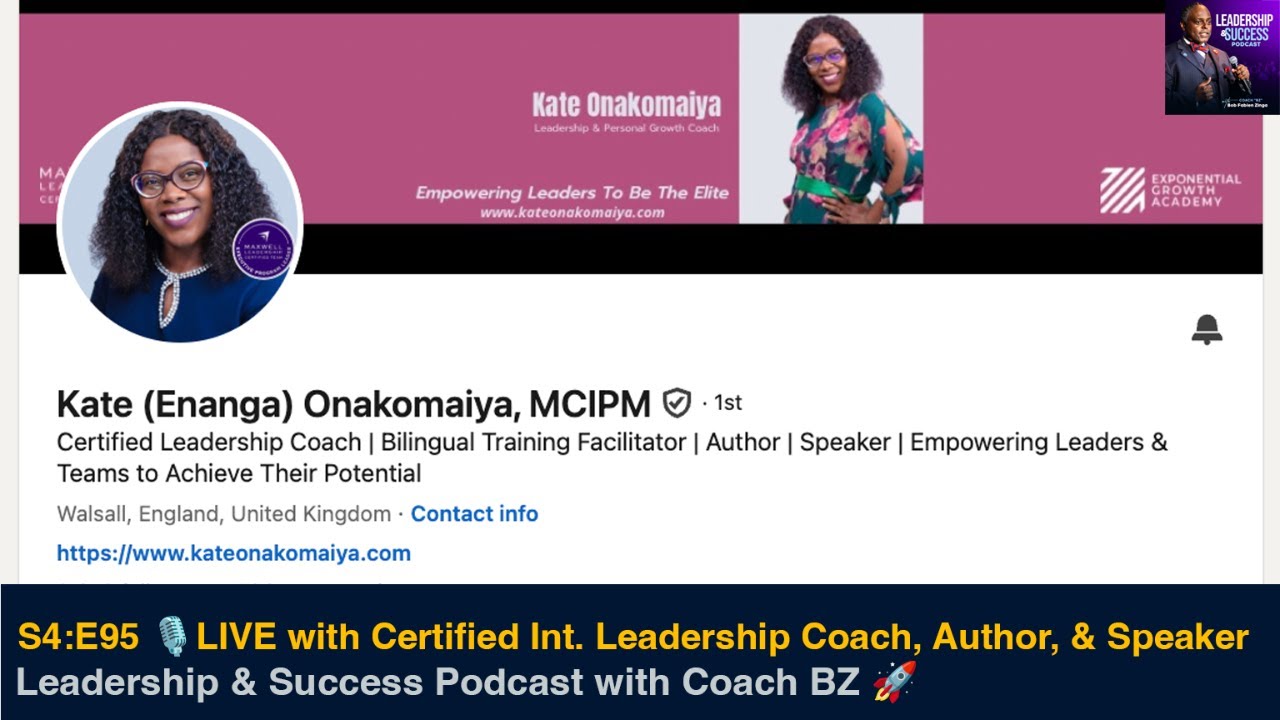
Kate Onakomaiya, a Maxwell Leadership Coach and Goldman Sachs 10,000 Women Fellow, talks about her path from finance in Nigeria to coaching, her mentorship under John C. Maxwell, and how intentional growth transformed her leadership. She shares that leadership is influence, discusses daily habits for growth, and emphasizes that people matter and kindness drives her work.
Chapters
Welcome to the Leadership and Success Podcast. Today I am not able to play my introductory video. That is okay, we are live. You should be able to listen to me. If I can please get Confirmation, someone watching, please type that you can watch and listen and let us know where you are joining us from, what city, what state, what country. If outside of the US, let us know what you are grateful for. And also, if you have a question for my guest, please type it in the comment. Thank you so much for being with us. So we're gonna start with our moment of gratitude like we do as a custom on this show. I want you to think about one thing that you are grateful for. All right, so you can close your eyes, take a deep breath, put yourself in your happy place, and think about one thing you are grateful for today. I think today I am really grateful for technology. I think we over-rely on technology, but when it works, it's just like magic. And I am grateful that with the power of technology, we can connect with people across America, and around the world. It is really amazing, me being here in California, in Silicon Valley, being able to talk to an international coach in Birmingham, England. It's just amazing what technology can do. All right, without any further ado, let me introduce my guest today. Today I would like to introduce Coach Kate Unakomaiya, and For those who don't know, she is a certified Maxwell Leadership Coach like me. She's a bilingual facilitator just like me. She speaks English and Français. And she's an author just like me. She's the author of A Growing Life: 10 Principles for Creating a Life of Intentional Growth and Staying the Path. For over 2 decades, she has had the privilege of working with leaders and teams across Africa, Europe, and the United Kingdom, helping them unlock potential, communicate with impact, and build cultures where people thrive. Again, help me welcome Coach Kate Onakomaiya. Hold on.
Hey!
All right, I think I can hear you. Okay, I can finally see you. Good to see you, Coach. Thank you so much for Yeah, man, it's been a challenging morning with technology today. So the introductory video, I couldn't play it now, but that's okay. On the podcast, that's going to be on Apple Podcasts and Spotify. I will make sure to include that. All right, to get started, uh, what is one thing you are grateful for today, Coach Kate?
Oh, today I am just grateful for my family. I'm grateful for, for my husband, my kids. And I'm just grateful that we have a close relationship, close bond.
That is wonderful. And, uh, can you tell us about one thing about you that most people may not know?
Oh, one thing about me that most people don't know is that I'm an amateur gardener. So I started gardening— well, I, I just started a little bit in 2023 and then I stopped. But this year I went kind of like more into gardening, learning about it, growing. So I grew vegetables, I grew tomatoes, and I grew onions, and I grew mint, and I grew a lavender plant and aloe vera. So I've just been trying my hand at gardening, and it's so interesting to watch my plants grow.
Wow, that is so good.
My fresh produce, as you see.
Wow, that is so wonderful. Can you tell us about your leadership journey?
Oh, my leadership journey, it's— where would I begin?
Ask her back as you want.
Where do I begin? Well, it's just been a journey of growth and learning for a long time. I started becoming really intentional about my leadership growth and development in 2011 when I realized that my team wasn't growing and I realized that I, I wasn't growing and I needed to become a better leader. That's when I started going after leadership books intentionally, looking for resources to grow I got connected to A Minute with Maxwell. At that time, I was also searching for an academic program on leadership that I could do. I was really looking to grow as a leader, intentionally grow as a leader, and not just assuming that I was leading. Because prior to that, I had the assumption because I was leading a team, I had a business, I had employees, so I just assumed that, oh, I'm a leader. But I realized that I needed something more. So in 2011, I got connected with John C. Maxwell more deeply and started following him intentionally. And then in 2012, I joined his team, his Legacy Team, and I've been mentored by him since, ever since. It's been a really wonderful journey of growth. I'm privileged to be a part of his Maximum Impact mentoring program where every month I get to learn from him, learn leadership from him. So I'm really gaining so much from, from him in that area of leadership. Of course, I've read other leadership authors. I follow different authors as well, not just John, but John is really like my, my main person, my Papa John, right?
Well, We definitely have that in common. What is your favorite book from Papa John?
Well, my favorite book from Papa John is The 15 Invaluable Laws of Growth.
Yeah, that's really my number one.
It's kind of like a growth manual for me, and I go there— that, that's the book that really taught me about intentional growth, that I have to know myself to grow myself. And yes, I just love that book. If you see my copy, it has ears, it has— it's so worn out because I keep it like, you know, like my— like an old Bible that you don't want to let go of. I have a new— I have new ones, but I just love that old one.
Yeah, yeah, it's, it's one of my, uh, favorite too. He has so, so many. Of course, to me, the one I really like the best is, uh, the 21 Irrefutable Laws of leadership. But that, that is so wonderful. So tell us, when we look at your career, you've had such a fascinating journey, right? From corporate finance in Cameroon, where they speak French, which is in Central Africa— I am originally from the Congo, Central Africa too— and Nigeria, to executive coaching across Europe and the UK. What inspired your transition from managing money to developing people?
Oh, Managing Money, it— I would say it was inspired, inspired by marriage actually. So when I got married, my husband is Nigerian, so when I got married I had to move to Nigeria. And where we were in Nigeria, I, I had the choice to shift, really to make a shift from managing money, finance, like in the finance part of the world, where the world— to customer service and commercial banking. One thing I love is I was still managing money but in a different way, not as an accountant like I used to be and do back in Cameroon, but as a personal financial consultant. And so I started helping people to, you know, to see how much money they have, what they can do with their money, to ensure that they have, you know, they're in touch with their investments and they have someone that they can relate with in terms of their banking needs and also ensuring that they have proper, really great service from the bank. Yes, so that was a transition that moved me from Cameroon finance to personal financial consulting and customer service, which was more of a people-facing role, and then later coaching.
That is really fascinating. What personal turning point led you to found Exponential Growth Academy and dedicate your life to empowering leaders?
Right, Exponential Growth Academy was born out of my desire to grow and see others grow, and not just grow, um, in, in a haphazard way, but in a structured way to grow intentionally. And I believe that if we can focus on growth, we can achieve our goals. So Exponential Growth Academy It's a space where people can actually become the best versions of themselves, and we do that through coaching, speaking, training, facilitation in English and French. And we also do keynote speaking at organizations. Yeah.
Wow, that is really, really fascinating, just the impact you've had, not just in Central Africa, but I guess Nigeria would be West Africa, in Europe and European Union and in the UK. And I know you do come to the US quite a lot. I'm surprised I missed you during the last IMC. It looks like you were in Orlando, right?
Yeah, I was in Orlando.
Yeah, maybe I'm going to meet you in person, the one next year. But one question I have for you with all of the global impact you are having, you know, someone who works across continent, what do you think are the universal truths of leadership that transcend culture, language, or geography?
One truth: leadership is influence, nothing more, nothing less. Yeah, I think that phrase, I, when I heard it the first time from John, I doubted it But as I grow as a leader and studied leaders and also empowered leaders, developed leaders, I realized that that statement, it's kind of like an absolute. Leadership is influence, nothing more, and it transcends culture and time. If we look at the greatest leaders in the world today, there's one common trait. Everywhere they have influence. Yeah.
Wow, that, that is so powerful. And I think it's probably the easiest, uh, simplest definition of leadership I have ever heard. And what it tells to me is, for you to be a leader, you don't have to have a title, right? And you don't have to have people that you supervise, because you can influence your neighbor, you can influence your children. Even as a parent, you can influence someone else. And that's really The Essence of Leadership. So let me ask you this. How do you coach leaders to balance ambition with contentment, the tension between striving for more and appreciating where they are right now?
I love that question. You know, in my book, The Growing Life, I know we're going to talk about it, but one of the principles that I talk about in my book is reach for more. Reach for more. And not more money, not more fame, not more titles, but for a higher version of yourself and to stay connected to your source. So I love talking about more. I believe that we are created for more, and I believe that that is the essence of people, the desire, of the desire to grow. Because we, you know, deep down in you that you have a great potential. And so our potential is always calling us to seek a higher expression of ourselves, to just reach out for more, more of who we are created to be. So for me, when leaders do that, reaching out for more from inside, more of who they are, more of their potential, more, uh, more influence, then we can really achieve greatness.
Wow, that, that is so powerful. So you mentioned your book, and I want everybody to get a copy, The Growing Life. And, uh, in your book, no, it has become a beacon for intentional growth. What does growth mean to you, and how can leaders avoid stagnation in their careers or teams?
Oh, for me, growth is simply reaching, like I mentioned, reaching out for more. I believe that we have an inherent desire inside of us to be more, to have more, and to do more. When we respond to that desire that is inside of us and we start taking intentional actions, you know, to just live a full, a more fulfilled life and to be the best version of ourselves That is growth. That is growth. That's what it means to me.
Let me ask you this. So for this audience, all kinds of people listen to the show, but those I focus on the most are the aspiring leaders in the military and in high tech, right? So, and many of them, they really lead under a lot of pressure. How can they create daily habits that drive both personal growth and professional excellence?
You know, Coach Bizzy, when we think of growth, right, we think it's something that I have— it's really big steps, big things that I have to do. It's probably, oh, I need to pick a book and read, or if I have to take a course, or I need to attend an event, or those big things. But growth happens daily, and it happens with small actions, small steps. And it happens with conscious choices that we get to make. When we started the— this podcast, you told us, you asked, what are you grateful for today? An attitude of gratitude, that's one area, that's where we— growth comes from that. When we start becoming grateful for small things, we are sparking something inside of us and we're sparking our potential that works We're just seeing a light. So growth happens every day by taking small intentional actions. Yes, you, you need to read. That's important. But there are several ways, there are different ways you can read. You can read a physical book, you can read an audiobook, you can read an ebook. And you don't really need to read so much in a day. I say 10 minutes, 15 minutes is just perfect. If you can do that consistently, over time you will find yourself becoming more, having more, and doing more.
That is, that is so powerful. So in your case, you coach and facilitate in both English and Français, uh, and even Japanese too, uh, which I understand Japanese just a little bit, but it's a very difficult language. I've gone to Japan several times especially Yokosuka, I've been based there with the Navy. But in any way, how has multilingual coaching deepened your understanding of human connection and leadership?
Well, I don't— Japanese, I'm still learning Japanese. I'm just fascinated by the language and the culture. And so I'm learning Japanese from Duolingo, just the basic things.
Oh, I see. Because I think my daughter will be speaking Korean before I learn Japanese. She likes K-pop music. But anyway, and I was also shocked last time I went to France, her cousins, right, my nieces and nephew over there, French-speaking African people originally from Africa, they are dancing and speaking Korean because they love K-pop. It's just amazing how much that music has influenced this Gen Z. It's incredible. Anyway, yeah.
Well, I think the beauty of being multilingual is the ability to— I think it helps our creative thinking. It helps me to think creatively and culturally. You know, that there are different cultures, there are two cultures, languages, cultures are attached to languages. So the cultures are different. And one thing that sometimes even amazes me is the ability to switch from one language to the other, the ability to think in English and to think in French, and to just— just— it's kind of like a dance to me.
Yes.
I mean, something happened recently, just last week. I was driving and I'd left the house, and I realized that I forgot something, and unconsciously I said, zut!
So let me, let me ask you this. Being from Cameroon, French is your first native language. When you dream now, do you dream in English or in French?
When I dream, I dream in English. Sometimes I think in French, and I think, I mean, it just happens spontaneously. And sometimes I have difficulties finding words in both languages. I can think of something in French and I'm looking for the English meaning, or I can think of something in English and I'm looking for the French meaning. So sometimes my husband catches me, I will say something that is the French version of that thing and he'll correct me. I know that's not how it is, but that's really something.
Now, your husband being originally from Nigeria, so English is his native language, does he speak French also?
No, no, he doesn't.
My wife doesn't speak French fluently. I think if I take her to Paris for like 2 weeks, she will be able to, but she's been studying for maybe, you know, 10, 15 years now. She understands French when it's written down. She can read it and understand it, but when it's spoken, it's too fast. She can't really pick it up. But same thing with my kids. She's originally from the US, so just like your spouse, English is your native language as well. Now, here is another big thing we have in common. You both, you and I, we are both Maxwell Certified Coaches. So Papa John is our primary mentor. Let me ask you, Patrick, your experience with Maxwell leadership. So how has Papa John's mentorship and methodology influenced your own leadership DNA?
Oh, tremendously. I mean, John's leadership ideologies are just life-changing. And I like the fact that he, he really talks more about leadership being servant service, that as leaders we are called to serve. And I, I love the legacy part also. John is also big on legacy. That's the, that's the reason he started the John Maxwell team, or Maxwell Leadership Certified team, because he wanted to build a legacy team that will carry his ideas, his ideologies on leadership, and just spread it across the world. So people can know and learn true leadership values and live leadership values. That's something that I've learned from him, being an authentic leader and a leader that is not afraid to fail, a leader that serves. Let me tell you a story. When I was moving to the UK, on our monthly mentorship call with John, I asked him the question and I told him, John, if you were moving to a new country, a new place where you've not been before, and you're just relocating, you want to kind of starting all over again, what are you going to do? Because that's what happened to me. I'm moving to England, and I just want to see some form of direction what to do when I get there. And John said if I were— if it were me moving to a new country, because I'm a person of faith, I'm going to find a church and serve. And he said, that's what I'll do if, if I was doing that. So when I got to England, the first thing I did was to find a church and serve. It took me a couple of months to understand But I had that word really resonating within me, and that has helped me to continue serving in my church and to really put my heart into service, you know, really serving the church, the members, and ensuring that things go right. So I'm currently the workers lead in my church, like the volunteers lead in my church, and I don't know how, I don't know how my pastor just Well, because you are a leader.
That is really powerful because I remember when I moved from Africa to the US when I was 17 years old, being part of a church, it really gives you community, right? You don't feel like you are alone and you can share life with other people who have the same values and mindset. That's really powerful. So you mentioned this one was your favorite book from Papa John, 15 Invaluable Laws of Growth. Which one of the laws means the most to you?
The law of intentionality. The law of intentionality, that's the— in fact, that is the first thing. Growth is intentional. Yes, you can't, you can't take— you can't do it any other way. I mean, Papa John has a way of saying this. He says everything worthwhile is uphill, and he says you don't just climb up a hill by accident. So you can't grow by accident. You have to take intentional steps. It's not going to happen by just sitting and waiting for it to happen, or it's not going to happen because you're growing older. You're not going to grow because you're getting older, because your kids are getting, you know, they're leaving the house and you've retired. You know, sometimes we think, oh, when I retire, I'm just going to be better.
Yes, yes. That is really powerful. And your book too, right? The Growing Life: 10 Principles for Creating a Life of Intentional Growth and Staying on Path. So intention, without it, life is just going to happen to you. You're going to end up somewhere you may not want to go. And like another one of my mentors, Les Brown, says, right? At least if you shoot for the star, you may not catch them, but at least, you know, you're going to be on top of the roof or in the cloud or somewhere not where you are now, right? You are going to be on the path toward whatever your goals are. Okay, before we go over to the second segment, I want to ask you, you are also a Goldman Sachs 10,000 Women Fellow. Congratulations for that, that's huge. How has that experience shaped your perspective on women empowerment and entrepreneurship?
Oh, the 10,000 Women's Fellowship, it's a— it was an intensive business growth program that I did in 2019, and it helped me to understand the business landscape. First of all, the business landscape, and then my leadership strengths, and also how to invest as a woman. And you know, there's a, there's a lot going on with women empowerment all over the world and opportunities for women, and women just becoming more on just growing into their potential and taking their place in business, in technology. And so the 10,000 Women Fellowship, first of all, it was a platform for me to learn and grow as a female entrepreneur. That was very important to me. And then it's connected me to a network of other female entrepreneurs, amazing women doing fantastic, doing so well all over the globe. So the community is a growing community, it's a rich community, and it just helps me to understand that there are other women out there who are, you know, reaching for more, who want to be the best they can be and are not afraid to step out and take risks.
Yeah, that is really, really powerful. We're going to be focusing on leadership now. I'm sure the question I'm going to ask you, you probably know about them. Because those are the 7 categories of questions that Papa John asks everybody he meets for the first time. But the other thing that's very interesting with this conversation is because we have both been mentored by Papa John, we really have the same DNA. So when I listen to you, it's like I'm listening to him. It's like I'm listening to myself. So it is really wonderful to have this feeling. We just met today for the very first time. I've never talked to you before, but it's as if I've known you my entire life. This is just amazing.
And we have so much in common, you know.
Yeah. So the first question I am going to ask you, and also by the way, I'm going to make sure this video is going to be translated in more than 24 languages, including French, Spanish, Portuguese, and Korean. So that's going to be fun. What is the greatest lesson you have ever learned?
The greatest lesson I've ever learned is that people matter. People matter, and people, people are worthy to be given space and opportunity to express themselves. I mean, one thing that I've learned is that we cannot disregard people, especially as a leader. Without people, there's no leadership. We lead people, we don't lead inanimate objects. People, they are who they are. Understanding human behavior, understanding people is really the key to really fruitful and fulfilling leadership, knowing that people matter and there is a way I need to relate with them so I can influence them. And when we talk of influence, by the way, it's not about— there's a thin line between influence and manipulating. We're not talking about manipulating them to get them to do our bidding or do what we want, but we're talking about empowering them so they can be the best version of themselves, so they can go to and do what they want to do, what's going to give them the best opportunities, the fulfillment, and the best life that they, they have. So that they can have. So people matter. That's really one of the biggest lessons I have learned that has stayed with me. Yeah.
Yeah, that is quite powerful. I also wrote an article about the difference between influence and manipulation a couple of months back, because once you become good at this, you can easily manipulate people to do things that you want and not in their best interest, and people have to watch out for that. So your career has really been extraordinary. Cameroon, Nigeria, Africa, European Union, and the United Kingdom, and your impact. What do you think is the secret of your success?
Oh, you know, funny enough, I don't usually think myself as success, successful. Some people say, oh, I downplay all my achievements. A lot. I downplay my journey a little bit, maybe a lot. But I think what— if I can think about it right now, I don't know if there's a particular secret to it. I'm just being who I am and just loving God and following Jesus and just treating people in the best way I can at all times, being kind and respectful. Yeah, really. So I wouldn't say there is a particular success story. I mean, like, secrets— there's no secrets. I'm just being who I am, growing to my full potential, and helping people along the way.
Yeah, that is, uh, very powerful, reaching your full potential. Being the very best version of yourself and treating people right. It goes back to what you said earlier, people matter and they really do. In the Navy, we say, you know, mission first, because you do have to accomplish the mission of the command. However, people always, without people, you can't do anything. And wow, that is powerful. So let me ask you then, leaders are learners like Papa John has taught us. What are you learning right now?
I'm learning how to be a better coach. Right now. And currently it's driven me to, to take the ICF accreditation. I'm currently working on ICF accreditation, but I want to be the best coach I can possibly be in the world and to help as many people as possible. So I believe that I'm called to coach. That's one thing. I love coaching, and when I coach and people, my clients, get the results, they find their breakthrough, it gives me a sense of fulfillment that I can hardly describe. And so I'm focusing on learning how to be a better coach, and I'm reading books on coaching right now. One, one that I'm reading right now is Breakthrough Coaching by Marcia Reynolds. I didn't tell Masiya Reynolds' Breakthrough Coaching. And there is another one I'm reading from ICF Accreditation by Iftikhar Nadeem, Mentor Coach. Yeah, so how to be the best coach that I can be.
Well, that is, that is quite, uh, powerful. Could you share, without giving, um, details on your client, but one recent experience where it was very rewarding for you to see the result of your coaching?
Oh, you know, that's a question that I, I hesitate to answer that because I believe that sometimes it just, um, I would disclose.
No, no, I, I, I, I, I come, come completely, uh, yeah, he's seen my clients getting breakthrough, you know, in different areas of their lives.
Okay, I can, I can give example. Let me just give an example. I don't need to call names, but an executive that I was coaching, aspiring to, to get to the board level and ensure that, look, I achieved that board level position because that's my ambition. And by the time we were done with the coaching, not really too long, This person discovered that, no, I can be so much more by impacting the people closest to me, and I can start doing that right now. I don't need to continue climbing that ladder of success, but my success lies in the person in front of me, and that's what I'm going to focus on. And right now, currently, I'm seeing the person doing amazing things. I, I just thought, wow, that's so fantastic.
Yeah, because you reminded me of something else that Papa John taught us, right? The difference between success and significance. And he always says, once you test significance, success will no longer satisfy. And that is so true.
Absolutely, absolutely.
Because when you coach people, it's not about you anymore, it's about other people, isn't it?
Mhm. Wow. And that's one thing I love about coaching, that look, I can really forget myself. I can really— it's not about me, it's about the person I'm coaching at that time, and I'm totally removed from the outcome. And so my coaching can take different directions. Like, clients can come to me and say, look, I want to, I want to get a promotion. And by the time we are done, they'll find out that, oh, it's not really a promotion I want. There's something else. Why I want that promotion, and the reason I want that promotion is for someone. They kind of chart a path for themselves that ultimately leads them to that goal that they wanted to, but they grow in the process. And that's what I love about coaching, the growth that happens in the process of achieving their goals.
Yeah. Wow. From confusion to clarity and focus and purpose. That is powerful. So let me Let me ask you this. We know all about your accolades. Even though you don't think you're successful, you are very, very successful. And we know all about this. This coin says success on this side, but there is also failure on the other side of the same coin. So how has failure shaped your life? Oh, and can you talk about it?
Probably that's why I don't think myself as successful, because I believe that I still— there's so many things that I want to do, but I procrastinate I still procrastinate. Even as a coach, even as a speaker and a leader, I still procrastinate. So I fail almost every day. I fail at taking my own instructions, and I fail at doing some of the things that I know, I know I'm supposed to do. So that is something that shapes me every single day because it gives me the opportunity to reflect on how I can be better and how I can move forward. Of course, I've had failed businesses, done failed businesses. Those ones, yeah, I consider them not as failure but as stepping stones on my journey of success because I've learned from them. So for me, failure is about learning how not to do it, and then helping others to do the same, but then still allowing them to fail as well, because people need to fail. We need— we all need failure in our lives.
Yeah, well, that's powerful. Another two things that Papa John has told us comes to mind. One is, uh, sometimes you succeed, sometimes you learn. So that's how he sees failure. He wrote a book about that. And then also failing forward, right? When you fail, understanding why it happened and then learning from it And that actually enables you to be even more successful, which is quite powerful. So let me ask you this.
You know what, you know something, we don't always learn from our failures. I don't know if it's happened to you that you failed the first time, nothing, you tried again, you failed it. You thought you learned the last time, but you still, you still make the same mistake, the same mistake. The same failure. Yeah, so we don't always learn from our failure, or sometimes it takes us longer.
So what, what would you advise to an aspiring leader who keeps making the same mistakes over and over again? How would you coach someone like that to really learn from their experience?
Well, to find out, okay, what is, what is the goal? What is it you're really trying to achieve? Because sometimes we fail because um, we don't— we're not— we don't have clarity on where we are going or what we really want. So if we can find clarity on where we're going and what we really want, and some— most often you can't do that by yourself. You need someone to come alongside you and partner with you. If you've been failing repeatedly on one thing, then you need to— that, that's a signal telling you that, look, you can't do this on your own. You need the guide, you need someone to come and, you know, just help you see things in a different way, different perspective. And that's when you can actually move forward. Because sometimes when we fail repeatedly at something, we abandon it and we say, oh no, I'm not good at this thing, I'm not good, I'm not doing it anymore, you know. But there is a lesson there, there's something there for you. You just have to understand that you can't do it by yourself, you need someone to help you. And That's where coaching can help.
Powerful. So who are some of your mentors, people that you follow, thought leaders that we should know about?
Oh, I follow Ed Mylett. Ed Mylett, I like. Valerie Burton. Yeah, she's our mentor on the Maxwell team, but I follow— I've been following her even before she joined the Maxwell team. Yeah, and of course John C. Maxwell.
Oh, sorry, okay, here we go. You said Valerie.
Yeah, Valerie, one of our faculty members. Yeah, one of our faculty members. Um, Paul Martinelli. Paul Martinelli is someone that I, I really, um, I respect and mentored me and still mentors me. And then Um, I won't be speaking right now without Roddy. Yeah, of course, Chris Robinson. And then I have, um, uh, yeah, and an old-time mentor, um, Christian Simpson. You know, I want to acknowledge the people that have helped me on my journey because they've, they've really helped me. They've taken me to from one point to another point. Yeah, and those people, they played an important role in my life. Right now I'm following Marcia Reynolds. Marcia Reynolds, she's an amazing coach and she's mentoring me as well. Yeah.
Wow. And yeah, powerful. Yeah, I believe she's the one you mentioned.
What?
No, that's not the one. Sorry, this one. She wrote the book.
Yeah, yeah, yeah, she wrote this book, Breakthrough Coaching.
Yeah, that is amazing. Okay, let me ask you this then. If you could choose 3 people to have dinner with, who would you choose and why?
Oh, that famous dinner question. But dead or alive?
Dead, alive, or even mythical figures, it doesn't matter.
Okay, okay, 3 people I could— I can—
people who fascinate you, inspire you.
Mother Teresa.
You don't have to say why for that one. Next.
John C. Maxwell, anytime, any day.
Of course, of course. You don't have to say why for this one either. Next.
No, no, there's always something new to learn from him because he's learning, he's growing.
So yeah, always.
Yeah, and my mom. Oh, that's wonderful.
Wow, thank you. So, uh, what are you reading now that we should read? Uh, earlier in the green room, uh, we mentioned— of course, I want people to purchase your book, Growing Life. Everybody needs to read that. Uh, which other book would you recommend?
Okay. You know, this will sound like a cliché, like I mentioned. It would sound like, okay, because they are your mentors, so you're promoting them. No, I'm not promoting.
No, it's perfectly okay. We want to promote the right mentor on this show.
I'm really not promoting my mentors, but these two books are amazing because it's talk— I can talk from them. I can talk, you know, what I'm learning from the books, how they are really changing my life. And how I see my worldview. Chris Robinson's book, From Drift to Drive, and Valerie Burton's book, The Rules of Resilience. The Rules of Resilience. Those are the two books that I have. Valerie's book is on my desk.
Chris's book is by my bedside, And you, you also mentioned the 15 Invaluable Laws of Growth from Patrick Dunn.
Yeah, this one is, this one is my growth manual. It's just, it's like a manual for me. I go there. Oh, this one, this one, The Power of One More. Yeah, I mean, it's really the guide to happiness and success. It teaches you to be humble as a leader. That there's always one more person you can reach, you can touch. There's always one more thing. I mean, that book is amazing, The Power of One More. I read it.
That is really great. I mean, of course, you mentioned your, your coach, um, Marcia Reynolds Wood. I don't know yet, but I'm going to be finding her and following her. And what about, uh, podcast? I know you don't do, um, movies. What about podcasts? Podcasts you would recommend?
Podcasts, I like that. Yeah, the Maxwell Leadership Podcast, that's, that's one for me. And then I, I have the Ed Mylett Show, really powerful. And The Diary of a CEO, I love that. Yeah, so those are the 3 tops for me right now.
All right, so, uh, What is the song, book, or movie that would be your life's theme or anthem?
The song, book, or movie that would be my life's theme? The book could be the Bible. The Bible. Yeah.
Okay, so we, we are getting towards, uh, the end now. Uh, what is one action you are thinking about taking that you believe will positively impact your life right now?
One action that I want to take— I mentioned this on a— we had this Connect call, Matto Leadership Coaches, um, in Nigeria this morning. And one action that I want to take right now is to host a small global youth initiative with the youth in my church on Sunday. Yeah, I want to speak to the youth in my church and just teach them some leadership principles, share with them. I won't say teach them because they are really— they are brilliant, they are brilliant. So share with them and add value to them on leadership. Yeah, on Sunday. So that's one action that is really close to my heart, top of my mind right now that I want to take this week.
Yeah, that is— I guess I was, I was still a youth when I was 17 years old, is when I was a serious about learning about leadership and success. I wish I had started even earlier. So what you're doing is really great. It can have a huge, huge impact on the future. Thank you. That's powerful. So, but what is one action that you have already taken that has positively impacted your life?
Oh, I just did another coaching certification. Wow. And yeah, I just did that. And I'm still on the journey, but that's, you know, I mentioned I want to be the best coach that I can be. And so that is, for me, that's a big step towards that, uh, becoming—
always learning.
Yeah, always learning, always learning. I'm always neck deep.
Yeah, yeah, yeah. Wow, that is, that is really amazing. And, uh, if you had one day, only one day to live, What would you have liked your final contribution to be?
Value people. I would like to— that's something that I would like to leave. People matter and value people. Always value people because everyone has value. So I want to be remembered as someone that values people, someone that, you know, inspired people to become the best version of themselves because I valued them.
That is, that is powerful. Again, remind me of what Papa John says all the time, right? I have great value, I value people, and I add value to people. Yeah, that would really make our world much better, isn't it?
It will. It absolutely will. I mean, I was telling my kids, um, about, um, kindness. You know, you know, with my— with children, it's important to find teachable moments, teachable moments to teach them stuff. So I was driving back home from school, for picking them up from school, and a car gave me the opportunity to get into the road. And I said, oh, that person is so kind. And he said, oh, that's fine. And then just a few meters up the road, another car was wanting to just enter into the streets. And so I stopped and I told them that, look, I'm paying it forward. What that person did to me, I'm paying it forward. And that's how we pay. When someone has been kind to you, you have to pay it forward by being kind to another person. So if we keep spreading kindness around the world, then the world will be a better place. So that was a teachable moment for me, and I tried to find all those things so I can pass on something.
So let me ask you this. You mentioned your children again. How many kids do you have?
I have 3.
2 boys. I have I have to go. Yeah, they really change your life, don't they? So let me ask you this. When you wake up in the morning, what is one problem you would like to solve?
When I wake up in the one problem I want to solve, hmm, bad leadership. I mean, it My heart bleeds when I see what's going on in the world, and when I realize that it's all as a result of bad leadership. Yes, I wish I can just— sometimes I say, if I can just— God, if you can just erase all these bad leaders. Yes, but not really. I said, then I'll catch myself. No, no, don't erase them, but help them, teach them how to lead better. Because ultimately, perhaps there's something they desire, there's something good that they desire to achieve, but they're not going— they're not going at it the right way.
So yeah, that is quite, uh, powerful. Again, Papa John, a few years ago, was talking about being leadership sad, and, uh, I felt that way so many times. Uh, we need more leaders in the world. Okay, so we are coming towards the end of the show. Thank you so much for spending the time with us. It's been almost an hour. How can we add value back to you?
Oh, simple. Please get my book, The Growing Life. You learn so much more about me from my book. Follow me on LinkedIn. Yeah, when you follow me on LinkedIn, you interact with my post, comments, share. And I can follow you. If you follow me, I'll follow you back.
That is awesome.
When you follow me, don't start selling. Don't start selling.
Yeah, yeah.
Follow me because you want to sell. Follow me because you really want to connect with me, and eventually you get to sell. So please, let's connect.
I think it was almost 20 years ago when I first joined LinkedIn. Back then, only recruiters would be spamming me and harassing me. But today it's mostly salespeople and I don't get it. But anyway, thank you so much for that. Okay, to end the show, we have about 8 minutes left. Let me ask you this. If you could go— oh, first, before I do, is there a question I should have asked you that I haven't asked yet?
Oh, I think you've just been amazing. You've just been really amazing. And I wish this could go on for longer so I could talk.
I know, I know, I know. But you only gave me an hour. I know you have to go, so I'm going to take full advantage of it. So if you could go back and give a piece of advice to your 17-year-old self, standing at the edge of this incredible career you've had in Africa, in the European Union, and in the UK, what would you say to 17-year-old Kate?
Where was I when I was 17? Oh, 17-year-old Kate. I would tell 17-year-old Kate, don't take life too seriously. Because, um, I was academic— I was academically focused and driven, um, in my teenage years, and I used to take life too seriously. And I think what I'll tell my 17-year-old is don't take life too seriously. It's a marathon, it's not a sprint. So you're not running anywhere. Life is Life is going to happen. So don't be in a hurry.
Yes. That is powerful. Actually, there is a video I use to promote this podcast where you talk exactly about that, life being a marathon, not a sprint.
I'd love to hear that.
Yeah, that's one of the main advices I received when I became an officer in the US Navy. My primary mentor told me, hey, life in the Navy is not a sprint. Marathon. So we don't want you to go all in and then you get tired and then you quit. No, we want you to go for the long run. I started as an ensign and now I am a commander. That's exactly what he wanted. Longevity. Keep yourself strong for the entire ride, for the entire race. That is powerful. Okay, we are running out of time. So this is going to be some rapid-fire questions. Don't take too long to think. Okay, we're just going to go boom, boom, boom, boom. One word that defines great leadership. Don't think too long, one word.
Love.
Love, okay. Morning routine or practice that keeps you grounded?
Reflection.
Okay, a book or a quote that changed your life?
The Bible.
Okay, and who inspires you most today, dead or alive? It doesn't matter.
I'll go Jesus.
Okay, and, uh, finish the sentence. Leadership is influence. Okay. What did you want to be when you were a kid?
An astronaut.
Wow, okay, that's good.
Good thing. Then a doctor, and then—
I mean, a lawyer.
I wanted to do so many things.
Did you want to be a lawyer also?
No, not a lawyer, but a military doctor. I was actually— I actually thought of going to the military at some point.
It's interesting that you say military doctor because I wanted to be a doctor when I was a kid because I was sick a lot, and actually a military doctor saved my life, and that's what I really wanted to be. Now I went to school here in the US. No, I was, uh, pre-med. I did biology and chemistry. Then I almost got a PhD in microbiology, but I ended up in technology. But anyway, so, uh, what are 3 adjectives describing you as a child?
What adjective?
As a child?
Oh, um, bookworm.
Okay, two more.
Nerd.
One more.
Four eyes.
Okay, as an adult?
As an adult, hmm, I don't think I think about that.
Quickly, quickly, quickly, running out of time. As an adult?
I don't know how people— how did— how people describe me. Maybe as a coach.
How do you describe yourself? Okay, coach. What else?
Yeah, a coach. Um, a daughter of Zion.
Okay, one more.
Lover of Jesus.
Okay, very good. All right, so we are coming to a very, very end. This is the very last question I'm going to ask you, and I'm giving you 3 minutes back. Thank you so much for, uh, spending the time with us today. What is one word that represents our shared experience on this podcast today? One word.
One word: collaboration.
Okay, I think I'm just so grateful and overjoyous to really see, you know, another person from the other side of the world. It's as if I've known you for my entire life. I'm just grateful for technology and John Maxwell leadership bringing us together. So thank you so much.
My pleasure, Coach Biz. Thank you for having me. Appreciate.
Awesome. Thank you. Hi. All right, everyone, that was Coach Kate, and I hope you follow her. And make sure you go on LinkedIn, and that's Kate Ona Komaiya. So follow her. And this week on Thursday, I'm going to have one of my primary mentors, the one and only Shelley Archambault, the author of the best-selling book, Unapologetically Ambitious. She's going to be here on the Leadership and Podcast Show, and I am so, so glad she's going to be here. So you don't want to miss it. So between now and first day since I meet you every day, I am going to have some AI recap from some of the podcasts we've had last week. So I hope to see you again tomorrow, probably going to be 6:30 AM California time, 9:30 AM Washington, D.C. Until tomorrow, thank you so much for being with us. Bye.
More from Bob

S250:E4🎙️LIVE 🇺🇸America 250: President Barack Obama Leadership, Service, and the Power of Hope






S5:E157🎙️ LIVE with CMD CMSgt Dennis L. Fritz, USAF (Ret.)(Multi Tracks Audio)



S5:E156🎙️ LIVE 🇪🇸 Leadership Lessons from the FIFA World Cup 2026 Champions (Multi Tracks Audio)

S250:E3🎙️ LIVE Leadership Lessons from America’s First Documented Family of African Descent 🇺🇸📖