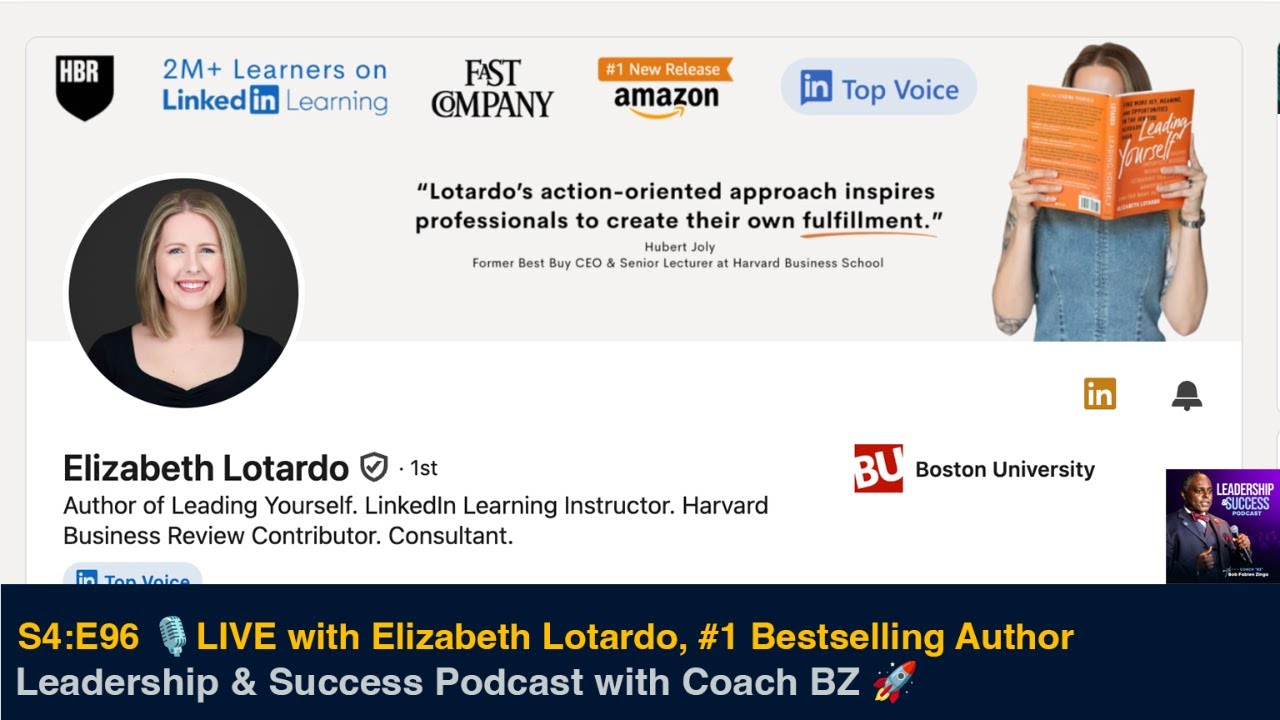
In this live episode of the Leadership and Success Podcast, host Coach BZ interviews Harvard Business Review contributor, LinkedIn Learning instructor, and author Elizabeth Lotardo. The conversation weaves together Lotardo’s personal leadership journey—from an early career in advertising to a PhD in organizational psychology—and the core concepts of her work on self‑leadership. She introduces a five‑question diagnostic framework to curb leader burnout and promote team autonomy, explains why the myth that self‑leadership ignores hierarchy is false, and emphasizes the importance of “controlling the controllable.” Practical tools such as the “Ripple Effect” technique for re‑engaging disengaged workers, the “This is my chance” brain hack for reframing fear, and the “you told me” phrasing to gain influence without formal authority are demonstrated. Lotardo discusses the difference between purpose that is truly lived versus merely lectured, the role of AI‑driven role‑play coaching for safe skill practice, and the evolving relationship between technology and emotional intelligence. Throughout, she shares personal anecdotes about being tattooed, motherhood, resilience at macro versus micro levels, and the mentors and books that shaped her thinking. The episode concludes with reflections on humility, optimism, and actionable next steps for listeners seeking to lead themselves and others more effectively.
Chapters
Hi, I'm John Maxwell. When the top companies in the world are looking for trainers, speakers, and coaches, there's one name that stands above the rest, and that's Maxwell Leadership. Our certified team members have gotten proven results for companies all over the globe, and our reputation I'm proud to say is second to none. Some of our members have risen to the top of their profession, including the one you're going to meet today. I proudly introduce you to my friend, Bob Fabien Zinga. Welcome to the Leadership and Success Podcast with your host, Coach BZ.
If you need to develop into a better leader, this podcast is for you. If you want to achieve a greater level of success, this podcast is for you. His mentor, Dr. John C.
Maxwell, said it best: everything rises and falls on leadership.
We hope to inspire you today and provide you with an insight that has the potential to positively impact the trajectory of your life. Welcome to the Leadership and Success Podcast.
One of the biggest causes of leadership burnout that I see: leaders trying to solve every problem their team brings to them. You care, you want to be helpful, but over time, this dynamic creates decision fatigue, bottlenecks, and dependency on you. I'm Elizabeth Letardo. I work with leaders to build high-performing teams without burning themselves out in the process. Here are 5 questions I use with my clients to help reduce leadership overwhelm and prompt independent thinking and problem solving in the teams they lead. What have you tried? This sends a signal that you are happy to help, but only after some initial effort. The first time you ask this question, you might be met with, uh, nothing yet, but over time your team will start coming with possible solutions, not just raw problems. What or who is getting in the way? This question helps you find out the real issue. It could be a budget constraint, a sign-off level, or another department that's holding things up. This enables you to remove the blocker once instead of constantly taking on these micro problems. What support do you need? Most well-intended leaders will default to asking, what support do you need from me? But what that question does is it unintentionally limits the volume of support avenues. It could be you. It could also be another leader, a colleague, or a tool your team hasn't thought to use yet. What would you do if you were in my seat? Over time, this builds repeatable problem-solving muscles. They're more likely to come to you with context, having thought about the trade-offs and what resources they might need. Instead of just handing you a cold problem. Is there anything else I should know? Sometimes your team member doesn't actually need you to solve the problem. They just don't want you to be surprised by it. This question enables you to keep communication open without reflexively grabbing the problem off of their plate. Of course, there will be times when you have to step in and solve the problem, but not all the time. And these 5 questions can help you decide. Being a supportive leader does not mean doing it all yourself. You can read the full article on hbr.org.
All right, everyone, thank you so much for being with us today. We have a very, very special guest for you, and I am so excited about what we're going to be learning today. But before we get started with that, let's do as we normally do, as is our custom. Let's have a moment of gratitude. This is where it takes less than a minute. We just think about one thing that we are grateful for today. So if you would close your eyes, take a deep breath, put yourself in your happy place, and think about one thing that you are grateful for today, this beautiful Tuesday, October 21st. I think I am so grateful for my network, Again, my mentor told me, right, my network is my net worth. And I think it is so true. And I really believe I've never met a stranger in my life. And I learned so much from the people I meet. I want to add value to them. And also, I appreciate all of the value I get from their perspective, which is going to happen today with our special guest. So if you would type it in the comment, and also if you have a question for my guest, please go ahead and type it in the comment as well. I will be watching the feed both on YouTube and LinkedIn. And I'm gonna make sure we get your questions answered. And also, I appreciate if you can tag someone to watch with you. So let me see if I can do a proper introduction for our guest today. So excited to have her. Thanks again for joining us for a live and I believe inspiring conversation with Elizabeth Lotharo. She's a number one bestselling author of Leading Yourself: Find More Joy, Meaning, and Opportunities in the Job You Already Have. Harvard Business Review contributor and LinkedIn Learning instructor with over 2 million global learners. She's a— her groundbreaking work helps professionals transform okay jobs into fulfilling ones, no matter how imperfect the boss, system, or economy is. So ladies and gentlemen, without any further ado, please help me welcome Elizabeth Lotharo. Let's see.
Can you hear me? Okay, here you are.
Fantastic. So glad that you are here. So, so grateful that, that you made the time. I guess to, to get started, what is one thing you are grateful for today, Elizabeth?
Well, it's a long list. I'm grateful to be here with you. I'm grateful I still have a little bit of my coffee left. But most of all today, I'm grateful for some cooler weather here in the south of the United States. It is It's so sweltering 90% of the time, and we have a nice fall day this morning. Wow.
That's beautiful. Yeah, I used to live in Tuscaloosa, Alabama, about 3 hours from Atlanta. We used to call it "Hotlanta," especially in the summer. But wonderful. Is there something about you that most people may not know about?
Well, you covered my professional background pretty holistically. I think, I guess, if you're just meeting me for the first time and you saw that little snippet on HBR and LinkedIn Learning as the intro, you might not know that I'm pretty heavily fully tattooed, which is something that is not super common in corporate America, but increasingly present, which I'm a fan of.
Wow, cool. You are really, really, really cool. And I guess if you can start by telling us about your leadership journey, how you got to be who you are today.
Sure. So the short of it is I started my career in advertising when I got out of college and quickly found that it wasn't for me, which is a frustrating realization after you spent 4 years and a lot of money and go into debt to get a degree in something. Um, but I, I grounded myself in that truth and I went back to school to study organizational psychology because I was so interested in why my work experience wasn't turning out like how I wanted it to and why so many of my friends were having that same experience going into their first job and not really loving it. I went to grad school to study organizational psychology with a focus on employee engagement, trying to figure out what like the perfect recipe was for employee engagement. Like, is it a great boss? Is it a great product? Is it Is it the schedule? Like, what makes a good work experience? And after a couple of years of really frustrating research, I reached a conclusion that it's not necessarily the environment, but the person and their ability to lead themselves through changes, through challenges, through the inevitable setbacks. So that set me on a 10-year journey studying self-leadership, which just recently culminated in my book, Leading Yourself.
Man, I really, really love the title of your book because for the longest, I used to think to be a leader, you have to have a big title and have a whole bunch of followers. But when I joined the Navy, I really learned, uh, you are a leader when you can lead one person, and that's yourself. So talking about your best-selling book, number one Forbes and Amazon, what, what inspired you to write that book?
So I've been studying and writing about self-leadership for a long time. I first wrote a LinkedIn Learning course, Leading Yourself, in 2017. And what I saw during the pandemic in 2020 was the analytics on that course started to really grow because people were home, they were alone, they didn't have their boss right over their shoulder every few minutes. They didn't have clear direction because we were all going into mass uncertainty. And the fundamental need to be able to lead yourself came front and center, right? And previously it was kind of this background softer skill thing. And then the spotlight got shown on that skill in the pandemic. So I updated my LinkedIn Learning course to reflect remote work, mass uncertainty, economic weirdness, all of those things, and it continued to grow. And as I was talking to learners and talking to their bosses who, you know, wanted them to have this ability to self-lead, I realized I had only scratched the surface in a 1-hour online course, and that there was an opportunity to go so much deeper into the mindsets, the behaviors, and the skill set that is self-leadership. So I wrote a book that is a, a much more expansive version of that content.
Wow, that is really fascinating. So many of my listeners serve in the military or work in, uh, fast-moving tech firms, two environments where control can be limited. What parallels do you see between leading yourself like in the Navy, for example, and leading yourself in corporate America?
I'm so glad you brought this question up because I think there's a fundamental myth about self-leadership that is prevalent in both the military and other organizations that are typically quite hierarchical. And that is the myth that if you are leading yourself, you don't care about the hierarchy, that it doesn't matter what your boss says. You're in charge of you. Nothing else matters. And that could not be further from the truth. We know that the people who lead themselves best control the controllable, even if that's a really small list of things depending on your position. It's not about flying in the face of your leader. It's not about disrespecting the chain of command in the case of the military, but it is about owning your seat end to end. And I think the ability to do that, whether you're in the military, whether you're in a fast-growing tech company, whether you're in a behemoth organization in the corporate space, that is an ice-cutter skill.
Man, that is so insightful because you remind me again of the Serenity Prayer, knowing the things that you can control. And, and, and that is, that is so powerful when you give yourself some type of agency, right? Because sometimes you feel like there is nothing I can do, I am completely powerless, I'm just gonna let life happen, when in reality there is definitely certain things that you can do to, uh, improve your stature in life. So, I guess the next question I'm going to ask is you've coached senior leader and entry professional alike. What universal truth about human motivation cuts across every level, you think?
I think the universal truth, and this kind of builds on our conversation of control the controllable, right, is you are never going to be unilaterally in charge. We often think like, oh, once I'm a manager and I can make my own decisions, then it'll be way easier because I'll control all these levers. But there's still someone above you. Oh, once I'm, you know, CEO, then I'll do whatever I want and it'll be so much easier. And there's still a board above you. Oh, once I'm on the board, I can really call the shots. Oh, and then you have to please the street, right? There's all these shareholders. There's never going to be a moment in your career, no matter where you are in that corporate hierarchy, where you are fully in control, where you have all of the power you wish you had. There is never coming. So the ability to accept that truth and operate in the face of it is what differentiates those who, as you say, you know, rise to the occasion, who still make progress in the face of not being fully in control, and those who sit on the sidelines and wait and say, oh well, there's nothing I can do, I'm powerless. And I think we typically think of that feeling as an entry-level feeling, right? But so often it plays out in senior roles. There's nothing I can do. I'm powerless. It's the CEO's fault. It's the shareholder's fault. It's our customers. They're doing these things. There's always going to be a scapegoat to blame no matter your level of the organization. Yeah.
And you do have a very impressive background, both in industrial and organizational psychology, which I believe gives you a unique lens on motivation. How does psychology inform the way you teach self-leadership?
So self-leadership is a mindset and a skill set, and the mindset has to come first, which is why I'm really glad I went to school to study organizational psychology. Because if we don't have our mindset right, if we don't believe that we are actually in control of our work experience, if we continue to tell ourselves, I'm powerless, work sucks, the grind, they don't care about you, none of these skills are going to work, right? You're going to have marginal improvements at best. So being able to get your mindset right and in the lane of self-leadership, that means creating a sense of purpose and meaning in your work, yourself, being able to operate in the face of fear and uncertainty, being able to contextualize and see your contributions as part of the greater whole. The mindset abilities to do that inform the skill sets of leading up, of getting people on board, of giving feedback. We often jump to those skill sets because we know they're important for the world of work. But without that mindset piece, they fall flat and they don't get executed in the way we hope.
OK, let me ask you this. Let's make this very practical. This has happened to me in the past, and I know some of the people watching now may be in this situation. Someone feels completely disengaged, but they can't change jobs. What's the first mental shift they can make tomorrow or this morning to reclaim agency?
If you feel disengaged at work, an easy, easy thing you can do to kind of reinvigorate your own spirit is articulate your ripple effect. One of the biggest factors of disengagement, why we feel so like bleh at work, is we think it doesn't matter, that it doesn't improve anybody, that it's pointless. It makes no difference in the, in the world, to our colleagues, whatever it is. So the more you are able to articulate your ripple effect and say, okay, For example, I have to fill out this report of all of our customer complaints, right? It's this boring thing. I have to do it every week. When you can articulate the ripple effect and dial into, okay, this report enables our product team to move faster and resolve these customer issues. That enables customers to use our product more effectively and have a better experience. That enables our organization to grow and create jobs and make sure my job's secure. The more you can trace that sightline, the more motivated you are going to feel. We often make the mistake of hoping someone inspires us and motivates us and gives us the sense of purpose. But the onus is truly on each of us as individuals to be able to articulate the ripple effect and know really clearly how our work is making a difference to someone. The more clearly we can articulate that, the more likely we are to be engaged in the work.
Wow. That really Powerful. Now, in addition to the book, we mentioned your LinkedIn course. Over a million people have taken your course, which is pretty amazing. When it comes to finding purpose at work, what do you think is the difference between finding purpose and manufacturing meaning?
What do you mean by manufacturing meaning?
Well, I guess maybe, I don't know, one of my mentors told me there are some people who are pretty much pretenders. Like, I'm sure you've heard this phrase when people say, fake it until you make it. In some way, I think, yes, I agree. But then when I really get to it, I really don't think you should be a faker, whether you've got it or you do not. And in corporate America especially, people tend to be nice or try to ensure that people perceive them a certain way or whatever is acceptable. And, but that's really not their, their true self, if you know what I mean.
Okay. I gotcha. I gotcha. So there was some interesting research that came out of EY as it relates to purpose and like faking it. And the title of their report, which I thought was great, was Is Your Purpose Lectured or Lived? And that's exactly what we saw play out in the pandemic is this feeling of purpose being lectured. Like we have a purpose here. Look at all of our advertising. Look at our recruiting materials. Purpose, purpose, purpose. But inside of the daily work experience, that feeling of purpose was completely absent. So there was a big disconnect between what organizations were saying and how they were behaving internally.
Yes.
And I think as it relates to your question, what is the difference? An easy way to tell is through the lens of decision-making. Is purpose a lens through which we make decisions? Does it make decisions more clear? Does it help us make decisions faster? And if that's not the case, the purpose is likely lectured. It's just something we put in marketing. It's something that was on the website. Maybe we use it for recruiting, but it's not woven into the fabric of our daily organizational behavior. So to me, when it comes to purpose, the lens of decision-making is probably the fastest way to tell, is it real or is it just as a tagline.
Wow, that is so powerful and practical. Thank you. Thanks so much. I, I really do appreciate that. And you have really spent so much time— I guess let me, let me ask, ask you this: when in, in your life, when did you kind of pivot? When did you really start getting into this idea of self-leadership? Because most people I meet don't even think of themselves as a leader. They always look up to someone, maybe it's my, my boss or my boss's boss or the president of the organization. Which experiences in your past kind of got you thinking along those lines, if you can share?
Well, I've been an entrepreneur for a long time, so unfortunately I have to lead myself, and sometimes I do that well, and other times I'm a really frustrating leader to myself. Um, but what set me down the path on studying this and, and going deeper, writing the creating these courses was really what I heard. And I use the phrase on the ground, but from people directly in a consulting practice, having experiences over and over again where someone would tell me, I really want work to be great, but it's my boss. I really want work to be great, but it's this annoying system I have to use. I really want work to be great, but the economy's being all weird and I can't be confident. There was always this but for a large subset of people. But for a small subset of people, the but somehow didn't matter, right? They were leading themselves through this and they're like, oh yeah, I want work to be great, my boss, you know, whatever, I'm gonna do what I can. I want work to be great, the economy's being kind of sketchy, but I'm gonna do what I can, right? There was this pocket of people who didn't let the but get them down. And I thought that was fascinating. And if we could replicate that mindset and skill set, we could improve the world of work in a really profound way. Instead of approaching it from a manager training standpoint, which is the Gallup cure to engagement, instead of approaching it from even an ESG standpoint, which we hear a lot about now, if we could approach work from an individual standpoint and give each person the mindsets and the skill sets to lead themselves, we can really make a difference in the collective work experience. So it happened in pockets at first, and as I started to see the power of it, I got more interested. I researched more and created more content around it.
That is really, really powerful what you just said. And I also love that you're talking not just about the mindset, but the skill set as well, which anybody can learn any, any skills if they really put their mind into it. So, bringing this to what's happening right now in the economy with the rise of AI automation, people feeling uncertain about layoffs and maybe AI replacing people and all of that, how can people quiet fear and doubt while staying hopeful?
So, I'll teach you a hack that I use and that I wrote about in my book. And the hack is called, "This is my chance." And this hack prompts your brain to find the opportunity inside of a frustrating or an uncertain situation. So let's apply it to AI, right? I share that worry. I'm a writer. Of course I lay awake at night worried about AI. But if I were to use this brain hack, this is my chance. Here's how it would look. This is my chance to bring my uniquely human skill set to the fore. This is my chance to create learning experiences that are in person that AI can't replicate. This is my chance to use all of the things I've written over my career and leverage them to create something new. I could have never done without the help of AI, right? So forcing my brain through that prompt, this is my chance to find the opportunity to carve out a space for myself inside of this frustrating kind of weird situation. That is the first step to overcoming fear.
That is so powerful. You reminded me of the half— no, the glass half full or, uh, yeah, it is a perspective, isn't it?
To me, I always felt kind of weird about like optimism and borderline toxic positivity because I felt like positionally we had to choose between like, okay, this situation sucks and it's weird, Or it's great and it's awesome. And to me, what the brain hack, this is my chance, offers is a seat in the middle to acknowledge that this is weird and uncertain and kind of frustrating and challenging. And also there's an opportunity for me instead of it. So to bring those two sides together in a way that's authentic instead of like posturing.
Wow. That is very, very insightful. And for some of our listeners right now, they may be called to lead without formal authority. One of your top courses on LinkedIn, you talk about leading without formal authority. What do you think are some of the biggest myths about influence in the workplace?
That positional power is the most important. We have all seen CEOs, senior leaders with all the positional power, right? And no respect. We have also all seen individual contributors who are considered subject matter experts, need-to-know people inside of their organization, the heartbeat of what's going on, even though they have no direct reports. So we've been fed this narrative, and some of it is true, that positional power is the only power. And while positional power can be helpful when it comes to decision-making, to sign off to budgets, it is hardly the only form of power. So what I wanted to set out to do in the course Leading Without Formal Authority, which I wrote in a similar timeframe to Leading Yourself, was offer a track for people who needed to get influence and buy-in and move work forward, even though they didn't have positional power. So whether you're a project manager, whether you're leading a team of your peers, whether you're an intern whose summer project depends on everyone answering your email, how do you operate from that seat when you don't have "because I'm in charge" to fall back on?
Okay, let me ask you the million-dollar question, especially for those who are in executive position like in IT or cybersecurity like myself. You tend to have to learn to influence people who don't report directly to you. You can't order them to do anything, right? Because they don't work for you. Unlike in the military where I can give order, I say, you know, jump and my sailors say, how high? But I tried to do that in Silicon Valley. It just didn't work. I just hit the wall. I couldn't understand how rebellious was Snowflake engineers, well, but anyway, the million-dollar question for you is how do you handle resistance from people who don't report to you but whose cooperation you need to succeed?
A quick hack you can use to get the buy-in of someone else who doesn't report to you is the phrase "you told me." And what that phrase enables you to do is put yourself on the same team as the person you are trying to engage. So I say, I need your sign-off. I need you to, you know, attend this series of meetings and make sure this project goes forward. I can say, you told me that one of our big priorities this year was getting new customers. Having you attend this meeting is gonna enable us to do that. You told me that one of your big priorities was to reduce our error rate. Having your sign-off on this new solution is going to help us do that. So contextualizing what you are asking in the service of a shared objective. Showing that this other person is heard, that you value what you're trying to do, and your ask is in service of that instead of just, I need you to come to this meeting. That one sentence can save you so much time and get so much more buy-in.
Well, folks, this one tip is worth every minute of you listening to this podcast. If you don't get anything else from this, you told me. It's really looking at what's in it for them. And that's how you cooperate with people. Wow, that is powerful. Thank you. Thanks so much. All right. You've worked with great organizations like Salesforce, DraftKings, Hilton, Berkshire Hathaway, and on and on and on. What pattern do you see in great culture versus toxic ones?
I want to push back on that question a little bit because I think a mistake that we see is assuming that a culture— while there are certainly toxic cultures, a great culture is great all the time, and that's not true. I have worked inside of organizations who are award-winning for their culture, who have exceptional team dynamics, and they also have bad days, bad quarters, sometimes even bad years. So this belief that you can find and fall into this perfect culture is setting the vast majority of people up up for failure. But what is inside of those organizations is a commitment to self-leadership and a recognition that if the culture isn't what you're hoping it is today, you, no matter what seat you're in, have the power to change that, right? Culture, I believe, is not defined from the top down. It is not defined by some HR playbook or some slick onboarding video. Culture is defined how each of us behave on a daily basis. You are the biggest determining factor of your work experience, and the organizations with great cultures are comprised of a lot of individuals who recognize their power to shape that.
Wow, that is really, really powerful. It, it really shifts your mindset. So even if you are at the bottom of the chain of command, you are just one individual, you can impact the culture of your organization, starting with you.
Absolutely. You can be the change you seek, so to speak. If you're not happy with the culture where you are, if your organization isn't winning Best Place to Work awards, you have the power to change that.
That is powerful. Let's talk about emerging technology just a bit. We, we mentioned AI earlier. So you were an early pilot for LinkedIn Learning's AI-powered role-play feature, which you, you mentioned. And what excites you about AI's role in leadership development?
So to me, the biggest opportunity for AI in leadership development and in learning, which is why I was so happy to be one of the pilots on LinkedIn Learning's new AI coaching roleplay, is the no-stakes opportunity to practice, right? So often we learn these lessons the hard way through a conversation that we didn't handle great, through some feedback that we delivered really poorly. AI is an open playing field to flex those muscles and practice those skills where there's no consequence. On LinkedIn Learning, you can take a course on how to give great feedback and you can AI roleplay and practice until you get it exactly right. So when you do go to deliver feedback, there's not a human paying the price for your crappy attempts, right? You got all those out of the way with AI and you can step into being a more powerful and more intentional leader with no consequence. You don't have to spend years fumbling it in front of all of your colleagues.
It's quite powerful. Okay. The last question I'm going to ask you for this segment is, how do you see the relationship between technology and emotional intelligence evolving in the next, let's say, 5 years?
It's for better and worse. And that's a big question. To me, Similar to the answer I gave to your learning and development question, AI, there is an opportunity for people to have more emotional awareness, to explore more aspects of their thoughts in a semi-confidential way. On the flip side of that, we have seen the biases that come with particularly ChatGPT. We have seen the lack of perspective in a lot of these tools. That they'll inflate whatever you, you currently believe. So there's a watch out there too. Having said that, I do think there is a, a bigger upside than there is a downside when it comes to emotional intelligence and how we can use AI to accelerate that.
Very, very good answer. Thank you. Thank you so much. So I'm going to switch over to the second half of the show where I focus mostly on leadership principle. To get started, I'm going to ask What is, you think, the greatest lesson you have ever learned?
Oh, that's a big question. The greatest lesson I've ever learned, um, is probably what I put in the dedication of my book. I dedicated Leading Yourself to my son, and in it I said, you are never powerless. And to me, that is the biggest lesson I have learned over time, is that No matter how frustrating or challenging a situation might be, I am never powerless, even if the only thing I control is how I think about it and my own emotional response.
Wow. And what do you think is the secret of your success?
The secret to my success? A lot of luck, being in the right place at the right time, a lot of privilege. I was raised in a leadership development space where ideas were valued and there was merit to exploring topics like this. So luck, privilege, and a dash of hard work.
Okay. Okay. Thank you for saying dash of hard work because it is true. There is definitely an element of luck in success because sometimes things happen to you and there are other people maybe even more qualified than you, but for some reason you are the one that was selected. I get that. But yeah, I think hard work definitely has a lot to do with that. Thank you. All right. What is the greatest leadership lesson you think you've ever received? I mean, leadership advice.
The best leadership advice I've received. I'll sum it up in the title of this book, The Long Game by Dory Clark, which you and I were chatting in the pre-show, to me is one of the books that has impacted me the most. This is my, like, elite shelf. These are my best books. Um, to be able to play the long game, particularly now, to recognize that even if something doesn't immediately pay off, it's worth it, that your network, to your point, is your net worth. To be able to have that long-term view is a decreasing skill set, I think, because we're looped into this, you know, short-term validation culture. But it's so important. So to me, the best leadership advice is to focus on the long game and make sure you operate with that in mind and never lose sight of down the road, even if you don't have it perfectly spelled out, to be able to think far ahead.
Wow. Powerful. And what are you learning right now?
Well, I'm always learning, but I, I've been reading a lot of books. The one I'm reading currently is not a leadership book. Book, but it does have some parallels, which is a book called How to Talk So Kids Will Listen. And I was joking to my husband, I have a toddler, so you can imagine why I'm reading this book. It really should be called How to Talk So Anyone Will Listen. This is like the leadership book and the parenting book space is almost a circle. Um, but to me, what that book has instilled in me and it has radiated into my coaching practice is the importance of making space and not leading with solutions. And that's challenging from a leadership perspective and from a parenting perspective because you care about the other person on the, on the other side of the table and you want to solve their problem. But to me, and it was kind of reflected in the HBR video that you showed, I wrote a piece called Stop Solving Your Team's Problems. This is the challenge of the empathetic leader and the empathetic parent. To not problem solve. So that is the skill set that I'm working on, both as an executive coach and as a mother, being able to hold space for independent problem solving.
That is so critical. I think when I first became a manager over 20 years ago, that was one of my biggest challenges, because most people, they get selected to lead because they've done so well as an individual contributor. But then having to have somebody else do the work and not you, like, they're not going to do it right, they're not going to do it on time, they don't gonna do it well. I'd rather, I may as well just do it for them. But if you keep doing that, then your people never learn and they never get to be excellent the way you've been lucky or privileged to be. So that's very important. Okay. So let me ask you this. I love showing this coin. One of my mentors gave it to me. On one side it says success and on the other side it says failure. So success, failure, two sides of the same coin. I know people know all about your successes. Can you tell us how failure has shaped your life?
How failure has shaped my life. So the list is long, and I love that you asked this question because it doesn't really get publicized, right? No one puts out like, oh, I got rejected from this. But I've had a lot of HBR pieces rejected. I've had LinkedIn Learning courses rejected. I've had things taken down that didn't go well. I've had bad feedback. I have had technical problems through the end of time, I feel like. So I appreciate the sentiment of what failure was in tandem with this journey, and the list is long.
So by going through all of those rejections, obviously you didn't give up, and at the end you won. What, what do you think made you I don't know. I guess it is, it is grit, it is resilience, but there is something in you that just made you not quit. Can you tell us a little bit more?
Well, I think it's an important distinction between giving up and quitting a part of the thing versus the whole thing. I did give up tons of things. I had pieces that were rejected that I did not rework and try and pitch somewhere else. They died on my desk. Desktop. I've had content flop that was taken down and I didn't redo it. I didn't push to have it put, put back up there. So the ability to fail in the micro and cut your losses to me is an underrated skill. And we are fed this narrative on LinkedIn of like, keep trying, keep pushing, keep pushing, keep pushing. But being able to recognize when to give up is actually really important. And resilience doesn't play out in the micro on each individual thing. It plays out in the macro. So while I have had pieces rejected, while I've had courses taken down, while I've had book proposals denied, like you name it, I never gave up on the macro. And a mistake you can make is never giving up on the micro and running yourself into the ground with something that just is never going to work.
That is so powerful. You've got to say that again about resilience, please. This is— wow. I've never heard it quite said it this way.
So to me, you must have resilience in the macro, right? You must be able to move past failure. But to demonstrate unwavering resilience in the micro is a mistake. If I had this piece rejected, right, say I pitch it around, nobody wants it. If I keep pitching this piece and keep pitching this piece and keep pitching this piece, I'm gonna start to feel really bad. I'm probably not gonna see any success that I want to have with it. If I do see some success, it's going to be isolated and pocketed and not that successful. So the ability to separate out this task from the macro and say, like, you know what, cut my losses, gonna let this one go, is something that I've really tried to get better at. Because I too am like, oh, I'm, I'm not gonna give up. But to know that sometimes you gotta give up in service to the greater good is something I've struggled with, but I've gotten better at.
Actually, I think I misspoke earlier. This year is the reason why you should have listened to this podcast. If you don't get anything else, Wow, resilience. No, the difference between the micro and the macro, that really makes a big, big, big difference. That's why some people just succeed no matter what they seem to be going through, and other people, they just quit and, uh, no, nobody knows their name. Uh, wow, that is, uh, powerful. So let me ask you this. I really believe in mentorship, and sometimes your mentor doesn't really have to, to be someone you have a personal relationship with. You can read their work. But who are some of your mentors or thought leaders, people you follow that you think we should know?
So Dori Clark, who I mentioned, the author of The Long Game, has probably been the most instrumental voice in my own career development. I've also learned a lot from Alan Weiss. I have a whole section of his books down here on consulting and how to build a business based on value-based fees. I think economically and from a strategic lens, that's really valuable insights. And I also learn a lot from books on, like I said, motherhood and parenting and relationships. I think we often believe that leadership development comes from this really specific lane of Adam Grant, who's great, Brené Brown, Simon Sinek, that sort of A-tier crew. But I have learned so much from art and from music and from parenting that informs who I am as a leader and as an entrepreneur.
Wow, cool. And, uh, if you could choose 3 people to have dinner with, it doesn't matter if they're dead, alive, or even mythical figure, who would you choose and why?
So I would choose Jane Goodall because unfortunately she just passed away, and seeing her legacy and appreciating with new eyes everything she has done through people's posts and, you know, the articles that have come out in the last couple of weeks has been really interesting to me. I would invite Monica Lewinsky, whose podcast I listen to, Reclaiming. And I would also invite Kesha, who is a pop star but similar to Monica Lewinsky, went through an experience where she was silenced in a way because of positional power. And as a creative, as a woman, I've been really interested, especially in the last year, about how institutions and money and power relate to the creative voice, especially female creative voice, and that dynamic. So I think the four of us could have a really interesting conversation about that for sure.
Now, what are some of the books that you would recommend? Of course, we want everybody to, uh, purchase— oh, hold on— this one, Leading Yourself. We've been talking about it, but you also have Another book with Lisa, uh, which is, uh, Sailing with Noble Purpose. Which other book would you recommend to the audience?
So some of my favorite books are— you, you flashed up David Epstein on there, the book Range, which is about why generalists triumph in a specialized world. To me, that book gave me permission to explore seemingly unrelated things to my lane. Like, he talks about how Steve Jobs took calligraphy, and 15 years later that played into Apple's packaging. Like, being able to follow your interests and know that they'll pay off somehow is a really freeing truth as an entrepreneur and as someone who likes to learn. I also got a lot out of the book All the Gold Stars by Rainsford Stauffer. That's a book about ambition and sort of redefining what success looks like to you in different areas of your life. So those two books to me, in, in the way I think, have been really instrumental.
Wow, thank you. And you also mentioned the podcast by Monica Lewinsky. I think we can definitely learn a lot from, from her. Uh, so let me ask you this, uh, what is maybe a song, a book, or a movie that would be your life's theme or anthem?
Oh, I love the movie It's a Wonderful Life, which is an old movie, but I think speaks to our need to feel our need to feel significance. And through my work, while I don't always say the touchy-feely things, leading yourself, leading without formal authority, finding your purpose at work, there's definitely a through line to all of those things.
Thank you. So we are getting toward the end. So let me ask you, What is one action you are thinking about taking that you believe will positively impact your life?
And I'm looking— so right behind my computer, I have a giant whiteboard of like all the stuff I'm supposed to be doing. And I was looking at that being like, okay, there's a lot of things on there that I could pick. Um, but I'll go a different direction. And say an action that is positively impacting my life is I'm trying to be more trusting in the universe. And by that I mean softer energy, opening myself to new experiences, having more faith that it's not pure will and grind it out that gets you there. And I have seen small pieces of evidence that that mindset shift is paying off. So So one thing I'm trying to do that I think is already positively impacting me and will impact me more in the future is let go of a little bit of control. Ironically.
That's quite powerful. I think it's more of an art than a science, definitely should aspire to. So when you wake up in the morning, what is one problem you'd like to solve?
We have a lot of problems that need solving, but usually my most crucial problem to solve in the morning is getting my toddler into clothes. So that's the first problem I solve every day. But I think more generally than that, one problem that I'd like to solve and a problem I've been working on is how many people feel no sense of agency who are paralyzed with fear over AI, over layoffs, over the economy, over the state of work in general, and are showing up holding their breath. Every day. I think there is a huge price to be paid for that, and we haven't seen the full of it in terms of how it impacts our health, how it impacts our relationships, how it impacts our creativity. I think unfortunately over the next 24 months, we will see some really troubling evidence of this sort of collective breath holding.
And thank you so much for the work you do, all of your books, LinkedIn Learning, and everything you do. It definitely helps a lot. In getting people to not have that sense of, I guess, inevitability and complete powerlessness. Yeah, because you really cannot dream and achieve anything if you feel like your life is over before it even gets started. So thank you for that. Okay, let me ask you this one more question. If you had one day and only one day to live, what would you have liked your final contribution to be?
Being a good mother. As much as I talk about HBR and LinkedIn Learning and writing a book and working with clients and being an executive coach, to me, the marker of my life will always be the type of mother I was, regardless of all of this.
Very good. So how can we add value back to you?
Well, give me a follow on LinkedIn. I feel like we've heard from some of your listeners. They always have insightful questions, and I know you and I are like minds when it comes to agency and self-leadership and the ability to sort of chart your own path. So if any folks listening resonate with that belief, you can give me a follow. You can check out my book and see some of the work I do in more depth.
Fantastic. Thank you. Thank you so much. Okay. We have about 10 minutes left. I'm going to be landing this plane soon, but let me ask you the most important question of this entire podcast. If you could go back and give a piece of advice to your 17-year-old self standing at the edge of this incredible career you've had, what would you say to 17-year-old Elizabeth?
It's not that serious is what I would say. And I try to remind myself of that now. I am someone who gets really earnest and cares a lot and tries to bat 1,000 and really strives for perfection. I've gotten better with age, but I'm nowhere near perfect. If I could go back and tell 17-year-old Elizabeth, lighten up, take a deep breath, you're going to be great.
Thank you. Okay, to end this lightning round, so don't take too long to think, but What is the most rewarding aspect of your life right now?
Uh, being a mother.
Okay, one word that defines great leadership?
Humility.
Morning routine or practice that keeps you grounded?
I need to work on that one. I don't have a good answer.
That's all right. Okay, book or quote that changed your life?
Um, The Long Game by Dory Clark. If not that, Range. Some of these books— Transcend was a great one, Gift of Fear. Gave too many answers. Can't pick.
Very, very good. Thank you. And who inspires you the most today?
My son. I wish I could have the wonder of a toddler more in my life.
Yeah, they grow up so quickly, don't they? Okay, finish the sentence. Leadership is—
Hard.
Okay. What did you want to be when you were a kid?
I wanted to study education and television, and my high school English teacher told me those did not go together. And now I work for LinkedIn Learning, so she was obviously wrong.
Yeah, I guess you kind of did it. Fantastic.
Ironically, I did not major in those two things because she told me it wasn't a good idea, but that is where I landed, so I think it was pretty right.
That is powerful. Okay, three adjectives describing you as a child.
Um, shy, driven, and Picky.
Okay. As an adult?
Shy, driven, and picky again.
Okay. The same. Very good. All right. The very, very last question of this. Oh, actually, before I do that, is there a question I should have asked you that I haven't asked yet?
No, I think this was great, but I wanna flip the script a little bit in our final couple minutes now. You reached out to me because you really landed with leading yourself. How have you seen the skillset, which you clearly have, the mindsets and the skillsets of self-leadership play out in your career?
Well, that's probably the secret of my success. One of the questions I ask you, I guess I wrote an article on my newsletter. And by the way, you don't have a newsletter yet. I checked and checked and checked.
I don't have a LinkedIn newsletter. I have one on my website, but—
Okay, so I need to sign up for it. Maybe you should put a link like some people do, subscribe to my newsletter at the very, very top. Because I think people definitely need to hear what you have to say. But anyway, one of my newsletters on LinkedIn Lead, one of the most important articles I think I ever wrote is Embracing the Impossible. Because my entire life, people have always told me, no, can't do, impossible, you cannot do it. Nelson Mandela, we call it Madiba in Africa, he once says, no, it's impossible until it is done. So really anything is possible. And my mother, who I consider to be the first feminist I ever met, uh, no, growing up in Africa, not a society made for women, but she did very, very well because she never took no for an answer. If you have an obstacle, you have to find a way through it, around it, jump. I mean, do something, but you're gonna get to where you, you want to go. You are going to make, make way. Wherever there's a will, there's a way. But anyway, having said all of that, I guess that's what self-leadership means to me. No, It may not be right now, but I know it is in my future and I'm going to make a way, find a way. I will get there some way, somehow. I know it. And it doesn't matter what people tell me now. I am, I guess, focused. I have decided that that's what my life is going to be and it will be. There is no other option. One simple example. When I first came to this country, first I couldn't hardly speak English. I applied for maybe like 100 jobs when I was in college. All of them said, no, no, no, we can't hire you because you don't have the experience. I'm like, okay, how can I get the experience unless somebody hires me? Right? It's like a catch-22, I think is what it's called. So, but the thing is, the mindset is, all right, I don't have the experience and I'm going to get it. Somebody somewhere is going to give me a chance. So I kept applying and applying and eventually somebody had mercy on me and they gave me an opportunity. And then I'm like, okay, you are not going to regret this. So I'm going to be the best worker. You've ever seen. And I did. So I guess that luck that you mentioned, the privilege, but also the hard work, which put me above the rest, right? Because most people, they go to work, they do the bare minimum so they don't get fired. No, I was there early and I stayed late and I really added a lot of value in a very short period of time. So when it was time to promote someone, even though I wasn't a US citizen at the time, I was promoted over everybody else in the office. It was very, very clear. I was the best worker there. Like they say, the rest is history. But I guess it's a long way to answer your question, but I think that's really the story of my life. It's about that resilience, that mindset, which I'm glad you said it's not just a mindset, but skills that comes with it too. But I think it's also the ability to be humble enough to know that you don't have all of the answers and you need help, right? Because I know I'm here, where I am today because so many people have helped me. Some of them, I don't even know their name and I cannot pay them back. But, and I definitely wasn't in a position to pay them back way, way back then. But now all I can do is kind of pay it forward. Hopefully that answers your question.
It does. There's an expression, um, in parenting, like your children will never love you as much as you love them. And it's kind of designed that way. And the expression is love rolls downhill. And I think the same plays out at work. We all receive help from people we'll never be able to pay back up, but we can pass it forward.
True. There might be an exemption to that, an exception. I think I love my mom so much. I don't know. She was my hero. She really meant everything to me.
She loves you more, I promise.
Yeah, yeah. I am sure she does, and she's proven it time and time again. Again. Yeah, it's just amazing when you have a child. I remember when I first became a father, like, I would do anything for this child, this human being I am responsible for. It's like, what a miracle. And I think it really made me grow up almost overnight. It's like, okay, no more playing games anymore. Life is serious. I have to take care of this child and change my professional life.
So yeah, life is serious, but I think for me, it also taught me that life is a lot less serious. This too.
True, true. Don't take it too seriously. That's exactly, uh, what you, what you said. Yes, uh, that is so true. Uh, okay, so the very last question I'm going to ask you then, uh, yeah, you say it's, it's not that serious. That is so true. Okay, very last question, uh, what is one word then that represents our shared experience on this podcast today?
Optimism.
Optimism. Okay, I think I am almost always grateful, just so grateful you made the time to be here and speak to my audience. You've taught us so much. And thank you. Thank you. Thank you. And I know myself, there are at least a couple of books that you mentioned I'm going to purchase today. And it's just incredible the work you do. Keep doing what you do because you are impacting a lot of people. I think what, more than 2 million people now have gone through your courses on LinkedIn. It's just incredible the impact you are having. Oh, maybe let me ask you one last question. You are a top voice on LinkedIn. You have that blue badge. People who are watching you right now, do you know why you got it? What is the secret of earning a blue badge on LinkedIn?
I wish I knew the secret. I tried for 10 years and finally got it. So I don't know what particular thing hit me over the edge. But I do know, and what LinkedIn has said, is that it is a consistency game, consistently adding value, consistently engaging with the platform. I started with Lynda.com, who was acquired by LinkedIn in 2016. So it took me 9 years of consistently trying to get it.
That is powerful. Always adding value. Like my primary mentor, Dr. John C. Maxwell, says, right? I have great value. I value people. And I add value to people. So, it was—
You certainly do. I'm most appreciative of you inviting me on today. I know we share a lot of beliefs around world of work and what's possible and leadership. So, this was a hugely enjoyable conversation.
Thank you so much. And I know your book already number one on Amazon and Forbes, but I'm hoping we're gonna get more sales and get you on the New York Times bestselling list.
We'll see. I maybe I don't know if they do it anymore. I think it was Wall Street Journal that stopped doing their list. It's all a game.
Oh, you know, New York Times is still out there. Yeah, Wall Street Journal, unfortunately, they, uh, stop. I guess there is USA Today too, which is okay. But, um, one of my life dreams is to be on the New York Times best-selling list. It's, uh, uh, incredible what it, what it means. I, I guess just know the value you've, you've added to your audience. And I think we need to sell more of your books. You have so many important and critical things to say, especially in this time in our country right now. All right, I'm going to stop rambling, but I am so happy you took the time to be here. And I know you have to go. And thank you, thank you, thank you. Really, I appreciate you so much, Elizabeth.
Thank you so much for having me. And thank you for all of those who listened and chose to spend your morning with us.
Thank you. All right, folks, thank you so much for being here. And again, if you haven't learned anything, I think what really touched me the most, and I've never heard it quite said that way, right? Resilience does not play out in the micro, it plays out in the macro. I guess that's really my life story, you know, going through obstacles but always knowing that there's gotta be a way for me to get to my destination, right? I will not be denied. And that is so powerful. Okay, this is it for today. I'm gonna be back here tomorrow. I think tomorrow we're gonna have a 10-minute recap of some of the live podcast leadership conversation we had last week. And this first day, I am so, so happy and pleased my major mentor, Shelley Archambault, the best-selling author of Unapologetically Ambitious is going to be in the house. I can't believe I'm gonna have an hour with my mentor. You absolutely do not want to miss it. She's one of the very first Black women CEOs in tech, and you absolutely need to be here on Thursday. All right, until tomorrow, have a wonderful, wonderful rest of your day. Bye for now. Thank you for listening to the Leadership and Success Podcast with your host, Coach BZ. If you like what you heard, please subscribe to our channels and come back for more wisdom nuggets on how you may develop into a better leader and achieve greater levels of success. Leadership is the most critical skill. The world will always need leaders to lead others, deploy the next disruptive technology, or execute a business strategy.
You may as well decide on counting yourself among the 21st century leaders.
See you right here next time on the Leadership and Success Podcast with Coach B.
More from Bob

S250:E4🎙️LIVE 🇺🇸America 250: President Barack Obama Leadership, Service, and the Power of Hope






S5:E157🎙️ LIVE with CMD CMSgt Dennis L. Fritz, USAF (Ret.)(Multi Tracks Audio)



S5:E156🎙️ LIVE 🇪🇸 Leadership Lessons from the FIFA World Cup 2026 Champions (Multi Tracks Audio)

S250:E3🎙️ LIVE Leadership Lessons from America’s First Documented Family of African Descent 🇺🇸📖