S4:E97🎙️LIVE with Shellye Archambeau (Multi Tracks Audio)
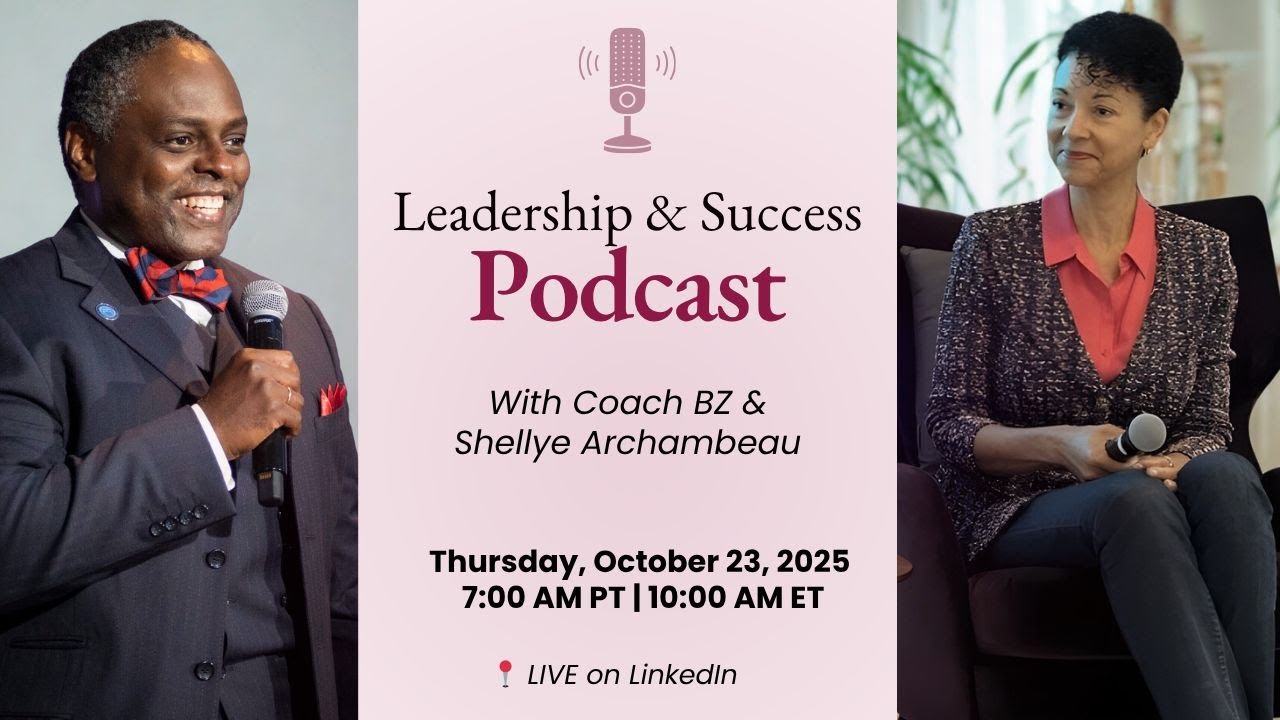
Shellye Archambault, one of Silicon Valley's first Black female CEOs, talks about her path from aspiring CEO at 16 to the boardroom. She covers ruthless prioritization, her "adopt a mentor" approach, handling failure, and staying calm under pressure.
Chapters
Hi, I'm John Maxwell. When the top companies in the world are looking for trainers, speakers, and coaches, there's one name that stands above the rest, and that's Maxwell Leadership. Our certified team members have gotten proven results for companies all over the globe, and our reputation, I'm proud to say, is second to none. Some of our members have risen to the top of their profession including the one you're going to meet today. I proudly introduce you to my friend Bob Fabien Zinga.
Welcome to the Leadership and Success Podcast with your host, Coach BZ, where we help you lead with purpose and succeed with impact. If you're ready to grow into the kind of leader others want to follow, this podcast is for you. If you're determined to elevate your success and leave a lasting legacy, this podcast is for you. As my mentor, Dr. John C. Maxwell, reminds us, everything rises and falls on leadership. Our goal is simple: to inspire you, challenge you, and equip you with insights that can transform the trajectory of your leadership journey. Welcome aboard to another episode of the Leadership and Success Podcast with Coach BZ.
Hi. I'm Shellye Archambault, a former tech CEO, Fortune 500 board member, and author of "Unapologetically Ambitious: Take Risks, Break Barriers, and Create Success on Your Own Terms." As much as we may like to believe otherwise, ambition alone is not enough to be successful. There are many ambitious people in this world, but only a fraction of them accomplish their highest goals. That's why I wrote this book, to share the strategies, approaches, and tools that have worked for me and that I suspect may work for you too. Now, success means different things to different people. When I was a teenager, I decided that I wanted to be a CEO one day. But maybe you hope to make a scientific discovery or create a beautiful piece of art or change your community for the better. Whatever it is you are striving for, this e-course will cover some of the challenges that you may encounter, plus some useful suggestions that may not be on your radar. From dealing with imposter syndrome to building your reputation to finding the right mentors, the road to success can be bumpy and often takes some unexpected turns. But with an intentional, dedicated plan in place, Your vision of a fulfilled, successful life can become reality. So at 16, I decided I was gonna be a CEO. I was that ignorant and that audacious. Exactly 14 years later, my dreams became a reality. I turned a broken company around. I've sat on Fortune 500 company boards, and I became one of Silicon Valley's first Black female CEOs. I'm Shelly Archambault. I'm the author of Unapologetic Be unapologetically ambitious. Take risks, break barriers, and create success on your own terms. She might have been the only Black woman CEO in tech, but she's like, "Look, if I get a chance to be a CEO, I'm gonna be a CEO." She knew where she wanted to go and how she was gonna get there. None of this just happened for me. I planned a lot. She did what she needed to do. You know, she earned it every step of the way. I'll tell you how I strategized for success. Show you the people I met and the lessons I learned along the way so that you too can become unapologetically ambitious.
All right, everyone, I am so excited today. This is one of the best days for 2025. And if you are watching right now, please let us know where you are watching from, what city, what state. And if you are outside of the US, since we have the global audience now, let us know which country.. And if you have a question for my guest, please, please type it in the comment and we're gonna be answering your questions live. Okay. Before we get started, first, the guest I will introduce to you doesn't need any introduction, but let's do as we customarily do. Let's have our moment of gratitude. And as you know, the reason why I do this is because in the military, I am a US sailor, about 21, 22 veterans commit suicide every single day in this country. And I believe it's impossible to be grateful and be suicidal at the very same time. So if you would, like we customarily do, close your eyes if you can, maybe take a deep breath and think about one thing you are grateful for today. And I think today I am really grateful for the power of mentorship and sponsorship. There are so many people who have shared their knowledge with me that have helped me overcome a lot of obstacle in life and who have sponsored me and people I cannot pay back, but I am so grateful that they did. Really, the only thing I can do is to pay it forward. So let us know what you are grateful for and type it in the comment. Okay, let me see if I can do a right introduction for the legendary human being we're going to be talking to today. She's a Fortune 500 board director, former CEO of MetricStream, author of Unapologetically Ambitious, And get ready for an unforgettable conversation with one of Silicon Valley's most admired leaders. She's one of the first female, Black female CEOs in Silicon Valley. She is my mentor, Shelley Archambault, a trailblazer who turned a struggling startup into a global powerhouse and paved the way for countless women and diverse leaders like me in tech. In this episode, she's going to be joining us to kind of share the hard-won lesson On ambition, leadership, resilience. If you want career advice, you are in the right place. And make sure to pick up a copy of her book. But really, without further ado, please help me welcome the one and only Shelley Archambault. Good morning, Shelley. How are you doing today?
Good morning, Bob. I'm doing great. Thanks. That was quite an introduction. Thank you very much.
Yeah, you've had such a huge, huge impact. I can't believe I am talking to you live on the air right now. I guess Just to get started, is there one thing you are grateful for today?
Ah, today I am grateful for my family, for my children and my grandchildren.
That is so powerful. And, uh, is there something about you that most people may not know about?
Oh goodness.
Uh, for me, for example, yes, here's one actually.
Yes, something that you may not know is at the age of 60, I ran in the Masters Track and Field 400-meter national competition. And when I finished, I was ranked 14th in the country.
You've got to be kidding. Wow, that is awesome. Okay, that's one of my dreams too. I'm gonna have to do it someday. Wow, congratulations. Bravo. That is powerful. And, uh, can you tell us about your, uh, leadership journey? How you got to be Shelley? We don't even need a, a last name. Uh, you are such an impactful person in the world today?
Oh goodness, Bob. You know, it really started from the fact that as a kid, I realized very early that the odds were not in my favor. And so if I wanted anything, I was going to have to figure out how to improve my odds to get it. So fast forward, that made me very intentional. And I had this fateful conversation with my high school guidance counselor. You know, that junior year conversation, are you going to go to college? Yes, because That was it. My father didn't have a college degree. Mom was a stay-at-home mom. It was all about us going to college. And she said, well, OK, what do you want to do when you graduate? And I had no idea, Bob. None. What I did know is I wanted to earn enough money, which I told her. I want to earn enough money to be able to keep my thermostat at 72 degrees in the wintertime. I want to be able to eat out in restaurants. And I want to be able to travel. So she said— she said, after she laughed, but then she realized I was actually quite serious, those were all things I couldn't do. And so she said, well, what do you like to do? And when I told her I like clubs, you know, I was head of the French club, the American Field Service, I was in the National Honor Society, I was a Girl Scout, right? All these things. She said, well, Shelley, clubs are like business. You pull people together and get things done. And I said, great. And I like running these clubs. And I looked up and the people who ran these organizations were called CEOs. So at the bright age of 16, I came home and told my parents, I'm going to be a CEO.
Wow.
Now, did I have any idea what that actually meant? Right? Not really. But now I had a goal. So then every step of the way, it was like, how do I improve my odds? So I applied to the best business school undergraduate. I went to Wharton. And then I joined IBM because it was the number one back then in the early '80s. It was a top company in tech. And tech was growing. So I said, great. I'll come be CEO of IBM. So, I joined IBM, rose through the ranks. I actually got— after 14 years, I was running a multibillion-dollar division over in Asia Pacific. My boss reported to the CEO of the company. There wasn't anybody higher than me that looked like me. So, I'd done well. But it wasn't clear I was going to get the opportunity to truly be CEO.
Yes.
So, I made the really hard decision because being a CEO is what I really wanted. And I left IBM and worked my way to Silicon Valley where after being the Chief Marketing Officer and EVP of Sales of a couple of public companies, I finally got my opportunity to be CEO. CEO of MetricStream— became MetricStream. It was Zaplet, and then we renamed it. And I did that at the time I was 40.
Wow, that is really, really impressive. And the, the work you did at Zaplet, which, uh, became MetricStream— you took a struggling company and turned it into a global market leader. Uh, what mindset helped you lead through uncertainty and pressure?
Oh my gosh, it was probably two main things. One, I refused to let them win. And the them was the forces that were trying to keep us from being successful. So I'm not going to let them win. We need to win. And two, I had a whole organization that was counting on me every day, not just for their jobs, but their livelihoods, right? Supporting their families, all of it. So I needed to make sure that we were going to be successful so they could be successful. So those are the two things. One, I wanted to make sure that we won, right? The forces didn't. And two, I wanted to make sure that the team won and the team was able to be successful. So those were really my thoughts every day.
And also, for those who know you, you tend to stand pretty calm under pressure and focused and decisive. When the fog of business war sets in. How do you do that?
You know, I'll tell you, it was a learned behavior. Because what I saw was that when I was nervous, worried, whatever it was, then that just rippled through the organization. Because the higher you are in the company, the more closely people watch your behavior to try to get an indication of how things are going. So if you're walking around a little down low energy, people sense it. And they're going to assume, oh my God, something's wrong. Right? So it's really important as a leader to be steady. And the mantra that I always remind myself of, Bob, to help me do that is things are never as bad as they appear. But they're also never as good as they appear. Because you have to be calm under pressure when things are challenging. But you also have to be calm when things are, quote, great. Because if you swing, that's the problem. You're going to swing the entire organization with you, right? So, just remember, things are never as bad as they appear and they're never as good as they appear. And if you can just remain calm, it's taking the breath before you respond. Because you want to remember that people are counting on you. And they're going to decide how they feel and how they act based on how you react and respond.
Wow, that is so powerful. I've got a copy of— oh, here it is— Anapolitically Ambitious right there, which I read every single year. This is really like a life manual. You've put so much into this, and you mentor so many, many people across America and around the world. What inspired you to write such a book that is not only you telling your story, but you are also really teaching and mentoring and helping the next generation to try to achieve their own goal as well.
You know, Bob, throughout my career, people reached out to me for advice, for counsel, for mentoring. And I did that. I tried to meet and talk with as many people as I could. But as I rose higher and higher in the ranks, the amount of time I had to do that was shrinking, right? I had less time. I still did it, but I had to turn people away. And I thought, you know, when I pass the CEO baton at some point, I'm going to write this down. I'm going to write down kind of what made Shelly, Shelly, right? What were the impacts? I'm going to share the lessons learned. But I wanted to do it not just business lessons because there's lots of business books. 8 Steps to Success, 7 Habits, right? 10 Things. There's all kinds of business advice. The hard part is not taking the business advice. The hard part is how do you take the business advice in the context of your life? Because you have all these other things pulling on you. So I wanted to talk about how to be successful across your life, not just in business. And that's really what Unapologetically Ambitious is all about. It's about how do you improve your odds every step of the way to get what you want out of life, personally and professionally.
Hmm. That is really powerful because there are many leaders right now, especially in the volatile world we are living in with AI and all of that, the kind of struggle, right, to balance ambition with authenticity. I know one thing you taught me was this myth about life and work balance. You said that doesn't exist. It's really the integration of the two. And I think that is so true. Completely changed my perspective on that. How can we pursue bold goals without losing ourselves in the process?
The key is ruthless prioritization. And when I say ruthless, I mean ruthless. So prioritization for your life is about taking the things that you have to get done, right, that you need to get done that are professional with the things that you have to get done personal. You put the two together and now you prioritize so that you get the most important things across your life done. But Bob, what that means is there going to be items down at the lower level, both work as well as personal, that you're not going to be able to get to. So the key is be intentional, right? Find somebody else to do them, or decide that you're just going to live without them being done. But the worst thing that you can do is put everything on your plate knowing it's not going to fit, and then things fall off. Because when they fall off your plate, they break. There is damage. There are repercussions. If you take them off your plate and set them down, They don't break.
Wow.
Right? That's the metaphor. So ruthless prioritization, the things that don't fit on that plate, take them off, give them to someone else, or decide they don't need to get done, or decide they can get done, but maybe not to the level that you had hoped. And you live with it. The key is, if you don't make the conscious decision, then it's constantly eating at you. You're thinking, oh my God, I should have been doing this. I should have been doing this. I should have been doing this, right? And that eating at you just dries up your stress. You have enough stress in your life. Prioritize. Take things off the plate and make a conscious decision that you're just going to live with it.
Yes, ruthless prioritization. Yeah, I think that's really a master key to success, being able to only work on your highest task at the moment. And let's talk about mentorship a little bit. Something you said in your New York Times interviewed, you adopted mentors without asking. I believe I did that with you earlier because I didn't know you first. So I went to your LinkedIn and then you published this wonderful book. I got your book and of course I wrote a couple of posts and I was tagging you, hey, you have a great book. I think I went to the San Francisco Library and I saw your book on the shelf. I don't know if this is where you were, but anyway, with a book you are really able to mentor so many people who don't even know you but who can really benefit from your wisdom. So when you said that to the New York Times, can you explain how that works and why it's so effective? Again, I think I did the same thing, but I think people need to hear it.
Yes, no, absolutely. So, you know, an interesting thing happened. I'm going to tell you the backstory because it involved a mentor. I was at IBM at the time. And IBM decided that they wanted their high potential people to have mentors. But they were doing something different. They asked us who we would like our mentor to be in the company. And so I picked a guy. His name was Roland Harris. He was a couple levels above me. I knew him. I thought he liked me. So I thought he would be a good mentor. So I put his name down. Well, Bob, like 3 or 4 days later, Roland calls me up. "Shelly." "Hi, Roland." "Shelly, you put my name down to be your mentor." And he didn't sound happy about it. And I was like, "Well, yes, Roland, I did. I thought you liked me." And he said, "Shelly, you've got me. Go get somebody else." And I was like, "Interesting." So, what I learned in that very short conversation, but what I learned was he already considered himself a mentor. I didn't know it, which means that mentorship could be informal. It doesn't have to be formal. And two, he told me to go get somebody else, which means I could have more than one mentor. I could have as many as I wanted. And so, what I started doing was adopting mentors because I learned if you ask them to be your mentor, they typically say no. And mainly because they don't have time, right? So instead, you adopt them. And adopting a mentor is really just about asking for advice and then following up. So I usually start light. So let's say, I saw somebody speak and I thought, "Man, they did a great job. I really could learn some things from them." I might send them a note to say, "Hey, I heard you speak at blah, blah, blah. I thought your points on this, that, and the other were terrific. I have a speech coming up in a month. Do you have a quick tip for me?" Or if I pass them in a hall, or if I do, I could do this verbally. But just real quick, you want to do something that won't take them any time. "Right, to think about." And then respond back. Look at your audience, add some humor, do whatever it is. Fine. Here's the key. The key is you take the advice.
Wow.
Take the advice. And then reply back. Right? Absolutely. Say, "Oh my God, Bob, thank you so much. That advice was so helpful. It was probably one of the best speeches I made." Because here's what happens. When they read your response or when you tell them your response, what happened, They feel good. They feel, wow, they may not even remember that they gave you the advice. But they feel good that they had a positive impact on you. And to paraphrase Maya Angelou, right? People won't remember what you say. They won't remember what you do. But they remember how you made them feel. So now you've connected with them.
Yeah.
Odds are high that if you ask them for another piece of advice, they'll respond because they know that you're listening and you value it. And then you start light and then you can build up to the point where you now have a relationship. You can ask for something deeper. So anyway, that's the way I did it. It was basically asking for help and then closing the loop.
That is really so crucial. And I do believe that mentorship is a master key for success for sure. And like you say, don't really have to have a personal relationship with your mentor. Like in your case, there is the TED Talk, of course, your best-selling books and your blogs and LinkedIn. Everything you do. So people, even without knowing you, can learn so much from your experience. And thank you so much for making it possible. And you are also on the board of the leading Fortune 500 companies, which is pretty amazing. You serve on Verizon, Okta, Nordstrom, and on and on and on. So what differentiates great boards from average ones, in your opinion?
Oh goodness, I would say it's a couple of things. One, You have a group of people that have different perspectives and backgrounds. Therefore, they're able to provide the company with broadening— I call it strategy broadening kinds of questions and perspectives, which I think is helpful. It's also respect. The board members all respect each other. They're going to be able to operate and execute well. And then, if the board meetings are run effectively and efficiently so that you feel valued, you're going to put your value forward. So it's the group of people you have on the table, right? How they interact. It's the respect, right, that happens. And then how effective the meetings themselves are run so the company can get the most from the people that they have recruited to the board.
Well, and there are people who are listening right now who are aspiring to be on a board. What advice would you give them to kind of prepare for such a role in the future?
Make sure you have— well, there's a couple pieces of advice. The biggest one is during your career, run a business. Take responsibility for some type of a P&L, you know, P&L, profit and loss. Because when you're sitting in a boardroom, the CEO values people who bring the perspective of understanding what they're dealing with and the trade-offs you have to make.
Yes.
So, the boards that I serve, most of them, not everybody. So, it's not like it's absolutely everyone. But most seats are occupied by people who've actually run some aspect, whether it's the CEO or major divisions, but run a business and have that experience. So, if you have that, there are just more seats that you can compete for. Then there are also areas of specialty, people like folks who have, you know, depending on the company, tech or industry experience, right? Can be regulatory experience, right? There's a lot of different things. But my biggest advice is really make sure that as you're building your career, you actually have the opportunity or you seek out an opportunity to run a business.
Wow, that is so powerful. Thank you. Part of the reason why I was inspired to go ahead and get my MBA also, although I am more into tech and cybersecurity. And it definitely paid off huge dividends being able to understand the business and then adding value to it and not just doing your own tech or cybersecurity thing in, in silo, completely separate from what the business is doing and where the company is going. That is great. So we're going to switch over to the second half of the show where I focus more on leadership lessons that you have learned that a lot of your mentees out there are going to be able to learn from. Maybe the first question I would ask is, what do you think is the greatest lesson you have ever learned?
The greatest lesson was to manage my calendar. And that's— I'm assuming you're talking business lesson.
Yes.
And I know that doesn't sound like what would normally come out of somebody's mouth, but your time is your most precious commodity. And if you aren't applying your time to your priorities, then you're probably not going to be as effective as you need to be. So when I got the advice from a mentor years and years and years ago about, oh, manage your calendar, I thought, what do you mean manage my calendar? Everybody else puts meetings on my calendar, right? How can I possibly manage my calendar? But then I thought about it and reflected on it and realized that, you know what, Yes, that doesn't mean I can't manage my calendar and how I'm spending a good chunk of my time. And Bob, one of the things I do to this day is I go back and look at my calendar typically every 3 or 4 months. I look at the past 3 or 4 months. And then I ask myself, am I spending my time in alignment with my priorities? And you'd be surprised because there are times when, you know what, that's not the case.. And so I make changes on, all right, how much time I'm willing to allocate to this or to that or what have you. So if you aligned how you spend your time to your priorities, you have a much higher odds of actually achieving what you need to achieve from your priorities. It goes back to that ruthless prioritization I talked about. Yeah. So there's a lot of things that can take up your time that might be interesting. Right? Might be fun, might just be relaxing. And it's important to do those things. But you want to make sure that you've got the focus, right, and the attention so that the majority of your time is spent on what you think is important, not just what everyone else thinks is important. Because it's really easy to get caught in that, to actually focus on other people's priorities in pursuit of helping and supporting them and not get yours done.
Well, so let me ask you this then. What do you think is the secret of your success? If you had to—
oh gosh, you know what, I think secret— I really believe it just comes down to how intentional I am. I set goals and then I figure out a plan to achieve them, and then I try to make decisions consistent with those goals and the plan every day. So I'm intentional about how I spend my time. I'm intentional about what I learn. I'm intentional about the actions I'm taking. So for me, it's really about being intentional.
Wow, powerful. Okay, what about the leadership advice? What is the best leadership advice you've ever received?
You know, it actually came from Bill Campbell, who was a legendary leader in Silicon Valley. And what Bill crystallized for me was it's okay to let people know you care.
Wow.
People actually want to know that you care about them. So showing that you care is actually good business and good leadership.
Powerful.
Wow.
And I've always cared about people, but, you know, you're care— I was careful about my, okay, my professional thing, keeping the boundaries, doing all this, whatever. And it was like, you know, that's much— I'm much more comfortable and much more myself when I'm— when I actually bring those barriers down and I just let people know that I care about them, right? And demonstrate that. It's powerful for leadership. Because at the end of the day, everybody wants to be cared about, right? And it's not what you say. I mean, think about it, Bob. If you had a wife or a girlfriend, boyfriend, and they tell you all the time, "Oh, I love you. I love you. I love you." But they don't do anything that actually demonstrates it, right? They're not really very thoughtful, right? They aren't taking the special time to put your needs first, Right? They aren't actually doing things that show they're investing in you. Then you've got to kind of doubt this 'I love you' thing. It's like, well, you're saying it, but you're not showing it. Well, the same is in business. I can say, oh, I care about my employees, right? I care about— but if you're not actually doing things that demonstrate that you care, nobody believes you.
Wow, that is Powerful. Yeah, I think it's also applicable. I think when you have kids and you start raising kids, they really watch what you do more than what you say. It's incredible. So what are you learning right now?
Right now? Right now, for me, it's all about AI, right? I'm learning in terms of AI prompts, how to be better at it. I'm actually just I'm just getting ready to sign up for a course. I'm just trying to find my window in which I can get this thing done. But that's really what I'm doing.
Well, let me ask you this. How has failure shaped your life? I know one thing you taught us was risk and opportunity are two sides of the same coin. And I really got a lot from that. But I also have this, one of my commanding officers gave it to me. Besides says success, here it says failure. I think success and failure are two sides of the same coin.
As well.
So how has that impacted you? Because everybody knows about all of your successes, and they are really great and admirable. But what about failure?
Yes, I will tell you, I had an experience early in my career that really shaped how I view failure, and it was thanks to my late husband. I was at IBM, and I was responsible for sales. This was— I was only like, I don't know, 4, 3, 4 years in the business and into my career. And I had this big opportunity that I closed at Rite Aid drugstores, where I sold IBM point-of-sale equipment for all of their retail outlets, and all the backend systems they would need for processing all the telecommunication stuff. I mean, it was, it was huge. It was tens of millions of dollars. It was over several years. And I was a hero. Because not only was I going to overachieve on my numbers, but my boss was, their boss was, executives who went from headquarters and corporate to meet with the customer to say thank you.
Right?
Wonderful. Now, back then, when you put orders in place, it took literally like a year for things to actually get delivered. It was ridiculous. But that's what it was. So everything's on order. Well, the CEO calls me into his office and says, Shelly, we've changed our minds. We've decided since we were going to spend so much money on point of sale, well, just to invest in a point-of-sale company.
What?
Exactly. What? Oh my God. I mean, there was nothing I could do. There's no way to overcome that obstacle or that challenge, right? That's not a pricing issue. It's not a this issue because we already gave them what the deal is. We got a price. They're now going to invest in a company. So they basically, yes, they spend it, but they get it in the returns, right? Oh my God, so now I've got to come back and tell my boss, his boss, their specialists, the whole branch what happened. All right, I'm feeling awful. I'm having to do loss reviews. People are calling, what happened? I mean, and people are walking around like, like somebody died. Oh, Shelley, I heard, right? Oh my God, I'm just— I was awful. Okay, so I come home from work like 3 days after this happened. And my husband says, so how was your day? I'm like, how do you think my day was, right? I mean, this whole writing deal, the loss, I'm doing reviews, I gotta write a report on such and such, I've got to meet with so-and-so. I'm like, right? And my husband looks at me and he says, Shelley, the mourning period is over. He said, you are the same person you were 4 days before you got the news about this deal. He said, forget this deal, go out and find another one. And I was like, huh. You know what I, what I learned through that, what I really learned through that, Bob, was, you know, a failure is only— you only become a failure if you don't learn from failure and move forward. A failure is not a failure. It's just a learning process, right? So as long as you can learn something from it and move forward, it's just a learning process. So I do believe that in order to achieve success, you will absolutely have some failures, and if you don't, it means you're not pushing yourself hard enough.
Hmm, such a powerful, powerful story. And, uh, you, uh, mentioned your late husband, Scotty. And you've shown so much grace, strength through both triumph and tragedy. And so the question I want to ask with deep empathy and respect is, you lost your husband, I believe it was in 2019. He was your partner and he shared so much of your life journey. Well, I can't pretend to know what it feels like to lose a spouse, and I don't know what I would do if I ever lost my wife, my best friend. But in part, I can relate when I lost my mom during COVID-19 in 2021. But anyway, that experience did change the way I lead, I love, and I serve others. For leaders listening today who are walking through grief while carrying heavy responsibilities, within the boardroom, the battlefield, or at home? What practices, mindset, sources of faith have helped you find comfort, hope, and strength to keep leading through pain?
You know, Bob, I would say it's a few things. One, the community around me. I have an amazing community around me. Friends, family, right? Support. And they supported me all through it. Unfortunately, my husband fought a terminal cancer for 10 years, a long, if you will, process. But my friends and family came to our help and support kind of throughout that period. So that's one. It's lean on people, ask for help. Asking for help is a strength. It is not a weakness. I also sought out counseling so that I could just talk through it and try to process it, and that was definitely helpful. And the other was, we had a deal, my late husband and I. When he got diagnosed with the terminal cancer, I made him promise that we were going to live life first. And fight cancer second, that our life was not going to become cancer. Cancer was something we were fighting while we were living life. It was a mindset. And yes, when he was, when he was late stage and when we, and we knew it was ending soon, he said to me, Shelly, I live life first. For all this time. He said, when I'm gone, you better continue to live life for me.
Wow.
And what that did, when you talk about mindset, was yes, I absolutely experienced deep grief in terms of losing him, but at the same time, I also had a deep sense of support and motivation to keep, to keep going, to keep doing, to keep impacting, to keep all of that, because that's what living life was. And I promised him I was going to do that. So even in, even in death, Scotty has been my supporter.
Wow.
Thank you. Thank you so much. That is really, really powerful for the people who are listening out there. Wow. And I am so grateful that you kept on going. I think this is one of the pictures of you and Scotty. He was such a great, great, great man. And yeah, thank you for all you do, Shelley. Really appreciate that. And Who are some of your key mentors or thought leaders? I guess a better way to ask it, some of the key messages you have received from people who've been able to pour into your life or you were able to learn from?
Yeah, we've talked about some of them coming from Roland and then from obviously Bill Campbell. But other advice that I've gotten from mentors that I found extremely helpful, one early on, was that my mentor said, Shelley, trust me, people are not thinking as much about you as you were thinking about you. And what they were trying to say is basically stop sweating the small stuff. Because people, they're focused on them. They're focused on trying to get done what they need to get done. So if you have a I mean, if you make a bad statement or you have a bad day or something, whatever, I mean, it's not like other people are sitting there thinking, oh my God, Shelley had this or Shelley did that or Shelley— they're not.
Yeah.
So let it go, right? People are not thinking about you as much as you think they are. So just let it go. And I thought that was actually super helpful to me because early in my career, I was very self-conscious, very self-conscious. I want to be professional. I want to be tight. I want to be this, that, and the other, right? And that really helped. So that was one. And the second, which I talk a lot about today, was the fact that to be a good, effective leader at scale, you have to be vulnerable. Because I wasn't. Early in my career, I had like armor, right, around me. To protect me as I was pushing through and getting things done. So learning how to break away and open up that armor was, was hard. But they were right. Because here's what happens. If people don't feel they actually know you, then they can't trust you.
Hmm.
And if they don't trust you, then when push comes to shove, they may not be there for you. So you need to develop trust among your team and your people. But trust is a really hard thing to earn. It's easy to lose, but really hard to earn. But people, if you read up on it, you'll find that if people feel they know you, that it is easier for them to trust you. So you have to let them know you. So you have to be vulnerable. You have to share that, hey, you're not perfect and this happens. And this is, I mean, you know, so that's helped me to be frankly very open, very transparent. As you know, Bob, I'm an open book.
You are, you are. And I guess we really learn a lot from your transparency because to me, you are a living legend. You are and you always will be, but it's true. You are still a human being, but yes, it's It's really wonderful to see. I think one thing I told you before, right? I am married to an African American, so we have two Black daughters. And in this society, it's very, very difficult to find role model, anybody who really rises at the level of CEO or above. And sometimes people like you, you really don't have a choice. You have to be a role model for everybody, whether you like it or not, right? People are going to adopt you as a mentor because you are the one and only. There is nobody else who can represent.
Okay, that's too much. Yeah, the answer is there are more people like me. I am not the one and only.
It's very, very difficult to find, especially in Silicon Valley. Let's just put it that way. We live in the San Francisco Bay Area. So that's— it really, really means a lot. Like I've learned in the military, we do stand on the shoulders of Giant. Okay, so we have about 12 minutes left. The next question I have for you is, uh, if you could choose 3 people to have dinner with, they could be dead, alive, or even mythical figure, who would you choose and why?
Oh gosh, so first is Harriet Tubman, and that's, and that's because I value courage. Yes, so highly. I think it is a lack of courage that gets individuals, companies, teams into trouble. People know what should be done, but they don't have the courage to do it. And then all of a sudden, right, you have issues, you have problems, et cetera. And so to me, she just is emblematic of courage. So, yes, number one. Number one is definitely Harriet Tubman. Uh, number two is— what's that?
Yeah, two more.
Okay, yes, two more. So number two is my mother's mother, who I never met, because my, my mother's mother, Edith Nixon, um, She was a doctor.
Wow.
And, and think about that, because she was born in the 19— I don't remember exactly what year, but she was born like 19, you know, 10, right? 19 whatever.
Wow.
Shelley, are you still with us?
Sorry, I don't understand.
Hold on a second. Uh, let's see. Backstage. Oh, sorry, I don't know what happened. You were talking about your great, um, my grandmother. She was born Yeah, my grandmother.
Yep, she was born around 1910, and doctor was not something that women did, and definitely not a Black woman. Um, so she became a doctor, and then she couldn't practice because nobody would hire her. So she ended up becoming a psychiatrist, right? It wasn't, it wasn't her dream. She actually wanted to be a surgeon. But to talk to her about how she did that back then and fought through, right, so many things and dealt with— I would have just loved to have met her.
That's incredible.
Absolutely.
And one more.
And she came from— I mean, her father. Okay. I guess I'd like to know where your ambition comes from.
For sure.
Oh yeah, exactly.
Yeah, that's amazing.
Absolutely. Um, and probably the other one I'd like to have dinner with is the Dalai Lama.
Yes.
Um, I had a chance to meet— blown away by— oh, we have a picture— was blown away by the grace and the compassion. I just thought, man, there was so much to learn here. So those would be my three.
Wow. Okay. What are some of the books and podcasts you would recommend to the audience? One of them you've already mentioned several times. Um, yeah, Campbell.
Exactly.
Trillion Dollar Coach, which is about Bill Campbell, one of my longtime mentees. Another one is All You Have to Do Is Ask, um, by Wayne Breaker. That's right.
There you go.
Um, and then And then, the third is the Disconnect Principle, which is really about how to have hard conversations. So between Trillion Dollar Coach, learning how to lead, all you have to do is ask how to get help to support you, and then how to have tough conversations. That kind of rounds out most of the— a lot of the challenges that people have as they're building their career.
What about podcasts?
I like Huberman Lab. I'm really into health. And so, I enjoy listening to Huberman Lab. I also like How I Built This. Which is a long-form podcast on how people built companies.
So what is the song, book, or movie that would be your life's theme or anthem?
Oh my gosh, um, Just Fine, Mary J. Blige, Just Fine.
Love that. Ah, powerful. Okay, uh, What is one action you are thinking about taking that you believe will positively impact your life?
Oh God. For me, it's this course. I plan to take a course on learning how to be very effective at using AI tools by learning how to do prompt, prompts effectively. So to me, that should have a major impact.
Okay, more serious, Dawn. What is, uh, if you had one and only one day to live, what would you have liked your final contribution to be?
Spending time sharing wisdom with my grandchildren, having their joy, you know, just seep through my body.
Powerful. And the last one before I ask you how we can add value back to you is if you had one problem to solve, only one, when you wake up in the morning, what would that be?
If I had one problem to solve, what would be? Meaning if I could solve a problem? What do we mean by if I had? I'm sorry, I'm trying to understand. I could solve a problem.
If you could, which problem?
So like if I had a magic wand, so if I had a magic wand and could solve a problem in the world, oh gosh, it would be teaching everyone how to listen to each other.
Hmm, powerful. Yeah, I think we need that now more than ever before. We are so divided in these United States right now. All right, so we are getting to the end. How can we add value back to you? Thank you so much for your time and wisdom and sharing your experience with us.
Oh, absolutely. And I'll, you know, follow me. I try very hard to put out lessons learned, share advice and perspective. This phase of my life I call Phase 2, which is all about impact and inspiration. So I try to spend time doing that through participating in podcasts like this, writing the book that I put out. I do speaking engagements as well, but If you'd like more, there's the book. You can join Ignite Ambition, which is really designed to help people. I provide mentoring and advice and perspective in a scaled way to people who are ambitious in building their careers. So there's lots of ways to engage.
Fantastic. Okay, we only have about 4 minutes left. I think we can do this quickly. But first, I think the most important question for this podcast If you could go back and give a piece of advice to your 17-year-old self standing at the edge of this incredible career you've had, what would you say to 17-year-old Shelley?
I would say, "You're going to be all right. Just keep pushing forward and stick to your plan." Wow.
"You are going to be all right." That is powerful. Thank you. And is there a question I should have asked you that I haven't asked yet?
Oh goodness, you asked a lot of things, Bob. I think one piece of advice I'd offer to anybody who is building their career, and that is set goals, be intentional, right? Because you would never spend thousands of dollars on an airline ticket, pack your bags, put the dog in the kennel, tell your friends, Oh, I'm going to be traveling and going away, right? Travel to the airport, get on that plane, buckle that seatbelt, and then look at the pilot and say, "So where are we going anyway?" Yes. Right? You would never do that. But we do that with our careers all the time. We invest tens, or if not hundreds of thousands of dollars in our education and training and knowledge, books, right? All these things. So We put it all into us. We work hard. We work down at our seats. And we wait for somebody to tap us on the shoulder and say, "Oh, you can do this now," or to call us and say, "Oh, we have an opportunity here." Okay. And you just move, right, around. No, be intentional. Don't let the pilot take you wherever they want to. Decide where it is you want to go and be intentional about it.
Wow. If you don't get anything else from this podcast, this is the lesson. Be intentional. And that's the lesson also from the bestselling book Right, and apologetically ambitious. All right, so for, for Vian, this is going to be, uh, rapid fire, right? Lightning round. Don't take too long to, to think, but, uh, one word that defines great leadership?
Connection.
Okay. Morning routine?
Great leaders connect.
Okay. Morning routine or practice that keeps you grounded?
Meditation and exercise.
Book or quote that changed your life?
Manage your calendar.
Yes. And, uh, who inspire you the most today?
Oh my gosh, today I'm actually inspired by the younger generation. It's not a person, it is a generation. I see a lot of smart, um, connected people who are curious, and I really believe they're going to help solve the problems that my generation created.
Powerful. And the last one is, uh, finish the sentence: leadership is all about inspiration and building followership. Powerful. Okay. And, um, what did you want to be when you were a kid? Actually, I know, and you became it.
A CEO.
CEO, that's right. And I think I have, um, the— yeah, here it is. When you first become CEO. Come on, computer. Yeah, there it is. Powerful. Okay, and, uh, what are 3 adjectives describing you as a child?
What are 3 adjectives describe me as a child? Oh my gosh, I was a pleaser. I like pleasing teachers, etc. I was, um, in, uh, what's the word? I wasn't— I was not confident. I definitely lack confidence. And I was probably a little shy.
All right. And what about as an adult?
Oh, gosh. As an adult, I think many things are opposite. I think I'm seen as being a confident leader. I'm seen as being well organized and a good communicator.
That is definitely true. Okay, last one. And this is it. And we are at the top of the hour. One word that represents our shared experience in this podcast together.
Oh, rapid, rapid fire.
I think I am really, really, really grateful. I know you are super, super busy. I really love what you do with the mentorship. I mean, people, lives you have impacted. And yeah, we love you so much. And I am so grateful for your presence. And thank you. Thank you so much for everything you do.
Well, thank you for having me, Bob. I appreciate it.
Thank you. All right, everybody, this has been just incredible. So you have seen exactly why Shelley is who she is. So I encourage you to purchase the book, again, "Analogically Ambitious." Follow Shelley on LinkedIn, go to our website, and be part of the next mentoring cohort. You are not going to regret this. All right, we are done for today. Just a reminder, tomorrow I am going to be back, and I think I'm giving a 10-minute recap with the leadership conversation I had with Sharon, Sharon Leggett. That's going to be tomorrow. So until then, have a wonderful day, and thanks again for joining us. Bye-bye.
Thank you for tuning in to the Leadership and Success Podcast with your host, Coach BZ. If today's episode added value to your leadership journey, be sure to subscribe, share, and join us again for more wisdom nuggets on how to lead better and achieve greater success. Remember, leadership is the most critical skill of our time. The world will always need leaders to inspire others, drive innovation, and execute execute meaningful strategy. So why not count yourself among the bold leaders shaping the 21st century? Until next time, stay inspired, stay committed, and keep leading with excellence.
More from Bob

S250:E4🎙️LIVE 🇺🇸America 250: President Barack Obama Leadership, Service, and the Power of Hope






S5:E157🎙️ LIVE with CMD CMSgt Dennis L. Fritz, USAF (Ret.)(Multi Tracks Audio)



S5:E156🎙️ LIVE 🇪🇸 Leadership Lessons from the FIFA World Cup 2026 Champions (Multi Tracks Audio)

S250:E3🎙️ LIVE Leadership Lessons from America’s First Documented Family of African Descent 🇺🇸📖