S4:E97AI RECAP🎙️ LIVE with Shellye Archambeau (Multi Tracks Audio)
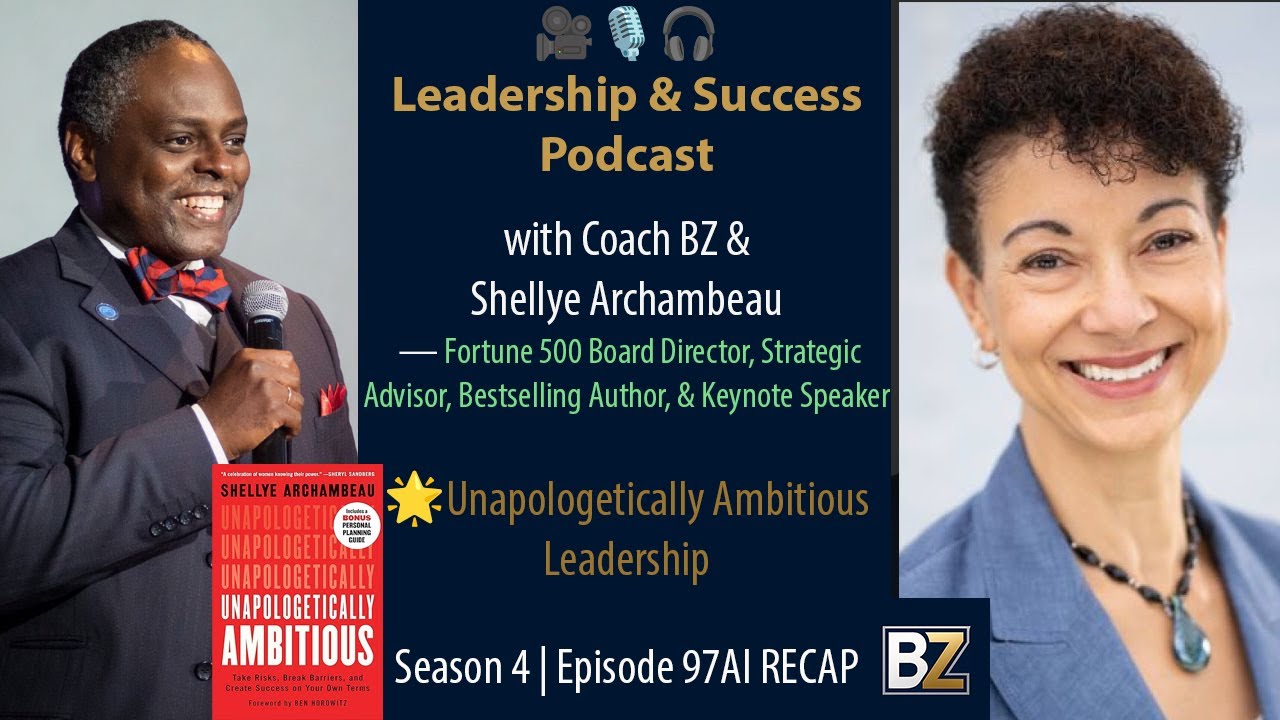
Shellye Archambeau, former CEO of MetricStream, shares five practical plays for ambitious leadership: own your ambition, ruthlessly prioritize, build a crew through mentorship, learn to bounce back from failure, and live life first. She set her personal north star at 16 and deliberately aligned every move to it.
Chapters
Hi, I'm John Maxwell. When the top companies in the world are looking for trainers, speakers, and coaches, there's one name that stands above the rest, and that's Maxwell Leadership. Our certified team members have gotten proven results for companies all over the globe, and our reputation, I'm proud to say, is second to none. Some of our members have risen to the top of their profession, including the one you're going to meet today. I proudly introduce you to my friend, Bob Fabien Zinga.
Welcome to the Leadership and Success Podcast with your host, Coach BZ, where we help you lead with purpose and succeed with impact. If you're ready to grow into the kind of leader others want to follow, this podcast is for you. If you're determined to elevate your success and leave a lasting legacy, this podcast is for you. As my mentor, Dr. John C. Maxwell, reminds us, everything rises and falls on leadership. Our goal is simple, to inspire you, challenge you, and equip you with insights that can transform the trajectory of your leadership journey. Welcome aboard to another episode of the Leadership and Success Podcast with with Coach BZ.
Hi, I'm Shellye Archambault, a former tech CEO, Fortune 500 board member, and author of Unapologetically Ambitious: Take Risks, Break Barriers, and Create Success on Your Own Terms. As much as we may like to believe otherwise, Ambition alone is not enough to be successful. There are many ambitious people in this world, but only a fraction of them accomplish their highest goals. That's why I wrote this book, to share the strategies, approaches, and tools that have worked for me, and that I suspect may work for you too. Now, success means different things to different people. When I was a teenager, I decided that I wanted to be a CEO one day. But maybe you hope to make a scientific discovery, or create a beautiful piece of art, or change your community for the better. Whatever it is you are striving for, this eCourse will cover some of the challenges that you may encounter, plus some useful suggestions that may not be on your radar. From dealing with imposter syndrome, to building your reputation, to finding the right mentors, The road to success can be bumpy and often takes some unexpected turns. But with an intentional, dedicated plan in place, your vision of a fulfilled, successful life can become reality.
That is really powerful because there are many leaders right now, especially in the volatile world we are living in with AI and all of that, they kind of struggle, right? To balance ambition with authenticity. I know one thing you taught me was this myth about life and work balance. You said that doesn't exist. It's really the integration of the two. And I think that is so true. Completely changed my perspective on that. How can we pursue bold goals without losing ourselves in the process?
The key is ruthless prioritization.
Yes.
And when I say ruthless, I mean ruthless. So prioritization for your life is about taking the things that you have to get done, right, that you need to get done that are professional with the things that you have to get done personal. You put the two together and now you prioritize.
And you mentioned your late husband, Scotty. And you've shown so much grace, strength through both triumph and tragedy. And so the question I want to ask with deep empathy and respect is, you lost your husband, I believe it was in 2019. He was your partner and he shaped so much of your life journey. While I can't pretend to know what it feels like to lose a spouse, and I don't know what I would do if I ever lost my wife, my best friend. But in part, I can relate when I lost my mom during COVID-19 in 2021. But anyway, that experience did change the way I lead, I love, and I serve others. What everyone, this is Coach Bizzy. I just show you two extracts from the hour-long discussion I had with my mentor Shirley Archambault. You need to go back and watch the full episode, Season 4. Episode 97, and we met, I think it was October 23rd. You really need to go back and listen to it. And if you haven't yet, for whatever reason, please make sure to purchase a book, An Apologically Ambitious. It's one of the few books I read every single year, and you definitely are not going to regret that decision. As we customarily do, we are going to take just a moment for a moment of gratitude. Every time we meet, we want to be grateful for at least one thing every single day. So if you would, close your eyes if you can, maybe take a deep breath and think about one thing you are grateful for today. I think today I'm just grateful for another day. I am here to see another day. I am so grateful for it. Somebody went to bed last night and they didn't wake up, but I am here, and what a blessing that is. So if you would type in the comment what you're grateful for today, And if you have a question, type it in the comment as well. And also let us know where you are coming from, what city and state. And if outside of the US, what country. I'm not going to play two 5-minute AI recap videos. That pretty much gives you a summary of the, again, hour-long conversation I had with Shelly Archambeau. And I'll be back in about 10 minutes.
All right. Today we're cracking open the playbook of Shelly Archambeau, who was one of Silicon Valley's very first Black female CEOs. It's called "Unapologetically Ambitious," and it's basically a step-by-step guide for you to design your own success.
Wow.
This quote, it really hits home, doesn't it? I mean, it's so true. We plan our 2-week vacations with more detail than we plan our entire careers. It's such a powerful way to frame things, and it really sets us up for a totally different way of thinking. So, I'll ask you directly: are you actually flying your plane? Are you in the cockpit, making the decisions? Or are you just kinda sitting in the back, hoping for the best? Shelley Archambault's entire philosophy is about giving you the tools to grab the controls and become the pilot of your own life. And she literally wrote the playbook on how to do it. So her playbook kicks off with a really fundamental idea: you can't take off until you know where you're going. You have to design your destination first. Okay, so what's the deal with the number 16? Well, this was the age that Shelley Archambault said something out loud that basically charted the entire course for the rest of her life. That's what she said. Just— think about that for a second. At 16 years old. She didn't have a clue how she was gonna do it, but she knew her destination. She basically set her north star before she even had a map. And that story, right there, is the perfect example of her core principle: intentional design. You see, her success wasn't an accident. It wasn't luck. It was a long series of very deliberate choices. From getting into the Wharton School, to working at IBM, and then having the guts to leave a great job there because she realized it the fastest path to CEO, every single move was aligned with that one goal. And bam, she was CEO of MetricStream by the time she was 40. So, once you've got your destination locked in, what's next? Well, the second play is all about mastering the journey itself. You know, handling all the daily turbulence that comes with an ambitious career. You know this phrase we're all obsessed with, "work-life balance"? Yeah, Shelly says forget it. It's a myth. Her reality, and her strategy, is something she calls "ruthless prioritization." It's not about trying to juggle everything perfectly. It's about deciding what actually matters, and then being okay with letting the other stuff go. Like, deciding that family dinner is a non-negotiable, even if a last-minute work thing pops up. It's a conscious choice. I love this analogy because you can just picture it, right? Your plate is piled high, things are wobbling, and when something falls, It shatters. Ruthless prioritization is about being proactive. It's about taking things off your own plate before they have a chance to fall and break. But look, you can't master the moment all by yourself. Even the best pilot needs a flight crew. And that brings us to Play #3, which is all about building your crew, your alliance. Okay, let's be honest. We've all thought about doing this, right? That super awkward, formal, um, "Will you be my mentor?" question. It almost never works. Why? Because successful people are incredibly busy. So Shelly figured out a much, much smarter way to do this. This is her method, and it is brilliant. It's called Adopt, Don't Ask. So instead of that big formal ask, you just start treating them like a mentor. You ask for one small, very specific piece of advice. Then you go do it right away. And this is the most important part. You report back and tell them how it went. This creates a real relationship, one built on results, and they start to feel invested in your success. It's a total game-changer. And that brings us to the last play. And honestly, this might be the most critical one of all. Because if you're ambitious, you are going to hit turbulence. That's a guarantee. It's not about avoiding it; it's about learning how to bounce back. So, let me tell you a quick story. Early on at IBM, Shelly was working on a massive, multimillion-dollar deal with Rite Aid. And she lost it. Just lost the deal. For most people, a mistake that big, that's a career ender. You just don't recover from that. But then, her late husband Scotty said this to her. It's so direct, so powerful, and it just completely reframed the whole thing. The loss wasn't who she was, it was just something that happened. An event. And it was over. Those words taught her everything about resilience. And that's the mindset. That's the secret sauce. A setback is not a final verdict on who you are. It's just information. It's only a true failure if you refuse to learn anything from it. Otherwise, it's just tuition. And that resilience, that ability to learn the bounce, it was tested in the hardest way you can imagine when her husband passed away. And somehow, she was still leading her company through all of that immense grief. She says she leaned on these three things: her faith, her community, and counseling. It's such an important reminder that asking for help isn't weakness. For a leader, it is the ultimate sign of strength. Okay, so we've walked through her place. What does this all mean for you, right now? Let's boil all this incredible wisdom down into the core rules for your playbook. Here they are, 5 simple rules. Number 1: Own your ambition. Just like that 16-year-old girl did. 2. Be ruthlessly intentional with your choices. 3. Learn the bounce. Turn every failure into a lesson. 4. Lead with real empathy, for others and for yourself. And finally, number 5, live life first. Because that's the whole point of all of this, isn't it? And there you have it. We are right back where we started. This is the heart of the entire playbook. Be intentional. You are the pilot. You set the destination. Whatever you do, don't let someone else take the controls. So, I'll leave you with this question: What is the very first unapologetic, ambitious move that you are going to make? Really think about it. And then, go fly your plane.
Welcome to the podcast! Today, we're diving deep into the world of unapologetically ambitious leadership, where success is seen as a matter of intention rather than luck.
Yeah, absolutely. I love that idea. It's like saying, if you want success, you have to design it, right?
Exactly. It's all about intentionality, setting clear goals, and strategically planning your path. Shelly Archambault lays it out brilliantly in her book, "Unapologetically Ambitious." Right.
So what really stood out to you about her approach?
Well, for one, she challenges the notion that success is just about being lucky. You know, it's about preparation meeting purpose. She emphasizes that you don't need anyone's permission to be ambitious, just the courage to start.
It's almost like the idea that our careers are self-designed journeys, isn't it?
Yeah, exactly. She even says success doesn't happen by chance. It happens by choice.
Yeah.
I mean, when you think about it, it's like every decision, every risk you take builds into that success.
I appreciate that perspective. But don't you think sometimes the environment or systemic barriers can also play a big role?
Absolutely, and Shelly doesn't ignore that. She talks about navigating those obstacles, particularly as one of the first Black female CEOs in Silicon Valley.
Right.
It's about breaking barriers, managing bias, and building networks that support you.
Yeah, and speaking of networks, her idea on mentorship was pretty innovative, wasn't it? Adopt mentors without asking.
She says, totally. It's a subtle shift. It's like treating someone as a mentor by simply asking for small bits of advice and then implementing it. It creates a natural reciprocal relationship that builds trust.
It almost feels like a grassroots approach to leadership where respect and trust develop organically.
Right on. And then there's the concept of ruthless prioritization. Shelly argues that balancing work and life isn't about finding a perfect balance, but rather aligning your priorities so that you focus on what really matters. You know, it's like if your plate is too full, you simply let go of what doesn't need your focus.
I find that approach really practical. It's not just motivational, it's actionable advice.
Exactly. And speaking of actions, another key point is learning from failure. Shelly shares a poignant story from her early career when losing a big deal could have broken her. But instead, she learned to see failure as a critical part of growth.
That reminds me of the saying, "Failure is not fatal, but failure to learn is." It's such a powerful mindset shift.
Yeah, and she really drives home that lesson by showing that resilience and adaptability are just as crucial as any technical skill.
Absolutely. And earlier you mentioned intentionality. How does that connect with leading under pressure?
Great question. Shelly talks about leadership under pressure by highlighting that as a leader, your demeanor sets the tone. When you carry calm and confidence, your team follows suit. Her mantra, "Things are never as bad as they appear and never as good as they appear," really underscores that balance.
It almost feels like an emotional thermostat for an entire organization.
Exactly. Like keeping the collective temperature in check. It's a leadership skill that transcends industries, from the boardroom to the battlefield.
And what about her advice on embracing discomfort? How does that play into overall leadership?
That's a big one. Shelly is all about adopting discomfort as a pathway to growth. It takes a special kind of boldness to keep moving forward, even when things are tough. It's not just about being ambitious, but being resilient and learning continuously from each setback.
I think some might argue that always pushing forward could lead to burnout, though. What are your thoughts?
I can see that, but Shelley also emphasizes living life first, balancing the intensity of ambition with self-care.
Right.
It's about setting priorities that not only drive your professional success, but also nurture your personal well-being.
That holistic view is definitely refreshing. It challenges the conventional hustle culture.
Exactly. It's like, um, you're not just crafting a winning career, you're sculpting a fulfilling life, one decision at a time.
And her boardroom insights, how does she link those back to daily leadership?
She makes a solid connection. In the boardroom, she observed that respect and diversity of perspective lead to more effective decisions. That's a reminder that great leadership is not about one voice, but about harnessing a chorus of insights.
I love that image, a chorus rather than a solo act.
Right, and it's all wrapped up in the concept of being intentional. Whether it's mentoring, handling crises, or making tough decisions, every action should align with your broader goals.
So, if someone feels hesitant to pursue a big dream because they worry it might be too ambitious, What's Shelley's take?
She would tell them, "Um, don't apologize for your ambition. It's about owning that desire for greatness and taking smart, calculated risks. It's a call to act with purpose and confidence without waiting for external validation." It sounds both empowering and challenging at the same time. Definitely. It challenges old paradigms and pushes us to rethink what success really means.
Mm-hmm. I really appreciate how she blends personal resilience with strategic leadership. It seems like a blueprint for thriving in any high-stakes environment.
Absolutely. It's a masterclass in deliberate leadership. Shelly's experiences from navigating tech to leading under crisis provide a roadmap for anyone looking to break barriers while staying true to their values.
Right on. So if our listeners could take one core lesson away from this, what would it be?
I'd say it's this: own your ambition unapologetically, be ruthlessly intentional, and remember that every setback is just a setup for a greater comeback.
Yeah, absolutely. I love it. Thanks for this enlightening discussion. It's given me a whole new perspective on leadership.
Well, that is so powerful. I've got a copy of— oh, here it is, Unapologetically Ambitious right there, which I read every Single Year. This is really like a life manual. You've put so much into this, and you mentor so many, many people across America and around the world. What, uh, inspired you to write such a book that is not only you telling your story, but you are also really teaching and mentoring and helping the next generation to try to achieve their, their own goal as well?
You know, Bob, throughout my career, people reached out to me for advice, for counsel, for mentoring. And I did that. I tried to meet and talk with as many people as I could. But as I rose higher and higher in the ranks, the amount of time I had to do that was shrinking. Right? I had less time. I still did it, but I had to turn people away. And I thought, you know, when I pass the CEO baton at some point, I'm going to write this down.
Thank you for tuning in to the Leadership and Success Podcast with your host, Coach BZ. If today's episode added value to your leadership journey, be sure to subscribe, share, and join us again for more wisdom nuggets on how to lead better and achieve greater success. Remember, leadership is the most critical skill of our time. The world will always need leaders to inspire others, drive innovation, and execute meaningful strategy. So why not count yourself among the bold leaders shaping the 21st century? Until next time, stay inspired, stay committed, and keep leading with excellence.
More from Bob

S250:E4🎙️LIVE 🇺🇸America 250: President Barack Obama Leadership, Service, and the Power of Hope






S5:E157🎙️ LIVE with CMD CMSgt Dennis L. Fritz, USAF (Ret.)(Multi Tracks Audio)



S5:E156🎙️ LIVE 🇪🇸 Leadership Lessons from the FIFA World Cup 2026 Champions (Multi Tracks Audio)

S250:E3🎙️ LIVE Leadership Lessons from America’s First Documented Family of African Descent 🇺🇸📖