🚨 S4:E98AI RECAP LIVE | Leadership Under Fire (Multi Tracks Audio)
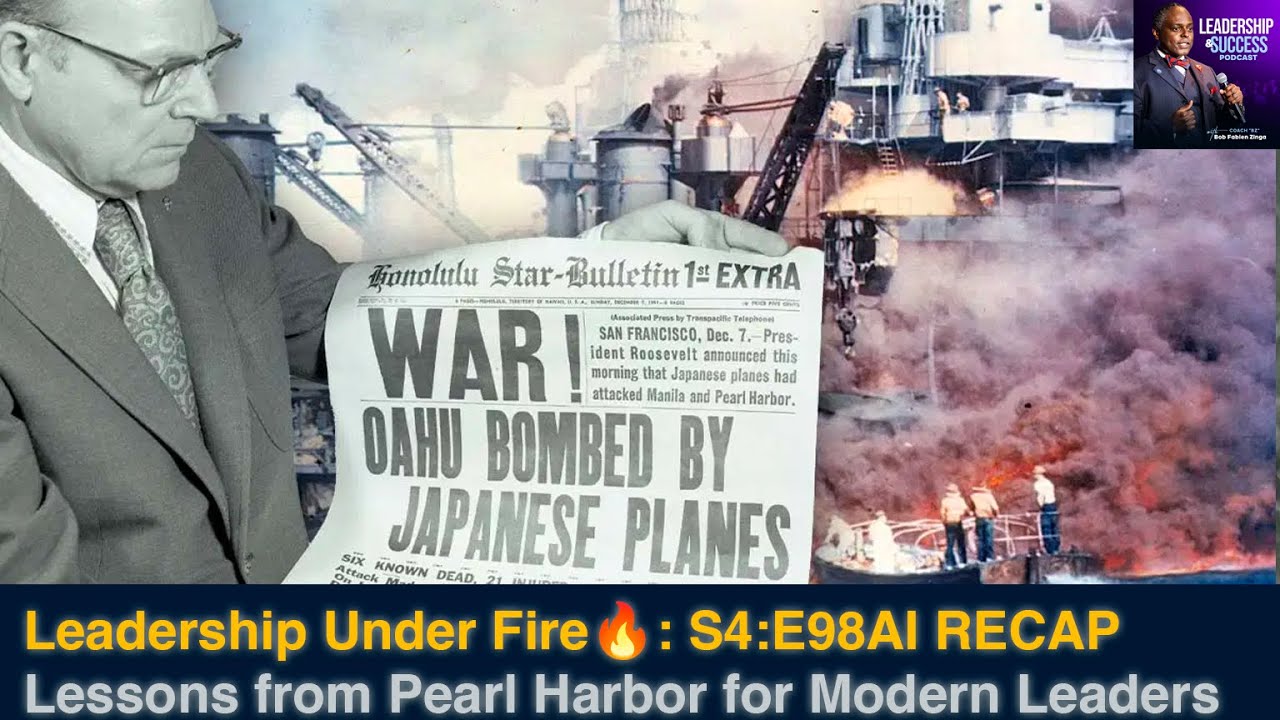
Coach BZ uses Pearl Harbor to teach leadership under crisis. Admiral Kimmel ignored radar warnings and assumed no threat. The lessons: challenge complacency, empower teams to act without waiting for orders, stay calm, and run crisis drills.
Chapters
Hi, I'm John Maxwell. When the top companies in the world are looking for trainers, speakers, and coaches, there's one name that stands above the rest, and that's Maxwell Leadership. Our certified team members have gotten proven results for companies all over the globe, and our reputation, I'm proud to say, is second to none. Some of our members have risen to the top of their profession, including the one you're going to meet today. I proudly introduce you to my friend Bob Fabien Zinga.
Welcome to the Leadership Success Podcast with your host, Coach BZ, where we help you lead with purpose and succeed with impact. If you're ready to grow into the kind of leader others want to follow, this podcast is for you. If you're determined to elevate your success and leave a lasting legacy, this podcast is is for you. As my mentor, Dr. John C. Maxwell, reminds us, everything rises and falls on leadership. Our goal is simple: to inspire you, challenge you, and equip you with insights that can transform the trajectory of your leadership journey. Welcome aboard to another episode of the Leadership and Success Podcast with Coach BZ.
But the analyst thinks 'Ah, probably just that backup script acting up again,' and ignores it. That's the B-17 assumption happening right now in organizations everywhere.
So you need protocols that say, essentially, investigate first, assume later for certain kinds of alerts.
You absolutely do, especially for high-impact, low-frequency events. Strategic awareness isn't just nice to have, it's fundamental stewardship. You have to build processes that force you to consider What if this isn't the B-17s?
Which ties directly into Lesson 2: Challenge assumptions to prevent complacency. This feels like the internal version of ignoring external warnings.
It is.
It's about confronting those ingrained beliefs within your own organization. Before Pearl Harbor, there was this widespread, almost arrogant assumption that the Japanese simply couldn't pull off such a complex, long-range attack. Admiral Kimmel himself admitted he didn't think it was possible.
A failure of imagination, almost.
Rooted in complacency, a satisfaction with the status quo, thinking your defenses are adequate because they haven't been breached yet. And remember, the planes parked wingtip to wingtip.
Yeah, you mentioned that. Easier targets for bombs, but harder to sabotage individually.
They feared sabotage, an internal threat they understood from World War I, more than a large-scale air attack, the external threat they underestimated. That it can't happen here thinking blinded them to the most obvious danger.
So for leaders today, this means actively looking for those dangerous assumptions in your own team, your own strategy.
Constantly. What are your sacred cows? Is your product secure just because you haven't had a major breach? Will your project succeed just because the last one did? You need to build a culture, and this is hard, where people feel safe, even rewarded, for respectfully pointing out potential flaws, for poking holes in the plan before the enemy does.
Like formalizing a risk—
Right, the Vestal was moored right alongside the Arizona when it exploded, The blast actually blew Commander Young overboard into the water.
Most people would swim for shore, surely.
He swam back, back to his damaged ship, through the smoke and debris, climbed aboard, took command, and managed to navigate the burning, damaged vessel away from the inferno around the Arizona. He deliberately beached it to prevent it from sinking and blocking the channel. Saved his ship through sheer force of will.
So what does all this tell us? This collective resilience, this bottom-up initiative.
Well, the critical insight I think is about organizational structure and maybe culture. This spontaneous action from admirals down to chiefs and ensigns, it was essential. It prevented an even worse disaster. When your top command is gone, your communications are out, your Plan A is instantly irrelevant, what's left?
The people on the ground.
Exactly. Organizational survival hinges on whether the people closest to the problem feel empowered, trained, and trusted enough to act without waiting for orders.
That makes sense. Yeah. But doesn't the need for that level of heroism also point to a massive failure higher up? I mean, should a well-run Navy need a 22-year-old ensign to die holding a flashlight for others to escape?
That's the hard truth, isn't it? The heroism was necessary because the readiness failed systemically. Which brings us perfectly to the view from the top, 4,000 miles away in Washington, D.C., where President Roosevelt is getting the news.
Right. So the reports start coming in. What was his immediate reaction?
The sources describe initial audible shock, disbelief. There's an account of him shouting, "No!" into the phone when he first heard the confirmation. But crucially, that lasted only moments.
And this is where we really see that third lesson starting to form: maintain composure in crisis.
Precisely. Witnesses said he moved past the talk almost immediately, became, as they described him, angry but composed.
All right, these were two highlights from the podcast about the article I wrote about leadership lesson from Pearl Harbor, December 7th, 1941, the day that should live in infamy, Leadership Under Fire. All right, and today we are going to add the 10-minute AI recap. Actually, I have another surprise for you. Before I play the 10-minute recap, I'm gonna play like a 5-minute overview of the historical context, and then I will play the 10-minute recap. But, um, before we do that, let's do what we do every time we meet— our moment of gratitude. So what are you grateful for today? All right, if you would, you can close your eyes if you can. Put yourself in your happy place and think about one thing you are grateful for today. I think today I am grateful for the weather. We had a little bit of rain today in Bali. Doesn't rain enough, I think. Every time we get a little bit of rain, I am always happy. I'm fond of seeing the grass yellow or brown. I like green grass, and we definitely need more Raghu here. If you would type in the comment, what are you grateful for today? And also, uh, let us know where you're joining from, what city, what state, and if outside of the US, which country. And if you have a question for me, please type it in the comments. All right, so, uh, I'm gonna play a 5-minute overview of Pearl Harbor, and then we're gonna get the 10-minute AI recap of, uh, my, uh, article about leadership and the fire leadership lesson from the Pearl Harbor attack. And, uh, I'll be back in about 15 minutes.
You know, we often look to history for lessons, but some moments, they're more than that. They're like an urgent blueprint. So today we're going to look at the attack on Pearl Harbor not just as some dusty historical event, but as a genuine masterclass in leadership under fire. We're going to unpack principles that are just as critical right now as they were back in 1941. Yeah, you've probably heard those words a thousand times. President Franklin D. Roosevelt, just nailing the nation's shock. But really, try to picture it: a peaceful, quiet Sunday morning in paradise, completely shattered in an instant. That single moment wasn't just the start of a war; it became the ultimate, pop quiz test of leadership, from the highest office in the land all the way down to the sailors on the decks of sinking ships. And just think about the speed of this crisis. In a little over 1 hour, 2,390 American lives were gone. This wasn't some slow-burning problem that gave people days to react; it was an absolute catastrophe that unfolded in minutes. And it's in those moments, those moments of pure, unfiltered pressure, that you see what leadership is really made of. I mean, can you even imagine the scene? Explosions are just rocking the harbor, and the pride of the entire U.S. Pacific Fleet is being systematically wiped out. The USS Arizona just vanishes in this massive explosion, taking over 1,000 of its crew with it. The USS Oklahoma capsizes, trapping hundreds more inside. This was the definition of a crucible, a place where all the leadership theories in the world meant absolutely nothing, and decisive action meant everything. But you know what? Out of that fire, leadership absolutely emerged. There's that old saying that crisis doesn't build character, it just reveals it. Well, on this day, character was revealed at every single level, from the young sailors on burning decks to the President staring down the brink of a world war. So you've got these two totally different kinds of leadership that were desperately needed at the exact same moment. Right there on the ground, it was all tactical, immediate, junior officers and sailors making life-or-death decisions in a split second. And then, thousands of miles away, you have this strategic, calm leadership—President Roosevelt, absorbing the shock and figuring out how to rally an entire nation for the fight ahead. And this is what that leadership actually looked like. We're talking about Ensign Flaherty, he's just 22 years old, giving his life, holding a flashlight so his crewmates could escape a dark, flooding turret. Or Commander Kasson Young, who gets blown overboard and then swims back to his burning ship to retake command. These aren't just war stories, folks; they are absolute masterclasses in courage and what it means to lead. Okay, so what's the first real lesson we can pull from all this? Well, it's the catastrophic, devastating cost of complacency. It's about the absolute necessity of paying attention to the warnings, no matter how quiet or unlikely they seem. Get this: On the morning of the attack, a huge blip appeared on a radar screen. It was dismissed. "Ah, probably just friendly planes." That was a fatal assumption. So the modern principle here is crystal clear: great leaders have to be willing to act on incomplete data, and they have to relentlessly, aggressively challenge that dangerous assumption that it can't happen here. That's a huge takeaway for any leader today. Alright, lesson number 2, this one is all about what a leader projects when everything is falling apart. Because in a crisis, your composure? That's not just a personality trait; it's a tactical tool. It is a force multiplier. Just look at FDR. People who were there described him as "angry but composed." He didn't panic; he got focused. Or think about Lieutenant Commander Fuqua, on the deck of the burning Arizona, calmly organizing rescue efforts. That composure spread like wildfire through the crew. The lesson is so simple: your team will always take their cues from you. Your calm becomes their confidence. And our final lesson, you know, this might be the most important one for building a team that can actually withstand a shock. It's about what happens when the senior leaders are gone and the people on the front lines have to step up and act. It's all about empowerment. Honestly, one of the most incredible things about that day was how junior sailors and officers immediately took charge. They didn't wait for orders. Now, that doesn't just happen by accident. It happens because a culture of trust and decentralized command has already been built. The lesson for us? Delegate authority and trust your team to adapt. You have to build that resilience long before the crisis ever hits. Okay, so history is one thing. But taking action is another. Let's make this super practical. How do you take these incredibly hard-won lessons and apply them to your team, to your company, right now? This is your leadership playbook. So here are 4 things you can do: 1. Run crisis drills. Ya gotta build that muscle memory before ya actually need it. 2, actively encourage a devil's advocate on your team. You wanna reward people who challenge your assumptions. 3, deliberately delegate authority. Empower your frontline. And 4, when you communicate, do it with clear intent. In a crisis, clarity is literally life. And this is exactly why that playbook is so critical. Think about it. At Pearl Harbor, ammunition lockers were locked shut. Planes were parked wingtip to wingtip, making them perfect targets. That lack of preparation didn't just allow the disaster to happen; it made it so much worse. It's just a stark reminder: preparation might not guarantee success, but a lack of it? That absolutely guarantees failure. When it comes down to it, studying an event like this isn't just some academic exercise; it's an act of respect. We learn from these stories, we really try to internalize the lessons, and by doing that, we honor the legacy of those who faced the ultimate test of leadership. We prepare ourselves to try and be worthy of their example. So I'll leave you with this question. It doesn't have to be a national crisis, right? It could be a project that went completely off the rails, or a huge personal challenge. What was your Pearl Harbor moment? That moment when you were truly, genuinely tested, And what did it teach you about leadership?
Let's dive into a discussion about a piece that really digs into leadership lessons drawn from one of history's most pivotal events, Pearl Harbor. It's fascinating how those extreme circumstances illuminate timeless principles for modern leaders. Absolutely.
It's like history handed us a blueprint on how to lead under fire. The article reminds us that even in the wake of devastation, exemplary leadership can be a beacon.
Yeah, exactly. It walks us through the chaos of December 7th, 1941, where the USS Arizona, the Oklahoma, and other vessels were caught completely off guard, and then shows how heroes emerged from such dire straits. And that's where we see the indispensable value of acting on early intelligence.
I mean, think about it. The article highlights that there were early warning signs, blips on the radar, intelligence hints. But the failure to act on them turned a potential near-miss into an all-out catastrophe. Exactly. Right, right.
It's like, um, if you think about cybersecurity or business, you don't want to ignore those red flags. The idea is to, uh, act decisively when you sense trouble brewing, even if the evidence isn't 100% conclusive yet. Mm-hmm.
That's a great analogy. And then there's the point on challenging assumptions. It's really a wake-up call against complacency. Leaders assumed the unthinkable couldn't happen, kinda like saying, "Our network can't be breached," right? Yeah, exactly.
Oh, totally. It's like, it's like assuming that because something has never happened before, it never will. And when you challenge those beliefs, you actively protect your organization, whether that's in warfare or cybersecurity.
Right. So now, one part that stood out to me is the emphasis on calm, decisive leadership under crisis. I mean, look at FDR in those crucial minutes. Shouting "No!" in shock, but then quickly gathering himself to lead. That resilience? It's gold.
Mm-hmm, absolutely, yeah. And it's not just FDR. Think about the officers on deck, like Lieutenant Commander Fuqua. Even after being hit, he jumped right back to organize firefighting and rescue efforts. It really shows that being calm under pressure doesn't just inspire confidence, it actively saves lives.
Yes, indeed. But here's a thought: while cool-headedness is vital, do you think there's ever a risk in oversimplifying the crisis to just staying calm? I mean, sometimes you need to fuel a bit of urgency too, right?
Interesting point. I see what you're getting at, and, um, I agree to a point. It's a balancing act. Leaders need to be calm yet bold enough to rally their teams quickly. The article suggests that a composed clarity is what actually transforms panic into a well-organized response. So it's not about inaction, but measured, informed fuel for action. Fair enough.
That balance is essential. Now, let's talk about empowering the team. The narrative of unsung heroes who, without direct orders, took initiative really resonates. In times of crisis, every member becomes a leader in their own right, right?
Yes, indeed. Definitely. It's like a decentralized command structure. When communication lines fail and higher-ups are taken out, those on the front lines simply do what's needed, whether it's manning a machine gun or organizing an evacuation. This stands in stark contrast to environments where people wait for orders. Mm-hmm.
That's a crucial lesson for modern organizations. Especially in tech or cybersecurity, where a single point of failure in decision-making can be catastrophic. Empowerment and decentralization really make your team resilient in the face of unexpected disruptions. Right.
And then there's the element of communication—clear and empathetic. FDR's Infamy Speech, brief but potent, unified a shattered nation. It underscores how important it is to keep everyone on the same page when crisis Strikes.
Yeah, clear communication can either build bridges or create chaos. A lot of our modern incident response strategies could learn a thing or two from how those orders were crisply delivered on deck.
Absolutely. And another interesting point is the ongoing insistence on training and preparation. The attack exposed how unprepared the forces were due to neglecting basic training protocols. It's a blunt reminder that regular drills and readiness exercises aren't just bureaucratic exercises; they are fundamental.
Mm-hmm. It really brings home how preparation empowers teams. Whether it's battle drills in the Navy or cybersecurity simulations in corporate settings, continuous training creates a readiness that can turn a potential disaster into a manageable event. Exactly.
And that idea extends into everyday leadership. The coaching prompts in the piece encourage leaders to regularly update intelligence briefings, challenge assumptions, and hold practice sessions to build that muscle memory. It's a proactive rather than reactive mindset. Right on.
Now, something that struck me was the integration of leadership with a sort of ethical or even spiritual dimension. They mention scriptures and timeless proverbs, which illustrate moral underpinnings of responsibility and accountability. How do you see that fitting into today's leadership paradigms?
Well, you know, it serves as a reminder that leadership is not just about the mechanics of decision-making, but also about character. Those timeless verses, whether it's Proverbs or passages from the New Testament, remind us that integrity and empathy should anchor every decision. It underscores that leading effectively means caring for the people you lead.
Yes, indeed. However, I do wonder if incorporating those spiritual dimensions can be tricky in secular or diverse environments. Do you think that could alienate some, or is it more about the underlying values than the specific references? That's a fair challenge.
I'd say it's more about the universal values. The message isn't necessarily to impose religious beliefs, but to highlight principles like foresight, clear communication, and trust. These are applicable regardless of personal belief systems.
Mm-hmm, right. It's the values that resonate universally. And speaking of values, don't you think that the article does an excellent job of linking past leadership failures with modern strategic failures particularly in cybersecurity.
Absolutely, yes. Yeah, it really draws a parallel. Just as the misinterpretation of early radar signals allowed an enemy to strike unchallenged, today's organizations can suffer when warning signs are misread in cyber threat landscapes. It's a call to cultivate alertness and adaptiveness in leadership.
Right. So it's like having a built-in early warning system. And by fostering a culture that questions long-held assumptions, leaders can avoid the trap of complacency. As simple as, um, thinking, "This will never happen to us." Absolutely.
Yeah, exactly. The analogy reminds me of, um, an old saying: "If you don't test your defenses, how will you know they hold up when the real challenge comes?" Mm-hmm, so true.
So let's break it down. Act on intelligence, challenge assumptions, maintain composure under fire, empower your team, communicate clearly, and invest in continuous training. Each of these isn't isolated. They genuinely feed into one another, building a resilient system overall.
Right. Perfectly put. Yes, precisely. And I also appreciated the coaching prompts sprinkled throughout the content. They serve as practical steps rather than just abstract ideals. For instance, asking yourself if you're conducting regular threat briefings or if your team feels empowered to deviate from protocol in a crisis, they're very actual.
Yeah, absolutely. Now for a moment, let's consider the modern leader who might work in a digital or cybersecurity realm. How can these Pearl Harbor-inspired lessons be implemented on a day-to-day basis?
Interesting question. Well, it starts with creating systems that constantly monitor risk signals. Whether it's through regular intel briefings or security simulations, leaders should integrate constant training as a core practice. And like the unsung heroes of Pearl Harbor, every team member should feel they have the authority to act if needed, without the burden of waiting for higher orders.
Mm-hmm, exactly. I love that. And, um, it also underscores the importance of clear, inspiring communication. A leader's exact words in a moment of crisis can literally be the difference between coordinated action and chaos.
Absolutely, right on. Yeah, it's about building that culture where ideas are freely challenged, where assumptions are continuously questioned, and where every individual knows what to do in an emergency. Empowerment, clarity, and constant preparation are the bedrock of resilient leadership. Right.
So this discussion really makes you reflect on personal leadership experiences too. Moments when maybe a quick decision, a calm word, or the trust you placed in your team made all the difference.
Exactly. It's a call to keep improving ourselves. And while we may not face enemy planes or massive cyberattacks, on a daily basis. Each crisis, big or small, is an opportunity to exercise these principles.
Couldn't agree more. In conclusion, these lessons from Pearl Harbor aren't just historical anecdotes. They're a playbook. Whether you're steering a naval ship or managing a cybersecurity incident, the fundamentals remain the same. Be alert, challenge the status quo, empower your team, and importantly, communicate with purpose.
Yes, indeed. Right, and if there's one takeaway, it's that leadership under pressure can transform tragedy into triumph. These lessons compel us to be vigilant, adaptable, and above all, humane in our leadership.
Exactly. Well, that was an engaging rundown of those powerful insights. It really highlights that history, with all its harsh lessons, can be an invaluable teacher for leaders today.
Mhm, for sure. It's about learning from the past so we can build a more resilient future, on the battlefield, in boardrooms, or in cyber war rooms. Thanks for the insightful chat. It's been, um, really enriching.
Absolutely. Thanks for the discussion.
Welcome to the Deep Dive. This is where we take those huge pivotal moments from history and, well, we pull out the practical actionable insights that you as a modern professional can actually use today. We're not just looking back, we're finding blueprints for leadership, especially when things get really tough. And today we are doing a deep dive into a date that truly changed everything. December 7th, 1941, that Sunday morning, Pearl Harbor, Hawaii. It went from quiet to chaos In what, just over an hour? President Roosevelt called it "a date which will live in infamy," and he wasn't wrong.
Absolutely. The scale is hard to fathom even now.
A surprise attack by the Japanese Navy devastated the U.S. Pacific Fleet. 2,390 American lives lost, ships sunk or crippled. So, our mission, it's a big one. Understand how leaders reacted in that absolute crucible, from the top down to, you know, the sailors on deck. And more importantly, what does that chaos, that complacency, that crisis management teach us today? Whether you're facing, I don't know, a corporate meltdown or maybe a major cyberattack. That's exactly right.
When you really dig into the analysis, the reports, the firsthand accounts of Pearl Harbor, it's, it's more than just military history. It becomes this incredibly raw case study. You see organizational failure, you see human psychology stripped bare under extreme pressure, but you also see this amazing resilience, right? And yet, 8 decades on, the core principles of leading under that kind of sudden overwhelming pressure, they haven't changed one bit. We're essentially drawing a line from the, the smoke and fire on the deck of the USS Arizona, where tragically 11,177 men died almost instantly, right to your modern challenges, your boardroom decisions, your cybersecurity ops center when the alarms go off.
So if you want to understand how to react when basically your worst nightmare happens in minutes, this is the place to start. Yeah. Okay. Let's start there then, right on the water. Mm-hmm.
Because the sheer scale of it. Yeah.
It's almost unbelievable looking back. You mentioned—
Your words need to inform, yes, but also motivate people towards that absolute victory, whatever that looks like in your context.
Clarity fuels action. And that leaves us with the final lesson, Lesson 6: Invest in training and preparation. This feels like the ounce of prevention lesson.
It's the painful pound of cure lesson learned at Pearl Harbor. The lack of readiness was frankly shocking. Ammunition locked away, planes parked like easy targets. These weren't accidents. They were choices based on flawed assumptions and likely a lack of rigorous preparation for the right threat.
Sabotage versus air attack again. Exactly.
The system wasn't drilled or equipped for the event that actually happened. Of course, after the attack, there was a massive urgent overhaul. Better drills, better radar training, better intelligence sharing. But the cost of learning that lesson was immense.
So the takeaway is obvious: prepare before the crisis.
It sounds simple, but it requires real commitment, rigorous training, realistic simulations, constantly probing for vulnerabilities and addressing them before they're exploited. Leaders have to champion this. Preparation doesn't guarantee success, but as the saying goes, lack of preparation pretty much guarantees failure.
So, right. Oh, preparation doesn't guarantee success. But lack of preparation pretty much guarantees failure. All right, this is it for today. I don't see any question, uh, on LinkedIn or YouTube, so I'm gonna be back tomorrow. I'm going to have a live interview with Maman Ibrahim all the way from the United Kingdom, from Engineering and Audit to the Global Boardroom. And then on Tuesday, I will be speaking with, uh, Coach Renata Bernardi, originally from Brazil, now resident in Australia. Uh, that's going to be our 100th episode. I am so happy about that, 100th episode for, uh, season 4. Uh, that's quite an achievement for the Leadership and Success, uh, podcast. And, uh, then on Wednesday I will have two interviews. First with Coach Valerie Martinelli in the morning, and then in the afternoon I'm going to be speaking with my shipmate, the one and only Lieutenant Commander Amy Forsyth, U.S. Navy retired, but she used to be enlisted U.S. Marine Corps. So that's going to be quite a leadership conversation. I am very excited about that. And I want to say hello, someone watching from Twitch, Comporte-toi-moi is their Nick, Nem, most people on Twitch, they play games, so they don't really listen to what we are saying. But anyway, I am broadcasting this there just in case they pay attention. But yeah, so that's what we have planned for this week. And thanks again for being with us. And I'm looking forward to speaking with information security leader Ibrahim, Maman Ibrahim from the United Kingdom, right here on the Leadership and Success Podcast tomorrow.
Bye. Thank you for tuning in to the Leadership and Success Podcast with your host, Coach BZ. If today's episode added value to your leadership journey, be sure to subscribe, share, and join us again for more wisdom nuggets on how to lead better and achieve greater success. Remember, leadership is the most critical skill of our time. The world will always need leaders to inspire others, drive innovation, and execute meaningful strategy. So why not count yourself among the bold leaders shaping the 21st century? Until next time, stay inspired, stay committed, and keep leading with excellence.
More from Bob

S250:E4🎙️LIVE 🇺🇸America 250: President Barack Obama Leadership, Service, and the Power of Hope






S5:E157🎙️ LIVE with CMD CMSgt Dennis L. Fritz, USAF (Ret.)(Multi Tracks Audio)



S5:E156🎙️ LIVE 🇪🇸 Leadership Lessons from the FIFA World Cup 2026 Champions (Multi Tracks Audio)

S250:E3🎙️ LIVE Leadership Lessons from America’s First Documented Family of African Descent 🇺🇸📖