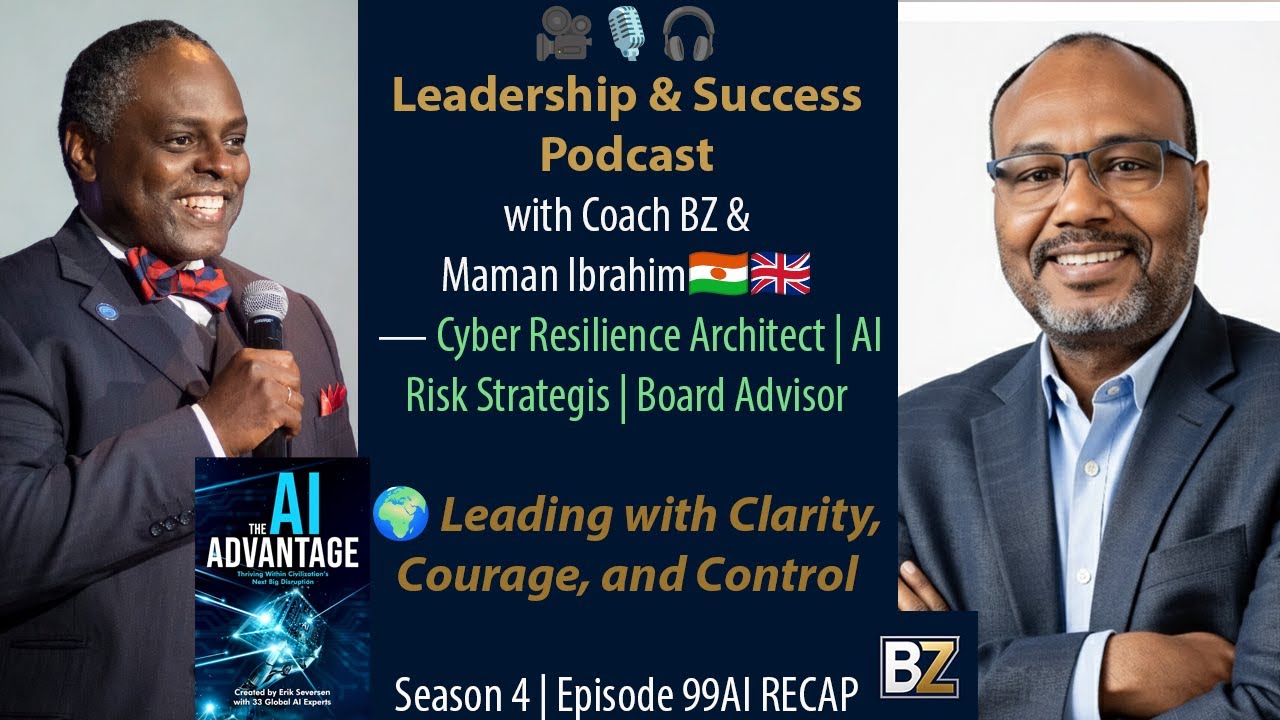
Coach BZ talks with Mamoun Ibrahim, founder of Dymco Resilience, about his "From Rough to Diamond" philosophy and a three-layer framework for responsible AI: ethics, technology, and governance. Ibrahim argues AI should augment human expertise, not replace it, and that combined human-AI effort outperforms either alone.
Chapters
Hi, I'm John Maxwell. When the top companies in the world are looking for trainers, speakers, and coaches, there's one name that stands above the rest, and that's Maxwell Leadership. Our certified team members have gotten proven results for companies all over the globe, and our reputation, I'm proud to say, is second to none. Some of our members have risen to the top of their profession, including the one you're going to meet today. I proudly introduce you to my friend Bob Fabien Zinga.
Welcome to the Leadership and Success Podcast with your host, Coach BZ, where we help you lead with purpose and succeed with impact. If you're ready to grow into the kind of leader others want to follow, this podcast is for you. If you're determined to elevate your success and leave a lasting legacy, this podcast is for you. As my mentor, Dr. John C. Maxwell, reminds us, everything rises and falls on leadership. Our goal is simple, to inspire you, challenge you, and equip you with insights that can transform the trajectory of your leadership journey.
Welcome aboard to another episode of the Leadership and Success Podcast with Coach Hello everyone, I'm Mamoun Ibrahim, founder of Dymco Resilience, principal at Eugene Zonda, and an eternal student of leadership, technology, and humanity. For more than two decades, I've worked across industries and continents, from Michelin and GSK to Helion and beyond, helping leaders transform cybersecurity and AI governance into sources of clarity, trust, and stability. Strategic advantage. But my story isn't just about technology, it's about resilience. I grew up believing that every person, like every organization, holds the potential to go from rough to diamond. That phrase defines my philosophy: growth through friction, strength through challenge, and brilliance through intentional leadership. Today, through my work at Ginkgo Resilience and Eugene Zonda, I partner with boards and CISOs around the world to build organizations that don't survive disruption. They thrive through it. I believe that cyber resilience is not an act of survival. It's an act of, an act of purpose, one that combines ethics, innovation, and courage. When I'm networking with executives, I mentor emerging cybersecurity leaders and explore the interactions between AI, behavioral science, and philosophy, because the future belongs to those who understand both Technology and Humanity. So to everyone watching, whether you're a naval officer preparing for command or a Silicon Valley engineer stepping into leadership, my message is simple: lead with clarity, act with conviction, and always remember resilience begins long before crisis strikes. Thank you, and I look forward to this meaningful conversation with Coach BZ on the Leadership and Success Podcast. Game on, game forever!
And we have, uh, Rami Sham says, I agree 100% with my man. So you have a lot of fans out there. Okay, a question from, for you from Greg. Uh, you talk about turning rough into diamond, developing people, not just the process. How do you see AI fitting into that, number one? And number two, is it sharpening the craft of cybersecurity or dulling the human edge we actually need to stay ahead of threat actors. What would you answer to Greg?
Oh, what I will say to Greg is that, I mean, it's a—
I will not oppose human and AI anyway. In the book that you mentioned, Thriving with AI, The AI Advantage, the one that you wrote, yeah, yeah. I wrote a chapter about how AI will change technology and cybersecurity. But everything that I said in that, in that chapter can be summarized as today, anyway, we have to deal with AI. There's no choice. It's technology evolution. And what I can add as well is that 30 years back, for my thesis in telecommunication, I worked using artificial neural networks in computer design of telecommunication system. Okay. And guess what? We were only few of us working on that topic. Then we just left to say, oh, there's no future on this. Yes. And see where we are now, nearly 30 years after that. It means that we cannot, we cannot change this evolution anyway. But yes, today the way it's going, uh, um, is that, uh, human alone will not make it. AI alone will not make it. So, but human together, augmented with AI, will outperform human and AI separately.
I see. So in that case, then the second part of Greg's question, do you think that's sharpening the craft of cybersecurity, or is it dulling the human edge when you add AI into the mix? Hey everyone, this is Coach Bizzy. Very glad to be here. If you want to get my man's answer to that question, watch the full episode. That's Season 4, Episode 99. That was with my man Ibrahim. And I'd like for everyone to go ahead and purchase this book, The AI Advantage: Thriving Within Civilization's Next Big Disruption. He co-wrote this book with 32 other authors. And before we get any further, I'm reminded for our moment of gratitude as it is our custom. So if you would, this will only take a moment, go ahead and maybe close your eyes and take a deep breath and think about one thing you are grateful for today. Almost every day when I wake up, I am always, always grateful for life. I'm grateful that I am still here. I may be going through a lot of challenges, but I am still here. I may be battered, but I am still here. I may be defeated, but I am still here, which means there is hope for me, right? Which means that my tomorrow can be different than my today, if only I don't give up. So I am very, very grateful today that I am still alive. I am grateful that I live in Silicon Valley in the United States of America. I still believe the best country in the world. And I really believe that my tomorrow can be so much better than my today and my yesterday. So that's why I'm grateful. So if you would type into the comment, what are you grateful for? So what we're going to do today, I am going to play— we're first going to do this in English and then I'm going to do this all over again in French, which is Maman and my native language. So we're going to play two AI videos about 5 minutes each. So it's going to be a 10-minute AI recap of the hour-long conversation I had with Maman. So I am going to play those and then I'm gonna play one more teaser from the hour-long episode, leadership conversation I had with my man and that's going to be the end. Again, I encourage everyone to please go and watch the full episode, Season 4, Episode 99. And in the meantime, if you have a question for me, please type it in the comment. Also would like to know where you are watching us from, what city, what state. And also I would appreciate it if you could tag someone and have somebody else watch the show if you believe it's going to add value to them. So like the post and repost in your feed and rate the podcast. I really do appreciate that. Okay, here we go to the first AI video.
You know, in a world that's just completely obsessed with tech, we're going to do something a little different. We're going to explore the timeless wisdom of this really unique leader, Mammon Abraham. He's a cybersecurity executive, sure, but he's also a philosopher. And today, we're gonna unpack his incredibly powerful principles on things like humanity, resilience, and, well, purpose. And this quote right here? It just sets the stage perfectly. See, Ibrahim isn't just talking about, you know, protecting computer systems. He's asking a much bigger question: Why are we even doing it? He's basically reframing resilience. It's not just a defensive reaction anymore. Nope, it's a proactive, mission-driven choice. And that's, that's a really powerful shift, right? It connects whatever work we do every day to a much, much deeper sense of meaning. So, who is the man behind these big ideas? Well, Mamoun Ibrahim, he isn't just some expert in AI governance or cybersecurity. People describe him as a philosopher of resilience. And you get the sense that his deep calm, his conviction, it all comes from this truly remarkable life journey that has shaped his entire way of seeing the world. Okay, so what's really at the heart of his philosophy? It's this powerful metaphor, really, for how he sees potential in, well, in everyone and everything. Let's dive into this core concept he calls "From Rough to Diamond." I think what makes this idea so compelling is just how universal it is. It's this profound belief that untapped potential is literally everywhere. This isn't about finding perfect people, not at all. It's about having the vision to see the brilliance that's just waiting to be polished inside of them. And look, this isn't just some corporate catchphrase he came up with. It's a philosophy that was born from real, lived experience. Growing up in the really harsh environment of Niger, Ibrahim learned that survival, it depends on community. He even recalls, "You never go out alone, and the reason why is so powerful." It's because the person that society might overlook, that might be the very person who helps you get home. I mean, that's a direct lesson in psychological safety, isn't it? It's about creating an environment where every single voice matters because you truly never know where the next life-saving idea is going to come from. So what this all really boils down to is this belief that a leader's number one job is to be a talent scout for the human spirit. Isn't that just a fascinating way to think about it? It's about cultivating people, right? Seeing their potential long before anyone else does and really understanding that every single person adds something to the collective.— journey. Okay, so that's the philosophy, but how does it actually translate into action? Let's take a look at how this way of thinking leads to a leadership style that pretty much flattens those traditional power structures we're all so used to. Wow, this is just such a powerful statement on respect! For Ibrahim, authentic leadership, it doesn't come from a title. It's not about where you are on an org chart. No, it's built on genuine human connection and this unwavering belief that dignity is universal. True influence, he'd say, comes from respect, not from your rank. And you know, he really pushes back against this common idea that we have to "balance" our human side with our technical work. Ibrahim's perspective is way different. He says people are always the most important thing. You don't just set your humanity aside to do your job; you bring it with you. It's the foundation for everything else. And this deep respect for every individual, it's way more than just a nice idea. It actually becomes a critical safeguard, especially when we start designing systems that can operate at a massive scale. So the big question is, how do these timeless human-centric principles hold up against our biggest technological challenge yet? Let's see how Ibrahim applies this whole philosophy to the age of AI. He frames the AI challenge with just perfect clarity. On one hand, you've got this incredible opportunity with AI-driven defense, but on the other hand, you have the very real growing threat of AI-driven attacks. This duality, this two this two-sided coin means we can't just dive in headfirst. We absolutely need a responsible, structured framework for how we lead. And here it is. This is his framework for navigating that challenge. He proposes this three-part approach to what he calls responsible AI, and it makes so much sense. It all starts with a foundation of ethics. From there, you build the technology on top of it, and then finally, you wrap the whole thing in governance, making sure that what we're creating actually serves and aligns with our shared human values. I mean, this quote just captures his ultimate vision perfectly. It's not about humans versus machines; it's about symbiosis. The future isn't about replacement; it's about augmentation. It's about a world where technology amplifies our collective human intelligence and our potential. Okay, so we've talked about the philosophy, the action, and the application. But what's the one core mindset that ties all of these powerful ideas together? What's the foundation for all of it? You know, when he was asked to just distill everything down to a single word, Ibrahim's answer gets right to the very heart of his entire philosophy. Any guesses what it might be? Authenticity. It's as simple as that. Leadership isn't about the authority your title gives you.
Not at all.
It's about the influence your character earns. Just like he says, "Titles fade, but authenticity stays." It's about leading from your core values, from who you really are. And of course, that kind of authenticity requires courage. This advice he gives to his younger self, it's really a powerful reminder for all of us. I mean, having conviction is one thing, right? But putting that conviction into motion, being bold about it, that's what creates real impact. So, what does this authentic mindset actually look like in practice? Day-to-day? Well, it's about staying teachable. Because let's be honest, leaders who stop learning, they stop leading. It also means debriefing failures quickly, sharing what you know to multiply your impact, and of course, always, always leading with humanity. Towards the end of a conversation with him, he was asked this really deeply personal question. And his answer, it reveals everything you need to know about what truly matters to him and what he believes is the ultimate measure of a life well-lived. In the end, it's not about the accomplishments, the titles, or the technologies. It's about relationships. It's about connection. It's just about presence. And that, right there, is the foundation of his leadership and, as he suggests, the foundation of a truly meaningful life. You know, the real value in all of these ideas is how we apply them. It's not just about understanding Mammon Ibrahim's philosophy; it's about taking a moment to reflect on our own, So, I'm gonna leave you with this question: How will you lead more authentically this week?
Today, we're diving into leadership that's, um, about more than just titles. It's about clarity, courage, and genuine connection. Think about how Mamoun Ibrahim went from the deserts of Niger to becoming a global thought leader in cybersecurity and AI governance.
Mm, absolutely. Right. It's almost poetic how he transforms the very idea of adversity into a diamond-like quality.
Exactly. His idea that every person, like every organization, holds the potential to go from rough to diamond really challenges the conventional view of leadership.
Yeah, that's so true. And then there's his approach to people. Treating a janitor, a CEO, or anyone with the same respect. It's not your typical hierarchical mindset.
Right. He emphasizes that authentic leadership isn't about control or rank, but about, you know, connection and genuine care for every single person.
Yeah, that really hits home. It's almost as if he says leadership should be as simple as greeting everyone warmly each morning. And then, bam, you build trust that lasts through decades.
Exactly. And that's the crux of his philosophy. Leadership is authenticity. Like, he doesn't separate people by titles at all.
Exactly. And speaking of authenticity, I was struck by how he talks about learning from failures immediately rather than letting them pile up over time. That reminds me of a sort of debrief early, debrief often mindset.
Right. It's like Every setback is just an opportunity to recalibrate. I mean, he admitted, 'I've failed many times,' yet never waited years to learn from his mistakes, which is an incredible lesson for us all.
Yeah, that's really valuable.
And then there's this whole connection to cybersecurity and ethics, where he says that cyber resilience is not just survival, but an act of purpose.
Absolutely. It's as if technology becomes an extension of ethical leadership. Precisely. His emphasis on responsible AI governance, balancing ethics with robust technical security, really speaks to today's challenges in tech.
Yeah, he lays it out in three layers: ethics, technology, and governance. It's like he's saying if we don't ground our innovations with integrity, we're just building castles in the air.
I get that. But don't you think sometimes that mix of technical mastery and soft skills might be a bit idealistic in— high-pressure environments.
That's a good point. I mean, while it's challenging to integrate both seamlessly, Maman's own journey from harsh realities of Niger to global boardrooms proves it can be done.
Yeah, that resilience is inspiring.
It's like, um, he really transforms every challenge into a resource. He mentors everyone, whether it's nurses transitioning into cybersecurity or non-technical stepping into tech roles.
Mm-hmm.
True mentorship really does multiply leadership. And that idea of mentoring is so critical. Leaders, whether military officers or tech professionals, often miss this simple truth: everyone has potential waiting to be unlocked.
Absolutely. He's all about seeing diamonds where others see rocks. That's not just poetic; it's a powerful call to, uh, nurture latent talent regardless of background.
Right on. Something else I loved was his view on AI, where he points out that while AI is transforming cybersecurity, it's not replacing the human element. In fact, he believes that human together, augmented with AI, will outperform either alone.
Yeah, it's like he's challenging that cold, impersonal view of technology. Instead, he envisions a future where empathy and technical prowess are intertwined.
Mm-hmm, exactly right.
And when it comes to ethics, he pushes hard for fairness, transparency, and accountability, something that resonates with what we need in our tech-driven era.
For sure. There's a lesson here for every leader out there. Before launching any initiative, ask yourself if it aligns with your core values and public conscience.
Right. And he even ties in the idea of the UN Sustainable Development Goals, reminding us that technical innovation must also advance human rights and responsibility.
Yeah, that broader perspective is critical. I also love how he talks about continuous learning. "Every day, I learn something new," he says. It's almost like a mantra for staying humble and ready to grow in every circumstance.
Exactly. It's a reminder to never stop being a student of life, whether you're in cybersecurity or any other field.
Mm-hmm.
That's spot on.
And what really ties it all together is that leadership for him is not about prestige or power. It's about service, a quiet form of influence that speaks louder than authority ever could.
Right. It's more about being present than being at the top. Yeah. His answer to what he'd do with one day left, just gathering with loved ones, sharing presence without words, really encapsulates that gentle yet powerful form of leadership.
Totally. That moment was almost poetic, reminding us that really, what matters in the end is the genuine bonds we form and the lives we touch.
Mm-hmm. Truly moving.
And then there's his approach to failure, not as a permanent mark, but as a perspective-based lesson. It's a notion that sometimes people might say you failed, but really, you're just doing the best with what you had at the moment.
Yeah, that really reframes failure in such a positive light. I especially appreciate his timeless advice for aspiring leaders: "Be bold, be authentic, and share your knowledge freely." That kind of courage and humility is needed more than ever.
Absolutely. It's like he's saying that leadership isn't just what you do, it's who you are. And with AI and evolving technology, this human touch becomes even more important.
Right.
Human connection is irreplaceable. But here's a thought. Don't you think in today's hyper-digital world, Balancing this human element with rapid technological advancements is a tall order.
That's a fair challenge. I mean, it's not easy to integrate empathy seamlessly with cutting-edge tech. But Mamun Ibrahim shows that when you ground your technological strategies in ethics and genuine care, you actually fortify trust and resilience.
Mm-hmm. That's a good counterpoint.
Exactly. And his insistence on, um, Treating every single person with respect, whether it's a frontline worker or a board executive, preaches a powerful lesson for all leaders. Right on.
That's the kind of universal leadership that bridges gaps. I also noticed how his journey from a harsh environment in Niger to global influence reinforces the truth that adversity is a foundation for growth. It's like your struggles can, um, eventually polish you into a diamond.
Precisely. And that whole concept is a call to see potential in ourselves and others, even when circumstances are challenging.
Absolutely.
And as we wrap up, the big takeaway is clear. Leadership is an act of purpose, a mix of human connection, ethical innovation, and continuous learning. It's about forging a legacy that's built not on control, but on authentic—
Right, a legacy that truly matters. I think this conversation really underlines how, whether on the frontlines of cybersecurity or in everyday leadership, the human element remains at the core of effective resilience.
Absolutely. And remember, every one of us can lead from where we are by practicing empathy, staying curious, and always being willing to mentor and learn.
Mm-hmm, exactly. Here's to all the leaders out there. Grab those rough edges and, you know, polish them into diamonds.
Well said. Keep leading with clarity, courage, and control, and let every challenge refine your brilliance.
All right, everyone. So that was it. That was the 10 Minute AI recap with Mamane Ibrahim. So make sure to follow him on LinkedIn and his LinkedIn URL is linkedin.com/in and this username, Maman, and then add an E, Maman. So you should be able to find him there. And again, please purchase his book, bestselling book about The AI Advantage. All right, so I don't see any question on LinkedIn or on YouTube. I want to remind you guys, I'm going to be back here tomorrow, Sunday, and we are going to have a 10-minute AI recap from the leadership conversation I had with award-winning coach Renata Bernardi, originally from Brazil, now living in Australia. She's an award-winning career coach. We're going to be talking about leading with purpose across borders. That's for Season 4, Episode 100. You can watch the entire or listen to the entire podcast. So we're going to have the 10-minute AI recap tomorrow, and then on Monday, I'm going to have a 10-minute AI recap with a conversation I had with Commander Amy Forsyth. US Navy retired, and she was a Marine enlisted, author and speaker. So a Navy and Marine vet. We're going to be talking about Resilient by Nature. And she also has a book, Heroes Live Here, and make sure to get a copy of it. And Commander Fossaff was also my friend in the Spotlight a couple of weeks ago. So that's what's coming up next. My man also shared his library with me, which you're gonna see on the podcast. But let me give you a quick overview. So he believes everybody should read Infinite Game. I think that's a great book, although the one that I'm used to is the one by Simon Sinek. He has a book by the same title, and I think I wrote a post where I compared the two. We the Leader by Jeffrey Spann, and Simon Sinek, Leaders Eat Last. I love this book. If you don't have trust, you don't have a team, right? We Align by Jonathan Trever, talking about strategic drift is real. And Winning from Within by Erika Ariel Fox. Another book you should look into is Getting to Yes with Yourself by William Ury. It's one of the most challenging negotiations, really, is with yourself, not with others. Negotiating the Non-Negotiable by Daniel Shapiro. The Tipping Point by Malcolm Gladwell. This is a best-selling book, New York Times, very, very popular. You need to learn how to leverage small changes for outsized impact. And Auditing at the Speed of Risk with Agile Continuous Audit Plan by Norman Marks. And he also recommends how to measure anything in cybersecurity. As a matter of fact, I believe I will have the author of this book on the podcast soon. We are trying to figure out which date, so you don't wanna miss it. I will announce it as soon as we confirm the date. But he really teaches you how to measure anything, including cybersecurity risk. And I think it's, okay, this is his library here. So what I'm gonna do now is I am going to play one more, highlight from the conversation I had with my man, and that's going to end the show for today. And then I'm going to come right back and we're going to do this show all over again, but this time for my French-speaking audience. So it's going to be all in French. All right, see you in just a minute. Very, very powerful. So if you had one and only one day to live, what would you have liked your final contribution to be?
If I have only one day to live, final confession. If it's true that it's the only day, it's the last day, then I will, I will reach out to the people that I love to have them with me this last day. We just sit, you see. Uh, I sometimes, uh When I was growing up, sometimes with some mentors or with some family members, with the people that I love really, we just sit. Loving someone is just being able to sit with the person without a word for days. You don't need to talk a lot. We don't need to— no, you just, you are just there and you feel good, you feel safe. That's so— that's what I will do. I will put together all the people that I love and we sit. Whether we talk or not, it doesn't matter. We are just sitting together. And then when you look right, you see one, the other one is at left, and all this. That's it. Yeah, yes, that's it.
And thank you for tuning in to the Leadership and Success Podcast with your host, Coach Easy. If today's episode added value to your leadership journey, be sure to subscribe, share, and join us again for more wisdom nuggets on how to lead better and achieve greater success. Remember, leadership is the most critical skill of our time. The world will always need leaders to inspire others, drive innovation, and execute meaningful strategy. So why not count yourself among the bold leaders shaping the 21st century? Dream. Until next time, stay inspired, stay committed, and keep leading with excellence.
More from Bob

S250:E4🎙️LIVE 🇺🇸America 250: President Barack Obama Leadership, Service, and the Power of Hope






S5:E157🎙️ LIVE with CMD CMSgt Dennis L. Fritz, USAF (Ret.)(Multi Tracks Audio)



S5:E156🎙️ LIVE 🇪🇸 Leadership Lessons from the FIFA World Cup 2026 Champions (Multi Tracks Audio)

S250:E3🎙️ LIVE Leadership Lessons from America’s First Documented Family of African Descent 🇺🇸📖